
Musculoskeletal Pain and Associated Factors among Building Construction Workers in Southeastern Ethiopia
Background: Musculoskeletal disorder (MSD) is a major global occupational health problem, and employees in the construction industry have potential risk of it. Worldwide, the prevalence of musculoskeletal symptoms involving one or more body regions is higher in construction workers. Objectives: This study aimed to investigate prevalence of musculoskeletal pain and associated factors among building construction workers. Methodology: An institutional based cross sectional study was carried out among building construction employees in Goba towm from April 01-30/2017. Structured and pre-tested questionnaire was used to select the study sample. Simple random sampling method was employed to select the study participants. The data was analyzed using SPSS version 20 computer software. Binary logistic regression and multivariable logistic regression analysis with 95% confidence interval (CI) were performed. Result: The overall prevalence of musculoskeletal pain among building construction workers was 43.9% [95 % CI: (37.2, 49.3)] in the previous 12 months. Lower back (25.5%), wrist/ hands (16.9%), and upper back (15.7%) disorders were the three leading types of musculoskeletal disorders. Work category (AOR=3.71 for manual laborer and AOR=1.30 for masonry), and experience (AOR = 0.51) were identified as risk factors of musculoskeletal pain. Conclusion: In this study the prevalence of musculoskeletal pain among building construction workers is high. Being manual laborer and masonry, and working more than 5 years in the construction work will raise the odds of musculoskeletal pain.
Nuriye2 and Yonas Lamore3
Ethiopia
Bale Goba, Ethiopia; Email: abate.lette@yahoo.com
more body regions is higher in construction workers.
construction workers.
(CI) were performed.
masonry), and experience (AOR = 0.51) were identified as risk factors of musculoskeletal pain.
musculoskeletal pain.
Musculoskeletal Pain and Associated Factors among Building Construction Workers in Southeastern Ethiopia Ergonomics Int J
Keywords: Musculoskeletal Pain; Lower Back Pain; Manual Workers; Construction Safety and Health Abbreviations: CI: Confidence Interval; COR: Crud Odds Ratio; ILO: International Labor Organization; IRB: Institutional Review Board; LBP: Lower Back Pain; WRMSDs: Work Related Musculoskeletal Disorders.
Background
Musculoskeletal disorder (MSD) is a major global occupational health and safety problem, and employees working in the construction company have potential risk of it [1, 2, 3]. Worldwide, the prevalence of musculoskeletal symptoms involving one or more body regions is higher in construction workers [4]. The load of physical work associated with awkward prolong working postures and manual handling of materials by the construction workers can cause various musculoskeletal pains and disorders [5]. Work related musculoskeletal disorders (WMSDs) are injuries and disorders of the soft tissues such as muscles, tendons, ligament, joints, and cartilage that can affect nearly all tissues including the nerves and tendons that involve neck, shoulders, backs, arms, and legs [6]. Most WRMSDs are chronic disorders which can develop over time. They can be episodic or chronic in duration and can also result from injury sustained in a work-related accident. Additionally, they can progress from mild to severe disorders through time. These disorders are seldom life threatening but they impair the quality of life of a large proportion of the adult population in the world [7].
Lower back pain (LBP) is one of the commonest and most prevalent forms of musculoskeletal disorders which cause disability and work absenteeism in the developed nations. LBP is considered as one of the leading causes of disability, inability to work, work absenteeism, financial costs and loss of quality of life [8, 9, 10]. Approximately from 60% to 90% of people will suffer from low back pain at some point in their life. Many of the factors causing LBP can be associated with a job. Globally, about 37% of LBP can be attributed to work [11]. Three different groups of potential risk factors have been identified: (a) individual factors such as age, height, body weight and smoking (b) physical factors such as heavy lifting, rapid work pace, repetitive motion patterns, insufficient recovery time, twisted postures, awkward and vibration (both segmental and whole-body), contact stress, and extreme temperature (c) psychosocial factors such as psychological demands and mental workload, organizational and job dissatisfaction [12, 13].
In Great Britain, about 6.6 million working days were lost due to WRMSDs, where work related upper limb disorders (WRULDs) account for around 2.6 million of days lost, back disorders about 2.2 million and work related lower limb disorders (WRLLDs) 1.7millions of days. An average of 14 days was lost for each case [7]. In the United States, the National Arthritis Data Workgroup reviewed national survey data showing that each year some 15% of adults report frequent back pain or pain lasting more than two weeks. In Canada, Finland and the United States, more people are disabled from working as a result of musculoskeletal disorders (MSDs) - especially back pain than from any other group of diseases [11]. In Jimma town, about forty percent of building construction workers was suffered from back pain, and in Robe town about 4% of construction workers injured due to lifting heavy load [14, 15]. In Ethiopia, there is lack of data on work-related musculoskeletal pain in construction workers. This study aimed to identify prevalence of musculoskeletal pain and associated factors among building construction workers in southeast Ethiopia.
Methods
Study Design, Area and Period
An institutional based cross sectional study was carried out among building construction workers in Goba town from April 01-30/2017. Goba town is found in Bale Zone, Southeast of Ethiopia, located 445 km from Addis Ababa. The town has 7 construction industries; a total of 712 workers were involved during the study period. All construction projects were included in the study.
Sample Size Determination
The sample size will be determined using a single population proportion formula by taking an estimated 50% proportion (p = 0.5), 5% margin of error (d = 0.05) and 95% confidence interval (Z = 1.96) the sample size will be calculated to be 384. Finally, the total sample size for the study was adjusted by 10% to 422 to account for potential non-response rate.
Data Collection Process and Quality Management
A standardized questionnaire was adapted by reviewing different literatures based on the study objectives [5, 14, 16]. The questioner was developed in English and translation to local (Afaan Oromo) language and retranslated to English language with independent language experts. Then face to face interview was conducted by using pre-tested and structured questioner.
Simple random sampling technique was employed to select the required sample from each construction site. The required sample size was proportionally allocated to the number of workers for each construction industry. Then the required sample was selected by using the employees’ payroll. Three 12 graduates and one environmental health profession who can speak Afaan Oromo language were recruited for data collector and supervisor respectively. Then data collectors and supervisors were trained two days about the questioner and how to administer it. The questionnaire was pre- tested on 5% of the sample before data collection to check consistency. During data collection, the supervisors supervise for its completeness on daily basis and feedback was given to each data collectors. The questionnaire included socio-demographic data, personal information, work related history, musculoskeletal pain in the previous 12 months, affected body parts, work absent seem due to the pain and treatment taken among construction workers in the previous one year were collected.
Data Analysis
All components of data were entered and cleaned, coded and analyzed using SPSS version 20 computer software. Frequency distributions, percentages, ranges, means and standard deviations were done using descriptive statistics. Binary logistic regression and multivariable logistic regression analysis with 95% confidence interval (CI) was performed. In binary logistic regression variables with p- value <= 0.25 were selected for multivariable logistic regression model to control cofounders. All variables p-value<0.05 in multivariable logistic regression analysis were taken as significance.
Ethical Considerations
Ethical clearance letter was obtained from Madda Walabu university ethical clearance committee. Support letter was taken for construction industries responsible persons and other concerned bodies in Oromia region, Goba town. Informed consent was obtained from each interviewee and they were also given the choice to refuse to participate in the study.
Results
Of the total 422 workers, 410 participated in the study yielding the response rate of 97.2%. The age of the respondents’ range from 21−58 years with a mean age of 31.32 (7.54%) years. One thirds, 128(31.2%) of the employees were manual laborers. The majority 227(55.4%) have less than five years of experience. About seventy percent of the employees worked for more than 8 hours per day. Only 71(17.3%) have trained on ergonomics. One fourths 105(25.6%) were drink alcohol (Table 1).
| Variables | Age (in years) |
| Mean (SD) | 31.32 (7.54) |
| Range | 21-58 |
| Height (m) | |
|---|---|
| Mean (SD) | 1.62 (0.08) |
| Range | 1.49-1.85 |
| Weight (kg) | |
| Mean (SD) | 69.770 (14.08) |
| Range | 45-92 |
| BMI (kg/m²) | |
| Mean (SD) | 27.06 (4.77) |
| Range | 15.41-35.32 |
| Educational level | |
| Illiterate | 44(10.7) |
| Read and write | 35(8.5) |
| Primary(1-8) | 171(41.7) |
| Secondary and above | 160(39) |
| Job category | |
| Manual laborer | 128(31.2) |
| Masonry | 105(25.5) |
| Plasterer | 69(16.8) |
| Painter | 50(12.2) |
| Carpenter | 29(7.1) |
| Welder | 18(4.4) |
| Driver/Operator | 11(2.7) |
| Work experience | |
|---|---|
| <5 years | 227(55.4) |
| >5 years | 183(44.6) |
| Work hours per day | |
| <8 hours | 124(30.2) |
| >8 hours | 286(69.7) |
| Duration of break during work | |
| <20 minutes | 129(31.5) |
| >20 minutes | 281(68.5) |
| Job satisfaction | |
| Yes | 146(35.6) |
| No | 264(64.4) |
| Training on ergonomics | |
| Yes | 71(17.3) |
| No | 339(82.7) |
| Drink alcohol | |
| Yes | 105(25.6) |
| No | 305(74.4) |
| Smoke cigarette | |
| Yes | 78(19.0) |
| No | 332(81.0) |
Table 2: Participants characteristics in Goba town, southeast Ethiopia.
Characteristics and Consequences of Musculoskeletal Pain
The overall prevalence of musculoskeletal disorder in building construction workers was 43.9% [95 % CI: (37.2, 49.3)] in the previous 12 months, where lower back (25.5%), wrist/ hands (16.9%), and upper back (15.7%)
| Variables | Number (%) |
| Location of Musculoskeletal Pain | |
|---|---|
| Neck | 14(7.6) |
| Elbow | 10(5.7) |
| Shoulder | 19(10.5) |
| Wrist/Hand | 30(16.9) |
| Upper back | 28(15.5) |
| Lower back | 46(25.5) |
| Hip/Thigh | 6(3.3) |
| Knee | 16(8.9) |
| Ankle/foot | 11(6.1) |
| Time of Symptom | |
| During activities | 92(51.1) |
| During rest | 31(17.2) |
| At sleep | 57(31.7) |
| Frequency of Pain | |
were the most frequently affected body parts. Dull aching (42.8%) followed by cramping (35.6%) was the most prevalent type of pain. The average duration of pain was 1–2 weeks in 35.6% workers. About 51.7% construction workers took more than 15 days sick leave over last 12 months (Table 2).
| Occasional | 89(49.4) |
| Often | 71(39.4) |
| Sometimes | 16(8.9) |
| Always | 4(2.3) |
| Type of Pain | |
|---|---|
| Cramping | 64(35.6) |
| Dull aching | 77(42.8) |
| Shooting | 28(15.5) |
| Burning | 9(5.0) |
| Others | 2(1.1) |
| Duration of Pain | |
| < 2 hours | 17(9.4) |
| >2 hours | 29(16.1) |
| 2-6 days | 47(26.1) |
| 1-2 weeks | 64(35.6) |
| >2 weeks | 23(12.8) |
| Sick Leave | |
| Nil | 75(41.7) |
| <15 days | 12(6.6) |
| >15 days | 93(51.7) |
| Treatment Taken | |
| Medical | 101(56.1) |
| Physiotherapy | 74(41.1) |
| Others | 5(2.8) |
Table 4: Characteristics and consequences of musculoskeletal pain in building construction workers in Goba town, southeast Ethiop
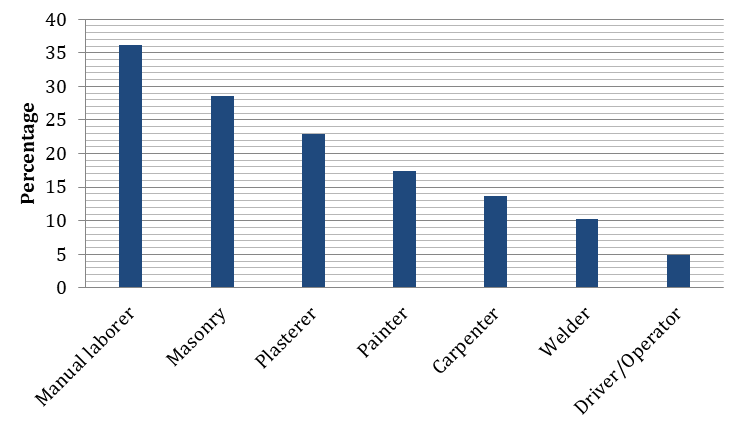
In this study, manual laborer (36.1%) followed by masonry (28.6%) workers were the most highly affected Occupational groups (Figure 2).
Factors Associated Musculoskeletal Pain
This study revealed that musculoskeletal pain prevalence was 43.9% [95 % CI: (37.2, 49.3)]. Work category (manual laborer: AOR=3.71 and masonry:
AOR=1.30), and experience (AOR = 0.51) were significantly associated with musculoskeletal pain in multivariable logistic regression (Table 3).
| Musculoskeletal Pain | OR(95% C.I) | |||
|---|---|---|---|---|
| Variables | Yes | No | COR, (95% C.I) | AOR, (95% C.I) |
| Work category | ||||
| Manual laborer | 89 | 39 | 3.29(1.06,7.55) | 3.71(1.02,7.67) |
| Masonry | 64 | 41 | 4.96(2.48,10.73) | 1.30(1.06,10.28) |
| Plasterer | 11 | 58 | 1.91(1.00,4.95) | 2.73(0.39,4.55) |
| Painter | 7 | 43 | 2.55(0.64,5.79) | 2.09(1.00,5.09) |
| Carpenter | 4 | 23 | 11.98(0.71,22.92) | 10.44(0.45,13.39) |
| Welder | 2 | 16 | 1.84(0.17,7.35) | 2.09(0.37,6.74) |
| Driver/Operator | 3 | 8 | 1 | 1 |
| Work experience | ||||
| <5 years | 81 | 146 | 0.52(0.05,0.79) | 0.51(0.01,0.97) |
| >5 years | 99 | 84 | 1 | 1 |
Table 5: Factors associated with work-related musculoskeletal pain, using multivariable logistic regression model, Goba Table 3:
Table 3: Factors associated with work-related musculoskeletal pain, using multivariable logistic regression model, Goba Table 3: Factors associated with work-related musculoskeletal pain, using multivariable logistic regression model, Goba town, southeast Ethiopia. AOR: Adjusted for age, height, weight, body mass index, educational level, duration of break during work, training on ergonomics, work hours per day, cigarette smoking, alcohol drinking and job satisfaction.
Discussion
The overall prevalence of musculoskeletal disorder in building construction workers was 43.9% in the previous 12 months. This finding was comparable with a study conducted in Saud Arabia, and lower than a study conducted in Malaysia and Taiwan [16, 17]. This study was also greater than a study conducted in Great Britain [7]. This variation may be due to a difference between countries in work organizations and workers behavior on safety practice.
In this study lower back, wrist/ hands, and upper back disorders were the three leading types of musculoskeletal disorders. Comparable findings were reported from different countries: In Germen a cohort study reported 30.9% of LBP(13). A study conducted in Malaysia declared lower back (45%), followed by shoulder (28.3%), neck (16.7%), and wrist / hand (15%), upper back (13.3%), knees (13.3%), elbow (10%), hip/thigh (8.3%) and ankles or feet (5%) [17]. A case study among Iranian steel bar bending employees showed 59% of workers have suffered in their wrists/hands, and 46% had low back trouble [18]. A study among male manual construction workers in South Africa reported 25% of low back pain [19]. In Ethiopia 35.6% of construction workers were suffered from low back pain [14].
Manual laborer and masonry workers were the most affected working groups. This finding was comparable with a study in Great Britain, Malaysia and Ethiopia [15, 16, 17].
Work category and experience were significantly associated with musculoskeletal pain. Manual laborer and masonry worker were more likely affected with musculoskeletal disorder compared with the drivers or machine operators. The study conducted Jakarta indicated an association between manual handling practice and musculoskeletal disorders specially LBP [8]. It can be concluded that manual handling in construction industries have a significant level of higher physical stress associated with the jobs [20]. In Ethiopia 39.6% of manual laborers and 17.0% masonry workers were affected with low back [14]. Workers who have less than 5 years’ experience were less likely develop the pain compared with their counterparts(AOR = 0.51). Work related musculoskeletal disorders was about 4 times more among workers with greater than 20 years of work experience than those with 11-20 years and are about 2 times more in those with 1-10 years of work experience respectively. Working in the same position for long periods, manual lifting of heavy loads were the most perceived job risk factors among India construction workers [5]. Our finding was also similar with a study conducted in Saudi Arabia reported that workers with greater than 5 years’ experience were more likely affected with musculoskeletal pain compared with those who have less than 5 years of experience[16].
Conclusion
In this study the prevalence of musculoskeletal pain among building construction workers is high compared with another study conducted in Ethiopia. Work category and experience were factors significantly associated with musculoskeletal pain.
Declaration
The study was performed by interviewing the construction workers after an ethical approval was obtained from IRB of the College of Health Sciences and individual verbal consent is obtained from the study participants. This manuscript has never been submitted and considered for publication to any other journal.
Availability of Supporting Data
Data will be available upon request.
Competing Interests
Authors have no competing interest and all have approved the manuscript for publication.
Funding
This study was supported by Madda Walabu University, Ethiopia
Authors’ Contributions
All authors have equal contribution on this manuscript. All authors read and approved the final manuscript.
Acknowledgments
Authors are grateful to Madda Walabu University for supporting this study. We are also very grateful to construction companies for their cooperation to undertake this study.
Authors' Information
AL and AH are lecturers at Madda Walabu University, MK is a lecturer and academic and research coordinator at Madda Walabu University, SN is a lecturer at Wolayta Sodo University, and YL is a lecturer at Debre Markos University.
References
-
Uen S, Hisanaga N, Jonah H, Shibata E, Kamijima M (1999) Association Construction Consumption , between Musculoskeletal Pain in Japanese Workers and Job , Age , Alcohol and Smoking. Ind Health 37(4): 449-456.
-
Chung JWY, So HCF, Yan VCM, Kwok PST, Wong BYM, et al. (2019) A Survey of Work-Related Pain Prevalence Among Construction Workers in Hong Kong : A Case-Control Study. Int J Environ Res Public Health 16(8): E1404.
-
Izzat M, Ridhwan A, Nazri A, Abas NH, Affandi M, et al. (2018) A Survey on Work-Related Musculoskeletal Disorders Among Construction Trades. International Journal of Integrated Engineering 10(4): 131-139.
-
Kaminskas KA, Antanaitis J (2005) A Cross-Sectional Survey of Construction Workers : An Ergonomic Approach.
-
Telaprolu N, Lal B, Chekuri S (2013) Work Related Musculoskeletal Disorders Among Unskilled Indian Women Construction Workers. National Journal of Community Medicine 4(4): 658-661.
-
Kusmasari W, Sutalaksana IZ (2018) Risk Factors for Musculoskeletal Symptoms of Construction Workers : A Systematic Literature Review, pp: 1-15.
-
Executive S (2018) Work related musculoskeletal disorders in Great Britain (WRMSDs).
-
Harrianto R, Samara D, Tjhin P, Wartono M (2009) Manual handling as risk factor of low back pain among workers. Universa Medicina 28(3): 170-178.
-
Vujcic I, Stojilovic N, Dubljanin E, Ladjevic N, Ladjevic I, et al. (2018) Low Back Pain among Medical Students in Belgrade (Serbia): A Cross-Sectional Study, pp: 1-6.
-
Bc C, Chansa C, Chikoti M, Thewo S, Sakala S (2019) A Comparison of The Prevalence of Low Back Pain in Formal and Informal Occupation Setup: A Review of The Literature. Integral Sciences 2(2): 24-28.
-
Punnett L, Prüss-ustün A, Nelson DI (2005) Estimating the global burden of low back pain attributable to combined occupational exposures. Am J Ind Med 48(6): 459-469.
-
Holmström EB, Holmstrom EB (2009) Musculoskeletal disorders in construction workers related to physical , psychosocial , and individual factors Musculoskeletal disorders in construction workers related to physical , psychosocial , and individual factors.
-
Latza U, Karmaus W, Stürmer T, Steiner M, Neth A, et al. (2000) Cohort study of occupational risk factors of low back pain in construction workers. Occup Environ Med 57(1): 28-34.
-
Lette A, Ambelu A, Getahun T, Mekonen S (2018) A survey of work-related injuries among building construction workers in southwestern Ethiopia. Int J Ind Ergon 68: 57-64.
-
Lette A, Kumbi M, Hussen A, Nuriye S (2019) Determinants of Occupational Injury among Building Construction Employees in Southeastern Ethiopia 34(4): 1-11.
-
Alghadir A, Anwer S (2015) Prevalence of Musculoskeletal Pain in Construction Workers in Saudi Arabia. Scientific World Journal 2015: 529873.
-
Deros B, Daruis DDI, Khamis NK, Mo- D, Fairus S, et al. (2014) Prevalence of Work Related Musculoskeletal Disorders Symptoms among Construction Workers : a Case Study in Malaysia. 43(3): 53-57.
-
Asl SB, Naeini HS, Ensaniat LS, Khorshidian R, Alipour S, et al. (2014) Injury Prevention among Construction Workers : A Case Study on Iranian Steel Bar Bending Workers International Journal of Industrial and Manufacturing Engineering 8(8): 467-470.
-
Himalowa S (2012) The effect of occupationally- related low back pain on functional activities among male manual workers in a construction company in Cape Town, South Africa 18(5): 28-32.
-
Adeyemi BO, Adejuyigbe S, Akanbi O, Ismaila S, Adekoya AF (2013) Manual Lifting Task Methods and Low Back Pain among Construction Workers in the Southwestern Nigeria 13(3).
- The Expanding Landscape of Road Rage: A Systematic Review of Conflicts Involving Drivers, Pedestrians, and Micromobility
- Validating Cognitive Models of Royal Navy Performance on Control Systems
- Comparing Standard and State-of-the-art Firefighter Coats on Postural Balance and Gait in a Live Burn Environment
- Investigating the Integration of Telemedicine into Clinicians Workflow: A Review of Methods
- Risk Assessment of Ergonomic Factors in a Textile Firm by RULA, REBA and Fine Kinney Methods
- Impact of Self-Esteem Training on Individuals with Disabilities Aged 17-30