
The Study of Universal Design and Cultural Elements Depicted in Queen’s Stepwell of Patan in Gujarat
Ancient Indian monuments always represent the combination of cultural and design attributes. Architectural marvels of the Patan stepwell in Gujarat state were studied, to look into the Cultural and Design tradition in India. The outer surfaces of the monuments were always decorated with intricate design to depict the cultural tradition of Ancient Indian lifestyle. The initial investigations showed that the artifacts are full of components of daily use, which reflects the concurrent evolution of rituals and style in that era and its growth in the subsequent periods. The ideal elements are seriously following all the artistic domain of Indian art and Indian philosophy. It represents a real panorama of life with all its weal and woes, transcending in a spiritual life of redemption through such magnificent sculptures on the panels and niche in the wall. Analytical observation of body shift and flexions from the central plumb line in NÄyikÄs figures are one of the key cultural design elements in the monument. Behind this project there was a deep sense of System Design which was formulated a step by step progression of the monument. The analytical study of the monument will reveal the Holistic Design Approach behind the monument. The vision and the unique concept of the stepwell also reflect the personality of the Queen UdayamatÄ« of Solanki Dynasty, who was built this unique stepwell for mankind in 11th century AD. The UNESCO declared this stepwell as a world heritage site in 2014. This monument is a true sense of “Universal Design†and constantly inspiring the creative world in modern era.
Introduction
India occupies an exalted position in the realm of art forms from the world of Ancient India. If the Greeks excelled in the portrayal of the physical charm of the The Study of Universal Design and Cultural Elements Depicted in Queen’s Stepwell of Patan in Gujarat human body, the Egyptians in the grandeur of their pyramids and the Chinese in the beauty of their landscapes, the Indians were unsurpassed in transmitting the spiritual contents into their plastic forms embodying the high ideals and the common beliefs of the people. The Ergonomics Int J
Indian artists visualized the qualities of various gods and goddesses as mentioned in their scriptures and infused these qualities into their images whose proportions they based on the idealized figures of man and woman. Indian art is deeply rooted in religion and it conduces to fulfilling the ultimate aim of life, moksha or release from the cycle of birth and death. There were two qualities about which the Indian artists cared more than about anything else, namely, a feeling for volume and vivid representation, even at the risk of sacrificing, at times, anatomical truth or perspective. Senses of narrative a taste for decoration, keenness of observations are clearly brought out in each sculpture. Indian art is a wholesome, youthful and delicate art, a blend of symbolism and reality, spirituality and sensuality. Indian art may well be said to bear in itself the greatest lesson an exemplary continuity from pre- historic times to the present age, together with an exceptional coherence. We said earlier that Indian art was inspired by religion and birth place of three of the world's great religions Hinduism, Buddhism and Jainism and these three faiths have inspired most of our Indian art The Indian artist was a man of this universe, he lived here, looked around himself, saw the joys and sorrows of the life and reproduced them in whatever medium he happened to be working in at a given time; clay, wood, paper, metal or stone. The creation of art by the Indian artists are not realistic representations in the sense we understand the term on Greek or Roman Art depicted but they are imagined and are idealized to its extreme.
Design of a stepwell is a great tradition in India, traditional planning and architectural structure are visible in simple to complex stepwell monuments. Queen’s stepwell is a regular structure which is elaborated expansively and added decorative structure on the entire wall of the shrine. Both the side wall decorated heavily, diameter of the well is also much larger than the regular size of the stepwell. The wall of the circular structure of the well is also decorated immensely. Intermediate horizontal platforms connect, stabilize and balance the structure of the well. The pillars on the horizontal platforms create underground structure dynamics. Probably the construction started from bottom. The entire stepwell is constructed by three layers. Layer first is brick wall, layer second is structure wall of sand stone, and layer third is the decorative wall of the surface. Where all the niches are the same size, the decorative pieces were being used as modular system. The pattern repeated in the modular system is more or less same. Still the foundation of the well is a mystery, at the same time the perspective view of the heavenly body on stone carving creates the climax of the amalgamation.
Design and Culture
The shape and forms of its sculpture and the color on its walls only recorded the heart-breath and the spiritual aspiration of a vigorous racial life. When the worshipper spics the spire of the holy monuments, he breathes a sign of relief. The shapes and figures of gods, men, animals and foliage on the walls spring before his eyes into vivid form, and the varied richness of the creation is about him. Then, as he observes one figure after another and follows with interest the successive meaning of the Puranic episodes depicted on the walls, his sub-conscious mind embraces both the history and the hopes of his race. He recognizes his favorite gods. His heart turns to them in thankfulness or expectation. He becomes one with them. He feels that he is in a higher world, surcharged with divine power. When he bows before the deity, he feels himself in the presence of God. This is the purpose of sculptured image. It stimulates the worshipper’s imagination, vivifies association, and gives his aspiration a shape. By its divine touch a living, inspiring presence is brought into his life. It is only possible by a unique combination of Stapatya Kalā (Art of Fabrication) and Śilpa kalā (Art of Sculpture). The Queen’s concept of stepwell was very well visualized by the Rajmistri (master craftsmen) and planned and executed in such a manner that it is able to stands and glorify its rareness creative attribute to the world of Art. From project ideation to accomplishment, various level of system design process had been implemented with consultation of the various experts, right locating for the monument, the divisions of fabrication and sourcing of right materials, sourcing of manpower, their logistics, quality control, phase wise plan and their execution, performance of intermediate religious rituals, inspection and accountability, rejection and further collation, funding and financial management and many more systems worked together very efficiently in all aspect. Breaking the system down into smaller pieces requires some thought into what those pieces are going to be and how they fit together, which is exactly the art of system design.
In this mega project the experts from various parts of India might be contributed, their specialty in sculptural art, technical knowledge of complexity, water rescue management, secret underground subway for safety issue, health issue and other social and religious concerns were deliberately merged in the system design of the mission of this stepwell. A small gate is placed below the last step of the well, leading to a 30 km. long tunnel, now blocked by fallen stones and mud. The tunnel goes to the town of Sidhpur, near Patan, and was built as an escape gateway for the royal family. The monument is also covered the aspect of safety escape of the royal family in emergency. So it had been designed, considered all the parameter in the monument. It is an example of a complex design solution which has many unrevealed facts.
Throughout the period we care dealing with the architect – Stapati, was a learned man. The Śilpa Śāstra, the text-books of the craft was as much his monopoly as were rituals or medicine. Throughout the country he had a common heritage inspired by a single mission. The artisans who worked under the architect – the surveyor, the designer and the craftsmen – also belonged to certain caste – guilds which specialized in religious building. His skill and technique were perfected by training handed down from generation to generation, and it was the caste- guilds to which such artisans belonged that were pressed into service by the royal dynasties which were anxious to build great monuments in all parts of India. The differences in plan and technique arose either because of the difference in local traditions or on account of external influences as in the North-West of India.
Descend into any of Gujarat’s stepwells, and the first thing you might notice is the temperature change— though they are bone dry, it’s nonetheless like stepping into a pool of cool water. The second sensation is disorientation. They are marvels of proportion and symmetry, but they’re also recursive and vertiginous. The final impression, as you look up, down, and through the stepwell, surprise us that something as mundane as a well can be both monumental and intimate. The specialists involved in this mammoth work were all mavens in their own field and their efforts are alive till now in the form of the monument.
Measurement of Body in Flexions and Curves
The curves and flexions of the body are called bhaṅga. This can be classified into three types: ābaṅga, samabhaṅga, atibhaṅga. Since the flexions of the body are in three parts in all of these, each is also known as tribhaṅga. When a figure is erect, without any bend or displacement of weight away from the center of gravity or bodily plumb line, and the arms and legs are placed in a stable position with a direct gaze, the sculptural image is called samapādasthānakam (stable erect posture in equilibrium). When such an image is represented in an arched, curved or flexed posture, its height is found to be less than that of the erect figure.
The samapādasthānakam or erect posture of an image denotes the balanced stable position of a measuring balance in equilibrium, which does not sway or shift. When the image is represented in a ābhaṅga posture, it portrays the serenity and gentleness_. An image in _samabhaṅga posture characterizes sensuousness (sriṅgāra) and passion (rajasa). Atibhaṅga signifies the aggression and pride of vīra (valour).
These are the three bhaṅga postures that are largely used for fashioning images meant for worship. Their faces should be represented with a serene expression, the eyes compassionate and the lips parted in a benevolent smile. Since the basis for images created for worship is their gracious ability to cleanse and purify the soul of the devotee, these principles should be adhered to. There are various ways in which flexions or bhaṅga in the figure can be determined. The plumb line or central line is that which passes from the head downwards, through the forehead, nose, chin, chest, navel, genitals, between the thighs and feet in an erect figure. This is called the madhyasūtram. This central plumb line is absolutely essential in creating equilibrium and stability in the erect figure. It is possible to determine the shift or curve of the various parts of the body only with reference to the central plumb line.
It is a very interesting and practical way of manipulating the female figures although they don’t appear veered. They all create the natural movement of eyes all around. The eyes movement is controlled by the depiction of static and dynamic figures. The static figures are the architectural forms present in the monument and the dynamic forms are the movement of female forms in different gestures and postures. There is the combination of static and dynamic forms together creating a rhythm in our perceptual subconscious mind. So our conscious mind is not aware of this mechanism in our brain but the outcome is always very pleasing. The pleasure which has been experienced by the viewer is actually manipulated measurement of body in flexions and curves present in the sculptures. It is indeed a very interesting analytical approach of sculptural art in India tradition. This creative ethnic tradition strictly followed by Indian craftsmen generation after generation. Although their designs do not appear within the format only, the extreme improvisation of style and form application generated variation in their work. Different dynasties and their distinct style followed strictly the canons of Sthāpatya Kalā (Art of Fabrication) and Śilpa Kalā (Art of Sculpture) although their style and quality was never compromised in fabrication. Minute cultural observations were the key points of variations in style and manner in Śilpa Kalā (Art of Sculpture). For this reason all the ancient monuments seem distinct.
The central plumb line passes through side mid of the left eye, center of the right breast, off-center of naval, genitals, mid of the left thigh and right knee.
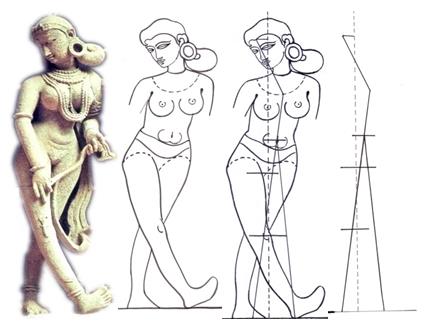
The visual balance is created by twisting the body in opposite direction. The face is turned on right hand side and the right foot is extended on left hand side. So the variance is applied on upper and lower part of the body by extending their position on opposite direction from the central plumb line.
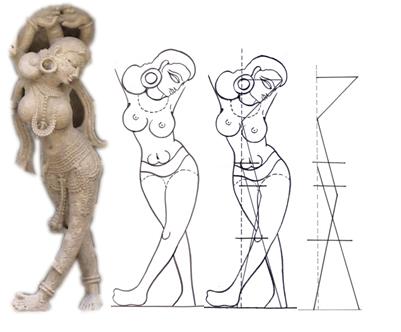
The shift: Forehead from center 3.5 cm Naval on the left side 1 cm Genitals on left side 1.5 cm Right knee and left knee 2 cm Right foot on left side 3.5 cm The central plumb line passes through side mid of the right ear, off-center of the right collar bone, off-center of naval, mid of the right thigh and left foot.
The visual balance is created by twisting the body in opposite direction. The face is turned on left hand side and the left foot is extended on right hand side. The body is balancing on the right foot. So the variance is applied on upper and lower part of the body by extending their position on opposite direction from the central plumb line.
The central plumb line passes through extreme right, from right shoulder, from naval, mid of the right thigh and right heel.
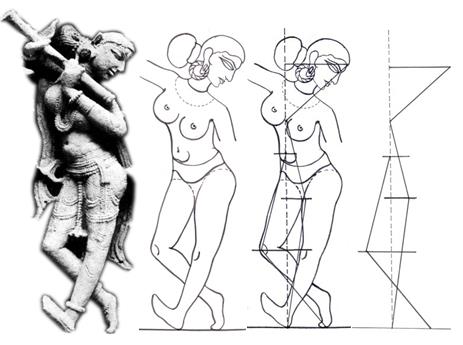
The visual balance is created by shifting the body weight as well as twisting the body movement in opposite direction. The face is turned on left hand side and the left foot’s lifted movement towards right hand side. Here the body weight is on left foot and the hip is extended towards left but left leg is on central plumb line. The right knee is extended towards right side but the toe is towards left. Both the legs are intersecting each other. So the variance is applied on upper and lower part of the body by extending their position from the central plumb line towards opposite direction with a proportion. The line drawing helps to understand the Analytical observation of Spatial Flexion in the sculptures.
- The central plumb line passes through the middle of the two breasts; exception is the figure number 3.
- The Apsara sculptures are shown maximum their head turned towards left.
- Body gesture is realistically balanced by the principle of shifting the body weight on one leg and the waist line of the same leg is uplifted and the shoulder is bended down. This is the natural principle of human body.
- The movement of the free leg actually balanced the composition visually although many times, but it is the exaggerated posture but seems realistic in composition.
- The lower body part seems larger than the upper part but centre point of the Apsarā sculptures is just above the genitals.
- The upper part of the body looks heavy because of heavy breasts and their front projection.
- The turning of head is having the relation of the movement of knee or opposite knee in reverse direction proportionately to balance the composition.
- The movement of all the joints like neck, waist, knee and feet are overstated by the master craftsmen to represent the various ways in which flexions or bhaṅga can be determined.
- The hands movements are not shown in the sketch of the figures to avoid their activity, here the movements of the entire body without hands are observed particularly in Spatial Flexion.
- They are all seven heads figures. The face is considered to be one Tālam in rhythmic measurement.
In the field of sculptural measurement, particularly in connection with divine images, there is a very special scale known as tālamānam or rhythmic measure. The adoption of the talamanam not only ensures the symmetrical beauty and artistic grace of the images but also imparts unique spiritual meaning and symbolism to them. The grammar of measurement has been evolved through the formulation of an orderly system with regard to the consonant rhythmic relationship between the parts of the body. The fundamental unit from which the rhythm of the various bodily parts can be interrelated is the length of the face. This facial length which is the basic unit is an extremely significant part of the sculptural tradition [1, 2, 3, 4, 5, 6].
The head forms an important part of the whole body. In this, the long portion between the forehead and the chin is called the face. The length of the face or mukham (face) is equal to the distance between the middle finger and thumb of the extended hand (span of the hand). The length of the palm, from the wrist to the tip of the middle finger is also equal to the facial length. This length of hand, standing for the length of the face, is adopted as the basic unit in sculptural tradition.
Concept of Viśvotpatti
I also resized the concept of Universal creation is being depicted in the monument. The mythical stories, their importance mainly preserved as a source of the concept of the creation of the Cosmos. The different energy levels and their importance were realized and placed them in the monument to show the balance of the law of nature. The universal law controls the destiny of living being. The Vedic literatures explain the secret of God, Cosmos, Creation of Universes, our Universe-its worlds and inhabitants. The Vedic literature of India definitely and firmly expounds that God, who created the tangible worlds with their inhabitants, is super tangible and He and His Creation can be readily perceived by the proper use of senses of a human being. My study from the book name “The Vedic Map of the Universe”, written by C.V.N. Rao, relates some of the very interesting concepts about the origin of Universe.
The Devayoni Gaṇas are residing in various worlds. The Devas cannot come and reside in Bhuloka (planet Earth) permanently. They can reside only at special time and in special regions.
There are many countless Universes in the cosmos, like our Universe. All these Universes are having their own BRAHMĀS, VIṢṆU, RŪDRAS, MANUS, ṚṢiS, DEVAS and other GAṆAS including the human beings, and their own 14 Worlds etc. the wall of the Universe, are practically confined within it and can never go out or communicate with other Universes unless specially permitted and empowered by Paramātman [7, 8, 9, 10, 11, 12, 13]. Probably the immense size of the monument was considered to accommodate the concept of 14 worlds and their characteristics to depict in the monument. It shows that the Queen had deep knowledge of Vedic literature and she had profound devotion of this particular concept of Universe, which she realized in her spiritual practice and also envisaged an ideal form of complete creation. Perhaps it was the path of her liberation for her own soul from the materialistic world.
Conclusion
None had actually seen the gods like Rāma, Krishṇa, Viṣṇu and Śiva, etc., but according to their description in the scriptures the Indian artists visualized them as shown generally standing erect, signifying mental power, physical and spiritual equilibrium. In form, the males are virile beings broad shouldered, deep chest and narrow hipped. The females are precisely contrary to the males narrow shouldered, having full and blossom breasts, and attenuated waist and broad hips. The females according to the Indian artists represent Mātri or the mother. Indian art is a treasure house of ancient contemporary life, its faiths and beliefs, customs and manners. It is considered by some to be the function or purpose of art of any age to mirror contemporary society, its customs, manners, habits, modes of dress and ornamentation etc.
Culture is most complicated word; the first important assertion is that no culture has appeared or developed without a religion: according to the point of view of the observer, the culture will appear to be the product of the religion, or the religion the product of the culture. The system of cultural value accommodated all sorts of Indigenous cultural activity in the ornamentation of the monument. Without the attraction they could not affect each other, and without the repulsion they could not survive as distinct cultures; one would absorb the other, or both would be focused into one culture.
The abstract ideas represented in terms of animals or people as known as personification. The gods and goddesses of classical myths were endowed with human qualities, and female figures have repeatedly been used to personify such concepts as liberty, peace, beauty, love, adornment, rituals, dance, dawn, nation and the muse of painting and sculpture. In societies dominated by religious ideologies, control of the population’s behavior was facilitated by the idea that God was watching and judging everyone all the time. This visual effect reinforces the omniscience of God’s gaze.
The art of painting and sculpture developed particular visual culture and cognitive skills facilitated their scope of appreciation. The eye was a central means of self- representation and visual experience a central mode of self-consciousness. Artists were likely to flourish in a society to develop visual culture. Their analysis focuses even upon pleasures supplied by Visual Culture. Every artifact is the result of multiple determinants or factors – economic, political, cultural, institutional, technological, human need, creative will or desire, etc. Visual culture focuses the basic facts about the physiognomy of the eyes and the psychology of visual perception, not only because such knowledge is pertinent to the subject in general, but also because many artists have acquired and made use of such knowledge. Our knowledge of reality comes from many acts of perception which we compare and subject to logical analysis. Viewers are not pairs of eye – they have minds, bodies, genders, personalities and history. The fact that we perceive one world rather than five (corresponding to each of the five senses) suggests that inside the brain/mind visual information from the eyes merges with information arriving from the other senses, and with existing memories and knowledge, so that a synthesis occurs. It is through our senses that we interact with and learn about the world.
Most designed works; they are new inventions, addition to nature. Because drawing, painting, sculpture appeal to sense of touch as well as sense of sight. They need not limit themselves to what already exists, they can present imaginative vision of fictional worlds and creatures – such as fairies and aliens from outer space – which can still have a compelling reality effect. I would like to quote the remarked by Paul Klee: ‘Art does not reproduce the visible; rather it makes visible’.
References
-
Sthapati V Ganapati (2002) Indian Sculpture and Iconography, Form & Measurement_._ Sri Arobindo Society Pondichery, Maping Publishing, Ahmedabad.
-
Swami Chidatmanjee (2009) Art Forms of India. Anmol Publication Pvt. Ltd, New Delhi.
-
Sompura KF (1969) The Structural Temples of Gujarat. Ahmedabad.
-
Roy Brajdeo Prasad (1992) Techniques of Making Stone Imges in Ancient India. Motilal Banarasidas Private Limited, Delhi.
-
Natalia Lidova (1996) Drama and Ritual of Early Hinduism. Motilal Banarasidas Private Limited, Delhi.
-
Deva Krishna (1995) Temples in India. Aryan Books International.
-
Shivaramamurty C (1993) The Art of India. Abrams Book.
-
John A Walker, Sarah Chaplin (1997) Visual Culture: An Introduction. Manchester University Press.
-
Cox Richard, Savalia RT (2007) The Stepwells of Gujarat, Rajasthan and New Delhi. Journal of the B J Institute, Ahmedabad 24: 1-2.
-
Mankodi Kirit (1991) The Queen's stepwell at Patan, Franco-Indian Pharmaceuticals, Ltd.
-
Newbauer Jutta Jain (1991) The Stepwells of Gujarat. Abhinav Publications, New Delhi.
-
Sadani Jaikishnadas (2008) Underground Shrine: Queen's Step-Well at Patan. Journal of B J Institute, Ahmedabad 24: 3-4.
-
Savalia RT (2009) Steps of Indology. B J Institute of Learning & Research, Ahmedabad.
- The Expanding Landscape of Road Rage: A Systematic Review of Conflicts Involving Drivers, Pedestrians, and Micromobility
- Validating Cognitive Models of Royal Navy Performance on Control Systems
- Comparing Standard and State-of-the-art Firefighter Coats on Postural Balance and Gait in a Live Burn Environment
- Investigating the Integration of Telemedicine into Clinicians Workflow: A Review of Methods
- Risk Assessment of Ergonomic Factors in a Textile Firm by RULA, REBA and Fine Kinney Methods
- Impact of Self-Esteem Training on Individuals with Disabilities Aged 17-30