
Functionality of the Nudge to Reduce the Frequency of Use of Smartphones in a School Context
The Nudge techniques concern every aspect in the architecture of the choices that alters, in a simple and economic way, the behavior of people in a predictable way without the use of prohibitions or economic incentives. In order to address the problem of the high frequency of use of the smartphone in the school context during the course of educational activities, a nudge intervention was developed in a higher institute in Piedmont to reduce its use. Simplification has made it possible to propose information in such a way as to reduce its complexity (physical or conceptual) and therefore decrease the cognitive cost necessary, in terms of time and energy, to make a choice, increasing the probability that the correct choice will be made in the children how to store your smartphone in your backpack during educational activities. The data showed that, under experimental conditions, the frequency of use of the devices was reduced compared to the control rate, which suggests the effectiveness of the intervention.
Introduction
The smartphone is often present in the school context and its use has been associated with a reduction in school performance [1, 2].
In a study conducted by Ugur & Koc [3] an entire sample of 349 students reported of having a smartphone and 99.1% said they brought it to the classroom. 98% of respondents said they receive or send messages while waiting to start the lesson, 95% admitted to using it during the lesson at least once or twice and 32% of them do it every day. 51.6% of students put the phone in Functionality of the Nudge to Reduce the Frequency of Use of Smartphones in a School Context Investigation Paper vibration mode, 44.4% in silent mode, 1.7% in ring mode and only 2.3% turn it off. Most students (77.8%) use their smartphone to check the time and 54% as a calculator. 56.9% say they use it to check Whatsapp, 41% to send messages, 32.9% to use Facebook and 22% to surf the internet. Regarding the reasons that influence students to conduct this behavior, 13% report using their smartphone because it allows them to stay "connected" with the world, another 13% because they enjoy playing games, but most of them (60%) say because they become bored during the lesson. Only 14% of students state that they use their smartphone only in case of emergencies.
Ergonomics Int J
Nowadays, the use of instant messaging, social networks and online games leads literature to talk more about smartphone addiction [4, 5].
According to a widely shared vision, the main users and experts of these technologies are the new generation, the so-called digital natives, that are those who, from an early age, have been used to using and taking into account digital technologies in their daily lives [6].
While the use of smartphones and social media have pushed people towards a more positive change in learning such as; allowing them to participate in online training courses, be constantly updated on educational offers and exchange information [7]. However, a great number of researchers agreed more on the negative impacts that the use of the smartphone has in the scholastic context; specifically on school performance as it reduces the student’s concentration levels and also a reduction in the retention of the information, also in time and efficiency of the execution of a task or activity [8, 9, 10, 11, 12]. The same students now perceive more negative aspects than positive in their use of the smartphone during educational activities. They say that they are "too attached" to their devices and they have "slowed down" in facing the immediate demands of society [12, 13, 14, 15].
Smartphone-mediated activities during school hours negatively correlate with the school average of students [16, 17, 18]. The constant presence of the smartphone in a school context has allowed the students to use the device as a useful tool for other non-scholastic activities and are carried out in the classroom, deterring them away from what they consider boring or unimportant; being inattentive and involved in other activities that go beyond educational ones and therefore this provides a possible explanation for their failure at school. From the assumption that attention and cognitive abilities are limited and are used according to the needs of a task, the deficits related to scholastic and non-scholastic performance, induced by multitasking, could be reduced by decreasing the frequency of use of the smartphone. This configures as a conditioned stimulus, whose simple presence is to be able to create a distraction in a task. The individual when they see their device, is influenced to use it because at that moment they do not feel part of the vast world of social networks, so the presence of the smartphone potentially interferes with the performance of a task, especially when they are involved in complex tasks thus, it is important to participate in the relevant stimuli for the realization of the task itself [19].
It is easier to keep a task oriented focus when there are fewer stimuli present that can evoke thoughts unrelated to the task itself [20]. So far the interventions that are used by the school board have focused on a punitive educational system, or the use of the device in the school environment is totally banned or sanctioned through a note on the register. In the study conducted by Sánchez-Martínez and Otero [16] this modality appears to be unsuccessful, as half of the sample they interviewed reported bringing their electronic devices to school and leaving them switched on during classes. Therefore, they had decided to use a different educational method to guide the behavior of students on reducing their usage of their smartphone during school activities.
The Nudge, a form of behavioral modification widespread in Italy thanks to the publication of the book "The gentle push" by Sunstain and Thaler [21] has captured the attention of researchers and public officials over time are gradually pushing them to apply the principles and procedures in different contexts of everyday life, in order to modify human behavior, leading them towards useful and functional behaviors, for the short term and for the entire community and also for the long term.
The term “Nudge” translates into Italian as "gentle push" describes how a worl of architecture of choice can change people's behavior in a predictable way, without using incentives or punishment [21]. Sustainability and low cost are peculiarities of the approach. In literature, there are numerous existing nudging interventions that range from social policy to respect for the environment, because it adapts to being used in many situations [22, 23, 24, 25, 26, 27]. Cialdini and Griskevicius (2008) providing clear and simple information on the behavior that is wanted to be issued, makes some behaviors more salient, as well as changing the default option in the catering sector could lead to a reduction in food waste or to the consumption of alternative and healthy foods.
Materials and Method Setting
The research conducted in an industrial technical institute in Piedmont saw the use of Nudge to reduce the frequency of use of smartphones during school hours and was supported by members of the Nudge Italia Team who were in collaboration with the teachers of the institute.
The research was carried out within a higher technical institute in Piedmont, subject to the approval of the head teacher and availability of teachers. The classes available for testing the intervention were a third and a fourth period. The behavioral survey lasted two weeks: one for the control phase and one for the experimental phase, in March 2019. Specifically, the observations were carried out in the second and third hours of the morning (from 9:00 to 11:00).
Sample
The sample was composed of students attending the third class and a fourth class of the institute hosting the initiative, each consisting of 12 students, with a total of 24 boys.
Materials
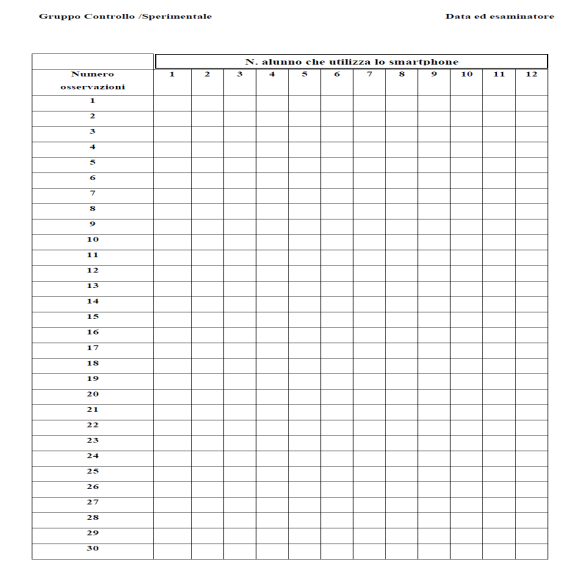
In both phases of the research the detection of the target behaviors (operationalization of smartphone use) was carried out using grids built specifically to perform the operation, consisting of 12 columns and 30 lines (Figure 1).
- Observation grids created ad hoc for each phase of the research. Both on the control cards and on the experimental cards, there were boxes to record the number of people interacting with a smartphone.
- List of target behaviors (Table 1).
- Audio file that scans the number of students to be observed every 5 minutes.
- Electronic device to reproduce the audio file (smartphone of the two observers).
- Pair of earphones (two pairs, one for each observer).
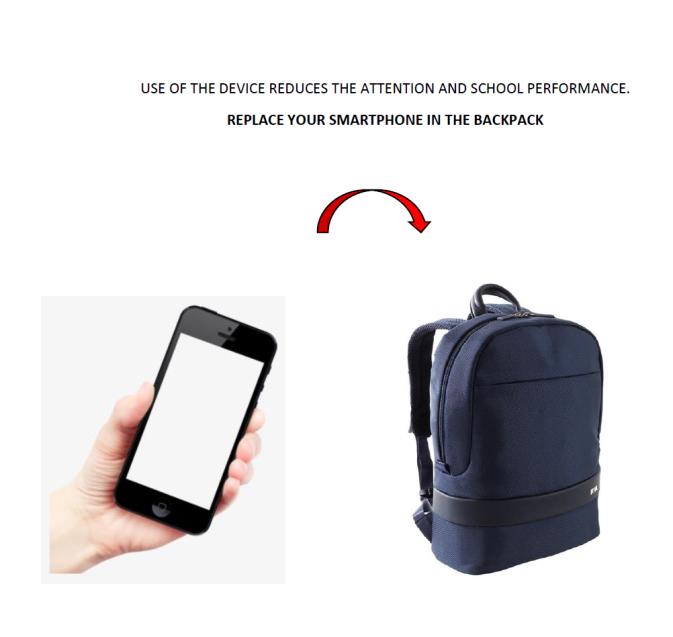
The experimental phase saw the presence of a poster inside each class behind the teacher's shoulders that was in direct view of the students with the words "Use of the device reduces attention and school performance. Put your smartphone in your backpack "and the image of the device accompanied by an arrow that led to the shape of a backpack (Figure 2).
Measures
The frequency of use of the smartphone was measured by two independent observers. The observations were anchored to a list of specific behaviors that served to describe in an objective and measurable way what was intended as "interaction with the smartphone". These behaviors, reported in the table below (Table 1), had been discussed among the observers during the design phase.
The method chosen to record people's behaviour, applied in all observations, is Momentary Time Sampling (MTS). With the MTS, the observer records whether behaviour occurs at the end of a present time interval. This procedure was chosen for several reasons.
First of all, the main objective of the experiment was to capture long-term behaviours such as making or receiving calls and text messages, checking the internet, playing games, etc.even if short-term behaviours were included during the observations. To be able to observe them, it is necessary to fragment the number of observations in small intervals of time. This method allows you to record a wide range of behaviours. In fact, when the observed
- behaviour is not easy to detect, it is possible to measure it by counting the number of time intervals in which it occurred.
- Behaviours to mark as interacting with the
- Behaviours to mark as not interacting with the smartphone smartphone
- The subject picks up the smartphone and observes it.
- The smartphone is kept next to them on the school desk.
- The subject takes the smartphone to call or send an sms.
- The device is placed on their leg but is not in sight.
- The subject touches his device to view notifications /
- They are alone at the table and the subject uses the time etc. smartphone as a "distractor".
- The subject picks up the smartphone and uses it as a tool for sharing with other components of the classroom (In this case the frequency of the behaviour to be reported will be twofold: X = subject that holds their phone in their
- The device is in their hand when they go in the bathroom, so it is slipped into their hand. hand; X = subject (s) observing / not looking at the smartphone).
- The subject takes photographs or selfies (in this case the frequency of the behaviour to be marked will be twofold:
- There is no clear visibility of the contents of the
- X = subject who holds the device in their hands; X = subject(s) that look(s) at the device and is part of the backpacks. photo).
- The subject holds the smartphone without looking at it.
- There is no clear visibility of the behaviour of the people sitting at the school desk.
Table 1: The table illustrates the specific behaviours considered and agreed upon by observers such as "interaction with
For both the control phase and the experimental phase, the median and mean value of people who used the cell phone during observation was calculated.
Procedures
Each table was observed at a rate of 5000 ms (5 seconds). Each observation string included the observation of 12 people, observed in succession, for a total duration of 60000 ms (1 minute): person 1 + person 2 [---] + person 12.
At the end of each observation a pause of 5000 ms was inserted in the audio file. The total duration of each observation string was 65,000 ms (1.08 minutes). 600 The observations were carried out by pairs of observers (two support professors) to evaluate the agreement between observers through the use of their own device, through which, through wireless headphones, they listened to an audio file calibrated for the observation of 12 people, which scans the person / counter to be observed every 5 seconds.
The order in which to consider the observation (from the bottom up or vice versa of the benches arranged in the class was agreed between the observers before the observation).
The intervention could be considered concluded after having compiled four observational grids. Observations are carried out one week apart from the other.
Experimental Design
The frequency of use of smartphones was detected through an experimental design between groups with an independent variable (intervention vs. non-intervention) and 2 independent groups (control phase vs.
experimental phase) with repeated measurements on the dependent variable.
The independent variable was the poster with the words "Use of the device reduces attention and school performance. Put your smartphone in your backpack "and the image of a device accompanied by an arrow that led to the shape of a backpack.
Results
The expected result was the reduction in the frequency of use of the smartphone in the presence of the independent variable. Specifically, it was expected that it was inferior in the experimental phase (independent variable presence) with respect to the control phase (independent variable absence). The null hypothesis was that there was no difference between frequency of use in the experimental phase and in the control phase.
Altogether, 600 observations were made, 300 in the control phase and 300 in the experimental phase.
The Mann-Whitney U test was adopted to compare on two independent groups ordinal variables or interval/rational variables characterized by a non-normal distribution. The control group and the experimental group were considered independent although they were formed by the same individuals, because the comparison did not take place on the individual participants, but on the level of overall use by the group. All the analyses were carried out with SPSS version 20.0 of 2009. Finally, a score p <.050 was considered statistically significant for all the analyses performed.
The agreement between observers (IOA), or the degree to which two or more independent observers report the same observation after measuring the same event, was evaluated both in the control phase both in the experimental one. Both in the control group and the experimental group, the agreement between observers was 100%. From the values obtained we can see a statistically significant reliability of the agreement between the observers, which makes it possible to consider the data obtained as valid.
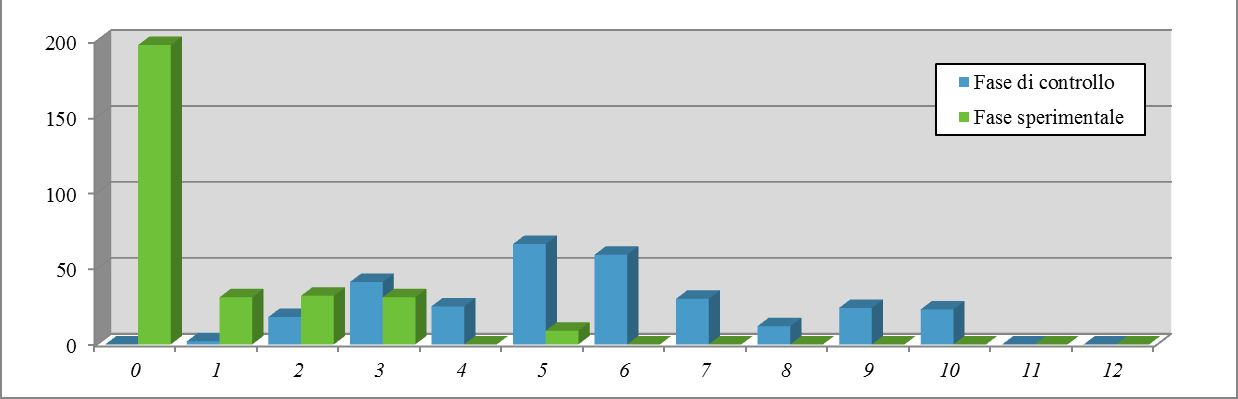
In the control phase, in 0 cases (0.0%), none of the 12 participants had used a smartphone, in 2 cases (0.7%), only one participant had used it. In 18 cases (6.0%) 2 participants, in 41 cases (13.7 %) 3 participants, in 25 cases (8.3%) 4 participants. In 66 cases (22.0%) 5 participants, in 59 cases (19.7%) 6 participants, in 30 cases (10.0%) 7 participants, in 12 cases (4.0 %) 8 participants. In 24 cases (8.0%) 9 participants, in 23 cases (7.7%) 10 participants. In no case have a number of 11 to 12 participants been used.
In the experimental phase, in 197 cases (65.7%), none of the 12 participants had used a smartphone; in 31 cases (10.3%) only one participant had used it, in 32 cases (10.7%) 2 participants, in 31 cases (10.3%) 3 participants. In no case have a number of 4 to 12 participants been used.
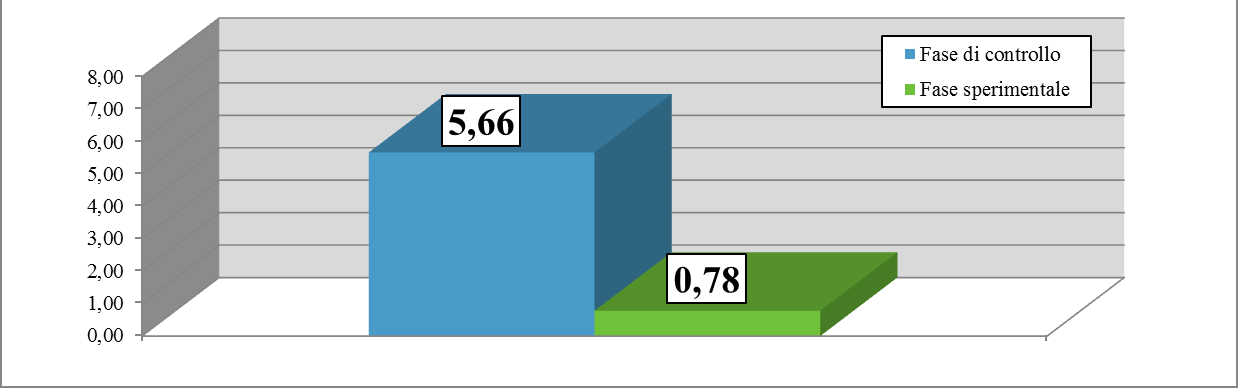
experimental phase (U=2709.500; p=.000). Specifically, the number of users during the control phase (median=5;
interquartile distance=3; average=5.66) was significantly greater than that of the experimental phase (median=0; interquartile distance = 1; average=0.78). In this case, we chose to use the U test given the non-normality of the duration of the statistical units (p=.000), but the averages referring to the two phases were highlighted, for a further comparison between the two conditions.
Discussion
The way in which the stimuli of the context are presented has a considerable influence in the decision- making process and in the choice of people. The experiment verified the effectiveness of the use of the nudge technique known as simplification to reduce the frequency of use of the smartphone during the hours devoted to carrying out educational activities in a higher technical institute in Turin. It also supported the experimental hypothesis as shown by the statistically significant difference between the control phase and the experimental phase [28].
The results show how the nudging intervention led to a 66% reduction in the frequency of smartphone use among students.
Pushing students not to use their device during school hours in an age where being online means keeping in touch with the world and being constantly updated is not easy, even if you are aware that the smartphone reduces the attention to the task and school performance. Nowadays, we talk about smartphone addiction, so it is essential to work in different contexts, first and foremost the school environment, to reduce its use. The use of small and simple nudging interventions could help institutions to make their students aware of the problem, inviting them, without punishment or incentives to reduce their frequency of use during school hours.
Ethical Approval
All the procedures carried out comply with the ethical standards of the national research committee and the Helsinki declaration of 1964 with its subsequent amendments.
References
-
Lepp A, Barkley JE, Karpinski AC (2014) The relationship between cell phone use, academic performance, anxiety, and satisfaction with life in college students. Computers in Human Behavior 31: 343-350.
-
Lepp A, Barkley JE, Karpinski AC (2015) The relationship between cell phone use and academic performance in a sample of US college students. Sage Open 5(1): 2158244015573169.
-
Ugur NG, Koc T (2015) Time for digital detox: Misuse of mobile technology and phubbing. Procedia-Social and Behavioral Sciences 195: 1022-1031.
-
Haug S, Castro RP, Kwon M, Filler A, Kowatsch T, et al. (2015) Smartphone use and smartphone addiction among young people in Switzerland. Journal of behavioral addictions 4(4): 299-307.
-
Cha SS, Seo BK (2018) Smartphone use and smartphone addiction in middle school students in Korea: Prevalence, social networking service, and game use. Health Psychology open 5(1): 2055102918755046.
-
Rapetti E, Cantoni L (2010) “Nativi digitali” e apprendimento con le ICT. Journal e-learning knowledge society 6(1): 43-53.
-
Ahlquist J (2014) Trending now: Digital leadership education using social media and the social change model. Journal of Leadership Studies 8(2): 57-60.
-
Shelton JT, Elliott EM, Eaves SD, Exner AL (2009) The distracting effects of a ringing cell phone: An investigation of the laboratory and the classroom setting. Journal of environmental psychology 29(4): 513-521.
-
End CM, Worthman S, Mathews MB, Wetterau K (2009) Costly cell phones: The impact of cell phone rings on academic performance. Teaching of Psychology 37(1): 55-57.
-
Fox AB, Rosen J, Crawford M (2009) Distractions, distractions: does instant messaging affect college students' performance on a concurrent reading comprehension task? Cyberpsychology Behavior 12(1): 51-53.
-
Bowman LL, Levine LE, Waite BM, Gendron M (2010) Can students really multitask? An experimental study of instnt messaging while reading. Computers & Education 54(4): 927-931.
-
Elder A (2013) College Students’ Cell Phone Use, Beliefs and Effects on their Learning. College Student Journal 47(4): 585-592.
-
Duggan M, Rainie L (2013) Cell phone activities 2013. Pew Research Center's Internet & American Life Project, Washington, DC.
-
Duggan M, Smith A (2013) Social media update 2013. Pew Research Internet Project.
-
Kibona L, Mgaya G (2015) Smartphones’ effects on academic performance of higher learning students. J Multidisciplinary Engineering Sci Technol 2(4): 777- 784.
-
Sánchez-Martínez M, Otero A (2009) Factors associated with cell phone use in adolescents in the community of Madrid (Spain). Cyberpsychology Behavior 12(2): 131-137.
-
Harman BA, Sato T (2011) Cell phone use and grade point average among undergraduate university students. College Student J 45(3): 544-550.
-
Walsh JL, Fielder RL, Carey KB, Carey MP (2013) Female College students’ media use and academic outcomes: Results from a longitudinal cohort study. Emerging Adulthood 1(3): 219-232.
-
Smallwood J, Schooler JW (2006) The restless mind. Psychol Bull 132(6): 946-958.
-
McVay JC, Kane MJ (2010) Does mind wandering reflect executive function or executive failure? Comment on Smallwood and Schooler (2006) and Watkins (2008). Psychol Bull 136(2): 188-197.
-
Thaler R, Sunstein C (2008) Nudge: Improving Decisions about Health, Wealth, and Happiness. Yale University Press, Yale.
-
McNeil B, Pauker S, Sox H, Tversky A (1982) On the elicitation of preferences for alternative therapies. New England Journal Medicine 306(21): 1259-1262.
-
Thaler RH, Benartzi S (2004) Save More Tomorrow™: Using Behavioral Economics to Increase Employee Saving. Journal Political Economy 112(S1): S164- S187.
-
Goldstein NJ, Cialdini RB, Griskevicius V (2008) A Room with a Viewpoint: Using Social Norms to Motivate Environmental Conservation in Hotels. Journal of Consumer Research 35(3): 472-482.
-
Pichert D, Katsikopoulos KV (2008) Green defaults: Information presentation and pro-environmental behaviour. Journal Environmental Psychology 28(1) 63-73.
-
Kallbekken S, Saelen H, Hermansen EAT (2013) Bridging the Energy Efficiency Gap: A Field Experiment on Lifetime Energy Costs and Household Appliances. J Consumer Policy 36(1): 1-16.
-
Bettinger EP, Long BT, Oreopoulos P, Sanbonmatsu L (2009) The Role of Simplification and Information in College Decisions: Results from the H&R Block FAFSA Experiment. NBER (National Bureau of Economic Research) working paper no 15361.
-
Castleman BL, Page LC (2015) Summer nudging: Can personalized text messages and peer mentor outreach increase college going among low-income high school graduates? J Economic Behavior Organization 115: 144-160.
- The Expanding Landscape of Road Rage: A Systematic Review of Conflicts Involving Drivers, Pedestrians, and Micromobility
- Validating Cognitive Models of Royal Navy Performance on Control Systems
- Comparing Standard and State-of-the-art Firefighter Coats on Postural Balance and Gait in a Live Burn Environment
- Investigating the Integration of Telemedicine into Clinicians Workflow: A Review of Methods
- Risk Assessment of Ergonomic Factors in a Textile Firm by RULA, REBA and Fine Kinney Methods
- Impact of Self-Esteem Training on Individuals with Disabilities Aged 17-30