
Application of Acacia Catechu Natural Dye on Banana Fiber
The use of natural dyes on textiles has become a matter of importance because of the increased environmental awareness to avoid hazardous, non-biodegradable synthetic dyes (soluble and Non water soluble) and synthetic chemicals. Pre-mordanting, and post-mordanting of 10%, 30% and 50% concentration of mordants carried out using alum, stannous chloride and ferrous shulphate. Results were achieved for dyeing at 90°C for 60 min at 10%, 30% and 50% concentration of the dye on the weight of fabric using pre- and post-mordant dyeing techniques Treated fiber showed a substantial increase in colour depth (K/S) and adequate wash, light and rubbing fastness properties without and with mordanted and dyed banana fiber.
Introduction
Natural dyes are extracted from various parts of plants such as roots, barks, leaves, flowers, and fruits as well as from insects. They have been primarily used for coloring food, leather, and textiles made from natural fibers as silk, wool, cotton. Recently, interest has grown in natural dye applications in the textile industry as a result of the urgent demand for eco-friendly and biodegradable products. Although natural dyes are viewed as a safer alternative to synthetic dyes, they have the following disadvantages: low color yield, poor reproducibility, and inferior color fastness properties.
Natural dyes were used in place of synthetic dyes due to environmental conditions. They are non-biodegradable, non-polluting, non-carcinogenic and eco-friendly. Synthetic dyes are broadly disparaged in the world because; they cause water pollution and waste disposal problems. Natural dyes are environmental friendly in nature, biodegradable and non-toxic [1, 2, 3, 4, 5, 6]. They are attracting the awareness of people. Some of natural dyes are anti-allergic and proved to be safe for body contact.
Catechu, it is a vegetable dye used for tanning and dyeing wool, silk and cotton to give a yellow brown colour. It gives a gray brown with iron mordant and olive brown with cupper mordant. Catechu has excellent light and washing fastness properties.
Catechu (or Cutch/ Katha) is a brown natural dye obtained chiefly from the heartwood of Acacia catechu, found in most of the Indian sub-Himalayas. The chief coloring component present in the catechu is catechin having molecular formula C15H14O6. The content of catechin in catechu varies from 4-7%. This dye is being used extensively in dyeing of textile materials. Pharmacological studies have demonstrated that catechu is used in traditional medicines, show anti- inflammatory and anticancer activities [7, 8, 9, 10].
• Cutch Extract: This catechu natural dye powder is an extract prepared from steeping the wood of the Acacia catechu tree in warm water until a syrupy liquid immerges. This is dried and then convert into powder form. It is common to most parts of Indonesia India, Burma, and Peru. Indian cutch is a good source of colour fast shades of brown - cinnamon, nutmeg, and clove. Cutch extract contains tannin as well as the dye compound. It is easily soluble in water. Cutch has excellent light and washing fastness properties.
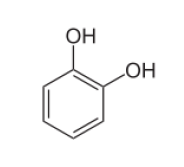
• Dyestuff Catechu Dye: It is a natural coloring matter. Coloring substance used was extracted from Acacia catechu tree (Figure 1).
• Experimental Materials used for experimental work Materials used for experimental work The Natural madder dye was supplied by Sky Morn Fashion Accessories Exports, Ghaziabad, India. Chemicals Laboratory grade metallic salts such as ferrous (II) sulphate, (FeSO4.7H2O manufactured by Rankem RFCL Ltd), Stannous Chloride (SnCl2Manufactured by Fisher Scientific and Alum (KAl(SO4)2 manufactured by were used as a mordant.
• Equipment: Weighing balance, Water bath, HTHP dyeing Machine, Digital thermometer, Hot air oven,
Methods
Extraction Methods used for Acacia Catechu
Acacia Catechu was crushed to the powder form, and then the coloring matter was extracted using (According to shade % required gram of the heena powder in 100 ml water) at the boiling. At the end, the solution was filtered off with filter paper [11, 12].
Pretreatment with Alam
Alam solution was freshly prepared by dissolving (5%) of alum in distilled water at a liquor ratio 1: 30 and treated banana fiber at laboratory HTHP dyeing machine with programmable time and temperature control for 60 min. Fibers were then squeezed and dried.
Pretreatment with Ferrous Sulphate
Ferrous Shulphate solution was freshly prepared by dissolving (5%) of Ferrous Shulphate in distilled water at a liquor ratio 1: 30 and treated at laboratory HTHP dyeing machine with programmable time and temperature control for 60 min. Fibers were then squeezed and dried [13, 14, 15, 16].
Pretreatment with Stannous cChloride
Stannous chloride solution was freshly prepared by dissolving (5%) of stannous chloride in distilled water at a liquor ratio 1: 30 and treated at laboratory HTHP dyeing machine with programmable time and temperature control for 60 min. Fibers were then squeezed and dried.
Dyeing Procedure
Three different mordants like (Alum, Ferrous Shulphate, stannous Chloride) were used for dyeing as pre- and post-mordanting agents. Mordanting and dyeing were carried out in a laboratory HTHP dyeing machine with programmable time and temperature control. The required amount of dye was taken according to the dyeing shade of 10, 30, and 50%, respectively, on the weight of fabric (o.w.f.). Around neutral pH and material-to-liquor ratio of 1:50 were maintained, and dyeing was carried out at 90ºC for 60 min [17, 18, 19].
* % % Weight of fabric Required mordant Amount of mordant required in ml Concentration of stock solution prepared = * shade % % Weight of fabric Required Amount of dye required in mL Concentration of stock solution prepared =
Evaluation of Dyeing
Evaluation of dyeing was done by determining K/S and L*, a*, and b* values using computer color matching system. Color depth of the samples was evaluated measuring reflectance values by using Spectra Scan 5100+ computer color matching system. The relative color strength (in term of the K/S value) of natural dyed banana fiber was measured using the following Kubelka– Munk equation:
( )
2
2 1 K S R R − =
Where K is the absorption coefficient, S is the scattering coefficient, and R is the reflectance of the dyed fabric at the wavelength of maximum absorption
| Type of Mordant | Dye Conc. % | Dyed Sample |
|---|---|---|
| Alam (5%) Pre-mordnting | 10 | |
| 30 | ||
| 50 | ||
| Post Mordanting | 10 | |
| 30 | ||
| 50 | ||
| Ferrous Sulphate (5%) Pre-mordnting | 10 | |
| 30 | ||
| 50 | ||
| Post Mordanting | 10 | |
| 30 | ||
| 50 | ||
| Stannous Chloride (5%) Pre- mordnting | 10 | |
| 30 | ||
| 50 | ||
| Post Mordanting | 10 | |
| 30 | ||
| 50 |
Table 1: K/S values of the banana fiber.
Results and Discussion
general, quite low due to the absence of mordant. When mordant was used before or after dyeing, there was increase in the K/S values, which is attributed to distinct chelation and complex formation of coloring compound with mordant, thus improving fixation on the fabric, giving enhanced K/S values. Different mordants, however, influenced this fixation of dye on fabric to a different extent. This is attributed to increasing the amount of colorant.
- Natural Dyeing with Acacia Catechu Extracts on
- Banana Fiber
- It is observed in Table 2 that the K/S values of the banana fiber with extract Acacia Catechu dye solution itself increased even without the use of mordant with increase in dye concentration. However, the K/S values were, in
- Type of Mordant
- Dye Conc. % o.w.f.
- K/Svalue
- L* a* b*
- Alam (5%) Pre-mordnting
- 10
- 17.08
- 2.76
- 12.52
- 17.19
- 30
- 13.42
- -1.4
- 12.12
- 13.15
- 50
- 15.54
- -0.33
- 12.87
- 12.55
- Post Mordanting
- 10
- 7.38
- -2.92
- 4.13
- 7.69
- 30
- 2.99
- -9.91
- 1.74
- 1.94
- 50
- 2.94
- -9.78
- 1.57
- 1.81
- 10
- 22.81
- 7.71
- 12.99
- 16.06
- 30
- 17.26
- -0.7
- 13.37
- 11.16
- Ferrous Sulphate (5%) Premordnting
- 50
- 17.86
- 0.01
- 13.61
- 11.71
- Post Mordanting
- 10
- 21.56
- 3.79
- 17.39
- 15.78
- 30
- 13.38
- -3.27
- 13.27
- 11.09
- 50
- 14.33
- -2.25
- 14.35
- 13.67
- 10
- 8.26
- -2.22
- 4.86
- 6.76
- 30
- 2.99
- -10.44
- 2
- 1.44
- 50
- 4.21
- -9.41
- 3.41
- 2.43
- Stannous Chloride (5%) Premordnting
- Post Mordanting
- 10
- 22.32
- 11.46
- 13.62
- 17.06
- 30
- 17.31
- 3.21
- 15.54
- 14.78
- 50
- 12.75
- -3.7
- 12.02
- 9.78
Table 2: K/S values and color coordinates of dyed banana fiber without and with mordant getting fixed on banana fiber.
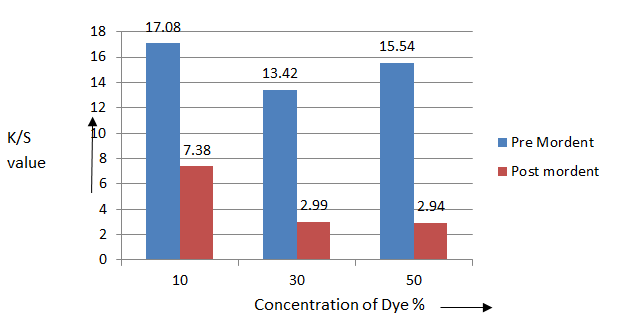
The figure 2 indicated the colour strength (K/S value) of Acacia Catechu while using different concentration of 10%, 30% and 50 % of dye using alum mordant. The results representing the k/s value is more in case of Pre-mordanting in comparison to post-mordenting. The colour strength of the natural dye extracted from Acacia Catechu showed the colour strength is more in case of pre- mordanting.
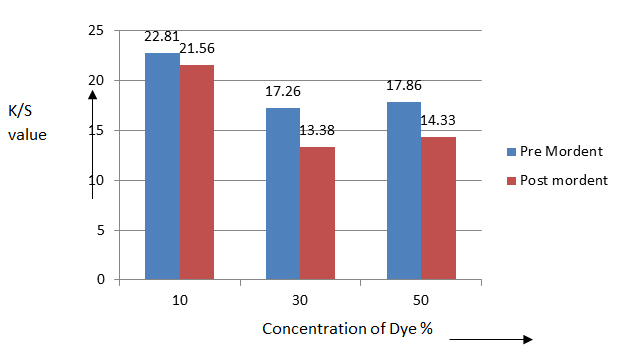
The figure 3 indicated the colour strength (K/S value) of Acacia Catechu while using different concentration of 10%, 30% and 50 % of dye using Ferrous Shulphate mordant. The results representing the k/s value is more in case of Pre-mordanting in comparison to post-mordenting. The colour strength of the natural dye extracted from Acacia Catechu showed the colour strength is more in case of pre- mordanting.
The figure 4 indicated the colour strength (K/S value) of Acacia Catechu while using different concentration of 10%, 30% and 50 % of dye using stannous chloride mordant.
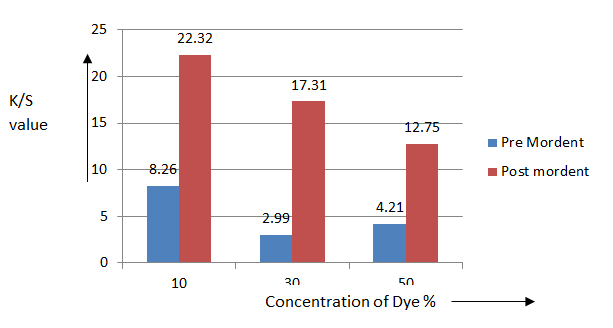
The results representing the k/s value is more in case of post-mordanting in comparison to pre-mordenting. The colour strength of the natural dye extracted from Acacia Catechu showed the colour strength is more in case of post- mordanting.
L*: lightness (0 = black, 100 = white), a*: red–green coordinates (positive values = red, negative values = green), b*: yellow–blue coordinates (positive values = yellow, negative values = blue).
Acacia Catechu extract in combination with alum ferrous Shulphate and stannous Chloride mordants onto Banana Fiber produced good improvement in color depth (K/S), and their values were in positive color coordinates in terms of a* (red) and b* (yellow) values. Thus, they showed shifts in their tones, resulting in beautiful gamut of colors as compared with the dyeing obtained without using mordant..
Assessment of Fastness Properties of Dyed Banana Fiber
The fastness ratings of banana fiber dyed without and with mordant at different dye concentrations of 10, 30, and 50% are presented in Table 3. These results indicate that the washing fastness of the banana fiber dyed with catechu was very good to excellent (4to 4–5) and the light fastness was of good to very good (5 to 5–6) grades. The color fastness to rubbing was found to be in the range of 3 to 5, i.e. Good to excellent, for the banana fiber with or without mordant. Hence, after mordanting, fiber improves washing, light and rubbing fastness proper-ties. Also, fixation level of dye increases. Natural dyes are less substantive and thus require a mordant to fix them on fiber and prevent color from either fading with exposure to light or washing. These pre- or post-mordanting have different effects on the shade obtained after dyeing and also on fastness properties. Alum is a white powder, safe for hands and easy to use and produces bright shades and relatively good light fastness. It is, therefore, necessary to choose a proper mordanting method to get the desired shade and fastness properties.
| Type of Mordant | Dye Conc. % o.w.f. | Washing fastness | Light fastness | Rubbing fastness (Dry) | Rubbing fastness(wet) | ||||
|---|---|---|---|---|---|---|---|---|---|
| Pre | Post | Pre | Post | Pre | Post | Pre | Post | ||
| Alum (5%) | 10 | 4-5 | 4-5 | 6 | 5 | 5 | 4-5 | 4-5 | 4 |
| 30 | 4-5 | 4-5 | 6 | 5-6 | 4-5 | 4 | 4 | 4 | |
| 50 | 4-5 | 4 | 5-6 | 5-6 | 4-5 | 4-5 | 4 | 3-4 | |
| Ferrous Sulphate (5%) | 10 | 4-5 | 4 | 6 | 5 | 5 | 5 | 4-5 | 4-5 |
| 30 | 4-5 | 4-5 | 5-6 | 5-6 | 4-5 | 4-5 | 4-5 | 4 | |
| 50 | 4-5 | 4 | 5-6 | 5 | 4-5 | 4-5 | 4-5 | 4 | |
| Stannous chloride (5%) | 10 | 4-5 | 4-5 | 6 | 5-6 | 5 | 5 | 4-5 | 4-5 |
| 30 | 4-5 | 4 | 5-6 | 5-6 | 4-5 | 4 | 4-5 | 4 | |
| 50 | 4-5 | 4 | 5-6 | 5 | 4-5 | 4-5 | 4 | 4 |
Table 3: Fastness ratings of banana fiber dyed without and with mordant at different dye concentrations.
Conclusions
Acecia Catechu extract can be successfully employed as a natural dye with different mordants for dyeing of banana fiber as a natural source of colorant. Banana fiber showed higher color depth in terms of K/S values on mordanting with alum,Ferrous Shulphate, stannous Chloride as compared to without mordanting. The banana fiber showed decreasing K/S values as the mordanting method was varied from pre mordanting to post mordenting using different types of mordent like Alam, Ferrous Shulphate, stannous Chloride. In case of fastness properties pre mordanting method of dyeing gives more fastness like Rubbing, washing and light fastness as compared to Post mordenting and without Mordenting.
References
-
Punrattanasin N, Nakpathom M, Somboon B, Narumol N, Rungruangkitkrai N (2013) Silk fabric dyeing with natural dye from mangrove bark (Rhizophora apiculata Blume) extract. Industrial Crops and Products 49: 122- 129.
-
Shahid M, Shahid-ul I, Mohammad F (2013) Recent advancements in natural dye applications: a review. Journal of Cleaner Production 53: 310-331.
-
Samanta AK, Agarwal P (2009) Application of natural dyes on textiles. Indian Journal of Fibre Textile Research 34: 384-399.
-
Benli H, Bahtiyari MD (2015) Green strategy for Dyeing Wool Fibers by madder Natural Dye. Cellulose 22: 867- 877.
-
Vankar PS, Shanker R, Wijayapala S (2009) Dyeing of cotton, wool and silk with extract of Allium cepa. Pigment & Resin Technology 38(4): 242-247.
-
Wang L, Li J, Feng H (2009) Dyeing of flax fabric with natural dye from chestnut shells. Pigment & Resin Technology 38(6): 347-352.
-
Zhang B, Wang L, Luo L, King MW (2014) Natural dye extracted from Chinese gall – the application of color and antibacterial activity to wool fabric. Journal of Cleaner Production 80: 204-210.
-
Ali NF, El-Khatib EM, El-Mohamedy RSR (2015) The antimicrobial activity of pretreated silk fabrics dyed with natural dye. International Journal of Current Microbiology and Applied Sciences 4(6): 1166-1173.
-
Barber EJW (1991) _Prehistoric Textiles_. Princeton University Press.
-
Goodwin Jill (1982) A Dyer’s Manual. Pelham.
-
Cardon Dominique (2007) Natural Dyes: Sources, Tradition, Technology and Science. Archetype Publications.
-
Hofenk de Graaf, Judith H (2004) The Colourful Past: Origins, Chemistry and Identification of Natural Dyestuffs. Abegg-Stiftung and Archetype Publications, pp:1-396.
-
Chattopadhyay SN, Pan NC, Roy AK, Saxena S, Khan A (2013) Development of natural dyed jute fabric with improved colour yield and UV protection characteristics. Journal of the Textile Institute 104(8): 808-818.
-
Pandian S, Karuppiah SP, Sivakumar P, Vinoba M, Renganathan S (2012) Optimization of extraction process and kinetics of Sterculiafoetidaseed oil and its process augmentation for biodiesel production. Industrial & Engineering Chemistry Research 51(26): 8992-8998.
-
Prabhu KH, Teli MD, Waghmare NC (2011) Eco- friendly dyeing using natural mordant extracted from emblicaofficinalis g. fruit on cotton and silk fabrics with antibacterial activity. Fibers and Polymers 12: 753-759.
-
Teli MD, Pandit P, Basak S (2017) Coconut shell extract imparting multifunction properties to ligno-cellulosic material. Journal of Industrial Textiles 47(6): 1261- 1290.
-
Teli MD, Pandit P, Jangle A (2015a) Antibacterial property of Sterculia foetida fruit shells. Asian Dyer 12: 40-44.
-
Teli MD, Sheikh J, Mahalle K, Labade V, Trivedi R (2012) Application of Tamarind seed coat in dyeing of cotton and silk using catechu and heena. Journal of the Textile Association 73: 90-95.
-
Teli MD, Sheikh J, Valia SP, Yeola P (2013) Dyeing of milk fibre with marigold and turmeric dyes. Journal of the Textile Association 74: 12-17.
- The Expanding Landscape of Road Rage: A Systematic Review of Conflicts Involving Drivers, Pedestrians, and Micromobility
- Validating Cognitive Models of Royal Navy Performance on Control Systems
- Comparing Standard and State-of-the-art Firefighter Coats on Postural Balance and Gait in a Live Burn Environment
- Investigating the Integration of Telemedicine into Clinicians Workflow: A Review of Methods
- Risk Assessment of Ergonomic Factors in a Textile Firm by RULA, REBA and Fine Kinney Methods
- Impact of Self-Esteem Training on Individuals with Disabilities Aged 17-30