
Human Factor Considerations in Virtual Reality: Adequate or Inadequate?
Despite the continued progress in human factor (HF) considerations in virtual reality (VR), health and safety issues persist in VR applications, especially in fully immersive VR. This article reviews those issues and the recent developments to address them and discusses the adequacy of current HF considerations in VR. The four types of realities are first defined: reality, augmented reality, augmented virtual reality, and virtual reality (non-immersive, semi-immersive, and fully immersive). A brief review of the general VR applications (arts, community services, engineering, and others) is presented, followed by a more detailed review of engineering applications (industry, research, and education and training). Notable general HF issues in immersive VR are discussed, including cybersickness, hygiene, immersion injuries, and repetitive strain injuries. Manufacturer support in addressing various health and safety issues, such as in-use symptoms, post-use symptoms, repetitive strain injuries, and system alerts is highlighted. An in-depth review of the research issues related to VR is presented. Based on this study, it is concluded that significant efforts by researchers and manufacturers are still needed to address several HF issues in VR.
Introduction
Virtual reality (VR) is a breakthrough technology that has been applied in many fields, including entertainment, social sciences and psychology, medicine, engineering, fine arts, and education and training. An Internet search for the term ‘virtual reality’ revealed that 23,763 peer-reviewed papers were published on this subject in 2020. Clearly, technology has been advancing at a fast pace.
Head-mounted displays (HMD) for virtual reality have been sporadically developed in preliminary forms since the 1960s. The fully immersive VR technology as we know it today has been progressively developed in the past three decades. Widespread commercial releases of consumer headsets occurred in the 1990s, followed by a relatively calm period in the early 21st century, then rapid developments of VR headsets during the past decade. Notable results included the Oculus Rift in 2010, the HTC Vive in 2015, the HTC Vive Steam VR in 2016, the Oculus Rift S in 2019, and the Oculus Quest 2 in 2020. By 2016, at least 230 companies developed VR-related products, including Amazon, Apple, Facebook, Google, Microsoft, Sony, and Samsung. There were some concerns related to the designed headsets, such as below par haptic interfaces and low-resolution visual displays. The latest headsets were wireless, utilized inside-out tracking compared to external outside-in tracking, and included a sharper screen, reduced price, and increased performance [1].
The frenetic pace of VR technology advancement during the past decade has not been accompanied by intensive considerations of human factors. As a result, immersive VR technology still has numerous safety and health issues [2]. VR users experience in-use and post-use symptoms that still need to be fully addressed. The in-use symptoms could hinder the validity of experimental research or the effectiveness of training and education. The post-use symptoms could compromise safety and health, especially when performing activities that require balance and hand-eye coordination, such as driving. Many of these undesirable VR effects are caused by limitations in the temporal performance of the system hardware [3, 4]. These problems could hinder the full implementation of VR, especially in some research areas that involve parameters in the range of a few seconds.
This paper focuses on the human factors that are related to immersive VR systems. The main objectives of the paper are fourfold: (1) to briefly present the general applications of virtual reality in various fields, along with some details in the engineering field, (2) to describe the human factor concerns about VR systems, along with manufacturer support, and how they have been addressed in recent designs, (3) to present an in-depth review of the research issues related to VR, and (4) to evaluate the adequacy of HF considerations for various VR issues and the developments needed to address them. Before addressing the preceding aspects, it is helpful to define virtual reality.
What is Virtual Reality?
There are three main types of virtual reality [5, 6]: non- immersive (desktop), semi-immersive, and fully immersive. A non-immersive VR system simply displays a 3D virtual world on a device such as a desktop or mobile phone. The system leaves the user visually aware of the real world and observe the virtual world. A video game is an example of such a system. A semi-immersive (simulation-based) VR system involves a computer-generated simulation or approximate imitation of a real-world environment. A virtual tour is a popular example of this system, such as the recently developed Google virtual tour [7]. Other notable examples of this system are driving, flight, and ship simulators. A fully immersive VR system involves a simulated virtual environment in which the user is fully immersed and has no visual contact with the physical world, usually through a head-mounted display, as shown in Figure 1. In addition to HMD, other VR technology devices include the Cave Automatic Virtual Environment (CAVE) and pinch gloves [8].
The HMD brings the user to a seemingly enclosed 3D virtual environment. Virtual reality is typically provided through a small screen in front of the eyes. The user’s movements and reactions are detected and projected within the virtual environment. In fully immersed VR technology, the user is immersed in an entirely 3D virtual environment (experienced 360 degrees). The user feels as though they are being immersed in the simulated virtual environment that completely blocks the user’s view of their actual surroundings. The person using the VR equipment can look around the virtual environment, move around in it, and interact with its virtual features. The headsets are widely used with video games and simulators. The headset is comprised of a stereoscopic HMD, stereo sound, and head-motion tracking sensors that may include gyroscopes, accelerometers, magnetometers, and structured light systems. Some VR headsets also have eye-tracking sensors [9, 10].
![Figure 1: In addition to HMD, other VR technology devices include the Cave Automatic Virtual Environment (CAVE) and pinch gloves [8].](/fulltextimages/6890/fig_1.png)
Both driving simulators and fully immersive VR systems rely on a computer-generated environment that the driver or user interacts with. In a virtual simulation, the environment is depicted on a screen, while in VR the environment is generated through an HMD. The driving simulator in the writer’s lab at Ryerson University was used to model and analyze numerous aspects related to road safety, driver mental workload, traffic operations, and in-vehicle collision warning systems [11, 12, 13, 14]. Note that a driving simulator can include the use of an HMD as its primary input-output equipment.
In addition to virtual reality, there are other types of realities, as shown in Figure 2. Within the continuum of the two extremes of reality (real world with no technological overlays) and virtual reality (virtual environment isolated from the real world) lies a mixed reality [15, 16, 17, 18]. Mixed reality includes augmented reality (AR) and augmented virtual reality (AVR). In augmented reality, which is the next level after reality, virtual reality objects are superimposed on a real-world environment. The user is still in touch with the real world while interacting with the virtual objects. In AR, the computer uses sensors and algorithms to determine the position and orientation of a camera. AR technology then renders the 3D graphics as they would appear from the viewpoint of the camera, superimposing the computer- generated images over the user’s view of the real world [19]. For example, through an App, the user can view a virtual 3D solar system, including the planets’ atmospheres, moons, and rings, along with real-time data (e.g. object diameter, mass, and distance from the sun), on the mobile screen in his/her room.
In augmented virtual reality, which is the level before virtual reality, real-world objects (such as physical objects or people) are dynamically merged into the virtual world in real- time and can interact with it. This merging is accomplished using such techniques as streaming video from physical spaces or 3D digitalization of physical objects. Another form of AVR is the use of real-world sensor information (e.g. gyroscopes) to control the virtual environment [1]. AVR technology could produce a wide range of capabilities not currently available in AR or VR. The Facebook Oculus equipment has a Mixed Reality Capture Tool that allows the user to place real-world objects in VR. For example, the user can capture footage of himself and superimpose it in the virtual world [20].
![Figure 2: Within the continuum of the two extremes of reality (real world with no technological overlays) and virtual reality (virtual environment isolated from the real world) lies a mixed reality [15-18]. Mixed reality includes augmented reality (AR) and augmented virtual reality (AVR). In augmented reality, which is the next level after reality, virtual reality objects are superimposed on a real-world environment. The user is still in touch with the real world while interacting with the virtual objects. In AR, the computer uses sensors and algorithms to determine the position and orientation of a camera. AR technology then renders the 3D graphics as they would appear from the viewpoint of the camera, superimposing the computer- generated images over the user’s view of the real world [19]. For example, through an App, the user can view a virtual 3D solar system, including the planets’ atmospheres, moons, and rings, along with real-time data (e.g. object diameter, mass, and distance from the sun), on the mobile screen in his/her room.](/fulltextimages/6890/fig_2.png)
Applications
General Applications
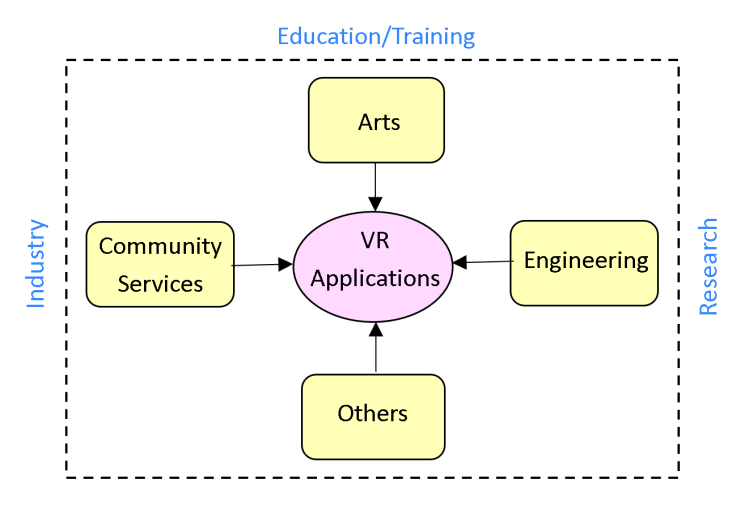
Virtual reality has been implemented in many fields, as shown in Figure 3. The arts applications include entertainment, fine arts, social sciences, and psychology. The community services applications include health care and medicine, occupational health and safety, and urban/ regional planning. The engineering applications cover all engineering areas, including civil engineering, electrical engineering, mechanical and industrial engineering, aerospace engineering, and chemical engineering. The other applications include architecture, computer science, business, military, aviation, and space. All areas involve industrial implementation, research, and education and training. In particular, education and training have been more prominent in mining, military, medicine, flight and vehicular applications, and space. To provide the reader with highlights on industrial implementation, education and training, and research, these aspects are discussed next in the context of the engineering field.
Engineering Implementation
Industry: Virtual reality is one of the key technologies that are shaping the future of the engineering industry by providing engineers with a new vision into the virtual world. VR can be used for planning, prototyping, and construction purposes. Commercially available VR software and peripherals enable companies to start building different VR applications to address real engineering problems [21, 22, 23]. Virtual reality allows designers and stakeholders to literally walk through their design before it is built. As a result, potential issues can be identified, saving time and resources. In addition, along with other tools, VR allows for real-time adjustments of the design. For example, Bombardier Transportation, a global leader in rail technology, uses VR to accelerate product development and launch its vehicles on the market more quickly. Integrating VR in factories and product design enables manufacturers to simplify these processes, improve quality, and establish a safety culture.
Research: Virtual reality has been used to conduct research in all areas of engineering. In some research areas, considering human factors could be critical. Two
engineering areas are discussed here for illustration. In transportation engineering, many researchers have used VR to analyze pedestrian behaviour and characteristics [24, 25, 26, 27]. The virtual environment has avoided the limitations of the real-world studies, including the difficulties of installing specific experimental traffic settings, replicating the experiments, and exposing pedestrians to risk. Virtual pedestrian simulators that can support free movement in all directions, allow monitoring of pedestrian behaviour (e.g. tracking of position and orientation of gaze) and collisions, and provide 3D positional audio have been developed [28]. These simulators require an ample space and scenarios that can be conducted within a single room. In construction, VR has supported the manual workspace planning process by simulating construction activities using immersive VR and Building Information Modeling technologies [29]. VR has improved the planning process by integrating the workers' VR-based experience with the knowledge of the construction managers. This approach has a beneficial impact on planning and safety-related learning.
The following are examples of PhD research projects funded by the United Kingdom’s Engineering and Physical Sciences Research Council [30] that highlight some emerging VR research Council (note: projects from physical sciences are included for general interest): • DTPSCIDM: A virtual reality platform for safe testing of human-robot interactions.
• Building full-body illusion in immersive virtual reality with physically based avatars.
• Analytical and applied biosciences: Virtual reality work or AI to improve manufacturing processes and training.
- 2D and 3D crowd steering analysis in virtual reality
- Modelling ‘difficult’ choices combining virtual reality and physiological data
- Advanced virtual reality future power plant dynamic simulations.
• Understanding eye-hand coordination in object interception: A computational modelling approach.
• Consumer decision making based on cutting-edge digital technologies and sustainable retailing models.
• Perceptual stability in virtual reality across the adult lifespan.
• Audio for virtual and augmented reality.
• Sustainable personalisation in fashion retail.
Education and Training: For engineering education, VR represents a technological breakthrough that holds power to facilitate better learning by augmenting the existing curriculum [31, 32]. The unified hear-see-do experience facilitated by VR can support complex understanding by stimulating all human senses. In addition, virtual simulation is proven as an effective pedagogy that supports student learning outcomes. Virtual reality provides broad capabilities for training engineers in different industries, such as automotive, healthcare, and space [20, 33]. In space training, for example, NASA uses immersive VR simulators to train astronauts before flights to expose them to zero-gravity environments and train them on how to spacewalk. VR also provides improved techniques for health and safety training, such as an ergonomics assessment of workspace layout, prototyping of control interfaces, and simulating potentially dangerous environments (e.g. nuclear plant maintenance).
An interesting development for higher education is ClassVR, a standalone, classroom-ready device that delivers a fully immersive VR experience under the teacher’s control [34]. The headset (Figure 4) has been designed for use by students. It integrates a complete set of technology, such as a high-definition display, integrated speakers with volume controls and an audio-out port to connect headphones, and Wi-Fi and Bluetooth connectivity to enable classroom control. The ClassVR technology is an open platform that supports curriculum content for VR, AR, and MR, and allows students and teachers to create, upload, and share their content. The ClassVR portal includes access to a massive library of pedagogically sound curriculums and standards, along with downloadable structured lesson plans, guides, and worksheets. One of the challenges of VR technology in higher education is the associated cost which has been prohibitive for educational institutions [35].
![Figure 4: ClassVR standalone headset [34].](/fulltextimages/6890/fig_4.png)
Human Factors in VR
General HF Issues
There are numerous concerns about the use of virtual reality, such as health and safety concerns, privacy concerns, concerns surrounding use by children, and conceptual and philosophical concerns [36]. This section focuses on the notable health and safety issues: sickness, hygiene, immersion injuries, and repetitive strain injuries.
Sickness: The symptoms of virtual reality sickness, also known as cybersickness, are similar to those of motion sickness and include general discomfort, headache, nausea, vomiting, sweating, fatigue, and drowsiness, among others [37]. These symptoms can be caused by the visually induced perception of self-motion. VR sickness can have unfavorable consequences since it may be a barrier to conducting effective research and virtual reality training. Some research has suggested that older adults (over 50) are more susceptible to virtual reality sickness than younger adults, as are women. Disorientation and nausea in VR and simulator environments have been attributed to the discrepancy between visual and vestibular information about body orientation and motion (sensory conflict) [38]. This discrepancy is caused by the lags between head movements and the corresponding displayed- image movements in an immersive VR environment. This lag may also directly affect the performance of tracking, manipulation, and reading tasks.
Several tools have been developed to reduce VR sickness, such as using a static frame of reference (independent visual background) [39]. Nausea has been reduced by reducing rotational motions during navigation, decreasing the field of view [40]. Special glasses have also been developed as an add-on device to prevent VR sickness [41]. Artificial intelligence has also been used to reduce motion sickness in virtual reality [42]. Despite these developments, there are many aspects of VR sickness that have yet to be resolved.
| Recent Developments | Reference | |
|---|---|---|
| Sickness | - Using a static frame of reference as an independent visual background. - Reduce the discrepancies between the visual aspects and body movements. - Using special glasses as an add-on device. - Using artificial intelligence. | [39-42] |
| Hygiene | - Replacements for the VR headset cover and face foam padding. | [43] |
| Immersion Injuries | - Self-contained headsets (no wires/cables connecting the headset to the PC). - Using a virtual boundary that helps the user stay within the cleared play area (it appears when the user is near or touching its edge). | [43] |
| Repetitive Strain Injuries | - Development of lighter headsets. - Identifying areas for future research. | [43,44] |
Table 1: Notable health and safety issues of VR and some recent developments to address them.
Hygiene: For fully immersive systems, hygiene is a significant concern when using VR headset technology. HMD environments can be a medium of transmission for all sorts of bacteria and may cause infections. In addition, since HMD often involves an enclosed design, a considerable amount of heat is generated, leading to some sweating. To address this issue, some companies have changed the ergonomic features of the HMD to make them more comfortable to use and easy to clean. One solution was the development of replacements for VR headset covers and face foam padding. That being said, some customers have recently reported facial skin irritation associated with the Oculus-Quest 2 in the area where the headset foam interface makes contact with the skin [43]. In general, keeping the headsets clean remains a challenge.
Immersion Injuries: There is the possibility of injury in a fully immersive system since the user is functionally blind to the real world [1]. The injuries may be caused by colliding with real-world objects or tripping over the VR system cables.
In addition, the sound cues provided in many HMD systems may effectively cut off audio stimulation from the real world. To avoid immersion injuries, someone must watch over the user when using VR.
Repetitive Strain Injuries: Repetitive strain injuries result from conducting prolonged, repeated activities using rapid carpal (bones forming the human wrist) and metacarpal (any of the five bones of the hand) movements [6]. The injuries are associated with using standard input devices (e.g. mice and keyboards), which can be an issue with non- immersive (desktop) and semi-immersive VR systems. The injuries include tendonitis, ligamentous injury, and fibrous tissue hyperplasia. For fully immersive VR, a recent study revealed that some common movements can contribute to muscle strain and discomfort [44]. VR users wear a headset and engage in full-body, 3D movements. The heavy headset may also increase the burden on the cervical spine, leading to greater neck strain.
Manufacturer Support
Equipment manufacturers have recognized most of the HF concerns presented in the previous section. Most VR systems include consumer warnings. A glance at some manufacturers' health and safety warnings regarding possible symptoms from using headset equipment clearly shows that the symptoms could be severe. Some highlights of those warnings for in-use symptoms, post-use symptoms, repetitive strain injuries, age requirements, and system alerts are presented in the following sections. The information is based on the Oculus-Quest headset guide, which is available in the online safety center [43]. The center provides help to address VR health and safety concerns along with video explanations.
In-use symptoms: This warning states: “Immediately discontinue using the headset if any of the following symptoms are experienced: seizures; loss of awareness; eye strain; eye or muscle twitching; involuntary movements; altered, blurred, or double vision or other visual abnormalities; dizziness; disorientation; impaired balance; impaired hand- eye coordination; excessive sweating; increased salivation; nausea; light headedness; discomfort or pain in the head or eyes; drowsiness; fatigue; any symptoms similar to motion sickness” [43].
Post-use symptoms: Symptoms of VR exposure can persist for hours after use. These symptoms can include the in-use symptoms listed above, as well as excessive drowsiness and decreased multi-tasking ability. Such symptoms may put the user at increased risk of injury when engaging in normal real-world activities. Therefore, until they have recovered from the symptoms, the user should not drive, operate machinery, engage in other visually or physically demanding activities, or other activities that require unimpaired balance (e.g. riding a bicycle). If the symptoms are severe or persist, the user should see a doctor.
Repetitive strain injuries: The use of a headset can hurt the muscles, joints, neck, hands, and skin. The warning states that if the user feels any symptoms (e.g. tingling, numbness, burning, or stiffness), the user should stop and rest for several hours. If those or other symptoms persist, the user should see a doctor.
Age Requirement: The warning states that children under the age of 13 should not use virtual reality headsets. For children 13 and older, adults should ensure that the children properly use the equipment and monitor them for any of the symptoms mentioned above. Prolonged use should be avoided since this could adversely impact the user, as discussed in the post-use symptoms section.
System alerts: Typically, the headset may provide such alerts as: (a) overheating alert (audible and visual) when the headset is overheating, (b) sound volume alert (visual) in the event of high volume levels, (c) outside of play space alert (visual) if the user is outside of the play space, and (d) tracking error system alerts (visual) if the tracking system of the headset is not operating correctly.
Research Issues
Virtual reality is still an immature technology, and numerous issues still need to be resolved. A review of recent papers in several fields, shown in Table 2, provides a snapshot of the research issues/needs in virtual reality. The fields include engineering and architecture, civil engineering, built environment, psychology, medicine, and all fields. For each field, the table shows the research topic, research issues/ needs, and a reference. As noted, most of the issues/needs are related to human factors. Most papers were published in 2020. Some of the highlights of these papers are presented next.
An excellent paper by Delgado, et al. [45] presented a research agenda for VR and AR in engineering, architecture, and construction. The agenda was based on concerns and issues raised from industry practitioners, views and expectations of technology development companies, and gaps in the literature review were identified by the authors. The proposed agenda consisted of three categories: (1) engineering-grade VR and AR devices, (2) workflow and data management, and (3) new capabilities. The first category includes HMD comfort and safety, high accuracy tracking, improved indoor localization systems, dynamic 3D mapping of changing environments, explicit indication of accuracy, and larger model capacity and battery life. The workflow and data management category includes archiving AR and VR content and experience, visualizing data in a 3D spatial and temporal context, developing data exchange standards, system integration with other built environment systems, multi-user and multi-device capabilities, and addressing security, privacy and data ownership issues. The new capabilities category includes object and gesture recognition, real-time model modification, diminished reality and real- time occlusion, automatic environment capture, real-time integration with internet of things devices, and multimodal human–computer interaction.
| Research Topic | Research Issues/Needs | Reference | |
|---|---|---|---|
| Architecture and Engineering | Research Agenda | - Needs for engineering-grade devices. - Needs for workflow and data management. - Needs for new capabilities. | Delgadoa, et al. [45] |
| Psychology | Episodic Memory | - Evaluation of the interactions between various properties of immersion and memory performance. - How learning mechanisms in VR compare (or contrast) with learning that occurs in real life. | Smith [46] |
| All fields | Sickness | - Establish how negative symptoms or effects interact with each other. - As technology develops, monitor various effects as some effects may lessen and others may remain unchanged or worsen. - Studies should ensure that empirical data can be converted into guidelines. | Wikipedia [1] |
| Built Environment | Research Needs | - Construction training systems incorporating human factors. - User-centered adaptive design. - Attention-driven virtual reality information systems. - Occupant-centered facility management and industry adoption. | Zhnag, et al. [47] |
| All fields | Ethical Aspects | - Potential adverse effects of virtual or augmented reality have not been explored. - After-effects and mental consequences of using VR (e.g. extreme violent games) and real-world transitions from VR are unknown. - There are no data that can help address those ethical challenges. | Ives [48], Slater, et al. [49] |
| Psychology/Medicine | Older People | - Despite minor interaction issues and bugs, virtual systems are rated as feasible. Still usability and user experience pilot studies to aid interaction in VR clinical applications for older people are encouraged. | Tuena, et al. [50] |
| All fields | Scientific Research | - Varying the offset between the virtual and the physical tracking spaces makes the HTC Vive at present unsuitable for scientific experiments that require accurate visual stimulation of self-motion. | Niehorster [51] |
| All fields | Education | - VR development for higher education should take a holistic standpoint and provide results that allow for generalization. - Future educational VR applications should be thoroughly evaluated using quantitative and qualitative research methods to assess the increase in the knowledge and skills of students. - Technological progress is needed to create environments that are perceived as realistic, thus providing real immersion. | Radianti, et al. [52] |
| Civil Engineering | Education and Training | - VR technologies should be evaluated to explore how they can be systematically integrated with emerging education approaches. - VR-related educational kits should be improved to provide such things as a larger field of view. - There is a need to develop VR-enhanced online education. - Further develop hybrid visualization approaches for the ubiquitous learning environment of engineering education. | Wang, et al. [53] |
Table 2: Research issues/needs related to using virtual reality in different fields.
In the field of psychology, Smith [46] has pointed out that much work is still needed to clarify the current discrepancies that occur between studies of episodic memory phenomena. In particular, attention should be given to: (1) the interaction between various properties of immersion and memory performance, (2) exploring the mediating role that presence might play in this relationship, and (3) continued comparisons between the quality of encoding in VR and that of the analogous real-life settings.
The presence of sickness and other symptoms in research studies could distract the participant from the virtual environment, thus reducing their sense of existence and the accuracy of related measurements. It is vital to establish how negative symptoms or effects interact with each other. As technology develops, some effects may lessen, but other effects remain or become even more pronounced. Studies should therefore ensure that empirical data can be converted into guidelines as required. In this way, the human factor issues associated with VR use can be addressed in a systematic and useful manner [1].
In the field of built environment, Zhang, et al. [47] systematically presented an in-depth review of research trends and revealed challenges for future research. The authors first explored the state-of-the-art in VR applications for the built environment by reviewing 229 journal articles. Based on this review, future research directions were proposed in five areas: (1) construction training systems that incorporate human factors, (2) user-centered adaptive design, (3) attention-driven virtual reality information systems, (4) occupant-centered facility management, and (5) industry adoption.
Ives [48] and Slater, et al. [49] warn about the dangers that might arise as VR technologies become more popular and urge new research to address ethical issues. The following ethical issues have been raised: (1) potential adverse effects of virtual or augmented reality have not been explored (2) the after-effects and mental consequences of using virtual reality (e.g. extreme violent games) and of the real-world transition from virtual reality are not known, (3) there are no data that can help address the ethical challenges of VR and AR, and (4) there is a lack of funding for interdisciplinary research to address various issues.
Adequacy of HF Consideration
Are HF adequately addressed in fully immersive virtual reality? Based on the review presented in this paper and the related literature, the writer’s subjective judgement of the adequacy of HF considerations in VR is presented in Figure 5. The human factor issues (sickness, hygiene, immersion injuries, repetitive strain injuries, post-use symptoms, research-related, and industry-related) are rated using a five-level scale (Poor, Fair, Good, Very Good, and Excellent).
Industry-related applications are rated as Excellent since human factors do not seem to represent an issue in such applications. The immersion injuries issue was also rated as Excellent due to the recent developments in HMD that have significantly reduced such injuries, such as the self-contained headsets (no wires/cables connecting the headset to a PC) and the use of a virtual boundary that helps the user stay within the cleared play area, as previously mentioned. The hygiene issue was rated Very Good since, despite the recently developed replacements for VR headset covers and face foam padding, apparently there are still health issues with the headset foam technology.
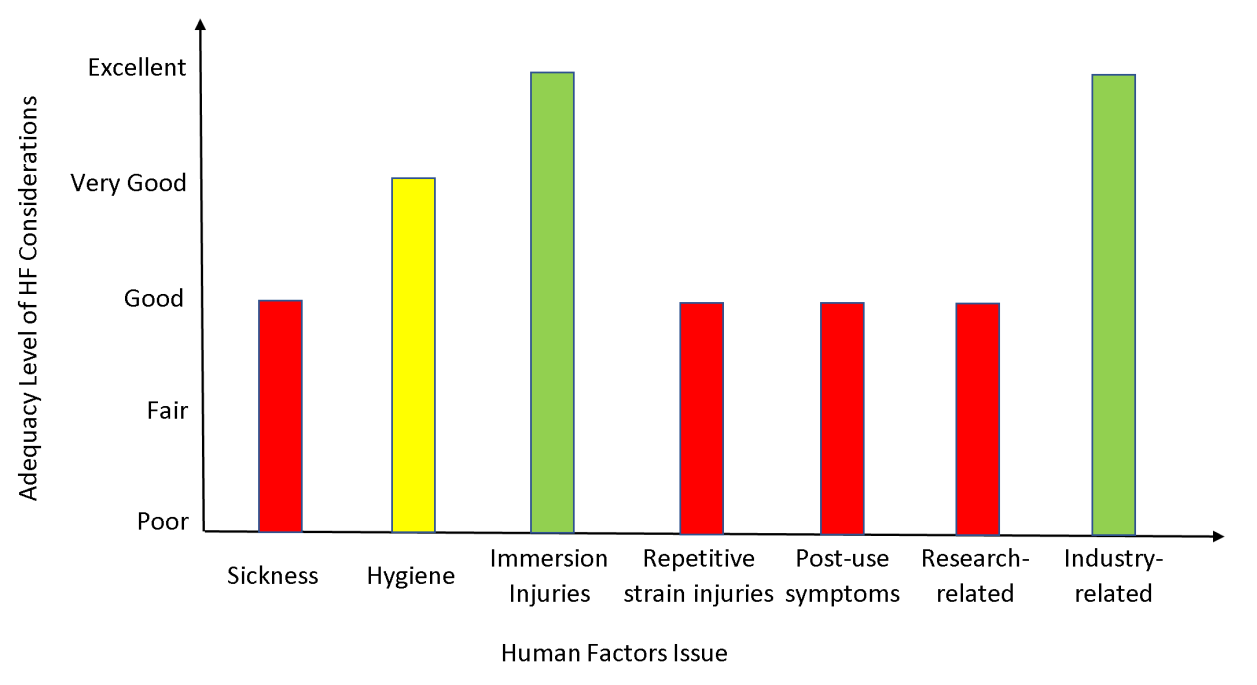
The lowest rating of Good was given to three issues: sickness, repetitive strain injuries, and research related. Obviously, sickness and repetitive strain injuries are still major issues, as evidenced by the literature on user experience and the recognition by VR equipment manufacturers. The issue of human factors in research also received a rating of Good. Researchers have raised many issues regarding the use of VR to conduct research, as discussed in the previous section. In
addition, in the writer’s area of transportation engineering, using VR to accurately measure small-value parameters, such as pedestrian or driver perception time (which is in the order of 2-3 s) is a challenge. This challenge is mainly due to the presence of VR in-use symptoms. Furthermore, such transportation studies should include users of all ages, and for older users the measurements are likely to be questionable.
The post-use symptoms of VR exposure still represent an issue that has not been adequately addressed. As previously mentioned, such symptoms, which include in-use symptoms as well as excessive drowsiness and decreased multi-tasking ability, can persist hours after use. There is currently no solution to eliminate these symptoms, only guidelines to cope with them.
Concluding Remarks
This paper first discussed the continuum of reality, mixed reality, and virtual reality, along with a brief description of VR applications. General human factor issues and manufacturer support in addressing these issues were then described, followed by the research issues/needs. The adequacy of HF considerations in VR for each issue was then subjectively determined. The following conclusions were obtained based on the results of this study:
- Although virtual reality has been applied in many fields, the human factors related to the needs and abilities of VR users have not been adequately assessed. Research should continue to improve VR methods and products to provide the most effective interface, especially for the three issues that received a rating of Good (sickness, repetitive strain injuries, post-use symptoms, and research. In general, the challenges of addressing human factors in research fall into three distinct areas [54]: health and safety concerns (e.g. sickness), human performance efficiency (e.g. user characteristics), and social implications (e.g. societal aggression).
- The in-use symptoms of VR may interfere with the learning of skills in a virtual environment through distraction, leading to compromised research results or training. In addition, the post-use symptoms, such as visual and postural disturbances, could compromise safety and health following exposure, especially when driving.
- Universities should form research groups to address human factors in virtual reality.
The groups can develop the theoretical background to obtain a more profound knowledge of both VR technology and related human issues to optimize the design and application of VR technology. Through experimental and observational work, the groups can contribute toward excellence in creating new concepts, products, processes, and systems.
The groups must advise the industry, government, and international bodies regarding the human factor issues of VR. One example is the group in the Faculty of Psychology at the University of Barcelona [48]. Besides, the International Virtual Reality Professionals Association can serve as a central communication link for the VR industry to promote human factors in the development of VR technology and advocate for the protection of user privacy. 4. There is a long way to go to address human factors in virtual reality fully. However, VR holds great promise as a valuable tool for industrial applications, research, and education and training in all fields. The technology can accelerate product development and reduce cost for industry, make a difference in the quality of education and training, and lead researchers to discoveries.
Acknowledgement
This research was made possible by a Discovery Grant from the Natural Sciences and Engineering Research Council of Canada.
References
-
Wikipedia (2021) Virtual reality.
-
Jerald J (2015) Human-centered design for virtual reality. Morgan & Claypool, New York.
-
Sherman WR, Craig AB (2019) Understanding Virtual Reality: Interface, Application, and Design. Morgan Kaufman, Burlington, Massachusetts 12(4): 441.
-
Milgram Paul, Kishino Fumio (1994) A taxonomy of mixed reality visual displays. IEICE Trans. Information Systems 77(12): 1321-1329.
-
Sultan CS (2021) 5 Types of virtual reality: Creating a better future. Rextheme.
-
Costello PJ, Costello P (1997) Health and safety issues associated with virtual reality: A review of current literature. Leicestershire, pp: 1-23.
-
Kim J (2017) Get a closer look with Street View in Google Earth VR. Google Earth VR.
-
Gandhi RD, Patel DS (2018) Virtual Reality-Opportunities and Challenges. International Research Journal of Engineering and Technology 5(1): 482-490.
-
Robertson A (2021) The ultimate VR headset buyer’s guide. The Verge.
-
Miles S (2015) Forget head tracking on Oculus Rift, Fove VR headset can track your eyes. Pocket-lint.
-
Yang Y, Chen M, Wu C, Easa SM, Lin W, et al. (2020) Effect of highway directional signs on driver mental workload and behavior using eye movement and brain wave. Accident Analysis & Prevention 146: 105705.
-
Yang Y, Easa SM, Zheng X, Hu A, Liu F (2019) Evaluating effects of two types of freeway deceleration markings in China. PLoS ONE 14(8): e0220811.
-
Mehmood A, Easa SM (2010) Development of new and improved driver-sensitive car-following model. Can J Transp 4(1): 11-27.
-
Hassein U, Diachuk M, Easa SM (2018) In-vehicle passing collision warning system for two-lane highways considering driver characteristics. Transportation Research Record 2672(37): 101-112.
-
(2021) Mixed reality. Wikipedia.
-
Jung K, Nguyen VT, Piscarac D, Yoo SC (2020) Meet the virtual Jeju Dol Harubang: The mixed VR/AR application for cultural immersion in Korea’s main heritage. International Journal of Geo-Information 9(6): 367.
-
Farshid M, Paschen J, Eriksson T, Kietzmann J (2018) Go boldly! Explore augmented reality (AR), virtual reality (VR), and mixed reality (MR) for business. Business Horizons 61(5): 657-663.
-
Eugenijus K (2016) Evaluation of quality and personalization of VR/AR/MR learning systems. Behaviour & Information Technology 35(11): 998-1007.
-
Penning J (2017) Understanding virtual reality. Accedo.
-
(2021) Applications of Virtual Reality. Virtual Reality Society.
-
Brown L (2021) Virtual reality in engineering and business applications. Wondershare Filmora.
-
Watson T (2020) Virtual reality in engineering: Pros, cons, and use cases. Skywell Software.
-
Zhu W, Peng X, Leu MC (2015) 13 Engineering applications of virtual reality. Mechanical Engineer’s Handbook.
-
Feng Y, Duives DC, Hoogendoorn SP (2021) Using virtual reality to study pedestrian exit choice behaviour during evacuations. Safety Science 137: 105158.
-
Sonja S, Klaus B (2020) Virtually the same? Analyzing pedestrian behaviour by means of virtual reality. Transportation Research Part F: Traffic Psychology and Behaviour 68: 231-256.
-
Luo H (2020) Using virtual reality to identify and modify risky pedestrian behaviors amongst Chinese children. Traffic Injury Prevention 21(1): 108-113.
-
Deb S, Carruth DW, Hudson CR (2020) How communicating features can help pedestrian safety in the presence of self-driving vehicles: Virtual reality experiment. IEEE Transactions on Human-Machine Systems 50(2): 176-186.
-
Deb S, Carruth DW, Sween R, Strawderman L, Garrison TM (2017) Efficacy of virtual reality in pedestrian safety research. Appl Ergon 65: 449-460.
-
Getuli V, Capone P, Bruttini A, Isaac S (2020) BIM-based immersive Virtual Reality for construction workspace planning: A safety-oriented approach. Automation in Construction 114: 103160.
-
(2021) Virtual reality PhD research projects. University of Dundee. FindAPhD.
-
(2021) Virtual reality for engineering education & research. VizExperts.
-
D’Errico M (2021) Virtual simulation versus immersive virtual reality: What’s the Difference?. Ubi Sim.
-
Fertleman C, Aubugeau Williams P, Sher C, Lim AN (2018) A Discussion of virtual reality as a new tool for training healthcare professionals. Frontiers in Public Health 6: 44.
-
(2021) Introducing: The ClassVR standalone headset. ClassVR.
-
Abulrub AH, Attridge A, Williams MA (2011) Virtual reality in engineering education: The future of creative learning. International Journal of Emerging Technologies in Learning.
-
Nichols S, Patel H (2002) Health and safety implications of virtual reality: A review of empirical evidence. Applied Ergonomics 33(3): 251-271.
-
Kolasinski EM (1995) Simulator sickness in virtual environments. US Army Research Institute for the Behavioral and Social Sciences.
-
Whittinghill DM, Ziegler B, Moore J, Case T (2015) Nasum Virtualis: A simple technique for reducing simulator sickness in head mounted VR. Game Developers Conference, San Francisco.
-
Kemeny A, George P, Mérienne F, Colombet F (2017) New VR Navigation Techniques to Reduce Cybersickness. Electronic Imaging 3: 48-53.
-
Fernandes AS, Feiner SK (2016) Combating VR sickness through subtle dynamic field-of-view modification. IEEE Symposium on 3D User Interfaces (3DUI), pp: 201-210.
-
Matchar E (2018) Could these glasses cure your motion sickness? Smithsonian Magazine.
-
Kyle Wiggers (2018) LG develops AI to deal with nausea in VR. Venture Beat.
-
(2021) Oculus safety center. Oculus.
-
Penumudi SA, Kuppam VA, Kim JH, Hwang J (2020) The effects of target location on musculoskeletal load, task performance, and subjective discomfort during virtual reality interactions. Applied Ergonomics 84: 103010.
-
Delgadoa JM, Oyedelea L, Demianc P, Beach T (2020) A research agenda for augmented and virtual reality in architecture, engineering and construction. Advanced Engineering Informatics 45: 101122.
-
Smith SA (2019) Virtual reality in episodic memory research: A review. Psychonomic Bulletin & Review 26: 1213-1237.
-
Zhang Y, Liu H, Kang SC, Mohamed Al Hussein (2020) Virtual reality applications for the built environment: Research trends and opportunities. Automation in Construction 118: 103311.
-
Ives J (2020) Researchers warn about the ethical problems of virtual and augmented reality. News.
-
Slater M, Gonzalez-Liencres C, Haggard P (2020) The ethics of realism in virtual and augmented reality. Frontiers in Virtual Reality.
-
Tuena C, Pedroli E, Trimarchi PD, Gallucci A, Chiappini M, et al. (2020) Usability Issues of Clinical and Research Applications of Virtual Reality in Older People: A Systematic Review. Frontiers in Human Neuroscience 14: 1-19.
-
Niehorster DC (2017) The accuracy and precision of position and orientation tracking in the HTC Vive virtual reality system for scientific research. i-Perception, pp: 1-23.
-
Radianti J, Majchrzak TA, Fromm J, Wohlgenannt I (2020) A systematic review of immersive virtual reality applications for higher education: Design elements, lessons learned, and research agenda. Computers & Education 147: 103778.
-
Wang P, Wu P, Wang J, Chi HL, Wang X (2018) A critical review of the use of virtual reality in construction engineering education and training. Int J Environ Res Public Health 15(6): 1204.
-
(2021) Human factors in virtual reality: Human factors issues.
- The Expanding Landscape of Road Rage: A Systematic Review of Conflicts Involving Drivers, Pedestrians, and Micromobility
- Validating Cognitive Models of Royal Navy Performance on Control Systems
- Comparing Standard and State-of-the-art Firefighter Coats on Postural Balance and Gait in a Live Burn Environment
- Investigating the Integration of Telemedicine into Clinicians Workflow: A Review of Methods
- Risk Assessment of Ergonomic Factors in a Textile Firm by RULA, REBA and Fine Kinney Methods
- Impact of Self-Esteem Training on Individuals with Disabilities Aged 17-30