
A Review on Grip and Pinch Strength Tests
Grip strength measurement data has many applications in health assessment and ergonomic strategies. However, this issue has been neglected by wellness researchers and activists in Iran. Therefore, this study was designed to review the factors affecting grip strength, the protocol and tools necessary for grip strength tests, the validity and reliability of grip strength tests, as well as the databases and forward-looking equations of grip strength. This is a review study. The required information was obtained by searching the International Information Banks of Science Direct, Web of Science, Scopus, Springer, ProQuest, Google Scholar and PubMed (between 1980to2022). Search keywords were "hand strength, grip strength, pinch strength, normative data, dynamometer, regression models, and anthropometric measurements". One hindered and forty relevant articles were found in total 45 of them were reviewed and finally used in this study. In this study, effective demographic and anthropometric factors, measurement instruments, test protocols, validity and reliability of measurement, principles of creating databases of grip strength, and also forward-looking models of these databases were reviewed and results were presented. The measurement of grip strength is performed with the purpose of investigating upper limb disorders, designing hand tools, designing workstations, and determination of the improvement level of different treatments. Demographic characteristics and anthropometric factors, particularly the upper anthropometric dimensions, affected the grip strength. Researchers, ergonomists, therapists, and physicians can benefit from the results of this study.
Introduction
Grasping and holding an object is one of the most important functions of the hand, and any disturbance in this ability can disrupt daily activities. Because proper hand strength is a prerequisite to meeting the daily needs of life. Therefore, grip and pinch strengths are generally the most important performance indexes of the hand. The grip strength is defined as a combined force resulting from the external and internal muscles of the hand that bends the joints of the hand; which reflects the total force of the muscles of the upper limbs and is also related to the force of other muscles in the body [1, 2, 3]. The grip strength not only describes the hand’s condition but it is used as an objective evaluation of the upper limb’s function in treating hand injuries [4, 5]. Grip strength is even a predictor of general complications and failures after surgery [6], disabilities, and the consequences of aging such as disability [7], increased risk of disease [8, 9], and mortality [10]. It is also used in examining the work capacity of patients with local injuries [11]. Hand grip strength is also used as a nutritional assessment technique because it is sensitive to short-term changes in nutritional status [11, 12]. The measurement of the pinch strength is also used for the same purposes as mentioned [13].
According to what was said and based on previous research, the information obtained from the measurement of grip strength is very useful in the field of health assessment and ergonomic measures. While this issue has been paid less attention by health researchers and activists. Accordingly, examining and providing information about grip strength for the use of researchers, ergonomists, health activists, and industrialists seemed necessary. Therefore, this study was designed to review the factors affecting grip strength, the protocol, and tools necessary for grip strength tests, the validity and reliability of grip strength tests, as well as the databases and forward-looking equations of grip strength.
Materials and Methods
This is a review study and the desired information was obtained by searching the international databases Science Direct, Web of Science, Scopus, Springer, ProQuest, Google Scholar, and PubMed. The search keywords included “hand strength, grip strength, pinch strength, normative data, regression models, anthropometric measurements”. Being in the time range from 1980 to 2022 and using the standard test protocol (following the standards of the American Society of Hand Therapists (ASHT) were among the criteria that were considered for the inclusion of scientific articles in the literature review process. A total of 140 related articles were found, and finally, the texts of 45 articles were reviewed and used to write the present study.
Demographic Factors Affecting Grip Strength
Gender
The conducted studies confirm the general idea that men are stronger than women. Gunther, et al. [14] believe that the grip strength in healthy people of both sexes increases until the third decade of life, and then a continuous decrease begins with increasing age, but women reach the threshold of reduction earlier (first half of the fourth decade and men in the second half of this decade). In Mohammadian, et al. [11] study, the grip strength of Iranian men in the dominant and non-dominant hands was 40% (17.7 kg) and 42% (17.6 kg) stronger than women, respectively [11]. These results are consistent with the findings of other researchers [14, 15, 16, 17]. Mitsionis, et al. [4] while investigating the grip strength of the Greek population, state that in recent years the grip strength of women has improved, which can be attributed to the dramatic change in the role of women in the current modern society. He knew the reason for these changes can be found in the increase in women’s job needs [4, 18].
Age
In a study conducted on Iranian adults, the maximum grip strength of men was achieved in the age group of 20-24 years old [11]. In past research, the studies of Mathiowetz, et al. [17], Adedoyin, et al. [19], and Wu SW, et al. [20] found the maximum grip strength of men in the same age group [11]. Among women, the maximum grip strength was obtained in the age group of 35-39 years, which is consistent with the results of Gunther, et al. [14] and Puh [13] studies.
Dominant Hand
The dominant hand shows expertise and distinction in the upper musculoskeletal of the body [21]. The results of Mohammadian, et al. [11] research showed that the grip strength of the dominant hand is significantly higher than the non-dominant hand among both women and men. Also, the pinch strengths (tip, key and palmar) of the dominant hand were stronger in both genders, except for men’s palmar pinch strength. Based on this, the grip strength of the dominant hand of men and women was 4.4 and 7.1% respectively (1.96 and 1.89 kg) stronger than their non-dominant hand. As well as, Crosby, et al. [15], Werle, et al. [22] reported that the dominant hand was stronger than the non-dominant hand by 5-7% and 5.4%, respectively.
Physical Activities
The type of job and activities performed in free time are effective on grip strength [15]. In some studies, they have specifically investigated the effect of the job on grip strength; their results were contradictory. Some researchers did not find differences in grip strength between different occupational groups (such as official, technical, manual, and agricultural workers) [23]. While other study had reported that workers in heavy occupations have more grip strength than workers in light and office occupations [24]. Other researchers stated that leisure and physical activities performed in free time have a greater effect on grip strength than a heavy job [15]; although, this issue has not been investigated comprehensively and completely. Ultimately, physical activity (in occupation or free time) has affected grip strength; but it is not possible to quantify this effect [15].
To investigate the effect of occupation on grip strength, researchers divided the occupational activities into 6 categories [25]. This job classification is based on the strength demands of job duties. As well as, people’s sports activities have been taken into consideration based on the method of Crosby, et al. [15]. In addition, other important factors including posture and biomechanics of the body (size, shape, and moments) contribute to the division of jobs.
Anthropometric Factors Affecting Grip Strength
The results of Ugurlu and Ozdogan’s study showed that the height of the participants compared to their weight has a greater correlation with grip strength [26]. These findings are compatible with the results of Mohammadian, et al. [27], Puh [13], and Angst, et al. [21] studies. Also, the anthropometric dimension of forearm circumference had the highest correlation with grip strength among Iranian people (r=0.42). While Nicolay and Walker [28] found a stronger correlation than the study of Iranian society (r=0.74). Although, Gunther, et al. [14] observed a weaker correlation coefficient (r=0.37). The arm circumference also had a positive correlation with the grip strengths measured in Iran [27]. Harries also reported a positive significant correlation between grip strength and arm circumference of Africans [29]. The hand length also had a positive correlation with grip strength in Iranian adults (r=0.39) [27]. As well as, Wu SW, et al. [20] found a strong correlation between grip strength and hand length (r=0.69).
In the interpretation of this correlation, it can be said that the length of the hand provides a larger volume for the thenar musculature (muscular structure of the palm); which naturally increases the grip strength [20]. The anthropometric dimension of hand width had a stronger correlation with the Tip and Key pinch strengths compared to the grip strength in Iranian people [27]. A similar correlation has been observed in German people (r=0.31) [14].
Tools for Measuring Grip and Pinch Strengths
In general, grip strength measurement tools are classified into five main categories:
- hydraulic tools,
- pneumatic tools,
- mechanical tools,
- digital tools, and
- strain gauges.
Describing the mechanism of each of these is beyond the goals of this study.
Hydraulic Tools
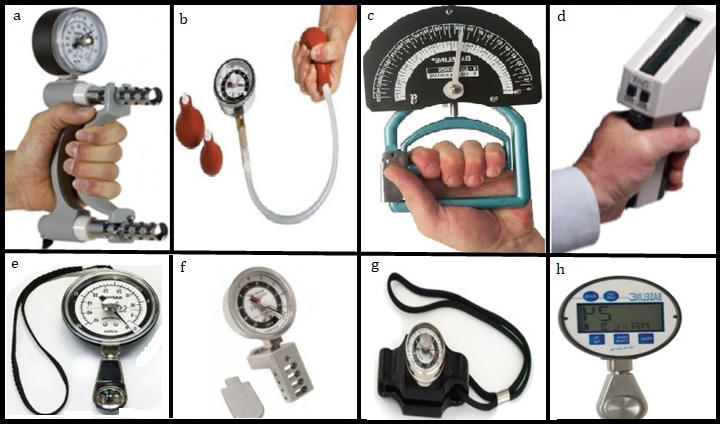
The hydraulic equipment for measuring grip strength includes a closed system that shows the results in pounds or kilograms of force. Jamar dynamometer (Asimow Engineering, Santa Fe springs, CA, USA) (Figure 1) is included in this group of tools. This tool measures the grip strength with handles that can be adjusted in five positions (2.5, 3.8, 5.1, 6.4, and 7.6 centimeters) [30]. The use of this device has been reported in many studies and recommended for measuring grip strength [8, 27, 31, 32]. In a survey of American occupational therapy schools and clinics, it was found that almost 80% of therapists measure grip strength using the Jamar dynamometer [33]. There is also a hydraulic tool to measure the pinch strength, which can be used to see the force in terms of pounds or kilograms of force, just like a dynamometer [18].
Pneumatic Tools
In pneumatic tools, the pressure of the grip strength is measured by compressing the air inside a bubble or bag. These types of tools are usually used by people who have painful hands with thin skin (such as people who suffered from rheumatoid arthritis). Because pneumatic tools are softer and easier to grip. The pneumatic tools include a modified sphygmomanometer, Martin vigorimeter with different bubble sizes, Tekdyne dynamometer (Tekdyne Corp., North Wales, PA, USA), and boots grip strength meter (Boots Co. Ltd, England), which are similar to Martin vigometer [30].
Mechanical Tools
These types of tools measure grip strength based on the amount of tension produced in a steel spring. Smedley dynamometer (a clinical instrument used in Clifton State, USA), Stoelting dynamometer, Harpenden dynamometer (both are similar to Smedley), Kny-Scheerer dynamometer (Kny-Scheerer Corp., Germany), Collins dynamometer (Gebrüder Martin, Germany) (these are known as steel spring dynamometers) and My-Gripper (Yamasa, Tokei, Japan) are mechanical tools. In these tools, the grip strength has measured in kilograms or pounds of force.
Digital Tools
Companies that manufacture precision instruments trying to keep up with the remarkable technological progress. Based on this, digital tools for assessing hand grip strength emerged. Meanwhile, Jamar, TKK, Bisline, B&L, Dyn X, and Seahan companies have widely offered grip strength evaluation tools that can be connected to the computer. Figure 1 shows different types of dynamometers and pinch gauges.
Strain Gauges
These tools usually measure the grip strength in terms of newtons of force and include MIE digital pinch/ grip analyzer (MIE Medical Research), Statham electronic dynamometer (Statham Instrument Inc. Oxnard, CA, USA), the Isometric Strength Testing Unit (ISTU) and other strain gauges. Despite the abundance of force measurement tools, ergonomists, therapists, and physicians must be familiar with each of them and know how to use each one. Knowing about the validity and reliability of the tools, the standard measurement protocol for each of these tools, and the availability of normative data related to them is essential for evaluation and treatment.
The Protocol of the Grip Strength Test
Body Posture during the Test
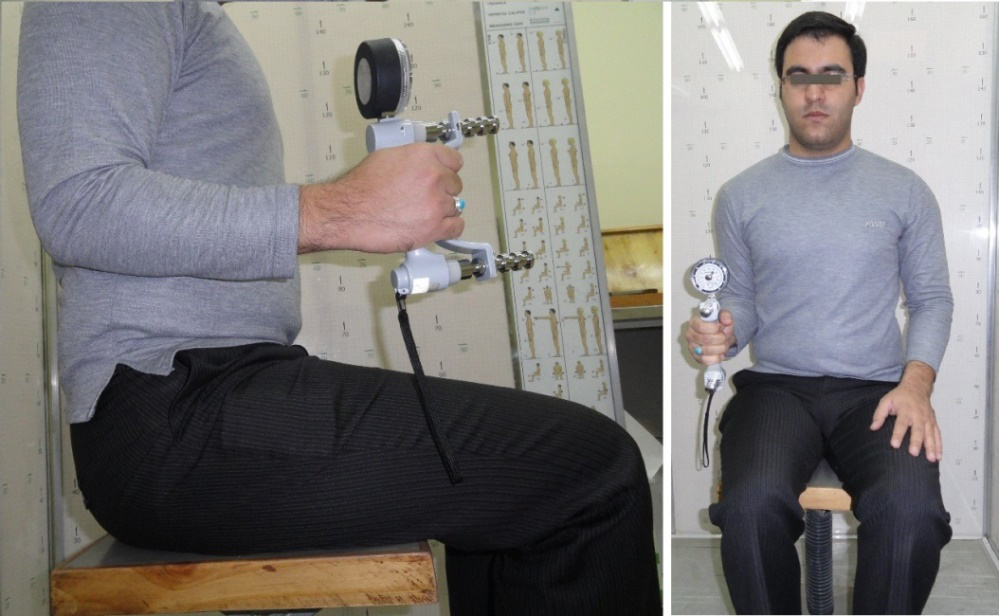
Many studies have followed the standard postures approved by the ASHT. In this standard, the posture of the body is described as follows [31, 32, 34]: “A person sitting on a chair, the back is straight and the feet are completely on the floor; the shoulders are fixed and do not rotate. The elbow is bent to a 90-degree angle, the forearm is in a neutral position and the wrist is between 0 to 30 degrees of extension and 15 degrees deviates to the ulnar side. The arm should not be supported by the chair handle. To measure grip strength, the dynamometer should be placed in the hand vertically and in line with the forearm, maintaining the standard position of the forearm and wrist (Figure 2). The above explanations have been developed for using the Jamar dynamometer, of course, it also corresponds to the body’s position when using Martin vigorimeter.
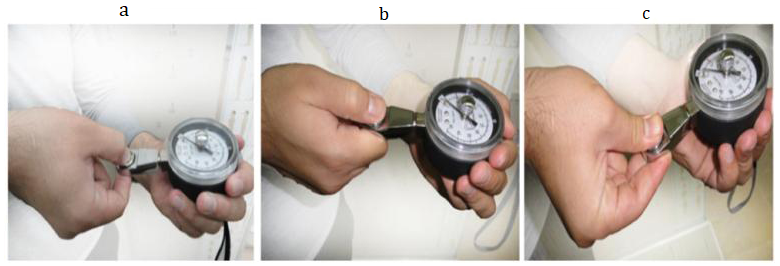
To measure pinch strength, one should also follow the body posture approved by ASHT (the above-mentioned posture). It is common to measure three types of pinch strengths Key, Tip, and Palmar. The method of measuring each pinch strength according to the study of Mathiowetz, et al. [18] is as follows (Figure 3):
- Tip: The thumb tip in front of the index fingertip is placed on the pinch gauge and the applied force and the results are read on the display of the device (Figure 3, part a).
- Key: The thumb pad is placed against the lateral aspect of the middle phalanx on the pinch gauge and the force is measured (Figure 3, part b).
- Palmar: The thumb pad is placed in front of the pads of the index and middle fingers are placed on the Jamar pinch gauge and the force was measured (Figure 3, part c).
The Number of Grip and Pinch Strength Measurements
The preferred method to obtain the maximum grip strength is averaging three trials [31, 35]. The number of grip and pinch strength measurements has been investigated in studies (for example, one-time measurement is better or two or three times and etc.). Based results the average of two times of exerted grip and pinch strengths showed the highest force among the three times of applying the force of the individual [15, 36]. While all these policies had high retest reliability (ICC<0.93) and no significant difference was observed between them [35, 37]. Despite this, the highest reliability for the averaging method has been obtained from 3 times exertion of strength measurement [36].
Rest Periods between Each Effort Exerted
When several times of effort and application of force are needed to reach the maximum strength in a limited time, the fatigue of the subject is mater. Mathiowetz investigated the effect of force exerted three times on grip strength between rehabilitation patients and healthy people; the results indicated no significant difference between of force exerted three times in any of these two groups [38]. In a similar study, Trossman and Lee also investigated the effect of rest periods between five times of force exerted [39]. They did not find a significant difference between rest periods with intervals of 60 seconds, 30 seconds, and 15 seconds. Although in the exertion of the first to fifth forces, a trend of grip strength reduction was observed. In summarizing this issue, it should be said that most researchers recommend a 60-second rest period between each force exerted.
Verbal Encouragements
The standard protocol includes fixed instructions that show how to perform the test [18, 40]. The instructions become especially important when the use of volume (verbal encouragement of the person to apply force until reaching the maximum grip strength) is also added to the instructions. Innes, et al. [30] found a significant difference between oral instructions and isometric strength. Therefore, wherever the voice and verbal command increased, the results showed an increase in strength. It is important to use the same tone of voice along with creating sound in each test.
Normative Data of Grip and Pinch Strengths
The purpose of creating normative data is to describe the normal or standard values of a characteristic such as a grip and pinch strengths in a specific population [30]. Establishing the natural range of grip strength is a valid method of diagnosing the severity of damage to each of the two musculoskeletal and nervous systems of the hand. This information is usually collected from healthy people in the community and based on factors such as age and gender [19, 31]. To create normative data on grip and pinch strengths, it is necessary to pay attention to the recommendations (mentioned in the present study) and standards, until these data have been used by therapists and other professionals. Factors affecting the quality of studies on the creation of normative data on grip and pinch strengths include the following:
• Structure of population and race: The first important point for the creation of normative data on grip and pinch strengths is race. Angst, et al. [21] point to the lack of generalizability of information on the natural range of force to countries and populations with different social and economic conditions as one of the limitations of their study. Also, Ugurlu and Ozdogan emphasized the use of normative data on grip and pinch strengths specific to each population [26]. It should be noted that along with the changes in the social, economic and political situation of the society or the change of generation, normative data of grip and pinch strengths should be updated as well.
• Sample size: The sample size for creating normative data on grip and pinch strengths should be large, random, and representative of the population with different genetics of the target society; until it be statistically valid. The reliability of normative data is affected by insufficient acceptable sample size, a small number of elderly people, focusing on a part of the population, deviation from the standard protocol, or the type of dynamometer [22]. Also, the sample size may be small, especially in the old age groups. For example, in Newman, et al. [41] study, there were only four females and nine males 75 years old. As Fike and Rousseau used seven males and six males aged 71-80 years to create normative data [42]. The size of the samples, when participants are broken into subgroups with age and gender restrictions, often has 20-40 samples [43, 44].
• Screening of healthy people: Another important point in creating normative data is an accurate and correct screening of healthy people to enter the study. Mathiowetz, et al. [11] have recommended inclusion criteria for creating normative data of grip and pinch strengths should be divided into people under 60 years and over 60 years old as follows [17]. People under 60 years old: no pain or disorder in the body’s upper limbs and not having a history of hand surgery, fracture, or any other type of disease (such as arthritis, Intervertebral disc herniation, joint diseases, etc.). People over 60 years old: not having severe pain in the arms and hands, not having a history of being hospitalized for more than six months (due to a heart attack or any type of surgery), and not having a limitation in the level of daily activities caused by a health disorder. If a person has any of the above health disorders and limitations; It should be excluded from normative data study.
• Age groups: Different researchers have used different age ranges to create normative data. For example, in some studies of age groups with five [4, 17, 20, 21, 22, 26], ten [14, 19], and even fifteen [13] year intervals have been presented. But to be able to more accurately provide normative data for each age group of society, it is recommended to use age groups with five-year intervals, including the age group over 75 years old [11, 17].
Predictive Models of Grip and Pinch Strengths
Currently, to achieve evaluation and treatment goals, the comparison of the subject’s hand strength with normative data on grip strength is used. While in past studies, the effect of factors such as age, gender, posture, anthropometric characteristics, fat percentage, body mass index, socio-economic status, occupation, lifestyle, and racial dependence on grip strength have been mentioned. Based on this, researchers have created models for easy and more accurate prediction of grip [13, 17] and pinch [45, 46] strengths in healthy people by statistical analysis of demographic variables and anthropometric factors affecting hand strength. It is useful and helpful to develop and present models for estimating the strength of a person’s hand based on normal data using parameters that can be measured quickly and easily [47]. Also, considering the relationship of anthropometric dimensions on hand strength in the calculation of predictive equations can help to estimate the amount of deviation from the values of normative data of grip and pinch strengths [26].
Conclusion
The measurement of grip strength is performed to investigate upper limb disorders, design hand tools, design workstations, and determination of the improvement level of different treatments. Demographic characteristics and anthropometric factors, particularly the upper anthropometric dimensions, affected the grip and pinch strengths. Researchers, ergonomists, therapists, and physicians can benefit from the results of this study. Also, in this study, the types of equipment, the principles of creating normative data, and the key points in the protocol for conducting grip strength measurement studies were mentioned; which can be helpful for ergonomists, therapists, and doctors to choose and use them optimally.
References
-
Andersen-Ranberg K, Petersen I, Rederiksen HF, Mackenbach JP, Christensen K (2009) Cross-National Differences in Grip Strength Among 50+ Year-Old Europeans: Results from the SHARE Study. Eur J Ageing 6(3): 227-236.
-
Nezhad NH, Choobineh A, Haghdoust AA, Mohammadian M (2014) Comparison of Grip and Pinch Strengths of Adults Among five Cities of IRAN. Journal of School of Public Health and Institute of Public Health Research 11(3): 65-81.
-
Nejad NH, Mohammadian M, Haghdoust AA, Charkhloo E (2021) The Relationship of Grip and Pinch Strength to Musculoskeletal Disorders in Female Carpet Weavers in Southeastern Iran, 2019. Indian J Occup Environ Med 25(3): 138-146.
-
Mitsionis G, Pakos EE, Stafilas KS, Paschos N, Papakostas T, et al. (2009) Normative Data on Hand Grip Strength in A Greek Adult Population. Int Orthop 33(3): 713-717.
-
Abdalla PP, Bohn L, Sebastião E, Santos APD, Junior MFT, et al. (2023) Handgrip Strength Asymmetry Cut Points to Identify Slow Gait Speed in Six Low- and Middle-Income Countries: A Cross-Sectional Analysis with 12,669 Older Adults. Arch Gerontol Geriatr 106: 104869.
-
Mahalakshmi VN, Ananthakrishnan N, Kate V, Sahai A, Trakroo M (2004) Handgrip Strength and Endurance as A Predictor of Postoperative Morbidity in Surgical Patients: Can it Serve as A Simple Bedside Test? International surgery 89(2): 115-121.
-
Guerra RS, Amaral TF (2009) Comparison of Hand Dynamometers in Elderly People. The Journal of Nutrition, Health & Aging 13(10): 907-912.
-
Bohannon RW (2008) Hand-Grip Dynamometry Predicts Future Outcomes in Aging Adults. J Geriatr Phys Ther 31(1): 3-10.
-
Lima TRD, Silva DAS (2023) Handgrip Strength is Not Associated with High Blood Pressure and Does Not Have Good Discriminatory Power for High Blood Pressure in Adolescents 37(1): 46-54.
-
Ensrud KE, Ewing SK, Taylor BC, Fink HA, Cawthon PM, et al. (2008) Comparison of 2 Frailty Indexes for Prediction of falls, Disability, Fractures, and Death in Older Women. Arch Intern Med 168(4): 382-389.
-
Mohammadian M, Choobineh A, Haghdoost A, Hasheminejad N (2014) Normative Data of Grip and Pinch Strengths in Healthy Adults of Iranian Population. Iran J Public Health 43(8): 1113-1122.
-
Farías-Valenzuela C,Ferrero-Hernández P,Ferrari G, Espoz-Lazo S,Castillo-Paredes A, et al. (2022) Reference Values of Absolute and Relative Handgrip Strength in Chilean Schoolchildren with Intellectual Disabilities. Children (Basel) 9(12): 1912.
-
Puh U (2010) Age-Related and Sex-Related Differences in Hand and Pinch Grip Strength in Adults. Int J Rehabil Res 33(1): 4-11.
-
Günther CM, Bürger A, Rickert M, Crispin A, Schulz CU (2008) Grip Strength in Healthy Caucasian Adults: Reference Values. J Hand Surg Am 33(4): 558-565.
-
Crosby CA, Wehbe MA, Mawr B (1994) Hand Strength: Normative Values. J Hand Surg Am 19(4): 665-670.
-
Kamarul T, Ahmad TS, Loh WYC (2006) Hand Grip Strength in the Adult Malaysian Population. J Orthop Surg (Hong Kong) 14(2): 172-177.
-
Mathiowetz V, Kashman N, Volland G, Weber K, Dowe M, et al. (1985) Grip and Pinch Strength: Normative Data for Adults. Arch Phys Med Rehabil 66(2): 69-72.
-
Mathiowetz V (1990) Grip and Pinch Strength Measurements. Muscle Strength Testing: Instrumented and Non-Instrumented Systems. Churchill Livingstone, USA, pp: 163-177.
-
Adedoyin RA, Ogundapo FA, Mbada CE, Adekanla BA, Johnson OE, et al. (2009) Reference Values for Handgrip Strength Among Healthy Adults in Nigeria. Hong Kong Physiotherapy Journal 27(1): 21-29.
-
Wu SW, Wu SF, Liang HW, Wu ZT, Huang S (2009) Measuring Factors Affecting Grip Strength in A Taiwan Chinese Population and A Comparison with Consolidated Norms. Appl Ergon 40(4): 811-815.
-
Angst F, Drerup S, Werle S, Herren DB, Simmen BR, et al. (2010) Prediction of Grip and Key Pinch Strength in 978 Healthy Subjects. BMC Musculoskeletal Disorders 11(1): 94-99.
-
Werle S, Goldhahn J, Drerup S, Simmen BR, Sprott H, et al. (2009) Age-and Gender-Specific Normative Data of Grip and Pinch Strength in A Healthy Adult Swiss Population. J Hand Surg Eur Vol 34(1): 76-84.
-
Harth A, Vetter WR (1994) Grip and Pinch Strength Among Selected Adult Occupational Groups. Occupational Therapy International 1(1): 13-28.
-
Josty IC, Tyler MP, Shewell PC, Roberts AH (1997) Grip and Pinch Strength Variations in Different Types of Workers. J Hand Surg Br 22(2): 266-269.
-
Dictionary of Occupational Titles (1991) US Department of Labor Employment and Training Administration. 4th(Edn.), United States Employment Service, USA.
-
Ugurlu Ã, Ozdogan H (2012) Age-and Gender-Specific Normative Data of Pinch Strengths in a Healthy Turkish Population. J Hand Surg Eur Vol 37(5): 436-446.
-
Mohammadian M, Choobineh A, Haghdoost AA, Nejad NH (2016) Investigation of Grip and Pinch Strengths in Iranian Adults and Their Correlated Anthropometric and Demographic Factors. Work 53(2): 429-437.
-
Nicolay CW, Walker AL (2005) Grip Strength and Endurance: Influences of Anthropometric Variation, Hand Dominance, and Gender. International Journal of Industrial Ergonomics 35(7): 605-618.
-
Harries AD (1985) A Comparison of Hand-Grip Dynamometry and Arm Muscle Size Amongst Africans in North-East Nigeria. Hum Nutr Clin Nutr 39(4): 309-313.
-
Innes E (1999) Handgrip Strength Testing: A Review of the Literature. Australian Occupational Therapy Journal 46(3): 120-140.
-
Mathiowetz V, Weber K, Volland G, Kashman N (1984) Reliability and Validity of Grip and Pinch Strength Evaluations. J Hand Surg Am 9(2): 222-226.
-
Mathiowetz V, Rennells C, Donahoe L (1985) Effect of Elbow Position on Grip And Key Pinch Strength. J Hand Surg Am 10(5): 694-697.
-
Smith RO, Benge MW (1985) Pinch and Grasp Strength: Standardization of Terminology and Protocol. Am J Occup Ther 39(8): 531-535.
-
Fess EE, Moran CA (1981) Clinical Assessment Recommendations. 3rd(Edn.), American Society of Hand Therapists, Grip Strength, USA.
-
MacDermid JC, Kramer JF, Woodbury MG, McFarlane RM, Roth JH (1994) Interrater Reliability of Pinch and Grip Strength Measurements in Patients with Cumulative Trauma Disorders. J Hand Ther 7(1): 10-14.
-
Hamilton A, Balnave R, Adams R (1994) Grip Strength Testing Reliability. Journal of Hand Therapy 7(3): 163- 170.
-
Trossman PB, Suleski KB, Li PW (1990) Test-Retest Reliability and Day-to-Day Variability of an Isometric Grip Strength Test Using the Work Simulator. Occupational Therapy Journal of Research 10(5): 266-279.
-
Mathiowetz V (1990) Effects of Three Trials on Grip and Pinch Strength Measurements. Journal of Hand Therapy 3(4): 195-198.
-
Trossman PB, Li PW (1989) The Effect of the Duration of Intertrial Rest Periods on Isometric Grip Strength Performance in Young Adults. Occupational Therapy Journal of Research 9(6): 362-378.
-
Richards L, Palmiter-Thomas P (1996) Grip Strength Measurement: A Critical Review of Tools, Methods, and Clinical Utility. Critical Reviews™ in Physical and Rehabilitation Medicine 8(1-2): 87-109.
-
Newman DG, Pearn J, Barnes A, Young CM, Kehoe M, et al. (1984) Norms for Hand Grip Strength. Arch Dis Child 59(5): 453-459.
-
Fike ML, Rousseau E (1982) Measurement of Adult Hand Strength: A Comparison of Two Instruments. Occupational Therapy Journal of Research 2(1).
-
Agnew P, Maas F (1982) An Interim Australian Version of the Jebsen Test Of Hand Function. Aust J Physiother 28(2): 23-29.
-
Agnew PJ, Maas F (1982) Hand Function Related to Age and Sex. Arch Phys Med Rehabil 63(6): 269-271.
-
Chandrasekaran B, Ghosh A, Prasad C, Krishnan K, Chandrasharma B (2010) Age and Anthropometric Traits Predict Handgrip Strength in Healthy Normals. J Hand Microsurg 2(2): 58-61.
-
Hossain MG, Zyroul R, Pereira BP, Kamarul T (2011) Multiple Regression Analysis of factors influencing dominant hand Grip Strength in an Adult Malaysian Population. J Hand Surg Eur Vol 37(1): 65-70.
-
Klum M, Wolf MB, Hahn P, Leclère FM, Bruckner T, et al. (2012) Predicting Grip Strength and Key Pinch Using Anthropometric Data, DASH Questionnaire and Wrist Range of Motion. Arch Orthop Trauma Surg 132(12): 1807-1811.
- The Expanding Landscape of Road Rage: A Systematic Review of Conflicts Involving Drivers, Pedestrians, and Micromobility
- Validating Cognitive Models of Royal Navy Performance on Control Systems
- Comparing Standard and State-of-the-art Firefighter Coats on Postural Balance and Gait in a Live Burn Environment
- Investigating the Integration of Telemedicine into Clinicians Workflow: A Review of Methods
- Risk Assessment of Ergonomic Factors in a Textile Firm by RULA, REBA and Fine Kinney Methods
- Impact of Self-Esteem Training on Individuals with Disabilities Aged 17-30