
Modeling and Simulation of a High-Performance Magnetic Biosensor for Biomedical Sensing
The current magnetic-based biosensor technologies are expensive and intricate, making them unsuitable for meeting the requirements of point-of-care medical diagnosis. This research introduces a straightforward magnetic biosensor architecture that includes an L-shaped ferromagnetic core with UL dimensions. The design involves an air gap being replaced with highly porous aluminum or copper foam, offering a potentially cost-effective and uncomplicated solution for point-of-care diagnosis based on the magnetic field effect. The foam serves as a medium for hosting biological samples, such as proteins and DNA, which are labeled with high-permeability ferromagnetic nanoparticles. The biosensor operates by detecting labeled biological molecules through magnetic field interactions. The electrical parameters of the system underwent methodical optimization to enhance overall performance. The investigation delved into the influence of various materials on the magnetic properties of the air gap. It also examined the relationships between permeability, output-induced voltage, input voltage, and input frequency. The findings reveal that utilizing materials with elevated magnetic permeability, such as Magnetite (Fe3O4) or Cobalt ferrite (CoFe2O4) ferrofluids, significantly enhances the biosensor's performance by optimizing magnetic coupling between primary and secondary windings. This innovative magnetic biosensor exhibits potential applications in diverse fields, including molecular biology and medical diagnostics. The study contributes valuable insights into the design and optimization of magnetic biosensors, offering opportunities for heightened sensitivity and selectivity in the detection of ferromagnetic nanoparticles labeled biomolecules such as DNA or proteins.
Introduction
Biosensors have emerged as potent tools for detecting and quantifying diverse analytes, finding applications in clinical diagnosis and environmental monitoring [1, 2, 3]. These devices rely on biological recognition elements like enzymes, antibodies, or nucleic acids, selectively interacting with target analytes to produce measurable signals. Biosensors can utilize electrochemical, optical, thermal, acoustic, or magnetic principles for sensing. Despite their widespread application, current technologies face limitations in stability, sensitivity, and selectivity, hampering their universal adoption across fields. Various studies have explored the advantages and drawbacks of different biosensors. For instance, electrochemical biosensors offer high sensitivity and rapid response times but are susceptible to interference and environmental factors like temperature and pH [4]. In contrast, optical biosensors provide high selectivity but are cost-intensive and require sophisticated equipment [5, 6].
Magnetic-based systems have been proposed as promising alternatives for highly sensitive biological analyte detection, as they are not influenced by the magnetic background of biological samples [7]. Magnetic biosensors detect changes in the biological sensing element through alterations in magnetic field or susceptibility. This approach offers superior sensitivity, stability, and selectivity compared to traditional biosensors. Ongoing research aims to enhance the sensitivity and reliability of magnetic biosensors through the selection of magnetic/paramagnetic materials, device design, and optimization of magnetic field gradients and interactions. Additionally, efforts focus on understanding the bio-mimetic and bio-tolerant aspects of magnetic biosensors [8].
Presently, magnetic-based biosensor technologies are characterized by their high cost and complexity, rendering them impractical for fulfilling the specific needs of point-of- care medical diagnosis. The existing intricacies associated with these technologies make them less than ideal for addressing the demands of rapid and accessible diagnostic procedures at the point of care. However, this field is still evolving, requiring further research. Hence, this investigation delves into the viability of creating a straightforward and economical magnetic-based biosensor utilizing paramagnetic nanoparticles to detect biological analytes within a bio-chip made of highly porous aluminium or copper foam to meet point-of-care necessities. The investigation concentrates on the bio-chip’s relative permeability under varying conditions and the consequent induced voltage as the biosensor’s output signal. The study aims to design and analyze a simple magnetic biosensor incorporating an L-shaped ferromagnetic core with UL dimensions and an air gap filled with the bio-chip. The electrical parameters of the transformer are optimized for specific applications, and the impact of Magnetite (Fe3O4) or Cobalt ferrite (CoFe2O4) particles on the bio-chip’s magnetic properties is explored. Furthermore, the relationships between permeability and output-induced voltage, input voltage, and input frequency are analyzed. The findings offer valuable insights into designing and optimizing magnetic biosensors for highly sensitive and selective detection of specific target molecules, opening avenues for applications in various fields, including medical diagnostics.
Theoretical Framework
Magnetic Field and Permeability in Magnetic Biosensors
Magnetic flux plays a pivotal role in the advancement and refinement of current magnetic-based biosensors. An essential consideration is permeability and its correlation with flux density in the ferromagnetic core, directly impacting sensor performance and sensitivity [9].
The induced voltage in a core exhibits direct proportionality to flux density and the number of turns in the core’s windings, expressed by the formula: E=4.44×f×N×B×A (1) where E is the induced voltage in volts, f is the applied voltage frequency in hertz, N is the number of turns in the core’s windings, B is the flux density in the core in tesla, and A is the cross-sectional area of the core in square meters.
In the realm of magnetic biosensors, permeability becomes a critical parameter influencing the sensor’s capability to detect specific target molecules with high sensitivity and selectivity. The introduction of Magnetite (Fe3O4) and Cobalt ferrite (CoFe2O4) particles to the air gap can modify the magnetic properties of the fluid, influencing the permeability of the core material and subsequently, the sensor’s performance. Altering the material in the gap enables tunable permeability, facilitating optimization of the sensor’s performance.
The relationship between permeability and reluctance is vital for assessing the magnetic biosensor’s energy storage and release capabilities. Permeability, representing the material’s resistance to magnetic flux flow, is related to reluctance through the formula: μ=B/H (2) where μ is the permeability of the material in henries per meter, B is the flux density in the material in tesla, and H is the magnetizing force in amperes per meter.
To compute the reluctance of a material, the formula:
R=l/(μ×A) (3) is utilized, where R is the reluctance of the material in ampere-turns per Weber, l is the length of the material in meters, μ is the permeability of the material in henries per meter, and A is the cross-sectional area of the material in square meters.
Understanding the interplay between the magnetic field, permeability, and reluctance is crucial for designing and optimizing magnetic biosensors incorporating ferrofluid particles. These insights contribute to the development of more efficient magnetic biosensors for applications like medical diagnostics, environmental monitoring, and industrial process control. A thorough understanding of the magnetic field, permeability, and reluctance allows for fine- tuning the ferromagnetic core and air gap, enhancing device performance across various applications. The exploration of these factors, coupled with practical implementation, sets the stage for creating highly sensitive and selective magnetic biosensors.
The suggested structure employs a straightforward design. In this setup, the designated target analyte within the biochip, replacing the air gap, influences the magnetic flux within the core, leading to a corresponding alteration in the induced voltage. The resulting induced voltage serves as the output signal, enabling the detection of the presence of the target analyte when compared with the null condition with no biological sample. The device design phase will delve into specific aspects of magnetic biosensor design, including the optimization of electrical parameters, winding configurations, and the incorporation of ferrofluids like Magnetite (Fe3O4) and Cobalt ferrite (CoFe2O4) in the air gap. Guided by insights from magnetic field and permeability studies, this design process aims to develop a magnetic biosensor aligned with desired performance and application requirements.
Methodology
Device Design
The magnetic biosensor is equipped with a UL-type core designed for a switch-mode power supply (SMPS), depicted in Figure 1, illustrating the device’s structural configuration. Specifically engineered for an input voltage of 120V AC, an output voltage of 12V AC, and a power rating of 100W, the biosensor operates at a frequency of 60 kHz. The transformer incorporates a turn’s ratio of 10:1 (120V:12V). Utilizing a UL-dimensions core, the device’s leakage inductance is established at 20% of the primary inductance (Figure 1).
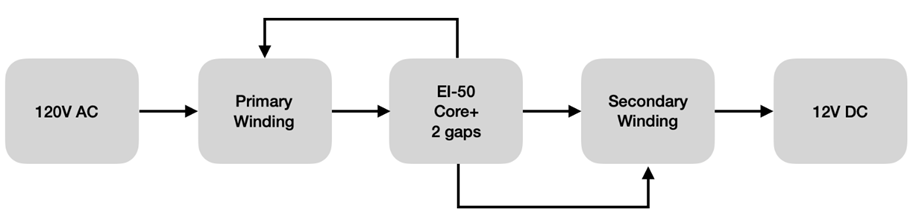
Figure 2 provides a depiction of the core design, highlighting the structural aspects of the magnetic biosensor. The electrical parameters of the biosensor play a crucial role in determining its overall performance and efficiency. To cater to the specified input voltage of 120V AC and output voltage of 12V AC, considerations include core dimensions, winding configuration, and magnetic properties of the ferrofluid.
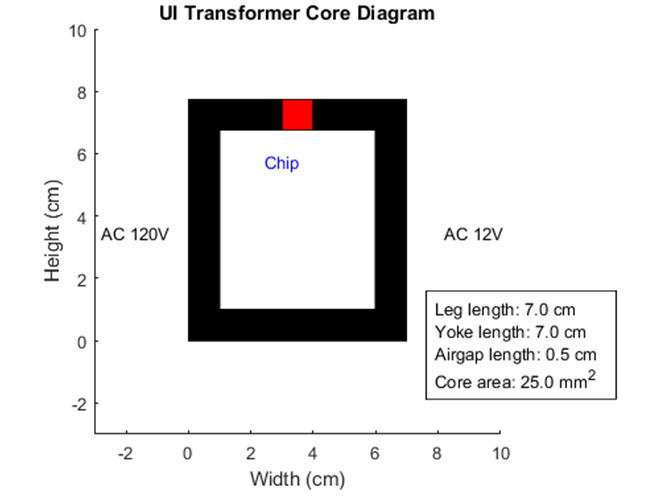
The turns ratio (N1/N2) is a critical element in the design, representing the relationship between the number of turns in the primary winding (N1) and the secondary winding (N2). In this study, the magnetic biosensor employs a turns ratio of 10:1, facilitating efficient energy transfer between the primary and secondary windings while meeting voltage specifications.
Crafted from laminated silicon steel, the core exhibits excellent magnetic properties and minimal core losses, aligning with the requirements of magnetic biosensors. The core dimensions include an average magnetic length of 7 cm for both the right and left legs, as well as the upper and lower yokes. The upper yoke, divided by the air gap situated in its middle, boasts an average magnetic length of 5 mm. The sectional area of both the air gap and the core is 25 mm2, a pivotal parameter influencing the magnetic properties and overall performance of the biosensor. These dimensions, encompassing legs, yokes, and air gaps, optimize the magnetic path, ensuring an efficient flow of magnetic flux through the core between the primary and secondary windings.
Two distinct ferrofluids, magnetite (Fe3O4) and Cobalt ferrite (CoFe2O4), are investigated for the air gap. The analysis focuses on the change in permeability as evidenced by the induced voltage in the secondary, providing insights into the impact of these ferrofluids on the biosensor’s performance.
The electrical parameters of the magnetic biosensor are pivotal for its overall efficacy. Input and output voltages, turns ratio, winding wire thickness, operating frequency, and core material and dimensions collectively contribute to the biosensor’s functionality. A meticulous consideration and optimization of these factors are imperative to meet specific application requirements. The design and analysis of the biosensor were conducted within a MATLAB environment.
Permeability Variations in Magnetic Biosensors
In the design of the magnetic biosensor, the air gap is filled with a highly porous aluminium or copper foam chip. This chip serves as a substrate for biological samples, such as proteins or DNA, which are bonded with paramagnetic nanoparticles, such as Magnetite (Fe3O4) or Cobalt ferrite (CoFe2O4). The purpose is to ascertain the presence of relevant biological molecules. These materials enable the analysis of the sample’s magnetic properties and the exploration of changes in permeability in response to the existence of biological molecules, offering a means for biomolecule detection.
The Utilization of High-Permeability Ferro fluids in Filling the Air Gap Serves Several Crucial Functions
Enhanced Magnetic Properties: The use of ferrofluids with higher magnetic permeability enhances magnetic properties, leading to improved coupling between the primary and secondary windings of the magnetic biosensor, resulting in enhanced performance.
Tunable Permeability: Selection of different Ferro fluids with varying magnetic permeabilities enables the tuning of fluid permeability, optimizing the biosensor’s performance.
Reduced Fringing Losses: Filling the air gap with ferrofluid aids in minimizing fringing losses in the magnetic field, preventing deviations from the intended path between the primary and secondary windings.
Improved Heat Dissipation: Ferrofluids contribute to efficient heat dissipation in the biosensor’s core by facilitating the transport of heat away from the core more effectively than air.
The incorporation of a high-permeability ferrofluid in the air gap enhances the overall performance of the magnetic biosensor by improving magnetic properties, tuning permeability, reducing fringing losses, and aiding in heat dissipation. The primary objective is to develop a device capable of biomolecule identification through magnetic biosensors by analyzing variations in permeability.
The MATLAB simulation results for the magnetic biosensor, designed to measure the output-induced voltage over time, are presented. The biosensor’s performance is assessed in four scenarios: no air gap, air gap filled with air, air gap filled with Magnetite (Fe3O4) Ferrofluid, and air gap filled with Cobalt ferrite (CoFe2O4) Ferrofluid. These scenarios were chosen to investigate the biosensor’s potential in detecting biomolecules based on variations in the output-induced voltage.
Results and Discussion
In Figure 3, the simulation outcomes illustrate distinct output voltage characteristics for each scenario. The black curve, representing the no air gap case, shows the highest output voltage, aligning with the ideal 12V output when the input voltage is 120V and the turns ratio is 10:1. This result highlights optimal core performance in the absence of an air gap.
The blue curve, corresponding to the air gap filled with air, exhibits a significant decrease in output voltage due to heightened reluctance in the magnetic circuit. Air, having lower permeability than the laminated iron core material, contributes to increased reluctance.
Conversely, when the air gap is filled with ferrofluid materials, the output voltage rises compared to the air gap with air. The green curve represents the Magnetite (Fe3O4)
Ferrofluid case, while the red curve represents the Cobalt ferrite (CoFe2O4) Ferrofluid case. Both curves demonstrate higher output voltage levels than the air gap alone, indicating that ferrofluids with increased permeability enhance the biosensor’s performance. The red curve (Cobalt ferrite (CoFe2O4) Ferrofluid) exhibits higher output voltage than the green curve (Magnetite (Fe3O4) Ferrofluid) due to its superior permeability, emphasizing the impact of ferrofluid permeability on output voltage.
These results imply that the choice of nanoparticle materials for binding to biological molecules significantly influences the magnetic biosensor’s performance by improving their sensitivity and specificity in detecting biological molecules [10, 11]. The distinct output voltage levels obtained for different ferrofluid materials suggest the potential for developing magnetic biosensors capable of biomolelcule detection based on output-induced voltage changes. Tailoring the air gap materials and employing ferrofluids with varying permeabilities could enable magnetic biosensors to differentiate between molecules, offering valuable insights for diagnostic applications and resulting in a more effective biosensor with unique output- induced voltage values.
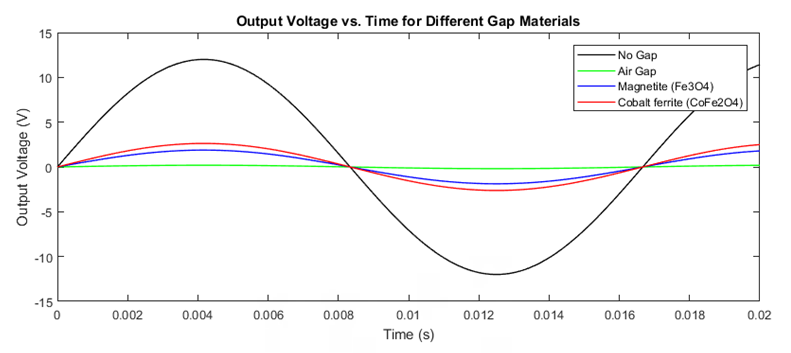
Figure 3 vividly illustrates the substantial enhancements in the magnetic properties and overall performance of the magnetic biosensor achieved through the utilization of Ferro fluids. The observed changes in the output signal highlight the positive correlation between permeability and output-induced voltage. Furthermore, the marked differences in output- induced voltage among the various materials underscore the critical importance of optimizing the magnetic properties of the Ferro fluid mixture to achieve superior performance in magnetic biosensor applications. These findings emphasize the potential for fine-tuning Ferro fluid compositions to maximize the biosensor’s effectiveness and sensitivity.
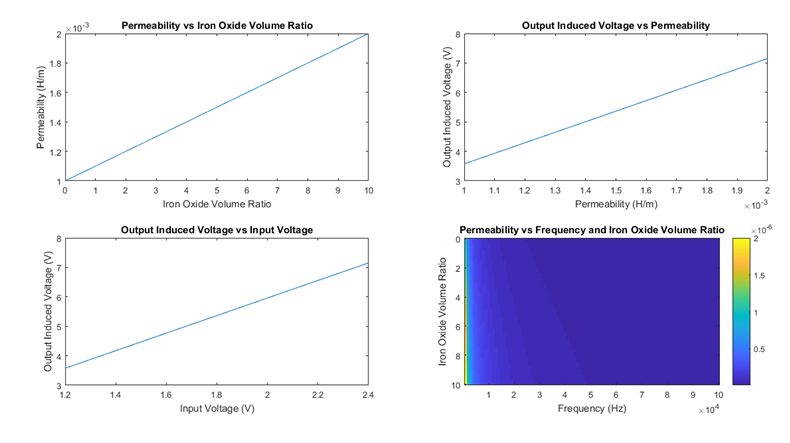
In recent modeling endeavors, magnetite (Fe3O4) and Cobalt ferrite (CoFe2O4) were examined. Prior studies suggested the use of these ferrofluids as nanoparticles that significantly enhance biosensor performance due to their distinct structural and magnetic properties [12, 13, 14, 15]. Moreover in current modeling the influence of varying the ratio of magnetite (Fe3O4) or Cobalt ferrite (CoFe2O4) in the ferrofluid on the permeability of the mixture is evident. As anticipated, the permeability increases with a higher concentration of these materials in the ferrofluid, given their superior magnetic permeability compared to air. This enhancement in magnetic properties contributes to increased permeability of the air gap, as visually depicted in Figure 4.
Figure 4 demonstrates a direct proportionality between the output-induced voltage and the permeability of the material filling the air gap when Magnetite (Fe3O4) or Cobalt ferrite (CoFe2O4) ferrofluid is used. The elevated permeability facilitates improved magnetic coupling between the primary and secondary windings of the magnetic biosensor, resulting in a higher induced voltage at the secondary winding. In contrast, the air-filled air gap, characterized by constant permeability, exhibits a lower output-induced voltage [16, 17]. These findings support the idea that materials with elevated permeability, like those influenced by low-frequency magnetic fields, can enhance magnetic coupling and induce higher voltages in biosensors compared to air-filled air gaps with constant permeability.
The relationship between the output-induced voltage, input voltage, and material permeability is highlighted in Figure 4 align with Faraday’s law [18]. Increasing the input voltage or permeability correlates with a higher output- induced voltage, underscoring the significance of optimizing the magnetic properties of the materials for enhanced performance.
While this simulation maintains a constant input frequency, it is crucial to acknowledge the dependence of the output-induced voltage on the input frequency, as seen in Figure 4. Generally, higher input frequencies tend to yield higher output-induced voltages. However, this relationship may not be linear and could vary based on the specific properties of the materials employed. Figure 4 showcases that incorporating Magnetite (Fe3O4) or Cobalt ferrite (CoFe2O4) Ferro fluid in the air gap substantially elevates its magnetic permeability. This heightened permeability directly influences the magnetic biosensor’s performance, exemplified by the increased output-induced voltage when using materials with superior permeability.
Integrating materials with enhanced magnetic permeability, such as Magnetite (Fe3O4) or Cobalt ferrite (CoFe2O4) Ferro fluids, holds significant potential for improving magnetic biosensor applications. By strategically selecting materials for the air gap, achieving a higher output-induced voltage becomes feasible, a critical factor for the effective functioning of magnetic biosensors. Further exploration may involve investigating the effects of different particle sizes, shapes, and concentrations of these materials on magnetic properties and biosensor performance.
Conclusion
The magnetic biosensor design outlined in this study holds promise for advancing molecular biology and medical diagnostics. The innovative incorporation of materials with superior magnetic permeability, such as Magnetite (Fe3O4) or Cobalt ferrite (CoFe2O4) Ferro fluids, in the air gap represents a pioneering approach to enhancing the performance and magnetic characteristics of magnetic biosensors. Future research endeavors should continue to explore the optimization of particle sizes, shapes, and concentrations, along with the integration of additional sensing modalities, to further enhance the capabilities of magnetic biosensors for diverse applications, particularly in Biomolecule detection.
References
-
Rajagopalan V, Venkataraman S, Rajendran DS, Vinod KV, Vasanth KV, et al. (2023) Acetylcholinesterase biosensors for electrochemical detection of neurotoxic pesticides and acetylcholine neurotransmitter: A literature review. Environmental Research 227: 115724.
-
Kulkarni MB, Ayachit NH, Aminabhavi TM (2023) A Short Review on Miniaturized Biosensors for the Detection of Nucleic Acid Biomarkers. Biosensors 13(3): 412.
-
Husseini AA, Derakhshandeh M, Tatlisu NB (2022) Comprehensive Review of Transcriptomics (RNAs) Workflows from Blood Specimens. Separation & Purification Reviews 51(1): 57-77.
-
He Q, Wang B, Liang J, Liu J, Liang B, et al. (2023) Research on the construction of portable electrochemical sensors for environmental compounds quality monitoring. Materialstoday Advances 17: 100340.
-
Singh AK, Mittal S, Das M, Saharia A, Tiwari M (2023) Optical biosensors: a decade in review. Alexandria Engineering Journal 67: 673-691.
-
Bolognesi M, Prosa M, Toerker M, Sanchez LL, Wieczorek M, et al. (2023) A Fully Integrated Miniaturized Optical Biosensor for Fast and Multiplexing Plasmonic Detection of High‐ and Low‐Molecular‐Weight Analytes. Advanced Materials 35(26): 2208719.
-
Grau J, Moreno-Guzman M, Arruza L, Lopez MA, Escarpa A, et al. (2023) Analysis of microsamples by miniaturized magnetic-based pipette tip microextraction: determination of free cortisol in serum and urine from very low birth weight preterm newborns. Analyst 148: 1050-1057.
-
Stroble JK, Stone RB, Watkins SE (2009) An overview of biomimetic sensor technology. Sensor Review 29(2): 112-119.
-
Chapman SJ (2005) Electric Machinery Fundamentals. 4th (Edn.), McGraw-Hill Companies, New york, USA.
-
Carinelli S, Luis-Sunga M, Gonzalez-Mora JL, Salazar- Carballo PA (2023) Synthesis and Modification of Magnetic Nanoparticles for Biosensing and Bioassay Applications: A Review. Chemosensors 11(10): 533.
-
Shao H, Yoon T-J, Liong M, Weissleder R, Lee H (2010) Magnetic nanoparticles for biomedical NMR-based diagnostics. Beilstein journal of nanotechnology 1: 142- 54.
-
Tripathy A, Nine MJ, Silva FS (2021) Biosensing platform on ferrite magnetic nanoparticles: Synthesis, functionalization, mechanism and applications. Advances in Colloid Interface Sciences 290: 102380.
-
Darwish MSA, Kim H, Lee H, Ryu C, Lee JY, et al. (2020) Engineering Core-Shell Structures of Magnetic Ferrite Nanoparticles for High Hyperthermia Performance. Nanomaterials 10(5): 991.
-
Alzoubi GM (2022) The Effect of Co-Doping on the Structural and Magnetic Properties of Single- Domain Crystalline Copper Ferrite Nanoparticles. Magnetochemistry 8(12): 164.
-
Zhuravlev VA, Minin RV, Itin VI, Lilenko IY (2017) Structural parameters and magnetic properties of copper ferrite nanopowders obtained by the sol-gel combustion. Journal of Alloys Compounds 692: 705-712.
-
Starodubtsev YN, Tsepelev VS, Belozerov VYa, Zelenin VA (2022) Permeability of Magnetic Cores with Air Gaps. Materials 15(3): 1217.
-
Burmistrov IA, Veselov MM, Mikheev A V, Borodina TN, Bukreeva TV, et al. (2021) Permeability of the Composite Magnetic Microcapsules Triggered by a Non-Heating Low-Frequency Magnetic Field. Pharmaceutics 14: 65.
-
Hartel H (2018) Electromagnetic Induction from a New Perspective. European Journal of Physics Education 9(2): 29-36.
- The Expanding Landscape of Road Rage: A Systematic Review of Conflicts Involving Drivers, Pedestrians, and Micromobility
- Validating Cognitive Models of Royal Navy Performance on Control Systems
- Comparing Standard and State-of-the-art Firefighter Coats on Postural Balance and Gait in a Live Burn Environment
- Investigating the Integration of Telemedicine into Clinicians Workflow: A Review of Methods
- Risk Assessment of Ergonomic Factors in a Textile Firm by RULA, REBA and Fine Kinney Methods
- Impact of Self-Esteem Training on Individuals with Disabilities Aged 17-30