
Changes in Loc285758 Expression in Response to Cytarabine- Based Treatment in Patients with Acute Myeloid Leukemia
Long non-coding RNAs are non-coding RNAs, which contribute to different biological processes. The expression of these RNAs alters in various diseases. This study aimed to compare the expression of long non-coding RNA genes in newly diagnosed patients with de novo acute myeloid leukemia and to evaluate their response to cytarabine-based treatment. In this cross-sectional study, approved by the Ethics Committee of Shiraz University of Medical Sciences (Shiraz, Iran), the expression of LOC285758, IRAIN, and HOTAIR was examined in de novo AML patients at Namazi Teaching Hospital during 2019-2020. The patients, treated with standard regimens, were compared with the controls, using quantitative real timepolymerase chain reaction assay. After whole blood samples were collected from the subjects, total RNA was extracted by Trizol reagent from whole blood. Next, cDNA was synthesized, and the expression levels of LOC285758, HOTAIR, and IRAIN were analyzed by RT-PCR assay, using SYBER Green Master Mix and 2-ΔΔCt method. The results showed that the expression of LOC285758 was significantly upregulated in AML patients, compared to the controls (P< 0.001). After complete remission, the expression of LOC285758 was re-evaluated in patients. It was found that LOC285758 was significantly downregulated in de novo AML patients (P=0.001). The expression of HOTAIR, similar to IRAIN, did not change in de novo AML patients, whereas it was downregulated in patients with complete remission, compared to the controls. The present findings indicated that LOC285758 could discriminate AML patients from the healthy controls and indicate the patients’ response to treatment.
Introduction
Acute myeloid leukemia (AML) is a type of blood cancer, which affects the blood and bone marrow. The incidence of AML increases with aging, and it is most commonly found in the elderly with an average age of 65 years. Although it is a very rare condition in young people, it accounts for almost 15-20% of childhood leukemia [1]. Accurate assessment of disease prognosis plays a critical role in the treatment of AML patients, as the prognostic factors can help clinicians determine the dose and type of treatment [2]. Generally, in AML, the main purpose of treatment is to induce remission and prevent relapse [3].
Long non-coding RNAs (lncRNAs) are a group of non- coding RNAs, which have been known as major epigenetic regulators over the past 11 years. These molecules, which are ≥200 nucleotides in length, can communicate with other molecules and influence the epigenetic process [4, 5]. Although they can be found in both the nucleus and the cytoplasm, they are more common in the nucleus [6, 7]. Evidence shows that the mean expression levels of lncRNAs and mRNAs are significantly different, and it is difficult to detect most lncRNAs [8]. Studies on the expression pattern of RNAs in malignancies have shown that the expression pattern of lncRNAs changes due to malignancies and may affect the process of malignancy in different ways [9].
Various lncRNAs have been detected in cancer cells [10, 11]. Unlike other non-coding RNAs, lncRNAs have the capacity to communicate with proteins, RNAs, and DNA. Research shows that lncRNAs are involved in different phases of the cell cycle. These molecules participate in the cell cycle, metabolism, differentiation, and apoptosis, and some evidence suggests that they contribute to malignancies through these activities [11, 12]. LOC285758 controls proliferation of leukemia cell clones by increasing the expression of HDAC2. LOC285758 has been shown to be associated with an aggressive status and a poor prognosis of AML [12, 13].
Therefore, this study aimed to compare the expression of lncRNA genes in newly diagnosed patients with de novo AML and to evaluate their response to cytarabine-based treatment.
Materials and Methods
Study Samples
This cross-sectional study was performed at Shiraz University of Medical Sciences, Shiraz, Iran, during 2019- 2020 and was approved by the Ethics Committee of Shiraz University of Medical Sciences (IR.SUMS.REC.1397.085). In this study, 30 new AML patients were enrolled. The inclusion criteria were based on clinical and laboratory finding, which was confirmed by a hematologist. Also, 15 volunteer, sex and age matched, were used as healthy controls in this study. The control group did not have any disease or malignancy (Table 1). Informed consent was obtained from all participants in this study. This study was carried out according to the principles of the Declaration of Helsinki. The de novo AML patients were diagnosed at the Hematology Department of Namazi Hospital, affiliated to Shiraz University of Medical Sciences, and treated with a standard regimen, 7days Cytarabin 100/ mg/m2 and 3 days Danorobicine 45mg/m2, during 2019- 2020. The criteria of remission were: blasts no more than 5% of the bone marrow and absent blast in peripheral blood smear. Moreover, a control group was recruited, consisting of healthy individuals, without any malignancies or other diseases, such as genetic syndromes and metabolic disorders. Peripheral blood samples (5 mL whole blood) were collected in an EDTA tube. In this study, written informed consent was obtained from the subjects, and their complete personal and familial history was documented.
Total RNA was extracted from whole blood, using TRIzol reagent (Invitrogen, USA). 500 μl of whole blood were placed in 2 ml free RNase tubes and proteins were digested by using 10 μl of proteinase K (Invitrogen) and 190μl of Tris - EDTA buffer (Tris-Cl 100mM, EDTA 50mM, NaCl500mM). TRizol and chloroform were used to separate total RNA and precipitated by 100% ethanol at -20 °C. After centrifugation Supernatant was removed and RNA pellet was air dried and eluted with 30μl of DEPC treated water. RNA quality was assessed taking into account 260/280 ratio and 260/230 ratio by NanoDrop 2000 instrument (Hellma, NY, USA) and aliquots of samples were stored at -80˚C. To synthesize single-stranded cDNA, 0.4 μg of RNA was reverse-transcribed, using a cDNA synthesis kit (Thermo Fisher Scientific, USA), according to the manufacturer’s instructions. Also, Allele ID 7 (Premier Biosoft, Palo Alto, USA) was used to design specific primers. The β-Actin gene was used as the housekeeping gene to normalize the gene expression of each sample.
Moreover, qRT-PCR assay was carried out in duplicate on an ABI system (Applied Biosystems, USA), and SYBR Green Master Mix (Takara, Japan) was used as a double-stranded DNA-specific dye. The qRT-PCR assay was run under the following conditions: Initial denaturation at 95˚C for five minutes, followed by 40 cycles of 95˚C for five seconds, 63˚C for 20 seconds, and 72˚C for 30 seconds. All qRT-PCR assays were performed in triplicate. The used primers are listed in Table 1. After normalizing the data according to the expression of β-Actin mRNA, the expression levels of lncRNAs was calculated, based on the 2-∆∆CT method.
| Sequences | Forward/Reverse | Gene | |
|---|---|---|---|
| 208 | 5'-TTCAGAGTCAGTTGTATA-3' | Forward | IRAIN |
| 208 | 5'-AATTCTTCATGTGTAGTG-3' | Reverse | IRAIN |
| 151 | 5'-ACATAGGAGAACACTTAA-3' | Forward | HOTAIR |
| 151 | 5'-CAATCTTAATAGCAGGAG-3' | Reverse | HOTAIR |
| 240 | 5'-ATTGGTCACTGTATTAAG-3' | Forward | LOC285758 |
| 240 | 5'-TGCTGATAGTAGATAAGT-3' | Reverse | LOC285758 |
| 177 | 5'-TCGTGCGTGACATTAAGGAG-3' | Forward | δ-actin |
| 177 | 5'-GAAGGAAGGCTGGAAGAGTG-3' | Reverse | δ-actin |
Table 1: The Primers used in reverse transcription-quantitative polymerase chain reaction.
Statistical Analysis
The collected data were analyzed, using independent samples t-test, paired t-test, and Mann-Whitney test to examine differences between the three groups. Also, one- way ANOVA and Pearson’s correlation coefficient tests were used to evaluate and compare the groups and determine the correlations between variables. P-value <0.05 was considered statistically significant. Data analysis was performed in SPSS version 25 (Chicago, IL, USA).
Results
Clinical Data
In this study, a total of 30 de novo AML patients, including 16 females and 14 males with the mean age of 50.80±15.77 years, were evaluated. Seventeen out of 30 AML patients, including ten females and seven males with the mean age of 52.35±16.59 years, showed CR (Table 2).
| Variables | AML patients | Healthy Controls | P.value |
|---|---|---|---|
| Parameter (median, range) | |||
| Gender (Female/Male) | 16/14 | 7-Aug | |
| Age (mean ± SD) | 50.8 ± 15.8 | 45 ± 17.28 | 0.8 |
| WBC (mean ± SD, ×103) | 24.73 ± 38.24 | 6.55 ± 1.01 | <0.001 |
| Platelet (mean ± SD, ×103) | 61.47 ± 58.81 | 252.2 ± 40.11 | <0.01 |
| Hemoglobin (mean ± SD, g/dl) | 8.39 ± 1.59 | 14.81 ± 1.23 | <0.01 |
| RBC (mean ± SD, ×106) | 2.81 ± 0.64 | 5.17 ± 0.54 | <0.01 |
| FAB classification: (no.) | 30 | ||
| M0 | 1 | ||
| M1 | 1 | ||
| M2 | 8 | ||
| M3 | 7 | ||
| M4 | 11 | ||
| M5 | 2 |
Table 2: Clinical information of patients and healthy controls.
Expression levels of IRAIN and HOTAIR Before and After Treatment in de novo
AML patients
The expression levels of IRAIN and HOTAIR were investigated in de novo AML patients and then compared with the healthy controls and AML-CR patients by use of the 2-∆∆CT method. Based on the results, the expression level of IRAIN did not change significantly before and after treatment (P=0.98 and P=0.46, respectively. The level of HOTAIR did not change significantly in de novo AML patients (P=0.54), whereas in AML-CR patients, the expression level of HOTAIR
changed significantly (P=0.01) (Figure 1).
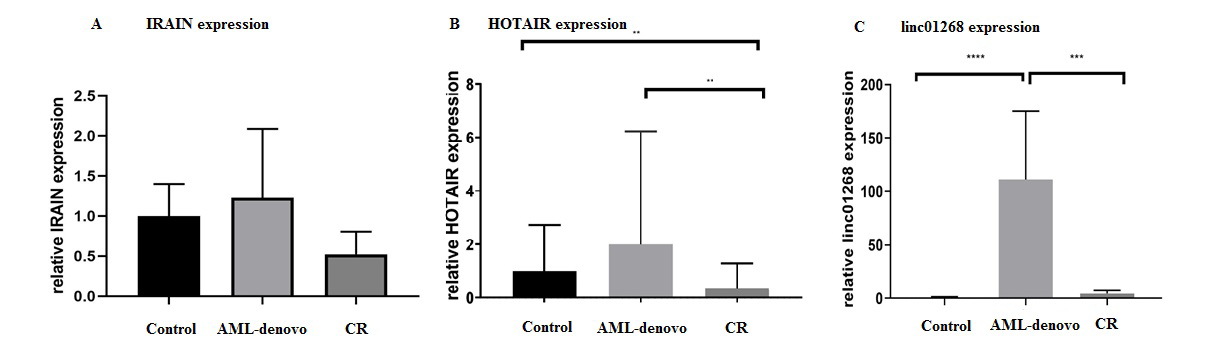
Figure 1: Comparison expression of IRAIN, HOTAIR and LOC285758 (linc01268) in different groups of AML-de novo, CR and control. The Mean ± SD was used to define the data. A. The expression level of IRAIN did not change significantly before and after treatment P=0.98 and P=0.46, respectively. B. The analysis showed HOTAIR did not change significantly in de novo AML patients (P=0.54), whereas in AML to CR patients, the expression changed significantly (P=0.01). C. Relative expression of LOC285758 in AML-de novo was significantly more than the controls and CR, P .value: < 0.001, and P .value: = 0. 01, respectively. Note: P<0.01, * P<0.001.
LOC285758 up Regulation in AML Patients
The expression of LOC285758 (linc01268), normalized to β-actin expression, was assessed using qRT-PCR assay in 30 de novo AML patients, 17 AML-CR patients, and healthy controls. The expression level of LOC285758 was upregulated in de novo AML patients, compared to the healthy controls (P<0.001). The results showed that the expression of LOC285758 was downregulated in AML- CR patients, compared to de novo AML patients (P<0.001) (Figure 1).
Correlations between LOC285758 Expression and Other Clinicopathological Features
Since the upregulation of LOC285758 is important in clinical conditions, the correlation between LOC285758 expression and other clinical features was investigated in de novo AML patients. The mean±SD of ∆CT was 8.73±1.99 in males and 12.94±3.89 in females, and the correlation between the expression level of LOC285758 and gender was found to be significant (P=0.001) (Table 3). It was more expression in males to females. Also, no relationship was found between the expression of these three and CD 34.
| IRAIN | LOC285758 | |
|---|---|---|
| IRAIN | ||
| Pearson correlation | 1 | 0.559** |
| Sig.(2-tailed) | 0.001 | |
| HOTAIR | ||
| Pearson correlation | 0.499** | 0.512** |
| Sig.(2-tailed) | 0.005 | 0.004 |
| LOC285758 | ||
| Pearson correlation | 0.559** | 1 |
| Sig.(2-tailed) | 0.001 | |
| Hb | ||
| Pearson correlation | 0.176 | 0.539** |
| Sig.(2-tailed) | 0.352 | 0.014 |
| RBC | ||
| Pearson correlation | 0.229 | 0.24 |
| Sig.(2-tailed) | 0.224 | 0.201 |
| WBC | ||
| Pearson correlation | 0.178 | -0.141 |
| Sig.(2-tailed) | 0.347 | 0.457 |
| Platelet | ||
| Pearson correlation | -0.012 | 0.149 |
| Sig.(2-tailed) | 0.949 | 0.43 |
| Age | ||
| Pearson correlation | 0.168 | -0.032 |
| Sig.(2-tailed) | 0.376 | 0.869 |
| ** correlation is significant at the 0.01 level(2-tailed) Hb: Hemoglobin |
Table 3: Correlation between IRAIN, HOTAIR, LOC285758 and clinicopathology finding.
Discussion
In This cross-sectional study enrolled 30 de novo AML patients and 15 healthy controls. We measured the expression of lncRNA genes in newly diagnosed patients and compared their responses to cytarabine-based therapy. Among the lncRNAs studied, the expression of HOTAIR and IRAIN did not changed in de novo AML patients compared to control but, the LOC285758 expression was upregulated in AML patients, and it was downregulated following cytarabine-based treatment.
According to the results of previous studies on lncRNAs, these RNAs play an important role in the regulation of cell proliferation, differentiation, and apoptosis [14]. Although many studies on hematological malignancies have focused on lncRNAs, not all lncRNAs have been investigated in leukemia. Investigation of AML cell lines showed that IRAIN is located in the insulin-like growth factor 1 receptor (IGF1R) locus and that its transcriptions can interact with DNA. It is known that genes in the IGF1R locus contribute to cell proliferation, survival, metabolism, and metastasis. Studies of AML cell lines revealed that IRAIN expression was downregulated in these cell lines [15]. In this regard, evaluation of AML patients indicated the downregulation of IRAIN. It was also found that the expression of this RNA is downregulated in patients with a poor prognosis; therefore, IRAIN downregulation is correlated with a poor prognosis [15, 16].
Many studies have focused on HOTAIR expression in AML patients. All studies, except for one from Iran, reported the upregulation of this lncRNA in AML patients. The upregulation of HOTAIR is correlated with an increase in the proliferation and risk of disease, and consequently, a poor prognosis. Besides, studies of AML cell lines indicated that HOTAIR inhibition is effective in apoptosis induction and reduction of cell proliferation [17, 18]. Moreover, analysis of AML cell lines showed that HOTAIR could serve as a sponge for miR-193a. This miRNA contributes to apoptosis induction and prevention of cell proliferation by controlling CD117 (cKit) [19]. Also, HOTAIR functions as a chromatin modifier through polycomb repressive complex-2 (PRC2); therefore, it can contribute to AML in different ways [20]. In a previous study from Iran on AML patients, HOTAIR expression was not significantly different between these patients and the healthy controls. However, considering the importance of HOTAIR as a biomarker, researchers have recommended further investigations on Iranian patients [21].
According to studies conducted on lncRNAs in AML patients, LOC285758 was found to be upregulated, and its expression was inversely correlated with the promoter methylation rate; a similar finding was also reported in gliomas [22, 23, 24]. This lncRNA is located in the upstream of histone deacetylase 2 (HDAC2) locus. Besides, in a study on AML patients, an increase in the expression of either HDAC2 or LOC285758 caused an increase in the expression of the other RNA, as inhibiting each of these RNAs would increase apoptosis and decrease cell proliferation [23]. Therefore, LOC285758 upregulation is correlated with a poor prognosis in patients, which is also related to the severity of glioma [22, 23]. Myristoylated alanine-rich C-kinase substrate (MARCKS) is another gene in close proximity to the LOC285758 locus. MARCKS and HDAC2 contribute to cell proliferation, although the correlation between LOC285758 and MARCKS is not clear [22, 23]. Studies have shown that LOC285758 can affect neighboring genes and act as a promoter of lncRNA [23].
In the current study, the expression levels of IRAIN, HOTAIR, and LOC285758 were examined before treatment in 30 AML patients, including 17 AML-CR patients, using qRT- PCR assay. The HOTAIR expression was compared between AML patients and the healthy controls before treatment, but the difference was not significant (P=0.54); this result is in line with an earlier study on Iranian AML patients. Moreover, analysis of HOTAIR expression in AML-CR patients showed that HOTAIR expression was reduced by standard treatment of AML (P=0.01). This finding confirms the results of previous research, which examined the effects of therapeutic drugs on HOTAIR expression in AML patients (Figure 1) [17].
The results of the present study showed that the expression of LOC285758 significantly changed in AML patients before treatment, compared to the healthy controls (P<0.001). However, the expression of HOTAIR did not change in Iranian AML patients before treatment; therefore, it is possible to use LOC285758 instead of HOTAIR as a biomarker for diagnosis and treatment of AML. Moreover, analysis of the correlation between LOC285758 expression and gender showed that LOC285758 expression in male AML patients was higher than that of females; this result confirms the higher prevalence of AML in males [1]. Also, analysis of LOC285758 expression in AML-CR patients showed that LOC285758 expression was reduced by standard treatment of AML (P<0.001). Since LOC285758 causes epigenetic changes through HDAC2, use of epigenetic drugs seems to be useful in the treatment of these patients.
Unlike a previous study on Iranian AML patients, the expression of IRAIN before treatment was not significantly different between AML-CR patients and healthy controls. Considering the importance of IRAIN in disease prognosis and its role as a biomarker of diagnosis and treatment, further research is recommended on AML patients in southern Iran to confirm the present results. Overall, the current study showed that the expression of IRAIN did not change in de novo AML patients and AML-CR patients.
In the present study, HOTAIR expression did not change significantly in de novo AML patients. This finding contradicts previous studies conducted in other countries, while it is consistent with the results of a previous study on Iranian patients. Also, evaluation of HOTAIR expression in AML-CR patients showed that it was downregulated by treatment. Besides, the expression of LOC285758 was examined in de novo AML patients and AML-CR patients, and it was found that LOC285758 expression was upregulated in de novo AML patients, compared to the controls. Overall, the current results indicated LOC285758 downregulation in AML-CR patients following treatment, compared to the AML patients and the healthy controls. This study also had some limitation. For example, although all AML patients, treated with cytarabine, were included in this study, the cytogenetic status and other genetic mutations were not examined in patients, which is the main limitation of this study.
Conclusion
In this study, the expression of IRAIN did not change significantly in de novo AML and AML-CR patients; also, the expression of HOTAIR in de novo AML patients did not significantly change. Evaluation of HOTAIR expression in AML-CR patients showed its downregulation by treatment. Also, LOC285758 expression was examined in de novo AML and AML-CR patients, and it was found that LOC285758 expression was upregulated in de novo AML patients, compared to the controls. However, it was downregulated following treatment in AML-CR patients, compared to the de novo AML patients and the healthy controls.
References
-
Döhner H, Weisdorf DJ, Bloomfield CD (2015) Acute Myeloid Leukemia. N Engl J Med 373(12): 1136-1152. **2.** Tandel P, Ranjbaran R, Ebrahimi E, Rezvan A, Ramzi Mani, et al. (2022) Decreased expression of autophagy- related genes in the complete remission phase of acute myeloid leukemia. Molecular Genetic and Genomic Medicine (10)3.
-
Zahedipour F, Ranjbaran R, Behzad Behbahani A, Afshari KT, Okhovat MA, et al. (2017) Development of Flow Cytometry-Fluorescent in Situ Hybridization (Flow- FISH) Method for Detection of PML/RARa Chromosomal Translocation in Acute Promyelocytic Leukemia Cell Line. Avicenna J Med Biotechnol 9(2): 104-108.
-
Betancur JG (2016) Pervasive lncRNA binding by epigenetic modifying complexes--The challenges ahead Biochimica et biophysica acta 1859(1): 93-101.
-
Forrest ME, Khalil AM (2017) Review: Regulation of the cancer epigenome by long non- coding RNAs. Cancer Lett 407: 106-112.
-
Iwakiri J, Hamada M, Asai K (2016) Bioinformatics tools for lncRNA research. Biochim biophysica acta 1859(1): 23-30.
-
Kazemzadeh M, Safaralizadeh R, Orang AV (2015) LncRNAs: emerging players in gene regulation and disease pathogenesis. Journal of genetics 94(4): 771- 784.
-
Nakagawa S, Kageyama Y (2014) Nuclear lncRNAs as epigenetic regulators-beyond skepticism. Biochimica et biophysica acta 1839(3): 215-222.
-
Isin M, Dalay N (2015) LncRNAs and neoplasia. Clinica chimica acta 444: 280-288.
-
Zhang F, Zhang L, Zhang C (2016) Long noncoding RNAs and tumorigenesis: genetic associations, molecular mechanisms, and therapeutic strategies. Tumour boil 37(1): 163-175.
-
Jain S, Thakkar N, Chhatai J, Pal Bhadra M, Bhadra U (2017) Long non-coding RNA: Functional agent for disease traits. RNA biology 14(5): 522-535.
-
Xue F, Che H (2020) The long non-coding RNA LOC285758 promotes invasion of acute myeloid leukemia cells by down-regulating miR-204-5p. FEBS Open Bio 10(5): 734-743.
-
Wang FY, Gu ZY, Gao CJ (2020) Emerging role of long non-coding RNAs in normal and malignant hematopoiesis. Chin Med J (Engl) 133(4): 462-473.
-
Liu Y, Cheng Z, Pang Y, Cui L, Qian T, et al. (2019) Role of microRNAs, circRNAs and long noncoding RNAs in acute myeloid leukemia. J ournal of hematology & oncology 12(1): 51.
-
Sun J, Li W, Sun Y,Yu D, Wen X, et al. (2014) A novel antisense long noncoding RNA within the IGF1R gene locus is imprinted in hematopoietic malignancies. Nucleic acids research 42(15): 9588-9601.
-
Pashaiefar H, Izadifard M, Yaghmaie M, Montazeri M, Gheisari E, et al. (2017) Low Expression of Long Noncoding RNA IRAIN Is Associated with Poor Prognosis in Non-M3 Acute Myeloid Leukemia Patients. Genetic testing and molecular biomarkers 22(5): 288-294.
-
Hao S, Shao Z (2015) HOTAIR is upregulated in acute myeloid leukemia and that indicates a poor prognosis. International journal of clinical and experimental pathology 8(6): 7223-7228.
-
Wang SL, Huang Y, Su R, Yu YY (2019) Silencing long non-coding RNA HOTAIR exerts anti-oncogenic effect on human acute myeloid leukemia via demethylation of HOXA5 by inhibiting Dnmt3b. Cancer Cell Int 19: 114.
-
Xing CY, Hu XQ, Xie FY, Yu ZJ, Li HY, et al. (2015) Long non-coding RNA HOTAIR modulates c-KIT expression through sponging miR-193a in acute myeloid leukemia. FEBS Lett 589(15): 1981-1987.
-
Bhan A, Mandal SS (2015) LncRNA HOTAIR: A master regulator of chromatin dynamics and cancer. Biochimica et biophysica acta 1856(1): 151-164.
-
Sayad A, Hajifathali A, Hamidieh AA, Roshandel E, Taheri M (2017) HOTAIR Long Noncoding RNA is not a Biomarker for Acute Myeloid Leukemia (AML) in Iranian Patients. Asian Pacific journal of cancer prevention 18(6): 1581-1584.
-
Matjasic A, Popovic M, Matos B, Glavac D (2017) Expression of LOC285758, a Potential Long Non-coding Biomarker, is Methylation-dependent and Correlates with Glioma Malignancy Grade. Radiology and oncology 51(3): 331-341.
-
Lei L, Xia S, Liu D, Li X, Feng J, et al. (2018) Genome-wide characterization of lncRNAs in acute myeloid leukemia. Briefings in bioinformatics 19(4): 627-635.
-
Wang F, Tian X, Zhou J, Wang G, Yu W, et al. (2018) A three lncRNA signature for prognosis prediction of acute myeloid leukemia in patients. Molecular medicine reports 18(2): 1473-1484.
- How to Identify and Overcome Barriers in Developing Blood Systems?
- Why Was Transfusion Medicine Not Recognized as a Clinical Discipline?
- Outcomes of Lenalidomide Relapsed/Refractory Patients
- Is Transfusion Always Necessary?
- The Logistics of Production and Use of Blood and Blood Components
- The Challenge for Component Therapies