
Need for Service Attitudes among Police Leadership: The Ideal Leadership Profile: A Case Study
This case study is based on interviews both with the then Chief of Police as well as with members off Coppell Police Department. The reflections are based upon research and comprise leadership qualities and skills in regard to policing based on Sir Robert Peels principles that effective policing is based on good relations with the public. The article discusses factors contributing to leadership in practice together with principals; and despite the special application of a single case analysis a rather elaborate insight concerning police attitudes has been obtained. Moreover, the article elaborates around leadership profile and leadership attributes proposing an ideal leadership profile based on the JobMatch Talent instrument.
Case Report
When Sir Robert Peel at the end of 1820, formed the London Metropolitan Police and thereby modern policing, he published his well-known nine principles which remain the guideline of many police officers today and state that the duty of the police is to serve society and its citizens. The main focus of these principles involves the need of cooperation between police and public and therefore the need for trust and respect in interactions with the public. Today, we too often hear of marks of disrespect both from officers and citizens. In the article, “From warriors to guardians” by Rahr and Rice the authors argued that we now have come to a crossroad regarding policing [1]. In the light of current world events and how policing has progressed, the authors imply that, if we are to make a shift away from the “war-on” focus that lead to an “us against them” approach when interacting with the public, there is a need for changes in mindset towards respect [2].
Professor Laurie Robinsons, professor at the George Manson University and one of the co-chairs of the President’s Task Force on 21st Century Policing, states: 'As police executives, elected leaders, and criminal justice professionals grapple with a response in the wake of Ferguson and related incidents, Rahr and Rice provide thoughtful insights on how to transform America's policing culture from the militaristic to the more humanistic. This article could not be more timely' [3].
When we, in the light of this article, look upon policing we cannot do so without looking back and remembering Sir Robert Peel’s nine principles. In those points of law, he argues that policing is based upon and in need of the cooperation between the police and the public and that this in itself is depending on trust built between the police and the public. Sir Robert Peel argued also that the efficacy of policing is to be found in proactive, not reactive, policing: “The test of police efficiency is the absence of crime and disorder, not the visible evidence of police action in dealing with them” (Sir Robert Peel’s Principle 9).
Respect and trust constitute one of the core values building interpersonal relations and society networks, linked to social interactions, joint problem solving, health outcome and safety [2, 4, 5, 6, 7, 8, 9, 10, 11, 12]. Nevertheless, gaining respect and trust from the public always starts with respect and trust between leaders and employees. Consequently, if we want change to occur regarding the relationship between police and society, we have to start to form respect and trust within the organization of the police by focusing on leadership, since leadership is crucial for the progress of police organizations and change always begins with leadership [13]!
Policing covers not just law-administration it is even more about the performance of the law. Leadership has an immense influence upon how assignments are performed through the influence leaders exert on people that function within an organization and through them on the organizational outcome [14, 15, 16]. Moreover, the law authority professions are regarded as knowledge-based professions that comprise a certain amount of autonomy, similar to doctors and teachers. Managing these knowledge-based professionals with traditional hierarchical leadership, often mixed with micromanagement, results in great negative effects [17]. So, if we want to accomplish changes in policing and advance towards a more guardianship and communicative approach there is also a need for change of mind-set in the context of leadership.
Leadership in Practice
In a review, Pearson-Goff and Herrington studied which leadership attributes were needed for employees within the police to perceive the leadership as “good leadership” [18]. Their conclusion was that a police leader should present good ethical qualities, lead by example, be critical and creative, be trustworthy, have legitimacy and be able to make decisions. These findings reflect also the findings of Boedker, et al. who described the effects of leadership on organizational performance and efficacy [15]. Moreover, Kajonius argues that service occupations, and police is to be considered as a service occupation, are built upon relations and that the quality of the relation is built upon the providers individual internal and external factors [13, 19]. Where the internal factors that enhance the quality are to be found in the body language, the giving of trust, respect and sympathy and the external factors are located in the time put in to the meetings, the focus towards the receiver and how clearly those involved present the ability to get the job done. Together, the above may be described in three areas: the leader as an individual, the leaders attitude towards the co-workers and towards the mission.
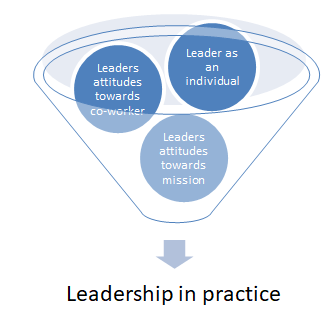
In November 2018 Mac Tristan, retired from his position as Chief of Police for Coppell Police Department, Texas, USA. He had then successfully led the change of two police departments, Carrolton PD and Coppell PD, Texas USA. Now he is often sought-after as a lecturer in police leadership education within and outside the US. His leadership style attributes that are so well-based in research that even when new leadership trends will find its way in to the world of leadership his leadership style will last as long as the aim is to make members of the organization grow and be a part of the decision-making [15, 18, 19]. It will last as long as we, as Sir Peel, believe that trust and positive interaction with the community and the public are the foundation of policing. Moreover, it is a leadership style wherein the leader with respect for others will act as a role model to gain trust both within the organization as well as with the community.
How Chief Tristan Describes his Leadership
This case-study is based upon several interviews, studies of Chief (ret.) Tristan’s work in real time and interviews with officers and other staff within the Coppell police department. Following are Chief (ret.) Tristan’s own description of his leadership:
“Policing was created by people like us a long time ago. It is nothing magical about it. So let us be more effective by doing something new something different. And by that give better service to our community.
I base my leadership on Servant leadership. This leadership model is often a misunderstood concept and it is something we have taken for whole both in the city of Carrollton and the city of Coppell. You have to strive to become a servant leader. In order to be a great leader, we must first be a great servant.
This leadership is about that those persons who choose to lead in either capacity, they encourage collaboration, build trust, are foresighted, are listening to others, and use the power they gain in an ethical way. It is also about having the courage to become the change that is wanted in the organization.
I was focusing on who wanted to be onboard and on what made us become police officers from the beginning. For to do that there has to be a willingness to get rid of all that bitterness and anger that has started years and years ago and get back to focus on why did we become a police officer in the first place. Why did we choose this profession? And it is quite simple – it is to serve others! If you decided to become a police officer to carry a gun and to arrest people I do not need you in my organization, in my team. That is not the kind of person that I need. So we filter people and say “Are you here for the right reason?” It is not about power and control. It is not about I have the authority to arrest you and you and you. Arrest should be the last resort on why we are doing it. Is there a better way to gain compliance?
With commitment comes passion. We often talk about passion. George Wilhelm Friedrich Hegel once said that “nothing great in the world have ever been accomplished without passion.” The most important question to ask yourself is what you can do to build a culture of leaders. What is important in this is that those questions are not only for top leaders – they are for everyone regardless of where in the organization you are.”
Principals
All leadership rests upon a set of principles, in some cases these are highly deliberate while in other’s they may be more subconscious. Sometimes, such as in Mac Tristan’s case, these principles are carefully thought-out and therefore create a firm foundation for his leadership methods and approach to change. The principles can be divided in to two groups:
Basic principles of the relationship to others:
o I’m only as good as those around me.
o I cannot control anyone else. I can only control myself.
Those who try to control others only tire themselves out.
Basic principles of the relationship to one’s self:
o It is only I who can make me happy. I cannot make others happy and they cannot be responsible for my happiness.
o It is only I who can make me motivated. I cannot make others motivated and they cannot be responsible for my motivation.
o I take pride in my job and my leadership is based on a foundation of self-respect.
Attitudes
The basic principles on which a leader builds his/her leadership style are connected to the attitudes the person has toward their leadership, toward their co- workers and their mission. Chief of Police (ret.) Mac Tristan is extremely clear when it comes to his attitudes to both his mission and his co-workers.
Attitude to his mission:
• The mission has to be accomplished based the need of the organization not on personal likes and dislikes.
• The goal is to do the right thing.
• There is no such thing as failure!
• The ultimate goal is a well-ordered society that provides the citizen with quality of life.
• Bee well informed of what is happening in society as a whole. This means that the police can be prepared and respond in good time to both prevent crime and take the correct action when crime is committed.
Attitudes towards his co-workers: • Attitudes and opinions affect others. Therefore I take great care to never allow bad moods or disagreements to shine through.
• Emotional states are easily transmitted between individuals. Focus on remaining calm under all circumstances.
• Deep down everyone wants to do their best. But, when coming across anyone who does not give their best and shows no inclination to do so, do not hesitate to dismiss the person. However in those occasions I also point out that there is nothing wrong with the individual – he or she is merely not suited to that particular job.
Leadership Profile
There is a problem with naming a leadership model as leadership models seem to replace each other as trends shape new names of models with more or less adjusted contents. Here, the authors instead focus on the attributes that will reinforce the leadership that will make the above changes possible and sustainable.
Leadership Attributes
As individuals, we all possess a set of personal characteristics, intelligence, skills, and we all carry our personal baggage, our history, our background. All of these are to be taken into consideration, as they all affect how an individual will perform his /her duties, when leadership is practiced in the field. The chosen leadership attributes have therefore been singled out as they together can give rise to organizational development and change towards a guardian perspective, while at the same time giving employees the opportunity to participate and develop in their respective professional roles [15, 18, 19]. Moreover, these are leadership attributes that aim at leaders that will act as role models when with respect interacting with employees showing the way in the pursuit to building trust in the interaction between the police and the public. In forming the police leadership ideal profile, we here relied on the JobMatch Talent (JMT) instrument. This is a certificated instrument that is designed to measure a person’s work-related abilities and behavior in relation to the demands of a certain the position, see below Table 1 below. The instrument has been used in research regarding gender and work patterns and police leadership [20, 21, 22, 23].
| Area | Main scale | Sub scale | |
|---|---|---|---|
| Stability pattern | Work structure | Focus on planning | |
| Stability pattern | Work structure | Focus on details | |
| Stability pattern | Work structure | Focus on order | |
| Stability pattern | Inner drive | Self-motivation | |
| Stability pattern | Inner drive | Optimism | |
| Stability pattern | Inner drive | Mood-stability | |
| Stability pattern | Stress tolerance | Self-control/restraint | |
| Stability pattern | Stress tolerance | Resilience | |
| Stability pattern | Stress tolerance | Concentration | |
| Stability pattern | Decision characteristics | Deliberation | |
| Stability pattern | Decision characteristics | Willpower | |
| Stability pattern | Decision characteristics | Persistence | |
| Stability pattern | Action pattern | Activity | Physical activity |
| Mental energy | Action pattern | Activity | |
| Need for speed | Action pattern | Activity | |
| Enterprise | Action pattern | Winning instinct | |
| Enterprise | Action pattern | Vision | |
| Enterprise | Action pattern | Development motivation | |
| Acting | Action pattern | Sphere of influence | |
| Acting | Action pattern | Power of initiative | |
| Acting | Risk-taking | ||
| Relation pattern | Tolerance | Concurring image | |
| Relation pattern | Tolerance | Tolerant attitude | |
| Relation pattern | Tolerance | Trust in others | |
| Relation pattern | Social interest | Displayed consideration | |
| Relation pattern | Social interest | Diplomacy | |
| Relation pattern | Social interest | Contact creation | |
| Relation pattern | Communication | Impact | |
| Relation pattern | Communication | Communicativity | |
| Openness | Communication | ||
Table 1: JMT: areas, main scales, and sub scales.
Ideal Police Leadership Profile
As an occupation, police leadership is a complex interaction of social, administrative and political related tasks. Police leaders are expected to perform in a myriad of often difficult situations that must apply high level of pressure upon the individual leader. Compared to Civil leadership and executive positions the demands exerted by the police corps must be excessive.
The ideal police leadership profile is based on Mac Tristan’s JMT test results. Chief of Police (ret.) Mac Tristen have long experience both of working within the police and of being a leader. When starting his leadership he was known by the organizations. Some moderations have therefore been performed for the profile to be more generalizable.
Stability Pattern
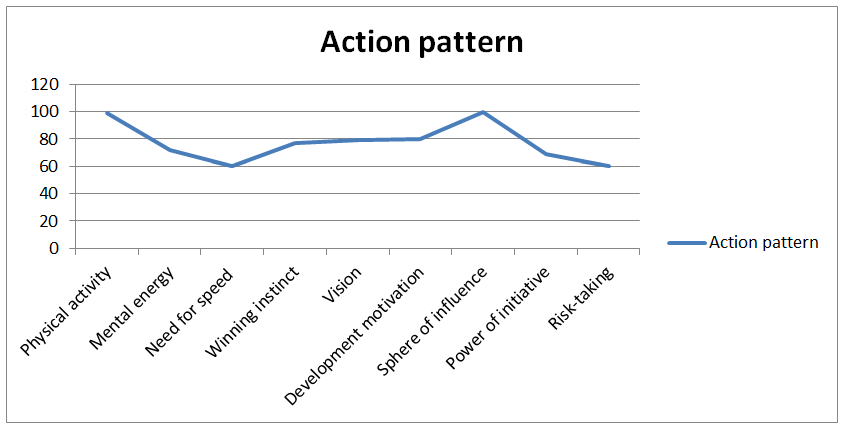
The stability pattern is composed of work structure, stress tolerance and decision characteristics. Together, these will give a deeper knowledge about how organized/disorganized a leader is regarding how the person in approaching their work tasks indicating a leader’s resourcefulness.
When changing an organization from one paradigm, warrior-top-down leadership in a hierarchical driven organization, to another paradigm, guardian-participative leadership in a learning organization, has to hold on tight to the development. Knowing the police culture of flying- under-the-radar the ideal profile leader have to develop a broader ‘bird’s-eye view’ to perceive the ‘bigger picture’ but also, more than in other situations, “Focus-on-details” and “Focus-on-order” reflecting a greater need for structuring and organizing the operations/ tasks with construction of routines [22].
Within the ideal profile leadership, “Concentration” has been assigned a lower level as higher levels form a more narrow concentration upon single items and the ideal leadership profile need a more ‘lateral’, selective task-related and context related attention. Just as older human brains retain the capacity to change in response to experience the ideal profile leader fits with the principle of experience-dependent neuroplasticity [23].
The “inner drive” and intrinsic motivation of leaders have been associated with activity, stamina, creative problem solving and positive emotions [24]. This implies that those characteristics may support the leadership role. Police and military organizations are regarded as compliance-enhanced organizations and within such an organization intrinsic motivation contributes to guidance and direction of employees. Moreover it does so without being overly controlling and restricting subordinate behaviour when exposed to external uncertainty [25]. Low levels of this attribute are expected to induce negative influences upon subordinates while high level may predict the opposite [26].
Low levels of “stress tolerance” seem to imply a great focus upon oneself to the exclusion of colleagues and subordinates, therewith the impoverishment of the leadership [27]. Moreover, low stress tolerance is associated with low energy, low positive affect and low optimism [28].
As decision-making plays a huge part of leadership, “will-power” becomes an important role in the context of leadership.
![Figure 2: A hypothetical Stability pattern to resemble an individual “X” profile. Action Pattern Often, the leadership concept is focusing on the nature of the leader but disregards the process dynamics that is connected to the leadership. Leadership has to be understood as a process, and not just as a function of a position [29]. The leaders should therefore be identified by the effects of their actions not by the fact of their appointment [30].](/fulltextimages/3187/fig_2.png)
Figure 2: A hypothetical Stability pattern to resemble an individual “X” profile. Action Pattern Often, the leadership concept is focusing on the nature of the leader but disregards the process dynamics that is connected to the leadership. Leadership has to be understood as a process, and not just as a function of a position [29]. The leaders should therefore be identified by the effects of their actions not by the fact of their appointment [30].
Changing from one paradigm to another is to be looked upon as demanding where there is a great need for both “Will-power” and “Winner-instinct” [31]. Even though higher levels of “Will-power” and “Winner- instinct” may come at a price since excessive application of these attributes implies stubborn and over ambitious pursuit of one’s agenda at the cost of being receptive to other arguments and points-of-view moderate levels of these attributes are important for a leader [32]. There is a balance of pursuance once agenda is met and at the same time showing less self- focused and prestige-oriented expressions. This is a leadership style wherein the opinions of and ‘room’ for others are welcomed to a greater extent. It is also about placing a higher priority upon seeing colleagues develop and teambuilding wherein the collective performance overrides individual performance.
“Sphere-of-influence” exerts an important influence upon leadership as experience in leading projects and estimating logistics may lead to an enlarging horizons and a greater knowledge of the concern for leadership and an attribute that often is improved by age [33].
Relation Pattern
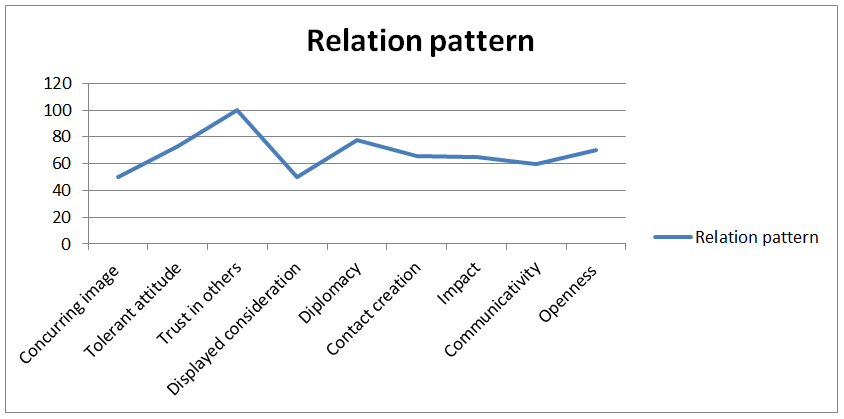
As stated in Sir Robert Peel’s nine principles building and maintaining trustfully relation with the public is essential for to acquire effective policing. Therefore, the leaders’ ability to build relations, internal as well as external, is of crucial. Role models facilitate, according to social learning theory, the acquisition of moral and other types of behavior [34]. Moreover, leaders are also those who make important contributions to social order [35].
Leaders matching the ideal profile are leaders that seek ‘togetherness’ have a high level of “Trust-in-others” and work to create unity within the group in opposite of leaders who pay less attention to others’ viewpoints and instead are focusing more on implementing their own ideas and initiative. The former are leaders who dare to give more space/leeway to employees. Moreover, ideal profile leaders show increased “Tolerant attitude” which implies a leadership that place a greater weight on listening to employees and considering their opinions. This situation may lead in turn to ideal profile leaders’ greater ability to delegate responsibility with less need for control in association with organizational behavioral science principles that advance the notion of delegation, but not “dumping” [36]. Modern leadership coaching sets a premium on ‘tolerance’ and ‘persistence’ at the workplace [37].
Leadership Qualities and Attributes
Below is presented a description of the leadership qualities, attributes, which are connected to Mac Tristan’s leadership and how they may be linked to the type of leadership, practiced by him. Through the search of leaders with these leadership qualities, an opportunity may be created for organizational development and change, while at the same time giving staff the opportunity to participate and develop in their respective professional roles.
| Mac Tristan's leadership | Related leadership attributes according to JMT |
| High demands on order and neatness | Focus on Order - without over-organizing |
| High demands on order and neatness | Focus on Details - without being pedantic |
| An innate calm | Self-control |
| An innate calm | Resilience |
| Patience to listen | A Need for speed that allows time for reflection |
| Desire and actual ability to listen to and respect others | Tolerant attitude without being a "wimp" |
| Desire and actual ability to listen to and respect others | Resilience without being indifferent. |
| Trust in your co-workers | Trust in others |
| Goal-orientation | Winning instinct, Vision combined with Development motivation |
| Goal-orientation combined with humility | See above combined with lower Willpower and high Tolerant attitude and Displayed consideration |
| Stable mood (Harmony) Predictable emotions | Mood stability |
| Have your tentacles out and know what’s going on. Internal and External. | A level of Concentration that allows for lifting your gaze and viewing the horizon |
Table 3: Comparison between “Mac Tristan’s leadership attributes and “Related leadership qualities” as derived from the Table 2:
Conclusion
Leadership is not just crucial for ‘what’ is performed within an organization. By being a role model leadership is even more crucial for ‘how’ the organization perform. Furthermore, leadership exerts an immense influence upon employees and thorough them on the organizational efficacy and as there is an extremely small possibility to change leaders by training, it is necessary to first of all find the appropriate person for the position of leader.
Service occupations, such as police, doctors and teachers are built invariably upon relations. This situation arises since the quality of the relation between the person who provides service and the people who are the receivers of that service is built upon the providers individual internal factors (body language, trust, respect, sympathy) and external factors (time put in the meeting, focus, ability to get the job done) [19]. Moreover, it has been found that it is important to find the right person for the position as leaders since the possibility to turn a manager that is well-suited for handling papers and doing deskwork is close to zero [38].
In a meta-analysis Macnamara et al., showed that deliberate practice did not predict performance in professions and that practice had more effect on predictable activities like running than on less predictable activities like handling an emergency [38]. That this also has leverage on policing has been shown by Mullins research on training and job performance among patrol officers where there were no relationship found between training and job performance [39]. Moreover, a meta- analysis performed on twin studies by Briley and Tucker- Drob showed that cognitive ability and personality are stable after adolescence and that cognitive ability is explained by around 75-80% of genetically factors, 5% by shared environment and 15% by non-shared environment [40]. On the other hand, personality was explained approximately 60% by genes and 40 % by non- shared environment. The conclusion that may be derived from these results is that it by all-time is the most effective for the organization and organization climate to find the right person for the right place. These results are also important especially for policing, since police work remains far from predictable and thereby less influenced by practice and training and leading personnel; under these circumstances, it therewith put greats demands on police management [41, 42, 43, 44].
Limitation
Despite the insights obtained, the application of this single case analysis (N = 1) has its limitation.
References
-
Rahr S, Rice SK (2015) From Warriors to Guardians. New Perspectives in Policing_._
-
Colwell JL, Huth C (2010) Unleashing the Power of Unconditional Respect_._ Boca Raton, FL: CRP Press.
-
Robinson L (2015) Citation from Executive Session on Policing and Public Safety (2008-2014)
-
Nummela O, Sulander T, Rahkonen O, Uutela A (2009) The effect of trust and change in trust on self-rated health: A longitudinal study among aging people. Arch Gerontol Geriatr 49(3): 339-342.
-
Luhmann N (1979) Trust and Power. Wiley.
-
Montori VM, Gafni A, Charles C (2006) A shared treatment decision-making approach between patients with chronic conditions and their clinicians: the case of diabetes. Health Expectations 9(1): 25-36.
-
Barefoot JC, Maynard KE, Beckham JC, Brummett BH, Hooker K, et al. (1998) Trust, health, and longevity. Journal of Behavioral Medicine 21(6): 517-526.
-
Lee YY, Lin JL (2011) How much does trust really matter? A study of the longitudinal effects of trust and decision-making preferences on diabetic patient outcomes. Patient Education and Counselling 85(3): 406-412.
-
Mainous AG 3rd, Kern D, Hainer B, Kneuper-Hall R, Stephens J, et al. (2004) The relationship between continuity and of care and trust with stage of cancer at diagnosis. Family Medicine 36(1): 35-39.
-
Nummela O, Raivio R, Uutela A (2012) Trust, self- rated health and mortality: A longitudinal study among ageing people in southern Finland. Social Science & Medicine 74(10): 1639-1643.
-
Thom DH, Kravitz RL, Bell RA, Krupat E, Azari R (2002) Patient trust in the physician: relationship to patient requests. Family Practice 19(5): 476-483.
-
Andersson Arntén AC, Huth C, Colwell J, Archer T (2017) Unconditional Respect: Change of Mindset for Effective and Safe Policing. Forensic Research & Criminology International Journal 5(5): 1-6.
-
van Dijk A, Hoogewoning F, Punch M (2015) What matters in policing? Change, values and leadership in turbulent times. Policy Press, Bristol UK pp: 240.
-
López CG, Alonso FM, Morales MM, León JAM (2015) Authentic leadership, group cohesion and group identification in security and emergency teams. Psicothema 27(1): 59-64.
-
Boedker C, Vidgen R, Meagher K, Mouritsen J, Runnalls M, et al. (2011) Leadership, culture and management practices of high performing workplaces in Australia: The high performing workplaces index. Society for Knowledge Economics: Sidney.
-
Dobby J, Anscombe J, Tuffin R (2004) Police leadership: expectations and impact. Home Office: London.
-
Lornudd C, Bergman D, Sandahl C, von Thiele Schwarz U (2016) Healthcare managers' leadership profiles in relation to perceptions of work stressors and stress. Leadersh Health Service (Bradf Engl) 29(2): 185-200.
-
Pearson-Goff M, Herrington V (2013) Police Leaders and Leadership Development A Systematic Literature Review. Australian Institute of Police Management.
-
Kajonius P (2015) An inquiry into satisfaction and variations in user-oriented elderly care. Depratment of Psychology, University of Gothenburg, Sweden.
-
Archer T, Andersson Arntén A-C, Olsen K, Jansson B (2016) Age and Gender Influence Upon Self-Reported Leadership Attributes during Recruitment. Clinical and Experimental Psychology 2: 140.
-
Archer T, Andersson Arntén A-C, Olsen K, Jansson B (2016) Self-reported Attributes Associated with Cognition and Motivation as a Function of Gender. Clinical and Experimental Psychology 3: 146.
-
Andersson Arntén A-C, Jansson B, Olsen K, Archer T (2017) Self-reported attributes of police-chiefs compared to civil leadership: Inner drive, tolerance to stress and enterprise. Journal of Forensic Research 8(1): 367.
-
Andersson Arntén A-C, Jansson B, Olsen K, Archer T (2017) Self-reported attributes of police-chiefs compared to civil leadership: Tolerance; social interest and communication. Journal of Forensic Science & Criminology 5(4): 1-6.
-
James A (2013) Examining Intelligence-Led Policing. Developments in Research, Policy and Practice. Palgrave Macmillan UK.
-
Leung NT, Tam HM, Chu LW, Kwok TC, Chan F, et al. (2015) Neural Plastic Effects of Cognitive Training on Aging Brain. Neural Plasticity 2015: 535618.
-
Loiser GF, Koestner R (1999) Intrinsic versus identified regulation in distinct political campaigns: The consequences of following politics for pleasure versus, personal meaningfulness. Personality and Social Psychology Bulletin 25: 287-298.
-
Kirkhaug R (2009) Antecedents of role conflict in Compliance-Enhanced organizations. Psychology Reports 105(3 Pt 2): 1113-1125.
-
Chappelle WL, McDonald KD, Prince L, Goodman T, Ray-Sannerud BN, et al. (2014) Symptoms of psychological distress and post-traumatic stress disorder in United States Air Force “drone” Operators. Military Medicine 179(8): 63-70.
-
Violanti JM (2011) Police organizational stress: The impact of negative discipline. International Journal of Emergency Mental Health 13(1): 31-36.
-
Thelwell RC, Wagstaff CRD, Chapman MT, Kenttä G (2017) Examining coaches´perceptions of how their stress influences the coach-athlete relationship. Journal of Sports Science 35(19): 1928-1939.
-
Gemmill G, Oakley J (1992) Leadership: An alienating Social myth? Human Relations 45: 113-129.
-
Karp T (2015) Is willpower important in acts of leadership?. Leadership 11(1): 20-35.
-
Knutsson J (2017) Advancing policing by using, producing and diffusing evidence. _In_: Knutsson J, Tompson L Advances in evidence-based policing. (Edn.), Routledge: London.
-
Archer T, Jansson B, Olsen K (2015) Effect of age upon leadership attributes from recruitment instrument: a selective developmental trajectory. Clinical and Experimental Psychology 1(1): 106.
-
McGonigle K (2012) The Willpower Instinct. How self-control works, why it matters, and what you can do to get more of it. Avery Publishers, London.
-
Eweje G, Brunton M (2010) Ethical perceptions of business students in a New Zealand university: Do gender, age and work experience matter? Business Ethics. A European Review 19(1): 95-111.
-
Brown ME, Treviño LK (2014) Do Role Models Matter? An Investigation of Role Modeling as an Antecedent of Perceived Ethical Leadership. Journal of Business Ethics 122(4): 587-598.
-
Hosking DM (1988) Organizing, leadership, and skilful process. Journal of Management Studies 25(2): 147-166.
-
Dow AW, DiazGranados D, Mazmanian PE, Retchin SM (2013) Applying organizational science to health care: a framework for collaborative practice. Academic Medicine 88(7): 952-957.
-
Little JW (1982) Norms of collegiality and experimentation: workplace conditions of school success. American Educational Research Journal 19: 325-340.
-
Macnamara BN, Hambrick DZ, Oswald FL (2014) Deliberate Practice and Performance in Music, Games, Sports, Education, and Professions: A Meta-Analysis. Psychological Science 25(8): 1608-1618.
-
Mullins WC (1992) Predicting job performance from training: The relationship between patrol officer basic academy training and job performance. Journal of Applied HRM Research 3: 20-29.
-
Briley DA, Tucker-Drob EM (2013) Explaining the increasing heritability of cognitive ability across development: a meta-analysis of longitudinal twin and adoption studies. Psychological Science 24(9): 1704-1713.
-
Olsen K (2000) JobMatchTalent Inventory.
- Forensic Implications of Adverse Drug Reactions in Schizophrenia A Case Series
- Narcotics and Digital Forensics: Bridging Crimes in the Digital Age
- Ethics in Forensic Psychiatry: Principles, Dilemmas, and Human Rights
- Impact of Acute Stress on Attentional Orienting to Social Cues
- Head Injury and Intracranial Hemorrhage in Western Region of Libya
- A Forensic Study on Handedness: Examination of Handwriting Features in Right and Left Handed Writers