
Simulation
Simulation is basically an imitation, namely a model that imitates a real-world process or a system. Simulation has a few definitions such as: “The description of something by something else” or “Dealing with real things while working with imitation” or “Imitation of conditions with a model for convenience and training”.
Opinion
Simulation is basically an imitation, namely a model that imitates a real-world process or a system. Simulation has a few definitions such as: “The description of something by something else” or “Dealing with real things while working with imitation” or “Imitation of conditions with a model for convenience and training”. Simulation is used in many contexts, such as simulation of technology for performance optimisation, safety engineering and education or when the real system is being designed but not yet built, or it may simply not exist. Generally, to simulate something physical or technological, you will first need to create a mathematical model that represents the object. In cases that analytical solutions are not possible, computer simulation, developed with the growth of the computer, is often used. Computer simulation is the discipline of designing a model of an actual or theoretical physical system, executing the model on a digital computer, and analysing the execution output. Simulation embodies the principle of ``learning by doing'' - to learn about the system we must first build a model of some sort and then operate the model.
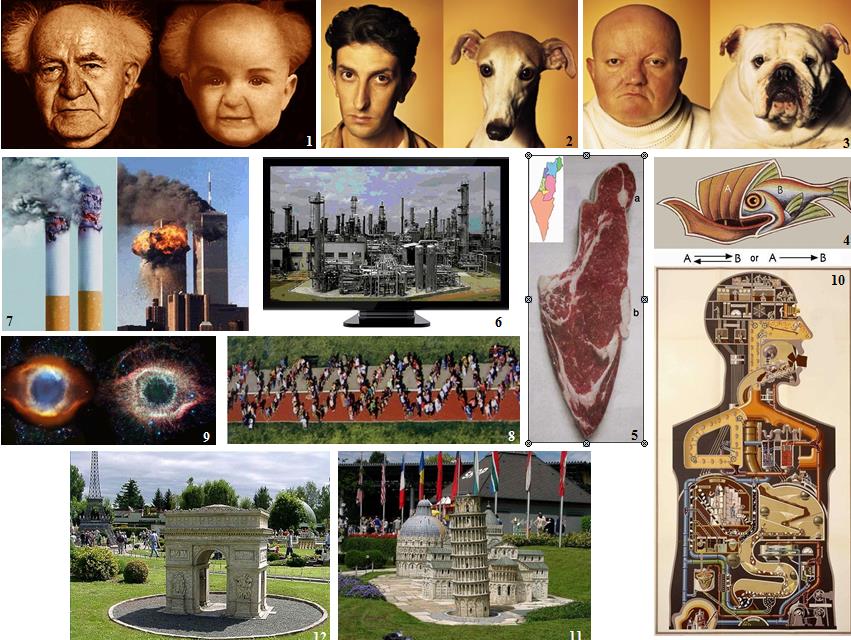
In the following simulation is demonstrated by pictures taken from the Internet. Figures 1, 2 and 3 are different demonstrations of facial simulations according to the first definition. Figure 1 right is a coincidental similarity of a baby’s face to that of David Ben-Gurion (1886-1973) - left, the chief statesman and political leader of the modern state of Israel and its first Prime Minister. Due to the extreme similarity it may be considered as Opinion Ben-Gurion’s simulation. Figures 2 and 3 are simulations of mankind by animals or vice versa. Figure 4 may be looked upon as a simulation of two types of a chemical reaction indicated on the Figure. The fish-ship combination is part of an artwork by M.C. Escher (1898– 1972), a Dutch graphic artist. Figure 5 demonstrates the map of Israel – top left – by a piece of meat where the white piece “a” is Lake Kinneret and “b” is the Dead Sea. Figure 6 demonstrates the simulation of a chemical plant on the computer screen where Figure 7 left is a very interesting simulation of the Twin Towers disaster. Figure 8 is a very interesting simulation of the DNA molecule created by people standing on a street exhibition in Warsaw. Figure 9 is a simulation of human’s eyes by two galaxies nicknamed “Eyes of God” where a galaxy is collection of stars, gas, and dust bound together by gravity. The smallest galaxies may contain only a few hundred thousand stars, while the largest galaxies have thousands of billions of stars. Figure 10 is an astounding simulation of human body entitled “Man as Industrial Palace” (www.nlm.nih.gov/.../ 1200 dpi/IV-A-01.jpg). A close look at the picture in the Internet reveals a detailed simulation of all inner parts of human body. Figure 11 simulates the Leaning Tower of Pisa located in city of Pisa, Italy, which leans now about 3.99 degrees. Unfortunately, even today the great mass continues to sink very slowly, about 1 mm every year. And finally the Victory Gate and Eiffel Tower in Paris the simulation of which are demonstrated in Figure 12.
- Narcotics and Digital Forensics: Bridging Crimes in the Digital Age
- Ethics in Forensic Psychiatry: Principles, Dilemmas, and Human Rights
- Impact of Acute Stress on Attentional Orienting to Social Cues
- Head Injury and Intracranial Hemorrhage in Western Region of Libya
- A Forensic Study on Handedness: Examination of Handwriting Features in Right and Left Handed Writers
- Techniques for Latent Fingerprint Development Using Natural and Synthetic Powders: A Review