
Child Asphyxiation Caused by Aspirated Vitamin C Tablet
Accidental cases of death from aspiration caused by laryngeal clogging with foreign body are common in children at the age of 3. Death in these cases occurs very quickly as a consequence of irritation of the laryngeal nerves and reflex heart failure, the general signs of suppression of the autonomic nervous system are either poorly expressed or absent, therefore the dying mechanism is determined based on the local autopsy finding and the circumstances of the case. In this article, we present one case of a 3 years old child who died from accidental aspiration of half vitamin C tablet.
Introduction
When food, liquid, or an object is swallowed, it passes from the mouth through the throat and esophagus into the stomach. Sometimes when we try to swallow, the swallowed substance "goes down the wrong way" and gets inhaled into the windpipe or lungs (aspirated). This occurs most often in children who are younger than 3 years and in adults who are older than age 50 [1]. When a substance is inhaled, coughing is a normal reaction of the body to clear the throat and windpipe [2]. Coughing is helpful and may clear up the problem.
Closing the airway with a foreign body leads to aspirational death. In children, asphyxiation usually involves inhalation of small objects in the larynx which leads to subsequent airway blocking [3]. In this case study, we present a 3-year old child, who died from accidental aspiration of half vitamin C tablet, which he was taking because of flu.
A 3-year old child, few days before his death, had flu and because of that he was given supplement - vitamin C (ascorbic acid) in a form of a tablets. One morning, after taking half of the vitamin C tablet, in the presence of his grandmother, first he began to cough a little bit, to gag, have noisy breathing and after a few minutes his lips had turned blue and he had fainted. On the way to the hospital, the child has already died (Figure 1).
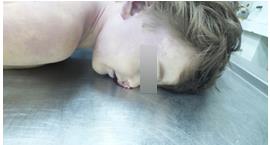
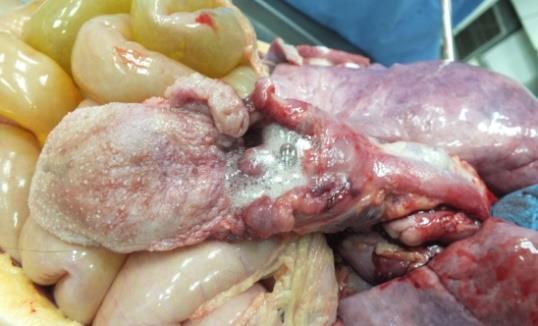
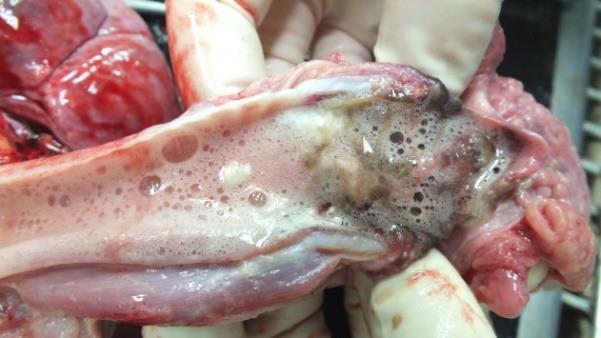
Figure2: White foam content in the initial larynx.
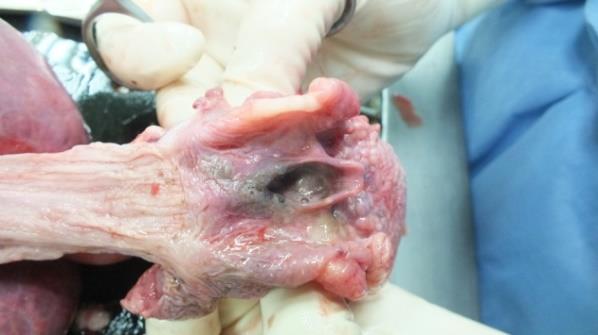
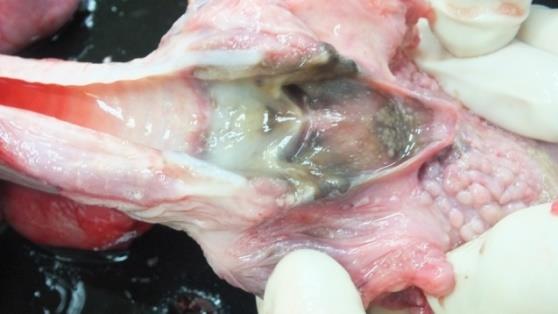
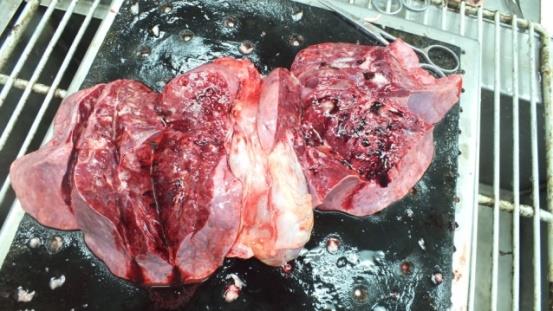
During the external examination of the child’s body, well-defined postmortem livid and hypostasis, cyanosis of the lips and the presence of white foam and blood in the nasal septum area have been identified. On autopsy a large amount of white foam content and a small piece of white tablet were found in the lumen area of the larynx s 2 and 4). The mucosis membrane of the larynx was with necrotic corrosive changes, slightly cloudy, dark grayish- yellowish-colored with surrounding hyperemia (Figure 5). Corrosive necrotic changes were also found in the mucosis from the initial part of the esophagus (Figure 3). At macroscopic examination of other internal organs, non-specific signs of asphyxia, such as ecchymosis, brain and lung edema, fullness of the trachea and the main bronchi with white foam, full blood of organs and etc., were found Figure 6).
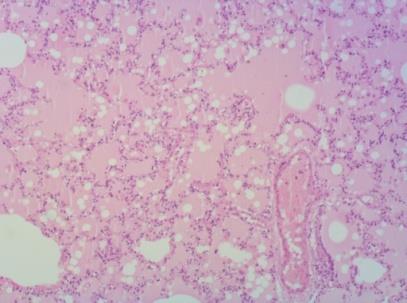
From the pathohistological analysis, the following microscopic finding was obtained: brain edema, subepithelial edema and absence of epithelium in the wall of the trachea, inflammation of the bronchi, edema of the lungs and rare inflammatory cells in the cardiac muscle (Figures 7-9).
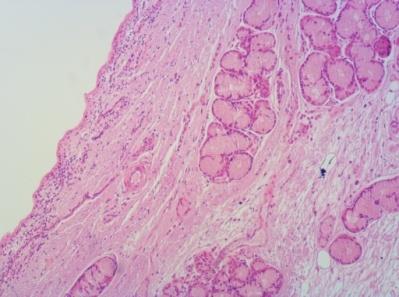
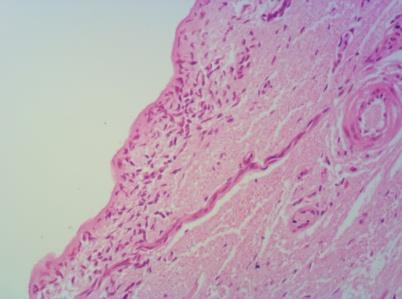
The pericardial fluid was analyzed by the IFCC method, whereof had obtain increased concentration of the enzymes Creatine kinase - MB isoenzyme and Tropinin I.
Discussion
There are lot of reports in the world of stifling small children with a variety of items, toys, parts of pens, pieces of foods, whole grains od vegetables, tablets, etc., which were removed on time and saved child’s life, but also lot of them had ended up lethally. For example, there is a statistic made in the United States that every five days, one child will die from choking. Choking is the fourth leading cause of death in children under five years of age. Children have airways that are 1/3 the size of an adult [4]. Their windpipes or breathing tubes are approximately the size of a drinking straw [5]. That’s the reason why medications in form of tablets shouldn’t be given to small children in a solid form, only in liquid consistency.
In our case, the vitamin C tablet was a fairly large foreign body, which had been accidently aspirated in the lumen of the larynx, consequently caused spasm with swelling of the surrounding tissue after which tablet had stuck and had cause a stop of the airflow in the airways. Because of the high dose of ascorbic acid in the tablet, coagulation necrosis on the mucous membrane of the larynx was caused [6].
Conclusion
Тhe speed of child suffocation, depends on the size and type of the inhaled foreign body, its reaction to the surrounding tissue, the degree of clogging of the airway and the timely intervention [7].
Some medical officials attributed the death to suffocation, although the airways were never completely blocked. They suggest that the larynx spasm is the cause of death. However, there is no objective evidence that this has happened. If the larynx is in spasm, its relaxation could be expected during the agony. This would lead to the opening of the airways and to recovery. Others hypothesized that a fatal "vagal reaction" or "reflex heart failure", conditioned by the parasympathetic part of the nervous system, arise as a result of the hypersensitivity of the larynx from aspirated foods. On the contrary, there is no objective evidence that all this exists [8].
References
-
Mohammad M, Saleem M, Mahseeri M, Alabdallat I, Alomari A, et al. (2017) Foreign body aspiration in children: A study of children who lived or died following aspiration. Int J Pediatr Otorhinolaryngol 98: 29-31.
-
Aslan N, Yildizdas D, Ozden O, Yontem A, Horoz OO, et al. (2019) Evaluation of foreign body aspiration cases in our pediatric intensive care unit: Single-center experience. Turk Pediatri Ars 54(1): 44-48.
-
Salih AM, Alfaki M, Alam-Elhuda DM (2016) Airway foreign bodies: A critical review for a common pediatric emergency. World J Emerg Med 7(1): 5-12.
-
Tsang JE, Sun J, Ooi GC, Tsang KW (2017) Endobronchial Foreign Body Presenting as Exacerbation of Asthma. Case Rep Emerg Med.
-
Holzki J, Brown KA, Carroll RG, Cote CJ (2018) The anatomy of the pediatric airway: Has our knowledge changed in 120 years? A review of historic and recent investigations of the anatomy of the pediatric larynx. Paediatr Anaesth 28(1): 13-22.
-
Levine M, Dhariwal KR, Welch RW, Wang Y, Park JB (1995) Determination of optimal vitamin C requirements in humans. Am J Clin Nutr 62 (6): 1347- 1356.
-
Rimell FL, Thome A Jr, Stool S, Reilly JS, Rider G, et al. (1995) Characteristics of objects that cause choking in children. JAMA 274(22): 1763-1766.
-
DiMaio JV, DiMaio D (2010) Forensic Pathology. publ Tabernacul, Skopje, pp: 240.
- Narcotics and Digital Forensics: Bridging Crimes in the Digital Age
- Ethics in Forensic Psychiatry: Principles, Dilemmas, and Human Rights
- Impact of Acute Stress on Attentional Orienting to Social Cues
- Head Injury and Intracranial Hemorrhage in Western Region of Libya
- A Forensic Study on Handedness: Examination of Handwriting Features in Right and Left Handed Writers
- Techniques for Latent Fingerprint Development Using Natural and Synthetic Powders: A Review