
Forensic Identification of Sindoor Stain on Cloth as Trace Evidence Analysis: A Case Study from Delhi, India
A case of domestic death mystery was presented before Investigating Agency wherein it was difficult to establish the death as murder, as the victim – a 32-year-old married lady, was found by her husband with ligature mark which prima-facie indicated suicide due to hanging. As per brief case history, her husband, as complainant, maintained the fact that both father and the son were not at home and there was no strong specific reason for his wife to commit suicide. The doctor stated the cause of death as Asphyxiation due to strangulation. The Investigating Agency was clueless in establishing the death as suicide or murder and looked towards Forensic Science Laboratory to play an important role in linking shreds of evidence scientifically. Chemical Examinations done on the samples seized by Investigating Agency (Delhi Police) disclosed an abnormally high level of mercury by Instrument Atomic Absorption Spectrometer (AAS). A detailed comparative analysis was again undertaken using Fourier Transform Infra-Red Spectrometer (FTIR) which further confirmed the same chemical composition present in both the samples i.e. the accuses' cloth containing unidentified stains and the victim’s scalp hair. By Locard’s Principle then, it was established that sindoor (vermilion) used by the deceased had left forensic trace evidence on the accused cloth. A firm scientific connection was recognized between the accused, the victim and the scene of crime in order to interpret the manner of death as a homicide.
Introduction
Cosmetics, purposefully used for beautification, are a women’s best friend. In the Indian subcontinent some cosmetics are attached with religion, lending it a more religious, spiritual, pure and pious meaning. Sindoor is one such artefact, traditionally applied by Hindu married women on the forehead and midline hair parting since centuries in India. The Sindoor or vermilion is an opaque pigment with a clear, brilliant hue ranging from bright orange-red to a duller reddish-purple, found in powder or liquid form, which was originally made by grinding a powder of Cinnabar [1]. Cosmetic products are used in Forensic Science as trace evidence in different criminal cases and have special significance in crimes related to Physical and Sexual Assault in women [2]. During the criminal incidences, smeared traces of cosmetic evidence gets accidentally, indiscriminately and effortlessly transferred from a female victim to an assailant either onto the body or clothing. “Locard’s Principle of Exchange” has enabled more than often the Investigating Agencies towards the criminal and scientifically aid judiciary to reach accurate conclusion. Death of a female leading in domestic life was presented to FSL by Investigating Agency with a challenge in a corroborating the pieces of evidence scientifically where they were facing difficulty in ascertaining the case as a murder or suicide. Here, cosmetics played an important role as Trace Forensic evidence in crime against women.
Case History
A 32-year-old married female was found dead with a cotton rope tied around her neck. A knife with cotton thread pieces struck in the sharp edge of the blade was found in the window near the bed. The husband of the deceased, found the body of the later lying on the bed. On further questioning, he informed that his wife had illicit relation with the suspect known to him. It was revealed that on the day of the murder, at 4:00 p.m she was found having an altercation with the suspect by her son who was then leaving for his tuition classes. At 6:00 p.m. the son returned to the house and found it locked from outside and informed him, who later informed the police, thus initiating an investigation. During Post-mortem examination of the body of the deceased, doctors clearly stated the cause of death as asphyxia caused by strangulation with clear ligature mark. All injuries were ante-mortem in nature and inflicted at the same duration. During the investigation, the accused was arrested who was found wearing a shirt with unidentified dry stains on it along with a missing button and torn buttonhole. This indicated an approximate scuffle between the accused and unknown person. Investigating Agency (Delhi Police) seized the cloth he was wearing. Blood, scalp hair and vaginal swabs were preserved during autopsy for further forensic toxicological analysis at FSL Delhi along with the stained cloth of the accused.
Materials and Methods
The seized samples were received at FSL for chemical analysis in proper packed and sealed condition. All the reagents, solvents and TLC plates used in the analysis were procured from Merck.
Chemicals: Copper strips, Concentrated Nitric Acid, Concentrated Hydrochloric Acid, Silver Nitrate, Lead acetate, Ethanol, Chloroform and Methanol. Sample 1: Extract collected from deceased scalp hair (Water extract for Inorganic analysis and Ethanol extract for organic analysis) Sample 2: Extract collected from the shirt of the accused (Water extract for Inorganic analysis and Ethanol extract for organic analysis)
Preliminary Chemical Analysis
Reinsch’s Test [3]
This test is often used as screening method due to its rapid, sensitive, reliable results in forensic toxicological analysis without extensive preliminary treatment. Washed and dried copper strips with Concentrated Nitric Acid were placed with dissolved samples and blank. Concentrated Hydrochloric Acid is added to each sample and gently heated for about one hour under the fume hood. Copper strips were removed and washed with water and dried on filter paper. The test gave a positive result for the presence of mercury which was identified by silvery shining deposits in Sample 1 and Sample 2.
Tests for Sulphide Ion [3]
This test is often used as screening method due to its rapid, sensitive, reliable results in forensic toxicological analysis without extensive preliminary treatment. Silver Nitrate test and Lead acetate test- In Silver Nitrate test, the presence of sulfide was confirmed by the formation of a black precipitate of silver sulfide (Ag2S) which is insoluble in cold but soluble in hot dilute Nitric Acid. In Lead Acetate test, sulfide was confirmed by the formation of a black precipitate of lead sulfide (PbS). Both the Samples gave positive results for Sulphide ion. With water and dried on filter paper. The test gave a positive result for the presence of mercury which was identified by silvery shining deposits in Sample 1 and Sample 2.
Thin Layer Chromatography
Samples were spotted with the help of microcapillary tubes on pre-coated TLC plates made by Merck silica gel G 60 F having layer thickness 0.25mm. TLC separation by ascending technique with the solvent system - Chloroform: Methanol (9:1) in the development tank was achieved. The top of the development tank was covered with an airtight lid to allow saturation of solvent vapors for fifteen minutes. The spotted TLC plate was placed in development chamber at room temperature (25oC) for 10 cm from the spotting point. The spots were visualized under UV light of 254 nm/366 nm. RF values of both the samples matched with each other [4].
Instrument Analysis
The next level of confirmation was done by Instrumental Analysis where the samples were subject to Atomic Absorption Spectrometer (AAS) and Fourier Transform Infra-Red Spectrometer (FTIR) [5].
Atomic Absorption Spectrometry (AAS)
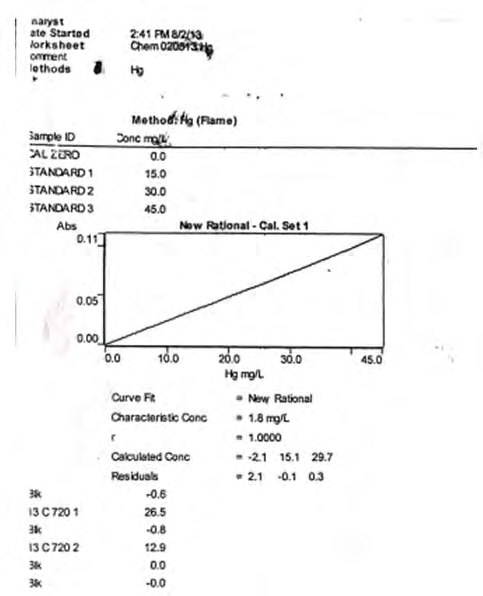
The sample was further analysed using AAS for the detection of Elemental Mercury. AAS is an analytical technique that measures the concentrations of elements [6]. Its sensitivity is to measure parts per billion of a gram in a sample. The model of Instrument used was make - Varian, model - FS 220, and was seen at Wavelength (nm) -523.7 nm which is specific for Mercury. Calibration of Mercury was made with standard concentration of 15mg/l, 30 mg/l, and 45mg/l. The results of samples 1 and 2 were found to be 26.5 mg/l and 12.9 mg/l respectively establishing the fact that both samples had a high concentration of elemental Mercury. Calibration curve of mercury and absorbance of samples are shown in Figure 1.
Fourier Transform –Infra Red Spectrometer(Ft- IR)
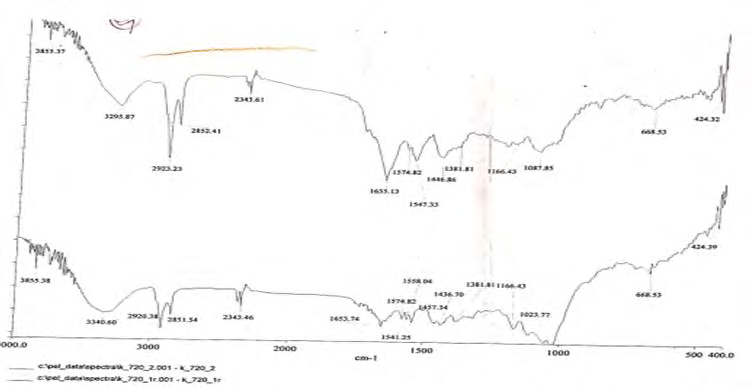
FT-IR spectrometer is the best available instrument for confirmatory identification of unknown samples by Selective Absorption of Infrared Radiation (IR). IR relies on the ability of different chemical compounds to absorb specific wavelength which is characteristics of that particular compound due to the molecular bonds present in the sample. Therefore, IR spectrum identifies the sample by its characteristic absorption and is of high utility in this case [7]. IR absorption spectra were acquired on a Perkin Elmer Spectrum GX FT- IR Spectrometer. In FT-IR spectrum was recorded over the wavenumber range 4000cm-1 to 400 cm-1 in the form of thin films made with the help of Potassium Bromide (KBr) pellets. IR radiation, when passed through a sample, is absorbed by the sample and some of it is transmitted. The simultaneous collection of spectra at all characteristic wavelengths in a single run is required in order to identify all of the sample components and the wave number values represent a chemical component or functional group present in the compound [7]. Measurements of samples were done on the transmission mode by Software-spectrum version 6.2. The resulting spectrum represents the molecular absorption and transmission, hereby, creating a molecular fingerprint of the samples of analysis. Like a fingerprint, no two unique molecular structures produce the same infrared spectrum which makes infrared spectroscopy advantageous in several types of forensic analysis. The spectra generated by both the samples after an average of twelve scans were gathered and compared. Peaks of the spectra produced by both the samples are shown in Figure 2 and a comparative observation table of wave numbers shown in Table 1.
| S No. | Wave Number in Sample 1 | Wave Number in Sample 2 | Remarks |
|---|---|---|---|
| 1 | 2920cm-1 | 2923cm-1 | |
| 2 | 2851 cm-1 | 2852 cm-1 | |
| 3 | 2343 cm-1 | 2343 cm-1 | Similarity Observed in |
| 4 | 1653 cm-1 1574 cm-1 | 1655 cm-1 1574 cm-1 | Samples 1 and 2 |
| 5 | 1541 cm-1 | 1547 cm-1 | |
| 6 | 1436 cm-1 | 1446 cm-1 | |
| 8 | 1085 cm-1 | 1087 cm-1 | |
| 9 | 668 cm-1 | 668 cm-1 | |
| 10 |
Table 1: Observation under FT-IR Spectrometer for Samples 1 and 2.
Discussion
Trace evidences are the invisible witness to the crime supporting the scientist, investigating agencies and judiciary to corroborate events and evidences for deducing the case. The samples were tested first according to the routine toxicological procedure. During elemental analysis, the unidentified stains on the cloth of the accused showed extremely high and positive results for elemental Mercury and Sulphide Ion. By matching the composition of the unidentified stains on the cloth (Sample 2) with the scalp hair the deceased (Sample1), the first and foremost confirmation was done that the accused was present at the scene of crime. Secondly, the trace evidence present on the cloth also confirmed that some contact between the accused and the deceased had taken place according to “Locard’s Principle of Exchange”. Now, the third aspect was to understand the cosmetic material present on female scalp hair which contained such high level of Mercury and Sulphide Ion. The literature showed similar chemical combination in Sindoor. Traditionally, Sindoor consists of a common base (turmeric powder), which becomes red when mixed with lime juice or lime powder (calcium compound), this is moistened with water or with alum, iodine and camphor or with oil and sea shell powder (calcium salts), or else aguru, chandan and kasturi are added. However, nowadays, the composition of Sindoor includes synthetic dyes, filler materials, lime and salts of lead and mercury to impart the red color [8]. All these constituents can help when drawing forensic inferences [8].
A variety of sophisticated instrumental techniques are available for the analysis of cosmetic products like Thin Layer Chromatography, High-Performance Liquid Chromatography, Gas Chromatography (GC) and Gas Chromatography-Mass Spectrometry (GC/MS), but here the selection of instrument was done on the basis of undergoing quick, confirmatory and reliable analysis. Thin layer chromatography is a versatile analytical Chromatographic Technique and has been earlier used in the comparison of Sindoor samples. But, very little work has been done on the Forensic analysis/ examination of Sindoor stains. Initially, a pure elemental analysis using AAS was conducted and then a comparative compositional examination using FTIR was done. It was observed that the peaks of the spectra produced by both the samples were similar as shown in Fig 2 and a comparative observation table of wave numbers exhibiting similarity was prepared as shown in table 1. While selecting the instrument for analysis the necessary parameters were minimum amount of sample and time for sample preparation. The quick disposal of cases according to priority set by Government to deal with cases of crime against women was also an indispensable feature while working on the entire case.
To conclude, “Locard’s Principle of Exchange” i.e. “every contact leaves a trace” was used to inferred that it is impossible for a criminal to act, especially considering the scene of crime and the intensity of a crime, without leaving traces of his presence1. In this case, the deceased wore vermilion on her forehead and vermilion stains were later found on the shirt of the accused which got transferred during the scuffle or probably during strangulation. The source of both exhibit 2 (shirt of the accused) and exhibit 1 (scalp hair of deceased) was confirmed through compositional analysis of the vermilion.
Conclusion
Sindoor (vermilion) stains are among the most frequently encountered cosmetic product trace evidence, due to their easy availability and routine use by Hindu women.8 Trace evidence analysis and identification is highly useful and reliable tool in the forensic field of investigations, especially when combined with other shreds of evidence and greatly adds to the success of crime case solving. Trace evidence analysis of Sindoor was successfully confirmed on both the samples provided by Investigating Agency
involving highly sophisticated instruments AAS and FTIR. Detection and preservation of this trace evidence at a crime scene is a challenge to crime scene investigators as such trace evidence often gives valuable information in relation to the reconstruction of the scene. Sample collection and preservation during autopsy also provides major support. Hence, a scientific, methodical and systematic plan of action was developed to analyse this cosmetic trace evidence and also to prevent loss of potential evidence. Thus, it served as important corroborative evidence in linking the suspect with the female victim and positive correlation was easily established between the suspect, the victim and the crime scene.
Conflicts of Interest: None.
- Ethical Clearance: Not necessary.
- Funding: Not applicable
Acknowledgement
Authors are thankful to Mrs. Deepa Verma, Director and Mr Sri Narain, Head of Division (Chemistry), Forensic Science Laboratory, Rohini, Delhi, for their encouragement and support for presenting this research work.
References
-
Kute VB, Shrimali JD, Balwani MR, Godhani UR, Vanikar AV, et al. (2013) Lead neuropathy due to Sindoor in India. Ren Fail 35(6): 885-887.
-
Sarma P, Kumar H, Medhi B (2017) Cosmetovigilance in India: Need of the day. Indian J Pharmacol 49(5): 341- 343.
-
Vogel AI (1962) A Text Book of Quantitative Inorganic Analysis. 3rd (edn.), ELBS and Longmans Green and Co. Ltd, London.
-
Chandel RS, Bhatia T, Jindal P (2013) Examination of sindoor (vermilion) stains on white cotton fabric using thin layer chromatography. Problems of Forensic Sciences 95: 601-610.
-
Moffatt AC, Osselton MD, Widdop B (2004) Clarke’s Analysis of Drugs and Poisons. 3rd (edn.), Published by The Pharmaceutical Press.
-
Dale IM (1982) Atomic Absorption Spectrometry. Tech Instrum Anal Chem 5: 381-394.
-
Ganzoury MA, Allam NK, Nicolet T (2015) Introduction to Fourier Transform Infrared Spectrometry. Renew Sustain Energy Rev 50: 1-8.
-
Vassilev ZP, Marcus SM, Ayyanathan K, Ciuffo V, Bogden JD, et al. (2005) Case of elevated blood lead in a South Asian family that has used Sindoor for food coloring. ClinToxicol (Phila) 43(4): 301-303.
- Narcotics and Digital Forensics: Bridging Crimes in the Digital Age
- Ethics in Forensic Psychiatry: Principles, Dilemmas, and Human Rights
- Impact of Acute Stress on Attentional Orienting to Social Cues
- Head Injury and Intracranial Hemorrhage in Western Region of Libya
- A Forensic Study on Handedness: Examination of Handwriting Features in Right and Left Handed Writers
- Techniques for Latent Fingerprint Development Using Natural and Synthetic Powders: A Review