
Challenging Paternity Test: Determination of the Relationship 46 Years after Burial
One of the common applications of forensic genetics involves paternity testing. In this case, the difficulty in carrying out the test was given by the difficulty in obtaining the DNA of the alleged father because his body was buried for 46 years. Visibly wellpreserved soft tissue samples had to be collected for DNA extraction. For the same purpose, samples of teeth and bones such as the femur and rib, which are the most resistant tissues in human remains, were also taken. In a first step, DNA extraction was performed on soft tissue samples using the commercial QIAamp® DNA Investigator kit following the dedicated protocol. Despite the good preservation of the soft tissues, the analyzes did not produce significant results for the determination of the biological profile. It was necessary to proceed with the extraction of DNA from bones and teeth. Samples were pulverized as required by the QIAamp® DNA Investigator kit and by completing the extraction following the specific protocol for bones and teeth. However, DNA extraction using a validated protocol yielded no results. Therefore, we used a different strategy for DNA extraction which involves a demineralization step before lysis, without prior pulverization. This pretreatment was followed by DNA extraction using the same commercial kit. Thanks to this protocol, the comparison between the DNA of the alleged father and the genetic profile of the son, to determine a paternity relationship was possible. Autosomal DNA and Y STR profiling was performed using three commercial kits.
G Brescia*, V Cortellini, H Simoes Dutra Correa and A Verzeletti
Introduction
In forensic medicine, paternity testing is a common practice and consists in comparing the genetic profile of the child with that of the alleged father.
When the presumed father has died, it is not possible to use the fresh biological substrate. In this case, the preservation of the corpse is very important to find the soft tissues from which to extract the DNA.
When soft tissue is lost or does not provide significant results, teeth and bones are often the only sources of DNA available for identifying degraded or fragmented human remains [1]. Bone is a growing tissue consisting mainly of collagen and minerals. About 70% of bone is made up of the inorganic mineral hydroxyapatite, which includes calcium phosphate, calcium carbonate, calcium fluoride, calcium hydroxide and citrate. Areas of extensive mineralization within the bone represent physical barriers to the extraction reagents and thus prevent the release of DNA molecules [2].
Teeth, on the other hand, better preserve DNA over time. Thanks to their structure, with a naturally high mineral composition and low porosity, teeth are more resistant to contamination than bones. For these reasons it is possible to obtain greater efficiency in DNA extraction. To date, although standardized methods for extracting DNA from both types of samples have not been universally accepted [3, 4, 5], most of them involve pulverization and subsequent decalcification steps over several days.
Decalcification is performed using an extraction buffer containing ethylenediaminetetraacetic acid (EDTA) A genetic profile had to be determined through DNA extraction on teeth and bones, with a pretreatment with EDTA versus a commercial protocol for bone and teeth that do not need of any pretreatment and require powders. After EDTA treatment, some studies show the use of organic DNA extraction [6]; while in our case the complete demineralization of the samples is followed by the isolation of the DNA using the commercial QIAamp® DNA Investigator kit. This protocol allowed to obtain results in a simple, fast, reliable and overall minimally destructive way for DNA extraction from bones and teeth, in order to effectively determine a challenging paternity.
Part of the femoral shaft and canine root were pulverized to obtain a final amount of 95 mg of bone powder and 87 mg of dental powder. The sample powder was produced using a rotary instrument (Dremel® 3000), smoothing the samples at low speed. DNA extraction was performed following the dedicated bone and tooth protocol in the QIAamp® DNA Investigator kit manual, with overnight incubation (Table 1a). In the second approach, a premolar with a gold crown, two healthy premolars, the sternal end of a right rib and the femoral shaft were subjected to demineralizing pretreatment. About 20 mL of EDTA solution (0.5 M, pH 8) was added to each sample and left at room temperature. The samples were demineralized for different periods of time (Table 1b) and subsequently washed with ultrapure water. The demineralized samples were extracted following two different protocols (Table 1b). Approximately 200 mg of bone and 100 mg of teeth were extracted with the QIAamp® DNA Investigator Kit following the protocol for bone and tooth extraction and, alternatively, the protocol for tissue extraction. In both protocols, the samples were incubated for two different time intervals: 4 hours and overnight (minimum and maximum incubation time intervals for DNA extraction). Samples from the son were collected via buccal swabs and DNA extraction was performed with the classic Chelex® 100 method [7].
- Case Report
- In this case report, samples were collected from a body exhumed 46 years after burial. DNA was extracted from soft tissues such as psoas muscle, spinal cord, bone marrow and hair using the commercial QIAamp® DNA investigator kit with specific tissue protocol and overnight incubation. a) Validated Protocols b) Alternative Methods
- Sample
- Pretreatment
- DNA extraction
- Incubation time
- Sample
- Pretreatment
- DNA extraction
- Incubation time
- Premolars tooth with crow
- EDTA 72
- QIAamp®
- DNA
- Investigator protocols: isolation of total
- DNA from tissues; isolation of total DNA from bones and teeth
- Femur bone
- Powder
- Healty premolar tooth
- EDTA 24
- Overnight
- QIAamp® DNA
- Investigator protocols: isolation of total DNA from bones and teeth
- Overnight
- Healty premolar tooth
- EDTA 24
- 4H
- Canine tooth powder
- Right rib
- EDTA 72
- Overnight
- Femour
- EDTA 72
- Overnight 4H
Table 1: Detailed DNA extraction performed with a) validated protocol; b) alternative methods, followed for each sample.
DNA profiling were performed using the commercial AmpFℓSTR™ Identifiler™ Plus [8], AmpFℓSTR™ NGM Select™ kits [9] (Applied Biosystems, Foster City, CA, USA); PCR reactions took place in a GeneAmp® 9700 Gold Plate (Applied Biosystem, Foster City, CA, USA), following the manufacturer’s instructions.
All the samples were also amplified using the YFiler™
Plus Amplification Kit [10] (Applied Biosystems, Foster City, CA, USA), which allows the amplification of Y chromosome loci, present only in male subjects.
The amplified DNA fragments were analyzed using a 3500 Genetic Analyzer instrument (Applied Biosystems, Foster City, CA, USA) and the electropherograms were analyzed using the dedicated software GeneMapper ID-X
v1.4 (Life Technologies, Carlsbad, CA, USA).
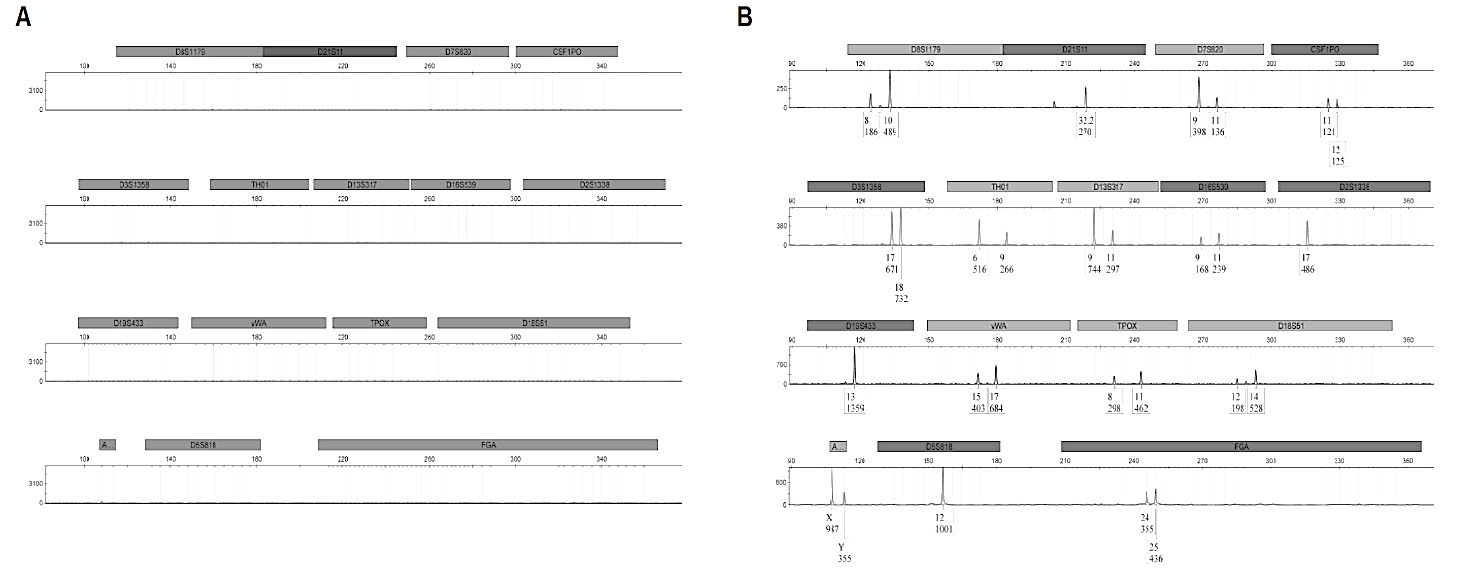
The statistical calculation, in order to quantify the probability of kinship, was carried out using the Familias v3.1.2 software [11]. In figure 1, by way of example, the electropherograms relating to the genetic profile obtained from the extraction of DNA from the spinal cord (A) and from the femur treated with EDTA (B) are shown.
Discussion
Extraction of DNA from soft tissues did not produce significant results in contrast with the conservation status of the same.
DNA extracted from bones and teeth with commercial protocols involving pulverization did not provide any genetic profile.
Regarding the extraction of DNA from bones and teeth with previous demineralization with EDTA, it is important to underline two main points: satisfactory results can be obtained with demineralization of teeth for 24 hours and incubating teeth and bone both for 4 hours (minimum time required by the commercial protocol). After demineralization, it is also possible to use the specific protocol for tissues in addition to that for bones and teeth without affecting the yield.
The absence of DNA in the rib samples can be explained by the structure of the bone tissue, which has a trabecular composition, not suitable for preserving DNA.
The comparison between the profile of the alleged father, whose body was exhumed, and that of the son demonstrated the paternity relationship between the two individuals, with a probability of 99.99999139%. Confirmation that the genetic profile was not derived from exogenous contamination was obtained by also comparing the Y-STR profiles of the remains and those of the child.
We have shown that EDTA pre-treatment followed by extraction with validated commercial protocols allows to obtain a sufficient quantity of DNA from degraded skeletal elements by eliminating the pulverization step. In conclusion this method allows a simple, fast, reliable and overall minimally destructive DNA extraction.
Declarations
Conflicts of Interest
None declared.
Ethical Approval
None declared.
Funding
None declared.
References
-
Higgins D, Austin JJ (2013) Teeth as a source of DNA for forensic identification of human remains: a review. Sci Justice 53(4): 433-441.
-
Loreille OM, Diegoli TM, Irwin JA, Coble MD, Parsons TJ (2007) High efficiency DNA extraction from bone by total demineralization. Forensic Sci Int Genet 1(2): 191-195.
-
Jakubowska J, Maciejewska A, Pawłowski R (2012) Comparison of three methods of DNA extraction from human bones with different degrees of degradation. Int J Legal Med 126(1): 173-178.
-
Latham KE, Miller JJ (2019) DNA recovery and analysis from skeletal material in modern forensic contexts. Forensic Sci Res 4(1): 51-59.
-
Vanek D, Budowle B, Dubska Votrubova J, Ambers A, Frolik J, et al. (2017) Results of a collaborative study on DNA identification of aged bone samples. Croat Med J 58(3): 203-213.
-
Corrêa HSD, Miranda Pedro FL, Ricci Volpato LE, Machado Pereira T, Siebert Filho G, et al. (2017) Forensic DNA typing from teeth using demineralized root tips. Forensic Sci Int 280: 164-168.
-
Walsh PS, Metzger DA, Higuchi R (1991) Chelex 100 as a medium for simple extraction of DNA for PCR-based typing from forensic material. Biotechniques 10(4): 506- 513.
-
(2015) AmpFlSTR® Identifiler® Plus PCR Amplification Kit. User Guide. Applied biosystems life technologies.
-
(2015) AmpFℓSTR® NGM Select™ PCR Amplification Kit. User Guide. Applied biosystems life technologies.
-
(2019) Yfiler™ Plus PCR Amplification Kit. User guide. Applied biosystems.
-
Kling D, Tillmar A, Egeland T (2014) Familias 3-Extensions and new functionality. Forensic Sci Int Genet 13: 121-127.
- Narcotics and Digital Forensics: Bridging Crimes in the Digital Age
- Ethics in Forensic Psychiatry: Principles, Dilemmas, and Human Rights
- Impact of Acute Stress on Attentional Orienting to Social Cues
- Head Injury and Intracranial Hemorrhage in Western Region of Libya
- A Forensic Study on Handedness: Examination of Handwriting Features in Right and Left Handed Writers
- Techniques for Latent Fingerprint Development Using Natural and Synthetic Powders: A Review