
Forensic Examination of Seized Transformer Oil: Case Study from Delhi, India
Forensic identification of Transformer Oils seized under suspicious circumstances by Delhi Police have been examined and reported after analysis of samples in Digital Abbe’s Refractometer, Fourier Transform Infrared Spectrophotometer and Gas Chromatograph for identification and matching of seized materials with standard/original Transformer Oil to determine the source of pilferation. These rapid analytical tools provide authentic methods for forensic laboratories having constraint of time, samples and equipment at their disposal.
Sweta Sinha1* and Kavita Goyal2
Introduction
Transformer oils (TO) are mineral oil, possessing excellent electrical insulating property at the same time being extremely stable at high temperature. Owing to this property, these oils have good usage in transformers where the main purpose is insulation and cooling. TO’s widely used in India are either naphthalene rich or paraffin rich oils [1]. Chemically, TO’s are a mixture of various aliphatic hydrocarbons derived from crude petroleum. Synthetic TO’s mainly silicon based have also been introduced as an alternative. But due to low heat dissipation, high moisture absorbing capacity and being costlier than regular/ petroleum fraction based TOs, its use is discouraged [2].
Other alternatives like pentaerythritol tetra fatty acids, natural or synthetic esters, nano based oils do exist but mainly oils containing certain aromatic compounds (closed chain or ring compounds) related to benzene, naphthalene, and derivatives of these with aliphatic chains are preferred in India [3, 4]. Good TO must insulate and prevent flash over on the exposed parts within the equipment and it must effectively transform the heat from the core to the radiating surface. In this process, the oil undergoes oxidation and changes its properties. Thus, the oil must have high chemical stability for long period [5].
Pilfering of TO and smuggling it for illegitimate use has been observed in various parts of country because of its multiple alternate uses and high price. It has a huge demand in metal industry for welding machines, some small industrial furnaces, incense stick units, added to diesel as adulterant and even finds usage in cosmetics and medicinal products (mainly for body massage), all these requirements push for illegal and criminal activities. Some people vouch for its efficient ability of used TO in curing wound. Pilfering is common because of huge profit involved in its trade as it is not a regulated commodity [6, 7, 8, 9, 10]. The illegitimate and unusual use as cooking oil to fry by street vendors, adding it to vegetable oil as TO is heat stable for a longer time unlike vegetable oils [11, 12].
In the present case study, suspicion was regarding theft of TO by linesman working for Bombay Suburban Electricity Supply (BSES) Rajdhani power limited. The seized samples were submitted to Forensic Science Laboratory (FSL), Delhi for ascertaining similarity among seized samples and standard/original/control provided by them. Standard parameters exist to identify oil as transformer oil, but the challenge was to establish that the questioned/ seized samples were similar to the control sample of BSES. The field of forensic science often faces such challenges of establishing the similarity among the materials provided.
Various standardised methods and parameters are available for specific testing of TO, but all those methods are to establish the potential of oil for efficient use as TO or characterisation of oil to understand the amount of oxidation products which will affect the life span of transformer [5, 13, 14, 15]. In the present case, purpose was identification and comparison of questioned oil with the original/standard provided. The instruments (Digital Abbe’s Refractometer, Fourier Transform Infrared Spectroscopy (FTIR) and Gas Chromatography (GC)) were chosen keeping in mind physical and chemical parameters for comparison. Tools such as spectroscopic and chromatographic techniques are often preferred techniques for understanding the chemical composition and for comparison of samples. Fourier Transform Infrared Spectroscopy being a non-destructive technique has often proved to be very useful tool for material identification. Gas Chromatography is also considered for comparison of the separated components in the mixture.
Digital Abbe’s Refractometer is a technique extensively used to measure Refractive Index (RI), a physical parameter, used to identify a substance, confirm its purity, a tool to differentiate or compare between substances. This is simple, accurate and fast method, also provides insight to the quality, as any change in optimal composition will affect the refractive index of TO [16].
FTIR analysis is popular non-destructive technique often used by forensic scientists to identify the chemical structure of samples. In FTIR, electromagnetic radiation after interacting with samples is not only absorbed / transmitted, but in this process provides significant information about the molecular structure of compound. The wavelengths that are absorbed by the sample are reciprocal of wavenumbers and characteristic of compound. The Infrared beam passes through sample and enters detector to measure the intensity of radiation. The resulting FTIR spectrum represents the molecular absorption and transmission, creating a molecular fingerprint of samples. Like a fingerprint, no two unique molecular structures produce the same infrared spectrum which makes infrared spectroscopy advantageous in several types of forensic analysis [17].
GC is a versatile technique, used for perceptive knowledge regarding similarity and differences in the samples analysed, commonly used for separating the individual components in compounds. Retention Time (RT) in samples is used for comparison of eluted peaks makes GC important in analytical efficacy. GC is widely used for oil analysis and its application to the proposed task is quite easy.
Material and Methods
Samples of TO numbered 1A- 14A were seized from suspected accused and sample number 15A was original/ Standard/Control by BSES for comparison.
Instrumental Analysis
Samples were analysed on Digital Abbe’s Refractometer of Kruss Optronic Germany. Water was used to standardise the instrument at N20D, indicating that RI is measured at 20 degree for Sodium D line at wavelength 589nm. Sodium lamp was used to obtain monochromatic light source. Table 1 represents the results of analysis of all 14A samples and standard/original sample no 15A supplied for comparision.
| S. No | Exhibits | RI value | Temperature℃ |
|---|---|---|---|
| 1. | Water | 1.633 N D | 32.0 |
| 2. | 1A | 1.457 | 32.2 |
| 3. | 2A | 1.457 | 32.3 |
| 4. | 3A | 1.456 | 32.4 |
| 5. | 4A | 1.457 | 32.7 |
| 6. | 5A | 1.456 | 32.8 |
| 7. | 6A | 1.457 | 32.9 |
| 8. | 7A | 1.456 | 32.1 |
| 9. | 8A | 1.457 | 32.1 |
| 10. | 9A | 1.457 | 32.1 |
| 11. | 10A | 1.457 | 32.2 |
| 12. | 11A | 1.457 | 32.4 |
| 13. | 12A | 1.456 | 32.4 |
| 14. | 13A | 1.456 | 32.4 |
| 15. | 14A | 1.457 | 32.5 |
| 16. | 15A(standard/original) | 1.457 | 32.1 |
Table 1: Abbe’s Refractometer’s Refractive Index comparison of all samples.
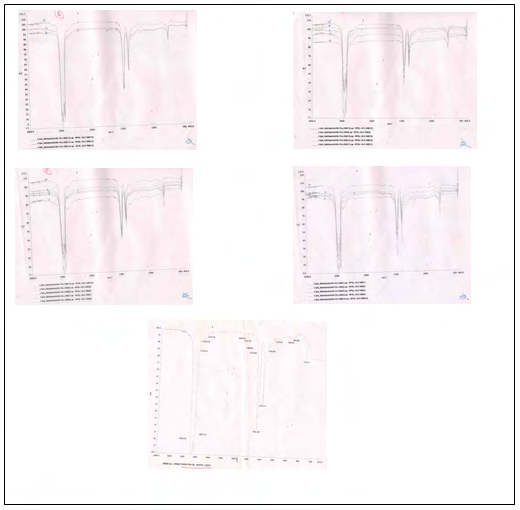
Software-spectrum version 6.2. The spectra generated by all the samples after an average of twelve scans were gathered and compared. Peaks of the spectra produced by all samples are overlapped for better comparison as shown in Figure 1 and a comparative observation table of wave numbers presented in Table 2.
IR absorption spectra were acquired on a Perkin Elmer Spectrum GX FTIR Spectrometer. The FTIR spectrum was recorded over the wavenumber range 4000cm-1 to 400 cm-1 in the form of thin films made with the help of Potassium bromide (KBr) pellets. Measurements of samples on FTIR instrument were done on the transmission mode by
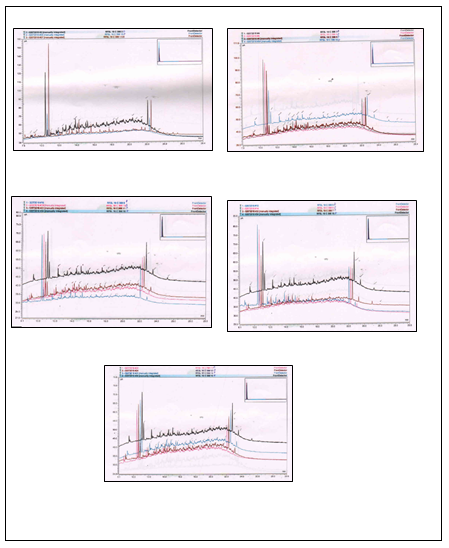
Thermo GC of model Trace 1300 was used for analysis and data was analysed in chromeleon chromatography data software. Literature suggests various GC and GC-MS method for analysis of TO [18, 19, 20]. 0.2 µl of sample was taken and Column: DB5ms Carrier gas: Hydrogen Injector Temperature: 290 ℃ Detector: 300 ℃ Temperature programme: 90 ℃ to 270℃ at rate 6℃/min and hold for 30 min made up to 2ml with chloroform. The results in comparison with the sample provided are presented in graph form in Figure 2. GC parameters were as below:
| Sample Num- ber | Wave Numbers |
|---|---|
| 1A | 2924,2855,2728,1462,1377,1304,1154,9 61,722,418 |
| 2A | 2924,2855,1463,1377,1155,722 |
| 3A | 2956,2924,2854,1462,1377,722,418 |
| 4A | 2955,2923,2854,1463,1377,722 |
| 5A | 2924,2855,1465,1463,1377,722 |
| 6A | 2920,2855,1456,1463,1377,722 |
| 7A | 2955,2924,2855,1462,1377,1154,722 |
| 8A | 2924,2854,2728,1463,1377,1155,966,7 22 |
| 9A | 2955,2924,2855,1462,1377,722 |
| 10A | 2955,2924,2855,1461,1377,722,418 |
| 11A | 2955,2924,2854,1463,1377,722 |
| 12A | 2954,2924,2854,1463,1456,1377,1155, 722 |
| 13A | 2923,2924,2854,2728,1457,1462,1377,1 154,722 |
| 14A | 2955,2925,2854,2728,1463,1377,1155, 722 |
| 15A | 2955,2925,2854,1460,1377,1155,722 |
| Paraffin oil | 2924,2852,2725,1461,1376,1160,968,7 20 |
Table 2: FTIR wave numbers comparison of all samples.
Results and Discussion
Theft of transformer oils is rampant and it cannot be prevented completely as reporting of such theft is few and far between mainly due to covert support from technical staff. Considering above, it becomes more important for forensic scientists to conclusively establish the seized TO as stolen and aid Law Enforcement Agencies in bringing the culprits to book. Nearly, all transformers in electric power delivery system round the world are filled with TO, primarily to function both as electric insulation and heat transfer. These fluids function reliably and efficiently to ensure uninterrupted power distribution and transmission. Although, Transformer Oils are good insulating material, but due to some inevitable factors they get contaminated during use. Therefore, analysis of physical parameters like RI was must as it reflects the quality of oil. The measure of RI provides information about its purity and turbidity. Temperature directly affects the RI so any change in temperature, is necessary to relate the change in RI of TO. Table 1 shows similarity in RI and temperature of all seized samples numbered 1A to 14A with standard/ original sample 15A during analysis on Digital Abbe’s Refractometer.
The quality of oil in the transformer plays a significant role in its performance. Therefore, plenty of work is done and literature is accessible which emphasises on the quality of TO and performance enhance capacity building of it. Immense data is available on determination of oxidation products, Polychlorobiphenyl in TO, oil spillage analysis, TO’s chemical composition, etc studied by different instruments like GC-MS, FTIR, TOGA. So far, many researchers have studied the powerful spectroscopic technique that involves electromagnetic radiation to understand the degradation processes of TO. This relevant characteristic of oil is the intrinsic property used in transformers to check the performance but in this case study, the requirement was to provide significant comparison of seized TO rather than studying on the specific component or its operating or controlled behaviour. For this purpose, FTIR and GC was instrument of choice as functional group identification was first necessary followed by chemical separation.
TO’s mainly constitute of aromatics, paraffins, naphthalene, olefins and hydrocarbon compounds. FTIR was used to identify the functional groups of seized material and standard provided. FTIR is used to gain quantitative information and compare the different compounds in fast, quick, easy and in consistent manner. In the present case FTIR absorption spectrum was used for comparison with the original/standard provided as the spectrum matches the constituents in the samples, especially the fingerprint zones which ranges from 400-1500cm-1 wave number and is highly specific for each material as shown in Figure 1 and Table 2. Results of FTIR showed chemical composition of the seized sample oil is paraffinic based oil which when compared with the composition of original/standard TO of BSES was found similar. Wave numbers 2924, 2852, 1461, 1376, 1160 and 722 of samples 1A to 15A showed matching with paraffin oil fraction. Paraffin oil spectrum from library was even studied and used for comparison as it emerged as the main constituent in TO samples. It was therefore, further concluded in the case study that this TO is paraffin-based oil and matches with the sample provided.
The samples 1A to 15A, when run on GC, displayed a similarity of peaks according to RT as shown in Figure 2. The comparative graphs of questioned samples were matched with the graph of reference sample peak by peak and respective RT. All the samples showed similarity in peak retention time with the sample 15A. Based on this, the analysis of chemical composition of the samples was not required once the oil finger printing was evident clearly by two different techniques. Finger printing process is used by the forensic scientist to reach conclusion when the samples in question are similar in nature and comparative data serves the purpose of Investigating Agency.
For forensic purposes, it was important to first identify the physical condition and then understand the composition of transformer oil involved for which restrictions are primarily concerned with used or unused oil or unauthorized possession to be made an offence which is satisfactorily done using these three techniques. This paper analyses, compares and evaluates the analytical results from all 15 samples which clearly states that the seized samples (1A-14A) were linked to be from the same source ie. Original sample (No 15A) and signifies pilfering of TO. The present case will also enhance forensic scientist’s knowledge and aid disposal of similar case rapidly.
Conclusion
Transformer Oils are used as coolant and insulation in electric transformers. Theft of Transformer Oil is a serious crime, so it is necessary to review laws on sabotage and related offences which facilitate illegal business-like smuggling, destruction and disruption in electricity supply causing unnecessary suffering to locals etc, so that they reflect the gravity of the crime and hence need regulation. Instrumental techniques FTIR, GC and Digital Abbe’s refractometer provided perfect accuracy and repeatable results for precise interpretation in qualitative analysis. There is a scope for more systematic study of various fuels with new approach to identify and classify them accurately.
Aknowledgement
Authors are thankful to Mrs. Deepa Verma, Director and Mr Srinarain, Head of Division (Chemistry), Forensic Science Laboratory, Rohini, Delhi, for their encouragement and support for conducting this research work.
References
-
Isaac Kaplan R, Jimmy Rasco, Shan Tan Lu (2010) Chemical Characterization of Transformer Mineral- Insulating Oils. Environmental Forensics 11(1-2): 117- 145.
-
Rouse TO (1998) Mineral Insulating Oil in Transformers. IEEE Electrical Insulation Magazine 14(3): 6-16.
-
Muhammad Rafiq, Yuzhen LV, Chengrong Li (2016) A Review on Properties, Opportunitis, and Challenges of Transformer Oil Based Nano fluids. Journal of nanomaterials 2016: 1-23.
-
(2019) Transformer Oil & its Evolution. Electrical India.
-
Kalathripi H, Karmakar S (2017) Analysis of transformer oil degradation due to thermal stress using optical spectroscopic techniques. Int Trans Electr Energ Syst 27(9): e2346.
-
Bhuvaneshwar (2014) Transformer oil theft worries Cesu. The Telegraph Online.
-
Amritsar (2019) Gang involved in theft of transformer oil busted in Amritsar, 15 arrested. Hindustan Times.
-
(2018) Theft of oil from transformers: Electricity department in ‘shock’. Mathrubhumi.
-
(2017) Transformer oil thefts disrupt power in Delhi areas. Business Standard.
-
(2015) Crime goes power(ful) with transformer oil theft!. Greater Kashmir.
-
Iraki XN (2014) Thieves fry Kenya’s power grid for fast food. Aljazeera.
-
(2019) Gang involved in theft of ‘valuable’ transformer oil busted by Mathura police, mastermind held. The Times of India.
-
Georgiev A (2008) Determination of oxidation products in transformer oils using FT-IR spectroscopy. Journal of Molecular Structure 872(1): 18-23.
-
Riley BJ, Lennard C, Fuller S, Spikmans V (2016) An FTIR method for the analysis of crude and heavy fuel oil asphaltenes to assist in oil fingerprinting. Forensic Science International 266: 555-564.
-
Munajad A, Subroto C, Suwarno (2018) Fourier Transform Infrared (FTIR) Spectroscopy Analysis of Transformer Paper in Mineral Oil-Paper Composite Insulation under Accelerated Thermal Aging. Energies 11(2): 364.
-
(2006) Abbe’ refractometer. In: Gooch JW (Ed.), Encyclopedic Dictionary of Polymers, Springer, New York.
-
Zakharich MP, Zaitsev II, Komar VP, Nikonovich FN, Ryzhkov MP, et al. (2001) Analysis of Transformer Oil using IR Analyzers. Journal of Applied Spectroscopy 68: 61-65.
-
Martinez HAR, Rodriguez GC, Castillo DH (2005) Determination of PCBs in Transformers Oil Using Gas Chromatography with Mass Spectroscopy and Aroclors (A1254:A1260). J Mex Chem Soc 49(3): 263-270.
-
Papzova D, Pavlova A (1999) Development of simple Gas chromatographic Method for Differentiation of Spilled Oils. Journal of Chromatographic Science 37(1): 1-4. 20. Pavlova A, Papzova D (2003) Oil Spill Identification by Gas Chromatography-Mass Spectrometry. Journal of Chromatographic Science 41(5): 271-273.
- Narcotics and Digital Forensics: Bridging Crimes in the Digital Age
- Ethics in Forensic Psychiatry: Principles, Dilemmas, and Human Rights
- Impact of Acute Stress on Attentional Orienting to Social Cues
- Head Injury and Intracranial Hemorrhage in Western Region of Libya
- A Forensic Study on Handedness: Examination of Handwriting Features in Right and Left Handed Writers
- Techniques for Latent Fingerprint Development Using Natural and Synthetic Powders: A Review