
High Energy Trauma in Relation to the Genesis of Nonunion in Tibial Shaft Fractures
Objective: To determine the relationship of high-energy trauma with nonunion of the tibial shaft fractures. Material and Methods: Observational, retrospective and cross-sectional study that included patients with a diagnosis of tibial nonunion with a history of high-energy trauma; high-energy trauma was assessed in relation to the genesis of nonunion in tibial shaft fractures; the relationship between both variables was determined. Data were analyzed using measures of central tendency and X2 test. Results: A total of 201 patients were obtained in total tibial shaft fractures from 2014 to 2018 (5 years), both of high and low energy trauma, female sex 42 patients (20.89%), male 159 patients (79.10%), with an average of 36.9 years of age; total nonunion in all patients 37 patients (18.40%), the external fixator in nonunion in 17 patients (45.94%), patients with plaque and posterior nonunion with high energy trauma in 10 patients (27.02%). Nonunion was recorded with high energy trauma at 55.22% and 44.77% low energy trauma with a statistical significance of p < 0.00058 and an X2 of 11.82 (RM = 23 and 95 % CI 21.6-25.4) Conclusions: High-energy trauma is related to the genesis of nonunion of any type in tibial shaft fractures.
Introduction
High-energy trauma produces the transfer of a large amount of energy between two or more bodies occurs from an accidental event that acts in three spheres: the object, the subject and their organs [1, 2]; According to the amount of this energy and its magnitude, events endanger life, a limb or an organ. According to the World Health Organization and the CDC, more than nine people die every minute from injuries or acts of violence and 5.8 million people of all ages and economic groups die each year from unintentional injuries and acts of violence [3], we must take into account that trauma represents 12% of the global burden of disease3; vehicular collisions (traffic accident trauma) cause more than one million deaths each year and about 20-50 million significant injuries, making it the leading cause of death from trauma, worldwide [3]. Currently more than 90% of vehicular collisions occur in developing countries and mortality from trauma is expected to rise dramatically by 2020 as a consequence of an 80% increase in current rates of the number of vehicular accidents in income countries medium and low [4, 5]. High-energy shaft tibial fractures are more frequently associated with vehicular accident trauma, in some studies, it is said that this type of high-energy trauma occurs in run over patients and that it is the most common fracture production mechanism (up to 59.2%). Treatment of tibial shaft fractures is governed mainly by the extent of the injury association to the soft tissues of the tibial shaft area. An exposed fracture is predictive of a high risk of nonunion, malunion and of reoperation. They can be related to the presence of long-term nonunion, as dictated by its classifications, after 9 months of absence of union of the shaft fracture traces once the corresponding surgical treatments are established [6, 7, 8, 9, 10]. The objective of the study was to determine the relationship of high-energy trauma with the genesis of nonunion of tibial shaft fractures.
Material and Methods
This study was carried out at the High Specialty Hospital of Veracruz, with a duration of 6 months to carry it out. Our universe of patients consisted of all patients with a shaft tibial fracture, including the files with said diagnosis, in addition to the classification of high-energy trauma from Snoek, A. from the Medical Center Alkmaar, Alkmaar, The Netherlands with the following characteristics:
High Energy Trauma Criteria [7]
Accident in a motor vehicle with a speed > 60 km / h (37 mph) Motor vehicle accident in which the vehicle was involved in a rollover Person ejected from the vehicle Pedestrian hit by a vehicle with a speed > 10 Km / h (6.2 mph) Cyclist hit with a speed > 20 Km / h (12.4 mph) Hit by motorized vehicle at a speed > 30 Km / h Drop from height > 5 meters (16.4 feet) As inclusion criteria we had patients with records that met the following characteristics: records of patients 18 years of age or older, of indistinct gender, with shaft tibial fracture, treated surgically, at the Regional Hospital of High Specialty of Veracruz, in the period from 2014 to 2018, with a complete file and with a minimum follow-up of 9 months.
Exclusion criteria: patients treated conservatively, who were underage patients and who did not have a full 9-month follow-up. As elimination criteria we only had incomplete files.
Only two of our study variables were taken, the dependent one, which was nonunion, and on the other hand, our independent variable that was high-energy trauma.
The files of the patients with the following inclusion criteria, age over 18 years, gender indistinct, With tibia fracture, Attended surgically, At the “Hospital de Alta Especialidad de Veracruz”, complete file, with a minimum follow-up of 9 months.
Exclusion Criteria: Patients treated conservatively, did not have complete follow-up.
Statistical analysis was performed with descriptive statistics with frequencies and percentages, inferential statistics, with measures of central tendency as median and X2 test.
Results
An observational, retrospective, cross-sectional and analytical study was carried out in patients with the diagnosis of shaft tibial fractures, and of which we intend to observe the relationship of high-energy trauma with nonunion genesis in this type of fracture and trauma.
Within the statistical data, we obtained 201 (100%) patients with shaft tibial fracture in their initial diagnosis from the year 2014 to 2018 (5 years), both high and low energy trauma, we obtained that the female sex had 42 patients, which corresponds to 20.89%, and within the male sex, 159 patients were obtained, of which corresponds to 79.10 % of the total, the age of the patients was from 18 years to 79 years, with a mean of 36.9 years old.
Among these patients, high-energy fractures correspond to 111 (55.22%), of low-energy 90 (44.77%); total patients with high energy nonunion 30 (14.92%), total patients with low energy nonunion 7 (3.48%), total patients without nonunion but with high energy trauma 82 (40.79%), total of patients without nonunion but with low energy trauma 82 (40.79%).
Within 100 % of all patients with a tibial shaft fracture, 65 patients (32.33%) underwent osteosynthesis with a locked medullary nail to the tibia, in 72 patients (35.82%) osteosynthesis with a tibial plate, 63 patients (31.34%) with osteosynthesis with external fixator; in 164 (81.58%) of all of them the stability of the fracture was sufficient for its consolidation, and only in 37 patients (18.40%) the stability was insufficient, for which the subsequent observation was required if the consolidation was performed, but when see that 9 months after it, the non-union was not consolidated and the non-union was generated, another surgical treatment is decided to be able to carry out the consolidation plus the autologous osteogenic contribution to the non-union site and also rethink the type of biomechanical principle and also the type of implant according to the type of non-union to which the patient was affected.
Among all the patients with a tibial shaft fracture (201 = 100%), we found 37 patients with nonunion (18.40%); Of all the patients with nonunion of the tibia, we found that there were nonunion patients with high energy trauma and surgery with an external fixator in 17 of them (45.94%), patients with nonunion with low energy trauma and surgery with an external fixator in 5 patients (13.51%), patients with nonunion with high energy trauma and plaque surgery 10 (27.02%), patients with nonunion with low energy trauma and plaque surgery in 1 (2.7%), patients with no union with high-energy trauma and surgery with a blocked centromedullary nail in 1 (2.7%), and non-union patients with low-energy trauma with surgery with a blocked centromedullary nail in 1 (2.7%). (Table 1) (Figure 1)
| Nonunion | High energy trauma | Low energy trauma |
|---|---|---|
| External fixator | 17 (45%) | 5 (13.5%) |
| Plate | 10 (27.02%) | 1 (2.7%) |
| Endomedullary nail | 1 (2.7%) | 1 (2.7%) |
Table 1: Treatment of nonunion in tibial shaft fractures in high-energy and low-energy trauma.
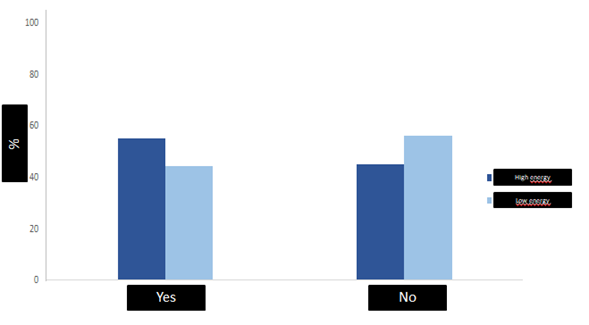
Non-union was recorded with high energy trauma in 55.22% and 44.77% with low energy trauma with a statistical significance of p < 0.00058 (OR = 23 and 95% CI 21.6 -25.4) (table 2)
| Trauma | With pseudoarthrosis N (%) | Without pseudoarthrosis N (%) | X2 | p |
|---|---|---|---|---|
| high-energy | 30(79%) | 11 (43%) | 5.3123 | 0.05* |
| no high energy | 64 (21%) | 6 (57%) | ||
| Total | 94 (100%) | 17 (100%) | ||
| with low energy | 7 (78%) | 14 (54%) | 2.61 | 1.065 |
| no low energy | 64(22%) | 5(46%) | ||
| Total | 71(100%) | 19 (100%) |
Table 2: Treatment of Pseudarthrosis in tibial shaft fractures associated with high-energy and low-energy trauma.
Discussion
In our study, it was confirmed that high-energy trauma is related to the genesis of nonunion of any type in tibial shaft fractures; however, we must remember that the type of biomechanical principle and the configuration of the fracture will always dictate its definitive treatment.
High-energy trauma, related to surgery with insufficient biomechanical principle according to what the fracture indicates from its diagnosis, with a poorly applied or inadequate implant, leads to the genesis of non-union after 9 months of follow-up of the patient. It was observed that the percentage of non-union genesis with the external fixator as the definitive treatment has high presentation rates, compared to osteosynthesis with a plate and ultimately with the centromedullary nail, which is the treatment of choice for this type of fracture [1, 2, 3, 9].
According to Snoek, et al [7], the criteria for cataloging high-energy trauma serve as a guideline to always prioritize their needs in an emergency service, and subsequently check with the other services the subsequent treatments that patients require and the protocol of agreement must be kept to pathologies that endanger the life of the patient. The characteristics of our patients include the majority of those with high-energy trauma, who also had the criteria proposed by Snoek in his article to classify patients in the emergency department in the Netherlands as inclusion criteria. From here, we were able to observe that according to this, we were able to obtain significant patients with such characteristics for the study that allowed us to screen the information to identify those patients who may have complications long after having had the accident [7]. The threshold to be able to discern between patients who can be taken to a lower limb amputation and those who must undergo other procedures such as bone grafts, vascularized grafts, among others, according to classifications such as that of MESS, which includes certain parameters to be able to decide the definitive treatment in this type of patients. Bosse, et al. found that patients with high-energy trauma to the lower limb present challenges in their treatment, despite taking into account the reconstruction or rehabilitation of the affected limb of the patients since it is related to the patient mortality and high hospital costs [10].
In another study, Camporro-Fernández, et al. comment on the treatment of Gustilo and Anderson grade IIIB and IIIC open tibial fractures with microvascularized free flaps, comment that debridement and bone stabilization were performed from day 1 of the injury, where they had to be performed from 1 to 3 of them until their wound coverage, having an average of 9.3 days of soft tissue coverage in the injury, obtained primary consolidation in 23 cases (47%) of the patients and had 94% of the legs saved, and a close relationship between traumatologists and plastic surgeons is recommended for the treatment of these patients, and they believe that adequate coverage with microvascularized flaps is key to obtaining consolidation, without infection, of these types of fractures. Affected were males in their study (43 males = 86%, 6 females = 14%), as in this research study [6].
In our cases, we only perform debridements and in some cases decortication to be able to carry out the consolidation of the fractures, we do not perform any microvascularized flap, which must be performed and considered in the patients and another study to be able to carry out better treatment and prevent patients from leading to nonunion. According to these authors, non-union was one of the late complications of high-energy trauma, in addition to brain problems such as head trauma, pulmonary contusions, rib fractures, fractures elsewhere in the skeleton, both appendicular and axial, etc. which should have priority to safeguard the lives of patients, according to Advanced Trauma Life Support (ATLS) [3, 11].
References
-
Jorge Aviña Valencia A, Graciela Gallardo García (2011) Trauma de alta energía. Alfil.
-
Víctor Cuacuas Cano, Martínez ME, Torres Méndez JL, Aureoles EH (2008) Trauma de alta energía y su respuesta inflamatoria sistémica. Ortho-tips 4(1): 39-50.
-
(2012) American College of Surgeons. Committe on Trauma. ATLS Chicago.
-
Charles Court Brown M, James Heckman D, Margaret McQueen M, William Ricci, Paul Tornetta III, et al. (2015) Rockwood and Green’s fractures in adults. Wolters Kluwer Health.
-
Nandra R, Grover L, Porter K (2015) Fracture non-union epidemiology and treatment. Trauma 18(1): 3-11.
-
Camporro Fernández D, Ontaneda Rubio A, Castellanos Morán M (2015) Tratamiento de fracturas abiertas de tibia grado IIIB-IIIC de Gustilo con colgajos libres microvascularizados. Cirugia Plastica Ibero- Latinoamericana 41(3): 283-293.
-
Snoek A, Dekker M, Lagrand T, Epema A, Van Der Ploeg T, et al. (2013) A clinical decision model identifies patients at risk for delayed diagnosed injuries after high-energy trauma. European Journal of Emergency Medicine 20(3): 167-172.
-
Stefanopoulos PK, Mikros G, Pinialidis DE, Oikonomakis IN, Tsiatis NE, et al. (2019) Wound ballistics of military rifle bullets: An update on controversial issues and associated misconceptions. Journal of Trauma and Acute Care Surgery 87(3): 690-698.
-
Paryavi E, Stall A, Gupta R, Scharfstein DO, Castillo RC, et al. (2013) Predictive model for surgical site infection risk after surgery for high-energy lower-extremity fractures. Journal of Trauma and Acute Care Surgery 74(6): 1521- 1527.
-
Bosse MJ, MacKenzie EJ, Kellam JF, Burgess AR, Webb LX, et al. (2001) A prospective evaluation of the clinical utility of the lower-extremity injury-severity scores. J Bone Joint Surg Am 83(1): 3-14.
-
Fox CJ, Kreishman P (2010) High-energy trauma and damage control in the lower limb. Seminars in Plastic Surgery 24(1): 5-10.
- Forensic Implications of Adverse Drug Reactions in Schizophrenia A Case Series
- Narcotics and Digital Forensics: Bridging Crimes in the Digital Age
- Ethics in Forensic Psychiatry: Principles, Dilemmas, and Human Rights
- Impact of Acute Stress on Attentional Orienting to Social Cues
- Head Injury and Intracranial Hemorrhage in Western Region of Libya
- A Forensic Study on Handedness: Examination of Handwriting Features in Right and Left Handed Writers