
Alcohol Use and Topography of Traumatic Injuries as Factors Leading to Road-Related Deaths; A 5-Year Study in Western Romania
We analyzed the cases of road related deaths autopsied at the Institute of Forensic Medicine in Timisoara during a five-yearperiod (2016-2020). We evaluated the types of trauma and the location of injuries, depending on the role they played: driver, passenger, motorcyclist, cyclist or pedestrian. We identified 397 cases. The presence of fatal injuries to the head, neck, thorax, abdomen and limbs were observed. The most common cause of death was multiple trauma (82.36% cases), followed by cranio-cerebral injury (16.12% cases), spinal injury (4 cases), decapitation (one case) and carbonization (one case). We also determined the alcohol blood level in the study group, given the well known role of alcohol use in the determinism of traffic accidents. We found 92 cases with blood alcohol levels ranging between 0.06g‰ and 3.48g‰. In 163 of the cases the persons were not under the influence of alcohol at the time of the traffic accident, and in 142 cases no biological samples were collected in order to determine the blood alcohol level (in the cases of persons who were hospitalized for more than 24 hours and in cases of children and teenagers involved as passengers in vehicles).
Background
The Global Status Report on Road Safety 2018, issued by the World Health Organization in December 2018, shows that the number of annual deaths caused by road accidents has reached 1.35 million [1]. In Europe, driving under the influence of alcohol is considered to be responsible for 10,000 deaths each year [2].
Road accidents are the leading cause of death for people aged 5-29 years [1].
In Romania, according to the Code of Criminal Procedure, forensic autopsies are mandatory in cases of violent or suspicious deaths and when the cause of death is unknown [3]. In the case of persons who die in road accidents, the role of the forensic expert is to determine which are the traumatic injuries detected during the external and internal examination of the corpse, the objects that produced them, the mechanisms by which the injuries were produced, and to establish the cause of death [4]. The types and locations of injuries also depend on the role of the victim in the road accident (driver, passenger, pedestrian, motorcyclist, cyclist) [5].
The causes of road accidents are complex, but mainly depend on the skills of the driver. Lack of experience and irresponsible behavior are elements that have been identified more often in the case of young drivers compared to drivers in other age groups. Data on the causes of road accidents in the case of young drivers most typically identified are reckless driving, violation of traffic rules, as well as alcohol and drug use [6].
Alcohol use is part of many social and cultural practices and its traditional role in social bonding is widely recognized. But the other side of alcohol must also be taken into consideration: pathologies due to chronic use, as well as violent incidents committed by people under the influence of alcohol. The role of alcohol use in traffic accidents is well known. It is associated with impaired driving ability and increased risk of accidents [7], therefore laws on driving under the influence of alcohol are present in the legislation of all states. According to the Romanian legislation, the blood alcohol level of 0.8g‰ in drivers represents the threshold between misdemeanour and felony.
There are numerous studies that have investigated the effects of alcohol use on driving skills. The study conducted by Irwin C, et al. for the assessment of simple reactions and motor coordination using computer simulation showed differences between the group that was under the influence of alcohol and the control group [8]. Nash demonstrated that drivers who drank alcohol were distracted when they were asked to perform a specific task [9]. Alcohol use can affect the vigilance, attention, and judgment and reaction speed of drivers, factors which have been closely related to their driving ability [10]. It is estimated that alcohol use increases the tendency to take risks [11]. Decreased attention spam, decreased control of simple tasks and increased tendency to take risks are the major dangers of driving under the influence of alcohol [12].
The main objective of preventive programs is addressed to the driver who has consumed alcohol. It is known that the driver’s attention and driving skills decrease directly proportional with the increase of the amount of alcohol ingested. But it is not only the driver’s alcohol use that contributes to the genesis of traffic accidents. Passengers under the influence of alcohol can also have a minor contribution, because they can distract the driver. The alcohol use in pedestrians should not be neglected either [13].
Material and Methods
We conducted a study on road-related deaths at the Institute of Forensic Medicine in Timisoara over a five-year period, between 2016 and 2020.
The inclusion criterion in the study group was represented by the involvement of the deceased in road accidents, regardless of the role they played: driver, passenger, motorcyclist, cyclist, pedestrian, respectively teamster. We included both persons who died immediately after the traffic accident and people who were hospitalized and died after various survival intervals.
In order to determine the alcohol blood levels, blood from the femoral artery was collected. The chemical analysis was performed using the gas-chromatographic method, with flame ionization detector, vapor space method (GS-HS), at the Forensic Toxicology Laboratory of the Institute of Forensic Medicine in Timisoara. This method uses tert-butanol as an internal standard and ammonium sulfate as a modifier of the distribution coefficient.
Results and Discussions
At the Institute of Forensic Medicine in Timisoara, over a five-year-period, between 2016 and 2020, a total of 3742 forensic autopsies were performed. Of these, 10.6% were road-related deaths.
Regarding the role of the deceased in the accidents, we found 120 drivers, 60 front seat passengers, 44 rear seat passengers, 22 motorcyclists, 46 cyclists, 104 pedestrians, and 2 teamsters (drivers of horse-powered vehicles).
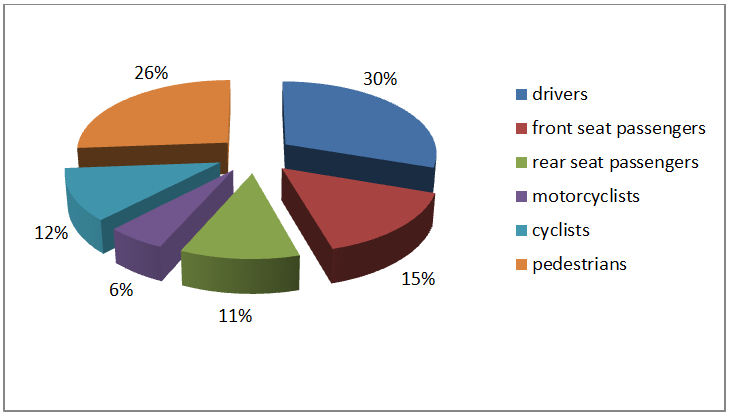
In most cases the victims were drivers. We note, however, that the number of pedestrians is close to the number of drivers.
According to the World Health Organization (WHO), more than half of all road deaths involve vulnerable road users, namely pedestrians, cyclists and motorcyclists [13]. In our study, the sum of vulnerable road users is 172, which exceeds the number of drivers.
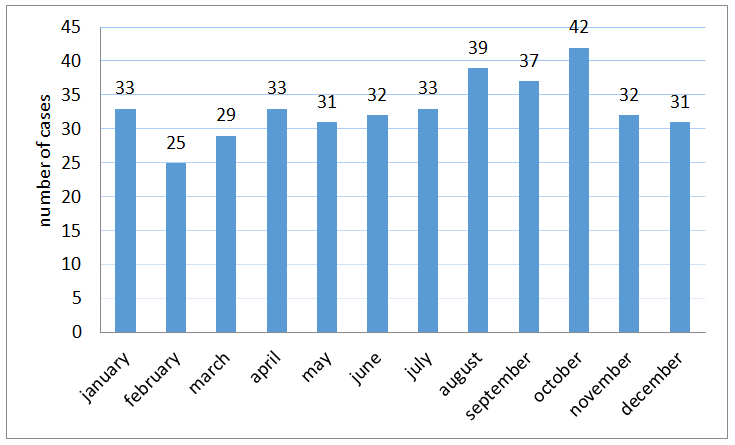
Regarding the monthly distribution of cases, we observe a relatively uniform distribution of the cases, with a maximum in October.
In terms of gender distribution, 291 of the road-related victims were male and 106 female. According to World Health Organization records, the ratio of men/women in fatal vehicle collisions worldwide is 2.7: 1 [14]. We observe the same distribution in our study.
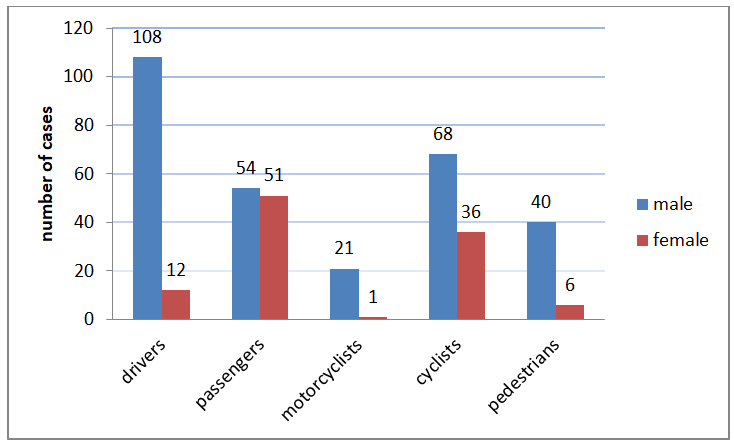
We notice that in all categories of participants in traffic, the number of male victims is higher than the number of female victims. The most significant difference is observed in the case of drivers, and the less significant difference is in the case of passengers.
In the study group, male victims were drivers in 107 cases, pedestrians in 68 cases, passengers in 53 cases (31 front seat passengers and 22 as rear seat passengers), cyclists in 40 cases, motorcyclists in 21 cases. In one case the victim was a teamster, while in another case the victim was a passenger in a horse-powered vehicle (wagon).
Female victims were passengers in 51 cases (29 front seat passengers and 22 rear seat passengers), pedestrians in 36 cases, drivers in 12 cases, cyclists in 6 cases. In one case the victim was a motorcycle passenger.
Nagoshi, et al. showed that male drivers, under the influence of alcohol, are more impulsive and more eager to seek sensation compare to female drivers under the influence of alcohol [15].
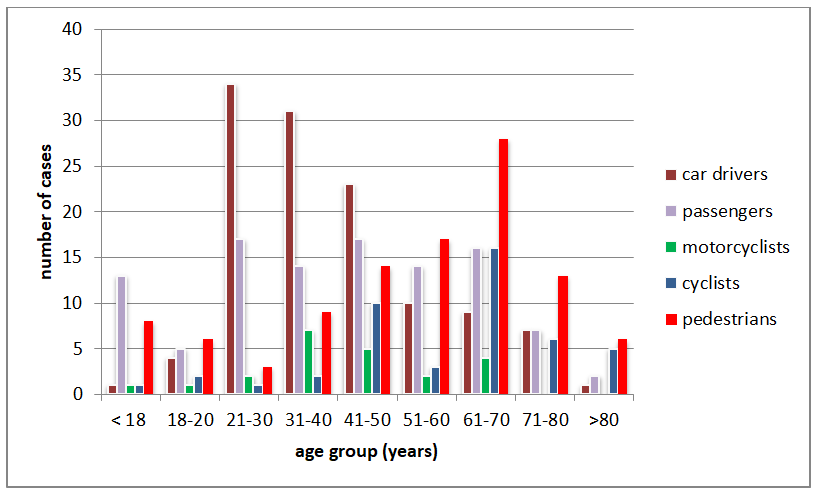
As far as age distribution is concerned, we found the largest number of cases among drivers in the age group 21- 40, followed by a linear decrease with age. The study made by Zador shows that at the same value of alcohol blood levels, young drivers have a higher relative risk of accident than older drivers [16]. We notice an increase in the number of cases for pedestrians starting with the age group 41-50, reaching a maximum in the 61-70 age group. There are also fewer cases in the underage group (under 18-years old). The extremes are represented by a 3-month-old infant and a 95-year-old man, both involved in the accident as passengers.
It is also worrying that we found 18 children and teenager victims, 10 of them passengers in the rear seat and 8 pedestrians.
Alcohol Use
Blood was sampled in 255 and the alcohol blood levels at the moment of the accident were determined. In 163 cases the victims were not under the influence of alcohol at the time of the traffic accident. In 92 of the cases the detected values ranged between 0.06g‰ and 3.48g‰. In 142 cases no biological samples were collected to determine the blood alcohol level (because the victims had been hospitalized for more than 24 hours prior to death or the victims were children and teenagers involved as passengers). In 25 of the 92 cases with alcohol imbibition, the levels were lower than 0.80g‰, and in 67 of the cases the blood alcohol levels were higher than 0.80g‰.
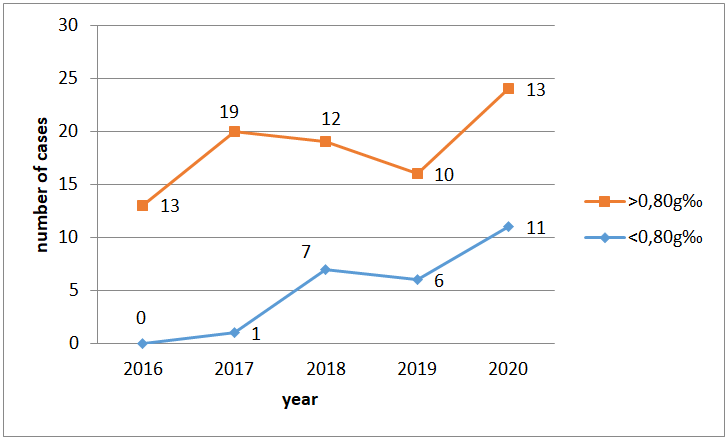
Among the drivers, we found that in 54 cases they were not under the influence of alcohol, in 5 cases they had blood alcohol levels below 0.80g‰ and in 26 cases the blood alcohol levels were between 0.80g‰ and 3.40g‰. In 35 cases no biological samples were collected - these were the cases of victims who were hospitalized for more than 24
hours. Studies show that even after ingesting small amounts of alcohol, the drivers are twice as likely to be involved in traffic accidents in comparison with drivers who have not consumed alcohol [17].
Studying the use of alcohol among pedestrians, we found 29 cases under the influence of alcohol (blood alcohol levels ranging between 0.06g‰ and 3.10g‰), 33 cases that were not under the influence of alcohol and 42 of the cases with hospitalized victims, where no biological samples were collected in order to determine the blood alcohol level. Of the 104 pedestrian victims, 68 were male and 36 were female.
Traumatic Injuries
Injuries of the Cephalic Extremity
We found neuro-cranial (arch and/or base skull) fractures in 179 cases, in 48 cases viscerocranial fractures, in 10 cases extradural hematomas, subdural hematomas in 70 cases, leptomeningeal hemorrhage in 147 cases and brain damage (contusions and lacerations) in 123 cases.
Injuries of the Spine
In 22 cases, atlanto-occipital disjunctions were identified, in 61 cases fractures of the cervical spine (10 cases with myelinated involvement, 51 cases of amyelemic), and in 87 cases fractures of the thoraco-lumbar spine were detected.
Injuries to the Chest and Organs of the Thoracic Cavity
We found 282 cases with sterno-costal fractures, 219 cases with pulmonary contusions and lacerations, 79 cases with cardiac contusions and lacerations, 32 cases with ruptures of large vessels (aorta and/or pulmonary), 24 cases with ruptures of the diaphragm, and 209 cases with hemothorax.
Injuries of the Abdominal Organs
Liver contusions and lacerations were most common (in 154 cases), as well as spleen contusions and lacerations (in 102 cases), followed by renal contusions and lacerations in 73 cases, mesenterium ruptures in 17 cases and pancreatic contusions and lacerations in 15 cases.
Limb Injuries
In 155 cases we found lower limb fractures, in 99 cases fractures/disjunctions of the pelvic bones and in 97 cases fractures in the upper limbs.
Correlations between Types and Topography of Injuries and Alcohol Imbibition
The collected data were processed as a database using the Microsoft Excel program, a component of the 2007 Microsoft Office package. Subsequently, these data were processed statistically through the STATA 12 programme (STATA Corp, College Station, TX).
We have identified the following significant correlations. Subdural hematoma (p=0.088), altanto-occipital disjunction (p=0.011), fractures of cervical spine with myelinated involvement (p=0.005), sterno-costal fractures (p=0.001), pulmonary ruptures and contusions (p=0.000), hemothorax (p=0.001), ruptures of large vessels (aorta and/or pulmonary) (p=0.004), ruptures of the diaphragm (p=0.027), liver contusion and laceration (p=0.023), renal contusions and lacerations (p=0.002), mesenterium ruptures (p=0.017), fractures in the upper limbs (p=0.0018).
We appreciate that in the case of persons under the influence of alcohol, one of the reasons for traumatic injuries is also represented by the inhibition of defensive reflexes/ reactions.
The Survival Interval
In 249 cases, the victims died on the scene, while in the rest of the cases they survived and were hospitalized for various time intervals, ranging from a few hours to 9 months. In 110 cases, the victims died within the first 30 days after the accident, while in 38 cases, the survival interval was longer than 30 days.
The World Health Organization and the literature label as death due to vehicle collisions the cases in which death occurs in the first 30 days after the accident [18].
The legislation in our country does not establish a maximum time interval between the moment of the traffic accident and the moment of the victim’s death. The forensic autopsy is mandatory even if more than 30 days have passed since the date of the road accident. In these particular situations, the role of the forensic autopsy is also to establish the presence or absence of a direct or indirect causal link between the initial injuries due to the traffic accident and the cause of death.
The Cause of Death
The most common cause of death was multiple trauma (82.36% of cases), followed by cranio-cerebral trauma (16.12% of cases), spinal injury in 4 cases and decapitation in one case (a 45-year-old male victim, motorcyclist in collision with a car). In one case the cause of death was carbonization (a 38-year-old male driver, whose vehicle caught fire after the impact).
Conclusion
Between 2016 and 2020, 397 victims of traffic accidents were autopsied at the Institute of Forensic Medicine in Timisoara. In most cases, the victims were drivers, but the number of summed vulnerable road users, namely pedestrians, cyclists and motorcyclists, is much higher. In terms of the role played in the accident, similarly to data reported by other authors, young men make up for most of the victims of traffic accidents, and the reasons are the same: lack of experience, risk-taking, speed, and, last but not least, driving under the influence of alcohol. In 163 cases, the victims were not under the influence of alcohol at the time of the traffic accident. In 92 cases the found alcohol blood levels ranging between 0.06g‰ and 3.48g‰. No biological samples were collected for blood alcohol level tests in 142 of the cases (victims who were hospitalized for more than 24 hours, children and adolescents passengers). Of the 92 cases with alcohol imbibition, in 25 cases the blood alcohol levels were lower than 0.80g‰, and in 67 of the cases the blood alcohol levels were higher than 0.80g‰. Although literature describes mechanisms of injury and, implicitly, the specific injuries in traffic accidents, in relation with the role of the victims, our study showed no significant correlation. The characteristics of traffic accident injuries depend on other factors as well: direction of impact, speed in the moment of impact, use of seat belts and other protective equipment and the dynamics of the vehicle after impact.
Author’s Contributions
MCO and EA contributed in the conceptualization and design of the study, MCO writing original and draft preparation, DR formal analysis, resources, SE, US, supervision, CV, corresponding author. All the authors have read and approved the final version of this manuscript.
Ethics approval no 21/2015 was made by the Ethical Commission of Research of UMFT.
References
-
WHO (2018) Global status report on road safety. World Health Organization.
-
European Commission (2003) Saving 20000 lives on our roads, Tech. Rep. COM 2003/311, European Road Safety Action Programme. Luxembourg.
-
Romanian Code of Criminal Procedure. Art. no. 185.
-
Enache A, Chatzinikolaou F, Enache F, Enache B (2009) The analysis of lethal traffic accidents and risk factors. Legal Medicine 11(1): S327-S330.
-
Kibayashi K, Shimada R, Nakao KI (2014) Fatal traffic accidents and forensic medicine. IATSS Research 38(1): 71-76.
-
Rolison JJ, Regev S, Moutari S, Feeney A (2018) What are the factors that contribute to road accidents? An assessment of law enforcement views, ordinary drivers’ opinions, and road accident records. Accident Analysis & Prevention 115: 11-24.
-
Smink BE, Egberts TCG (2009) The relationship between drug use and traffic accident severity. In: Verster JC, Pandi Perumal SR, Ramaekers JG, de Gier JJ (Eds.), Drugs, Driving and Traffic Safety. Birkhäuser Basel, pp: 135- 150.
-
Irwin C, Iudakhina E, Desbrow B, McCartney D (2017) Effects of acute alcohol consumption on measures of simulated driving: a systematic review and meta- analysis. Accid Anal Prev 102: 248-266.
-
Nash H (1962) Alcohol and Caffeine: A Study of Their Physiological Effects. Charles C Thomas, Springfield.
-
Chamberlain E, Solomon R (2002) The case for a 0.05% criminal law blood alcohol concentration limit for driving. Injury Prevention 8(3): iii1-iii17.
-
Weafer J, Fillmore MT (2012) Comparison of alcohol impairment of behavioral and attentional inhibition. Drug Alcohol Depend 126(1-2): 176-182.
-
Yoko Nishitani (2013) Alcohol and traffic accidents in Japan. IATSS Research 43(2): 79-83.
-
WHO (2018) Global status report on alcohol and health. World Health Organization.
-
Peden M, Scurfield R, Sleet D (2004) World report on road traffic injury prevention. World Health Organization.
-
Nagoshi CT, Wilson JR, Rodriguez LA (1991) Impulsivity, sensation seeking, and behavioral and emotional responses to alcohol. Alcohol Clin Exp Res 15(4): 661- 667.
-
Zador PL (1991) Alcohol-related relative risk of fatal driver injuries in relation to driver age and sex. Journal of Studies on Alcohol 52(4): 302-310.
-
Arnedt A, Wilde W, Munt M, Maclean M (2000) Simulated driving performance following prolonged wakefulness and alcohol consumption: separate and combined contributions to impairment. Journal of Sleep Research 9(3): 233-241.
-
Ampanozi G, Kovatsi L, Smyrnakis L, Zaggelidou E, Gavana M, et al. (2011) Analysis of fatal motor vehicle collisions: evidence from Central Macedonia, Greece. Hippokratia 15(1): 32-36.
- Forensic Implications of Adverse Drug Reactions in Schizophrenia A Case Series
- Narcotics and Digital Forensics: Bridging Crimes in the Digital Age
- Ethics in Forensic Psychiatry: Principles, Dilemmas, and Human Rights
- Impact of Acute Stress on Attentional Orienting to Social Cues
- Head Injury and Intracranial Hemorrhage in Western Region of Libya
- A Forensic Study on Handedness: Examination of Handwriting Features in Right and Left Handed Writers