
Forensic Image and Spectral Analysis of 500 Rupee Note in a Banking Fraud Case
With the availability of new-age technology, printing and circulation of higher denomination counterfeit bank notes i.e. 2000 - Rupee and 500 - Rupee are reported to be alarming in the country. Sometimes the quality of FICN printing is so sophisticated even it escapes from detection during transaction. In one case, a fraudster tried to deposit large quantities of 500 - Rupee counterfeit notes intermingled with some genuine notes to one of the nationalized banks. The cashier in the course of counting suspected genuineness of hundred pieces of notes kept in different bundles received for deposit. The fraudulent customer, was detained for further investigation. Similarly, in the same bank, an unknown customer had access for cash deposit and seventy pieces of 500 - Rupee counterfeit notes were forged in the cash deposit machine (CDM). Since the machine had scanner to detect counterfeit notes, automatically verified them without any system generated report. After the transaction hour, the cashier of the bank while collecting the cash from the machine, could find some counterfeit notes were separately segregated inside. The counterfeit notes were collected. Subsequently, the manager of the bank lodged an FIR for both the cases in the local police station. The disputed notes were seized by the investigator and forwarded for forensic examination. The different examination like physical, microscopic, spectral analysis and image forensic study could help to differentiate the genuine and counterfeit notes to establish the crime. The details have been discussed in this paper.
Introduction
Keeping in view of the market needs and other requirements, the 500 - Rupee denomination notes were printed in the recent past for the following reasons [1, 2]: • Convenient for handling heavy transaction.
- Economical than printing several notes of lower denomination.
- Convenient to carry good amount of money accommodating in wallet.
- Requirement of higher denomination currency due to inflation and economic growth.
- It also helps to hoard good amount of notes.
In addition, the appetite for the big bill 2000 - Rupee and 500 - Rupee is growing furiously and the growth in the value of bank notes outpaced that of volume, reflecting the compositional shift towards higher denomination bank notes, particularly 2000 - Rupee and 500 - Rupee notes.
Conventionally currency notes are examined by look, feel and tilt during transaction among the common people. When the fake currencies are seized and sent for forensic examination, the routine tests through illuminating magnifying glass, microscopic and instrumental studies are conducted to identify and establish the genuineness [3]. The genuineness of the notes is established after verification of the security features like water mark, see through register, latent image, OVI, micro letters RBI and 500, color shift windowed security thread, intaglio printing, Gandhi portrait etc. prescribed by the RBI. In addition to the conventional tests, a new approach like spectral studies and image forensic have been done and their results are found to be helpful in distinguishing the Genuine/Counterfeit note [4]. Case Report 1 In one case, a customer came to deposit Rupees two lakhs forty-five thousands in one nationalized bank. All the bank notes were 500 - Rupee denomination. In the course of counting, the cashier could detect about hundred pieces suspicious note kept in different bundles received for deposit. On further scrutiny with available detective tools, it was suspected to be counterfeit notes. The bank manager
lodged an FIR in the local police station and the police seized the notes in presence of the witnesses. The suspect was guilty in possession of counterfeit notes under IPC section 489(B)/489(C).
Case Report 2
A fraudster came to bank and deposited seventy pieces of 500 - Rupee counterfeit notes in the cash deposit machine (CDM) of one nationalized bank. Since the machine had scanner to detect counterfeit notes, automatically separated them. On opening the CDM, the fact was known from system generated report. Subsequently the case was registered in the local Police Station and counterfeit notes were seized for forensic examination. The case was registered under section 157 Cr.P.C.
Materials and Methods
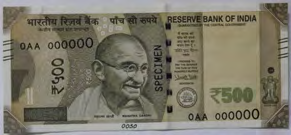
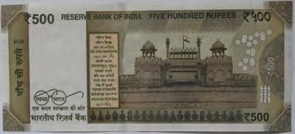
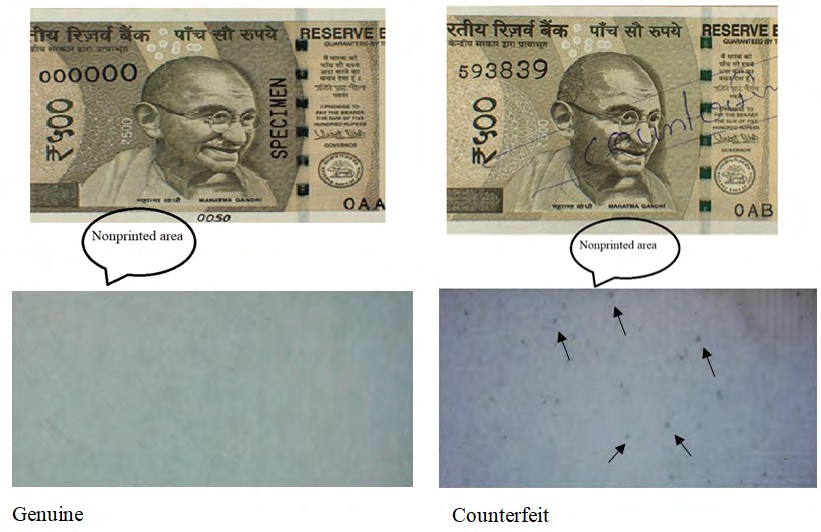
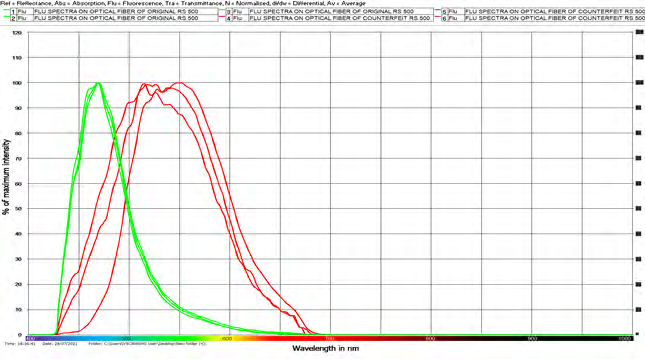
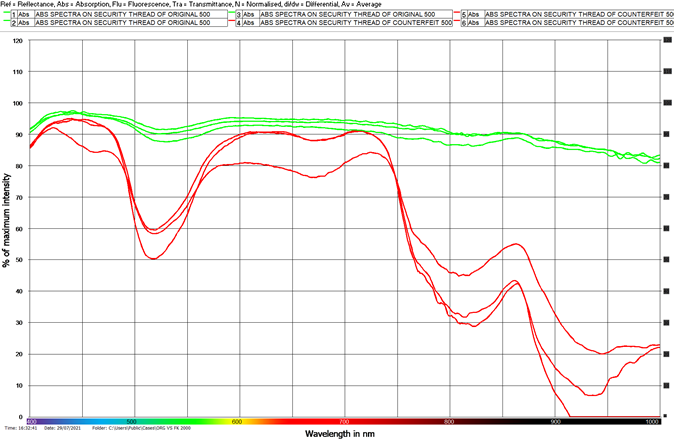
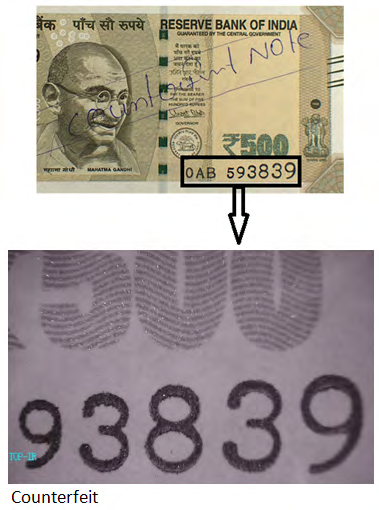
The genuine 500 - Rupee bank note (specimen) received from RBI and seized counterfeit notes 500 - Rupee are shown at Figure 1, 1(a) and 2, 2(a). The results of different physical parameters are shown at Table-1 & microscopic, spectral studies conducted by VSC8000 HS along with image histogram analysis are shown in Figure-3, 3(a), 4, 5, 6, 6(a), 7 & 7(a).
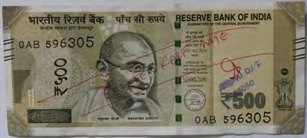
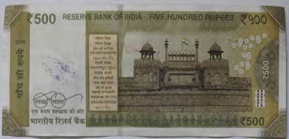
The Physical parameter on Indian Rs 500 denomination Genuine and Counterfeit notes are shown at Table-1 (Two notes from each category were taken for physical parameter study).
| Different Physical Parameter | Two Genuine notes undertaken for study | Two seized counterfeit notes undertaken for study | |
|---|---|---|---|
| 1. | Weight | 0.946 gm | 1.019 gm |
| 1. | Weight | 0.946 gm | 1.016 gm |
| 2. | Size | 66 X 150 mm2 | 65 X 151 mm2 |
| 2. | Size | 66 X 150 mm2 | 65.5 X 151 mm2 |
| 3. | Thickness | 0.08 mm | 0.09 mm |
| 3. | Thickness | 0.08 mm | 0.089 mm |
| 4. | Look | 100% Perfect | Look like genuine |
| 4. | Look | 100% Perfect | Look like genuine |
| 5. | Touch effect | Crackling sound | Difficult to distinguish by a common man |
| 5. | Touch effect | Crackling sound | -do- |
| 6. | Tilt effect | Proper display of variable ink observed | Not perfectly display |
| 6. | Tilt effect | Proper display of variable ink observed | Not perfectly display |
| 7. | Specific Gravity | 1.19759 | 1.15356 |
| 7. | Specific Gravity | 1.19759 | 1.15421 |
| 8. | Braille mark | Felt on touch | Presence not felt on touch |
| 8. | Braille mark | Felt on touch | Presence not felt on touch |
| 9. | GSM Value | 95.5 gm/m2 | 103.82 gm/m2 |
| 9. | GSM Value | 95.5 gm/m2 | 102.72 gm/m2 |
Table 1: Physical parameter.
Microscopic Study
Bank notes are generally made of cotton paper mixed
with linen or other types of fiber to increase its life. The chemistry of the pulp composition used for government currency notes is kept secret for various reasons.
The microscopic view was observed by Trinocular HD Stereomicroscope Model-RELIFE RL M3 T on individual note each time taking four numbers of genuine and counterfeit notes separately. In all the samples, identical microscopic views for each category of note were observed in Figure 3 & 3(a). In case of genuine note, the microscopic view of all the notes were uniform and spotless/ grain free due to standard fibre used in the process of making pulp for government currency paper, whereas the microscopic view in four different counterfeit notes was non uniform having undigested pigment as shown in Figure 3(a) at different places on the paper surface. The different microscopic view is due to different paper quality and secret formula used for making pulp for processing government currency paper. The microscopic view of the unprinted area of the currency paper in both genuine and counterfeit notes suggests different origin/quality. Spectral Analysis The spectral analysis were done by VSC 8000HS (Make- Foster + Freeman, UK)
Observation under IR
The genuine and counterfeit 500 Rupee denomination notes were exposed to IR (860 nm). In case of genuine, no
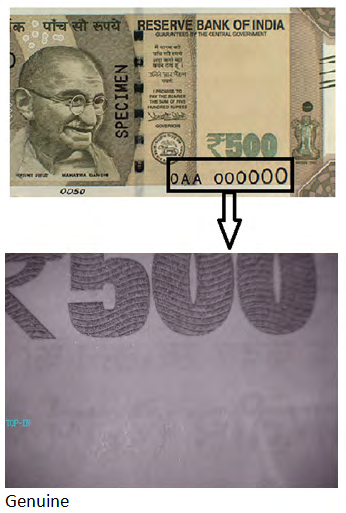
characteristic in sensing could be observed on the number panel but in case of counterfeit note the number panel was clearly visible.
Forensic Image Analysis
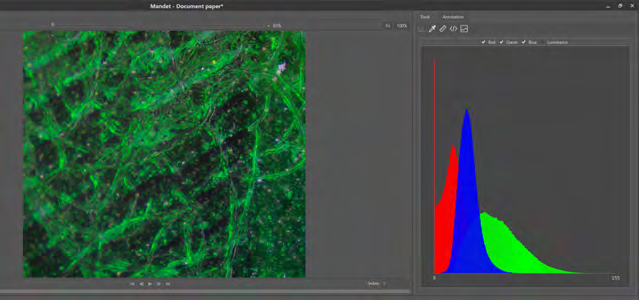
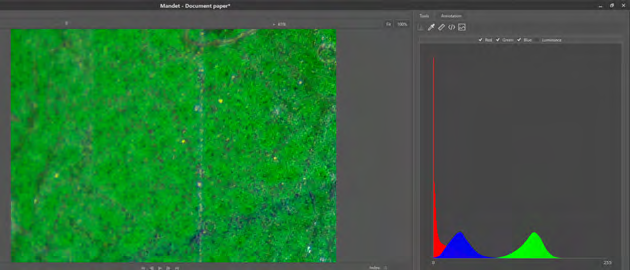
Figure 7a: RGB color histogram analysis of security thread area on counterfeit note. Courtesy Foclar Software The color composition in RGB (Red, Blue, Green) plane & their histogram analysis shows different histogram view of security thread for genuine and counterfeit notes.
Discussion
In the present study, both the banking fraud cases are interesting and detected in a nationalized bank located in urban area. It appears the fraudulent customers, in possession of high-tech counterfeit notes had enough confidence to forge by way of crediting in the bank account through the cashier and also in cash deposit machine of the bank. In both the cases the fraudster could not be successful due to availability of counterfeit currency checking system in the bank. However, the seized notes were received for forensic examination in the laboratory to detect the genuineness of the notes.
On examination/comparison of counterfeit notes with the specimen (genuine), adopting different methods like physical, microscopic, spectral study along with digital image forensic analysis could conclusively establish the disputed seized notes to be counterfeit. All the studies done have been discussed and their recorded data strengthen the forensic evidence in both the cases [5, 6].
Further, for abetting the circulation of counterfeit notes, the following points are submitted by way of suggestion:
- More awareness to know your Bank notes [7].
- Counterfeit detection tools be available in the ATM counter /business centre.
- Counterfeit detection pen be distributed to rural area to help the common people to get fast-hand knowledge in this regard.
- More anticounter feiting measures be implemented.
- Stringent law be enforced for circulation of counterfeit notes.
- Display of photograph of fake bank notes circulator in public places.
- More R &D work on FICN to know the country of origin, composition of paper etc.
- National data bank on FICN be established.
- Some application (App) should be introduced so that common man can identify the disputed currency through mobile device.
Acknowledgement
The authors are thankful to Shri Snehendu Roy, Asst Digital Forensic Analyst for extending technical assistant to study the image forensic analysis with available tools in cyber forensic division of the laboratory.
References
-
Mittal SC, Arora N (2003) Forgery of rupees Five Hundred Denomination Notes- Methods of Detection. CBI Bulletin 2: 4-20.
-
Mittal SC (2004) Recent trends in forgery of Rs 500 denomination bank notes of Mahatma Gandhi Series & their detection. CBI Bulletin 12: 4-24.
-
Pal A, Pratihari HK (2012) Spectral Studies on Original and Fake Rupees 1000 denomination Notes. International Journal of Chemistry and Applications 4(2): 91-96.
-
Seaman Kelly J, Lindblom BS (2010) Scientific Examination of Questioned Documents (Forensic and Police Science Series). Taylor & Francis Group.
-
Gonzalez R, Richard Woods. Digital image processing.
-
Wilhelm B, Mark JB (2013) Principles of digital image processing, Advance methods. Verlag London.
-
Know your bank notes in a new design. Reserve Bank of India.
- Forensic Implications of Adverse Drug Reactions in Schizophrenia A Case Series
- Narcotics and Digital Forensics: Bridging Crimes in the Digital Age
- Ethics in Forensic Psychiatry: Principles, Dilemmas, and Human Rights
- Impact of Acute Stress on Attentional Orienting to Social Cues
- Head Injury and Intracranial Hemorrhage in Western Region of Libya
- A Forensic Study on Handedness: Examination of Handwriting Features in Right and Left Handed Writers