
Digital Image and Spectral Analysis of Foreign Currency Notes - A Case Report
The state Tripura is located in the NE- region of India almost surrounded by neighboring foreign country Bangladesh. As per record 856 kms stretches having international borders. Considering the topography, the boarder crimes like circulation of FICN (Fake Indian Currency Note), foreign currency, gold, drugs, explosives, fake passports are frequently encountered in different cases. The boarder is also guarded by the BSF and customs officials to check various illegal activities. In one case, the customs officials detained one person carrying some Bangladesh currency illegally. On interrogation, more information was revealed leading to search of his house. In the course of search, huge amount of Bangladeshi Taka was recovered. The disputed foreign currency was received for forensic examination to establish the genuineness. The various examinations like physical, spectral, microscopic, digital image analysis were conducted comparing different security features with genuine Bangladesh currency notes. The different examinations of foreign currency notes conclusively established to be genuine notes. The details have been discussed in this paper
Introduction
It is very often reported that business man, Contractors, Government servants, executive, importer/exporters used to hoard huge number of currency notes of their own country and often foreign currencies also. Hoarding huge number of foreign currencies or own country currencies is illegal. As per rule, one can retain foreign currency in the form of notes or traveler cheque (TCs) for future use for a certain period. Hoarding currency beyond permissible time is a serious violation of FEMA (Foreign Exchange Management Act.) and punishable under law. Considering the guide lines any amount excess of the permissible limit is required to be surrendered to bank within a prescribed period or change within six months. The reasons for hoarding huge foreign currency notes are:
- To earn more money by selling to travelers
- To meet the need of cash for foreign transaction and business
- Precaution measures
- Compensation motive
- Influence the exchange rate
- Act as guarantor for liabilities such as external debt In one case, a person was detained by customs officials for interrogation since carrying foreign currency notes without valid documents. The interrogation helped, leading to search of his house. During search, about twenty-nine lakhs of Bangladeshi Taka having different denominations were recovered from his dwelling house. The case was registered. The Hon’ble court ordered to establish the genuineness of the seized currency notes for further investigation. As per court order the disputed currency notes were received for forensic examination/report in the laboratory.
Materials and Methods
The specimen of different denominations i.e 1000, 500,
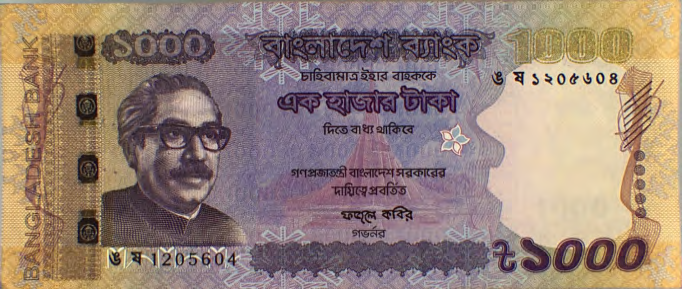
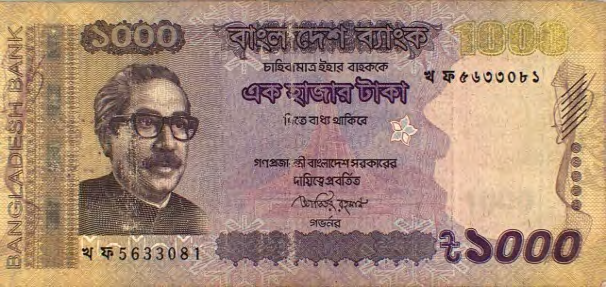
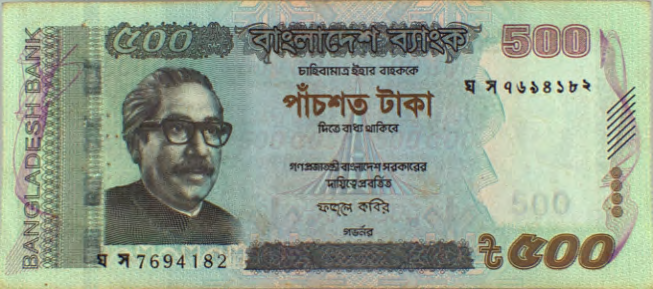
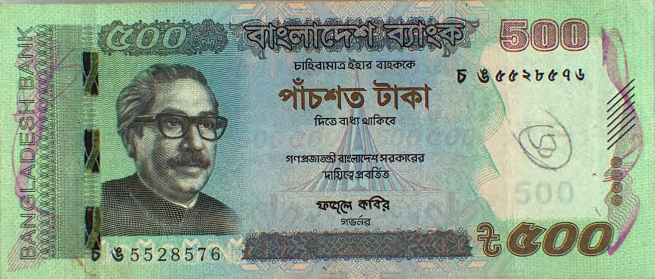
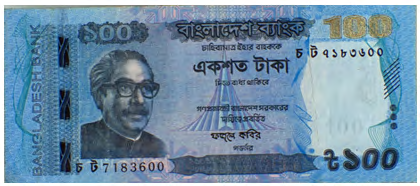
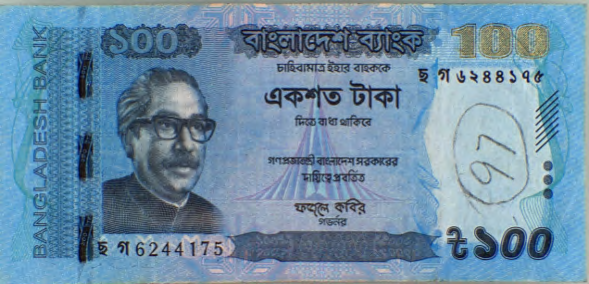
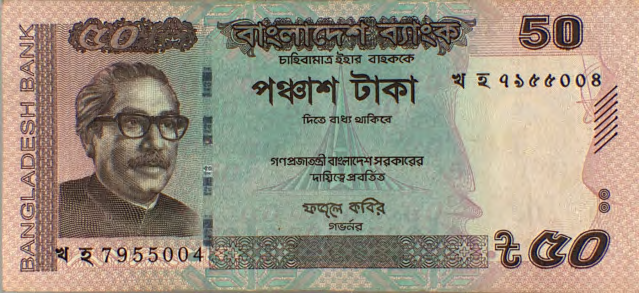
100, 50 Taka were received on request from the Bangladesh Assistant High Commission and disputed 1000, 500, 100, 50 Taka are shown in Figures 1, 1a; 2, 2a; 3, 3a and 4, 4a. The microscopic, spectral studies conducted by Trinocular HD Stereomicroscope Model-RELIFE RL M3 T and VSC8000 HS, Foster + Freeman respectively along with image forensic analysis are shown in Figure-5, 5(a); 6,6(a); 7,7(a); 8,8(a); 9,9(a); 10, 11, 11(a), 12, 12(a), 13, 14, 15, 16 & 17. The results of different physical parameters are shown at Table-1.
Examination under UV Light at 365 Nm
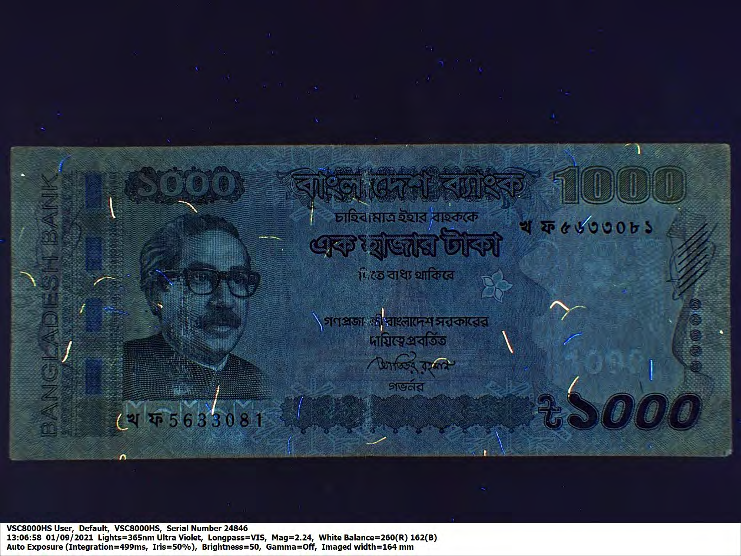
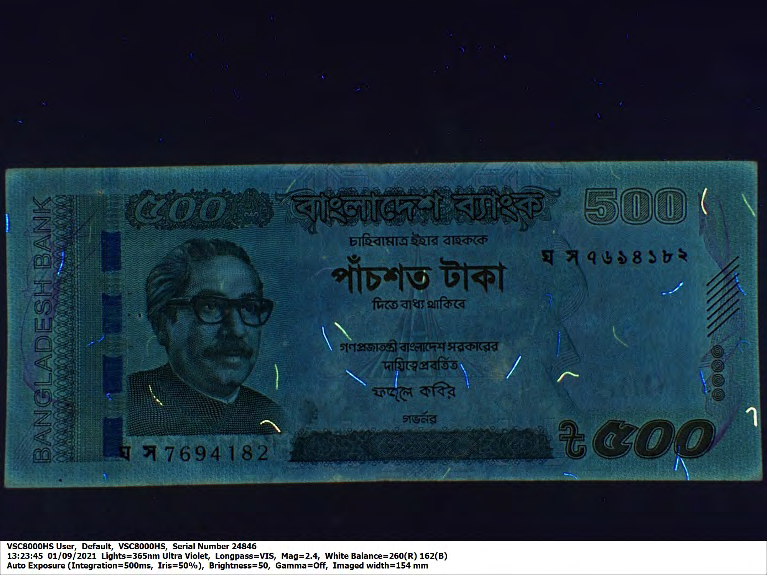
The disputed Bangladesh currencies along with specimen of similar denomination were exposed to UV chamber and identical optical fibers were observed on them (Figures 5, 5a, 6, 6a). It is indicating that the optical fibers were incorporated with similar manufacturing technique in both the currencies. Further, the chemical composition of the paper used in both the currencies are identical as such the observation under UV shows similar image character [1, 2].
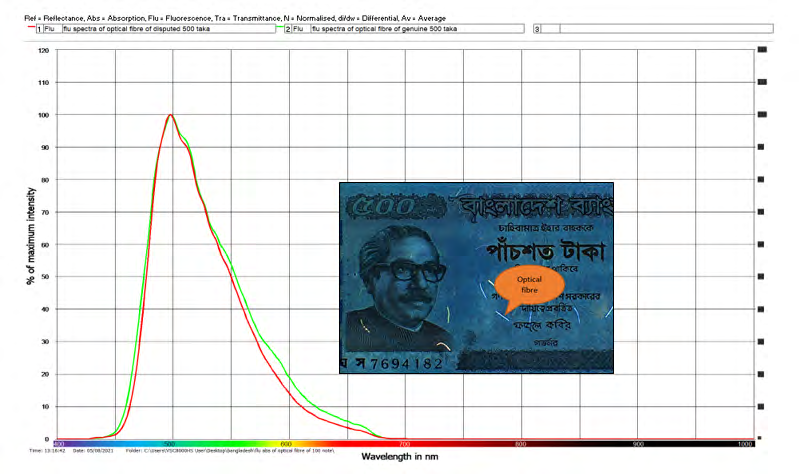
![Figure 10: The superimposition of fluorescence spectra on optical fibre in both the currencies (Specimen and disputed) are showing identical fluorescence response suggesting similar material composition in both the currencies [1,2].](/fulltextimages/8422/fig_10.png)
The examination/comparison of other denomination notes with specimen notes are found to be identical feature under UV and excluded to avoid space.
| Different Physical Parameter | Specimen 1000 Taka | Disputed 1000 Taka | Specimen 500 Taka | Disputed 500 Taka | |
|---|---|---|---|---|---|
| 1. | Weight | 1.200 gm | 1.200 gm | 0.946 gm | 0.946 gm |
| 2. | Size | 70X160 mm2 | 70X160 mm2 | 65 X152 mm2 | 65X152 mm2 |
| 3. | Thickness | 0.09 mm | 0.09 mm | 0.09 mm | 0.09 mm |
| 4. | Look | 100% Perfect | 100% Perfect | 100% Perfect | 100% Perfect |
| 5. | Touch effect | Crackling sound | Crackling sound | Crackling sound | Crackling sound |
| 6. | Tilt effect | Proper display of variable ink observed | Proper display of variable ink observed | Proper display of variable ink observed | Proper display of variable ink observed |
| 7. | Specific Gravity | 1.19 | 1.19 | 1.063 | 1.063 |
| 8. | Braille mark | Felt on touch | Felt on touch | Felt on touch | Felt on touch |
| 9. | GSM Value | 107.14 gm/m² | 107.14 gm/m² | 95.74 gm/m² | 95.74 gm/m² |
Table 1: Physical parameter of Foreign Currency 1000 Taka and 500 Taka denomination Specimen and Disputed notes [3].
Similar parameters were also examined and compared with other denomination disputed currency notes like 100 & 50 Taka and found to be matching with specimen notes.
Microscopic Study of Some Security Features
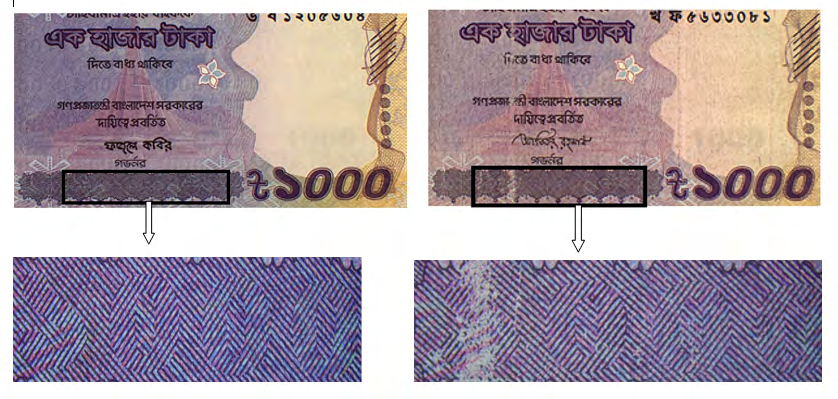
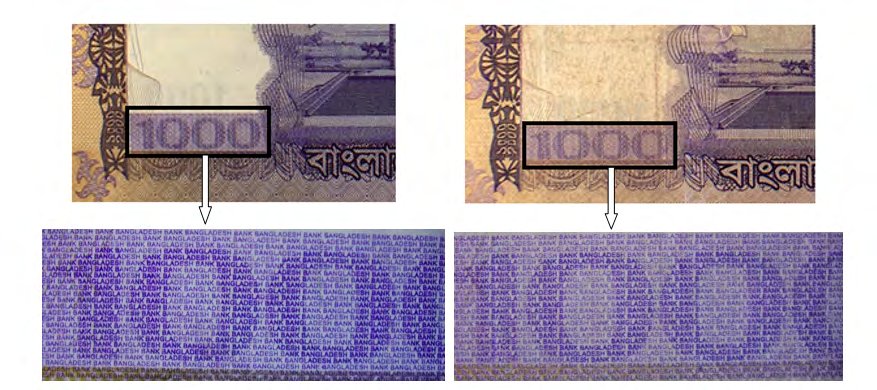
The microscopic study of some security features has been done by using trinocular stereo microscope on latent image of numeral denomination and microprinting area of both the disputed and specimen 1000 Bangladeshi Taka. The observation made shown at Figure-7,8 (Specimen note) and 7(a), 8(a) (Disputed note) are having identical features and microscopic observation suggesting use of identical printing pattern and similar ink composition in both the currencies [4, 5].
The identical features also observed for 500, 100, 50 Bangladeshi Taka and found to be similar.
Spectral Analysis
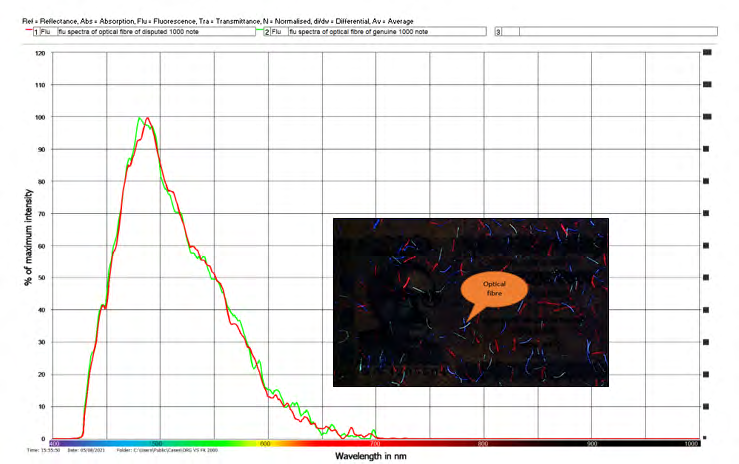
The fluorescence spectra analysis on optical fibre of both
1000 and 500 taka has been conducted shown at Figure 9 & Figure 10. The superimposition of fluorescence spectra on optical fibre in both the currencies (Specimen and disputed) are showing identical fluorescence response suggesting similar material composition in both the currencies [1, 2].
The spectral studies of other denomination notes (100 & 50 Taka) have also been verified and found matching.
Observation under IR
Infrared images are very useful in bank notes recognition
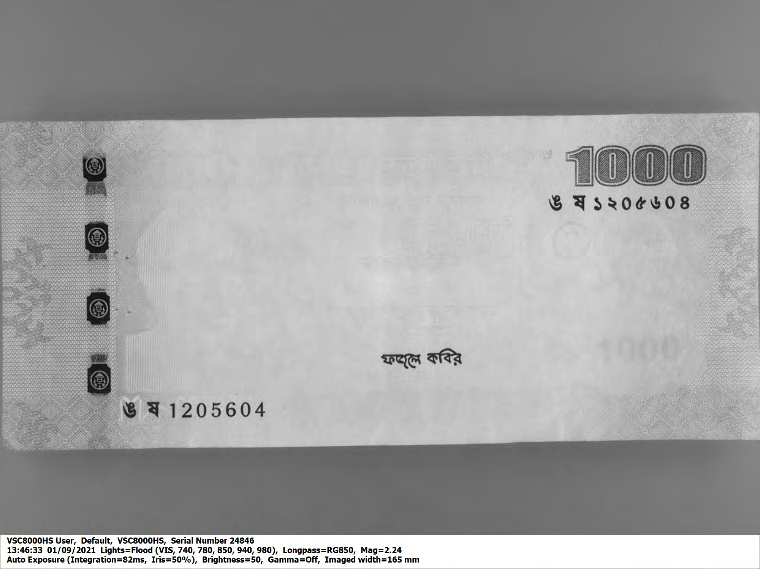
and the images of disputed notes were compared under IR with specimen sample. The specimen and disputed notes were exposed to IR (870 nm) and the observation are shown at Figure-11, 11a and Figure-12, 12a for Specimen and Disputed 1000 Taka.
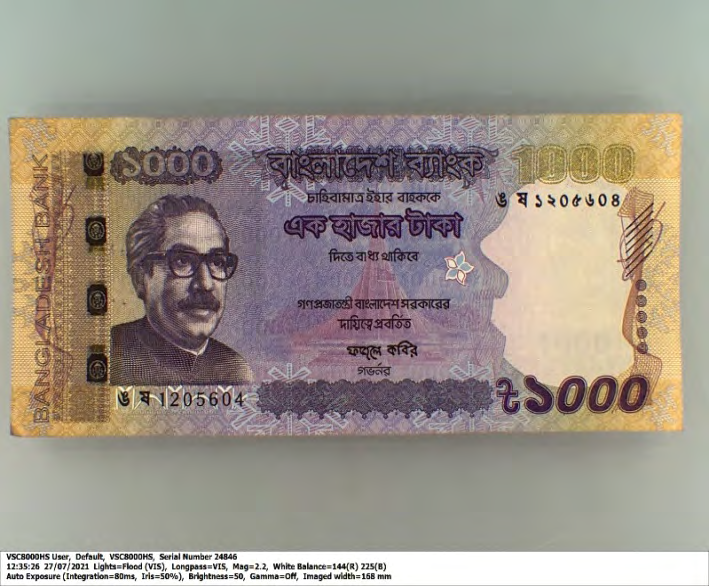
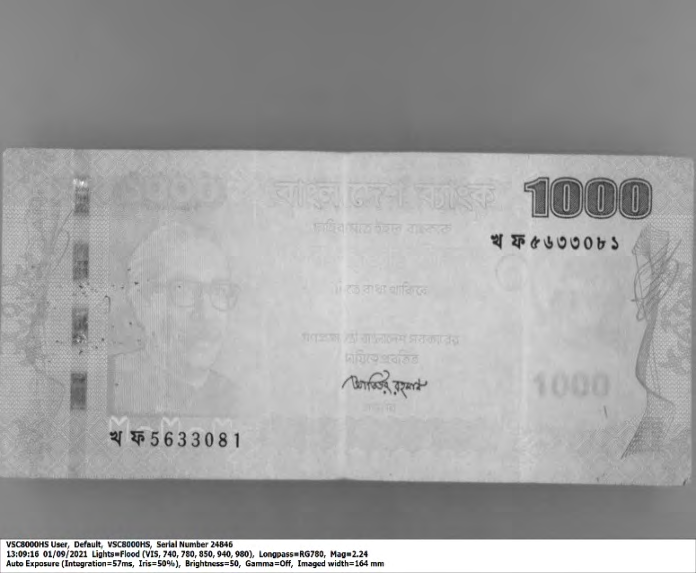
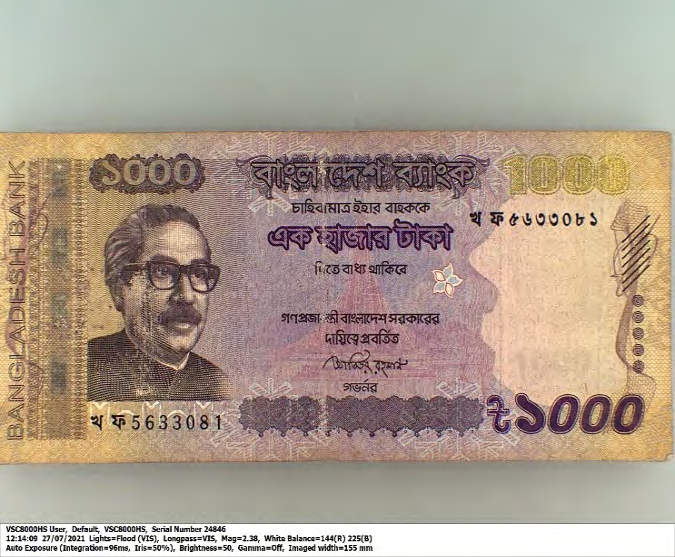
The IR absobtion view for genuine 500, 100, 50 Taka have also been studied and observed having identical features with disputed currency notes.
Image Forensics Study
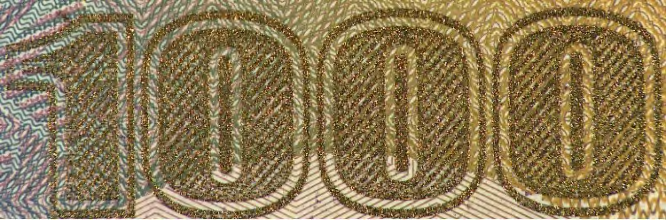
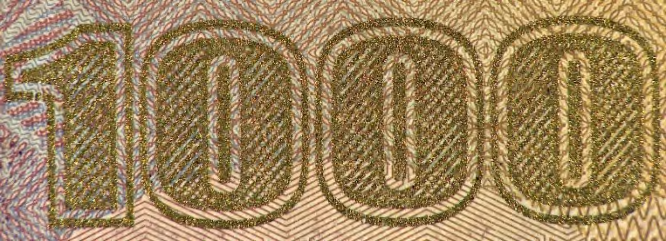
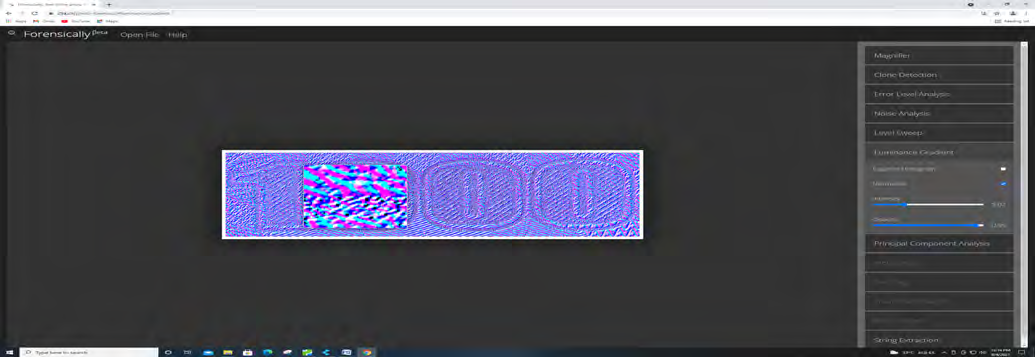
Image Forensics methods are generally applied to detect image tempering and perform image enhancement. In this study, Image Forensics techniques like Luminance gradient and Color histogram have been implemented on the images of disputed and specimen currency notes captured in identical environmental conditions to observe the differences [6, 7, 8, 9, 10]. Luminance gradient is the measurement of directional changes of colour intensity. The forensic image analysis on OVI (Optically Variable Ink) segment by luminance gradient
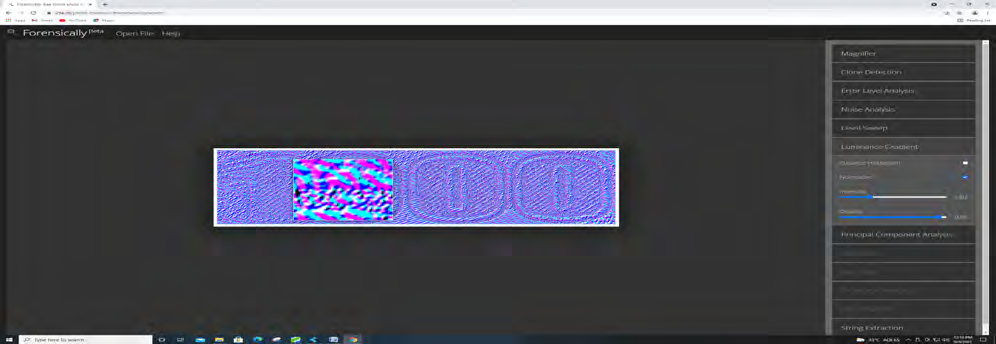
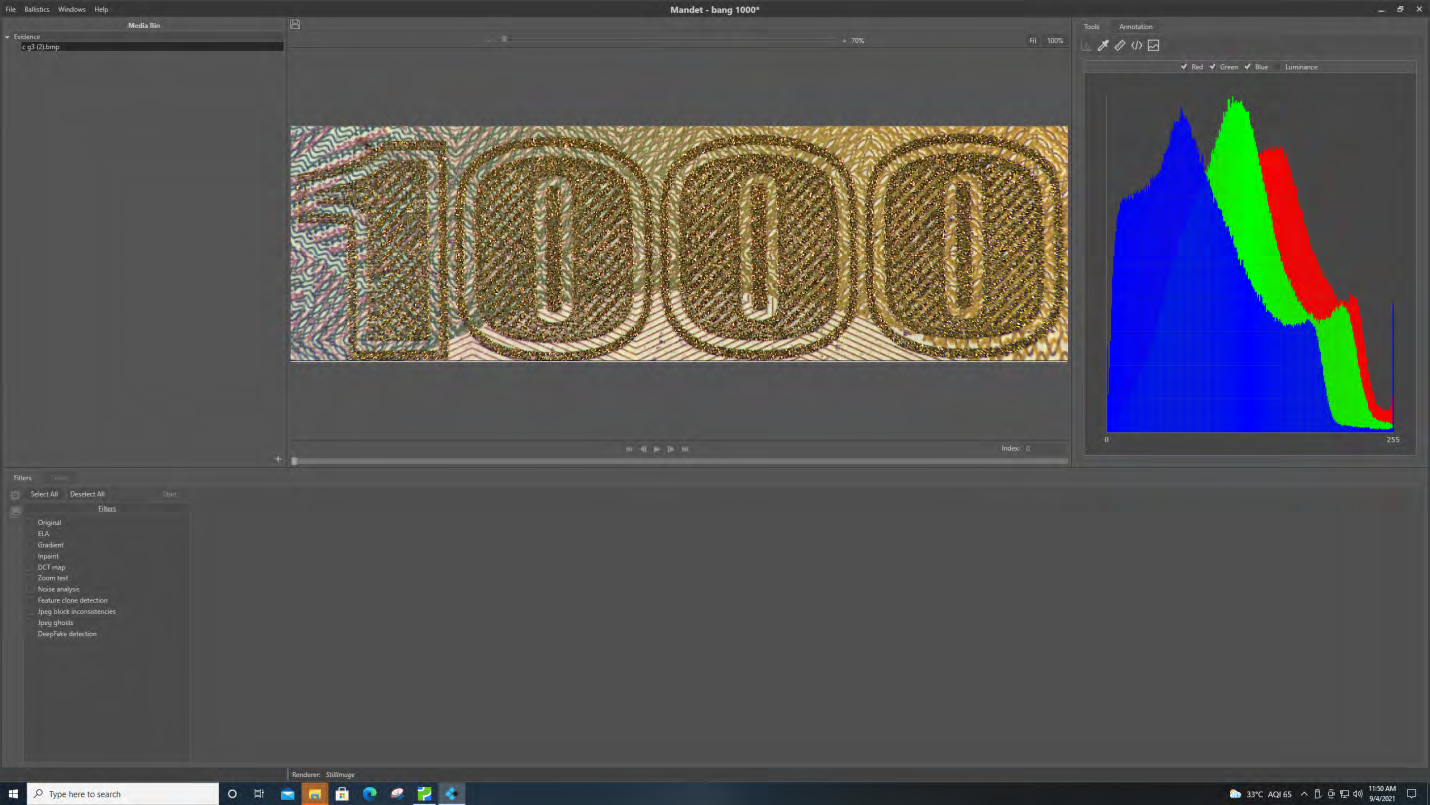
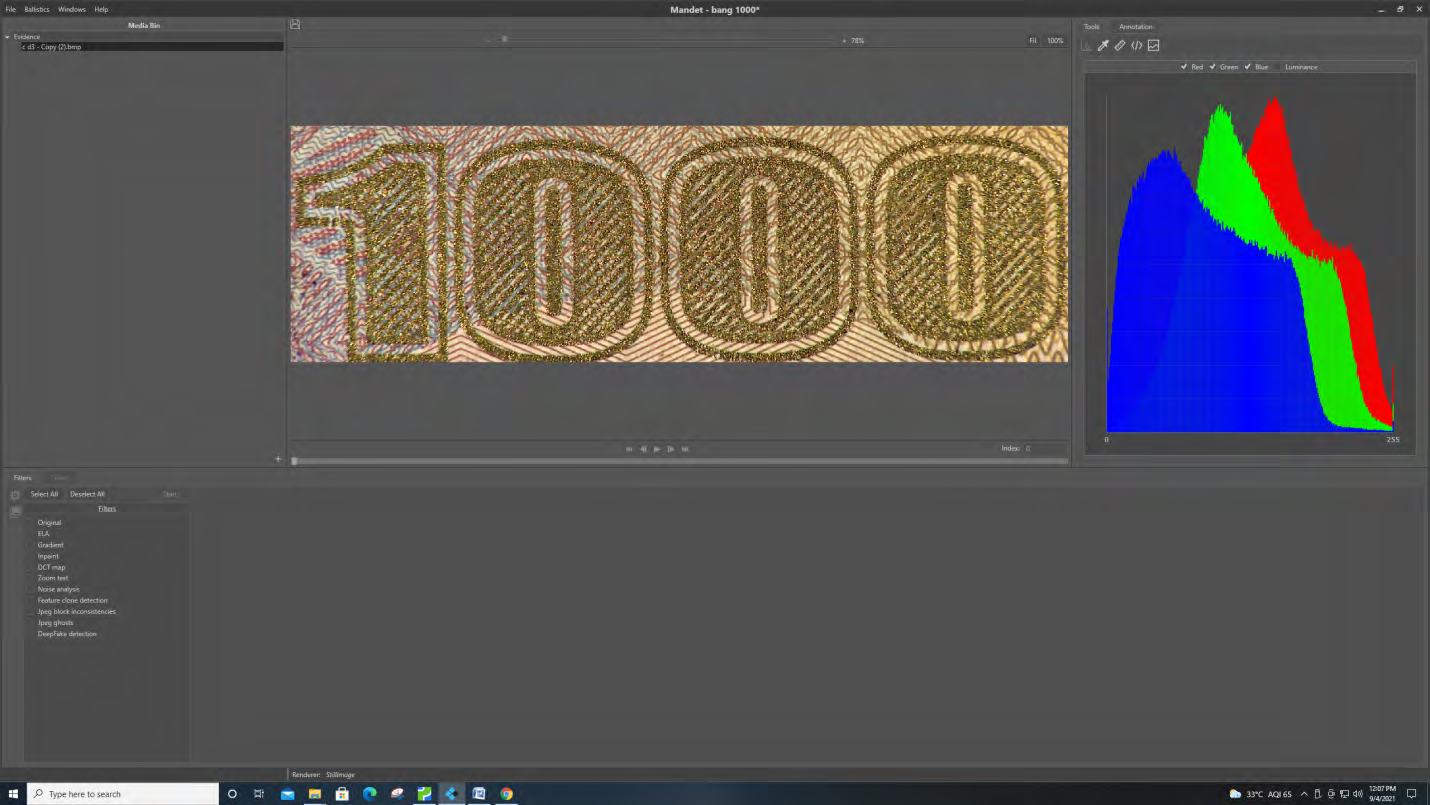
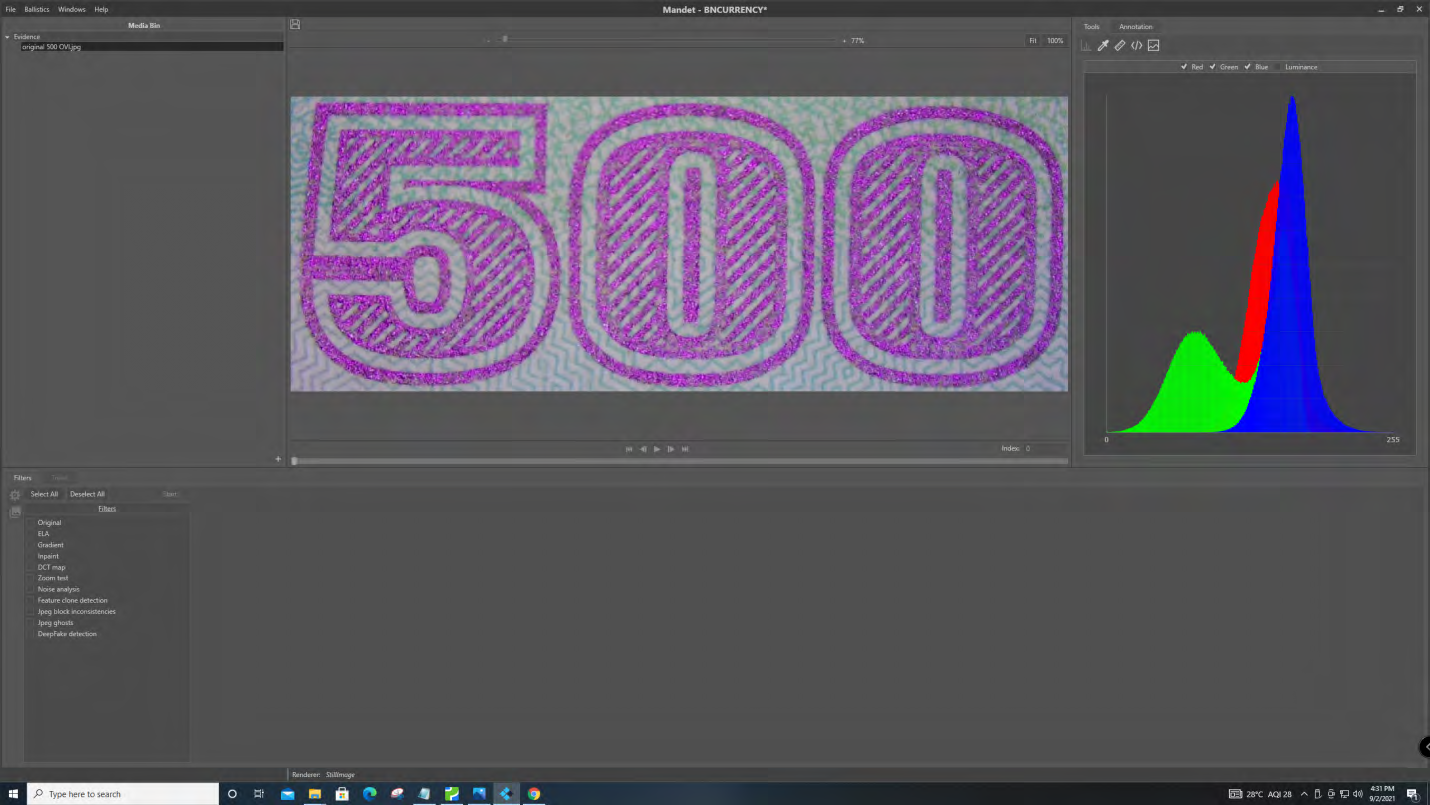
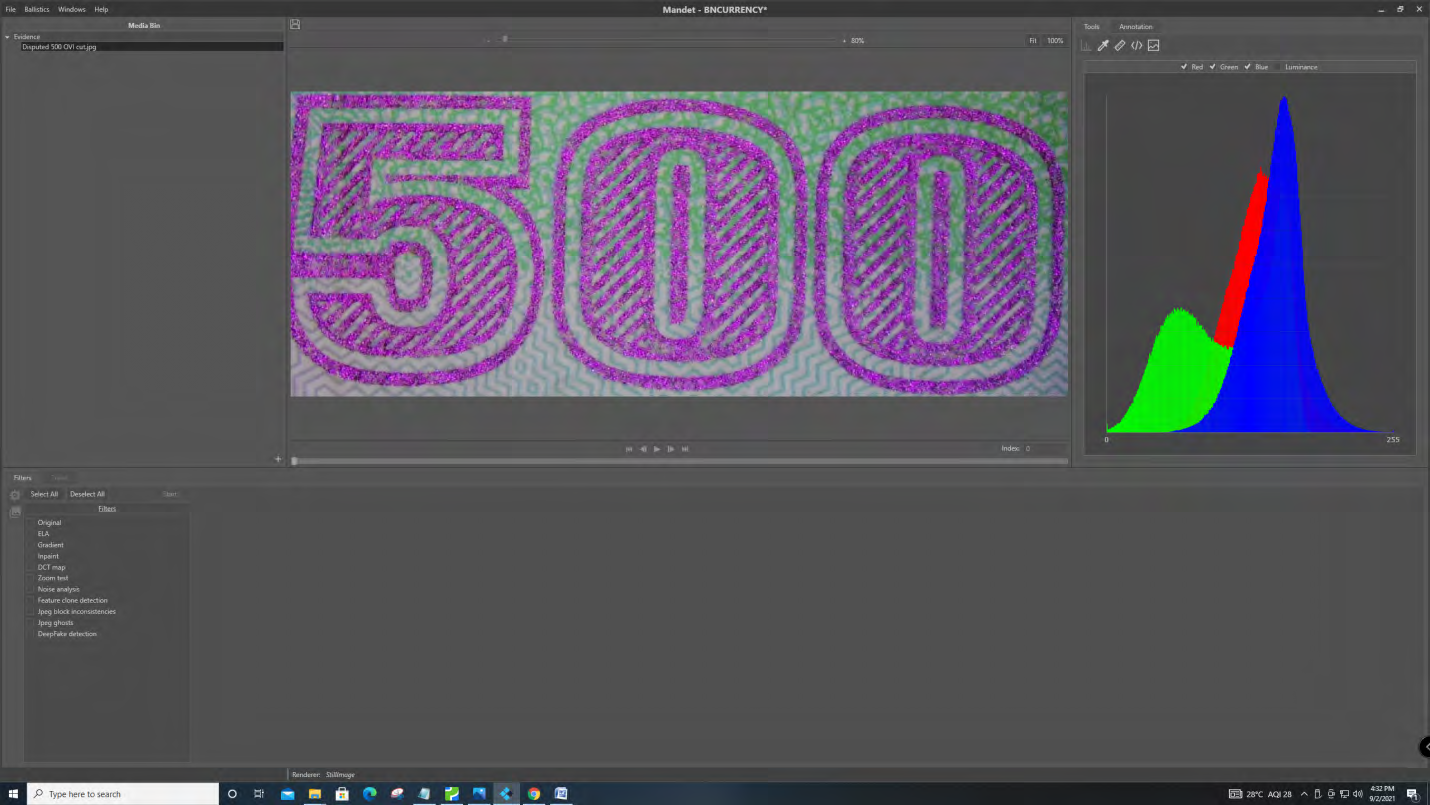
method is very unique to show characteristic features to compare. The intensity of light emitted from identical area of both the currencies (specimen/disputed) were retained and compared [11]. The magnified view of luminance gradient on 0 (zero) adjacent to numerical 1 (OVI area) of 1000 Taka shows identical color gradient in both the surfaces selected for study as shown in Figures 12, 13. Further, Color histogram method has also been applied on both the images of currency note (disputed/specimen) to determine the color component distribution over the region of image. The graphical representation of the color histogram, display the pixel intensity through X axis and number of pixel though Y axis. RGB color histogram analysis on 1000 & 500 Taka shows almost similar peak pattern/area (RGB) as graphically displayed in Figure- 14 to 17.
Discussion
In this case, seizure amount was high and Hon’ble court ordered for forensic examination/report to ascertain the genuineness of the foreign currency notes. The physical parameters of higher denomination currency notes 1000 & 500 Taka have been recorded and shown at Table-1. The lower denomination notes 100 & 50 Taka have also been verified and compared to be found matching. The physical parameters, microscopic study and spectral analysis have also been done and conclusive results have been observed.
Further, image forensics study on higher denomination of currency notes have also been applied for further confirmation about the genuineness of the disputed notes. The luminance gradient and histogram (RGB color components) study on higher denomination of currency notes (both specimen and disputed) conclusively showing similar features. The report of this case helped to prosecute the accused involved in hoarding huge amount of unauthorized foreign currency violating Foreign Exchange Management Act and other laws under Indian Panel Code.
Acknowledgement
The authors are thankful to the Assistant High Commission, Bangladesh for providing required specimen samples of Bangladesh currency notes Taka to support the examination. The authors are also thankful to Shri Kumar Alok, Chief Secretary, Government of Tripura for encouragement.
References
-
Pal A, Pratihari HK (2012) Spectral Studies on Original and Fake Rupees 1000 denomination Notes. International Journal of Chemistry and Applications 4(2): 91-96.
-
Pratihari HK, Saha B, Chaudhuri S, Rakshit M, Paul M, et al. (2021) Forensic Image and Spectral Analysis of 500 Rupee Note in a Banking Fraud. International Journal of Forensic Science 6(3): 000238.
-
https://www.bb.org.bd/openpdf.php
-
Kelly JS, Lindblom BS (2006) Scientific Examination of Questioned Documents (Forensic and Police Science Series). CRC/Taylor & Francis.
-
Mittal SC (2004) Recent trends in forgery of Rs 500 denomination bank notes of Mahatma Gandhi Series & their detection. CBI Bulletin 12: 4-24.
-
Woodland A, Labrosse F (2005) On the separation of luminance from colour in images. Proceedings of the International Conference on Vision, Video and Graphics, pp: 29-36.
-
Cai H (2013) Luminance gradient for evaluating lighting. Lighting Res Technol 48(2): 155-175.
-
Khatua CK, Nayak SK, Panda CS (2015) Content based image retrieval using color histogram. International Journal of Current Research 7(10): 21692-21703.
-
Krawetz N (2007) A Picture’s worth… Digital Image Analysis and Forensics. Hacker Factor Solutions, Blackhat briefings USA.
-
Farid H (2016) Photo Forensics. The MIT press, pp: 56- 58.
-
https://29a.ch/photo-forensics/#luminance-gradient
- Forensic Implications of Adverse Drug Reactions in Schizophrenia A Case Series
- Narcotics and Digital Forensics: Bridging Crimes in the Digital Age
- Ethics in Forensic Psychiatry: Principles, Dilemmas, and Human Rights
- Impact of Acute Stress on Attentional Orienting to Social Cues
- Head Injury and Intracranial Hemorrhage in Western Region of Libya
- A Forensic Study on Handedness: Examination of Handwriting Features in Right and Left Handed Writers