
Forensic Importance of Poroscopy in Age Estimation of the Fingerprint Donor and in Criminal Profiling
Fingerprints are unique patterns of ridges and valleys on the tips of fingers. The study of these unique patterns for the purpose of personal identification is called dermatoglyphics. These patterns are formed during fetal development and remain constant throughout a person's life, except in cases of permanent injuries and/or certain medical conditions. Fingerprint analysis, which involves the examination of the ridges on the fingertips, is a common method used in criminal investigations to identify suspects. Recently, pores present in the fictional ridges are also found to be having equal importance as the ridge minutiae characteristics in personal identification. Poroscopy as a ‘third level’ of fingerprint analysis can help the experts to identify criminals with their unique characteristic features such as the type of sweat gland openings, pore density, and shapes. This research focuses on studying the forensic importance of the pores present in the frictional ridges in estimating the age of the fingerprint donor, and in criminal profiling. 500 samples were collected to analyze the difference in the pore conditions between the genders and people of different age categories. The study showed significant results and the potential ability of the Poroscopy in personal identification and in criminal profiling.
Introduction
Fingerprint Sciences, also known as dactyloscopy, is a field of forensic science that focuses on the identification and analyzing the patterns present on the epidermal layer of the fingertips for the purpose of personal identification. They are unique patterns formed by ridges and furrows on the surface of the skin, which are formed during the first trimester and remain unchanged throughout a person’s life. Each person has a unique set of fingerprints, making them a valuable tool in identifying an individual and linking them to a crime scene. In fingerprint studies, forensic experts use specialized techniques to analyze and compare the fingerprints collected from a crime scene with those of suspects, known, and unknown individuals related to the crime scene, and from a database. The analysis can reveal details such as the type of fingerprint pattern, the presence of unique features or characteristics, minutiae details, and the orientation and spacing of ridge patterns. Fingerprint evidence can be used to establish a suspect’s presence at a crime scene, and also helps in excluding innocent individuals from suspicion. The analysis of these fingerprints is also used in other areas of forensic science, such as identifying human remains and verifying identities for security purposes, etc [1].
Even with the advancements in the field of forensic sciences, fingerprint experts who have been identifying criminals for decades face certain obstacles in obtaining a clear statement of comparisons having a very less amount of fingerprints developed from the crime scene. As science evolves, criminals evolve. Compared to the previous eras of criminals, recent criminals come up with various innovative ways not to leave any fingerprints on the crime scene, and even if left, it is more likely to be the chance prints and/or the possibility of retrieving a minimum of 8 minutiae details from the developed fingerprint is likely to be lesser than 50%. Hence to solve this issue, Sir Locard came up with an in-depth analysis of the fingerprints leading to poroscopy [2].
The study of pores was introduced in the year 1902 by Sir Edmund Locard. He stated that the pores present on the epidermal ridges possess unique characteristics similar to that of the ridge minutiae which are different for each and every individual. This study focused on those unique characteristic features and their importance in estimating the age of the fingerprint donor. The research also analyzed its potential significance in aiding the criminal profiling of an individual [3].
Methods and Methodology
Sample Collection
The samples were collected under a stratified method using the inkless fingerprint stamp pad on a Ten-Digit fingerprint data sheet. The individuals were asked to wash their hands prior to the sample collection and dried using soft tissues. They were then asked to take the stain from the fingerprint inkless pad staining their fingers’ entire nail end to nail end covering the entire pattern area of the fingerprint region and were instructed to provide the rolled print in the ten-digit fingerprint card [4].
Sample Conditions: The sample collection was divided into 5 categories as follows:
- Category 1: Age group (15-25)- 100 Male Samples and Female Samples
- Category 2: Age group (25-35)- 100 Male Samples and Female Samples
- Category 3: Age group (35-45)- 100 Male Samples and Female Samples
4. Category 4: Age group (45-55)- 100 Male Samples and Female Samples 5. Category 5: Age group (55-65)- 100 Male Samples and Female Samples The samples were collected from the North, South, East, West, and Central parts of India using a stratified sample collection method. The conditions also include the considerations such as the average height and weight of the age group of the samples in their respective regions from where the samples were collected [5, 6, 7, 8, 9, 10].
The collected samples were then analyzed under digital microscopy, Proscope, (the magnification power ranging from 30x to 300x). The microscope is calibrated for each sample before the analysis is initiated to reduce the error rate. The right thumb1 of the samples were then analyzed for the data such as ridge density, pore density, pore shape, and pore structures. The interpretations were derived from the analysis.
Results
The right thumb of the fingerprints samples was divided into 3 parts such as Distal Ulnar (DU), Distal Radial (DR), and Proximal regions (P) (Figure 1 & 2), and the ridge density, total finger ridge count (TFRC), pore shape, and pore density were studied in each of these regions present in the fingerprint samples. The comparison study performed inter and intra-categories also gave a very efficient result.
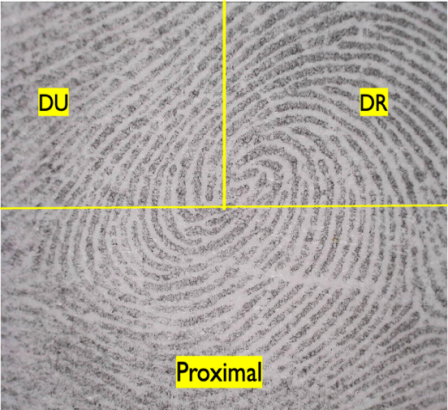
1 This research paper shows the data for the right thumb. A similar study was conducted on all the fingers. The infor- mation is available (if requested).
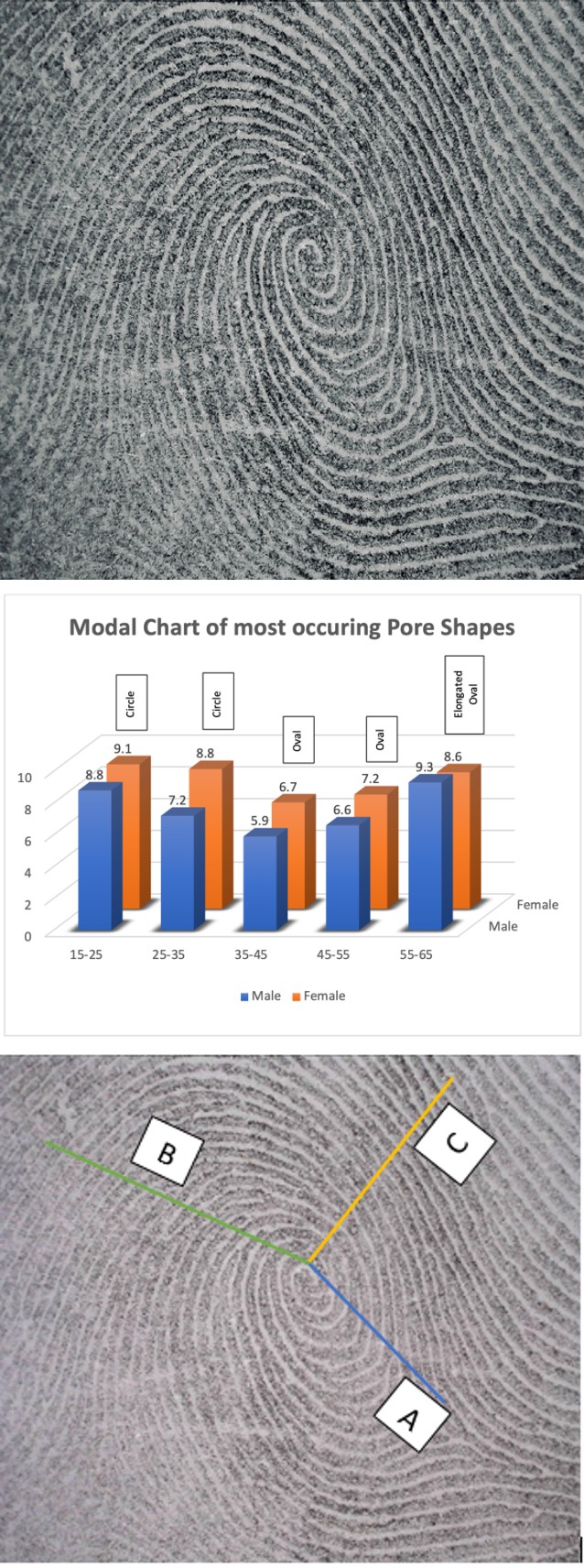
This research shows that the pores present in these three different regions of the fingerprints hold a potential ability to differentiate individuals belonging to different age groups, and gender. Hence, this study shows a very significant result proving the forensic importance of the poroscopy in the age estimation of the fingerprint donor and aiding effectively in criminal profiling.
Discussions
Pore Shape Analysis
On analyzing the pores present in all three regions (DU, DR, and R) with a focus on differentiating them based on their age category the following results were obtained (Table A1 & A2)(Graph1).
| Category (Male Samples) | I | II | III | IV | V |
|---|---|---|---|---|---|
| Age | 15-25 | 25-35 | 35-45 | 45-55 | 55-65 |
| Category ((Female Samples) | I | II | III | IV | V |
|---|---|---|---|---|---|
| Age | 15-25 | 25-35 | 35-45 | 45-55 | 55-65 |
| Most common Pore shape | Circular | Circular | Oval | Oval | Elongated Oval |
Table A1 & A2: Modal Values of the Pores Present in the Fingerprints Based on the Age Category.
Graph 1: Most Occurring Pore Shapes with Regards to the Age Category.
For the study of observing the most appearing pore shape with regard to the age of the donor, a numerical value was assigned to each of the shapes_. (a) Circle:1, (b) Oval:2, (c) Triangle:3, (d) Square:4, (e) Rectangle:5, (f) Polygonal:6, (g) Unidentifiable:7._ The above table shows the mode of the most appearing pore shape with each category. The above table also shows that the pore shapes were extending with the age group. The well-shaped-circular pores and hard-to- identify elongated pores present among the age group 15-25 and 55-65, respectively show that skin elasticity extends as a person ages and this aids forensic experts to estimate the age of an individual [11].
TFRC Analysis
The Total Frictional Ridge Count (TRFC) is a method of counting the number of ridges present in the pattern area of the fingerprints. This is studies using the following formula:
1 ( ) 2 TFRC a b c = + +
Where a is the principal line drawn from the core to the delta and b and c are the secondary lines drawn from the core to the ending of the pattern area in diagonals.
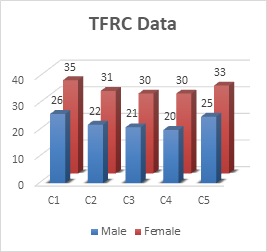
Graph 2: Mean TFRC Data of Categories C1 to C5.
The TFRC is measured by counting the number of lines crossing over the principal and secondary lines and applying the values in the above-mentioned formula. The study was conducted on the collected samples (total of 600 samples in each category) and the mean value is mentioned in the above bar diagram. The study shows that the TFRC value is high in the age category 1 and similarly in the age category 5. The reason was the shrinking of the skin that was seen in the age category 5 leading to higher TFRC values similar to that of category 1.
Ridge Density and Pore Density Analysis
The ridge density study was conducted by marking two 5mm squares in the proximal, distal ulnar, and distal radial regions, the number of ridges present in these regions was counted, and the average value was derived from them. Similarly, in the same region, the number of pores present was also counted as a pore density study, and their average values were calculated. The following tables (Tables C1-C6) depict the mean values of the average pore density and the average ridge density [12].
| Mean (ARD) | Male Samples | Female Samples |
|---|---|---|
| C1 | 18 | 19 |
| C2 | 10 | 14 |
| C3 | 9 | 14 |
| C4 | 11 | 15 |
| C5 | 12 | 16 |
Table C1: Proximal Region.
| Mean (ARD) | Male Samples | Female Samples |
|---|---|---|
| C1 | 18 | 19 |
| C2 | 9 | 14 |
| C3 | 10 | 13 |
| C4 | 11 | 15 |
| C5 | 12 | 16 |
Table C2: Distal Ulnar.
| Mean (ARD) | Male Samples | Female Samples |
|---|---|---|
| C1 | 18 | 19 |
| C2 | 10 | 14 |
| C3 | 9 | 13 |
| C4 | 10 | 14 |
| C5 | 11 | 14 |
Table C3: Distal Radial.
| Mean (APD) | Male Samples | Female Samples |
|---|---|---|
| C1 | 128 | 142 |
| C2 | 118 | 130 |
| C3 | 110 | 126 |
| C4 | 123 | 134 |
| C5 | 126 | 136 |
Table C4: Proximal Region.
| Mean (APD) | Male Samples | Female Samples |
|---|---|---|
| C1 | 151 | 146 |
| C2 | 122 | 131 |
| C3 | 120 | 136 |
| C4 | 127 | 139 |
| C5 | 130 | 142 |
Table C5: Distal Ulnar.
| Mean (APD) | Male Samples | Female Samples |
|---|---|---|
| C1 | 146 | 136 |
| C2 | 122 | 130 |
| C3 | 119 | 127 |
| C4 | 125 | 138 |
| C5 | 127 | 141 |
Table C6: Distal Radial.
From the above tables, it was depicted that the average ridge density value is higher in the Proximal region of the fingerprints in both the male and female populations. Contrastingly while studying the average pore density, it was seen that the pore density is considerably less in the proximal region despite having a higher ridge density. Similarly, the distal ulnar region was having denser pores despite having lesser ridge density than the proximal region. Further, the study of average pores present per ridge was also conducted in accordance with the age of the donor which potentially helps us in profiling an individual based on the same [13].
The following chart (Table C7) shows the average number of pores present per ridge in the proximal, distal ulnar and distal radial regions in both male and female populations (Graphs 3 & 4).
| Data Chart | R:APD (P) Male | R:APD (P) Female | R:APD (DU) Male | R:APD (DU)Fe- male | R:APD (DR) Male | R:APD (DR)Fe- male |
|---|---|---|---|---|---|---|
| C1: 15-25 | 1:14 | 1:09 | 1:10 | 1:10 | 1:08 | 1:07 |
| C2: 25-35 | 1:12 | 1:08 | 1:14 | 1.9 | 1:11 | 1:09 |
| C3: 35-45 | 1:11 | 1.8 | 1:12 | 1.8 | 1:12 | 1:09 |
| C4: 45-55 | 1:12 | 1.9 | 1:12 | 1.9 | 1:12 | 1.1 |
| C5: 55-65 | 1:11 | 1.9 | 1:11 | 1.9 | 1:11 | 1:11 |
Table C7: APD per Ridge Present in the Proximal, Distal Ulnar, and Distal Radial Regions.
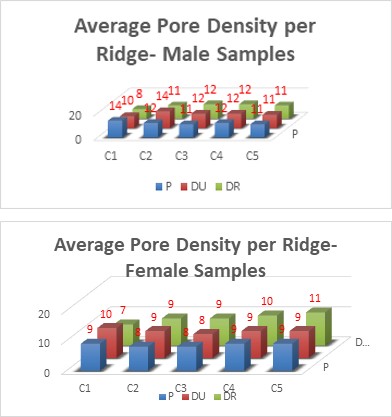
Graphs 3 & 4: Graphical representation of the average pore density per ridge).
(c.a) Comparison and Significance Study
To understand the significance of the study, Z-test was performed on the data analyzed as the sample number was more than 30 (n>30) with the probability error valueα, i.e.
0.05. The test was performed between the categories and between the genders. The significance values i.e. ρ values are tabulated below (Tables C8-C13).
| ρ Value (ARD) | Male | Female |
|---|---|---|
| C 1: C 2 | 0.000004 | 0.00007 |
| C 1: C 3 | 0.000003 | 0.00007 |
| C 1: C 4 | 0.000004 | 0.0003 |
| C 1: C 5 | 0.000004 | 0.0006 |
| C 2: C 3 | 0.158 | 0.012 |
| C 2: C4 | 0.726 | 0.089 |
| C 2: C 5 | 0.38 | 0.028 |
| C 3: C 4 | 0.03 | 0.00003 |
| C 3: C 5 | 0.009 | 0.00005 |
| C 4: C 5 | 0.53 | 0.00007 |
Table C8: Proximal Region.
| ρ Value (ARD) | Male | Female |
|---|---|---|
| C 1: C 2 | 0.00002 | 0.000001 |
| C 1: C 3 | 0.00005 | 0.000002 |
| C 1: C 4 | 0.00009 | 0.000009 |
| C 1: C 5 | 0.00006 | 0.000001 |
| C 2: C 3 | 0.847 | 0.007 |
| C 2: C4 | 0.714 | 0.545 |
| C 2: C 5 | 0.379 | 0.5451 |
| C 3: C 4 | 0.8 | 0.04 |
| C 3: C 5 | 0.35 | 0.04 |
| C 4: C 5 | 0.5 | 1 |
Table C9: Distal Ulnar.
| ρ Value (ARD) | Male | Female |
|---|---|---|
| C 1: C 2 | 0.0001 | 0.0006 |
| C 1: C 3 | 0.0002 | 0.0001 |
| C 1: C 4 | 0.0009 | 0.0013 |
| C 1: C 5 | 0.0004 | 0.0011 |
| C 2: C 3 | 0.707 | 0.51 |
| C 2: C4 | 0.59 | 0.57 |
| C 2: C 5 | 0.083 | 0.41 |
| C 3: C 4 | 0.29 | 0.196 |
| C 3: C 5 | 0.01 | 0.075 |
| C 4: C 5 | 0.16 | 0.868 |
Table C10: Distal Radial.
| ρ Value (ARD) | Male | Female |
|---|---|---|
| C 1: C 2 | 0.0132 | 0.0013 |
| C 1: C 3 | 3E-05 | 8E-05 |
| C 1: C 4 | 0.026 | 0.014 |
| C 1: C 5 | 0.6 | 0.06 |
| C 2: C 3 | 0.027 | 0.151 |
| C 2: C4 | 0.387 | 0.128 |
| C 2: C 5 | 0.018 | 0.0713 |
| C 3: C 4 | 0.0003 | 0.0045 |
| C 3: C 5 | 1E-05 | 0.0027 |
| C 4: C 5 | 0.0227 | 0.57 |
Table C11: Proximal Region.
| ρ Value (APD) | Male | Female |
|---|---|---|
| C 1: C 2 | 0.00005 | 0.0046 |
| C 1: C 3 | 0.00003 | 0.032 |
| C 1: C 4 | 0.00016 | 0.139 |
| C 1: C 5 | 0.00082 | 0.346 |
| C 2: C 3 | 0.7385 | 0.22 |
| C 2: C4 | 0.1668 | 0.0453 |
| C 2: C 5 | 0.0419 | 0.0086 |
| C 3: C 4 | 0.078 | 0.3414 |
| C 3: C 5 | 0.018 | 0.0827 |
| C 4: C 5 | 0.299 | 0.4243 |
Table C12: Distal Ulnar.
| ρ Value (APD) | Male | Female |
|---|---|---|
| C 1: C 2 | 0.0005 | 0.091 |
| C 1: C 3 | 0.0001 | 0.015 |
| C 1: C 4 | 0.0014 | 0.692 |
| C 1: C 5 | 0.0017 | 0.226 |
| C 2: C 3 | 0.738 | 0.509 |
| C 2: C4 | 0.33 | 0.09 |
| C 2: C 5 | 0.241 | 0.012 |
| C 3: C 4 | 0.078 | 0.015 |
| C 3: C 5 | 0.048 | 0.0005 |
| C 4: C 5 | 0.833 | 0.5203 |
Table C13: Distal Radial.
The above table explains that age the estimation of the donor from the ridges and pores present in the fingerprints is possible and might not be accurate as the data between categories 2 and 4 are very similar. i.e., age group 25-35 and 45-55, respectively, and significant results were not obtained in the comparison between these 2 categories whereas the remaining categories were able to provide significant and satisfactory results. To understand the results better, a similar comparison study was conducted between the male and female populations also and the results were tabulated [14].
The following table is the comparison study performed between the male and female population in the proximal, distal ulnar, and distal radial regions of the five categories (C1 to C5 age categories). The significance values i.e. ρ values are tabulated below.
| ρ Value (ARD) (B/W Male and Female samples) | P | DU | DR | ρ Value (APD) (B/W Male and Female samples) | P | DU | DR |
|---|---|---|---|---|---|---|---|
| C1 | 0.71 | 0.321 | 0.28 | C1 | 0.0007 | 0.33 | 0.109 |
| C2 | 0.0004 | 0.000004 | 0.000007 | C2 | 0.0012 | 0.05 | 0.09 |
| C3 | 0.0009 | 0.000006 | 0.00006 | C3 | 0.0009 | 0.0004 | 0.02 |
| C4 | 6E-05 | 0.000001 | 0.000002 | C4 | 0.0004 | 0.0003 | 0.004 |
| C5 | 2E-05 | 0.000003 | 0.000003 | C5 | 0.003 | 0.0007 | 0.0001 |
The above table depicts that the ridge density and the density of the pores are quite similar in the category 1: 15-25 age group. This changes drastically with the growth pattern and physical appearance changes as seen with the age groups 25-35, 35-45, 45-55, and 55-65, respectively. The study provided very significant results stating that this research data can aid in criminal profiling, such as gender identification and in age estimation of the donor analysis [15, 16, 17, 18, 19].
Conclusion
Poroscopy is a forensic technique that involves examining the sweat pores’ shapes, density, and patterns on a person’s fingerprints to determine their identity. The technique is based on the fact that the sweat pores on each person’s fingertips are unique and form distinct patterns that can be used for identification purposes. While poroscopy can be a useful forensic technique, it is not as widely used as other methods of identification, such as fingerprint analysis. This is because the technique requires specialized training and equipment, and the results can be more subjective than other forms of forensic evidence. This research conducted an experimental study on the pores present in the fingerprint samples to see their significance in forensic sciences and their efficiency in aiding criminal profiling. The study showed very satisfactory results proving that pores similar to that of the ridges have equal capabilities not only in establishing the identity of an individual but also in estimating the age of the fingerprint donor.
References
-
Karki RK, Singh PK (2014) Gender determination from fingerprints. Journal of Universal College of Medical Sciences 2(1): 12-15.
-
Jain A, Chen Y, Demirkus M (2006) Pores and ridges: Fingerprint matching using level 3 features. In 18th International Conference on Pattern Recognition (ICPR’06) 4: 477-480.
-
Roddy AR, Stosz JD (1999) Fingerprint feature processing techniques and poroscopy In Intelligent biometric techniques in fingerprint and face recognition, In: 1st (Edn.), Routledge, Oxfordshire, UK, pp: 35-105.
-
Bindra B, Jasuja OP, Singla AK (2000) Poroscopy: A method of personal identification revisited. Anil Aggrawal’s Internet Journal of Forensic Medicine and Toxicology 1(1).
-
Preethi DS, Nithin MD, Manjunatha B, Balaraj BM (2012) Study of poroscopy among South Indian population. Journal of Forensic Sciences 57(2): 449-452.
-
Wijerathne BT (2015) Poroscopy: an important research field in Medicine and Physical Anthropology. Anuradhapura Medical Journal 9(2): 44-46.
-
Oklevski S, Jasuca OP, Singh G (2019) Poroscopy as a method for personal identificatıon: Issues and challenges. Turkish Journal of Forensic Science and Crime Studies 1(1): 36-49.
-
Govindarajulu RB, Saha S, Parmar M (2020) Individual profiling through ridges and pores of fingerprints: Microscopic study on the variations of homeostasis and ambiance among the Cross-Sectional Young adult & Criminal Records. International Journal of New Innovations in Engineering and Technology 13(1): 41- 44.
-
Bhagwat V, Kumar DM, Lakshmi KNV (2020) Poroscopy- the study of sweat pores among central Indian population. Scholars International Journal of Anatomy and Physiology 3(6): 53-56.
-
Singh SP (2009) Poroscopy in Personal Identification Authenticity and Acceptance. The Indian Police Journal 56(3): 55-61.
-
Margot P, Lennard C (1994) Fingerprint detection techniques. University of Lausanne Institute of Forensic Science and Criminology.
-
Faulds H (1913) Poroscopy: the scrutiny of sweat-pores for identification. Nature 91: 635-636.
-
Ball RE (2020) Prevalence of Pores in Latent Fingerprints. West Virginia University, pp: 1-94.
-
Gupta A, Buckley K, Sutton R (2008) Latent fingermark pore area reproducibility. Forensic Science International 179(2-3): 172-175.
-
Jain AK, Chen Y, Demirkus M (2006) Pores and ridges: High-resolution fingerprint matching using level 3 features. IEEE transactions on pattern analysis and machine intelligence 29(1): 15-27.
-
Stosz JD, Alyea LA (1994) Automated system for fingerprint authentication using pores and ridge structure. Proceedings of the SPIE 2277 pp: 210-223.
-
Jain A, Chen Y, Demirkus M (2006) Pores and ridges: Fingerprint matching using level 3 features. In 18th International Conference on Pattern Recognition (ICPR’06) 4: 477-480.
-
Zhao Q, Zhang L, Zhang D, Luo N (2009) Direct pore matching for fingerprint recognition. Proceedings of the Third International Conference on Advances in Biometrics. pp: 597-606.
-
Genovese A, Munoz E, Piuri V, Scotti F, Sforza G (2016) Towards touchless pore fingerprint biometrics: A neural approach. IEEE congress on evolutionary computation (CEC) pp: 4265-4272.
- Forensic Implications of Adverse Drug Reactions in Schizophrenia A Case Series
- Narcotics and Digital Forensics: Bridging Crimes in the Digital Age
- Ethics in Forensic Psychiatry: Principles, Dilemmas, and Human Rights
- Impact of Acute Stress on Attentional Orienting to Social Cues
- Head Injury and Intracranial Hemorrhage in Western Region of Libya
- A Forensic Study on Handedness: Examination of Handwriting Features in Right and Left Handed Writers