
Efficiency of the Buikstra & Ubelaker and Ferembach Methods, In the Estimation of Sex in Human Skulls from the Department of Ayacucho, Peru
The estimation of sex in human skulls has been a very controversial issue over the years, due to the interpopulation sexual dimorphism that exists. For this reason, we have decided to carry out the following work, in which we will apply and discuss two qualitative methodologies in a sample of 84 adult skulls (male and female), from the Forensic Investigations Laboratory of the Department of Ayacucho - Peru in order to study the effectiveness of these methodologies. Each methodology will have numerical indicators that will represent the degree of sexual dysmorphism, in certain areas that vary differently according to the methodology. In the Buikstra & Ubelaker method we will assign degrees in 5 zones inside the skull; while in the Ferembach method we will evaluate 17 areas between the skull and the jaw that will be detailed later. When obtaining the results of both methodologies, it was observed that there is a significant difference between both methods, being the qualitative method Buikstra & Ubelaker with more successes, thus concluding its greater effectiveness in estimating sex in human skulls.
Introduction
Forensic odontology is the science in charge of the examination and proper handling of dental evidence and also of the identification of skeletal remains in the interest of justice. It helps her in the determination of oral lesions, evaluation of dental characteristics and collaborates in the study of human remains for the estimation of sex, height and ancestral pattern through the skull and dental pieces [1].
To do this, the forensic odontologist performs various analyzes of the skull and teeth, which will later provide information (sex, height, ancestral pattern and genetic aspects), thus contributing to the individualization of each one of them. From this, we can say that there is biological variability between each individual [2].
The estimation of the sex in skeletal remains, through different identification methods, provide a higher percentage of security in those who have reached the full development of their bones, that is, in adults; on the contrary, erroneous results will be obtained in bone remains that are in full growth (subadults) [3].
Additionally, the bones of the male gender will be larger, heavier and more robust; to differences of the bones of the feminine sex that will be more fragile and graceful, by the same development of the growth; foundation on which one of the most used methods for estimating sex is based, according to Buikstra & Ubelaker [4], a universal method that is applied to both the skull and the pelvis [5].
Another universal method is that of Ferembach et al. 1980, [6] that for the estimation of sex, a value or degree will be assigned according to the condition of the characteristic to be evaluated, which will later be multiplied by the value of importance expressed in the skull; you will get values in a range from -2 to +2; where the (-2) will indicate hyperfeminine and +2 hypermasculine. Zero will be indeterminate [7].
C Scabuzzo (2011), Argentina8, carried out research on bioarchaeological studies in the department of Victoria, in which exhumations were carried out with different objectives, including the general state of preservation of the skeletons and the conformation of the sample (estimate of sex and age); for the analysis of the estimation of sex, the standard criteria according to Buikstra-Ubelaker were followed.
Another investigation carried out in Magallania, (Chile) by L. Menéndez9 in 2010, on oral pathologies in human skulls in northwestern Patagonia, whose sample belongs to an archaeological museum where the skull data were unknown, including sex; for such a study it was essential to perform the determination of sex, using the method of Buikstra - Ubelaker 1994.
Both analyzes are easy and simple to apply, but since they were only applied in certain populations, they may vary when performed in others, since the morphological characteristics are very different and variable in each region or population [8].
That is why, this work aims to determine the effectiveness to estimate sex between the Buikstra & Ubelaker and Ferembach methods of human bone remains from the Ayacucho Region in the year 2018.
Goals
General Objective: To determine the most effective method between Buikstra & Ubelaker or Ferembach, in the estimation of sex in human skulls deposited in the Laboratory of Forensic Investigations (Public Ministry) of the department of Ayacucho – Peru.
Specific Objectives: Estimate the sex by the method of Buikstra & Ubelaker in human skulls deposited in the Laboratory of Forensic Investigations (Public Ministry) of the department of Ayacucho – Peru.
Estimate the sex by means of the Ferembach method in human skulls deposited in the Laboratory of Forensic Investigations (Public Ministry) of the department of Ayacucho – Peru.
Compare the sex estimated by the methods of Buikstra & Ubelaker and Ferembach with the actual sex.
Materials and Method
Study design
The type of study of this research will be: observational, descriptive, cross-sectional, prospective and comparative.
Population and sample
Population: it will consist of the human skulls found in the Forensic Investigations Laboratory (MP) in the department of Ayacucho - Peru 2018.
Sample: it was determined using the proportion comparison formula at a confidence level of 95%, with a statistical power of 80%, and with the values of 80% for proportion 1 and 93% for proportion 2 referred to by Bárbara Mazza4 , which provides a minimum sample size of 84 skulls for each method (Annex 1)
Selection criteria
Inclusion criteria:
- Full skulls
- Skulls belonging to adults
- Skulls with teeth or without teeth
- Skulls identified by sex
- Skulls without evidence of pathology Exclusion criteria:
- Sketchy skulls
- Skulls belonging to subadults
- Skulls with pathological evidence
Variables
SEX: Dependent variable, nominal qualitative, where the external physical characteristics that distinguish men from women are observed, whose indicator will be the record of the database of the Forensic Investigations laboratory (Ayacucho), valued in feminine and masculine.
Sex Estimation Methods
Buikstra - Ubelaker Method: Independent, ordinal qualitative variables, for the determination of sex whose indicators are: nuchal crest, mastoid process, supraorbital arches, supraorbital rims and chin prominence. Its values will be hypermasculine [9] and hyperfeminine [10].
Ferembach’s Method: Independent, ordinal qualitative variables, for the determination of sex whose indicator will be the sum of values over the sum of importance, valued in hypermasculine (+2) and hyperfeminine (-2).
Method and Techniques
Method: Structured observation.
Technique: The Buikstra & Ubelaker method, and the Ferembach method for the diagnosis of sex will be used in the analysis.
Procedure
The following investigation will have a pilot test previously, which will be carried out in the central morgue of Lima, 10% of the skulls of the indicated sample will be analyzed to later observe the correlation through the Chi- square test between the results obtained through the Buikstra methods. & Ubelaker and Frembach in the estimation of the sex, and the database of the institution where it will indicate the real sex; Along with this, the calibration of the researcher will be carried out together with a Gold standard (Annex 2-3).
After that, a special permit will be requested from the Public Ministry of Peru so that it can be issued to the headquarters of the same Ministry in the Ayacucho Region [11]. This permit will be sent from the Universidad Científica del Sur, which will allow access to the Forensic Investigations Laboratory in where the sample of 84 skulls will be found; each of them has information stored in a database, which describes their sex, age, height and racial pattern [12].
The analysis according to Buikstra & Ubelaker 1994 will first be carried out on each skull, which will consist of a file prepared with the criteria to be evaluated: nuchal crest, mastoid process, supraorbital arches, supraorbital ridges and prominence of the chin, in which each skull will be assigned. structure a value according to the characteristics it presents. Its values will be hypermasculine (5) and hyperfeminine (1) (Annex 4).
The second analysis according to Ferembach 1980, will also be evaluated through another file where the structures that we will study will be noted and whose value for each one of them must be registered in its corresponding place; then the sum of values will be made on the sum of importance, valued in hypermasculine (+2) and hyperfeminine (-2) (Annex 5).
Finally, the results will be obtained, which will be analyzed and compared with each other to determine which of the methods is more effective to estimate the sex of human skeletal remains of the Ayacucho Region 2018 [13].
Statistic analysis
The statistical method of choice in the analysis of the research will be the Chi-square test to determine the most effective method. This being the formula: The Chi-square value is calculated through the following formula
2 2 ( ) Oi Ei X Ei Σ − =
Where: X² = Chi square Oi = Observed frequency (response obtained from the instrument) Ei = Expected frequency (responses that were expected)
Ethical considerations
This research project will be reviewed by the Institutional Ethics and Research Commission of the Dentistry Career of the Southern Scientific University.
Results
Once the data required for the investigation was found, the analysis of the results was carried out according to the variables studied, through the advice of the thesis tutor and a specialist in Statistics, obtaining the following results.
| Sex | N | Percentage |
|---|---|---|
| Masculine | 50 | 60% |
| female | 34 | 40% |
| total | 84 | 100% |
Table 1: Distribution of the Sample According to Sex.
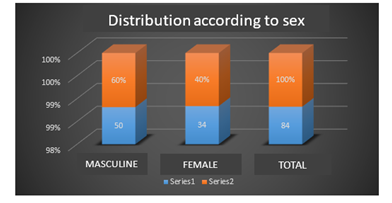
Graph 1: Distribution according to sex.
Table 2 Analysis of the results
The statistical method is Chi square (x²) because it is a test that allowed measuring qualitative aspects of the responses obtained from the questionnaire, measuring the variables under study.
The Chi square value is calculated through the following formula:
2 2 ( ) Oi Ei X Ei Σ − =
Where: X² = Chi square
Group statistics
Oi = Observed frequency (response obtained from the instrument) Ei = Expected frequency (responses that were expected) Significance level: 0.05 From Pearson’s Chi square between a representative independent variable and the representative dependent variable we have that:
From Pearson’s Chi square: 0.000< 0.05
The distinction and descriptive separation of the studied elements begins by providing the mean values and the standard deviation of the variables.
| Method | Gender | N | Media | Typical Deviation | Standard Error Of the Mean |
|---|---|---|---|---|---|
| Buistrack | Female | 34 | 1, 56 | , 613 | , 105 |
| Masculine | 50 | 1, 58 | , 538 | , 076 | |
| Ferembach | Female | 34 | 1, 15 | , 610 | , 105 |
| Masculine | 50 | 1, 52 | , 544 | , 077 |
Table 2: Shows the Average Values and Variability of the Buistrack & Ubelaker and Ferembach Methods of Human Skeletal Remains, I
Table 2: Shows the Average Values and Variability of the Buistrack & Ubelaker and Ferembach Methods of Human Skeletal Remains, It is observed that in the Buistrack & Ubelaker Method in Males the Mean Level is (1.58). Followed by Buistrack & Ubelaker; Female Sex with (1.56), In the Ferembach Method the Average is observed in the Male Sex Of (1.52) and Female (1.15).
| Ferembach | Total | ||||
|---|---|---|---|---|---|
| Effective | No Effective | ||||
| Buikstra | Effective | Count | 36 | 8 | 44 |
| Expected Frequency % | 25, 1 | 18, 9 | 44, 0 | ||
| Within buikstra | 75, 0% | 22, 2% | 52, 4% | ||
| No Effective | Count | 12 | 28 | 40 | |
| Expected Frequency % | 22, 9 | 17, 1 | 40, 0 | ||
| Within Ferembach | 25, 0% | 77, 8% | 47, 6% | ||
| Total | Count | 48 | 36 | 84 | |
| Expected Frequency % | 48, 0 | 36, 0 | 84, 0 | ||
| Within Buikstra-Ferembach | 100, 0% | 100, 0% | 100, 0% |
Table 3: Determine the most effective method between Buikstra & Ubelaker or Ferembach, in the estimation of sex in human skulls d
Table 3: Determine the most effective method between Buikstra & Ubelaker or Ferembach, in the estimation of sex in human skulls deposited in the Forensic Investigations Laboratory (Public Ministry) of the department of Ayacucho - Peru; the following is observed in the contingency table To determine the most effective method between Buistrak & Ubelaker and Ferembach in estimating sex in human skulls deposited in the forensic investigation laboratory, (Table 3) shows that the most effective method between Buistrack & Table 4 Chi-square tests Ubelaker with an expected count of 44,0 which make 52.4% effective and not effective with the expected count of 40.0 which make 47.6% meanwhile the Ferembach method is not effective.
| Worth | GI | ASYMPTOTIC GIS (BILALTERAL) | (TWO SIDED) EXACT GIS | (ONE SIDED) EXACT GIS | |
|---|---|---|---|---|---|
| Pearson’s chi-squares | 22,973a | 1 | ,000 | ,000 | ,000 |
| Correction for continuity | 20,906 | 1 | ,000 | ||
| likelihood ratio | 24,135 | 1 | ,000 | ,000 | ,000 |
| Fisher’s exact statistic | ,000 | ,000 | |||
| N valid cases | 84 |
Table 4: Shows that the Expected Frequency in the Female Sex is 34, Which Makes up 40.5%, While the Expected Frequency is of 50 i
Table 5 Estimating sex using the Buikstra & Ubelaker method in human skulls deposited in the Forensic Investigations Sex contingency table * Buikstra & Ubelaker Laboratory (Public Ministry) of the department of Ayacucho - Peru; The following is observed in the contingency table:
| Skull | Bukistra | Total | |||
|---|---|---|---|---|---|
| Masculine | Female | ||||
| Sex | F | Count Expected Frequency %Within Bukistra | 18 17, 8 40,9% | 16 16,2 40, 0% | 34 34, 0 40, 5% |
| M | Count Expected Frequency %Within Bukistra | 26 26, 2 59, 1% | 24 23, 8 60, 0 | 50 50, 0 59, 5% | |
| Total | Count Expected Frequency %Within Bukistra | 44 44, 0 100, 0% | 40 40, 0 100, 0% | 84 84, 0 100, 0% | |
| Worth | gl | Asymptotic GIS (Bilateral) | Exact GIS (Two-Sided) | Exact GIS (One-sided) | |
| Pearsons Chi-Sqaure | , 007a | 1 | , 932 | ||
| Correction for Continuity | , 000 | 1 | 1, 000 | ||
| Likelihood Ratio | , 007 | 1 | , 932 | ||
| Fisher’ s Exact Statistic | 1, 000 | , 555 | |||
| N0 Valid Cases | 84 |
Table 5: Shows that the Expected Frequency in the Female Sex is 34, Which Makes up 40.5%, While the Expected Frequency is of 50 i
To estimate sex using the Buistrak & Ubelaker method in human skulls deposited in the forensic investigation laboratory, (Table 5) shows that the expected frequency in the female sex is 34, which makes up 40.5%, while the expected frequency is of 50 in masculine who make 59.5%, the estimate being 100%.
Table 6 Chi-square tests
Note: 0 Cells (0.0%) have an Expected Frequency of Minimum Expected Frequency is 16.19 Table 6: Chi-square tests Table 7 Sex contingency table * Ferembach
| Ferembach | Total | ||||
|---|---|---|---|---|---|
| Masculine | Female | ||||
| Sex | F | Count | 19 | 15 | 34 |
| Expected | 19, 4 | 14, 6 | 34, 0 | ||
| Frequency % Within Ferembach | 39, 6% | 41, 7% | 40, 5% | ||
| M | Count | 29 | 21 | 50 | |
| Expected | 28, 6 | 21, 4 | 50, 0 | ||
| Frequency % Within Ferembach | 60, 4% | 58, 3% | 59, 5% | ||
| Total | Count | 48 | 36 | 84 | |
| Expected | 48, 0 | 36, 0 | 84, 0 | ||
| Frequency % Within Ferembach | 100, 0% | 100, 0% | 100, 0% |
Table 6: To estimate sex using the Ferembach method in human skulls deposited in the forensic research laboratory, it can be seen
| Worth | GI | Asymptotic GIS( Bilateral) | Exact GIS(Two Sided) | Exact GIS (One-Sided) | |
|---|---|---|---|---|---|
| Pearson’s Chi-Square | , 037a | 1 | , 847 | ||
| Correctioon for Continuity | , 000 | 1 | 1, 000 | ||
| Likelihood Ratio | , 037 | 1 | , 847 | ||
| Fisher’s Exact Statistic | 1, 000 | , 512 | |||
| N 0 Valid Cases | 84 |
Table 7: Ferembach * Buikstra contingency table.
Note: a. 0Cells (0.0%) have an expected frequency of less than 5. The minimum expected frequency is 14.57.
Analyzing table 8 for a significance level of 0.05 and 1 degree of freedom It is .847, a significance value with respect to the estimate of sex using the Ferembach method in human skulls deposited in the forensic research laboratory.
Table 9 Compare the sex estimated by the Buikstra & Ubelaker and Ferembach methods with the real sex; The following is observed in the contingency table:
| Buikstra | Total | ||||
|---|---|---|---|---|---|
| Masculine | Female | ||||
| Ferembach | Masculine | Count | 35 | 13 | 48 |
| Expected | 25, 1 | 22, 9 | 48, 0 | ||
| Frequency % within buisktra | 79, 5% | 32, 5% | 57, 1% | ||
| Female | Count | 9 | 27 | 36 | |
| Expected | 18, 9 | 17, 1 | 36, 0 | ||
| Frequency % within buisktra | 20, 5% | 67, 5% | 42, 9% | ||
| Total | Count | 44 | 40 | 84 | |
| Expected | 44, 0 | 40, 0 | 84, 0 | ||
| Frequency % within buisktra | 100, 0% | 100, 0% | 100, 0% |
Table 8: Ferembach * Buikstra contingency table.
To compare the sex estimated by the Buikstra & Ubelaker and Ferembach methods with the real sex in human skulls deposited in the forensic investigation laboratory, it can be seen in (Table 9) that Buikstra & Ubelaker the expected Table 10 Chi-square tests frequency in males is 44 while that of female is 40 and if we look at the expected frequency of Ferembach in Male it is 40 which makes a total of 57.1% and the expected frequency of female is 36 which makes 42.9%.
| Worth | GI | Asymptotic GIS(Bilateral) | Exact GIS(Two Sided) | Exact GIS(One-sided) | |
|---|---|---|---|---|---|
| Pearson’s Chi-Square | 18,936 a | 1 | ,000 | ||
| Correction for Continuity | 17,063 | 1 | ,000 | ||
| Likelihood Ratio | 19,698 | 1 | ,00 | ||
| Fisher’s Exact Statistic | ,000 | ,000 | |||
| N 0 Valid Cases | 84 |
Note: a.0 Cells (0.0%) have an expected frequency of less than 5. The minimum expected frequency is 17.14 Analyzing table 10 for a significance level of 0.05 and 1 degree of freedom It is a significance value of, 000 with respect to the comparison by the Buikstra & Ubelaker and Ferembach methods with real sex [14, 15, 16, 17, 18, 19, 20].
Discussion
There are certain areas of the skull that have been studied that have a greater capacity in estimating sex in the skull, such as the mastoid process and the glabella [5] unlike other authors who indicate that the supramastoid crest is the indicator with the highest capacity [9, 21, 22] however, there is a contradiction to this, since other authors indicate that the supramastoid crest as a whole with the occipital crest are those that present more incorrect results in the studies.
These contradictions exist due to the interpopulation variability that exists worldwide, that is, there are populations in which different areas to be evaluated could be more developed, such as the nuchal crest margin, mastoid process, supraorbital rim, supraorbital arch, and chin prominence. , which may be the result of the same sexual dysmorphism or due to certain cultural aspects that each population has.
On the other hand, in the case of the Lower Paraná Wetland, the sexual determination of the individuals recovered in several archaeological sites has been carried out through qualitative analyzes using elements of the skull and pelvis [4, 23] and quantitative from measurements in long bones [4, 24]. The application of these methodologies was possible because the individuals recovered in recent years have a good state of preservation and anatomical integrity. However, in the osteological collections from the late 19th century and early 20th century, due to prevailing paradigms at the time, the cranial skeleton was separated from the post-skull when individuals entered the different national institutions or the time in which they were extracted from the field [25].
From them we can affirm that although it is true that each cranial feature has a great capacity in estimating sex, it is advisable to work all the cranial features together since it will provide us with greater successes and better results in the study [24].
Conclusions
In the present work we sought to evaluate and discuss the greater effectiveness of two qualitative methods (Buisktra & Ubelaker and Ferembach) in estimating the sex of human skulls from the Department of Ayacucho.
In the first qualitative method applied, it was possible to obtain greater correctness in terms of real sex, said method that presented 5 indicators to be evaluated (nuchal crest, mastoid process, supraorbital rim, supraorbital arch and chin prominence.
In the application of the second method, fewer hits were obtained than in the previous method, thus finding a statistically significant difference, which is observed in table 3 and 4).
The results obtained can also be affected by the age of the individual, or by the population to which it belongs, this is due to the fact that the older the individuals are, the cranial features tend to become more pronounced (greater robustness). ), while in the female sex the features will be more fragile and smooth compared to the male sex.
This indicates that the application of a single methodology will not be sufficient in the estimation of the sex in skulls, thus being more favorable to apply the 2 methodologies together, since the estimation of the sex both in skulls and in bone remains is a multidisciplinary work, that requires many areas and disciplines.
References
-
Córtes C (1996) Treatise on Legal Medicine 3 Ed: Jurists and medicine 1996: 265.
-
Delfin Chango R (2017) Cranial indicators in the estimation of sex with adult subjects for the osteobiological reconstruction of bone remains. Lima: National University of San Marcos.
-
Krenzer U (2006) Compendium of Forensic Anthropological Methods. Guatemala.
-
Mazza B (2013) Sex determination in skulls from archaeological sites in the lower Paraná wetland. An approach from qualitative and quantitative analysis. Argentine Journal of Biological Anthropology 15(1): 15-
-
Buikstra JE, Ubelaker DH (1994) Standards for data collection from human skeletal remains: Proceedings of a Seminar at the Field Museum of Natural History organized by Jonathan Haas. Arkansas: Arkansas Archeological Survey pp: 272.
-
Ferembach D, Swidetzky I, Stoukal M (1980) Recommendations for age and sex diagnosis of skeletons. Journal of Human Evolutions 9: 517-549.
-
Meindl RS, Lovejoy C, Mensforth R, Carlos LD (1985) Accuracy and direction of error in the sexing of the skeleton: implications for paleodemography. American Journal of Physical Anthropology 68(1): 79-85.
-
Scabuzzo C, Ramos A. First bioarchaeological studies at the Los Tres Cerros 1 site (Department of Victoria, Entre Ríos). Archeology Magazine (Córdoba) 15: 191-197.
-
Menéndez L (2010) Oral pathologies in human skulls from northeastern Patagonia: temporal trends in diet and health status of late-holocene populations from the lower Río Negro Valley. Magallania (Chile) 38(2): 115- 126.
-
Frayer D, Wolpoff M (1985) Sexual dimorphism. Rev Anthrophol 14: 429-473.
-
Cocilovo J, Varela H, Quevedo S, Standen V, Costa M (2004) The geographic differentiation of the archaic human population of the north coast of Chile (5000- 3000 BP) from the statistical analysis of metric and non- metric features of the skull . Chilean magazine of natural history 77: 679-693.
-
Fuchs ML, Cocilovo JA, Varela HH (2015) Morphological changes of the skull due to age in the late population of the Puna de Jujuy. Argentine Journal of Biological Anthropology 17 (2): 1-8.
-
Ferembach D, Schwindezky I, Stoukal M (1980) Recommendations for Age and Sex Diagnoses of Skeletons. Journal of Human Evolution 9: 517-549.
-
Ubelaker DH (1984) Human skeletal remains. Washington: Taraxacum.
-
Ampuero A (2013) Techniques for determining sex from the skull in a current Mediterranean population. Doctorate. Granada: University of Granada.
-
Luna L (2002) Analysis of fragmented human skeletal remains from a complex funerary structure: Chenque I Site (Lihué National Park, Calel, La Pampa Province). Relations of the Argentine Society of Anthropology, Buenos Aires.
-
Menéndez L, Lotto F (2013) Comparison of techniques to determine sex in human populations: differential estimates from the pelvis and skull in a sample from San Juan, Argentina. Morfol (Argentina) 15(1): 12-21.
-
Isaza J (2015) Physical anthropology and the diagnosis of sex in the skeleton from the skull: current methods and future perspectives. Anthropology Bulletin University of Antioquia (Colombia) 30(50): 94-126.
-
Murillo E, Hernandez E, Pizano C, Candolfi O, Gonzales B (2016) The case of an unclear identity: sex determination. Electronic Medical Journal.
-
Bernardi L, Arrieta MA, Bordach M, Mendoca O (2016) Mandibular sexual dimorphism in Late Holocene hunter- gatherers: Comparing the diagnostic efficiency between two methodological proposals. Colombian Journal of Anthropology 52(1): 271-288.
-
Sand I (1990) Anthropology of a medieval Biscayan population, San Juan de Momoitio. Garai. Ethnographic Anthropology.
-
Bernard KA, Moore-Jansen PH (2008) Quantifying male and female shape variation in the mastoid region of the temporal bone. Proceedings 5th Annual GRASP Symposium. Wichita State University 80-81.
-
Loponte D, Acosta A (2006) Report on the archaeological investigations carried out in the south of the province of Entre Ríos. Second Season (2006). Secretary of Culture of the Nation. National Institute of Anthropology and Latin American Thought.
-
Béguelin M, González P (2008) Estimation of sex in southern South American populations using discriminant functions for the femur. Rev Arg Antrop Biol 10(2): 55- 70.
-
Jiménez Arenas J (2010) Sex Discrimination in a Middle Age Population of the Southern Iberian Peninsula by the Use of Simple Variables. Int J Morphol 28(3): 667-672.
- Forensic Implications of Adverse Drug Reactions in Schizophrenia A Case Series
- Narcotics and Digital Forensics: Bridging Crimes in the Digital Age
- Ethics in Forensic Psychiatry: Principles, Dilemmas, and Human Rights
- Impact of Acute Stress on Attentional Orienting to Social Cues
- Head Injury and Intracranial Hemorrhage in Western Region of Libya
- A Forensic Study on Handedness: Examination of Handwriting Features in Right and Left Handed Writers