
Unveiling the Threads – A Case Study on the Forensic Identification and Quantification of Cocaine Impregnated in Fabric Using GC-FID
Drug traffickers use different concealment methods to transport cocaine worldwide. Impregnation of cocaine into fabric, clothing and rubber is one of the concealment methods that drug traffickers use to transport cocaine. In 2018, an individual possessing a Bolivian passport, travelling from Dubai was taken into custody at the Katunayake International Airport, Sri Lanka by the officers of Police Narcotics Bureau. The individual had a baggage of fabric suspected to be impregnated with dangerous drugs, with his possession. The baggage containing suspicious fabric items was produced to the Narcotics laboratory of the Government Analyst’s Department for detailed forensic chemical analysis. Initial tests including presumptive tests and Thin Layer Chromatography indicated the possible presence of cocaine in the fabric items. Further analysis using Gas Chromatography with Mass Spectrometry confirmed that the suspicious fabric contained cocaine. The extraction procedure revealed that the average percentage of powder recovered from the fabric was approximately 27% out of the total weight of fabric items. Gas chromatography with Flame Ionisation Detector was used to quantify the amount of cocaine in the extracted powder. Purity of cocaine thus obtained varied from 28%-30%, and cocaine impregnated in fabric items was in the hydrochloride form. The total weight of cocaine impregnated to fabric items was 901.2 grams.
Introduction
Cocaine is a drug extracted from the leaves of two coca plant species, namely Erythroxylum coca and Erythroxylum novogranatense which are native to South America [1, 2]. It comes in two chemical forms, as a base and hydrochloride [1-
3]. Coca paste is off white or beige powder with damp friable aggregates while cocaine is white or off-white powder [2].
Coca plant is mainly cultivated in Colombia, Peru and Bolivia [2]. Cocaine is one of the most illicitly trafficked drugs in the world and American, European and African continents stand as world’s largest cocaine markets. According to the World Drug Report 2023 issued by United Nations Office on Drugs and Crime, world cocaine production is at a record high [4].
The drug dealers have become very innovative when smuggling cocaine. Most commonly encountered methods of smuggling cocaine have been hiding cocaine with other products such as fruits, concrete blocks and vehicles during shipments [2, 5]. Large quantity of cocaine (200 kilograms) was smuggled to Sri Lanka in 2016 in a shipment container of sugar. The “Body Packer” method, where cocaine is concealed as small packages inside the body is another frequently utilized method for drug smuggling but has led to fatalities when the package burst inside the body [6]. Incidents were identified where illicit drugs are starched into clothes and dissolved in rubber like material for the purpose of smuggling [7].
Impregnating cocaine into fabric such as clothes is another mode of smuggling this drug [7, 8]. These cloth materials are prepared by pouring cocaine solution onto the clothing and allowing the solvent to evaporate [7]. The case study presented in this paper discuss a case where cocaine smuggled to Sri Lanka via cocaine impregnated fabric.
Case Details
A Bolivian national travelling from Dubai was arrested at the Katunayake International Airport, Sri Lanka with baggage suspected to contain fabric impregnated with cocaine. The suspicious baggage consisted of two bath robes, two towels and three bed covers. The suspicious fabric items were submitted to the Narcotics laboratory of the Government Analyst’s Department for analysis.
Gas chromatography mass spectrometry (GC-MS) and Gas chromatography with Flame ionization Detector (GC- FID) are mostly applied and reliable analytical techniques for qualitative and quantitative identification of seized drugs [8, 9]. In this case study cocaine impregnated into fabric was extracted and quantified using a validated GC-FID method.
Methodology
Chemicals and Reagents
Methanol (AR) was obtained from VWR PROLABO chemicals, France. Chloroform (AR) was purchased from Sisco research laboratory, India. Ammonium hydroxide (AR) and Hydrochloric acid (AR) were purchased from Loba chemie Ltd, India. Cobolt thiocyante and acetic acid (AR) were purchased from Techno Pharmchem, India. Glycerine was purchased from Thomas Baker Chemicals, India. Tetracosane and Platinic chloride (AR) were obtained from Sigma Aldrich, USA. Potassium Iodide (AR) was obtained from Research Lab Fine Chem Industries, India. The Certified reference Material (CRM) of cocaine was purchased from Lipomed, Swizterland. SILICA 60 F- 254 plates (20 cm x 20 cm with 0.25 mm film thickness) for Thin Layer Chromatography (TLC) were purchased from Merck, Germany.
Extraction of Cocaine From Fabric
The weight of each fabric was measured prior to analysis. A piece of fabric from each item was taken for the presumptive test. Due to the difficulty of extracting the whole fabric, pieces of fabric were taken randomly for the extraction of the drug.
According to solubility studies carried out on cocaine, both the base and hydrochloride forms of cocaine are freely soluble in chloroform and methanol [1, 9]. Therefore a mixture of chloroform and methanol in 1:1 ratio was used to extract the powder from fabric [9]. The two bath robes, two bath towels and three bed covers were labelled as P1, P2 P3, P4, P5, P6 and P7 respectively. Pieces of cloth (2.5 cm x 2.5 cm) from random positions of each fabric were cut and weighed. The fabric pieces were placed in a conical flask, 10 mL of the extracting solvent consisting of methanol and chloroform in 1: 1 ratio was added, vortexed and sonicated. The extraction was done thrice using 10 mL aliquots of extracting solvent. The combined extracts were transferred to pre-weighed glass crucibles and solvent was evaporated to dryness on a water bath until a constant weight was obtained.
Extracted powder from each fabric were subjected to presumptive tests, TLC, GC-MS and GC-FID. Cocaine in the extracted powder was identified as the hydrochloride form, from solubility tests and chemical tests [8].
Presumptive Test
Presumptive test for cocaine (Scott test) was performed on pieces of fabric and on the extracted powder. A small amount of the extracted powder was placed in a test tube and five drops of cobolt thiocyanate reagent (prepared by dissolving 1.0 g cobalt thiocyanate in 50 ml of acetic acid and 50ml of glycerin) were added. Then a drop of concentrated hydrochloric acid was added, test tube was shaken and five drops of chloroform were added. Development of the colour in the chloroform layer was observed [1].
TLC
TLC was performed as the screening technique to identify the presence of cocaine. The extracted powders along with primary reference samples of cocaine were spotted on TLC plates and developed in the solvent system of methanol and ammonia in 100: 1.5 ratios.
Acidified potassium iodoplatinate was prepared by dissolving 0.25 grams of platinic chloride and 5 grams of potassium iodide in 100 ml of water and then adding 5 mL of concentrated hydrochloric acid. This reagent was sprayed on TLC plates to visualise the spots and retardation factor (RF) was calculated.
GC-MS Analysis
Presence of cocaine was confirmed using Agilent 7890 A Gas Chromatograph equipped with a 5975C Mass Spectrometer (GC-MS).
GC Conditions
HP 5 MS (5% phenyl methyl siloxane) column (30 m x 0.250 mm x 0.25µm) was used. Carrier gas was Helium with a flow of 0.6 mL/min, and injection mode was split less. Initial temperature was 90°C and held for 2 minutes. Then temperature was increased from 90°C to 300°C at 14°C/ min ramp and held for 10 minutes. The total run time is 27 minutes. Data analysis was done using the Agilent MSD Chemstation software.
MS Conditions
Solvent delay 3 minutes, low mass 50 and high mass was 550.
10 mg of the extracted powder from each fabric item from P1 to P7 was dissolved in 10 ml of methanol to obtain a solution of 1mg/mL concentration. These test samples were injected along with standard solution of 1.0 mg/mL cocaine CRM to GCMS. The mass spectrums obtained for the extracted powder were compared with that of cocaine CRM.
FC-FID Analysis
Quantification of cocaine was performed using Agilent 7890A Gas Chromatograph with a flame ionization detector (GC-FID).
GC Conditions
HP 5 (5% phenyl methyl siloxane) column (30 m x 0.250 mm x 0.32µm) was used. Nitrogen was used as the carrier gas with a flow rate of 1.0 mL/min and a split ratio of 60:1. Initial temperature was 175°C and held for 1 minute. Then temperature was increased from 175°C to 275°C at 15°C/ min ramp and held for 3 minutes. The total run time is 10.67 minutes.
Preparation of Standard Series of Cocaine
A 1.0 mg/mL stock solution of cocaine was prepared using cocaine CRM with tetracosane as the internal standard. A cocaine standard series of 0.1 mg/mL, 0.2 mg/mL, 0.4 mg/mL, 0.6 mg/mL, and 0.8 mg/mL concentrations were prepared using the above stock solution and injected to GC- FID along with the stock solution of 1.0 mg/mL concentration. Calibration curve of area cocaine/area tetracosane versus concentration cocaine/concentration tetracosane was constructed.
Known weight of extracted powder from each fabric item was dissolved in 25 mL solvent mixture consisting of chlroform and methanol (1:1 ratio) with tetracosane as the internal standard. These samples were injected to GC-FID and purity of cocaine was calculated using the constructed calibration curve.
Results and Discussion
Visual and physical examination prior to the analysis revealed that each individual fabric item is of same thickness and it was assumed that cocaine was distributed evenly in fabric. The weight of each fabric, number of fabric pieces from each item, total weight of fabric pieces, weight of extracted powder and the percentage of powder with respect to fabric weight are given in Table 1.
| Identification No: | Weight of item (grams) | Number of fabric pieces | Weight of fabric pieces (grams) | Weight of the extracted powder from the fabric (grams) | Percentage of extracted powder with respect to weight of fabric |
|---|---|---|---|---|---|
| Bath robe (P1) | 1481.4 | 3 | 1.3 | 0.317 | 24.4 |
| Bath robe (P2) | 1366 | 3 | 1.874 | 0.603 | 32.2 |
| Bath towel (P3) | 992.9 | 4 | 2.011 | 0.628 | 31.2 |
| Face towel (P4) | 294.8 | 3 | 2.009 | 0.399 | 19.9 |
| Bed cover (P5) | 538 | 4 | 1.472 | 0.275 | 18.7 |
| Bed Cover (P6) | 3896.9 | 7 | 2.533 | 0.575 | 22.7 |
| Bed cover (P7) | 2814.1 | 6 | 3.39 | 1.118 | 33 |
Table 1: Weights of Fabric, Pieces of Fabric and Extracted Powder and Percentage of Extracted Powder.
The percentage of extracted powder varies from 19.9% to 33.0%. The fabric items are different in size, weight, shape and type of woven thread; therefore, the amount of impregnated substance varies according to these parameters.
Presence of cocaine in extracted powder was qualitatively identified by Scott test and TLC. In the Scott test, development of a blue colour in the chloroform layer indicated the presence of cocaine in the extracted powder from all the fabric items. The Retardation factor value (0.59) obtained for the cocaine CRM and that of the extracted powder were the same, thus indicates the presence of cocaine in all the extracted powders.
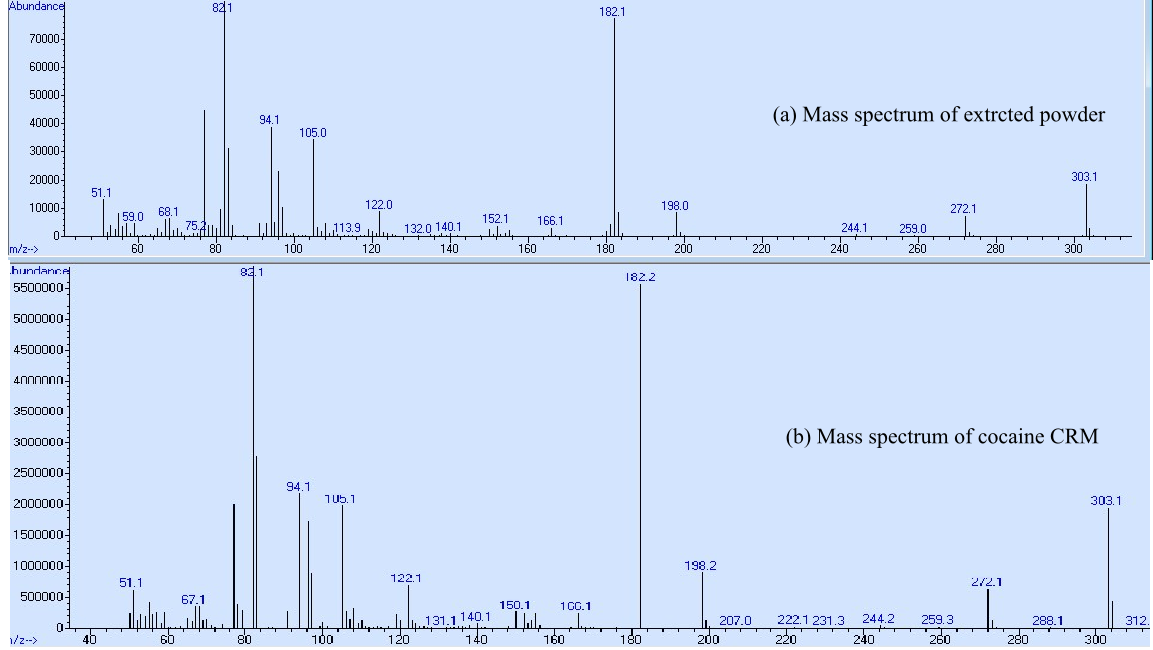
The GC-MS results confirmed the presence of cocaine with respect to the cocaine CRM, in all the extracted powders. The mass peaks m/z at 77, 82, 94, 96, 105, 182, and 303 (base peak) which are characteristic for cocaine molecule were observed in the mass spectrums for the samples and cocaine CRM (Figure 1).
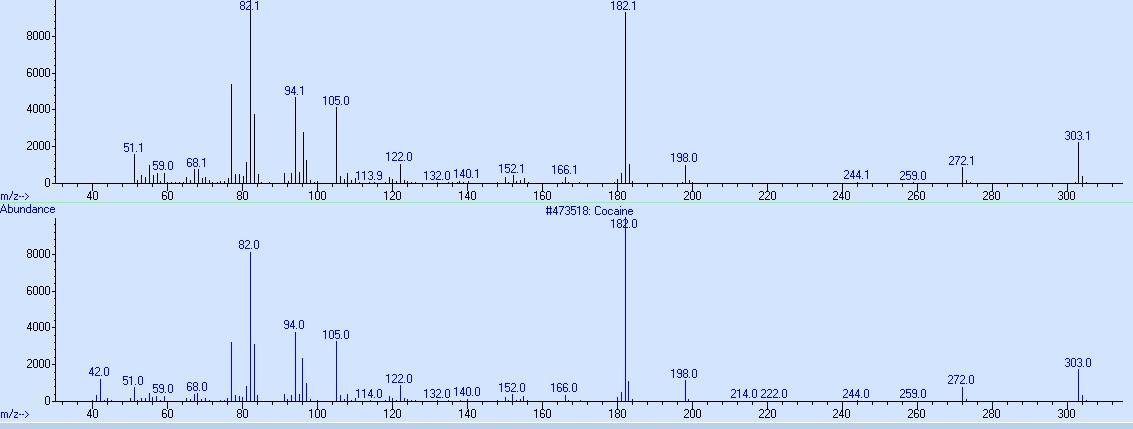
Figure 2 illustrates the mass spectrum of P1 along with library match results (NIST mass spectral library)
Calibration curve with 0.995 coefficient of regression (r2) was utilized for the determination of purity of cocaine in the extracted powder. The purity of cocaine extracted from each fabric is given in Table 2.
| Identification Number | P1 | P2 | P3 | P4 | P5 | P6 | P7 |
|---|---|---|---|---|---|---|---|
| Purity of cocaine (%) | 30 | 28.9 | 30.6 | 29.5 | 29.2 | 28.6 | 28.3 |
| Weight of cocaine impregnated to fabric (grams) | 108 | 127 | 95 | 17.3 | 37.6 | 253 | 262 |
Table 2: Purity of Cocaine Extracted From Fabric.
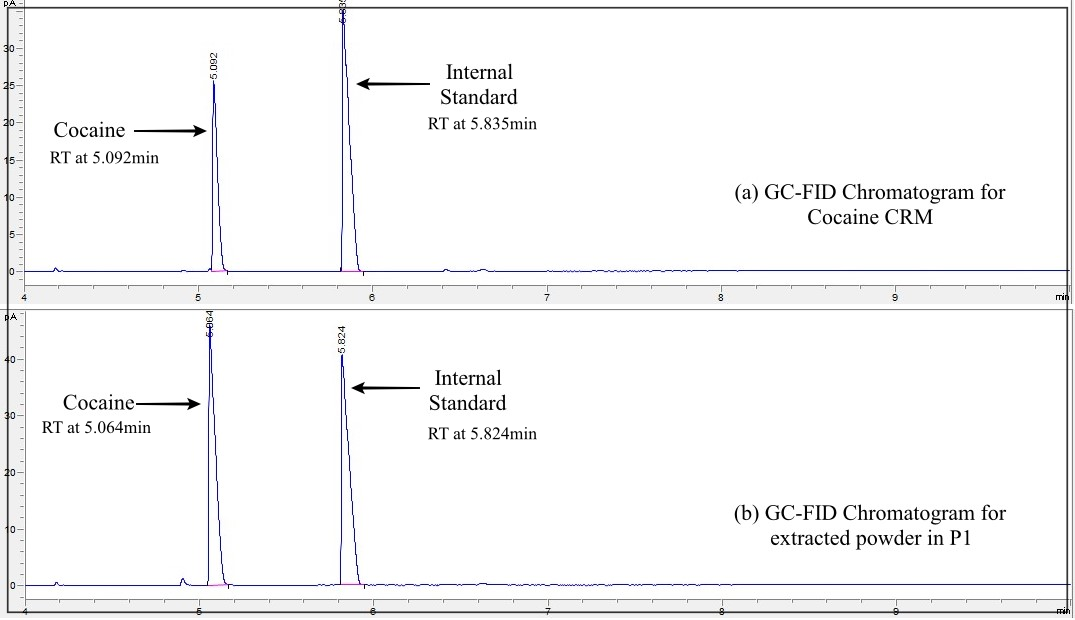
Figures 3 illustrate the GC-FID chromatograms for the cocaine CRM and for the extracted powder from P1.
The total weight of fabric was 11384 grams (11.384 kilograms) and the total weight of the extracted powder from all the seven fabric items was 3110.9 grams.
The GC-FID quantification method for cocaine was validated in the laboratory (LoD of 0.012 mg/mL, LoQ of 0.014 mg/mL) and it is relatively fast (less than 11 minutes), simple, specific and precise (RSD < 1%,). There is a good chromatographic separation between the analyte of interest (cocaine) and the internal standard. The purity of cocaine obtained using the validated method varies from 28.3% to 30.6%. Therefore it is reasonable to assume that same batch of cocaine drug has been impregnated to all fabric items. Further the GC-FID results revealed that the total weight of cocaine in the extracted powder was 901.2 grams. The study can be further developed towards cocaine drug profiling, to find out the origin of impregnated cocaine [10, 11, 12, 13, 14].
Conclusion
As per the analytical results obtained it can be concluded that, in cases where cocaine impregnated fabric or textiles are involved the best extraction solvent is Chloroform: Methanol 1:1 mixture. Further, Scott Test & TLC could be used as screening tests while GC-MS can be used for the confirmation. The validated GC-FID method given above is suitable for Quantitative analysis of Cocaine. This method was successfully applied for another case study in the Narcotic laboratory of GAD, where cocaine was impregnated into rubber carpets. Therefore this case study outlines a simple and accurate procedure which can be applied in identification and quantification of cocaine where the drug is impregnated into fabric or other matrices.
Acknowledgement
We express our gratitude to Mrs. Sakunthala Tennakoon (Government Analyst-retired) for her helpful guidance in preparation of this manuscript.
References
-
United Nations Office on Drugs and Crime (1998) Recommended Methods for identification and analysis of cocaine in seized material, manual for use by National Drug testing laboratories.
-
United Nations Office on Drugs and Crime (2021) Cocaine insights the illicit of cocaine from Latin America to Europe from oligopolies to free-for-all?
-
(2005) Scientific Working Group DRUG Monograph.
-
United Nations Office on Drugs and Crime (2023) World Drug Report 2023.
-
Grabherr S, Ross S, Regenscheit P, Werner B, Oesterhelweg L, et al. (2008) Detection of smuggled cocaine in cargo using MDCT. American journal of Roentgenology 190(5): 1390-1395.
-
Fucci N (2004) Phenacetin and cocaine in a body packer. Forensic science International 141(1): 59-61.
-
Ali EMA, Edwards HGM, Hargreaves MD, Scowen IJ (2010) In Situ detection of cocaine hydrochloride in clothing impregnated with the drug using benchtop and portable Raman spectroscopy. Journal of Raman spectroscopy 41(9): 938-943.
-
McDermott SD, Power JD (2005) Drug smuggling using clothing impregnated with cocaine. Journal of Forensic science 50(6): 1423-1425.
-
Yuksel B, Sen N (2018) Development and validation of a GC-FID method for determination of cocaine in illicit drug samples. Marmara pharamaceutical journal 22(4): 511-518.
-
(2006) Microgram Bulletin. The Drug Enforcement Administration Office of Forensic Sciences Washington 34(6): 67-82.
-
Xiao L, Alder R, Mehta M, Krayem N, Cavasinni B, et al. (2018) Development of a quantitative method for the analysis of cocaine analogue impregnated into textiles by Raman Spectroscopy. Drug testing and Analysis 10(4): 761-767.
-
Maldaner AO, Zacca JJ, Botelho ED, Silva DR, Oliveira FH (2021) Development and validation of a gas chromatographic method for the quantification of minor alkaloids in cocaine. Journal of Brazilian chemical society 32(4): 823-832.
-
Yilmaz B, Akba V, Cavus M (2017) Development and validation of GC-MS Method for Cocaine in Human Urine. Chromatography and Separation Techniques Journal 1(1): 114.
-
(2023) European Drug Report 2023: Trends and Developments. European Monitoring Centre for Drugs and Drug Addicts annual review.
- Forensic Implications of Adverse Drug Reactions in Schizophrenia A Case Series
- Narcotics and Digital Forensics: Bridging Crimes in the Digital Age
- Ethics in Forensic Psychiatry: Principles, Dilemmas, and Human Rights
- Impact of Acute Stress on Attentional Orienting to Social Cues
- Head Injury and Intracranial Hemorrhage in Western Region of Libya
- A Forensic Study on Handedness: Examination of Handwriting Features in Right and Left Handed Writers