
A Influence from the Religion at the Process in Resocialization of Stuck: One Analysis of the Detainees of Presidio in Victory in Santo Antão/Pe
Penalty can be conceptualized as a punishment for committing a certain crime. Beyond character punitive, The pity it has also function resocializing. Thinking in to guarantee O your character re-educational, The Law 7,210/84 predict one series in assists to the stuck, among to the which is the religious. Considering the power of religion to influence human behavior, the present study was developed with the aim of analyzing whether it is capable of exerting any influence on the process of resocialization of the prisoner. To this end, a qualitative and quantitative approach was carried out, with the application of a questionnaire with 66 prisoners from the Vitória de Santo Antão/PE Prison (PVSA) in order to observe inmates' opinions on the importance of religion in their reintegration process Social. Therefore, it was possible to see that the vast majority of PVSA inmates see the religion as one important tool at the process in resocialization of inmate.
Introduction
The penalty can be defined as a punishment directed by the State in counterpart to the criminal action committed by a criminal, in order to prevent the committing new crimes. It is known that, in the beginning of time, the only purpose from the pity it was to guarantee what O agent causative of damage pay for the infringement practiced. There was no proportionality between the penalty imposed and the crime that gave rise to it, being to the watered punishments in cruelty and torture.
Law 7,210/84, known as the Criminal Execution Law, is a manual that must guide the execution of the sentence in the national territory. This law provides means of ensure that the imposed sentence is served satisfactorily, casting rights It is duties from the person toilet in freedom, it is she stuck provisional or definitive.
Aiming to guarantee the resocialization, The Law 7,210/84, brings one series in assistance that must be guaranteed by the State to the prisoner, among which lies religion. Article 24 of the aforementioned law provides that religious assistance, with freedom of worship, will be provided to prisoners and internees, also providing that, The prison establishment must have an appropriate place for religious worship. It is important to highlight that this is also a constitutional guarantee, listed in the article 5th, section VII from the our Letter Magna, in addition in be gift in the rules minimum of United Nations for the treatment of the prisoner.
Thus, we can infer the importance given by legislation to religion, This is seen as one of the ways to guarantee a person deprived of liberty a greeting in pity more mild and any less distressing.
Given the facts narrated, the following question arises: Will religion, In fact, any influence on the prisoner’s resocialization process? Going further, this study seeks to evaluate the real thinking of the prison population about the importance of religion as an instrument of assistance for prisoners in your return to social interaction.
To this end, a questionnaire was carried out with inmates at the Vitória Prison of Santo Antão/PE (PVSA), where, through objective questions, it was possible to evaluate the feeling of the person deprived of freedom regarding the importance of religion in the your process in social inclusion after compliance with the pity.
Legal Aspects of Pity and a Law 7,210/84
Penalty is the criminal sanction imposed by the State, through criminal action; on the criminal as retribution of offense perpetrated it is prevention the new crimes [1].
O article 1st from the Law in Executions Penalties (LEP), disposes the next: Art. 1st A execution criminal he has per goal effect to the provisions in verdict or criminal decision and provide conditions for harmonious integration Social of condemned It is of hospitalized.
For Greco R [2], “The pity It is consequence Natural imposed for the state when someone commits a criminal offense. When the agent commits a typical act, illicit and culpable, opens up the possibility for the state to do worth your ius puniendi”.
Although, to the exercise O your power-duty in to punish, he must O state to guarantee, also, means for the resocialization of the individual, given the triple function of punishment, which be retribution, The prevention and re- education.
O article 59, caput, of Code Criminal Brazilian [3] predicts what: Art. 59 - The judge, taking into account the culpability, antecedents, conduct Social, The personality of agent, to the reasons, to the circumstances It is consequences of crime, good as to the behavior from the victim, shall establish, as may be necessary and sufficient for reproof and prevention of crime (...) emphasis our of article aforementioned denotes itself what The pity he must to be imposed at the sense no just in punishment for the offense practiced, but also as form in prevention to new crimes.
In relationship the prevention, it is subdivide in general It is Special. A first he has action prior to the commission of the criminal act, since the possibility of suffering a Criminal sanction raises awareness among the community not to commit crimes. The second, Act during The execution from the pity, one turn what it is on directly to the author of the criminal offense. The retributive character, as well as special prevention, acts in the instant in what the pity it is individualized or executed for the agent. Per end, O character re-education is present in the criminal execution phase, as it establishes that measures must be adopted to ensure the resocialization of the accused [4].
In addition to the function of punishing the offender for the commission of the crime by him accomplished he comes O our ordering to speak in reinstatement of same. It is understood the practice from the resocialization as one need in promote to the convict the conditions for him to restructure himself so that when he returns to society no more return the delinquent [5].
A Law 7,210/84 [3], in your article 10 determines O Following: Art. 10. A assistance to the stuck it is to the hospitalized it is duty of State, aiming to prevent O crime It is guide O return The coexistence in society.
Already O article 11 from the same Law, us incisors I to the SAW, collate which assists It is duty of state and law of inmate. Let’s see: Art. 11. The assistance it will be:
- Material
- Health
- Legal
- Educational
- Social
- Religious Emphasis our;
One can denote what at own Law in Executions Penalties remains Of course O sense resocialization of the sentence, by bringing in its wake a series of assistance that, in set, aim contribute in preparation of prisoner to your return Social.
Among to the assists brought for the Law 7,210/84 [3], have the assistance religious. Article 24 from the LEP foresees the Following: Art. 24. Religious assistance, with freedom of worship, will be provided to arrested and to hospitalized, allowing them the participation in services organized in the penal establishment, as well as the possession of books of instruction religious.
- 1st No establishment there will be a place appropriate for you cults religious.
- 2nd None stuck or hospitalized May to be thanks to participate in activity religious.
OK highlight what the assistance religious It is also one guarantee constitutional, Preview at the article 5th VII from the Constitution Federal in 1988, in addition in be provided for in the United Nations Minimum Rules for the treatment of prisoners. Like this, we can see that despite the Penal Executions Law having been enacted previously the Federal Constitution, it already assured prisoners the right to practice religious inside of unit’s prisons, including as quite in resocialization of the condemned.
Second Rodrigues: It can be seen what The presence from the religion in your miscellaneous shapes in manifestation in one system prison it works as one form in soften the suffering, pain, loneliness and anguish of being behind bars [6, 7] .
Being like this, there is who understand to be The religion one I cherish, one new form in see yourself, reducing idleness and the difficulties of facing years in one system penitentiary overcrowded It is what, few times, it achieves, in fact, to fulfill The re-educational purpose of pity.
A Religion and a Conduct of Individual Incarcerated
Religion, considered as a control over human conduct, can be evaluated under some strands, which be, being object in control Social, helping The no recidivism, good such as resocialization of prisoners.
Religious assistance is recognized as a Fundamental Right and Guarantee, according to precept the art. 5th from the our letter great.
Art. 5 Everyone is equal before the law, without distinction of any kind, ensuring yourself to the Brazilians It is to the foreigners residents at the Country The inviolability of the right to life, liberty, equality, security and property, in the following terms:
It is assured, us terms from the law, the installment in assistance religious in the entities civilians It is military of hospitalization collective [8].
With even greater protection assured by paragraph 4, IV of article 60 of the Constitution Federal: “No it will be object in deliberation the proposal in amendment trend to abolish: individual rights and guarantees.” Hence we understand the importance of insertion of religion in the unit’s prisons.
Such guarantee also finds forecast in the rules minimum of Nations United for O treatment of stuck, known as “Rules in Mandela” [9]. Let’s see:
Rule 65
- If the prison unit contains a sufficient number of prisoners from a same religion, he must to be indicated or approved one representative qualified that religion. If O number in prisoners justify such procedure, It is if to the conditions allow, one must to adopt This one procedure in time integral.
- A qualified representative appointed or approved in accordance with paragraph 1 of this Rule he must to have permission for accomplish celebrations regular It is to do visits pastoral private to prisoners in your religion in time appropriate.
- The right to contact a qualified representative of your religion Never he must to be denied. The any stuck. Per other side, if one stuck If you oppose the visit of any religious representative, your decision must be fully respected.
Rule 66
Every prisoner must have the right to meet the needs of his life religious, participating in celebrations held in prisons and keeping with you practice books It is in teaching in your confession.
It is understood the function of state at the exercise of paper penalizing- resocializer, what receive that one individual for the practice in one offense It is what must return it to society restored and aware of its attributes and responsibilities. In this context, how can religion influence behavior change? Human the point in contribute with this process of reinstatement?
Taking into account other objects influencing behavior human, there is no way not to consider the effect produced by religion on man. She modifies your form in to see O context Social in what it is inserted and O he does to assess their acts not only with regard to committing crimes, but also in terms of exercise of citizenship.
Religion, in fact, is not just a system of ideas; it is above all a system of forces. The man who lives religiously is not only the man who represents the world in this or that way, who knows what others ignore it; is first and foremost a man who experiences a power that no if do you know at life common, what no if feel in yes same when no if finds in state religious [10].
A religion unites miscellaneous layers from the society being just one of the aspects of social life, an aspect that has the characteristic of presenting solutions to desires of the collective. This creates unity between people and this union would be responsible for giving rise to the incarcerated person’s desire to integrate into the determined group.
In this way, it is understood that regardless of value judgment the respect for a given religion, it is understood that it can provide a basis for a organized social life, as it interferes with morals, customs, including the ordering legal.
We can to accept, to the any less as possibility, the theory in what all religion is important, even essential, of the social mechanism, in the same way that morals and laws, a part of the complex system that allows beings humans live together in an orderly organization of social relations. From this point of view, we do not consider the origins, but the social functions of religions, that is, their contribution to the formation and maintenance of order Social [11].
To the to understand what through from the religion O incarcerated he can meet O forgiveness he realizes the existence of a second chance to correct the mistakes caused. That This happens because isolation leads the individual to emotional weakening and religion, at that moment, could serve as an aid in the construction of new values for The life Social.
A doctrine Christian in Special Assists at the rescue from the self-esteem of the arrested per associate the crime committed to sin in the eyes of God and consequently O remoteness From him. When O criminal what if finds distant of ‘body’ celestial, which would be communion with those faithful to the same religious practice with God, Returns or if convert The Church, you sins through from the confession against of God and repentance can be forgiven. This idea of forgiveness the presentation brings with it a new perspective on the future for the condemned person [12].
O individual want if become one subject active inside from the collective, O what It is positive, then The leave in then he will design O your future after O greeting from the pity, being able, including, meet alternatives cool what help at the your return the society, bringing countless benefits to all you involved: State, collectivity It is incarcerated.
O what if intends prove with The gift search It is what The measure in what Incarcerated people remain linked to religiosity and distance themselves from that behavior that is constantly highlighted as negative and, if they return to practice conduct criminals, they will be in smaller gravity or complexity of what O crime previous.
Methodology
For the development of the present study, a quantitative It is qualitative, constituting in one search applied, in character descriptive, then, The leave from the analysis of the results, sought to describe to the characteristics and opinions of the prison population at the Vitória de Santo Prison Antão/PE, as well as the explanation, since he sought, through the analysis of collected data, demonstrate the influence of religion in the resocialization process of inmate.
For so much, he was carried out one vast search bibliographic It is legislative, The leave of the most varied fields of research, using books, scientific articles and theses, in addition to the application of questionnaires with inmates of the aforementioned prison unit, as well as photographic approaches to religious activities promoted by the Prison of Victory of Santo Antão/PE (PVSA).
The choice of inmates to be subjected to this research was carried out randomly, totaling sixty-six inmates submitted to the questionnaire. This value represents ten percent of the total prison population in the prison in question.
Suitable to clarify what before be submitted to study, all Participants were instructed about their purpose and objectives, as well as signed an informed consent form, being aware that your participation it was voluntary, with purposes only academics.
Results
After collecting and surveying the data, it was possible to observe that the majority part of the prison population subjected to research testifies to having Christian faith, being 30.3% declared Catholics It is 27.3% evangelicals. One total in 40.9% declared to believe in God, but no practice none religion.
Regarding participation in religious activities promoted in the unit prison, 72.7% stated that they attend work promoted by the prison. Of these, 57.6% declared participating in such activities 1 to 2 times a week, 9.1% in 3 The 4 times, while 27.3% they said no to participate of the works religious.
For 89.4% of inmates subjected to research, religion plays some role influence at your process in resocialization, of these 56.1%, stated what The religion contributes at the your return to the conviviality Social at measure in what O help The reflect about your behavior, so that you do not commit more crimes. 12.1% see religion one form in to be accepted for the society after O greeting from the pity; 21.2% see religion as a way to enter the job market and only 10.6% of those interviewed do not believe that religion can contribute, in any way, with their resocialization.
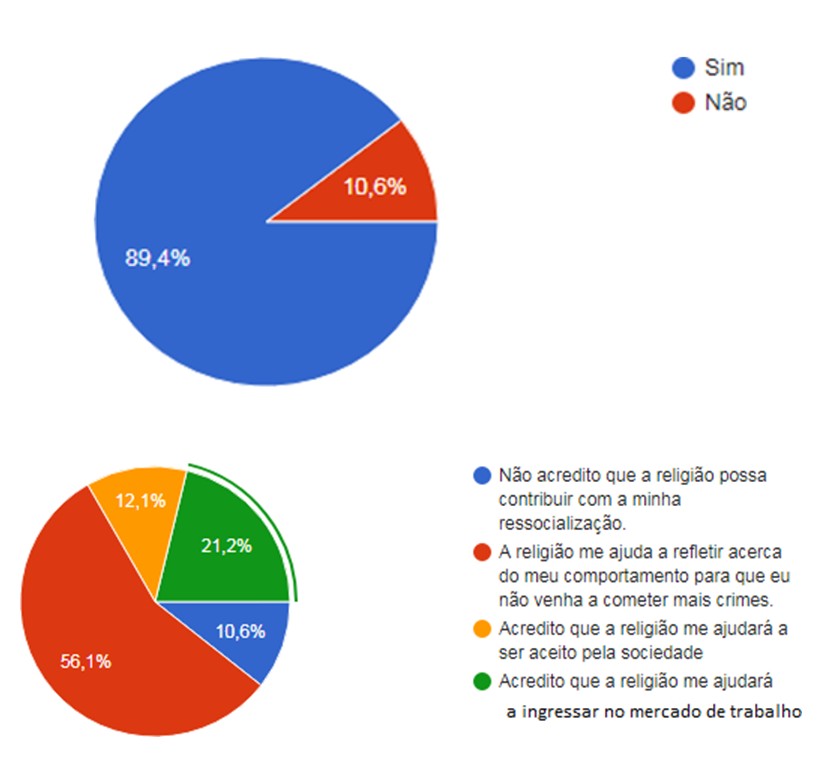
Graph 1: Opinion of the PVSA Prison Population Subjected to Research on the Influence of Religion at the your Process in Reinsertion Social.
Graphic 2: Opinion from the Population Prison of PVSA Submitted the Search About in as the Religion can Contribute to your Process in Resocialization.
Discussion
A religion it presents one big power in to influence at the behavior human, since it is capable of interfering in man’s unconscious, making him reflect about your acts It is your life.
To the units prison must to offer to the your inmates activities religious, including, as a way of complying with the provisions of the Federal Constitution, in the Law of Criminal Executions and Mandela Rules.
Therefore, in the Vitória de Santo Antão religious work is offered six days a week. Therefore, the unit account with the partnership in six churches: Assembly in God, Baptist, Episcopal, Universal Kingdom of God, Jehovah’s Witnesses and the Catholic Church, per quite of Prison Pastoral. With the application of the questionnaires, it was possible to notice that a large part of the submitted the gift search (72.7%) participate of activities religious promoted for the unit prison. Although, it was noticed what one amount yet bigger (89.4%) believe that religion is an influencing factor in the resocialization process of inmate.
From these data, it appears that even inmates who do not participate of cults, believes that religion is an important factor in the process of reinsertion of person deprived of liberty to the social interaction.
According to Rodrigues DSP [7], religion can be used as social control, since it has the power to influence human behavior when serving as north in search of the sacred. It also states that it has the power to influence your supporters the no practice actions what they are taken per negative it is sinful.
This statement is corroborated by the data collected, since only 10.6% of those interviewed stated that they did not believe that religion was capable of exercising some influence on the resocialization process.
56.1% find religion a way of rethinking your behavior, in order to understand what is right and what wrong, no returning more to delinquent.
This one it is one factor important, one turn what reflect about your acts, seeking out one new form in life, far away of the crimes, influence, directly, in the fees in recidivism. For Mosque Junior, et al. [13], in between you convicts what pass The professing a religion, the recidivism rate is significantly lower than the recidivism of those who do not attend religious services. Hence the certainty that the assistance religious must to be effectively implemented at the prison.
Mirabete it is Fabrinni RN, et al. [14] state what: Currently, religious assistance in the prison world has no place preferential nor It is point central of the systems penitentiaries, having adapted to the circumstances of our times. It cannot be ignored, However, the importance of religion as one of the factors of education total number of people hospitalized in an establishment penitentiary, reason for the which the assistance religious It is Preview in the legislations more modern.
Analyzing you results, he was possible to perceive, yet, what one part A considerable number of inmates (21.2%) see religion as a way to achieve enter the job market, thus demonstrating a concern to obtain means legal to obtain your sustenance.
No if he can to deny to the difficulties faced per one former inmate for get a job right after being released. Therefore, by not obtaining means to support himself and his family, end up returning to the world of crime, believing to be it is the only manner to obtain O your sustenance.
On the other hand, through religion, many of them believe that they can demonstrate your regret for the evil done, and may have a second chance for live by form worthy, being accepted by society.
Second mosque Junior: Religion exerts a significant influence on the prison, contributing to the reinstatement Social in many condemned. Furthermore, in face from the hope what there will be one future happy it is Eternal, The discipline of condemned what It is follower in some religion It is significantly better. No enough the protection of the members of the groups religious those ones what if unite The they. Such protection he does making the internal environment of the prison establishment better, more peaceful [13].
It is known that the vast majority of prison environments are unhealthy, with population prison above from the your capacity maximum, becoming O greeting from the pity yet more distressing It is suffered. Like this, the religion ends per to be one I cherish, a way to make cloistered days easier and to believe that there is still hope on one different future. A total of 12.1% of survey participants say they see religion as a form in to be accepted for the society, demonstrating, like this, The concern of the prisoners with the prejudice that exists towards those who once committed a crime, have paid for their mistakes and are looking for a chance to return to social life, being accepted as a subject in duties It is of rights.
Hostel apud Marcão R, [15], disposes in your constructions Right Penitentiary and Minor’s Law, which recognizes that religion is one of the most decisive factors in the resocialization of the prisoner. According to him, Pius XII stated that crime and guilt no arrive The to destroy at the bottom human of condemned O stamp printed for the Creator. And this one seal that illuminates the path of rehabilitation.
It is undeniable to accept the presence of religion as a preponderant factor in resocialization in many prisoners, one turn what, per quite her, comes up The hope in one acceptance Social, good as, he can to take O criminal The one process in repentance, contributing in form decisive for what This one no come back The delinquent.
This thought is corroborated by Durkheim, when he states that the effectiveness and the efficiency from the religion It is able in to transform O man individually It is collectively. For he, to the to practice the religion, you men become different [16].
Like this, after the analysis of the data collected, he was possible to perceive what the big Most prisoners see religion as a way to reflect on their actions, being able to be accepted by society after being released. It was found also what O Presidio in Victory in Holy Antão (PVSA) search to fulfill to the determinations cool at the sense in provide to the inmates The assistance religious, which it does six days a week, with several partner churches, with the inmates free to participate or no of these activities.
Final Observations
The main objective of this study was to verify whether religion is capable of exert some type of influence on the process of resocialization of the prisoner, more specifically in relation to inmates at the Vitória de Santo Antão/PE Prison. For that, 10% from the population prison from the cited unit prison he was submitted the application in one quiz what asked about from the relationship in between the religion It is The social reintegration of the detainee.
As forms of resocialization, the Criminal Executions Law provides for some assistance, which aims to provide the inmate with the means for the sentence to be fulfilled in the most dignified way possible. Among such assistances considered as the duty of the State, we can mention the religious. It is worth noting that this prediction is not just from Law 7,210/84, but also constitutional, in addition in be gift in the rules minimum of the United Nations for the treatment of prisoners, known as the “Rules of Mandela.” During The gift search, he was possible observe what O Presidio in Victory in Santo Antão/PE complies with the provisions of Law 7,210/84, by guaranteeing its inmate to appropriate religious assistance. Jobs are offered in the prison unit religious six days a week. To this end, partnerships were established with several churches evangelicals It is with The Catholic church.
In religious work promoted in prison, inmates hear about the word of God, sing praises, in addition to having the possibility of talking to the leaders of partner churches, where they receive advice and clarify possible doubts of a religious nature. It is important to highlight that participation or not in such work is completely voluntary, with the prisoner being able to choose his religion and which cults want to participate.
At the take place of gift study, he was possible to perceive what the religion It is View, per much of the doctrine, as a means of providing the prisoner with a fulfillment of milder penalty. For many indoctrinators, religion is the best way to re-educate. Without it, the internal reform of the condemned would not be possible, as it constitutes an important moral element, at the which one based all The re-education.
The data collected in the study only corroborated the idea of being the religion is an important factor in the re-educational aspect of punishment, since the great The majority of prisoners subjected to research stated that they believe that religion is capable of to influence directly at the your process in resocialization. Of these, many participate in religious activities in the prison unit at least once a week and think that religion is capable of making them reflect on their conduct so that they do not commit crimes again, in addition to helping them in the process of acceptance by the society, as well as entering the job market after fulfilling your pity.
It can be concluded, then, that religion is a preponderant factor in the process of resocialization of recluse, owing to be implemented in all to the units prisons as a means of adapting to what the law determines. Therefore, it is possible affirm that religion is capable of making serving a sentence less distressing, with the consequent reduction of recidivism rate.
Other References
1. Masson C Outlined Criminal Law-General Part, In: 10th (Edn.).
2. Bitencourt CR (2011) Failure of Prison Sentence: causes and alternatives, In: 4th (Edn.), Hail. São Paulo.
3. War S (2017) Human Rights-Elementary Course. In: 5th (Edn.), Saraiva.
4. Beccaria C (2014) Crimes and Penalties, In: 6th (Edn.), Martin Claret, São Paulo.
References
-
Nucci GS (2016) Commented Penal Code, In: 16th (Edn.), current rev and ampl Forensic Ed Rio de Janeiro.
-
Greco R (2015) Criminal Law Course, In: 17th (Edn.), Impetus Rio de Janeiro.
-
(1984) Brazil Criminal Executions Law. Law 7, 210 of July 11. Federative Republic of Brazil.
-
(1940) Brazil. Penal Code. Decree Law No. 2,848 of December 7. Federative Republic of Brazil.
-
Barros FAM (2006) Criminal Law-General Part. Hail São Paulo.
-
Figueiredo Neto MV, Ypvo Mosque, Teixeira RP, Rosa LCS (2009) The resocialization of prisoners in the Brazilian reality: perspectives for public policies. In: Legal Scope Rio Grande 7(65).
-
Rodrigues DSP (2016) The role of the Christian religion in the process of resocialization of the individual in collective prison institutions: APAC in Teófilo Otoni.
-
(1988) Constitution of the Federative Republic of Brazil of 1988. Presidency of the Republic Civil House Deputy Director for Legal Affairs, Brazil.
-
(2016) United Nations minimum rules for the treatment of prisoners. Series International Human Rights Treaties. National Council Of Justice (CNJ), Brazil.
-
Sanchis P (2011) The contribution of Émile Durkheim. In: TEIXEIRA, Faustino Sociology of religion: theoretical approaches.
-
Radcliffe-Brown AR (2013) Structure and function in primitive society. Petrópolis: Voices pp: 1-240.
-
Freitas AGM (2015) The influence of religion on the resocialization of prisoners. pp: 1-20.
-
Mesquita Junior SR (2014) Criminal Execution: Theory and Practice, In: 7th (Edn.), Atlas, São Paulo.
-
Mirabete JF, Fabbrini RN (2018) Criminal Execution, In: 14th (Edn.), Atlas.
-
Marcão R (2019) Criminal Execution Course, In: 14th (Edn.), Saraiva.
-
Eller JD (2018) Introduction to the Anthropology of Religion. Voices. Petrópolis/RJ.
- Forensic Implications of Adverse Drug Reactions in Schizophrenia A Case Series
- Narcotics and Digital Forensics: Bridging Crimes in the Digital Age
- Ethics in Forensic Psychiatry: Principles, Dilemmas, and Human Rights
- Impact of Acute Stress on Attentional Orienting to Social Cues
- Head Injury and Intracranial Hemorrhage in Western Region of Libya
- A Forensic Study on Handedness: Examination of Handwriting Features in Right and Left Handed Writers