
Efficacy of Forced Choice Testing in Detecting a Secret Cell Hiding Within a Group
The purpose of this project was to test whether a previously validated method of detecting deception known as forced choice testing would be effective at finding a “cell” of deceptive individuals hiding in a larger group. 64 men and women enrolled in a State Trooper Academy were the participants of this study; 57 participants were randomized to the truthful group and 7 were randomized to the deceptive group. Each participant was given an FCT by a member of the cadre who was blind to the status of the participants. The distribution of responses deviated significantly below the binomial prediction for 14 individuals; a cross-link analysis indicated 7 of these 14 did not select each other. These were the members of the deceptive group. Consistent with the hypothesis underpinning traditional FCT methods, deceptive individuals motivated to hide what they knew (i.e., the identity of the “cell” of deceptive individuals) avoided picking any of the other deceptive participants who appeared on the FCT. This avoidance behavior resulted in fewer number of “selections” than predicted by the binomial calculations. These data suggest it may be fruitful to explore how well the principles of FCT can be used in law enforcement or national security to detect potentially dangerous “cells” of individuals hiding within larger groups.
Introduction
National security professionals have placed an emphasis on deception detection and have developed tools to help them determine whether individual is being deceptive, or conversely, telling the truth [1]. Because of the limitations of current deception detection methods, we believe innovations in the field are needed."[1]. Over the past 15 years, our research team has examined whether a non-coercive, probability-based method that has been used in medicine for detecting deception - known as Forced-Choice Testing (FCT) could be used effectively within contexts other of interest to national security [2].
Our previous research has demonstrated that FCT methods have been effective in detecting information that individuals are trying to conceal. The classification accuracies for this approach have been between 82-85% [3] which is higher than the demonstrated efficacy of other approaches to detecting deception - such as the polygraph [4] or voice stress analyzer [5]. While promising, previous studies did not assess how well FCT could be used to find a group of collaborating deceptive individuals hiding within a larger group. Such a methodology may provide new investigative techniques for national security professionals tasked with finding “terrorist cells” of individuals who have been identified as presenting a threat to U.S. national security.
The present study was designed to assess the efficacy of the FCT when administered to a group of people, among whom several individuals attempted to hide their membership in "a cell of deceptive individuals." As in our previous studies, we hypothesized that these deceptive individuals would, when asked about a "cell" hiding within the group, deny any knowledge of a cell and withhold information about its members. This avoidance behavior would, hypothetically, skew the distribution of FCT-acquired “voting” data for each of the cell members; this would result in each cell member receiving significantly fewer votes than innocent members of the group. We also hypothesized that this avoidance behavior would become visible when conducting a link analysis between members of the group.
Method
Participants
Participants included 64 healthy Cadets (4 females; 60 males) who were enrolled in the Connecticut State Trooper Academy. Prior to enrollment in the study, each participant gave written, informed consent. The mean age of the participants was 25 (ranged =24-27) years of age. 52 of the men were Caucasian; 4 were African American and 4 were Hispanic. All were residents of the State of Connecticut.
Briefing
A pseudo-randomization method was used to divide participants into two groups (truthful, N= 57; deceptive, N= 7). The 7 Cadets randomly selected to be the deceptive group met with the research team during a noon break in their cadet training program; In this meeting, they received the answer key to the final exam of the State Trooper Academy and were told to make sure that they didn’t tell anyone about the identity of anyone in their cell. They were not told anything about the upcoming FCT interview. The Academy cadre was blind to the identities of the 7 members in the deceptive “cell” group. We selected the cell size of 7 based on the range of 5-11 exhibited by AQ cells. We selected a larger group size of 64 because this was within the range (50-80) of “groups of interest to the intelligence community.
Construction of the Forced Choice Test
The FCT administered to participants consisted of 32 power-point slides. Each slide presented two full- color photographs of two cadets in the class. Each cadet’s photograph appeared only once in the set of 32 FCT slides. Male cadets never appeared on the same slide as a female cadet; Similarly, the race of cadets depicted on a given slide was identical.
Administration of the Forced Choice Test
Each cadet was given an FCT by an Academy cadre who was blind to the ground truth status of the cadet.
Prior to showing the slides to a cadet, a cadre member would state, "We believe there is a group of students who have the exam key and are planning to cheat on the final exam." Then, as each of the 32 slides was shown to the cadet, the cadre member asked, "If you had to guess, which of these two individuals seen on this slide do you think might be part of this secret group that is planning to cheat on the exam? It is fine to just guess." Participants indicated their selection (or guess) by stating overtly (and by pointing) to one of the two cadet photographs. The cadre member recorded their response. Each cadet viewed all 32 slides only once.
Data Analysis
If a cadet’s photograph was selected as a “likely member of the cell” that cadet was assigned a target hit score of “1.” If a cadet depicted on the slide was not selected as a “likely member of the cell,” they were assigned a ‘no hit’ score of “0” (i.e., 1 = target hit; 0 = no hit). This resulted in the ability to determine the total number of times each cadet was selected as someone who might be a member of the secret “cell.” The 2-choice, 32-slide construction of our FCT meant that each cadet who appeared on a slide had a 50% chance of being selected by a viewer. This means that each cadet would receive approximately 31 votes by chance alone [6]. We did not expect 32 votes per cadet by chance since we did not believe that a cadet would identify themselves, when seeing their own photograph on the FCT, as a member of a secret “cell.” Consistent with previous studies, we also hypothesized that no member of the 7 members “cell” would choose to divulge the identity of another member of the “cell.” Therefore, this would hypothetically reduce, for each “cell” member, the expected number of votes (i.e. 31) by 7 (i.e. the number of members in the “cell,” (i.e., 24). We were not interested in cadets who received a greater than chance number of endorsements. We were interested in cadets whose number of “hits” was at least 7 fewer than those predicted by chance (i.e. fewer than 25 “hits”). A research team member utilized a binomial distribution calculator, calculated the “hit” rates and conducted a link analysis [6]. Based on the probability of success on a trial (.5), with 31 trials, and a number of successes equal to 25, the cumulative binomial probability (P(X>25) is 0.0004. This research team member was blind to the status of the cadets.
Results
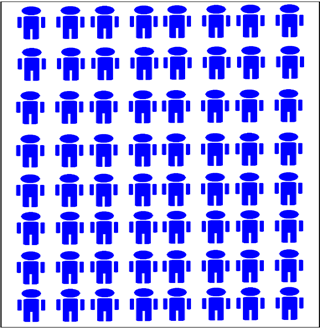
Figure 1 depicts the entire population of 64 participants in the study.
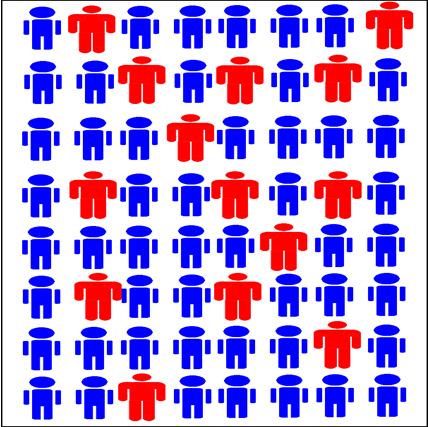
As shown in Figure 2, after calculating the “hit” rate the research team analyzed the results of the FCT and determined that 14 of 64 cadets had received ≤ 25 “votes.”
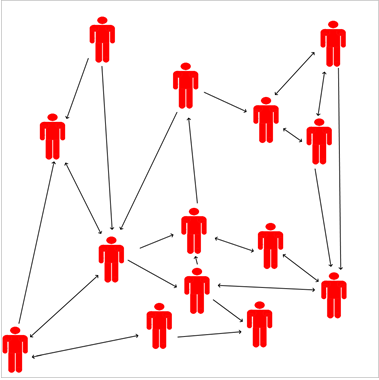
As shown in Figure 3, the link analysis conducted by the research team revealed patterns in the voting behaviors between suspected deceptive individuals.
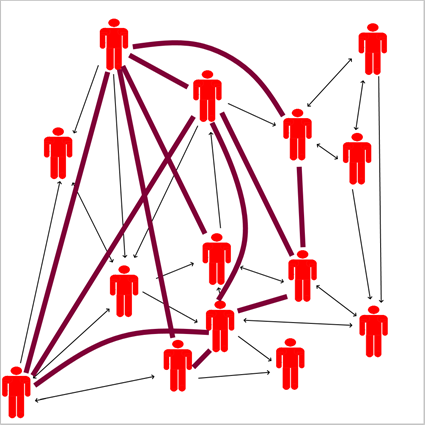
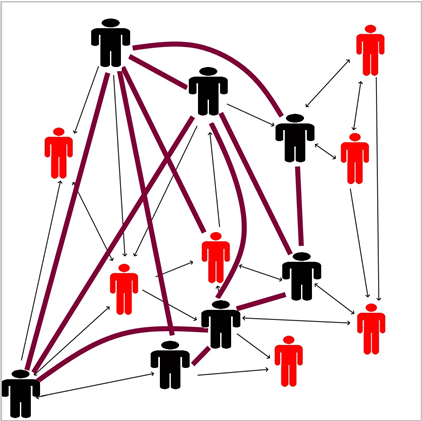
As shown in Figure 4, the link analysis indicates the voting patterns of the 14 individuals who got ≤ 25 “votes”, 7 did not “vote” for each other. Those individuals are connected with maroon lines.
As shown in Figure 5, those 7 deceptive individuals that did not vote for each other among the 14 suspected individuals are depicted in black.
Discussion
The data from this study are consistent with previous observations that individuals attempting to deceive or conceal information will avoid incriminating information of interest when exposed to an FCT in order to give an impression of innocence [3]. The avoidance strategy exhibited by the deceptive members of the “cell” skewed the overall distribution of votes for the group as a whole and permitted identification of this hidden “cell.” Their behavior is consistent with the findings of FCT methods used in clinical settings where the avoidance strategies used by deceptive patients ultimately reveal the malingered nature of their claimed illnesses [7]. The present findings suggest the behavior of humans who are being deceptive behave similarly whether the FCT administration setting is clinical or non- clinical.
The present data also suggests that in settings associated with national security lengthy FCT presentations, which are common in the clinical setting, may not be necessary in order to be effective. The 32-card test used in this study permitted an accurate identification of the deceptive individuals in the “cell.” The avoidance behavior of the deceptive individuals resulted in response profiles that were patterns that were less frequent than one would predict by chance and from binomial calculations. These deviations from chance reduced the number of people of interest from 64 to 14. This suggests the FCT method may be effective in helping reduce the workload of investigators by identifying a smaller group “of interest.” The link analysis conducted on this smaller group of interest revealed the identity of the cell members.
There are several limitations to the present study. First, the utility of this method for “finding a cell” is dependent upon two critical things: the number of people in the cell who know each other cell member’s identity, and the number of people in the larger group. The current method is dependent on cell members knowing the identities of - and avoiding the identities of - other members of the “cell.” The avoidance behavior is what contributes to the skewed “hit” rates noted in the large group as a whole. If cell members did not know the identities of other members - as was the case in IRA “cells” [8]- their selection behavior would not likely result in a skewed “hit” distribution profile. As noted above, our decision to employ a design in which cell members knew each other was based on historical data about AQ cells. This suggests that this approach will be useful with respect to some terrorist organizations but not others.
When using FCT for an organization in which “cell members” do know each other, the efficacy of the method will depend upon the size of the larger group relative to the size of the “cell.” Binomial calculations indicate that the number of individuals who will receive fewer than the predicted “votes” or “hits” will increase as the larger group size increases. This means that secondary analyses (i.e. link analyses) will become necessary. In this study we found that several non-cell members of the group received fewer than the expected number of “hits” according to the binomial prediction. During a debriefing with the cadets about the study several participants made comments that their picking behavior was not only in response to the question on the test (about who might be in a cell) but also was influenced by a cadet’s reputation in the class (for being a prankster or being an “unknown” or something else). However, it is important to note that when dealing with larger populations it may be feasible to utilize methods, or intelligence data, to decrease the “group size” who will be given an FCT. Doing this may mitigate some of the issues with having a disproportionately large “group size” to “cell” ratio.
The information from the debriefing of participants indicated that none of the cadets was aware of the principle of the FCT during testing. The cadets in this study did not know how representative their responses would be for the group of cadets as a whole, they could not discern how their responses would skew the findings derived from the overall group. This is consistent with our previous FCT work in foreign nationals and suggests FCT may be useful operationally and avoid some of the problems that arise with the use of traditional deception detection methods. Methods such as the polygraph require explicit testing and instructions about the nature of the questions which alerts the subject that the information they are providing on the test may lead to the “cell” being detected. Therefore the individual is more likely to engage in defensive behavior designed to alter their physiologic or behavioral responses [9, 10, 11, 12, 13, 14, 15, 16, 17, 18].
The implication of these data underscores the usefulness of link analyses that extend from FCT data. Future studies might examine the utilization of Forced Choice Testing with a multinomial approach in which the relationship between the variables and the “Ground Truth” is not binomial. Future studies may also examine the efficacy of combining other interviewing techniques with FCT. This may assist in detecting not only the identities of individuals but also the type of information they may be attempting to conceal [2].
References
-
Sonsteby A, McGovern M (2013) Emerging Science and Technologies: Securing the Nation Through Discovery and Innovation. Intelligence and National Security Alliance Council on Technology and Innovation, pp: 1-25.
-
Morgan III CA, Rabinowitz Y, Leidy R, Coric V (2014) Efficacy of combining interview techniques in detecting deception related to bio‐threat issues. Behavioral Sciences & the Law 32(3): 269-285.
-
Morgan III CA, Hazlett G (2009) Efficacy of forced choice testing in detecting deception in Russian. Journal of Intelligence Community Research and Development 1(1): 9.
-
Harnsberger JD, Hollien H, Martin CA, Hollien KA (2009) Stress and Deception in Speech: Evaluating Layered Voice analysis. Journal of Forensic Sciences 54(3): 642- 650.
-
Rigdon SE (2018) Exact Bayesian Inference for Assessing the Accuracy of Polygraph Testing. Journal of the Indian Society for Probability and Statistics 19: 67-78.
-
Binomial Probability Calculator. Stat Trek.
-
Pankratz L (1994) Malingering on Intellectual and Neuropsychological Measures. In: Rogers R (Ed.), Clinical Assessment of Malingering and Deception. Guilford Press, pp: 223-236.
-
Horgan J, Taylor M (1997) The provisional Irish Republican army: Command and functional structure. Terrorism and Political Violence 9(3): 1-32.
-
Saxe L (1991) Science and the CQT polygraph: A theoretical critique. Integrative Physiological and Behavioral Science 26(3): 223-231.
-
Bond CF, Kahler KN, Paolicelli LM (1995) The miscommunication of deception: An adaptive perspective. Journal of Experimental Social Psychology 21(4): 331-345.
-
Colwell K, Hiscock-Anisman C, Memon A, Rachel A, Colwell L (2007) Vividness and spontaneity of statement detail characteristics as predictors of witness credibility. American Journal of Forensic Psychology 25(1): 5-30.
-
DePaulo BM, Malone BE, Lindsay JJ, Muhlenbruck L, Charlton K, et al. (2003) Cues to deception. Psychological Bulletin 129(1): 74-118.
-
Greenwald AC, Nosek BA, Banaji MR (2003) Understanding and using the implicit association test: I. An improved scoring algorithm. Journal of Personality and Psychology 85(2): 197-216.
-
Hazlett G, Morgan III CA (2011) Efficacy of two deception detection strategies when assessing individuals within cross-cultural circumstances: Scientific Technical Report. DIA
-
Morgan III CA, Aikins D, Hazlett G, Doran A, Baranoski M (2006) The application of expected alternative testing dilemmas to detecting concealed information in humans during exposure to interrogation stress. Journal of Intelligence Community Research and Development 4: 1-22.
-
Morgan III CA, Colwell K, Steffian G, Hazlett G (2008) Efficacy of verbal and global judgment cues in the detection of deception in Moroccans interviewed via an interpreter. Journal of Intelligence Community Research and Development 3: 1-23.
-
Morgan III CA, Rabinowit YG, Kallivrousis G, Hazlett G (2010) Efficacy of automated forced choice testing dilemmas in Vietnamese. Journal of Intelligence Community Research and Development 6: 1-11.
-
Vrij A, Fisher R, Mann S, Leal S (2006) Detecting deception by manipulating cognitive load. Trends in Cognitive Sciences 10(4): 141-142.
- Forensic Implications of Adverse Drug Reactions in Schizophrenia A Case Series
- Narcotics and Digital Forensics: Bridging Crimes in the Digital Age
- Ethics in Forensic Psychiatry: Principles, Dilemmas, and Human Rights
- Impact of Acute Stress on Attentional Orienting to Social Cues
- Head Injury and Intracranial Hemorrhage in Western Region of Libya
- A Forensic Study on Handedness: Examination of Handwriting Features in Right and Left Handed Writers