
“Chemical Courage”: A Review on Pharmacotoxicological Aspects of Fenethylline (Captagon)
Fenethylline (Captagon) is a synthetic psychostimulant drug was synthesized in Germany in 1961. It is a combination of amphetamine and theophylline molecules and having central nervous system (CNS) stimulant effects similar to the amphetamine-type stimulants (ATS). First it used as a milder alternative of ATS in treatment of Attention Deficit Hyperactivity Disorder (ADHD) in children, narcolepsy and depression in Germany and the United States (US). In 1981, Fenethylline classified as a schedule I controlled substance and was banned in the US because of side effects including hallucinations, psychosis and visual distortions. The drug became illegal in most countries in 1986 after being listed by the World Health Organization (WHO). However, it is now a prominent drug of abuse in the Eastern Mediterranean Region (EMR). Recently, the drug manufactured as street drug in clandestine laboratories with its original brand as called Captagon in EMR countries. Captagon promotes euphoria, feeling of wellbeing, fearless, insomnia, anorexia and even analgesia and it is emerging as a drug associated with war and terroristic acts in the Middle East by nicknames such as: “Jihadi pill”, “Jihad pill”, “Jihadist’s drug” or “Abu Hilalain” in Arabian countries. It is popular abused drugs in Middle East by soldiers, militants, combatants, terrorists and even civilians. The aim of this review is an overview of pharmacotoxicological aspects of Captagon and its current status as a abused drug in wars and terroristic attacks.
Introduction
Fenethylline (Captagon as common brand name), is a synthetic psychostimulant drug was synthesized in Germany in 1961. It is a combination of amphetamine and theophylline and having central nervous system (CNS) stimulant effects similar to the amphetamine-type stimulants (ATS). First it used as a milder alternative of ATS in treatment of Attention Deficit Hyperactivity Disorder (ADHD) in children, narcolepsy and depression in Germany [1, 2].
Fenethylline developed in the 1960s in Europe as an over-the-counter (OTC) pharmaceutical preparation which substituted for amphetamines but rapidly was classified into prescription-only medicines. Then, the drug was approved in the United States (US). Fenethylline was marketed under the brand names Captagon, Fitton and Biocapton [1]. In 1981, Fenethylline classified as a schedule I controlled substance and was banned in the US because of side effects including hallucinations, psychosis and visual distortions. Also, it has been associated to serious adverse drug events such as myocardial infarction, seizures, and delusions [1, 2]. The drug became illegal in most countries in 1986 after being listed by the World Health Organization (WHO) for international scheduling under the Convention on Psychotropic Substances 1971 [3]. However, it is now a prominent drug of abuse in the Eastern Mediterranean Region (EMR) as defined by WHO. Recently, the drug manufactured as street drug in clandestine laboratories with its original brand as called Captagon in EMR countries mainly Syria [1, 2, 3].
Fenethylline is emerging as a recreational abused drug as well as a drug associated with war and terroristic acts in the Middle East. Captagon is an inexpensive and addictive drug that may be used to promote euphoria, feeling of well-being, fearless, insomnia, anorexia and even analgesia [1, 3, 4]. From this view, it is the most popular abused drugs in Middle East’s black market by soldiers, militias, combatants, terrorists and even civilians [1, 2].
The aim of this narrative review is a review on pharmacotoxicological aspects of Captagon and its current status as an illicit abused drug in wars and terroristic attacks.
Chemistry and Dosage Form
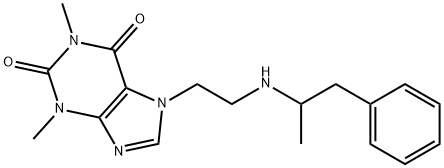
Fenethylline [or phenethylline or amphetaminoethyltheophylline or amfetyline] with Chemical Abstract Service (CAS) name: (R,S)- 3,7-Dihydro- 1,3-dimethyl-7-[2-[(1-methyl-2-phenylethyl)amino]ethyl]- 1H-purine-2,6-dione, defines as a covalently linked of an amphetamine molecule with theophylline as an alkyl chain (Figure 1) [5, 6]. In 1961, German chemists at Degussa AG Pharmaceutical company first synthesized fenethylline from amphetamine and 7-(2-chloroethyl) theophylline. The company began to market its hydrochloride salt under the property name Captagon [6]. Fenethylline is a co-drug of amphetamine and theophylline and a prodrug to both [1, 6]. The physicochemical characteristics of fenethylline and its hydrochloride salt have shown in Table 1 [6, 7].
| Physicochemical characteristics | Fenethylline | Fenethylline hydrochloride |
|---|---|---|
| CAS Reg. No. | 8/1/3736 | 1892-80-4 |
| Molecular Formula | C18H23N5O2 | C18H23N5O2.HCl |
| Molecular Weight (g/mol) | 341.41 | 377.87 |
| Melting point (ºC) | Not available | 227-229 and 237-239 (racemic mixture) |
| pKa | 10.3 | 9.39 |
Table 1: Physicochemical Characteristics of Fenethylline and Fenethylline Hydrochloride.
Captagon is available in the form of oral tablets containing 50 mg of fenethylline hydrochloride (in standard dosage form) but tablets can be crushed, heated, and intravenously injected for more powerful and rapid effects in cases of abuse [1].
Analysis of many seized samples of illicit and counterfeit Captagon tablets have been shown the mixtures of amphetamine plus caffeine, rather than fenethylline hydrochloride. In some counterfeit Captagon samples, methamphetamine rather than amphetamine is found.
The most common adulterants which detected in street-level manufactured tablets includes amphetamine, methamphetamine, procaine, caffeine, quinine, chloroquine, ephedrine, metronidazole, theophylline, chlorpheniramine, acetaminophen and trimethoprim [1, 8, 9, 10, 11].
Metabolism
In in vivo situation, fenethylline metabolizes by oxidative enzymes to produce its original components, amphetamine and theophylline, each of them has its own undesirable characteristics when taken in large quantities [12]. Captagon metabolizes to amphetamine (24.5%) and theophylline (13.7%) per oral dose.
Theophylline, a xanthine derivatives, is a weaker CNS stimulant in comparison with caffeine with a narrow therapeutic index. In supratherapeutic doses, it is induced arrhythmias and gastrointestinal side effects [1]. Captagon has greater lipophilicity than either theophylline or amphetamine alone, allowing its more rapid absorption into the CNS, but amphetamine penetrates brain tissue more rapidly than Captagon [12]. Theophylline is metabolized via cytochrome P450-2D6 (CYP2D6) enzyme, while amphetamine inhibits CYP2D6. Therefore, amphetamine is eliminated more rapidly from the body than theophylline, but these two agents act synergistically with each other to enhance the individual drug stimulant effects [13].
Investigation on metabolic fate of fenethylline in an animal model (male Sprague-Dawley rats) and human volunteers showed that six metabolites were identified in the rat and human urine samples including amphetamine(AP), p-hydroxy-AP, acetylaminoethyl-theophylline(TP), aminoethyl-TP, hydroxyethyl-TP and carboxymethyl-TP. In human, carboxymethyl-TP(39-43% dose) and AP(23-33% dose) were the major metabolites in 0-48h urine [14].
Mechanism of Action and Pharmacology
Captagon has a strong CNS stimulating effect that its primary metabolite, amphetamine. However, multi-targets issues associated with the drug and metabolites as well as its underlying mechanisms have not been fully understood [1, 15].
Amphetamine acts as an agonist at the trace amine- associated receptor 1 (TAAR-1), which enhances dopamine signaling. This dopaminergic effects may induce behavioral changes such as irritability and aggression and can lead to dependence. Wu N, et al. [13] performed a drug abuse chemogenomics-knowledge base systems pharmacology approach to conduct targets/off-targets mapping investigation of Captagon and its metabolites. Theophylline as an antagonist of adenosine receptors (e.g. A2aR) in the brain responsible for restlessness and analgesia, may attenuate the behavioral sensitization caused by Amphetamine. Also, they found that the synergies between two metabolites cause Captagon’s psychoactive effects to act faster and more potently than those of Amphetamine alone. The researchers carried out molecular docking modeling and molecular dynamics simulation to explore the molecular interactions between Amphetamine and Theophylline and their important G protein-coupled receptors (GPCRs) targets, including TAAR1 and adenosine receptors [13].
Serotonin (5-HT) receptors are important role in various neurobiological processes, such as cognition, learning, memory, anxiety, appetite, mood, sleep, aggression, and thermoregulation. These receptors are commonly related to drug abuse and addiction as targets for various medicinal and recreational drugs.
Wang YQ, et al. [15] investigated on all type of 5-HT receptors based on the existing crystal structures of 5-HT1B, 5-HT2B, and 5-HT2C. Then, they performed molecular docking studies between 5-HT receptors agonists/inhibitors and 3D models. They performed molecular docking simulations for 12 5-HT receptors complexed with ligands. They showed that 5-HT2C, 5-HT5A, and 5-HT7 were the most promising targets for Captagon before metabolism [15].
Side Effects and Toxicology
The most common side effects of captagon include psychosis, hallucinations, visual abnormalities, acute heart failure, seizures, and acute myocardial infarction [1, 16]. The pathophysiology of amphetamine-induced myocardial infarction has not been elucidated but it is likely associated with vasoconstriction and instability of the thrombus due to the amphetamine [16]. Other side effects are tachycardia, hypertension, hyperthermia and tachypnea [1]. Captagon chronic use can result in insomnia, lethargy, and depression [1, 17].
Some long-term Captagon users may suffer from malnutrition, as the drug can induce anorexia and reduce interest in food [1, 2]. However, prolonged insomnia and reduced appetite may be beneficial for soldiers and combatants in times of war. Hallucinations and psychosis have been reported with Captagon use along with depression, irritability and aggression [1, 3, 18]. It is unclear whether Captagon or other amphetamines lead to psychosis in general or whether they provoke prolonged insomnia as the triggers the psychosis [1, 19].
While insomnia is a common side effect of chronic use of Captagon, the effect of Captagon on sleep conditions has not been well known. In a study of 78 male patients with diagnosed amphetamine induced psychosis, the majority of participants (92.9%) experienced insomnia while taking Captagon, but insomnia was often intermittent. The longest period of persistent wakefulness observed in this study was seven days and occurred in one participant [17]. Subjects in this study reported that psychotic symptoms and/or hallucinations were mitigated or ended completely when normal sleep was restored [17].
Delusions may also occur with prolonged captagon use. In a study from Saudi Arabia of 101 male patients between the ages of 19 and 46 years with the diagnosis of Captagon induced psychosis, 25.7% developed infidelity delusions. Compared to other patients, those with jealous delusions had a higher divorce rate. It has been suggested that morbid jealousy may be related to Captagon-induced disordered sleep [20].
In rare cases, Captagon may induced arrhythmias and acute coronary syndrome [21]. In a case report, two patients with Captagon abuse has induced visible changes on the electrocardiogram that appear similar to those of congenital Brugada syndrome [22]. Also, three cases of hemorrhagic central retina vein occlusion following continuous use of Captagon has been reported. In one of them, notable improvement in the hemorrhage, edema and the engorged veins after discontinuing the drug and laser supplement has been observed [23]. However, there are no known cases of direct mortality due to Captagon use [1].
Abuse and Addiction
Captagon is an addictive agent, although it is considered less addictive than amphetamine, perhaps because it penetrates the brain tissue more slowly than amphetamine [1, 6]. Captagon is often part of intentional and unintentional polysubstance drug abuse pattern when a user takes a contaminated product mixed with other drugs [1].
However, polysubstance abuse in the EMR is more likely to include Captagon in the mix than polysubstance cocktails in Western Europe and North America. Captagon plus an opioid such as methadone is a common combination [2, 3]. Other Captagon combinations are including alcohol and/or cannabis, crystal methamphetamine and tramadol [24].
In a study of Jordanian university students using captagon over several days, they experienced increased level of stress, felt disorganized in a way that they missed classes, and were being socially isolated. It was noted that even those who wanted to stop taking the substance hesitated to ask for help because of the shame attached to drug abuse. That most students took the drug to manage personal and academic pressures [25]. Most Captagon users are young men [1, 2, 3, 25].
Captagon and War
The use of drugs to propel demonstrations into street battles and terrorism has been termed “pharmaco- terrorism” and represents a potential threat across the world [1]. Captagon may represent an important evolution in pharmaco-terrorism [11].
Captagon has been named as: “Chemical courage”, “Jihadi pill”, “Jihad pill” or “Jihadist’s drug” by the Islamic State of Iraq and Syria (ISIS) (also known as the Islamic State of Iraq and the Levant (ISIL) and by its Arabic acronym Daesh) fighters in Syria and Iraq [26, 27, 28]. Captagon use in military and terroristic operations, where it can increase to be desirable characteristics (aggressiveness, euphoria, prolonged wakefulness, alertness, and fearlessness) in their operations. Captagon has been reported to suppress or reduce pain perception. Captagon is reported to be taken not only by soldiers, but also by civilians in war-torn areas to help them manage crucial and terrifying conditions [1, 5].
In the early 2000s, a shift toward clandestine manufacturing of Captagon was observed in Balkan and Anatolia region countries (Slovenia, Serbia-Montenegro, Bulgaria and Turkey) with stockpiling and trafficking of this new synthetic ATS through Turkey and Bulgaria into the Arabian Peninsula [11, 27, 28, 29].
At present, Captagon’s production, use, abuse, and trafficking remain concentrated in the Middle East. Syria is considered to be the world’s largest manufacturer of Captagon, accounting for about 80% of the global supply [11]. Since the Syrian civil war started in 2011, this country has changed from being a transit country to becoming a producer site for Captagon and this country has become an international hub for Captagon production. A main Captagon trafficking route runs from Syria to the Arabian peninsula via Jordan and Lebanon [29]. This has caused increasing domestic consumption of Captagon in Jordan [29].
Syria and Lebanon were the top countries for Captagon seizures in 2016, the trade being partly fueled by the Syrian conflict [28]. Captagon (or ‘Abu Hilalain’ its Arabic nickname due to stamped the Captagon white pills with two crescents) is a popular street –level stimulant in the Middle East [30]. Authorities in Arab countries seize millions of Captagon tablets every year [29]. Captagon is particularly popular in Saudi Arabia and the United Arab Emirates where it is used as a stimulant and appetite suppressant. Its street value varies widely, depending on supply factors and range from $10 to $25 per pill in Saudi Arabia [31]. Recently, Captagon mostly enters Jordan at the southern Syrian border, but shipments have also been confiscated at the port in Aqaba, as well as at the borders with Saudi-Arabia and Iraq [32]. More than 21 million tablets have been reported seized in Jordan (all originating from Syria) between 2015 and beginning 2022 [29]. Also, there are some evidences about the Paris attackers in 2015 that were involved of use of Captagon [33].
Conclusion
Fenethylline (Captagon) is a combination of amphetamine and theophylline and a synthetic ATS. At first, it used as a milder alternative of ATS in treatment of ADHD, narcolepsy and depression. Since the cessation of its legal production in 1986, today, illicitly products have been produced in large scales in the EMR region mainly Syria and Lebanon. It is an addictive agent. Captagon is sold in the EMR mainly as a recreational drug among young men. Also, it is a drug used in war and terroristic measures by militants and terroristic organized groups. Captagon or “Chemical courage” or “Jihadi pill” is thought to give combatants stamina, alertness, wakefulness, and fearlessness in war. Further studies are needed on the role and impact of Captagon in terrorist attacks and civil war zones.
Conflicts of Interest: The author declare no conflict of interest.
Funding: This research received no external funding.
References
-
Pergolizzi J, LeQuang JAK, Vortsman E, Magnusson P, El- Tallawy SE, et al. (2024) The emergence of the old drug Captagon as a new illicit drug: A narrative review. Cureus 16(2): e55053.
-
Al-Imam A, Santacroce R, Roman-Urrestarazu A, Chilcott R, Bersani G, et al. (2017) Captagon: Use and trade in the Middle East. Hum Psychopharmacol 32(3).
-
Katselou M, Papoutsis I, Nikolaou P, Qammaz S, Spiliopoulou C, et al. (2016) Fenethylline (Captagon) abuse - local problems from an old drug become universal. Basic Clin Pharmacol Toxicol 119(2):133-140.
-
Mohaddes Ardabili H, Akbari A, Rafei P, Butner JL, Khan R, et al. (2022) Tramadol, captagon and khat use in the Eastern Mediterranean Region: Opening Pandora’s box. BJPsych Int 19(3): 58-62.
-
Nickel B, Niebch G, Peter G, Von Schlichtegroll A, Tibes U (1986) Fenetylline: new results on pharmacology, metabolism and kinetics. Drug and Alcohol Dependence 17(2-3): 235-257.
-
American Chemical Society (2017) Fenethylline hydrochloride.
-
Chemical book (2024) Fenethylline.
-
United Nations Office on Drugs and Crime (UNODC) (2011) GlobalAmphetamine Type Stimulant Assessment. Vienna: UNODC.
-
Alabdalla MA (2005) Chemical characterization of counterfeit captagon tablets seized in Jordan. Forensic Sci Int 152(2-3): 185-188.
-
(2013) World Drug Report. United Nations Office on Drugs and Crime (UNODC) Vienna: UNODC.
-
Van Hout MC, Wells J (2016) Is Captagon (fenethylline) helping to fuel the Syrian conflict? Addiction 111(4): 748-749.
-
Wenthur CJ, Zhou B, Janda KD (2017) Vaccine-driven pharmacodynamic dissection and mitigation of fenethylline psychoactivity. Nature 548(7668): 476-479.
-
Wu N, Feng Z, He X, Kwon W, Wang J, et al. (2019) Insight of captagon abuse by chemogenomics knowledgebase- guided systems pharmacology target mapping analyses. Sci Rep 9(1): 2268.
-
Yoshimura H, Yoshimitsu T, Yamada H, Koga N, Oguri K (1988) Metabolic fate of fenetylline in rat and man. Xenobiotica 18(8): 929-940.
-
Wang YQ, Lin WW, Wu N, Wang SY, Chen MZ, et al. (2019) Structural insight into the serotonin (5-HT) receptor family by molecular docking, molecular dynamics simulation and systems pharmacology analysis. Acta Pharmacol Sin 40(9): 1138-1156.
-
Gokdemir MT, Giden R (2019) Acute inferior myocardial infarction associated with the ingestion of captagon pills: A case report. Turk J Emerg Med 19(2): 79-82.
-
Shalaby AS, Bahanan AO, Alshehri MH, Elag KA (2022) Sleep deprivation & amphetamine induced psychosis. Psychopharmacol Bull 52(3): 31-40.
-
Rognli EB, Bramness JG (2015) Understanding the relationship between amphetamines and psychosis. Curr Addict Rep 2: 285-92.
-
Twark C, Suzuki J (2017) Fenethylline-induced psychosis, fenethylline-themed paranoid delusions, or both? Psychosomatics 58(5): 561-564.
-
Shalaby AS, Badr Nassar OM, Bahanan AO, Alshehri MH, Abou Elzahab NFN (2023) Captagone & morbid jealousy. Psychopharmacol Bull 53(1): 39-45.
-
Gresnigt FMJ, Smits ES, den Haan C, Riezebos RK, Franssen EJF, et al. (2023) The association of amfetamines and cathinones with acute coronary syndrome - a systematic review. Clin Toxicol (Phila) 61(5): 336-345.
-
Gul EE, Gamal G, Ghazni MS, Al Nozha F (2023) Captagon- induced Brugada phenocopy: A report of two cases. J Electrocardiol 79: 21-23.
-
Al-Ghadyan A, Rushood AA, Alhumeidan AA (2009) Fenethylline as a possible etiology for retinal vein occlusion. Ann Ophthalmol (Skokie) 41(3-4): 199-202.
-
Al-Hemiary NJ, Al-Diwan JK, Hasson AL, Rawson RA (2014) Drug and alcohol use in Iraq: findings of the inaugural Iraqi Community Epidemiological Workgroup. Subst Use Misuse 49(13): 1759-63.
-
Al Omari O, Wynaden D, Alkhawaldeh A, Alhalaiqa F, Al Dameery KH, et al. (2022) Jordanian university students’ lived experience of misusing amphetamine (captagon): A qualitative study. J Addict Nurs 33(1): 20-26.
-
Khanra S, Sen S (2016) Pharmacoterrorism: we should be worried. Asian J Psychiatr 22: 83.
-
Simon T (2024) Captagon®: The Secret Weapon of ISIS. Synergia Foundation.
-
Moor J (2017) Breaking the myth of Captagon, the ‘Jihadi pill’ made famous by ISIS. Newsweek.
-
Steenkamp C (2024) Captagon and conflict: Drugs and war on the border between Jordan and Syria. Mediterranean Politics pp: 1-25.
-
Kravitz M, Nichols W (2016) A bitter pill to swallow: Connections between Captagon, Syria and the Gulf. J International Affairs 69(2): 31-44.
-
Cornish C (2021) Saudi Arabia drugs haul exposes Syria and Lebanon’s booming illicit trade. Financial Times.
-
UNODC (2022) World Drug Report 2021: Drug market trends: Cocaine, amphetamine-type stimulants part 4. United Nations Office on Drugs and Crime.
-
Barker A (2015) Captagon: Evidence Paris attackers used ‘jihadist’s drug’ favoured by Islamic State fighters. ABC news.
- Forensic Implications of Adverse Drug Reactions in Schizophrenia A Case Series
- Narcotics and Digital Forensics: Bridging Crimes in the Digital Age
- Ethics in Forensic Psychiatry: Principles, Dilemmas, and Human Rights
- Impact of Acute Stress on Attentional Orienting to Social Cues
- Head Injury and Intracranial Hemorrhage in Western Region of Libya
- A Forensic Study on Handedness: Examination of Handwriting Features in Right and Left Handed Writers