
Beyond Borders: The Art and Science of Detecting Travel Document Forgeries
The incorporation of security features into travel documents is a key measure to prevent illegal migration. Some of these security features include watermarks, advanced printing techniques, holograms, security threads, and stamp impressions. Any alteration of these features typically results in imperfections that can reveal a forgery. One common method for producing counterfeit documents is scanning and printing using desktop printers. However, each printing technique has unique characteristics that are difficult to replicate with standard desktop printers, especially when it comes to micro-text and the color transitions in rainbow printing. Forged documents often include digitally created stamp impressions, which lack the physical qualities of genuine stamps made with rubber or ink-based stamps. In cases involving polycarbonate residence permit cards, forgers may attempt to replace the original owner’s photo with that of an imposter by physically removing and substituting it. However, this tampering often leaves visible evidence, which helps identify the document as counterfeit.
Introduction
Illegal migration occurs worldwide, despite the presence of strict migration regulations. To address this global challenge, countries have implemented various measures, including the use of comprehensive databases within border control agencies, the deployment of facial recognition systems at airports, and the introduction of advanced security features in travel documents. Security features are meticulously integrated at different stages of travel document production to enhance integrity and prevent fraud. This layered approach not only protects against tampering but also strengthens overall border security. Watermarks, security threads, planchettes and fluorescent elements are introduced into travel documents during the paper production stage. These security features are designed to be extremely difficult to alter or counterfeit. To further enhance the security of these documents, expensive and specialized printing techniques are employed throughout their production. Each printing method adds distinct and unique features to the final document, making it nearly impossible to replicate with desktop printers, the most common and accessible tool for forgers [1].
Another form of document forgery involves falsifying stolen blank documents by adding the imposter’s personal information. This type of forgery is often countered by maintaining comprehensive databases and employing facial recognition systems to verify the identity of travelers. Additionally, some forgeries involve altering genuine travel documents by erasing, modifying, or substituting bio-data or photographs. These manipulations are more difficult to detect, but advanced security measures and thorough document checks help mitigate such risks.
Forgery can also occur during the authorization or issuing process through the application of fraudulent stamp impressions. For example, counterfeit stamps may be placed on documents to mimic official authorization. Since authentic stamp impressions are typically applied with ink, forgers often attempt to replicate them by scanning genuine stamps and reproducing them through printing. However, careful inspection and the use of advanced detection technologies can help reveal these falsifications.
Case Report
Recently, a passenger was apprehended at Katunayake International Airport for attempting to travel to Italy with a forged passport and a residence permit card. Immigration officials arrested the individual and presented him in court, while his travel documents were sent for authenticity verification.
Methodology
A questioned passport and an Italian residence permit card were examined to assess their authenticity. A suspicious stamp impression was found on one of the visa pages. The passport, bio-data page, and stamp impression were analyzed using a LEICA M205C microscope (Foster & Freeman Company, UK) and a VSC 8000 (Foster & Freeman Company, UK) under various lighting conditions. The residence permit card was also examined using the same instruments and compared with the specimen Italian residence permit card to identify any discrepancies.
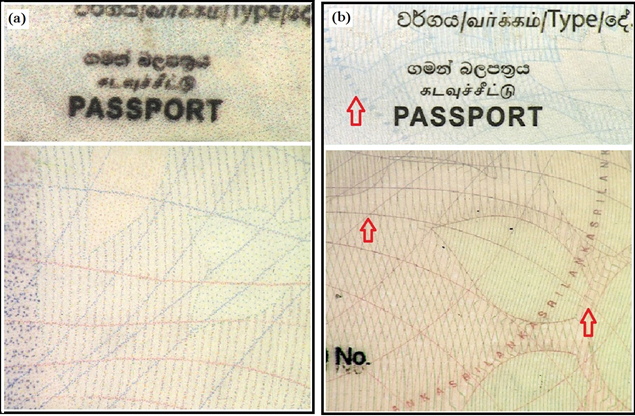
Results & Discussion The bio-data page was determined to be counterfeit, as it lacked all security features present in the specimen bio- data page. The absence of these essential security elements indicated that the questioned document was not authentic.
The background of the questioned bio-data page appeared messy, in stark contrast to the clear background of the specimen bio-data page. The specimen featured fine lines with a smooth color transition, shifting gradually from pink to blue, and included micro-text printed using a specialized and security printing technique known as “Rainbow Printing.” Rainbow printing requires precise machinery that are not available in the market. The technique involves combining several colors into a seamless, flowing gradient, making it difficult to replicate using scanning or photocopying methods. In comparison, the questioned bio-data page was produced with an inkjet desktop printer, which is incapable of replicating the micro-text, intricate fine lines, and gradual color changes evident in the authentic document [1].
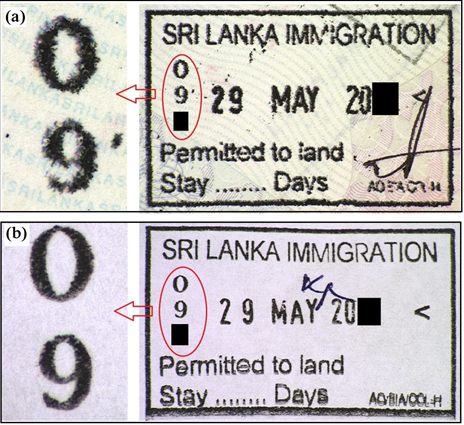
The questioned stamp impression found on a visa page of the passport was determined to be mechanically produced. It was compared to a specimen stamp impression provided by the Department of Immigration and Emigration
of Sri Lanka. Unlike a genuine, live stamp impression made with a rubber or other physical stamp, the questioned seal displayed distinct physical differences [2, 3].
The questioned seal lacked the usual characteristics of a live stamp, such as uneven ink distribution, slight smudging, and visible ridges resulted from pressure applied during hand stamping. Instead, it exhibited features consistent with inkjet printing, suggesting that it had been created by scanning an original stamp impression and then printing it. This process left the font edges of the questioned stamp somewhat irregular, due to the tiny dots sprayed by the inkjet nozzles. By contrast, the font edges in the specimen seal appeared sharper, despite some ink bleeding slightly into the paper fibers [2, 3].
Additionally, the chemical properties of printer ink differ from those of stamp inks, which respond distinctly under forensic methods like chromatography, UV, and IR analysis, making it easier to differentiate between the two.
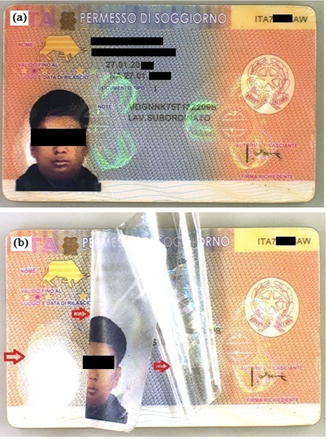
The specimen Italian residence permit card is made of polycarbonate material, which cannot be split into layers. In examining the questioned permit card, however, two additional cellophane layers were found adhered to the polycarbonate core. Notably, the polycarbonate card itself lacked a photograph, as it had been physically removed. Instead, the inner cellophane layer displayed a printed photograph of the imposter, while the outer cellophane layer contained the printed coat of arms, resembling a holographic structure [1].
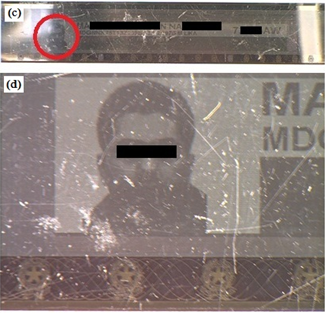
This questioned residence permit card was thus assembled by layering these cellophane sheets onto the polycarbonate card. On the reverse side, a black strip containing latent information about the cardholder was present. This information, along with the cardholder’s photograph, becomes visible under floodlight of the VSC 8000. The discrepancies between the images on the front of the card and the strip, along with the misalignment of the three layers, strongly suggest forgery.
Conclusion
Security features are incorporated into documents to enhance security and prevent unauthorized replication and misuse, particularly to combat illegal migration. When attempts are made to alter, substitute, or use alternative methods to create counterfeit documents, these modifications often result in imperfections that provide forensic evidence of tampering. Research should be conducted to prevent counterfeiting and to facilitate the detection and verification of easily forged documents.
Introducing anti-counterfeit technologies, such as Nano- printing, could greatly enhance document security by making replication significantly more difficult. This technique includes features like invisible patterns and micro-text, which require specialized equipment to observe [4].
Forgery detection systems based on AI and machine learning should be developed and employed to identify subtle alterations in document features, such as background patterns or micro-printing [5].
Countermeasure technologies should be implemented when printing secure documents, such as travel documents. Research should focus on developing unique ink formulations, specialized materials, and advanced technologies that are inaccessible to forgers, in order to prevent the counterfeiting of travel documents [4].
Another approach to minimizing travel document forgeries is the use of block-chain for document authentication to verify document authenticity. Once an entry is added, it cannot be altered, as it is verified by a network of computers. This decentralized and tamper-proof database can track a document’s issuance, validation, and updates, addressing many of the issues found in traditional verification systems [6, 7].
Age, physical disabilities, and surgeries present challenges in the identification of biometric parameters. Research should focus on developing improved biometric verification systems to address these challenges [8].
Conflicts of Interests
There are no conflicts of interest.
References
-
(2016) Passport Examination Procedure Manual, In: 2nd (Edn.), Geneva, Switzerland, International Organization for Migration.
-
Huber RA, Headrick AM (1999) Fundamentals of Forensic Document Examination. Charles C Thomas, Springfield.
-
Kelly JS, Lindblom BS (2006) Scientific Examination of Questioned Documents, In: 2nd (Edn.), CRC Press, Boca Raton, USA, pp: 1-464.
-
Hussain M, Baig S (2017) Anti-counterfeit technologies: A comparative review. Journal of Applied Security Research 12(4): 494-509.
-
Chen C, Zhang Y (2021) AI for document fraud detection: Recent advances. Journal of Digital Forensics 12(3): 213- 229.
-
(2024) Blockchain Verification: Instant, Secure, and Efficient. Dock
-
Saberi S, Kouhizadeh M, Sarkis J, Shen L (2018) Blockchain technology and its relationships to sustainable supply chain management. International Journal of Production Research 57(7): 2117-2135.
-
Balasubramaniam S, Kadry S, Prasanth A, Dhanaraj RK (2021) AI Based Advancements in Biometrics and its Applications. CRC Press, Taylor and Francis Group, Boca Raton, Florida, USA, pp: 1-274.
- Forensic Implications of Adverse Drug Reactions in Schizophrenia A Case Series
- Narcotics and Digital Forensics: Bridging Crimes in the Digital Age
- Ethics in Forensic Psychiatry: Principles, Dilemmas, and Human Rights
- Impact of Acute Stress on Attentional Orienting to Social Cues
- Head Injury and Intracranial Hemorrhage in Western Region of Libya
- A Forensic Study on Handedness: Examination of Handwriting Features in Right and Left Handed Writers