
Antiplasmodial Activity of Griffipavixanthone and Morelloflavone the Main Compounds from Garcinia Chromocarpa Engl. (Clusiaceae)
Introduction
Most of central Africa is endowed with tropical forests presenting a huge vegetal biodiversity. These plants constitute a rich, but largely untapped pool of natural products with potential socio-economic benefits.
Malaria remains one of the most serious world health problems and the major cause of mortality and morbidity in the endemic regions. In 2011, the United Nations Secretary- General declared a goal of reducing malaria deaths to zero by 2015 [1].
The large tropical genus Garcinia Linn is well known as a source of xanthones, biflavonoids and benzophenones [2]. Seeds and bark are the most commonly used, and G. kola, G. lucida and G. mannii are the most frequently and intensively exploited species.
In our previous studies, fingerprints and the LC-DAD method were developed and validated for the quality control of an antimalarial improved traditional medicine containing G. kola [3].
Research on new antimalarial substances must therefore be continued and several strategies should be explored.
Natural products isolated from plants used in traditional medicine, which have potent anti-plasmodial action in vitro, represent potential sources of new anti-malarial drugs [4]. Plants continue to serve as the basis for many pharmaceuticals used today [5].
Species of genus Garcinia are rich sources of bioactive constituents with antimicrobial, anticancer, anti- inflammatory, hepatoprotective and anti-HIV activities [6]. To our knowledge, only few investigations have been performed on the phytochemical composition and biological activities of Garcinia chromocarpa.
In continuing efforts to discover natural antimalarial agents, methanol and dichloromethane extracts of G. chromocarpa was studied for the first time against malaria parasite, and its phytochemical study allowed the isolation of their major compounds.
Materials and Methods
Plant Materials
Plant materials of G. chromocarpa were collected in Kinshasa-DRC in September 2015 and authenticated by Mr Nlandu at the Institut National d′Etudes et de Recherches en Agronomie (INERA) of the University of Kinshasa-DRC, where herbarium specimen is kept with the Voucher Number: PROCUV 2738. The leaves and stem-bark of G. chromcarpa were oven-dried below 50 °C and powdered for analysis.
Chemicals
All solvents used were of analytical and HPLC grade and purchased from Merck VWR (Leuven, Belgium). 2,2’-Azino-bis-(3-ethylbenzothiazoline-6-sulfonic acid) diammonium salt (ABTS), 2-Aminoethyldiphenylborat, Artemisinin (purity 98%), Folin-Ciocalteu’s phenol reagent, and sodium persulfate were purchased from Sigma (Bornem, Belgium). 1,1-diphenyl-2-picrylhydrazyl (DPPH) and 2′,7′-dichlorofluorescein-diacetate (DCFH-DA) were purchased from Eastman Kodak (Rochester, NY, USA). Water was treated using a Milli-Q water ultra-purification system before use.
Equipment
For fractionation, both column chromatography using silica gel (0.040-0.063 mm, Merck-Darmstadt) and preparative HPLC system with a Diode-Array Detection using a Hypersil ODS® RP18 column (2.5x25 cm; 12-15 µ, Merck packing system) equipped with an Armen pump and a Büchi fraction collector were used.
Mass spectrometer Time of flight QToF 2 with the Lock Spray option was conducted using negative electrospray ionisation in ToF MS, with the mass range between 50-1200 Dalton, and the cone voltage of 25 V. The ionisation mode (ESI negative) with MSE, MS/MS was applied with collision energy (V) between 20-35 ramp, at the scan time of 0.1 sec, and the leucine enkephalin as a lock mass.
NMR spectra were recorded using a Bruker Avance II spectrophotometer equipped with a 5 mm TCI cryoprobe operating at 500 MHz for 1H, employing a standard Bruker pulse sequences (Wisembourg, France).
Preparation of Extracts
Crude methanol extracts were prepared for preliminary in vitro antimalarial assay. The dried and grinded stem bark (20 g) were extracted with methanol (2 ×500 mL) at room temperature. After filtration and concentration in vacuo, the crude extracts obtained were submitted for anti-malarial test in vitro. On the other hand the ethanol extract was prepared for the antioxidant assay: 10 g of the stem bark powder of G. chromocarpa were extracted three times with 100 mL of ethanol and concentrated.
Isolation of Compounds
For the isolation process, at the beginning, standard screening tests were used to detect phytochemical groups in the plant extracts [7]t. After the phytochemical screening, 20 g of G. chromocarpa stem bark powder were macerated during 8 hours with 200 mL of methanol and then percolated. The concentrated extract was fractionated two times using preparative HPLC analysis.
On the first fractionation by preparative HPLC, 500 mg of the extract were filtered (Acrodisc PSF GXF/GHP 0.45 nm filter) and injected into a HPLC Varian chain using a Hypersil ODS® RP18 column eluted with 0.05% TFA in water (mobile phase A) and MeCN (mobile phase B) under the following gradient elution mode and modification time (in min) A: B (v/v) 100:0 (0 min); 97:3 (1 min); 60: 40 (45 min); 60:40 (55 min), and 100:0 (56 min). The volume of injection was 6 mL, and the flow rate of 30.0 mL/min. 79 fractions (F1-F79) of 10 mL were collected and assembled after TLC analysis using ethyl acetate/methanol/formic acid/water (20:2.5:0.5:2) as mobile phase and 2-Aminoethyl diphenylborinate- Polyethylene Glycol (1:5, v/v) in 100 mL methanol as a developer.
On the other hand column chromatography was used for fractionation. 100 g of G. chromocarpa stem bark powder were first macerated with 500 mL of methanol for 48 h, and evaporated under reduced pressure to give 19.7 g crude extract (yield =9.7%, w/w). 5 g of this extract were eluted over silica gel using the mixture hexane-ethyl acetate (100:0 → 50:50). 157 fractions of 20 mL were collected (f1-f157) and analyzed by TLC using ethyl acetate/methanol/water (100:13.5:10) as a mobile phase and sulfuric vanillin as a spray reagent. Based on TLC analysis of fractions collected, 15 fractions (f43-57) were assembled and eluted over sephadex using methanol 100 %.
In Vitro Anti-Plasmodial Assays
Culture of the chloroquine-sensitive (3D7) strain of P. falciparum was maintained as described by Frédérich, et al. [8]. The in vitro antiplasmodial assay was conducted by measuring the pLDH activity as described by Jansen, et al. [9].
IC50 values were calculated by linear regression from a set of eight two-fold dilutions concentrations tested for each extract. Each analysis was performed in triplicate (n = 3). According to the WHO guidelines and the previous work of our laboratory (Jonville et al., 2008; Jansen et al., 2010), antiplasmodial activity was classified as following: IC50 ≤ 15 µg/ml: promising activity ; IC50 = 15–50 µg/ml: moderate activity; IC50 > 50 µg/ml: weak activity; IC50 > 100 µg/ml: inactivity.
In Vitro Cytotoxicity Assay
The cytotoxicity of the plant extracts and pure compounds was assessed against WI-38 normal human fœtal lung fibroblasts as described by Stévigny, et al., [10] and as reported in our previous work [11].
In Vitro Antioxidant Activity
As reported in our previous work [11]; G. chromocarpa ethanol extracts and gallic acid were solubilized in DMSO. Gallic acid was used as positive control and ABTS•+ and DPPH• scavenging activities of extracts were expressed as IC50 values. Each sample was measured in triplicate.
ABTS Radical Scavenging Capacity: ABTS•+ radicals were generated by mixing potassium persulfate (2.45 mM) with ABTS (7 mM) and kept overnight in the dark. Working solution of ABTS•+ was obtained by adding 100% methanol to have an absorbance of 0.81 (±0.02) at 734 nm. Then 0.02 mL of standard or sample extracts were mixed with 1.98 mL ABTS•+ radical solution and incubated for 30 min in the dark. Absorbance was monitored at 734 nm with a Spectrophotometer Hewlett Packard 8453.
DPPH Radical Scavenging Capacity: Absorbance of the solution of 0.4 % of DPPH was adjusted to 0.75 ± 0.03 at 517 nm using fresh 80% (v/v) methanol. Then 0.02 mL of standard or sample were mixed with 1.98 mL of DPPH• solution and incubated for 30 min in the dark. Absorbance was monitored at 517 nm with a Spectrophotometer Hewlett Packard 8453.
Analysis of Total Phenolic Contents: The total phenolic contents (TPC) of ethanol crude extracts of the stem bark, the root bark and the leave of G. chromocarpa were determined using Folin-Ciocalteu method.
Results and Discussion
Phytochemicals
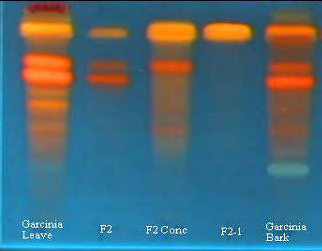
The TLC analysis of the two parts of the plant showed that the leave and the bark have the similar profile (Figure 1). We obtained good separation with the G. chromocarpa bark extract, so our work were mainly continued on the stem bark.
Phytochemical screening of the methanol crude extracts from the leaves and the stem bark revealed the presence of anthraquinones, flavonoids, saponins and terpenes. These compounds were already identified in the others species of Garcinia. From the Garcina plants growing in Africa, more than 130 secondary metabolites have been isolated. Benzophenones, flavonoids, triterpenoids and xanthones are identified such as the major constituents.
There is no more phytochemical study on G. chromocarpa in the literature. Cyanidin was already identified in sterm bark and seeds of G. chromocarpa from Cameroon.
Isolation and Structure Elucidation
As illustrated in figure 1, fraction (F2) from preparative HPLC fractionation, was concentrated to give F2 conc (9.38 mg). This latest was submitted to the second fractionation by preparative HPLC using the same system, to give a pure compound (F2-1= 3 mg). This pure compound has been identified by spectroscopic analysis. NMR and MS results were compared with the data in the literature. It was found to be a morelloflavone (compound 1).
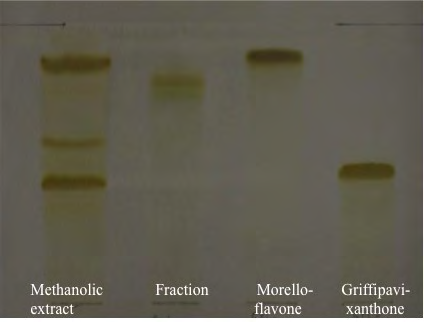
Column chromatography fractionation with over Sephadex using methanol 100 % lead to the isolation of three compounds, but only one was pure (Figure 2). This compound has been identified as Griffipavixanthone (compound 2) by mean of NMR and MS, and compared with the data in the literature.
Two major compounds were isolated from the methanolic crude extract of the G. chromocarpa stem bark (Figure 3). These compounds were (1) Morelloflavone a (3 → 8) biflavonoid and (2) Griffipavixanthone a bixanthone.
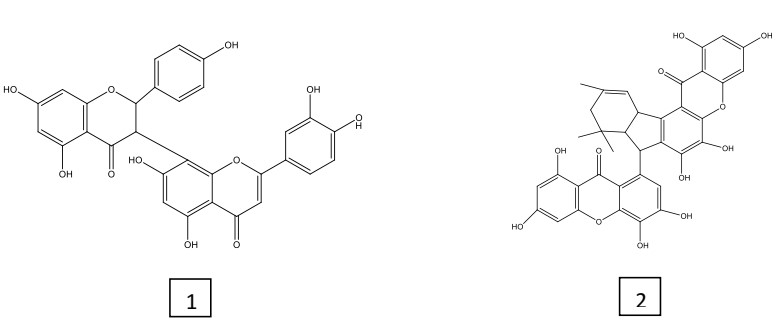
Griffipavixanthone is the bixanthone isolated from Garcinia griffithii [12]. Morelloflavone was already isolated from some species of the Clusiacea familly.
Antiplasmodial Activities of Crude Extracts and Pure Compounds
Crude extracts and isolated compounds were evaluated for their antiplasmodial activity in vitro against a chloroquine sensitive strain of Plasmodium falciparum (3D7) (Table 1). Artemisinin (98%, Sigma-Aldrich) was used as positive control.
| Garcinia chromocarpa crude extracts | CH Cl extracts 2 2 IC50 | MeOH extracts IC50 | Yield CH Cl 2 2 extracts | Yield MeOH extracts |
|---|---|---|---|---|
| Stem bark | 8.43±1.01 | 10.67±0.19 | 6.70% | 15.40% |
| Leave | 13.04±0.74 | 9.53±0.05 | 8.20% | 26.20% |
| Garcinia chromocarpa Pure compounds | IC50 | Yield (MeOH stem bark extract) | ||
| Compound 1 Morelloflavone (MM= 557) | 9.2±0.96 | 3.70% | ||
| Compound 2 Griffipavixanthone (MM= 653) | 5.80±0.323 | 1.90% |
Table 1: In vitro antiplasmodial activity and yield (m/m) of crude extracts and pure compounds from G. chromocarpa (n = 3) agains
Cytotoxicity Activity
The cytotoxicity test against the human non-cancer fibroblast cell line (WI38) through WST1 assay showed that the crude extracts and pure compounds had not any cytotoxicity, at the higher concentration tested of 100 µg/mL.
Antioxidant Activity
We evaluated the antioxidant potential of pure compounds and the ethanol crude extract of the stem bark, and the leave of G. chromocarpa using biochemical assays.
Scavenging of ABTS and DPPH radicals are the classic, simple and fast methods for evaluating radical- scavenging activity of pure compounds and complex samples [13].
The antioxidant activity of ethanolic extract and pure compounds was effective in the reduction of stable radicals ABTS•+ and DPPH• (Table 2). These assays showed that pure compounds, the ethanol crude extract of the stem bark, and the leave of G. chromocarpa have the ability to scavenge free radicals connected with their IC50 values. When comparing crude extracts, the sterm bark was more active than leaves and for the pure compounds, griffipavixanthone was more active than morelloflavone.
| Garcinia chromocarpa ethanol crude extracts and pure compounds. | TPC (GAE) | IC50 (µg/mL) ABTS | DPPH |
|---|---|---|---|
| Stem bark | 157.73 ± 0.58 | 7.6 ± 0.9 | 15.89 ± 1.53 |
| Leave | 114.40 ± 0.46 | 11.12 ± 1.41 | 30.83 ± 4.8 |
| Morelloflavone | - | 50.85 ± 4.6 | 79.43 ± 18.97 |
| Griffipavixanthone | - | 2.05 ± 1.27 | 4.54 ± 1.06 |
| Gallic acid (positive control) | - | 0.71 ± 0.08 | a. 0.10 |
Table 2: Total phenolic content (TPC) expressed in equivalent mg of gallic acid by g of crude material and IC50 ±S.D (n=6) expres
The high antioxidant activity of phenolic substances is often attributed to their -OH moieties, which are potent H donors because electron delocalisation across the molecule efficiently stabilises the resulting phenoxy radicals. For compounds such as xanthone, which is one of the cases in this work, another important feature is the planarity of the molecule, which permits conjugation and electron delocalisation. These factors are associated with an increase in radical stability. Intramolecular H-bonds between neighbouring –OH and C=O groups increase aromatic-ring conjugation and raise the H- donation power of the molecule, because the resulting radicals are more delocalised. On the second case, the presence of a dihydroxy group ortho to the C=O moiety of the biflavonoids also increases antioxidant activity [14]. Griffipavixanthone and Morelloflavone compounds exhibit powerful antioxidant activities related to these structural features. Morelloflavone was found to be the most active radical scavenger of rotameric (3 → 8) biflavonoids from the bark of Garcinia hombroniana [6].
Results from the quantitative determination of total phenolic content are summarized in Table 2. Total polyphenol contents were calculated as gallic acid equivalents in grams per 100 grams of dry weight (g GAE/100g DW) and varied significantly (p <0.05) between the leaves and sterm barks. The sterm barks showed the highest value of total phenol than the leaves. These results showed that there is a correlation between total phenols content and antioxidant capacities measured by ABTS and DPPH assays.
Conclusion
G. chromocarpa has been tested for the first time on P. falciparum and showed a significant activity. To the best of our knowledge any other phytochemical study on this plant could not be found in the literature.
As described in the table 1, the isolated compound (1) showed a good antiplasmodial activity, similar to the one of the initial methanol crude extract.
Compound 2 exhibited a higher antiplasmodial activity in vitro with IC50 ±S.D. of 5.80±0.32 µg/mL. This result is in accordance with data in the literature, in which we found that bixanthones exhibited potent bioactivities and promising pharmacological profiles such as cancer chemopreventive, anthelmintic, antimalarial, antitubercular and so on [15].
A high antioxidant activity of 2.05 ± 1.27 µg/mL (ABTS•+) and 4.54 ± 1.06 µg/mL (DPPH•) was observed for the compound (2), see Table 2. This compound has been described for the first time in the literature as a novel cytotoxic bixanthone isolated from Garcinia griffithii and Garcinia pavifolia, where the name griffipavixanthone has come from [16, 17, 18].
In this work, Griffipavixanthone and Morelloflavone were isolated for the first time from G. chromocarpa. Their antiplasmodial activity and the absence of cytotoxicity at the highest tested dose (100 µg/mL) have been demonstrated. This aspect could justify their use in traditional medicine but further studies are needed, especially in vivo studies to achieve improved traditional medicines.
References
-
Murray CJL, Rosenfeld LC, Lim SS, Andrews KG, Foreman KJ, et al. (2012) Global malaria mortality between 1980 and 2010: A systematic analysis. Lancet 379(9814): 413- 431.
-
Baggett S, Protiva P, Mazzola EP, Yang H, Ressler ET, et al. (2005) Bioactive benzophenones from Garcinia xanthochymus fruits. J Nat Prod 68(3): 354-360.
-
Tshibangu PT, Kapepula PM, Kapinga MJK, Lupona HK, Ngombe NK, et al. (2016) Fingerprinting and validation of a LC-DAD method for the analysis of biflavanones in Garcinia kola -based antimalarial improved traditional medicines ଝ. J Pharm Biomed Anal 128(1): 382-390.
-
Olasehinde GI, Ojurongbe O, Adeyeba AO, Fagade OE, Valecha N, et al. (2014) In vitro studies on the sensitivity pattern of Plasmodium falciparum to anti-malarial drugs and local herbal extracts. Malar J 13(1): 63.
-
Newman DJ, Cragg GM (2007) Natural Products as Sources of New Drugs over the Last 25 Years. J Nat Prod 70(3): 461-477.
-
Jamila N, Khairuddean M, Khan SN, Khan N (2014) Complete NMR assignments of bioactive rotameric (3???8) biflavonoids from the bark of Garcinia hombroniana. Magn Reson Chem 52(7): 345-352.
-
Wagner H, Bladt S (2001) Plant Drug Analysis: A Thin Layer Chromatography Atlas, 2nd (Edn.), Analytica Chimica Acta. Springer, Berlin.
-
Frédérich M, Jacquier MJ, Thépenier P, De Mol P, Tits M, et al. (2002) Antiplasmodial activity of alkaloids from various Strychnos species. J Nat Prod 65(10): 1381- 1386.
-
Jansen O, Angenot L, Tits M, Nicolas JP, De Mol P, et al. (2010) Evaluation of 13 selected medicinal plants from Burkina Faso for their antiplasmodial properties. J Ethnopharmacol 130(1): 143-150.
-
Stévigny C, Block S, De Pauw-Gillet MC, De Hoffmann E, Llabrès G, et al. (2002) Cytotoxic aporphine alkaloids from Cassytha filiformis. Planta Med 68(11): 1042-1044.
-
Tshisekedi Tshibangu P, Mutwale Kapepula P, Kabongo Kapinga MJ, Tujibikila Mukuta A, Kalenda, DT, Tchinda AT, et al. (2016) Antiplasmodial activity of Heinsia crinita (Rubiaceae) and identification of new iridoids. J Ethnopharmacol 196(1): 261-266.
-
Elfita E, Muharni M, Latief M, Darwati D, Widiyantoro A, et al. (2009) Antiplasmodial and other constituents from four Indonesian Garcinia spp. Phytochemistry 70(7): 907-912.
-
Boligon AA, Machado MM, Athayde ML (2014) Technical Evaluation of Antioxidant Activity. Med Chem 4(7): 517- 522.
-
Gontijo VS, De Souza TC, Rosa IA, Soares MG, Da Silva MA, et al. (2012) Isolation and evaluation of the antioxidant activity of phenolic constituents of the Garcinia brasiliensis epicarp. Food Chem 132(2): 1230-1235.
-
Isaka M, Jaturapat A, Rukseree K, Danwisetkanjana K, Tanticharoen M, et al. (2001) Phomoxanthones A and B , Novel Xanthone Dimers from the Endophytic Fungus Phomopsis Species. Jounal Nat Prod 64(8): 1015-1018.
-
Xu YJ, Cao SG, Wu XH, Lai YH, Tan BHK, et al. (1998) Griffipavixanthone, a novel cytotoxic bixanthone from Garcinia griffithii and G. parvifolia. Tetrahedron Lett 39(49): 9103-9106.
-
Jonville MC, Kodja H, Humeau L, Fournel J, De Mol P, et al. (2008) Screening of medicinal plants from Reunion Island for antimalarial and cytotoxic activity. J Ethnopharmacol 120(3): 382-386.
-
Stévigny C, Block S, De Pauw-Gillet MC, De Hoffmann E, Llabrès G, et al. (2002) Cytotoxic aporphine alkaloids from Cassytha filiformis. Planta Med 68(11): 1042-1044.
- Potential Medicinal Herbs and Secondary Metabolites in Combating Corona Virus
- Monkeypox and its Clinical Implications in Pregnancy
- Pharmacognostical Analysis of the Leaves of Important Nervine Medicinal Plant: Strychnos Nux-Vomica L
- Assessment of Antibacterial Activity of Various Solvent Extracts of Dictyota Dichotoma Against Multidrug Resistant Bacterial Strain
- An Insights of Bioactive Elements on Malignancy: Mechanistic Avenues
- Advances and Future Directions in Pharmacognosy and Chinese Medicine