
Anti-Inflammatory and Antioxidant Potential of Zanthoxylum alatum roxb Stem Bark
In humans, reactive oxygen species induce inflammation through oxidative stress. Persistent inflammation generates a large number of free radicals, which eventually create additional inflammation. This never-ending vicious loop can harm multiple components in the human body. In this study, we explored the anti-inflammatory and antioxidant potency of a locally available plant Zanthoxylum alatum utilizing both in vivo and in vitro models. Carrageenan induced paw edema and cotton pellet granuloma model were used to assess the anti-inflammatory potency of the extracts while as DPPH quenching and reducing power estimation were used to assess the antioxidant potency of the drug. Both aqueous and methanolic extracts of Zanthoxylum alatum stem bark showed dose dependent anti-inflammatory and antioxidant potency. Aqueous extract was further fractioned using different organic solvents which also revealed good anti-inflammatory and antioxidant potency. The current data revealed the antioxidant and anti-inflammatory potency of Zanthoxylum alatum. However, more research is needed in order to isolated and identify the active principle in order to support the existing findings.
Introduction
For centuries, plants have been used to treat a variety of diseases and save people’s lives as a natural medicine. They had no idea at the time that plants had healing properties. Because of this, we may conclude that medicinal plants have been used for healing from the beginning of time [1]. Humans and their pursuit of plant-based medicine date back a long time. Humans have been trying to learn about the medicinal properties of numerous plants for a long time [2]. Recent scientific research has shown their active role in current pharmacotherapy and incorporated ancient remedies used for millennia [3].
From the leaves, roots, bark, fruits, seeds and flowers of a plant researchers are extracting various medicinal properties [4]. Many diverse plant sections contain a wide range of nutrients. As a result, a section of a plant may be hazardous while the other part of the same plant is safe [5]. Plants are an essential source of medication and play a vital role in global health. Approximately two-thirds of the world’s population relies on herbal medicine for basic health care in several nations across the globe [6]. To treat therapeutic and curative illnesses in poor nations, herbal or medicinal plants are used as a primary source of medication [7].
Zanthoxylum alatum, is also known as winged prickly ash or timru. It is an aromatic and deciduous tree belonging to family Rutaceae. It is a tiny, evergreen tree with compound and aromatic leaves that may grow to a height of up to six meters. Fruits are reddish-purple and around 5 mm in diameter with shiny and acquired seeds [8]. Flowers range in colour from green to yellowish. Traditionally, Bark, fruits and seeds are widely used for the treatment of Dyspepsia, cholera and fever. Paste and powders from fruits and seed utilized for dental problems and also has antibacterial, disinfecting, and deodorant properties [9]. It is widely available from Assam to Jammu Kashmir and the Himalayan Warmer Valleys 1100 and 2100 meters above sea level [10].
Different sections of Z. alatum have been shown to have pharmacologically active phytoconstituents. In addition to sitosterol, magnoflorine, dictamnine, 8-hydroxydic- tamnine and epieudesmine as well as armatamide, xanthoplanine, and sikimmianine and other several phytoconstituents have been identified, including berberine, 8-hydroxydic- tamnine, dictamnine, and eudesmine. Traditionally the bark is used as anthelmintic, carminative, stomachic, and as anti- inflammatory agent. Antiproliferative and hepatoprotective properties were also found in this compound when tested on human keratinocytes [11].
Methods
Collection and Authentication
Zanthoxylum alatum Roxb bark was collected for the current study in the months of October and November at Tihri (Garhwal), Uttrakhand. Dr. H. B. Singh from the Raw Material Herbarium and Museum department at the National Institute of Sciences Communication and Information Resources in New Delhi performed the authentication under Ref. NISCAIR/ RHMD/Consult/-2009-10/1324/127. For later usage, the stem-bark was pulverised and kept in airtight containers.
Preparation of Extracts and Fraction
Both methanolic and aqueous extract were prepared using hot extraction technique, Aqueous extract, Chloroform fraction, Ethyl acetate fraction, n-butanolic fraction were prepared from aqueous extracts using separating funnel.
Animals
From the Animal House, I.S.F. College of Pharmacy, Moga (Reg. No. 816/04/C/CPCSEA), 180-250 g Wistar rats (either sexes) were obtained. The rats were housed in polypropylene cages, three to a cage, with a humidity level of 55-65 percent and a temperature of 25-2°C. The animal home was kept on a 12-hour light/dark cycle. The rats were given a commercial chow meal from Aashirwad Industries Ltd., Ropar, Punjab, as well as free access to fresh water throughout the experiment.
Chemicals/Equipment’s
Carrageenan (λ) and Diclofenac sodium were procured from Sigma Chemical Co. (St Louis, MO, USA) and Novartis, India respectively. Plethysmograph was used for measurement of paw oedema. All other chemicals and reagents were of analytical grade (AR) and were used freshly.
Acute Oral Toxicity Study
In accordance with the 1987 OECD 423 Guidelines, the acute toxicity investigation was conducted [12]. Briefly a single dose of alcoholic and water extract of Z. alatum stem- bark diluted in one percent carboxy methyl cellulose was given to the animal in the dosage of (5, 50, 300, 2000 mg/ kg) using oral canula. Then, the behavioural variations and mortality were recorded up to 2 weeks. Anti-Inflammatory Activity For the evaluating of anti-inflammatory potency of the extracts two models were selected namel.
1. Carrageenan- induced rat paw edema 2. Cotton pellet induced granuloma
Carrageenan Induced Rat Paw Edema
Wistar rats of either sex (180-200g body wt.) were categorized into 12 groups each comprising six animals. 0.1 ml of 1% w/v carrageenan suspension was injected into the subplantar side of the right paw of each group to elicit acute inflammation. The methanolic, aqueous extracts and different fractions of aqueous extract: chloroform, ethyl acetate, n-butanol and aqueous fractions derived from aqueous extract. Diclofenac (20 mg/kg) was administered orally as a reference and was given one hour before carrageenan delivery. All the test drugs including diclofenac were suspended in 1% CMC before administration. The percentage of edoema development inhibition was computed and compared to the control group [13, 14] (Table 1).
| S. No. | Extract | Treatment |
|---|---|---|
| Group I | CC | Carrageenan control |
| Group II | DS20 | Diclofenac sodium (20mg/kg, p.o.) |
| Group III | ME125 | Methanolic extract (125mg/kg, p.o.) |
| Group IV | ME250 | Methanolic extract (250mg/kg, p.o.) |
| Group V | ME500 | Methanolic extract (500mg/kg, p.o.) |
| Group VI | AE125 | Aqueous extract (125mg/kg p.o.) |
| Group VII | AE250 | Aqueous extract (250mg/kg p.o.) |
| Group VIII | AE500 | Aqueous extract (500mg/kg p.o.) |
| Group IX | CF125 | Chloroform fraction (125mg/kg p.o.) |
| Group X | EF125 | Ethyl acetate fraction(125mg/kg p.o.) |
| Group XI | BF125 | n-butanolic fraction (125mg/kg p.o.) |
| Group XII | AF125 | Aqueous fraction (125mg/kg p.o.) |
Assessment of Paw Edema
The subplantar region of paw was circled with ink marking and the initial paw volume was measured. Induction of paw edema was assessed at 30min, 60min, 90min, 120 mints, 3hr, 4hr, and up to 24 hr in each rat paw of different groups using the plethysmograph. The change in paw edema was expressed as percentage inhibition in paw volume as an index of anti-inflammatory activity. The percentage inhibition was calculated as:
% Inhibition = (Vo-Vt ) / Vo X 100
where Vo refers to initial volume and Vt refers to final volume.
Cotton Pellet Induced Granuloma Tissue Formation in Rats
The anti-inflammatory potential of bark extracts was evaluated using cotton pellet granuloma, a sub-chronic anti- inflammatory model and was produced in rats by the method prescribed by winter, et al. [15] with slight modification. Briefly cotton pellets of 20mg weight were sterilized in an autoclave. The rats were anaesthetized with thiopental sodium (40mg/kg, i.p.) and shaved the fur over back of the neck. Surgical implantation of sterile cotton on both sides of interscapular regions was done. The standard diclofenac sodium (15mg/kg) and aqueous extract (500mg/kg) were given orally once daily for 10 consecutive days from the day of cotton pellet insertion [16]. On the 10th day, the rats were sacrificed and the pellets were surgically removed, dried at 60℃ (up to 8hrs) and the weights of dry pellet were determined. Change in wt. of cotton pellet after drug treatment was taken as index of chronic anti-inflammatory activity [17].
Antioxidant Activity
DPPH Free Radical Quenching Ability
The method outlined by Braca et al. was slightly modified in order to evaluate the potency of different Zanthoxylum alatum bark extracts to neutralize DPPH free radicals. Briefly, fresh 2,2-diphenyl-1-picrylhydrazyl (DPPH) solution was put in test tubes following different bark extract dilutions (ranging from 50 g/mL to 250 g/mL). The combination was kept at room temperature for 30 minutes. Similar steps were taken to create a control sample, but without the test sample. The absorbance of the incubated solution was measured spectrophotometrically at 517 nm using Ascorbic acid as a reference. Methanol was used throughout the process as a blank solution [18, 19].
Reducing Power Quantification
With very minor alterations, Oyaizu’s approach was used to determine the reductive effectiveness of the aforementioned preparations. The test mixture was created by mixing different dilutions of Zanthoxylum alatum bark extracts (100–500 g) with 2.5 mL of 0.2 M phosphate buffer (pH 6.6), 2.5 mL of 1% potassium ferricyanide [K3Fe(CN)6], and 20 mL of 10 % trichloroacetic acid, respectively. The entire mixture was centrifuged at 3000 rpm for 10 minutes, and then the top 2.5 mL of the solution was removed and dissolved in 2.5 mL of purified water, followed by 0.5 mL of 0.1 % FeCl3. Standard ascorbic acid was produced using a similar technique. The solution’s absorbance at 700 nm was measured using spectrophotometry in comparison to a control sample [20, 21].
Statistical Analysis
Results were expressed as Mean ± SEM and were analyzed using one-way and two way analysis of variance (ANOVA) tests followed by Bonferroni post hoc tests. p value <0.05 was considered statistically significant.
Results and Discussion
Acute Toxicity Study
In acute toxicity study, acute treatment with aqueous and methanolic extracts of Zanthoxylum alatum Roxb. were caused no behavioral or toxic manifestations at the doses of 5, 50, 300 mg/kg. Moreover, no mortality had been observed even at highest dose (2000mg/kg) of both extracts. On this basis, both extracts in the dose of 125, 250 and 500 mg/kg were subjected for further pharmacological study.
as compared to normal paw in successive hrs upto 24 hr. However, the administration of aqueous extract (500mg/ kg p.o.) caused significant % inhibition in paw volume at time intervals 90min, 120min and 3hrs by 27.77±8.01%, 21.66±1.12% and 30±4.96% respectively and with methanolic extract (500mg/kg p.o.) at 90min, 120min and 3hrs by 31.94±3.63%, 25±2.88% and 31±3.39% respectively in comparison to carrageenan control. The administration of aqueous extract (250mg/kg p.o.) and methanolic extract (250mg/kg p.o.) to rats showed significant inhibition in paw volume at 120min and 3hrs up to 25.83±4.47%, 31.11±5.80% and 28.33±3.46%, 35±3.49% respectively as compared to carrageenan control.
The administration of chloroform fraction (125mg/kg p.o.) markedly lowered the paw volume at 90min, 120min and 3hrs up to 31.94±3.63%, 29.16±3.63%, 35.00±3.49% respectively in comparison to carrageenan control. While ethyl acetate, n-butanol and aqueous fractions showed mild effect in preventing the carrageenan induced paw edema by 50.00±3.33% at 3hr, 36.66±7.78%, 41.11±5.96% at 120 and 3hr, 45.83±5.46%, 39.16±5.57%, 47.22±4.18% at 90min, 120min and 3hr respectively (Table 2).
- Carrageenan Induced Rat Paw Edema
- In the carrageenan induced paw edema model, subplantar administration of carrageenan caused significant paw edema
- Percentage inhibition in Paw Volume at Different Time Intervals
- Group
- 30min
- 60min
- 90min
- 120min
- 3hr
- 4hr
- 24hr
- CC
- 100
- 100
- 100
- 100
- 100
- 100
- 100
- DS25
- 52.77±2.77*
- 31.94±3.63*
- 22.22±4.24**
- 17.50±3.28**
- 22.22±3.30**
- 28.09±2.43**
- 43.61±10.97
- AE125
- 77.77±12.6
- 58.33±5.46
- 45.83±6.70
- 42.50±4.81
- 53.33±5.96
- 57.30±3.77
- 60.83±14.00
- AE250
- 63.88±11.71
- 40.27±11.0
- 33.33±6.21*
- 25.83±4.47**
- 31.11±5.80*
- 41.03±7.43
- 46.94±10.17
- AE500
- 55.55±9.29
- 36.11±4.24*
- 27.77±8.01**
- 21.66± 1.12*
- 30.00±4.96**
- 34.76±4.26*
- 43.61±10.97
- ME125
- 79.17±10.24
- 60.23±8.56
- 47.53±5.46
- 44.30±4.37
- 54.30±5.61
- 59.20±2.40
- 61.73±12.44
- ME250
- 72.22±12.66
- 45.83±5.46
- 36.11±4.24*
- 28.33±3.46**
- 35.00±3.49*
- 46.03±3.47
- 55.27±13.03
- ME500
- 61.11±7.52
- 41.66±6.21
- 31.94±3.63*
- 25.00±2.88**
- 31.00±3.39**
- 42.69±4.60
- 47.77±10.44
- CF125
- 55.55±8.48
- 36.11±4.24*
- 31.94±3.63**
- 29.16±3.63**
- 35.00±3.49*
- 48.96±4.71
- 51.11±9.35
- EF125
- 77.77±9.35
- 72.22±9.35
- 68.05±3.63
- 54.16±5.05
- 50.00±3.33
- 54.92±5.73
- 53.33±10.39
- BF125
- 61.11±7.52
- 50.00±10.9
- 43.05±7.71
- 36.66±7.78*
- 41.11±5.96
- 49.92±6.68
- 51.94±6.68
- AF125
- 63.88±6.68
- 54.16±9.96
- 45.83±5.46
- 39.16±5.57*
- 47.22±4.18
- 52.14±2.49
- 52.50±10.19
Table 2: Effect of extracts and fractions on carrageenan induced rat paw edema in rats.
![Figure 1: Effect of test drugs on carrageenan induced paw edema Results Mean ± SEM; a p<0.05 statistically significant (n=6). [CC: Untreated rat receiving carrageenan, DS20: Diclofenac sodium 20mg/kg, AE125, AE250 and AE500: Aqueous extract 125, 250 and 500 mg/kg; ME125, 250 and 500: Methanolic extract 125, 250 and 500mg/kg], DS20: Diclofenac sodium 20mg/kg] CF125: Chloroform fraction 125mg/kg, EF125: Ethyl acetate fraction 125mg/kg, BF125: Butanolic fraction 125mg/kg, AF125: Aqueous fraction 125mg/kg].](/fulltextimages/10677/fig_1.png)
Figure 1: Effect of test drugs on carrageenan induced paw edema Results Mean ± SEM; a p<0.05 statistically significant (n=6). [CC: Untreated rat receiving carrageenan, DS20: Diclofenac sodium 20mg/kg, AE125, AE250 and AE500: Aqueous extract 125, 250 and 500 mg/kg; ME125, 250 and 500: Methanolic extract 125, 250 and 500mg/kg], DS20: Diclofenac sodium 20mg/kg] CF125: Chloroform fraction 125mg/kg, EF125: Ethyl acetate fraction 125mg/kg, BF125: Butanolic fraction 125mg/kg, AF125: Aqueous fraction 125mg/kg].
Cotton Pellet Induced Granuloma Model in Rat
In the cotton pellet induced granuloma model, interscapular implantation of sterile cotton pellets have caused significant granuloma tissue formation over the cotton pellet as indicated by elevated cotton weight. Treatment with the extracts showed dose dependent inhibition of granuloma development as compared with the toxic group. Treatment with ME500 mg/kg showed granuloma percentage inhibition of 43.03, while as the water extract showed 44.52 percentage granuloma inhibition at the same dose as compared to toxic group. Among fractions butanolic fraction at the dose of 125mg/kg showed 33.01% of granuloma inhibition followed by aqueous, ethyl acetate and chloroform fraction respectively (Table 3).
| Group | Wet weight (mg) | Dry weight (mg) | Percentage inhibition |
|---|---|---|---|
| CC | 218.8±2.13 | 208.2±2.16 | |
| Standard | 132.2±3.24 | 102.6±3.33 | 50.72 |
| ME125 | 167.7±3.27 | 156.3±3.44 | 24.92 |
| ME250 | 137.5±4.32 | 124.1±5.32 | 40.39 |
| ME500 | 135.7±4.56 | 118.6±3.44 | 43.03 |
| AE125 | 176.3±4.28 | 163.2±3.32 | 21.61 |
| AE250 | 148.9±3.12 | 127.5±4.52 | 38.76 |
| AE500 | 141.4±3.56 | 115.5±4.21 | 44.52 |
| CF125 | 174.4±4.32 | 174.4±3.24 | 16.23 |
| EF125 | 171.1±4.67 | 171.1±3.62 | 17.81 |
| BF125 | 162.7±4.91 | 139.5±3.15 | 33.01 |
| AF125 | 146.7±2.38 | 140.4±2.47 | 32.56 |
Table 3: Effect of extracts and fractions on cotton pellet induced granuloma in rats.
Effect of test drug on cotton pellet induced granuloma in rats: Results were expressed as Mean ± SEM; a p<0.05 statistically significant (n=6). [CC: Untreated rat receiving carragennan, DS20: Diclofenac sodium 20mg/kg] CF125:
Chloroform fraction 125mg/kg, EF125: Ethyl acetate fraction 125mg/kg, BF125: Butanolic fraction 125mg/kg, AF125: Aqueous fraction 125mg/kg].
Antioxidant Activity
DPPH
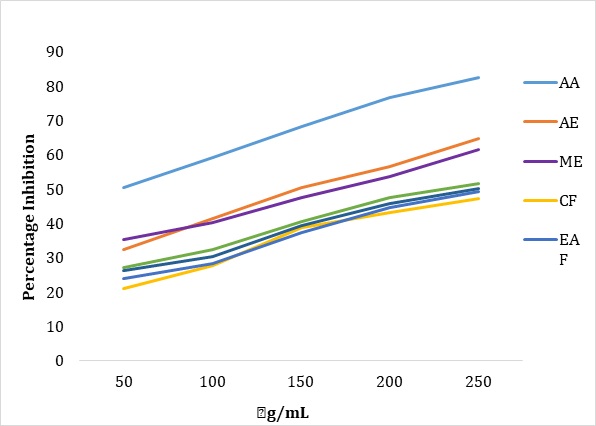
The DPPH radical, which has a maximum absorption at 517 mm, is considered a viable radical that an antioxidant might easily suppress. The research of free radical-quenching activity now makes extensive use of this procedure since it is well known that it is simple to carry out and easy to do so. The ability of extracts to contribute hydrogen atoms or electrons to the stable DPPH radical created in solution is assessed using the DPPH free radical quenching assay [22]. In the present study both the extracts demonstrated good antioxidant potency among which aqueous extract showed 64.64±3.82% and alcoholic extract 61.61±2.12% of quenching ability at 250 μg/ml as compared to ascorbic acid which showed 82.34±2.91% at the same concentration. Among fractions, butanolic fraction showed 51.62±5.06% followed by aqueous fraction (50.03±3.09%), ethyl acetate fraction (49.14±3.16%) and chloroform fraction 47.11±5.06% respectively (Table 4 & Figure 2).
| S.No. | Conc. (μg/ml) | % inhibition | ||||||
|---|---|---|---|---|---|---|---|---|
| Ascorbic Acid | Aqueous extract | Methanolic | Chloroform fraction | Ethyl acetate fraction | Butanolic fraction | Aqueous fraction | ||
| Extract | ||||||||
| 1. | 50 | 50.47±5.96 | 32.32±1.76 | 35.35±2.56 | 21.01±1.08 | 24.06±2.01 | 27.28±3.91 | 26.21±3.46 |
| 2. | 100 | 59.20±2.32 | 41.41±2.34 | 40.39±5.21 | 27.83±3.26 | 28.31±3.03 | 32.32±3.45 | 30.35±4.19 |
| 3. | 150 | 68.32±3.76 | 50.50±4.76 | 47.47±2.32 | 38.71±3.11 | 37.46±3.12 | 40.46±2.69 | 39.42±3.21 |
| 4. | 200 | 76.58±4.06 | 56.56±2.16 | 53.53±4.16 | 43.21±4.14 | 44.59±4.21 | 47.58±3.28 | 45.67±3.71 |
| 5. | 250 | 82.34±2.91 | 64.64±3.82 | 61.61±2.12 | 47.11±5.06 | 49.14±3.16 | 51.62±5.06 | 50.03±3.09 |
Table 4: DPPH quenching potency of extracts and fractions of Zanthoxylum alatum stem bark.
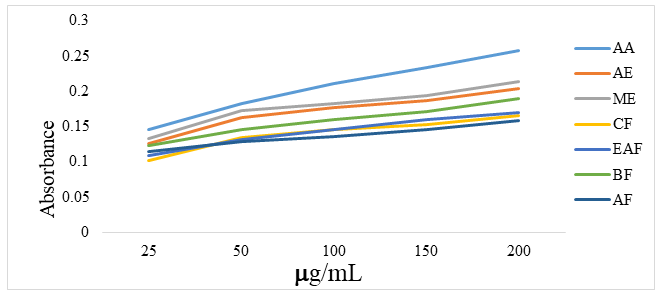
Ferric Reducing Ability of Plasma: Plant extracts’ reducing ability may be a sign of how effective they are as antioxidants. The coloration of the reaction mixture in this test changes from yellow to green based on the reducing potency of the extract. The existence of reductants in the mixture enables the Fe3+/ferricyanide complex to be reduced to ferrous form that showed absorption maximum at 700 nm. In the present study both the extracts demonstrated potent reducing potency in which water extract showed 0.203±2.03 and alcoholic extract 0.213±4.41 reducing potency at 200 μg/ ml as compared to ascorbic acid which showed 0.258±3.31 at the same concentration. Among fractions, butanolic fraction showed 0.189±3.12 followed by ethyl acetate fraction 0.170±4.76, chloroform fraction 0.165±3.21and aqueous fraction 0.158±1.87 respectively (Table 5 & Figure 3).
| S. No. | Conc. (μg/ml) | Reducing Potency | ||||||
|---|---|---|---|---|---|---|---|---|
| Ascorbic Acid | Aqueous Extract | Methanolic | Chloroform Fraction | Ethyl Acetate Fraction | Butanolic Fraction | Aqueous Fraction | ||
| Extract | ||||||||
| 1 | 25 | 0.146±2.16 | 0.126±2.34 | 0.133±1.22 | 0.102±2.56 | 0.109±2.34 | 0.123±1.67 | 0.115±3.39 |
| 2 | 50 | 0.183±3.01 | 0.163±4.23 | 0.173±1.56 | 0.134±2.63 | 0.132±3.51 | 0.146±2.31 | 0.128±4.62 |
| 3 | 100 | 0.210±2.14 | 0.176±4.01 | 0.183±2.09 | 0.146±2.81 | 0.145±3.32 | 0.159±4.02 | 0.136±3.23 |
| 4 | 150 | 0.234±1.32 | 0.186±3.09 | 0.193±2.82 | 0.153±3.67 | 0.160±3.42 | 0.171±2.05 | 0.145±1.48 |
| 5 | 200 | 0.258±3.31 | 0.203±2.03 | 0.213±4.41 | 0.165±3.21 | 0.170±4.76 | 0.189±3.12 | 0.158±1.87 |
Table 5: Reducing potency of extracts and fractions of Zanthoxylum alatum stem bark.
Conclusion
The above findings revealed that both the extracts viz. methanolic and water extracts of Zanthoxylum alatum stem bark possess potent anti-inflammatory potency as compared to diclofenac treated group evident in both carrageenan induced and cotton pellet granuloma model. However aqueous extract has marked efficacy in preventing cellular and biochemical events during acute inflammatory reactions in comparison to methanolic extracts. Water extract was further fractioned with different solvents which also showed good anti-inflammatory activity. Among the various fractions butanolic fraction showed potent activity in comparison to standard treated group.
All the tests whether extracts or fractions showed good antioxidant in a dose dependent manner. Both the extracts and fractions prominently inhibit DPPH free radical and showed good reducing potency. These findings demonstrate that both the preparations and fractions of Zanthoxylum alatum stem bark have strong anti-inflammatory and antioxidant potency as compared to benchmarks such as ascorbic acid, diclofenac. Nonetheless, water preparation revealed statistically prominent potency when compared to alcoholic preparation. However, more research is needed in order to isolated and identify the active principle in order to support the existing findings (s).
Acknowledgement
The authors gratefully applaud to Director, Khalsa College of Pharmacy Amritsar for providing the essential facilities for conducting this research.
Conflict of Interest
The authors declare that there is no conflict of interest.
References
-
Petrovska BB (2012) Historical review of medicinal plants usage. Pharmacognosy reviews 6(11): 1-5.
-
Suroowan S, Javeed F, Ahmad M, Zafar M, Jamil Noor M, et al. (2017) Ethnoveterinary health management practices using medicinal plants in South Asia a review. Veterinary research communications 41(2): 147-168.
-
Newman DJ (2020) Modern traditional Chinese medicine: identifying defining and usage of TCM components. Advances in pharmacology 87: 113-158.
-
Sani I, Abdulhamid A, Bello F (2014) _Eucalyptus_ _camaldulensis_ phytochemical composition of ethanolic and aqueous extracts of the leaves stem bark root fruits and seeds. Journal of scientific and innovative Research 3(5): 523-526.
-
Roy RN (2006) Plant nutrition for food security A guide for integrated nutrient management. FAO Fertilizer and Plant Nutrition Bulletin 16(368).
-
Ekor M (2014) The growing use of herbal medicines issues relating to adverse reactions and challenges in monitoring safety. Frontiers in pharmacology 4: 177.
-
Anand U, Herrera NJ, Altemimi A, Lakssassi N (2019) A comprehensive review on medicinal plants as antimicrobial therapeutics potential avenues of biocompatible drug discovery. Metabolites 9(11): 258.
-
Akhtar N, Ali M, Sarwar Alam M (2009) Chemical constituents from the seeds of Zanthoxylum alatum. Journal of Asian natural products research 11(1): 91-95.
-
Patiño LOJ, Prieto RJA, Cuca SLE (2012) Zanthoxylum genus as potential source of bioactive compounds. Bioactive compounds in phytomedicine 10: 184-218.
-
Sati VP (2007) Role of Off Season Vegetables in the Sustainable Livelihood of Hill People A Case in the Pindar Basin Uttarakhand Himalaya. Himalayan Ecology 15(1-2): 35.
-
Kumar N, Puri P, Kaur N, Uppal J, Chawla A, et al. (2022) Pharmacognostical Standardization, Phytochemical Characteristics of Stem bark of Zanthoxylum alatum Roxb. Pharmacognosy Research 14(3): 316-320.
-
Botham PA (2004) Acute systemic toxicit prospects for tiered testing strategies. Toxicology _in vitro_ 18(2): 227- 230.
-
Morris CJ (2003) Carrageenan induced paw edema in the rat and mouse. Inflammation protocols pp: 115-121.
-
Sadeghi H, Hajhashemi V, Minaiyan M, Movahedian A, Talebi A (2013) Further studies on anti-inflammatory activity of maprotiline in carrageenan-induced paw edema in rat. International immunopharmacology 15(3): 505-510.
-
Winter CA, Porter CC (1957) Effect of alterations in side chain upon anti-inflammatory and liver glycogen activities of hydrocortisone esters. Journal of the American Pharmaceutical Association 46(9): 515-519.
-
Lalitha KG, Sethuraman MG (2010) Anti inflammatory activity of roots of Ecbolium viride Forsk Merrill. Journal of ethnopharmacology 128(1): 248-250.
-
Kumar SS, Sivakumar T, Chandrasekar MJN, Suresh B (2005) Evaluation of Anti–Inflammatory Activity of Eclipta alba in rats. Ancient Science of Life 24(3): 112- 118.
-
Braca A, Tommasi ND, Bari LD, Pizza C, Politi M (2001) Antioxidant principles from bauhinia t arapotensis. Journal of natural products 64(7): 892-895.
-
Mir PA, Mahajan S, Verma A, Kumar N, Arora M, et al. (2022) In vitro Antioxidant and Anti-inflammatory Potential of Ficus infectoria Fruits. Pharmacognosy Research 14(2): 153-157.
-
Mir PA, Dar MD, Mohi-ud-din R, Bader GN (2019) Evaluation of antioxidant and anti-inflammatory activity of methanolic and aqueous extract of Arisaema propinquum Schott rhizomes. Journal of Biomedical and Pharmaceuticals Sciences 2: 120.
-
Oyaizu M (1986) Studies on products of browning reaction antioxidative activities of products of browning reaction prepared from glucosamine. The Japanese journal of nutrition and dietetics 44(6): 307-315.
-
Tepe B, Deferera D, Sokmen A, Sokmen M, Polissiou M (2005) Antimicrobial and antioxidant activities of the essential oil and various extracts of Salvia tomentosa Miller Lamiaceae. Food chemistry 90(3): 333-340.
- Potential Medicinal Herbs and Secondary Metabolites in Combating Corona Virus
- Monkeypox and its Clinical Implications in Pregnancy
- Pharmacognostical Analysis of the Leaves of Important Nervine Medicinal Plant: Strychnos Nux-Vomica L
- Assessment of Antibacterial Activity of Various Solvent Extracts of Dictyota Dichotoma Against Multidrug Resistant Bacterial Strain
- An Insights of Bioactive Elements on Malignancy: Mechanistic Avenues
- Advances and Future Directions in Pharmacognosy and Chinese Medicine