
Antianxiety Studies on Leaves of Clitoria Ternatea Linn a High Potential Medicinal Plant
Clitoria ternatea, commonly known as “Butterfly Pea”, is a remarkable plant species that has gained increasing attention due to its diverse range of potential applications in traditional medicine, culinary arts, and nutraceutical industries. This review article aims to provide a comprehensive overview of Clitoria ternatea, including its botanical characteristics, phytochemical composition, traditional uses across cultures, and emerging pharmacological potential. By examining the various aspects of this plant, we highlight its significance and offer insights into its promising future. The goal of the contemporary revision is to verify the methanolic extract of Clitoria ternatea leaves’ ability to reduce anxiety using an elevated plus maze model. Swiss wister rats being given several dosages of the leaf extracts (150 mg/kg p.o.) and alprazolam (2.5 mg/kg p.o.) served as the positive control. The study’s findings indicate that greater doses of methanolic extract—300 mg/kg—possess pronounced anti-anxiety activity and are comparable to the effects of alprazolam. The plant may be used to produce anxiolytic action.
Ajay kumar garg*1, Khushboo shrimali2, Ranjan Kumar Singh3, Chennu MM Prasada Rao4 and Rajeswari Tanniru5
Keywords: Leaves; Methanol; Anxiety; Alprazolam; Clitoria Ternatea
Introduction
Depression is a severe mood disorder that is marked by an inability to feel pleasure in normally pleasurable activities. insomnia or hypersomnia, psychomotor agitation, exhaustion, a sense of inadequacy or humiliation, trouble focusing, and recurrent impulses to commit suicide or fatality [1]. The presence of subjective ambiguity concerning the distress-inducing stimulus or scenario distinguishes anxiety from terror. For instance, the perception of potential negative outcomes causes anxiety, whereas the present presence of a stimulus that is damaging causes dread. Pathological anxiety involves chronic, excessive worry or fear about things or circumstances, as well as recurrent panic attacks, and is larger than what would be expected for a specific situation [2].
The great majority of the world’s population relies heavily on herbal medicines to treat their illnesses and maintain good health. People all around the world utilize conventional therapy, which seems centered on organic material. This puts them under duress and interferes with their ability to operate, including having frequent panic attacks and worrying excessively about things [3]. Patients who suffer from stress, anxiety, insomnia, moderate depression, and related issues can benefit from nervine herbs. The traditional use of these plants dates back a long time, and they seem to be both secure and efficient [4].
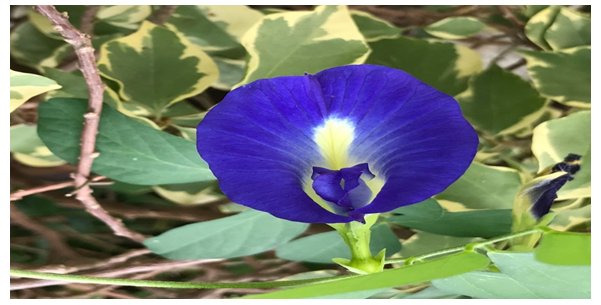
Many plants have been recommended in the ancient system of herbal medication for the rehabilitation of Neurodegenerative disorders. The well-known plant Clitoria ternatea L., which alludes to the Papilionaceae relatives, is recognized as a butterfly pea furthermore sankhpushpi. However, the plant has not been extensively examined to support its historical claims. To support historical assertions, it was decided to investigate the plant C. ternatea’s anti- anxiety properties [5]. Clitoria ternatea, a member of the Fabaceae family, is a perennial climbing plant that is native to Southeast Asia. The plant’s striking blue-violet flowers and unique leaf shape have earned it the common name Butterfly Pea. Over the years, it has been revered for its ornamental value, as well as its historical and cultural importance. Figure 1 shows the flowers and foliage of plants.
Botanical Characteristics
Clitoria ternatea is characterized by its slender stems, alternate leaves, and vibrant pea-like flowers. The flowers exhibit a vivid blue or purple coloration, with a distinctive structure that resembles the female reproductive organ of a butterfly, hence its common name. The plant’s roots, leaves, flowers, and seeds all hold significance in traditional medicine and culinary practices.
Phytochemical Constituents
Extensive research has revealed that Clitoria ternatea is a rich source of bioactive compounds. Flavonoids, anthocyanins, alkaloids, and phenolic compounds are among the major phytochemical constituents present in the plant. These compounds contribute to its vibrant coloration and potential health benefits.
Traditional Uses
Clitoria ternatea has a long history of use in traditional medicine across Asia, including Ayurveda and Traditional Chinese Medicine (TCM). Different parts of the plant have been employed to address a wide range of health issues, such as promoting cognitive function, reducing inflammation, managing stress, and supporting overall well-being. The plant has also been utilized for its reputed aphrodisiac properties and as a natural dye in various cultures.
Pharmacological Potential
Recent scientific investigations have shed light on the potential pharmacological activities of Clitoria ternatea. Studies suggest that the plant may possess antioxidant, anti- inflammatory, neuroprotective, and anxiolytic properties, which align with some of its traditional uses. Furthermore, Clitoria ternatea extracts have shown promise in preclinical studies for their potential role in cognitive enhancement and memory improvement.
Culinary and Nutraceutical Applications
Beyond its traditional medicinal uses, Clitoria ternatea has found its way into culinary arts and the nutraceutical industry. The flowers are utilized to create vibrant and visually appealing beverages, teas, desserts, and natural food colorings. The anthocyanin-rich extracts from the flowers are also being explored for their potential health-promoting effects in the nutraceutical sector. Clitoria ternatea, with its captivating appearance and diverse bioactive compounds, holds significant potential for various applications in the fields of medicine, nutrition, and aesthetics.
Continued research is essential to unlock the full range of its therapeutic benefits and to validate its traditional uses. As global interest in natural remedies and functional foods grows, Clitoria ternatea stands as a botanical treasure with a promising future. In conclusion, Clitoria ternatea, or Butterfly Pea, is a captivating plant that has captured the attention of researchers, herbalists, chefs, and consumers alike. Its rich history, cultural significance, and potential health benefits make it a subject of fascination and exploration across various disciplines. As we continue to uncover its secrets and harness its potential, Clitoria ternatea remains a symbol of nature’s intricate beauty and the potential of botanical wonders.
Experimental work
Amassing and Categorization of Plant Material
The leaves of Clitoria ternatea were procured from the local surrounding of Neemrana dist. Alwar, Rajasthan in January and authenticated at Raffles University Neemrana.
Preparation of the Plant Material
The collected plant leaves after authentication were washed with distilled water and dried under shade.
pulverized to a flake size of 40 mesh and kept in an airtight canister for further processes and investigation [6].
Extraction of Leaves
With a soxhlet apparatus, hot continuous extraction was performed on the powdered leaf. The solvents used for extraction included methanol (95%) The extraction process was carried out for about 13 h for each solvent. The extracts were filtered while hot through Whatman filter paper to remove any un-dissolved material (debris or impurities). The extracts were concentrated by distillation to reduce the volume. one-tenth.
Animals Used
10 to 12-week-olds, averaging 45 to 60g Swiss Wister Rats were grabbed. All the rats were fed with a standard diet The animals were kept in pervasive hutches. at room temperature (25 ± 3ºC), with 12hr light cycles. They were given 2 weeks to get acclimatized to laboratory surroundings.
Grouping of Animals
Group I: Received Vehicle (Control)
Group II: Standard group received Alprazolam (1mg/kg)
Group III: The test group received a methanolic extract of Clitoria ternatea (300 mg/kg)
Behavioral Studies
Trained rats were assessed for their behavioral change by using an elevated plus maze, the Neuroprotective effect of Clitoria ternatea, and according to the procedure.
Elevated Plus Maze
For evaluating learning, memory, and anxiety in rodents The EPM is widely used. Animals were placed at the center of the apparatus under silent and dark conditions. The total time spent in open and closed arms was recorded.
Statistical Analysis
Data from experiments are presented as the mean standard error of the mean (SEM). The one-way ANOVA was used in the statistical analysis to determine the differences between the two groups. AtP < 0.01 data were deemed significant.
Results
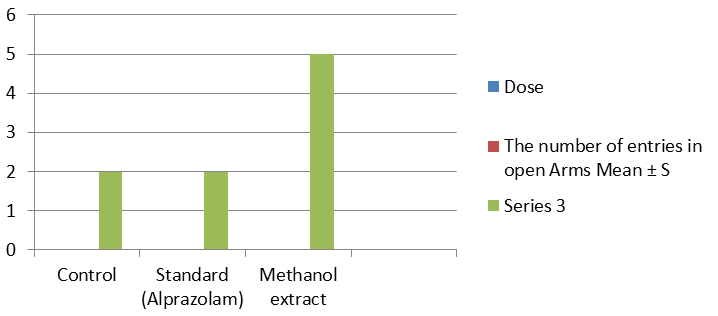
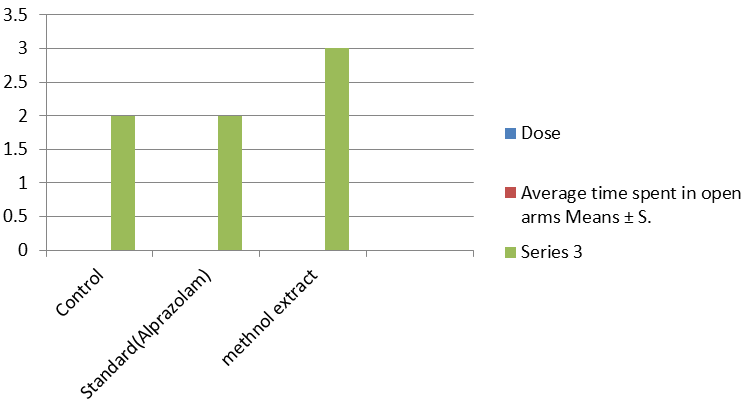
The antianxiety profile showing the mean number of entries and mean time spent in the open arms of the vehicle, standard drug alprazolam, and Methanolic extracts of Clitoria ternatea leaves are depicted in Figures 1 and Figure 2, respectively and the antianxiety activity profile is shown in Table 1.
| Treatments | Dose | The Number of Entries in Open Arms Mean ± S. | Average Time Spent in Open Arms Means ± S. |
|---|---|---|---|
| Control | 15 ml/kg | 1.05 ± 0.05* | 1.40 ± 0.20** |
| Standard | Alprazolam (2.5mg/kg) | 7.20 ± 0.48** | 14.80 ± 0.64** |
| Methanol extract | (150 mg/kg) | 5.50 ± 0.10* | 8.40 ± 0.28** |
Table 1: Evaluation of the anti-anxiety activity of plant drug. The data is expressed as Mean ± S.D.; *P<0.05, **P<0.01.
Discussion
Although Clitoria is traditionally utilized to address nervous disorders, the scientific community currently lacks reports that assess its potential anxiolytic properties. The elevated plus maze is a widely accepted animal model for studying anxiety, having been validated for use with both rats and mice [6]. An anxiolytic agent is expected to increase the frequency of entries Into the open arms and extend the duration spent in these arms of the EPM.this effect is thought to be mediated through the GABAA (γ-aminobutyric acid type A) receptor complex, which justifies the inclusion of alprazolam as a positive control in the study (Figure 3).
In Vivo Study for the Assessment of Anti- Anxiety Activity of Plant Drug
The results were recorded and calculated.
Conclusion
The findings of this investigation point to the potential value of this plant material as a source of knowledge and as appropriate benchmarks for assessing the degree of this plant’s functionality in subsequent research or proposal. The active components responsible for the plant’s anti-anxiety action are most likely its flavonoids.
Acknowledgment
The authors appreciate the board’s support. The organization of Raffles University, Neemrana Dist Alwar (Rajasthan). It has the authors’ gratitude. For providing all the resources required to complete this work, including the facilities.
References
-
Anderson JG, Taylor AG (2012) Use of Complementary Therapies for Cancer Symptom Management Results of the 2007 National Health Interview Survey. Journal Alternative and Complementary Medicine 18(3): 235- 241.
-
Cannistraro PA, Rauch SL (2003) Neural Circuitry of Anxiety Evidence from Structural and Functional Neuroimaging Studies. Psychopharmacology Bulletin 37(4): 8-25.
-
Thakur P, Rana AC (2013) Anxiolytic potential of medicinal plants. International Journal of Nutrition Pharmacol Neurological Diseases 3(4): 325-331.
-
Abascal K, Yarnell E (2004) Nervine Herbs for Treating Anxiety. Alternative and Complementary Therapies.
-
Kumar D, Dhobi M (2016) Antianxiety and antioxidant profile of blue and white variety of Clitoria ternatea L. Indian Journal of Research Pharmacy and Biotechnology 79(6): 1022-1025
-
Dutt V, Dhar VJ, Sharma A (2010) Antianxiety activity of Gelsemium sempervirens. Pharmaceutical Biology 48(10): 1091-1096.
- Potential Medicinal Herbs and Secondary Metabolites in Combating Corona Virus
- Monkeypox and its Clinical Implications in Pregnancy
- Pharmacognostical Analysis of the Leaves of Important Nervine Medicinal Plant: Strychnos Nux-Vomica L
- Assessment of Antibacterial Activity of Various Solvent Extracts of Dictyota Dichotoma Against Multidrug Resistant Bacterial Strain
- An Insights of Bioactive Elements on Malignancy: Mechanistic Avenues
- Advances and Future Directions in Pharmacognosy and Chinese Medicine