
Tissue Uptake of Zinc in Fresh Water Fish Channa Punctatus Exposed to Mixture of Pollutants
In the present study groups of fishes exposed for 96 hr to zinc+cadmium, zinc+copper, zinc+endosulfan, zinc+cadmium+copper+efldosulfan and zinc+cadmium+copper+ dimethoate combinations and it has been observed that some effects of metals may be prevented by the simultaneous administration of other metals. Bioaccumulation of Zinc decreased when the fish were exposed to zinc+ copper, zinc+cadmium+copper+endosulfan and zinc+cadmium+copper+dimethoate combinations as compared to fishes exposed to Zinc alone. Results clearly show that the level of accumulation of Zinc in different tissues (Muscle, liver, Gills, Kidney) and blood in the two types of exposures (individual and group exposure) varied in order Muscle>Kidney> Gills >Liver>blood.
Introduction
Among various toxic pollutants, heavy metals are particularly serious in their action due to the tendency of bio- magnification in the food chain. Global heavy metal pollution of water is a major environmental problem. With the advent of agricultural and industrial revolution, most of the water sources are getting contaminated. Industrial discharges containing toxic and hazardous substances, including heavy metals contribute tremendously to pollution of aquatic ecosystems [1, 2, 3]. Zinc is an essential element that acts as a structural component and possesses specific properties indispensable to life [4, 5, 6]. The risk of zinc is increased by being in the environment almost indefinitely because it cannot be biologically destroyed, but only converted from one oxidation state or organic compound to another. Zn is a potentially toxic substance to fish [7], which causes disturbances of acid-base and ion regulation, dissolution of gill tissue and hypoxia [8].
Heavy metals alter the physical, chemical, and biological properties of water bodies as well as its ecosystems [9, 10, 11, 12, 13, 14]. Heavy metals are thus discharged from the source, leached into groundwater, deposited in aquifers, or rinsed in surface water. Industrial wastes with heavy metals cause biochemical disturbances in fish upon entering the aquatic environment.
The interactions among trace metals and pesticides possibly due to their competition for a common binding site are very well known and the most studied interactions are in the following groups: copper - molybdenum; copper — iron - zinc; cadmium — zinc - copper - iron; selenium — mercury — arsenic - cadmium; manganese -selenium; cadmium - endosulfan; cadmium - dimethoate; quinalphos — cypermethrin .
Studies of simple mixtures usually investigate the same well defined endpoint of one chemical co-administered with another. These simple interaction studies may have limited application to wildlife and human hazard assessment, but do show whether specific interaction occurs in the test species. Studies on chemicals ranging from persistent organohalogen to inorganic trace elements did not show any dramatic interactive effects beyond additive. As water bodies consist of various types of pollutants like heavy metals, pesticides and other chemicals, it is very essential to test for the interaction between these different chemicals in order to predict their effects such as synergistic, additive and antagonistic. So far, most of the researches are directed at studying the individual toxic effects of water pollutants and very little attention has been paid to the toxic effects produced by mixtures and their combination.
Materials and Methods
Exposure of Test Fish
Healthy living specimens of the fresh water teleost fish Channa punctatus collected from the local ponds or purchased from fish market were quickly transported to laboratory. The fish were maintained in glass aquaria and fed twice daily with pelleted diet (prawn powder, fish powder, and minced liver in 2:2:1 ratio). The water in aquaria was continuously aerated in order to maintain the dissolved oxygen concentration above 7 ppm. All experiments were run simultaneously for 96 hr and dead fishes were counted after every 8 hr intervals. A control experiment was also run for 96 hr in toxicant free tap water. All experiments were repeated three times at temperature varying between 20-25°C. From these experiments five combinations, zinc+cadmium, zinc+copper, zinc+endosulfan, zinc+cadmium+copper+endosulfan, and zinc+cadmium+copper+dimethoate were selected for the study of tissue uptake.
Individual Exposure
80 fishes divided into 4 groups of 20 each were exposed to LC50 of zinc (18.62mg/I), copper (0.56 mg/l), cadmium (11.8 mg/I) endosulfan (3 microgram /l) and dimethoate (14.84 mg/l) with above selected combination separately. The fourth group of 20 fishes was kept in metal free water served as control for each experimental group. After 96 hr from each of the experimental and control groups, 4 surviving fishes were processed independently for further experimentation
Group Exposure
60 fishes were divided into 3 groups of 20 fishes each and were exposed to LC50of zinc (18.62 mg/I), copper (0.56 mg/I), cadmium (11.8 mg/I) endosulfan (3 microgram/I) and dimethoate (14.84 mg/I) with selected combinations (zinc+cadmium, zinc+copper, zinc+cadmium+copper+endosulfan, zinc+cadmium+copper+dimethoate ) separately. After 96 hr from each of the experimental and control groups tissues were excised from surviving fishes for tissue uptake studies.
Processing of Tissues
After exposure for a period of 96 hr, the surviving fish were sacrificed for the estimation of cadmium, zinc and copper in their muscle, liver, gills, kidney and blood. Muscle tissue was excised from the lateral trunk region. Kidney, gills and liver were removed from the fish body. The tissues were separated from adjoining tissues and blotted free of blood with filter paper. Blood samples were collected from the caudal vein with the help of a syringe and whole blood was used for cadmium, zinc and copper analysis. Each tissue and blood were pooled separately in petridishes and dried at 60°C until the weight became constant. 1 gm of each tissue from control and exposed groups were transferred to a 100 ml beaker and 1.0 ml of sulphuric acid, 2.0 ml of nitric acid and 0.5 ml of perchloric acid were added. The beaker was gently heated on a hot plate, until the tissue dissolved. The content of the beaker was diluted to 10-15 ml with triple distilled water. Glassware was cleaned with hydrochloric acid and triple distilled water.
Estimation of Heavy Metals
Fishes from selected experiments were collected from the aquaria. The fish were sacrificed for the estimation of metals by MS (Hitachi Z-6000) in muscle, liver, gills, kidney and blood. Cadmium, zinc and copper were estimated with hollow cathode lamps at wavelengths 228.8, 213.9 and 324.8 nm respectively, with a slit of 1.3nm by atomic absorption spectrophotometer (Hitachi Z-6000) with air-acetylene mixture as fuel.
Results
Tissue Uptake of Zinc
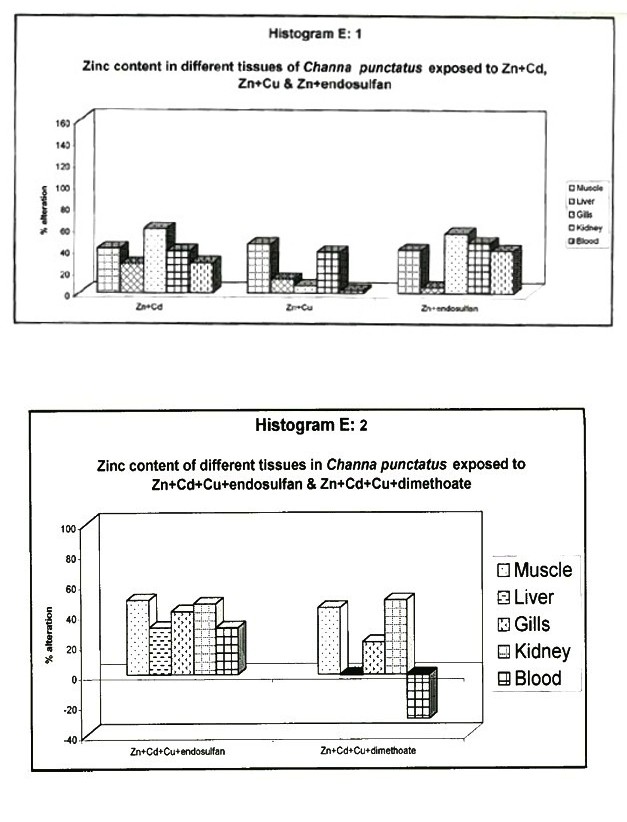
The accumulation of Zinc by fish exposed to the mixture of toxicant was compared with the accumulation in experiments in which fish were exposed separately to zinc alone. The results of the bioaccumulation experiments are given in Tables 1-5; Histograms E1&E2.
Muscle
In the group of fishes exposed for 96 hr to zinc+cadmium, zinc+copper, zinc+endosulfan, zinc+cadmium+copper+efldosulfan and zinc+cadmium+copper+ dimethoate .The metal concentration decreased by 41.4%, 45.5%, 40.2% 49.5% and 44.3% respectively as compared to fishes exposed to zinc alone. All the four fish in case of individual exposure to zinc+cadmium, zinc+copper, zinc+endosulfan, zinc+cadmium+coppper+endosulfan and zinc+cadmium+ copper+dimethoate showed significant decrease which varied from 1.65 to 2.67, 1.95 to 2.30, 2.02 to 2.64, 1.84 to 2.34 and 1.97 to 2.19 pg/gm respectively.
Liver
Liver is the main site for detoxification of xenobiotics. Therefore, as expected, accumulation was significant in this tissue. In the present study inclusion of cadmium, copper and endosulfan reduced uptake of zinc by 26.7%, 12.8% and 5.6% respectively as compared to fish exposed to zinc alone. Significant decrease of 31.2% was recorded in zinc.fcadmium+copper+endosulfan combination. In contrast, there was insignificant increase by 0.5% in zinc+cadmium+copper+dimethoate Combination. Although there was significant decrease of zinc in individual if fishes exposed to zinc+cadmium, zinc+copper, zinc+endosulfan. zinc+cadmium+ copper+ endosulfan, the decrease varied from 15.7 to 19.16, 19.52 to 22.23, 16.34 to 23.12 and 14.46 to 19.82 pg/gm respectively and increase varied from 24.66 to 29.42 pug/gm was recorded in exposure to zinc+cadmium+copper+dimethoate combination.
Gills
As gills remain in direct contact with ambient medium, it is presumed that the level of zinc in gills should be higher than other tissues. The level of zinc in fish exposed in groups to zinc+cadmium, zinc+copper, zinc+endosulfan, zinc+cadmium+copper+endosulfan and zinc+cadmiumi- copper+ dimethoate combinations decreased by 59.4%, 6.9%, 55.6% 41.91% and 21.6% respectively, over the fish exposed to zinc alone. Similar condition was noted in exposure of individual fishes. Decrease of zinc in four individually exposed fished varied from 49.57 to 62.46, 60.28 to 69.0, 26.46 to 37.72, 36.74 to 46.70 and 49.58 to 56.12 pg/gm in zinci+cadmium, zinc+copper, zinc+endosulfan, zinc+cadmium+ copper+endosulfan and zinc+cadmiuml+copper+dimethoate combinations respectively.
Kidney
As in other tissues, the level of zinc in kidney, decreased in both types of exposure. There was 39.1%, 38.2%, 47.1%, 47.0% and 49.3% decrease in the zinc content of the kidney of fish exposed in groups to zinc+cadmium, zinc+copper, zinc+endosulfan, zinc+cadmium+copper+endosulfan and zinc+cadmium+copper+dimethoate combinations respectively. In individual exposure, all the four fish showed significant decrease which varied from 27.62 to 32.82, 25.56 to 34.66, 23.84 to 28.98, 22.58 to 29.72 and 22.42 to 29.72 pg/gm in zinc+cadmium, zinc+copper, zinc+endosulfan and zinc+cadmium+copper+dimethoate combination respectively.
Blood
In group exposures the level of zinc in blood decreased significantly by 27.9%, 39.8% and 31.1% in zinc+cadmium, zinc+endosulfan, zinc+cadmium+copper+endosulfan combinations respectively and insignificant decrease by 2.4% in zinc+copper combination. There was significant increase by 29.4% in zinc+cadmium+copper+dimethoate combination. The decrease of zinc in blood of individually exposed fish was significant in case of zinc+cadmium, zinc+endosulfan and zinc+cadmium+copper+endosulfan combinations. In contrast, in case of zin+cadmium+copper+dimethoate combinations, the level of zinc significantly increased by 52.19 to 58.12 pg respectively.
- Time
- Control fish
- Zn alone exposed fish
- Zn+Cd exposed fish individually group exposed fish
- 1st
- 2nd
- 3rd
- 4th
- Muscle
- 1.74±0.16
- 3.92±0.04
- 17.84±0.12
- 1.65±0.09
- 2.26±0.08
- 2.03±0.06
- 2.67±0.04
- Liver
- 6.60±0.19
- 24.34±0.16
- 15.70±0.05
- 17.92±0.11
- 18.42±0.17
- 17.16±0.17
- 17.84±0.12
- Gill
- 16.22±0.42
- 69.45±0.17
- 49.57±0.12
- 55.16±0.91
- 60.92±0.82
- 62.46±0.12
- 59.65±0.82
- Kidney
- 18.10±0.09
- 49.12±0.29
- 27.62±0.12
- 29.48±0.06
- 31.84±0.38
- 32.82±0.18
- 30.28±0.14
- Blood
- 15.86±0.86
- 42.14±0.18
- 31.42±0.13
- 28.52±0.17
- 30.72±0.28
- 33.42±0.22
- 30.38±0.48
Table 1: Zinc context in different tissues of Channa punctatus exposed to Zn+Cd for 96 hr individually and in group.
- Time
- Control fish
- Zn alone exposed
- Zn+Cu exposed fish individually group exposed fish
- 1st
- 2nd
- 3rd
- 4th
- Muscle
- 1.7.±0.16
- 3.92±0.04
- 1.95±0.12
- 2.30±0.06
- 2.24±0.09
- 2.04±0.04
- 2.14±0.07
- Liver
- 6.04±0.19
- 24.32±0.16
- 22.23±0.12
- 19.52±0.40
- 20.46±0.52
- 21.58±0.42
- 21.23±0.15
- Gill
- 16.22±0.42
- 69.45±0.17
- 62.74±0.18
- 69.10±0.12
- 60.28±0.89
- 63.52±0.16
- 66.66±0.94
- Kidney
- 18.12±0.09
- 49.72±0.29
- 25.56±0.24
- 29.74±0.31
- 32.24±0.27
- 34.66±0.28
- 30.73±0.23
- Blood
- 15.86±0.80
- 42.14±0.18
- 38.68±0.18
- 40.48±0.28
- 41.76±0.32
- 41.02±0.16
- 41.19±0.28
Table 2: Zinc context in different tissues of Channa punctatus to Zn+Cu for 96 hr individually and in group.
- Zn+ Endosulfan exposed fish individually group exposed fish
- 1st
- 2nd
- 3rd
- 4th
- Time
- Control fish
- Zn alone exposed
- Muscle
- 1.70±0.16
- 3.92±0.04
- 2.02±0.08
- 2.42±0.12
- 2.39±0.10
- 2.64±0.06
- 2.34±0.02
- Liver
- 6.40±0.19
- 24.3±0.16
- 18.62±0.14
- 19.52±0.12
- 16.34±0.18
- 23.12±0.19
- 22.98±0.21
- Gill
- 16.22±0.42
- 69.45±0.17
- 26.46±0.22
- 28.24±0.16
- 32.56±0.15
- 37.72±0.22
- 30.84±0.32
- Kidney
- 18.12±0.09
- 49.12±0.29
- 28.88±0.44
- 24.74±0.46
- 23.84±0.12
- 28.50±0.24
- 26.30±0.19
- Blood
- 15.86±0.80
- 42.14±0.18
- 22.10±0.24
- 23.56±0.34
- 28.41±0.16
- 26.70±0.26
- 25.37±0.42
Table 3: Zinc context in different tissues of Channa punctatus to Zn+ Endosulfan for 96 hr individually and in group.
| Tissue | Control Fish | Zn alone exposed fish (Conc.) | Zn+Cd+Cu+Endosulfan exposed fish individually | Group exposed fish | |||
|---|---|---|---|---|---|---|---|
| 1st | 2nd | 3rd | 4th | ||||
| Muscle | 1.70±0.16 | 3.92±0.04 | 2.05±0.02 | 2.24±0.08 | 2.41±0.20 | 1.84±0.08 | 19.80±0.07 |
| Liver | 6.40±0.19 | 24.34±0.16 | 14.46±0.14 | 18.50±0.12 | 19.82±0.18 | 15.60±0.19 | 16.76±0.12 |
| Gill | 16.22±0.42 | 69.45±0.17 | 36.74±0.24 | 42.12±0.30 | 43.48±0.35 | 46.70±0.28 | 40.35±0.36 |
| Kidney | 18.12±0.09 | 49.72±0.29 | 22.58±0.12 | 27.12±0.26 | 29.72±0.26 | 28.45±0.18 | 26.35±0.18 |
| Blood | 15.86±0.80 | 42.14±0.18 | 30.54±0.18 | 27.72±0.16 | 24.47±0.42 | 28.47±0.12 | 29.04±0.28 |
Table 4: Zinc context in different tissues of Channa punctatus to Zn+Cd+Cu+Endosulfan for 96 hr individually and in group.
| Tissue | Control Fish | Zn alone exposed fish (Conc.) | Zn+Cd+Cu+Dimethoate exposed fish individually | Group exposed fish | |||
|---|---|---|---|---|---|---|---|
| 1st | 2nd | 3rd | 4th | ||||
| Muscle | 1.70±0.16 | 3.92±0.04 | 2.02±0.07 | 2.18±0.08 | 1.97±0.10 | 2.19±0.08 | 2.18±0.09 |
| Liver | 6.40±0.19 | 24.61±0.16 | 28.42±0.36 | 29.42±0.42 | 28.87±0.49 | 24.66±0.42 | 24.46±0.16 |
| Gill | 16.82±0.42 | 69.45±0.17 | 5.12±0.75 | 50.46±0.64 | 55.72±0.62 | 49.58±0.52 | 54.45±0.82 |
| Kidney | 18.12±0.09 | 49.12±0.29 | 22.42±0.12 | 24.42±0.48 | 26.42±0.50 | 29.72±0.36 | 25.21±0.19 |
| Blood | 15.86±0.80 | 42.14±0.18 | 58.12±0.39 | 56.16±0.28 | 57.42±0.38 | 52.19±0.42 | 54.23±0.42 |
Table 5: Zinc context in different tissues of Channa punctatus to Zn+Cd+Cu+Dimethoate for 96 hr individually and in group.
Conclusion
In the present study it was concluded that in group exposure of fish for 96 hr to zinc+cadmium, zinc+copper, zinc+cadmium+copper+endosulfan and zinc+cadmium+copper+dimethoate combinations, the metal content of various tissues like gills, kidney, liver, muscle and in blood significantly decreased as compared to zinc alone exposed fishes . Results clearly show that the level of accumulation of zinc in different tissues in the two types of exposure (individual and group exposure) varied. The level of accumulation was different in individual exposure because each fish had different physiological activity. Bioaccumulation of zinc in both the exposure (individual and group exposure) was in order Muscle>Kidney> Gills >Liver>blood.
References
-
Abdullah MH, Sidi J, Aris AZ (2007) Heavy Metals (Cd, Cu, Cr and Zn) in Meretrix Roding, Water and Sediments from Estuaries in Sabah, North Borneo. International Journal of Environmental & Science Education 2(3): 69-
-
Bawuro (2018) Bioaccumulation of Heavy Metals in Some Tissues of Fish in Lake Geriyo, Adamawa State, Nigeria. Journal of Environmental and Public Health 2018.
-
Buerki Thurnherr T, Xiao L, Diener L, Arslan O, Hirsch C, et al. (2013) In vitro mechanistic study towards a better understanding of ZnO nanoparticle toxicity, Nanotoxicology 7(4): 402-416.
-
Elnabris KJ, Muzyed SK, El-Ashgar NM (2013) Heavy metal concentrations in some commercially important fishes and their contribution to heavy metal exposure in Palestinian people of Gaza Strip (Palestine). J of the association of Arab Universities for basic and applied sciences 13(1): 44-51.
-
Fallah AA, Saei Dehkordi SS, Nematollahi A, Jafari T (2011) Comparative study of heavy metal and trace element accumulation in edible tissues of farmed and wild rainbow trout (Oncorhynchus mykiss) using ICP- OES technique. Microchemical Journal 98: 275-279.
-
Javed M (2005) Heavy metal contamination of freshwater fish and bed sediments in the River Ravi stretch and related tributaries. Pak J Biol Sci 8: 1337-1341.
-
Mustafa C, Guluzar A (2003) The relationships between heavy metal (Cd, Cr, Cu, Fe, Pb, Zn) levels and the size of six Mediterranean fish species. Environment and Pollution 121(1): 129-136.
-
Pandey G, Madhuri S (2014) Heavy metals causing toxicity in animals and fishes. Res. J. Animal, Veterinary and Fishery Sci 2(2): 17-23.
-
Ploetz DM, Fitts BE, Rice TM (2007) Differential accumulation of heavy metals in muscle and liver of a marine fish, (King Mackerel, Scomberomorus cavalla Cuvier) from the Northern Gulf of Mexico, USA. B Environ Contam Tox 78: 124-127.
-
Rahman MS, Molla AH, Saha N, Rahman A (2012) Study on heavy metals levels and its risk assessment in some edible fishes from Bangshi River, Savar, Dhaka, Bangladesh Food Chem 134(4): 1847-1854.
-
Arun R, Manoj K, Rajesh P, Sunil T, Yogesh S, et al. (2015) Assessment Of Zinc Bioaccumulation In Fish _Channa_ _Punctatus_ Exposed Chronically. Global Journal of Bio- science and Biotechnology 4: 347-355.
-
Murugan SS, Karuppasamy R, Poongodi K, Puvaneswari S (2020) Bioaccumulation Pattern of Zinc in Freshwater Fish Channa punctatus (Bloch.) After Chronic Exposure Turkish Journal of Fisheries and Aquatic Sciences 8: 55- 59.
-
Ahmed S (2019) Heavy metals and geo-accumulation index development for groundwater of Mathura city, Uttar Pradesh Desal. Water Treat J 138: 291-300.
-
Vinodini R, Narayanan M (2007) Bioaccumulation of heavy metals in organs of fresh water fish Cyprinus carpio (Common carp). Int J Environ Sci Tech 5(2): 179- 182.
- Natural Decline to Extinction of A New Zealand Rabbit Population
- Mitochondrial Bio-Logistics: Steering Co-Enzyme Q10 and Lycopene Synergies within the Science 4.0 Bio-OS Framework
- Hymenoptera Specimens from the Caño Negro Wetland, of the National Museum Collection, Costa Rica
- Science 4.0: Comprehensive Architecture of the Biological Operating System (Bio-OS) A Framework for Systemic Resilience and Industrialized Bio-Governance
- Rabbit on, or Hare Back? Understanding Climate Change
- Clinical Validation of Science 4.0: Flow Steering and Epigenetic Drift Inversion on a 76-Year-Old Hybrid System