
Bioaccumulation of Zinc in Fresh Water Fish Channa Punctatus Exposed to Mixture of Pollutants
In the present study groups of fishes exposed for 96 hr to zinc+cadmium, zinc+copper, zinc+endosulfan, zinc+cadmium+copper+endosulfan and zinc+cadmium+copper+dimethoate combinations and it has been observed that the interaction between one metal with another metal can be antagonistic or synergistic. In some cases no interaction among them was noticed. Experiments on fish have shown that some effects of metals may be prevented by the simultaneous administration of other metals. The metal concentration decreased as compared to fishes exposed to zinc alone. Bioaccumulation of zinc decreased when the fish were exposed to zinc+cadmium combination. Results clearly show that the level of accumulation of zinc in different tissues (Muscle, liver, Gills , Kidney) and blood in the two types of exposures (individual and group exposure) varied in order Gills>Blood>Kidney >Liver>Muscle.
Introduction
Among various toxic pollutants, heavy Metals are especially severe due to trend of bio-magnification in the food chain. Global heavy metal pollution of water is a major environmental problem with the advent of Agricultural and Industrial Revolution; Most Water Sources are getting contaminated. Poisonous and containing industrial discharges Hazardous substances including heavy metals. Our health and environment have become almost synonymous today; it is equally true for all biotic organisms, and fishes are thus no exception. Fishes are one of the most primitive groups of vertebrates and their environment i.e. hydrosphere is everything for them. The impairment of behavioral and physiological functioning due to polluted ambient habitat could result in gradual reduction in the adaptation capacity of a species leading to decrease in the survival capacity and gradual fall in population density.
Chemical mixtures are characteristic of life. The environment, including soil, air, food and all kinds of living organisms is a complex mixture of chemicals. The nature of the mixtures varies widely according to the specific chemical present and their concentration with in living system, which is controlled within relatively close limits. Furthermore, as is well known to toxicologists, all chemicals, both natural and synthetic are capable of producing adverse effects under some exposure conditions. Fortunately, individual chemicals differ widely in their capacity to produce adverse effects. Indeed for many individual elements and chemical compounds, there is a spectrum of effects associated with exposure. In some cases the elements or chemicals may be essential for life, delicately balanced between deficiency, sufficiency and toxicity with increase in levels of intake.
Contamination of soil and water is caused often by chemical mixtures than by single pollutants. Common examples of mixed chemical pollutants include gasoline; crude oil and land fill leachates. Although these mixtures consist essentially of organic compounds, other pollutant mixtures may include both organic and inorganic chemicals such as B heavy metals. Even in cases where a site is contaminated by only one pollutant, the generation of degradation products, such as humic acid changes the chemical makeup of the soil and water at the site so that they are better described as mixtures. Therefore, the toxicity of mixtures or combinations acquires great significance. Zinc is widely used in semiconductors, solar panel devices [1], paints, personal care products (sunscreens) and even in waste water treatment. Although, zinc is an essential trace element for both plants and animals but it induces toxicity at elevated concentrations particularly under conditions of low pH, low alkalinity, low dissolved oxygen and elevated temperatures [2]. Partially but relatively quickly, zinc dissolves in water, and releases free zinc ions which become primary source of aquatic toxicity [3, 4, 5]. Moreover, in combined state (ZnO) higher toxicity of zinc has been reported [6, 7, 8, 9, 10], than dissolved Zn (II) alone. Zinc is the only metal to be involved in all six classes of enzymes viz; oxido-reductases, transferases, hydrolases, yases, isomerases and ligases [11]. Greig, et al. studied the concentration of silver, cadmium, copper and lead in liver of windowpane flounder and reported values which were typical for finfish. Stromberg, et al. studied pathology of lethal and sublethal exposure of fathead minnow to cadmium. The radiotracer studies using cadmium`’`’ showed a rapid uptake and two phase elimination of cadmium by the fish. This rapid elimination correlated with lesions in urinary epithelium. Ueda, et al. studied accumulation of cobalt by marine fish Chromium is reported to be toxic at higher concentrations and causes histopathological and ultrastructural changes in several tissues of aquatic animals [12, 13, 14]. Mohammad, et al, determined the distribution of heavy metals in the water and sediments collected from Kali Nadi, U.P. and their accumulation was also recorded in the fresh water fishes, Kuroshima, et al. studied accumulation of cadmium in the mummichog Fundulus heteroclitus adapted to various salinities. Abu, et al. reported the concentration of mercury, cadmium, copper and zinc in two populations of Fundulus heteroclitus. One population was from piles creek (PC), a polluted tidal creek in a heavily industrialized area in Linden, New Jersey, and the other population was a pristine area in Southampton, long Island (LI), New York. Copper is an essential element and tends to accumulate to a greater extent than other essential elements, such as zinc and iron [15, 16]. Kargin, et al. reported accumulation of iron, zinc, copper, lead and cadmium in freshwater fish Capoeta barroisi tissues.
Materials and Methods
Exposure of Test Fish
Healthy living specimens of the fresh water teleost fish Chan- na punctatus collected from the local ponds or purchased from fish market were quickly transported to laboratory. The fish were maintained in glass aquaria and fed twice daily with pelleted diet (prawn powder, fish powder, and minced liver in 2:2:1 ratio). The water in aquaria was continuously aerated in order to maintain the dissolved oxygen concen- tration above 7 ppm. All experiments were run simultane- ously for 96 hr and dead fishes were counted after every 8 hr intervals. A control experiment was also run for 96 hr in toxicant free tap water. All experiments were repeated three times at temperature varying between 20-25°C. From these experiments five combinations, zinc+cadmium, zinc+copper , zinc+endosulfan, zinc+cadmium+copper+endosulfan, zinc+ca dmium+copper+dimethoate were selected for the study of tissue uptake.
Group Exposure
90 fishes divided into 6 groups of 15 each and five groups were exposed to LC50 of zinc (18.62mg/I), copper (0.56 mg/l), cadmium (11.8 mg/I) endosulfan (3 microgram /l) and dimethoate (14.84 mg/l) with above selected combination separately. The 6th group of 15 fishes was kept in metal free water served as control for each experimental group. After 96 hr from each of the experimental and control groups, 4 surviving fishes were processed independently for further experimentation
Processing of Tissues
After exposure for a period of 96 hr, the surviving fish were sacrificed for the estimation of cadmium, zinc and copper in their muscle, liver, gills, kidney and blood. Muscle tissue was excised from the lateral trunk region. Kidney, gills and liver were removed from the fish body. The tissues were separated from adjoining tissues and blotted free of blood with filter paper. Blood samples were collected from the caudal vein with the help of a syringe and whole blood was used for cadmium, zinc and copper analysis. Each tissue and blood were pooled separately in petridishes and dried at 60°C until the weight became constant. 1 gm of each tissue from control and exposed groups were transferred to a 100 ml beaker and 1.0 ml of sulphuric acid, 2.0 ml of nitric acid and 0.5 ml of perchloric acid were added. The beaker was gently heated on a hot plate, until the tissue dissolved. The content of the beaker was diluted to 10-15 ml with triple distilled water. Glassware was cleaned with hydrochloric acid and triple distilled water.
Estimation of Heavy Metals
Fishes from selected experiments were collected from the aquaria. The fish were sacrificed for the estimation of metals by MS (Hitachi Z-6000) in muscle, liver, gills, kidney and blood. Cadmium, zinc and copper were estimated with hollow cathode lamps at wavelengths 228.8, 213.9 and 324.8 nm respectively, with a slit of 1.3nm by atomic absorption spectrophotometer (Hitachi Z-6000) with air-acetylene mixture as fuel.
Results
Tissue Uptake of Zinc
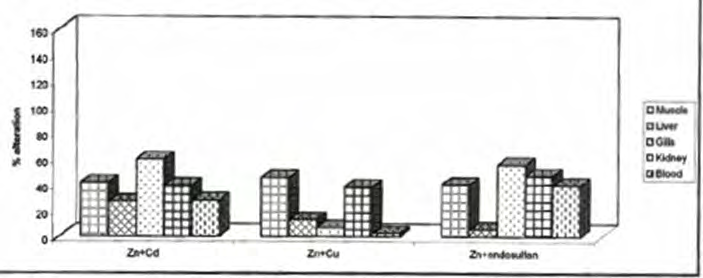
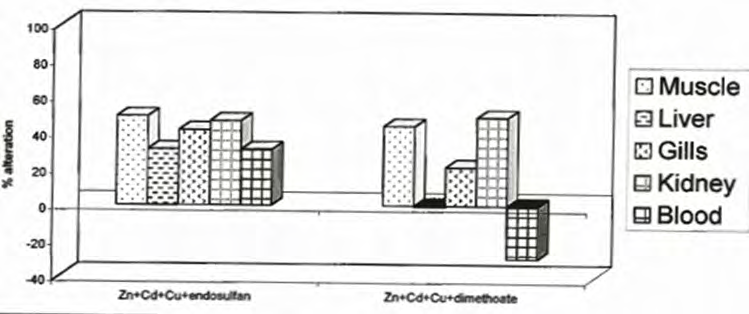
The accumulation of Zinc by fish exposed to the mixture of toxicant was compared with the accumulation in experiments in which fish were exposed separately to zinc alone. The results of the bioaccumulation experiments are given in Tables 1-5 and Figures 1&2.
Muscle
In the group of fishes exposed for 96 hr to zinc+cadmium, zinc+copper, zinc+endosulfan, zinc+cadmium+copper+efldosulfan and zinc+cadmium+copper+dimethoate the metal concentration decreased by 41.4%, 45.5%, 40.2% 49.5% and 44.3% respectively as compared to fishes exposed to zinc alone. All the four fish in case of individual exposure to zinc+cadmium, zinc+copper, zinc+endosulfan, zinc+cadmium+copper+endosulfan and zinc+cadmium+ copper+ dimethoate showed significant decrease which varied from 1.65 to 2.67, 1.95 to 2.30, 2.02 to 2.64, 1.84 to 2.34 and 1.97 to 2.19 µg/gm respectively.
Liver
Liver is the main site for detoxification of xenobiotics.
Therefore, as expected, accumulation was significant in this tissue. In the present study inclusion of cadmium, copper and endosulfan reduced uptake of zinc by 26.7%, 12.8% and 5.6% respectively as compared to fish exposed to zinc alone. Significant decrease of 31.2% was recorded in zinc.fcadmium+copper+endosulfan combination. In contrast, there was insignificant increase by 0.5% in zinc+cadmium+copper+dimethoate Combination. Although there was significant decrease of zinc in individual fishes exposed to zinc+cadmium, zinc+copper, zinc+endosulfan and zinc+cadmium+ copper+ endosulfan, the decrease varied from 15.7 to 19.16, 19.52 to 22.23, 16.34 to 23.12 and 14.46 to 19.82 µg/gm respectively and increase varied from 24.66 to 29.42 µg /gm was recorded in exposure to zinc+cadmium+copper+dimethoate combination.
Gills
As gills remain in direct contact with ambient medi- um, it is presumed that the level of zinc in gills should be higher than other tissues. The level of zinc in fish exposed in groups to zinc+cadmium, zinc+copper, zinc+endosulfan, zinc+cadmium+copper+endosulfan and zinc+cadmiumi- copper+ dimethoate combinations decreased by 59.4%,
6.9%, 55.6% 41.91% and 21.6% respectively, over the fish exposed to zinc alone. Similar condition was noted in expo- sure of individual fishes. Decrease of zinc in four individu- ally exposed fished varied from 49.57 to 62.46, 60.28 to 69.0, 26.46 to 37.72, 36.74 to 46.70 and 49.58 to 56.12 µg/gm in zi nc+cadmium, zinc+copper, zinc+endosulfan, zinc+cadmium + copper+endosulfan and zinc+cadmium+copper+dimethoa te combinations respectively.
Kidney
As in other tissues, the level of zinc in kidney, decreased in both types of exposure Tables 1-5. There was 39.1%, 38.2%, 47.1%, 47.0% and 49.3% decrease in the zinc content of the kidney of fish exposed in groups to zinc cadmium, zinc+copper, zinc+endosulfan, zinc+cadmium+copper+endosulfan and zinc+cadmium+copper+dimethoate combinations respectively. In individual exposure, all the four fish showed significant decrease which varied from 27.62 to 32.82, 25.56 to 34.66, 23.84 to 28.98, 22.58 to 29.72 and 22.42 to 29.72 µg /gm in zinc+cadmium, zinc+copper, zinc+endosulfan and zinc+cadmium+copper+dimethoate combination respectively.
| Tissue | Control Fish | Zn Alone exposed fish | Zn+Cd exposed fish individually | Group exposed fish | |||
|---|---|---|---|---|---|---|---|
| 1st | 2nd | 3rd | 4th | ||||
| Muscle | 1.70±0.16 | 3.92±0.04 | 17.84±0.12 | 1.65±0.09 | 2.26±0.08 | 2.03±0.06 | 2.67±0.04 |
| Liver | 6.60±0.19 | 23.34±0.16 | 15.70±0.05 | 17.92±0.11 | 18.42±0.13 | 19.16±0.17 | 17.84±0.12 |
| Grill | 16.22±0.42 | 69.45±0.17 | 49.57±0.12 | 55.16±0.91 | 60.92±0.82 | 62.46±0.12 | 59.65±0.82 |
| kidney | 18.10±0.09 | 46.12±0.29 | 27.62±0.15 | 29.48±0.06 | 31.84±0.38 | 32.82±0.18 | 30.28±0.14 |
| Blood | 15.86±0.80 | 42.14±0.18 | 31.42±0.13 | 28.52±0.17 | 30.72±0.28 | 33.72±0.22 | 30.38±0.48 |
Table 1: Zinc content in different tissues of Channa Punctatus exposed to Zn+Cd 96hr individually and in group.
| Tissue | Control Fish | Zn Alone exposed fish | Zn+Cn exposed fish individually | Group exposed fish | |||
|---|---|---|---|---|---|---|---|
| 1st | 2nd | 3rd | 4th | ||||
| Muscle | 1.70±0.16 | 3.92±0.04 | 1.95±0.12 | 2.30±0.08 | 2.24±0.09 | 2.04±0.04 | 2.14±0.07 |
| Liver | 6.60±0.19 | 23.34±0.16 | 22.23±0.12 | 19.52±0.40 | 20.46±0.52 | 21.58±0.42 | 21.23±0.15 |
| Grill | 16.22±0.42 | 69.45±0.17 | 62.78±0.18 | 69.10±0.12 | 60.28±0.89 | 63.52±0.16 | 64.66±0.94 |
| kidney | 18.10±0.09 | 46.12±0.29 | 25.56±0.24 | 29.74±0.31 | 32.24±0.27 | 34.66±0.28 | 30.73±0.23 |
| Blood | 15.86±0.80 | 42.14±0.18 | 38.68±0.18 | 10.48±0.28 | 41.76±0.32 | 41.02±0.16 | 41.17±0.28 |
| Tissue | Control Fish | Zn Alone exposed fish | Zn+Endosulfan exposed fish individually | Group exposed fish | |||
| 1st | 2nd | 3rd | 4th | ||||
| Muscle | 1.70±0.16 | 3.92±0.04 | 2.02±0.08 | 2.42±0.12 | 2.38±0.10 | 2.64±0.06 | 2.34±0.02 |
| Liver | 6.60±0.19 | 23.34±0.16 | 18.62±0.14 | 19.52±0.12 | 16.34±0.18 | 23.12±0.19 | 22.98±0.21 |
| Grill | 16.22±0.42 | 69.45±0.17 | 26.46±0.22 | 28.24±0.16 | 32.56±0.15 | 37.72±0.22 | 30.84±0.32 |
| kidney | 18.10±0.09 | 46.12±0.29 | 28.88±0.44 | 24.74±0.46 | 23.84±0.12 | 28.50±0.24 | 26.30±0.19 |
| Blood | 15.86±0.80 | 42.14±0.18 | 22.10±0.24 | 23.56±0.34 | 28.42±0.16 | 26.70±0.26 | 25.37±0.42 |
Table 2: Zinc content in different tissues of Channa Punctatus exposed to Zn+Cn 96hr individually and in group.
| Tissue | Control Fish | Zn Alone exposed fish | Zn+Cd+Cu+Endosulfan exposed fish individually | Group exposed fish | |||
|---|---|---|---|---|---|---|---|
| 1st | 2nd | 3rd | 4th | ||||
| Muscle | 1.70±0.16 | 3.92±0.04 | 2.05±0.02 | 2.24±0.08 | 2.41±0.20 | 1.84±0.08 | 19.80±0.07 |
| Liver | 6.60±0.19 | 23.34±0.16 | 14.46±0.14 | 18.50±0.12 | 19.82±0.18 | 15.60±019 | 16.76±012 |
| Grill | 16.22±0.42 | 69.45±0.17 | 36.74±0.24 | 42.2±0.30 | 43.48±0.32 | 46.70±0.28 | 140.35±0.36 |
| kidney | 18.10±0.09 | 46.12±0.29 | 22.58±0.12 | 27.12±0.26 | 29.72±0.26 | 28.46±0.18 | 26.35±0.18 |
| Blood | 15.86±0.80 | 42.14±0.18 | 30.54±0.18 | 22.72±0.16 | 34.47±0.42 | 28.47±0.12 | 29.04±0.28 |
Table 3: Zinc content in different tissues of Channa Punctatus exposed to Zn+Cd+Cu+Endosulfan 96hr individually and in group.
| Tissue | Control Fish | Zn Alone exposed fish | Zn+Cd+Cu+Dimethoate exposed fish individually | Group exposed fish | |||
|---|---|---|---|---|---|---|---|
| 1st | 2nd | 3rd | 4th | ||||
| Muscle | 1.70±0.16 | 3.92±0.04 | 2.02±0.07 | 2.18±0.08 | 1.97±010 | 2.19±0.08 | 2.18±0.09 |
| Liver | 6.60±0.19 | 23.34±0.16 | 28.48±0.36 | 29.42±0.42 | 28.87±0.49 | 24.66±0.42 | 24.46±0.16 |
| Grill | 16.22±0.42 | 69.45±0.17 | 56.12±0.75 | 50.46±0.64 | 55.72±0.62 | 49.58±0.52 | 54.45±0.84 |
| kidney | 18.10±0.09 | 46.12±0.29 | 22.4±0.12 | 24.42±0.48 | 26.42±0.50 | 29.72±0.36 | 25.21±0.19 |
| Blood | 15.86±0.80 | 42.14±0.18 | 58.12±0.39 | 56.16±0.28 | 57.42±0.38 | 52.19±0.42 | 54.23±0.42 |
Table 4: Zinc content in different tissues of Channa Punctatus exposed to Zn+Cd+Cu+Dimethoate 96hr individually and in group.
Discussion
In the present study it has been observed that the interaction between one metal with another metal can be antagonistic or synergistic. In some cases no interaction among them was noticed. Experiments on fish have shown that some effects of metals may be prevented by the simultaneous administration of other metals .In the present study groups of fishes exposed for 96 hr to zinc+cadmium, zinc+copper, zinc+endosulfan, zinc+cadmiuml-copper+endosulfan and Zinc+cadmium+copper+dimethoate the metal concentration decreased as compared to fishes exposed to zinc alone. Our results are supported by the findings of Moreau, et al. who reported that radioactive zinc and phenantherene at concentration approximately 50% of the 96 hr LC50 level demonstrated that phenanthrene caused a reduction in the short term accumulation of zinc by sheepshead fry. It is not clear, what mechanism would be responsible for the reduction of zinc accumulation, while it has been shown that similar interactions among aquatic diatoms species were due to competetions for binding to and uptake by the manganese uptake system [17].
Conclusion
In the present study it was concluded that concentration of zinc decreased when the fish were exposed to zinc+cadmium combination. Results clearly show that the level of accumulation of zinc in different tissues in the two types of exposure (individual and group exposure) varied. The level of accumulation was different in individual exposure because each fish had different physiological activity. Bioaccumulation of Zinc in both the exposure (individual and group exposure) was in order Gills>Blood>Kidney >Liver>Muscle.
References
-
Abdullah MH, Sidi J, Aris AZ (2007) Heavy Metals (Cd, Cu, Cr and Zn) in Meretrix Roding, Water and Sediments from Estuaries in Sabah, North Borneo. International Journal of Environmental & Science Education 2(3): 69- 74.
-
Agarwal R, Kumar R, Behari JR (2007) Mercury and lead content in fish species from the River Gomti, Lucknow, India, as biomarkers of contamination. Bull Environ Contam Toxicol 78(2): 118-122.
-
Alloway BJ (2008) Zinc in soils and crop nutrition. Paris, France: IFA; and Brussels, Belgium, pp: 1-135.
-
Bawuro (2018) Bioaccumulation of Heavy Metals in Some Tissues of Fish in Lake Geriyo, Adamawa State, Nigeria. Journal of Environmental and Public Health 2018: 7.
-
Buerki-Thurnherr T, Xiao L, Diener L, Arslan O, Hirsch C, et al. (2013) In vitro mechanistic study towards a better understanding of ZnO nanoparticle toxicity. Nanotoxicology 7(4): 402-416.
-
Elnabris KJ, Muzyed SK, El-Ashgar NM (2013) Heavy metal concentrations in some commercially important fishes and their contribution to heavy metal exposure in Palestinian people of Gaza Strip (Palestine). J of the association of Arab Universities for basic and applied sciences 13(1): 44-51.
-
Fallah AA, Saei-Dehkordi SS, Nematollahi A, Jafari T (2011) Comparative study of heavy metal and trace element accumulation in edible tissues of farmed and wild rainbow trout (Oncorhynchus mykiss) using ICP- OES technique. Microchemical Journal 98(2): 275-279.
-
Herschfinkel M, Silverman WF, Sekler I (2007) The zinc sensing receptor, a link between zinc and cell signaling. Mol Med 13(7-8): 331-336.
-
Hotz C, Brown KH (2004) Assessment of the risk of zinc deficiency in populations and options for its control. Food and Nutrition Bulletin 25: S91-S204.
-
Hu X, Cook S, Wang P, Hwang HM (2009) In vitro evaluation of cytotoxicity of engineered metal oxide nanoparticles. Sci Total Environ 407(8): 3070-3072.
-
Javed M (2005) Heavy metal contamination of freshwater fish and bed sediments in the River Ravi stretch and related tributaries. Pak J Biol Sci 8: 1337-1341.
-
Mustafa C, Guluzar A (2003) The relationships between heavy metal (Cd, Cr, Cu, Fe, Pb, Zn) levels and the size of six Mediterranean fish species. Environment and Pollution 121(1): 129-136.
-
Pandey G, Madhuri S (2014) Heavy metals causing toxicity in animals and fishes. Res J Animal Veterinary and Fishery Sci 2(2): 17-23.
-
Ploetz DM, Fitts BE, Rice TM (2007) Differential accumulation of heavy metals in muscle and liver of a marine fish, (King Mackerel, Scomberomorus cavalla Cuvier) from the Northern Gulf of Mexico, USA, B. Environ. Contam Tox 78(2): 124-127.
-
Rahman MS, Molla AH, Saha N, Rahman A (2012) Study on heavy metals levels and its risk assessment in some edible fishes from Bangshi River, Savar, Dhaka, Bangladesh Food Chem 134(4): 1847-1854.
-
Arun R, Manoj K, Prashad, Rajesh, Trivedi, et al. (2015) Assessment Of Zinc Bioaccumulation In Fish Channa Punctatus Exposed Chronically. Global Journal of Bio- science and Biotechnology 4(4): 347-355.
-
Vinodini R, Narayanan M (2007) Bioaccumulation of heavy metals in organs of fresh water fish Cyprinus carpio (Common carp). Int J Environ Sci Tech 5(2): 179- 182.
- California Red-Legged Frog and Non-Listed Amphibians Response to Non-Native Fish Removal
- Industrial Standardization of the Bio-OS: Algorithmic Codification of Resilience Engineering Guidelines and Version V8 Architecture
- Climate Variability and the Sustainability of Snail Farming in Nigeria: Past Trends, Present Challenges and Potential Outlook
- The Evaluation of the Surveillance System of Anthrax in Gilgit-Baltistan, Pakistan, 2018
- Natural Decline to Extinction of A New Zealand Rabbit Population
- Mitochondrial Bio-Logistics: Steering Co-Enzyme Q10 and Lycopene Synergies within the Science 4.0 Bio-OS Framework