
Horse Breeds of Nepal
This article is a review on the horse breeds of Nepal. The contents in this article is obtained from google books, blogs, online articles and conference papers. Information about indigenous horse breeds on Nepal is limited and papers on this topic has not been published yet which made the review task challenging. In Nepal, six types of horse and pony breeds is known of indigenous origin: Jumli, Chyanta, Tanghan, Terai, Tattu and Bhotia. Most area of the country is covered with Hill and mountains where horses are commonly used for transportation, cart-pulling, riding, carrying goods and bricks. They are also used for trekking or as pet animals and during festivals like marriages, Ghode Jatra, Yartung festival. Being a developing country as well as from religious point of view, horse rearing is found common in certain parts of Nepal. However, lack of breeding programme, conservation and poor nutrition has resulted in the decline of horse population in Nepal. Therefore, proper study, research and conservation strategies on these local horse breeds is necessary.
Introduction
From ancient times, the bond between human and horses has been seen in Nepal; horses were used by Kings, heads of villages and for transportation of goods [1]. Being a developing country, the rearing and use of horses for various purposes is still common on many parts of the country. However, recently, modernization has affected the horse population and their use in Nepal [2]. According to Economic Survey 2017/18 [3], the total population of horse is 68,711, growth rate being only 6.8 % in Nepal. Nowadays, horse is gaining popularity in tourism areas being used by trekkers for riding, for accompany as well as for horse racing and transportation of goods where the vehicles are unable to transport [4]. Similarly, in Brick Kiln, horses are used for carrying bricks and used for pulling carts [5].
‘’Ghode Jatra or Horse Parade’’, also known as horse racing festival is held every year in Nepal when horse racing is organized by Nepal Army and police in Tundikhel, Kathmandu [6]. Likewise, ‘’Yartung Festival’’ is a three-day horse-racing celebration held in Mustang [7]. In marriage, the use of Ghodi or female white horse is used for carrying groom.
Mostly, horses are reared in Hilly and Mountainous regions than Terai region of Nepal. Jumli, Chyanta, Tanghan, Terai, Tattu and Bhotia are the known indigenous breeds of horse in Nepal till date. These breeds are hardy in nature, having high disease resistance and are strong and sure -footed.
Jumli Horse
Jumli horse is the most commonly known indigenous breed of horse of Nepal which looks similar to Bhotia horse breed [8]. It is mostly concentrated in the Jumla district (high hills) of Nepal and also found in India [9]. It is small, solid; has almond - shaped eyes, wide forehead; neck is horizontally set, exceedingly sloping croup, low set tail, straight back, and small hooves and have thick and dense mane and tail [8].
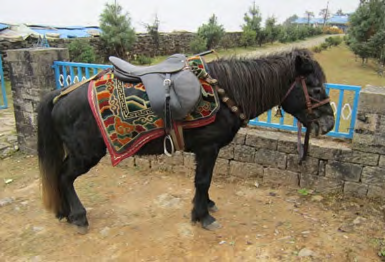
Jumli horses are hardy in nature, has fortitude and very well acclimatize to hilly and mountain region, having greater ability in hiking even in snow. Due to their hardy nature, Jumli possess good health and being undemanding in nature, are easy to raise. They are known as good pack horses and are still used for transportation of goods in difficult-to-reach areas [10]. The have been used for tourism as company for trekkers. They are also used to produce excellent mules [8].
Tanghan Pony
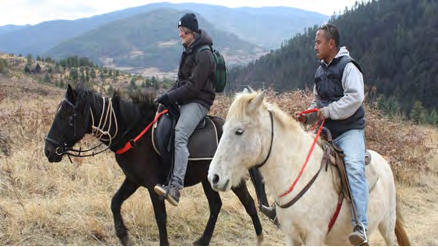
Tanghan pony is one of the principle horse breeds of Nepal, also found in Bhutan. Tanghan is one of a variety of Bhotia pony, et al. [11] Eric, et al. [12]. It is the largest pony among three varieties Tattu, Chyanta and Tarai. They are strong, powerful, enduring in nature [13] and are 136 cm tall to the withers (Eric, n.d.). Tanghan are never shoed and their hooves frequently crack [14].
Chyanta Pony
In Nepali, Chyanta means dwarf. Chyanta pony, et al. [15] is local mountain horse breed and native horse breed of Nepal (Riding Everest, n.d.). They are primarily bay in colour [16]. They are very similar in physique and bloodiness as to Bhotia and Tattu pony, slightly smaller than Bhotia and greater than Tattu pony [15]. They are sturdy, strong and strong-willed and their average height is 12-13 hands [15]. Generally, with strong and quite character, their physique is particular same as Indian ponies having short thick neck, compact body and strong back, strong legs with hooves and have long and heavy manes and tails. This breed is very special to the native people who developed to suit local region. They are used for tourism, used by trekkers, riding, sport and transportation of goods in mountain regions.
Tarai Pony
Tarai pony is smaller with an average height of 115 cm at withers and mostly found in southern Terai region of Nepal [16]. It is usually bay in colour but occasionally also found in white with dark skin [16]. Tarai pony is used for pulling cart, transport goods and used in brick kiln factory for carrying bricks [17, 18, 19, 20, 21, 22].
Tattu Pony
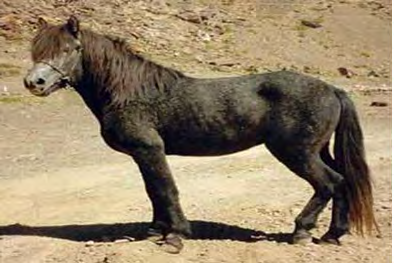
Tattu pony, found in mountains rather than hills, is one of the three varieties of Bhotia pony (Sparks, n.d.) [22]. It is the smallest variety of the group, about 110 cm tall in height and is used for pack animal, riding for trekkers etc. This horse has ability to suffice in higher mountains where the paths are narrower (Sparks, n.d.) [22].
Bhotia Pony
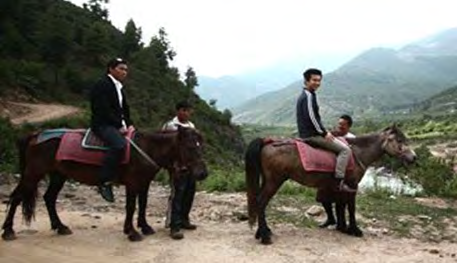
Bhotia pony has different names varying according to the areas. In Nepal, it is called Bhote ghoda or Bhutani Pony or Bhutuwa. They are found in Nepal, Bhutan and India.
They are most often found in gray or bay, chestnut and roan in colour [21]. Bhotia is similar but less broad than Tibetan pony. They are better known for intelligence, willing and quite in character and hardy nature. They are well adapted and suited in mountains and cold climate region of the country. In spite of small size, it is very sure-footed pack horse. Height of these breed is 14.3 and 12.3 hands for male and female respectively. Head is wide, neck is short & thick, back is strong, body is compact, legs are short, body is coarse & hairy but strong, mane and tail are heavy & long, and hooves are open at the heels. They are known for well -developed chest low withers and sloping quarters. They are used as pack animal, light agriculture work, carrying loads, transporting people and occasionally for riding in sports.
Discussion and Conclusion
Only six breeds of horse are commonly known in Nepal. However, other unidentified horse breeds are found in different parts of country which needs identification and characterization. Horses are used in Terai region of Nepal in brick industry for transportation of bricks, goods, cart and in marriage ceremony for riding by groom; in Hilly region previously used by king, head of village for riding while nowadays used for transportation of goods where the vehicle is not possible to transport; and in Himalayan region for transport of goods, by trekkers, tourist for riding & transport of their luggage and for horse racing. Horses imported from foreign countries are reared by Nepal Army as the cavalry which are used for traffic control and in shows in special occasion like Ghode Jatra.
Mechanization and modernization have made horse less useful, causing decline in their population and some breeds are even at high risk of being endangered. These days, horses are very rarely seen in Terai and Hilly region of Nepal. Horses craze and population remains limited only in Himalayan region due to use by trekkers and tourist and lack of reach of vehicle routes. Due to lack of breeding programme, conservation and poor nutrition, welfare and growth of these breeds are in declining rate. Hence, in order to conserve the property of the country, proper research of these local horses along with appropriate breeding strategies are required.
Conflict of Interest
The authors declare that there is no conflict of interest.
Acknowledgement
Authors would like thank teachers, seniors, friends and juniors of Institute of Agriculture and Animal Science, Tribhuvan University, Nepal for help and support.
References
-
Kandel P (2019) Developing a horse sense in Kathmandu.
-
Hansen N, Postmes T, Tovote KA, Bos A (2014) How Modernization Instigates Social Change: Laptop Usage as a Driver of Cultural Value Change and Gender Equality in a Developing Country. Journal of Cross-Cultural Psychology 45(8): 1229-1248.
-
(2018) Economic Survey 2017/18 - Ministry of Finance, Nepal.
-
Jez C, Coudurier B, Cressent M and Mea F (2013) Factors driving change in the French horse industry to 2030. Advances in animal biosciences 4 (2): 66-105.
-
Animal Nepal (2019) Beats of burden. Equine abuse in Nepaljung. pp: 1-31.
-
Ashesh (2019) Ghode Jatra Festival of Horses & Pahachare.
-
(2020) Yartung Festival Mustang Trek.
-
Rousseau E (2017) Horses of the World. New Jersey, USA, Princeton press.
-
Ministry of Agriculture and Cooperatives (2004) Country Report on Animal Genetic Resources of Nepal.
-
Messerschmidt D (2010) High in the saddle: horse and windhorse in Nepal. Ecs Nepal.
-
Bhotia Pony (n.d.) The Equinest.
-
Eric P (n.d.) Tanghan pony. Pinterest.
-
Yule H, Burnell AC (1996) Hobson- Jobson, The Anglo - Indian Dictionary. Hertfordshire, England: Wordsworth reference.
-
Hooker JD (2004) Scientific Travellers 1790-1877. In: Knight D, et al. (Eds.), 11 new fatter lane London EC4P 4EE: Routledge.
-
Chyanta pony (n.d.) The Equinest.
-
Porter V, Alderson L, Hall SJG, Sponenberg DP (2016) Mason’s World Encyclopedia of Livestock Breeds and Breeding volume 2. Oxfordshire, England: CABI publishing.
-
Heilman J (2011) Horse Everest.
-
Heilman J (2011) There are horses that one can hire to carry them out if injured on the Everest trek.
-
Horse breeds pictures (n.d.).
-
Jin and Jirsa (n.d.) Baraat l Indian wedding tradition.
-
Ryan A (n.d.) Bhotia pony. Pinterest.
-
Sparks M (n.d.) Tattu pony [Pinterest post].
- California Red-Legged Frog and Non-Listed Amphibians Response to Non-Native Fish Removal
- Industrial Standardization of the Bio-OS: Algorithmic Codification of Resilience Engineering Guidelines and Version V8 Architecture
- Climate Variability and the Sustainability of Snail Farming in Nigeria: Past Trends, Present Challenges and Potential Outlook
- The Evaluation of the Surveillance System of Anthrax in Gilgit-Baltistan, Pakistan, 2018
- Natural Decline to Extinction of A New Zealand Rabbit Population
- Mitochondrial Bio-Logistics: Steering Co-Enzyme Q10 and Lycopene Synergies within the Science 4.0 Bio-OS Framework