
A Review on the Status of Sambhar Wetland Bird Tragedy
Sambhar Lake is India’s largest inland salt lake. It is a shallow Ramsar wetland Subject to seasonal fluctuations. The site is important for a variety of wintering water birds, including large numbers of flamingos. Human activities consist of salt production and livestock grazing. It is also an Important Bird Area (IBA) due to migratory avifaunal population, especially flamingo and waterfowl. Presence of salt-tolerant algae makes the lake one of the most important wintering areas for flamingos. The specialized algae and bacteria growing in the lake provide striking water colors and support the lake ecology that, in turn, sustains the migrating waterfowl. Current conservational threats owing to the drastic reduction in water spread and anthropogenic pressures were major concerns till Oct.2019. The death of thousands of birds was detected on 11th November 2019 which belonged to 25 different species. Majority of were migratory birds and a few local species The main cause identified was avian botulism. The paper reviews the cause and efforts taken to revive it as a safe wetland.
Introduction
Sāmbhar Lake comes under Ramsar Convention. The Ramsar Convention is an international treaty for the conservation and sustainable utilization of wetlands, recognizing the fundamental ecological functions of wetlands and their economic, cultural, scientific, and recreational value.
Sambhar Lake (Figure 1) was given the status of a Ramsar Site in March 1990. The lake receives water from five rivers Medtha, Samaod, Mantha, Rupangarh, Khari, and Khandela. Lake has 5700 square km catchment area. It occupies an area of 190 to 230 square kilometers based on the season. The lake is elliptically shaped with a length of approximately 35.5 km and a breadth varying between 3 km and 11 km. The circumference of the lake is 96 km, and it is surrounded by the Aravali hills on all side.
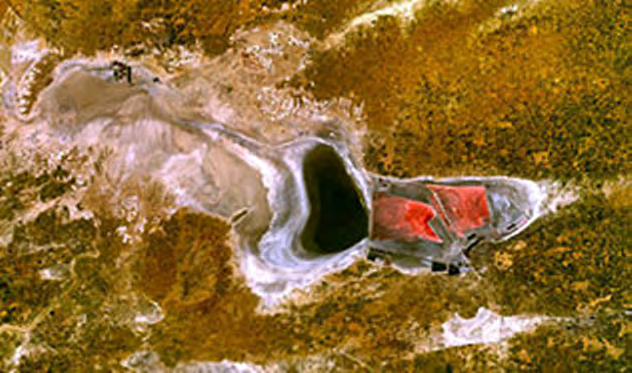
Ecological Importance
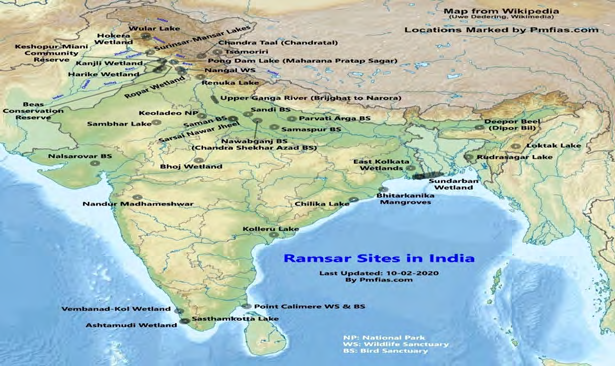
Sambhar has been designated as a Ramsar site (Figure
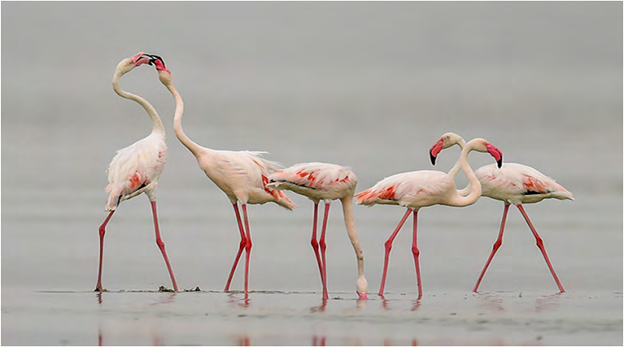
2) (recognized wetland of international importance) because the wetland is a key wintering area for tens of thousands of pink flamingos (Figure 3)and other birds that migrate from northern Asia and Siberia.
The specialized algae and bacteria growing in the lake provide striking water colors and support the lake ecology that, in turn, sustains the migrating waterfowl.
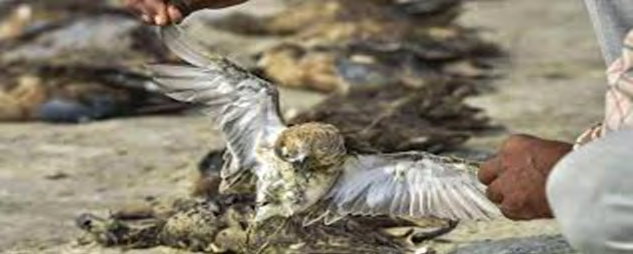
In November 2019, nearly 20,000 of migratory birds were found dead mysteriously in the lake area. The salt (NaCl) concentration in this lake water differs from season to season. The salt concentration in the pans Kyars varies and, accordingly, the color of the brine ranges from green, orange, pink, purple, pink and red due to the bloom of haloalkaliphilic microorganisms. More recently, haloalkaliphilic microalgae namely Dunaliella, Euhalothece, Nitzchia, etc. have also been isolated [1].
The Human Connection
Sambhar is known as a source of salt production. Over the decades, salt extraction in the lake has undergone a transformation. The traditional process is monsoon- dependent. The lake taps water from seasonal rivers, streams and rivulets. This water reacts with the lake sediments and becomes brine. It evaporates over 50 days leaving behind crystallized salt. Today, most salt production units use deep bore wells to extract groundwater, reducing the entire process to barely two weeks.
Cause of Bird Tragedy
Thousands of birds, including this Pallas’s Gull, have been found dead around Rajasthan’s saline, Sambhar Lake, triggering alarm among birders. This incident needs immediate investigation and remediation.The deaths of over thousands birds in Sambhar Lake have been attributed to Avian botulism. Attached is the detailed report by the Indian Veterinary Research Institute (IVRI), Bareilly. A potential cause of the presence of the bacteria could be toxicity of the water possibly due to excessive salt extraction by illegal salt units around the lake.
Avian botulism is a neuromuscular illness caused by a toxin produced by a bacteria-Clostridium botulinum. It is a paralytic, often fatal, disease for birds. Heavy rains that lashed northern India this July reduced the salinity of the lake. However, when the water evaporated, it increased the salinity around the edges of the lake bed. The bacteria that caused the present outbreak-_C. botulinum-_is an anaerobic bacterium, meaning it can grow and produce toxins only in the absence of oxygen. The low-levels of warm, saline water in the lake are further estimated by ecologists to have provided an ideal location for the manifestation of botulism.
The decaying plant or animal materials are capable of hosting the bacteria for a longer period of time. A bird-to- bird cycle: Since only insectivorous and omnivorous birds were affected and not herbivores, the birds feeding on dead birds could have been a possible cause of such mortality. In studies conducted by the USGS National Wildlife Health Center, several environmental factors, including pH, salinity, temperature, and oxidation-reduction potential in the sediments and water column, appeared to significantly influence the likelihood of botulism outbreaks in wetlands.
For several years activists have highlighted commercial and other activities detrimental to the eco-system of the wetland were being carried out contrary to the provisions of the Wetland (Conservation and Management) Rules framed under the Environment Protection Acts of 1986 and 2010.
The Rajasthan state hosts one of India’s largest migratory bird populations. On November 20, the Rajasthan High Court took notice of the tragedy and sought a report from amicus curiae Nitin Jain (Figure 5).
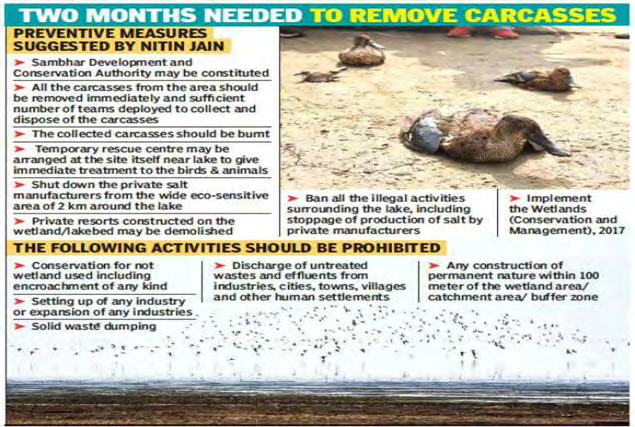
Authorities are burying the piling bird carcasses in pits after wrapping them in polythene sheets. This has raised concerns about the risk of contamination of soil, water and salt produced in the area. Experts also suspect poisonous algae and dumping of waste and carcasses in the lake behind the epidemic.
Sambhar Bird Diversity
A total of 71 species of wetland birds have been recorded (Tables 1&2).
| Lesser WhistlingDuck | Eurasian Collared Dove | Little Egret |
| Bar-headed Goose | Red Collared Dove | Black-headed Ibis |
| Greylag Goose | Spotted-necked Dove | Eurasian Spoonbill |
| Common Shelduck | Laughing Dove | Indian Black Ibis |
| Ruddy Shelduck | Yellow-legged Green Pigeon | Glossy Ibis |
| Red-crested Pochard | Chestnut-bellied Sandgrouse | Little Cormorant |
| Common Pochard | Little Swift | Great Cormorant |
| Ferruginous Duck | Greater Coucal | Oriental Darter |
| Tufted Duck | Jacobin Cuckoo | Eurasian Thick-knee |
| Garganey | Common Koel | Great Thick-knee |
| Northern Shoveler | Grey-bellied Cuckoo | Pied Avocet |
| Gadwall Common | Hawk Cuckoo | Black-winged Stilt |
| Eurasian Wigeon | White-breasted Water hen | Grey Plover |
| Indian Spot-billed Duck | Purple Swamphen | Pacific Golden Plover |
| Mallard | Common Moorhen | Little Ringed Plover |
| Northern Pintail | Common Coot | Kentish Plover |
| Common Teal | Demoiselle Crane | Greater Sand Plover |
| Comb Duck | Common Crane | Yellow-wattled Lapwing |
| Indian Peafowl | Painted Stork | Red-wattled Lapwing |
| Common Quail | Black Stork | White-tailed Lapwing |
| Rain Quail | Great White Pelican | Greater Painted-snipe |
| Jungle Bush Quail | Black-crowned Night Heron | Eurasian Curlew |
| Rock Bush Quail | Indian Pond Heron | Black-tailed Godwit |
| Grey Francolin | Cattle Egret | Ruddy Turnstone |
| Greater Flamingo | Grey Heron | Ruff |
| Lesser Flamingo | Purple Heron | Broad-billed Sandpiper |
| Little Grebe | Great Egret | Curlew Sandpiper |
| Rock Dove | Intermediate Egret | Temminck's Stint |
| Dunlin | Northern Wryneck | White-browed Wagtail |
| Little Stint | Black-rumped Woodpecker | White Wagtail |
| Common Snipe | Yellow-crowned Woodpecker | Rufous-tailed Lark |
| Common Sandpiper | Coppersmith Barbet | Ashy-crowned Sparrow Lark |
| Green Sandpiper | Green Bee-eater | Singing Bush Lark |
| Spotted Redshank | Blue-tailed Bee-eater | Indian Bush Lark |
| Common Greenshank | Blue-cheeked Bee-eater | Bimaculated Lark |
| Common Redshank | Indian Roller | Greater Short-toed Lark |
| Wood Sandpiper | European Roller | Oriental Sky Lark |
| Marsh Sandpiper | Common Kingfisher | Crested Lark |
| Red-necked Phalarope | Pied Kingfisher | Grey-breasted Prinia |
| Barred Buttonquail | White-throated Kingfisher | Ashy Prinia |
| Indian Courser | Common Kestrel | Plain Prinia |
Table 1: Sambhar Birds.
| Little Pratincole | Merlin | Common Tailorbird |
| Brown-headed Gull | Peregrine Falcon | Streak-throated Swallow |
| Black-headed Gull | Blossom-headed Parakeet | Red-rumped Swallow |
| Pallas's Gull | Plum-headed Parakeet | Wire-tailed Swallow |
| Caspian Gull | Alexandrine Parakeet | Barn Swallow |
| Gull-billed Tern | Rose-ringed Parakeet | Dusky Crag Martin |
| Whiskered Tern | Small Minivet | Plain Martin |
| River Tern | Common Woodshrike | White-eared Bulbul |
| Black-winged Kite | Black Drongo | Red-vented Bulbul |
| Egyptian Vulture | Isabelline Shrike | Common Chiffchaff |
| Short-toed Eagle | Bay-backed Shrike | Greenish Leaf Warbler |
| White-rumped Vulture | Long-tailed Shrike | Lesser Whitethroat |
| Indian Vulture | Great Grey Shrike | Yellow-eyed Babbler |
| Cinereous Vulture | Rufous Treepie | Oriental White-eye |
| Indian Spotted Eagle | Common Raven | Large Grey Babbler |
| Steppe Eagle | House Crow | Scrub Babbler |
| Bonelli's Eagle | Large-billed Crow | Jungle Babbler |
| Booted Eagle | Purple Sunbird | Common Starling |
| Western Marsh Harrier | Baya Weaver | Rosy Starling |
| Pallid Harrier | Red Avadavat | Purple-backed Starling |
| Montagu's Harrier | Indian Silverbill | Asian Pied Starling |
| Shikra | Scaly-breasted Munia | Brahminy Starling |
| Eurasian Sparrowhawk | House Sparrow | Common Myna |
| Black Kite | Spanish Sparrow | Bank Myna |
| White-eyed Buzzard Chestnut | Bush Sparrow | Indian Robin |
| Long-legged Buzzard | Tree Pipit | Oriental Magpie Robin |
| Spotted Owlet | Olive-backed Pipit | Black Redstart |
| Short-eared Owl | Paddyfield Pipit | Eastern Stonechat |
| Dusky Eagle Owl | Tawny Pipit | Pied Bush Chat |
| Indian Grey Hornbill | Grey Wagtail | Isabelline Wheatear |
| Common Hoopoe | Citrine Wagtail | Desert Wheatear |
| Pied Wheatear | Brown Rock Chat | Variable Wheatear |
Table 2: Sambhar Birds.
Anatids were largest in number and 27 species have been sighted for the first time from the lake waters. Under Ramsar definition, some twenty families of water birds have been designated as birds ecologically dependent on wetland. Out of 20 families recognized, 15 families are recorded from Sambhar Lake. The other two families also form the part of wetland dependent birds. All the 17 families recorded from Sambhar Lake are taxonomically categorized to define clearly the nature of dependence and status of wetland birds.
Discussion
Notable contributions have been made by Cornell Lab of Ornithology 2018 [2], Dickinson, et al. [3], Sangha, et al. [4] and Kumar, et al. [5].
Sambhar Lake is not the first instance where deaths due to botulism have been recorded. 7,000 water birds died in Lake Michigan in 2007 and 2008. In Hawaii, the toxin killed around 183 Laysan Ducks in 2008.The botulism outbreaks are likely to become more frequent as climate change alters wetland conditions to favour bacteria and pathogens.
Conclusion
Thus, the establishment of rescue and medical centres along with the mitigation of climate change need to be considered by the government as a precautionary measure for the future. There is a need to further provide a good climate in the wetland so that the birds can survive in the environment.
References
-
Upasani VN (2007) Microbiological studies on Sanbhar Lake Rajasthan. Proceedings of TAAL 2007. The 12th World Lake Conference, pp: 448-450.
-
(2018) Cornell Lab of Ornithology. E Bird Basic Dataset.
-
Dickinson EC, Remsen JV (2013) The Howard and Moore Complete Checklist of the Birds of the World. Aves Press.
-
Sangha HS (2009) The birds of Sambhar Lake and its environs. Indian Birds 4(3): 82-97.
-
Kumar S (2005) Fauna of Sambhar Lake. ZSI Wetland Ecosystem series 6: 1-200.
- California Red-Legged Frog and Non-Listed Amphibians Response to Non-Native Fish Removal
- Industrial Standardization of the Bio-OS: Algorithmic Codification of Resilience Engineering Guidelines and Version V8 Architecture
- Climate Variability and the Sustainability of Snail Farming in Nigeria: Past Trends, Present Challenges and Potential Outlook
- The Evaluation of the Surveillance System of Anthrax in Gilgit-Baltistan, Pakistan, 2018
- Natural Decline to Extinction of A New Zealand Rabbit Population
- Mitochondrial Bio-Logistics: Steering Co-Enzyme Q10 and Lycopene Synergies within the Science 4.0 Bio-OS Framework