
Tissue Uptake of Cadmium in Fresh Water Fish Channa Punctatus Exposed to Mixture of Pollutants
In the present study groups of fishes exposed for 96 hr to zinc+cadmium, Cadmium+Endosulfan zinc+cadmium+copper+endosulfan and zinc+cadmium+copper+dimeth-ate combinations and it has been observed that some effects of metals may be prevented by the simultaneous administration of other metals. Tissue uptake of cadmium decreased when the fish were exposed to zinc+cadmium, zinc+Endosulfan, zinc+cadmium+copper+Endosulfan and zinc+cadmium+copper+dimethoate combinations as compared to fishes exposed to cadmium alone. Results clearly shows that the level of accumulation of cadmium in different tissues (Muscle, liver, Gills, Kidney) and blood in the two types of exposures (individual and group exposure) varied in order Gills>Blood >Liver>Muscle>kidney.
Introduction
Water is considered a vital resource because it is necessary for all aspects of human and ecosystem survival. However, due to natural processes and anthropogenic activities, various pollutants have been added to the ground water system. Among these, heavy metals are some of the most serious pollutants [1].
Cd, a toxic heavy metal used in Ni-Cd batteries, the colouration of plastic and various discarded electronic Products released into the water system causes serious health issues Water is considered a vital resource because it is necessary for all aspects of human and ecosystem survival. However, due to natural processes and anthropogenic activities, various pollutants have been added to the ground water system [2, 3]. Among these, heavy metals are some of the most serious pollutants. Cd, a toxic heavy metal used in Ni- Cd batteries, the colouration of plastic and various discarded electronic products released into the water system causes serious health issues The heavy metal cadmium (Cd) is a hazardous pollutant known to exert various toxic effects and other sublethal to lethal effects on aquatic organisms, and can be commonly found in environment. Water is considered an important resource because it is essential for all aspects of humans and ecosystem [4]. However, due to natural processes and anthropogenic activities, various pollutants have been added to the groundwater system. Among these, heavy metals one of the most serious pollutant is Cd and cadmium is a toxic heavy metal used in Ni-Cd batteries and in plastic coloration and various electronic products left in the water system causes severe health problems [5, 6]. Cadmium can be released to water from some galvanized plumbing and water main pipe material corrosion. It can also enter water through industrial discharge; Waste disposal and spills; And leaching from hazardous waste sites or certain fertilizers. Human exposure to Cd is mainly through inhalation or ingestion [7, 8, 9, 10]. Ten to fifty percent of inhaled cadmium dust is absorbed depending on the particle size. Absorption through skin contact is negligible. About five to ten percent of ingestion Cd is absorbed, which also depends on the particle size. Intestinal absorption is higher in individuals with iron, calcium, or zinc deficiency [11].
Man is responsible for drastically altering the natural resources through his intelligence [12]. He has tried to improve the quality of life through industrial, agricultural and urban development and thus control his own evolutionary process. It is estimated that about 800-1000 tons of pollutants are being ejected into the atmosphere each day by all the big cities of our country [13]. Agriculturists in their bid to improve the quality and quantity of food products have been using fertilizers and chemical pesticides indiscriminately. Such indiscriminate use may result in nutritional imbalance of the soil, which ultimately will reflect in men and animals in that area [14, 15]. Therefore, increasing industrialization and developmental programs lead to continued addition of pollutants to the environment. Environmental pollution by heavy metals has increased in recent years due to extensive use of heavy metals in agricultural, chemical and industrial processes and has become a threat to living organisms. Pesticides are used extensively throughout the world in agricultural and public health programs. The contribution of pesticides to agriculture and public health has been substantial, but their injudicious use has created serious problems [16].
Heavy metals alter the physical, chemical, and biological properties of water as well as its ecosystems. Heavy metals are thus discharged from the source, leached into groundwater, deposited in aquifers, or rinsed in surface water. Industrial wastes with heavy metals cause biochemical disturbances in fish upon entering the aquatic environment.
The interactions among trace metals and pesticides possibly due to their competition for a common binding site are very well known and the most studied interactions are in the following groups: copper - molybdenum; copper — iron - zinc; cadmium — zinc - copper - iron; selenium — mercury — arsenic - cadmium; manganese -selenium; cadmium - endosulfan; cadmium - dimethoate; quinalphos — cypermethrin .
Studies of simple mixtures usually investigate the same well defined endpoint of one chemical co-administered with another. These simple interaction studies may have limited application to wildlife and human hazard assessment, but do show whether specific interaction occurs in the test species. Studies on chemicals ranging from persistent organohalogen to inorganic trace elements did not show any dramatic interactive effects beyond additive. As water bodies consist of various types of pollutants like heavy metals, pesticides and other chemicals, it is very essential to test for the interaction between these different chemicals in order to predict their effects such as synergistic, additive and antagonistic. So far, most of the researches are directed at studying the individual toxic effects of water pollutants and very little attention has been paid to the toxic effects produced by mixtures and their combination.
Shivraj, et al. studied the toxicity of cadmium and copper to a freshwater fish, Puntius arulius. Beena, et al. studied the effects of cadmium and mercury on the fish Cyprinus carpia. Sankaraperumal, et al. reported the synergistic effect of cadmium and zinc on the erythrocytes and opercular activity of the fishes Lepidocephalichuiyes thermalis and Amblyphai’yngodon melettinus.
Chakrabarty, et al. studied the effect of sublethal toxicity of three organophosphorus pesticides on the peripheral haemogram of the fish Channa punctatus. Singh, et al. studied the effect of copper and zinc sulphate on the blood parameters of Mystus vittatus (Block). Carpene, et al. reported that in gold fish injected with cadmium, zinc and copper, there was high accumulation of cadmium in liver; zinc accumulation was less evident while copper was absent. Most of the cadmium was cytosolic and bound to metallothionein. Detectable amounts of the injected metals were recovered in the bile. Moreau, et al. studied the interaction between phenanthrene and zinc and their toxicity to the sheepshead minnow (Cyprinodon variegatus). Brown, et al. studied the acute lethal toxicity of mixture of copper, phenol, zinc and nickel to rainbow trout. Spehar, et al. studied chronic effects of cadmium and zinc mixtures on flagfish (Jordanella floridae).
Materials and Methods
Exposure of Test Fish
Healthy living specimens of the fresh water teleost fish Channa punctatus collected from the local ponds or purchased from fish market were quickly transported to laboratory. The fish were maintained in glass aquaria and fed twice daily with pelleted diet (prawn powder, fish powder, and minced liver in 2:2:1 ratio). The water in aquaria was continuously aerated in order to maintain the dissolved oxygen concentration above 7 ppm. All experiments were run simultaneously for 96 hr and dead fishes were counted after every 8 hr intervals. A control experiment was also run for 96 hr in toxicant free tap water. All experiments were repeated three times at temperature varying between 20-25°C. From these experiments four combinations, zinc+cadmium, cadmium+endosufan, Zinc+cadmium+copper+endosulfan, zinc+cadmium+ copper +dimethoate were selected for the study of tissue uptake.
Individual Exposure
80 fishes divided into 4 groups of 20 each were exposed to LC50 of zinc (18.62mg/I), copper (0.56 mg/l), cadmium (11.8 mg/I) endosulfan (3 microgram /l) and dimethoate (14.84 mg/l) with above selected combination separately. The fourth group of 20 fishes was kept in metal free water served as control for each experimental group. After 96 hr from each of the experimental and control groups, 4 surviving fishes were processed independently for further experimentation
Group Exposure
60 fishes were divided into 3 groups of 20 fishes each and were exposed to LC50 of zinc (18.62 mg/I), copper (0.56 mg/I), cadmium (11.8 mg/I) endosulfan (3 microgram/I) and dimethoate (14.84 mg/I) with selected combinations (zinc+cadmium, cadmium +endosufan, zinc+cadmium+copper+endosulfan, zinc+cadmium+copper+dimethoate ) separately. After 96 hr from each of the experimental and control groups tissues were excised from surviving fishes for tissue uptake studies.
Processing of Tissues
After exposure for a period of 96 hr, the surviving fish were sacrificed for the estimation of cadmium, zinc and copper in their muscle, liver, gills, kidney and blood. Muscle tissue was excised from the lateral trunk region. Kidney, gills and liver were removed from the fish body. The tissues were separated from adjoining tissues and blotted free of blood with filter paper. Blood samples were collected from the caudal vein with the help of a syringe and whole blood was used for cadmium, zinc and copper analysis. Each tissue and blood were pooled separately in petridishes and dried at 60°C until the weight became constant. 1 gm of each tissue from control and exposed groups were transferred to a 100 ml beaker and 1.0 ml of sulphuric acid, 2.0 ml of nitric acid and 0.5 ml of perchloric acid were added. The beaker was gently heated on a hot plate, until the tissue dissolved. The content of the beaker was diluted to 10-15 ml with triple distilled water. Glassware was cleaned with hydrochloric acid and triple distilled water.
Estimation of Heavy Metals
Fishes from selected experiments were collected from the aquaria. The fish were sacrificed for the estimation of metals by MS (Hitachi Z-6000) in muscle, liver, gills, kidney and blood. Cadmium, zinc and copper were estimated with hollow cathode lamps at wavelengths 228.8, 213.9 and 324.8 nm respectively, with a slit of 1.3nm by atomic absorption spectrophotometer (Hitachi Z-6000) with air-acetylene mixture as fuel.
Results
Tissue Uptake of Cadmium
Uptake of cadmium by muscle, liver, gills, kidney and blood is presented in Tables 1-4 and Histogram 1.
• Muscle In the group of fishes exposed to 96 hr the metal content of muscle decreased by 38.3%, 37.9%, 34.6% and 30.8% in zinc+cadmium, cadmium+endosulfan, zinc+cadmium+copper+Endosulfan and zinc+cadmium+copper+dimethoate exposures respectively as compared to cadmium alone exposure. Results clearly show that the level of accumulation of cadmium in muscle in the two types of exposure varied.
• Liver The mean concentration of cadmium in the liver of the group of fishes decreased by 42.7%, 4.2%, 43.8% and 30.1% in zinc+cadmium, cadmium+endosulfan, zinc+cadmium+copper+Endosulfan and zinc+cadmium+copper+ dimethoate combinations, All the four fish in case of individual exposure to zinc+cadmium, cadmium+endosulfan, zinc+cadmium+copper+Endosulfan and zinc+cadmium+copper+dimethoate combinations showed significant decrease which varied from 7.76 to 8.62, 10.16 to 15.72, 7.64 to 9.64 and 9.56 to 12.42 µg/ gm respectively, clearly showing that the accumulation of cadmium in liver of four fishes was not uniform in all the combinations.
• Gills The level of cadmium in gills also decreased in fishes exposed to zinc+cadmium,cadmium+en dosulfan, zinc+cadmium+copper+endosulfan and zinc+cadmium+copper+dimethoate by 60.8%, 64.9%, 56.5% and 32.7% respectively as compared to fish exposed to cadmium alone . There was significant decrease of cadmium in individual fishes exposed to zinc+cadmium, cadmium+endosulfan, zinc+cadmium+copper+endosulfan and zinc+cadmium+copper+dimethoate and decrease varied from 18.02 to 20.42, 13.74 to 16.92, 19.72 to 24.74 and 29.42 to 36.72 µg/gm respectively.
• Kidney The level of cadmium in kidney of the group of exposed fishes decreased significantly by 25.2%, 10.2% and 34.8% on exposure to zinc+cadmium, cadmium+endosulfan and zinc+cadmium+copper+endosulfan combination respectively. In contrast the level of cadmium increased by 7.1% in zinc+cadmium+copper+dimethoate combination. In individual exposure, all the four fish showed significant decrease which varied from 8.36 to 11.30 µg/gm, 9.46 to 16.26 µg/gm and 7.42 to 10.02 µg/gm to zinc+cadmium, cadmium+endosulfan and zinc+cadmium+copper+endosulfan combinations respectively. In contrast increase in each fish varied from 13.74 to 16.58 µg/gm was recorded in exposure to zinc+cadmium+copper+dimethoate combination.
• Blood The level of cadmium in blood in group exposure decreased significantly in all combinations. The percentage of alteration in fish exposed to zinc+cadmium, cadmium+endosulfan, zinc+cadmium+copper+endosulfan and zinc+cadmium+copper+dimethoate combination was 51.1, 30.7, 36.6 and 33.9 respectively as compared to cadmium exposed fishes. All the four fish exposed to zinc+cadmium, cadmium+endosulfan, zinc+cadmium+copper+endosulfan and zinc+cadmium+copper+dimethoate separately also showed significant decrease which ranged between 12.42 to 16.05 µg/gm, 18.52 to 22.69 µg/gm and 16.46 to 19.68 µg/ gm respectively.
| Tissue | Control fish | Cd alone exposed fish | Zn+Cd exposed fish individually | Group exposed fish | |||
|---|---|---|---|---|---|---|---|
| 1st | 2nd | 3rd | 4th | ||||
| Muscle | 1.10±0.01 | 2.37±0.07 | 1.52±0.06 | 1.04±0.07 | 1.39±0.12 | 1.56±0.09 | 1.46±0.02 |
| Liver | 5.40±010 | 14.65±0.24 | 7.76±0.31 | 7.96±0.26 | 8.62±0.42 | 8.50±0.19 | 8.41±0.15 |
| Gill | 16.07±0.24 | 48.14±0.31 | 18.05±0.12 | 19.45±0.12 | 20.42±0.48 | 19.12±0.12 | 18.88±0.20 |
| Kidney | 5.70±0.34 | 13.63±0.18 | 11.33±0.40 | 8.36±0.22 | 9.42±0.16 | 10.72±0.17 | 10.23±0.08 |
| Blood | 10.48±0.14 | 28.42±0.1 | 13.08±0.42 | 15.80±0.14 | 16.05±0.22 | 12.42±0.20 | 13.90±0.07 |
Table 1: ** Cadmium content in different tissues of _Channa Punctatus_ exposed to Zn+Cd for 96hr individually and in group.
Unit μg/mg wet weight Values are Mean ±SD, n=6, Level of significance as composed to Cd alone exposed fish *P<0.05, P<0.01, *P<0.001 NS-not significant Table 1: Cadmium content in different tissues of Channa Punctatus exposed to Zn+Cd for 96hr individually and in group.
| Tissue | Control fish | Cd alone exposed fish | Cd+Endosulfan exposed fish individually | Group exposed fish | |||
|---|---|---|---|---|---|---|---|
| 1st | 2nd | 3rd | 4th | ||||
| Muscle | 1.10±0.01 | 2.37±0.07 | 1.31±0.09 | 1.15±0.16 | 1.48±0.12 | 1.42±009 | 1.47±0.12 |
| Liver | 5.40±0.10 | 16.48±0.42 | 1016±0.22 | 11.52±0.32 | 15.72±0.12 | 14.78±0.12 | 14.06±0.26 |
| Gill | 16.09±0.24 | 48.12±0.32 | 14.52±0.18 | 13.74±0.19 | 16.91±0.26 | 15.42±0.27 | 16.91±0.18 |
| Kidney | 5.70±0.34 | 13.68±0.18 | 9.46±0.18 | 13.76±0.12 | 16.26±0.27 | 14.42±0.31 | 12.28±0.19 |
| Blood | 10.40±0.14 | 28.42±0.12 | 19.72±0.22 | 22.39±0.32 | 20.42v0.42 | 18.52±0.40 | 19.49±0.14 |
Table 2: ** Cadmium content in different tissues of _Channa Punctatus_ exposed to Cd+Endosulfan for 96hr individually and in grou
Unit μg/mg wet weight Values are Mean ±SD, n=6, Level of significance as composed to Cd alone exposed fish *P<0.05, P<0.01, *P<0.001 Table 2: Cadmium content in different tissues of Channa Punctatus exposed to Cd+Endosulfan for 96hr individually and in group.
| Tissue | Control fish | Cd alone exposed fish | Zn+Cd+Cu+Endosulfan exposed fish individually | Group exposed fish | |||
|---|---|---|---|---|---|---|---|
| 1st | 2nd | 3rd | 4th | ||||
| Muscle | 1.10±0.01 | 2.37±0.07 | 1.18±0.20 | 1.56±0.08 | 1.58±0.06 | 1.64±0.18 | 1.54±0.08 |
| Liver | 5.40±0.10 | 16.68±0.24 | 7.64±0.04 | 8.08±0.09 | 8.72±0.17 | 9.64±0.12 | 8.23±0.09 |
| Gill | 16.09±0.24 | 48.16±0.32 | 17.81±0.22 | 20.12±0.26 | 22.46±0.16 | 24.74±0.42 | 20.94±2.29 |
| Kidney | 5.70±0.34 | 13.68±0.18 | 7.42±0.08 | 7.96±0.12 | 8.48±0.10 | 10.02±0.14 | 8.91±0.22 |
| Blood | 10.40±0.14 | 28.42±0.12 | 16.46±0.12 | 19.68±0.11 | 20.46±0.12 | 18.12±0.15 | 18.02±0.18 |
| Tissue | Control fish | Cd alone exposed fish | Zn+Cd+Cu+Dimethoate exposed fish individually | Group exposed fish | |||
| 1st | 2nd | 3rd | 4th | ||||
| Muscle | 1.10±0.01 | 2.37±0.07 | 1.59±0.09 | 1.52±0.12 | 1.65±0.08 | 1.68±0.06 | 1.64±0.05 |
| Liver | 5.40±0.10 | 14.68±0.24 | 11.21±0.10 | 10.46±0.13 | 12.42±0.14 | 9.56±0.16 | 10.26±0.09 |
| Gill | 16.09±0.24 | 48.16±0.31 | 33.42±0.48 | 30.18±0.36 | 29.42±0.16 | 36.72±0.20 | 32.46±0.17 |
| Kidney | 5.70±0.34 | 13.68±0.18 | 16.58±0.12 | 14.25±0.18 | 13.74±0.42 | 15.70±0.28 | 14.68±0.12 |
| Blood | 10.40±0.14 | 28.42±0.12 | 18.24±0.26 | 19.46±0.22 | 16.58±0.30 | 17.56±0.27 | 18.78±0.18 |
Table 3: ** Cadmium content in different tissues of _Channa Punctatus_ exposed to Zn+Cd+Cu+Endosulfan for 96hr individually and i
Unit μg/mg wet weight Values are Mean ±SD, n=6, Level of significance as composed to Cd alone exposed fish *P<0.05, P<0.01, *P<0.001 Table 3: Cadmium content in different tissues of Channa Punctatus exposed to Zn+Cd+Cu+Endosulfan for 96hr individually and in group.
Unit μg/mg wet weight Values are Mean ±SD, n=6, Level of significance as composed to Cd alone exposed fish *P<0.05, P<0.01, *P<0.001 Table 4: Cadmium content in different tissues of Channa Punctatus exposed to Zn+Cd+Cu+Dimethoate for 96hr individually and in group.
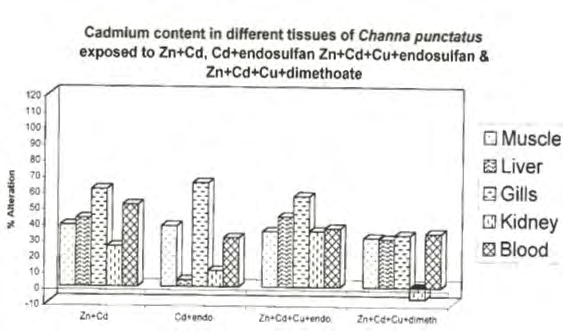
Histogram 1: Cadmium content in different tissues of Channa Punctatus exposed to Zn+Cd, Cu+endosulfan and Zn+Cd+Cu+dimethoate.
Discussion
In the present study it has been observed that the interaction between one metal with another metal is antagonistic. Experiments on fish have shown that some effects of metals may be prevented by the simultaneous administration of other metals .In the present study groups of fishes exposed for 96 hr to zinc+cadmium, cadmium+Endosulfan, zinc+cadmium+copper+endosulfan and Zinc+cadmium+copper+dimethoate the metal concentration ingills, muscle, liver, kidney and blood decreased as compared to fishes exposed to copper alone. Bioaccumulation of cadmium in both the exposure (individual and group exposure) was in order Gills>Blood >Liver>Muscle>kidney. The gill is in direct contact with the aquatic environment, and its external position, highly branched structure, and vascular nature highly increased surface area through which large volumes of water pass through the gill surface, making it a target organ for waterborne toxicants. Our results are supported by the findings of Moreau, et al. who reported that radioactive zinc and phenantherene at concentration approximately 50% of the 96 hr LC50 level demonstrated that phenanthrene caused a reduction in the short term accumulation of zinc by sheepshead fry. Our results also supported by the findings of Stromgren, et al. who reported that accumulation of copper and zinc in the algal thalli increased with the concentration of the metal added to the growth media in a near linear fashion, both when added singly and when added simultaneously. However, the accumulation of each metal was lowered when the alga was exposed to copper and zinc simultaneously, while the total accumulation of metal remained the same.
Conclusion
In the present study it was concluded that in group exposure of fish for 96 hr to zinc+copper, zinc+cadmium+copper+endosulfan and zinc+cadmium+copper+dimethoate combinations, the metal content of various tissues like gills, kidney, liver, muscle and in blood significantly decreased as compared to cadmium alone exposed fishes . Results clearly shows that the level of accumulation of cadmium in different tissues in the two types of exposure (individual and group exposure) varied. The level of accumulation was different in individual exposure because each fish had different physiological activity. Tissue uptake of cadmium in both the exposure (individual and group exposure) was in order Gills>Blood >Liver>Muscle>kidney.
References
-
Abdullah MH, Sidi J, Aris AZ (2007) Heavy Metals (Cd, Cu, Cr and Zn) in Meretrix Roding, Water and Sediments from Estuaries in Sabah, North Borneo. International Journal of Environmental & Science Education 2(3): 69- 74.
-
Ahmed S, Khurshid S, Qureshi F, Hussain A, Bhattacharya A (2019) Heavy metals and geo-accumulation index development for groundwater of Mathura city, Uttar Pradesh. Desal Water Treat J 138(2019): 291-300.
-
Annabi A, Messaoudi I, Kerkeni A, Said K (2011) Cadmium accumulation and histological lesion in mosquitofish (Gambusia affinis) tissues following acute and chronic exposure. Int J Environ Res 5: 745-756.
-
Baldisserotto B, Chaudhary MJ, Wood CM (2005) Effects of dietary calcium and cadmium on cadmium accumulation, calcium and cadmium uptake from the water and their interactions in juvenile rainbow trout. Aquat Toxicol 72(1-2): 99-117.
-
Bawuro (2018) Bioaccumulation of Heavy Metals in Some Tissues of Fish in Lake Geriyo, Adamawa State, Nigeria, Journal of Environmental and Public Health 2018.
-
Elnabris KJ, Muzyed SK, El Ashgar NM (2013) Heavy metal concentrations in some commercially important fishes and their contribution to heavy metal exposure in Palestinian people of Gaza Strip (Palestine). J Of the association of Arab Universities for basic and applied sciences 13(1): 44-51.
-
Fallah AA, Saei Dehkordi SS, Nematollahi A, Jafari T (2011) Comparative study of heavy metal and trace element accumulation in edible tissues of farmed and wild rainbow trout (Oncorhynchus mykiss) using ICP- OES technique. Microchemical Journal 98: 275-279.
-
Javed M (2005) Heavy metal contamination of freshwater fish and bed sediments in the River Ravi stretch and related tributaries. Pak J Biol Sci 8: 1337-1341.
-
Mustafa C, Guluzar A (2003) The relationships between heavy metal (Cd, Cr, Cu, Fe, Pb, Zn) levels and the size of six Mediterranean fish species. Environment and Pollution 121(1): 129-136.
-
Pandey G, Madhuri S (2014) Heavy metals causing toxicity in animals and fishes. Res. J Animal Veterinary and Fishery Sci 2(2): 17-23.
-
Ploetz DM, Fitts BE, Rice TM (2007) Differential accumulation of heavy metals in muscle and liver of a marine fish, (King Mackerel, Scomberomorus cavalla Cuvier) from the Northern Gulf of Mexico, USA. B Environ Contam Tox 78(2): 124-127.
-
Rahman MS, Molla AH, Saha N, Rahman A (2012) Study on heavy metals levels and its risk assessment in some edible fishes from Bangshi River, Savar, Dhaka, Bangladesh Food Chem 134(4): 1847-1854.
-
Saglam D, Atli G, Canli M (2013) Investigations on the osmoregulation of freshwater fish (Oreochromis niloticus) following exposures to metals (Cd, Cu) in differing hardness. Ecotoxicol Environ Saf 92: 79-78.
-
Thompson J, Bannigan J (2008). Cadmium:Toxic effects on the reproductive system and the embryo. Reprod Toxicol 25: 304-315.
-
Vinodini R, Narayanan M (2007) Bioaccumulation of heavy metals in organs of fresh water fish Cyprinus carpio (Common carp). Int J Environ Sci Tech 5(2): 179- 182.
- California Red-Legged Frog and Non-Listed Amphibians Response to Non-Native Fish Removal
- Industrial Standardization of the Bio-OS: Algorithmic Codification of Resilience Engineering Guidelines and Version V8 Architecture
- Climate Variability and the Sustainability of Snail Farming in Nigeria: Past Trends, Present Challenges and Potential Outlook
- The Evaluation of the Surveillance System of Anthrax in Gilgit-Baltistan, Pakistan, 2018
- Natural Decline to Extinction of A New Zealand Rabbit Population
- Mitochondrial Bio-Logistics: Steering Co-Enzyme Q10 and Lycopene Synergies within the Science 4.0 Bio-OS Framework