
Transform of Vegetation after Interventions in the Marshy Grassland (Vayal) Habitats of Periyar Tiger Reserve, Kerala, India
Periyar Tiger Reserve is one of the single largest compact forests blocks in the Western Ghats and plays a key role in maintaining regional connectivity in the otherwise fragmented forest tracts. Grasslands play an important role in providing food to the herbivorous animals. The vayals are also the prime habitats for herbivores providing food and hide to escape from predators. The vayal habitats were visited in the intervals of every month and 10 Number of permanent plots (5 x 5 m size) were laid randomly in each vayal with the wooden poles placed in the four corners of the plot and tagged with aluminum plates. Information such as indirect evidences of animal species and its feeding signs with in the plots were recorded. The animal abundance is high in maintained vayals. The fresh grasses and sedges are the major attractions in these vayals for the herbivores. The animals mainly consume Cyperus members. Maintaining the vayals often check extension and establishment of exotic weeds, which in turn retain the original habitat preserving water and preferred food species in the forest ecosystem. Often vayals act as ecological niches being the habitat for amphibians and balsams.
Introduction
Periyar Tiger Reserve is one of the Tiger Reserve in the state of Kerala situated in the High Ranges of the Southern Western Ghats. The reserve forms one of the single largest compact forests blocks in the Western Ghats and plays a key role in maintaining regional connectivity in the otherwise fragmented forest tracts. There are seven types of habitats in the reserve, of which, grasslands play an important role in providing food to the herbivorous animals. Three types of grasslands are seen in Periyar such as
- High altitude Pilot Study montane grassland
- Tropical savannah grassland and
- Marshy vayals. ‘Vayals’ as they are colloquially called in Malayalam/Tamil are seasonally waterlogged meadows or wet meadows dominated with grasses and sedges, categorized as “Ts” i.e seasonal/intermittent freshwater marshes/pools on inorganic soils of Ramsar’s Classification System for Wetland Type.
In Kerala these unique ecosystem has been mainly reported from protected areas like Parambikulam and Periyar Tiger Reserves. This unique wetland ecosystem is not so far explored for its distribution, services and ecological significance. Recently, a preliminary study on Vayals of Mudumalai Tiger Reserve shows that exotic weeds poses major threat to this ecosystem and without proper conservation and management strategies, this unique wetland ecosystems may lost forever [1]. A study on amphibians and reptiles of Vayals ecosystem in Parambikulam wildlife sanctuary shows that these communities have a proximate linkage to Vayal ecosystem [2].
This ecosystem diversity including grasslands contributes for the floral and faunal diversity in Periyar Tiger Reserve. Review of literature indicates the richness and diversity of flora and fauna in Periyar Tiger Reserve. For instance, Sasidharan, et al. [3] reported 1965 Angiosperm taxa (species and infraspecific) from Periyar Tiger Reserve. Different authors studied animal diversity in Periyar Tiger Reserve [4, 5, 6]. During the habitat improvement practice of maintenance of marshy vayals is one of the activity applied by the Forest Department regularly over the years. The only study available on vayals is the baseline study, which was conducted by Veeramani, et al. [7]. In that report they have suggested regular monitoring of the changes occurring in the habitat and animal utilization in that area for future forest management activities. The vayals are also the prime habitats for herbivores providing food and hide to escape from predators. Hence, monitoring of vayals was carried out to assess the changes in the habitat utilization by wild animals with the objective of changes in the vegetation and assessing the animal utilization for their consumption of palatable food species [8].
Methods
Periyar Tiger Reserve is located in the Peermade Taluk of Idukki District in Kerala between latitudes 9o 15’ and 9o 40’ N and longitudes 76o 55’ and 77o 25’ E with the extent of 925 Sq. Km. The boundary on the north, northeast and east, approximately 90 Km. is the interstate boundary between Tamil Nadu and Kerala. On the north, the boundary is formed by the Madurai District, east by Ramanathapuram and southeast by Tirunelveli districts of Tamil Nadu. On the south the reserve is bordered by northern boundary of Ranni Forest Division. Pamba River also forms the southern boundary. West is bordered by the eastern boundary of Kottayam Division and a few estates. Major vegetation types in Periyar Tiger Reserve are: Tropical evergreen and semi evergreen forests (74.6%), moist deciduous forests (12.7%), grasslands (1.5%) and Eucalyptus plantations (7.1%). Periyar Lake forms an important aquatic ecosystem, which occupies about (3.5%) of the area. 1965 species of flowering plants have been recorded from the Periyar Tiger Reserve in which 168 are grasses [3].
Five recently maintained vayals were selected in Thekkady area for monitoring the animal utilization in the vayal habitat. They are
- Anjuruli Vayal
- Kavalapara Vayal
- Pachakad Vayal
- Zero Vayal and
- Kalyanapara Vayal.
These vayals were visited in the intervals of every month and 10 number of permanent plots (5 x 5 m size) were laid randomly in each vayal with the wooden poles placed in the four corners of the plot and tagged with aluminum plates. Information such as indirect evidences of animal species and its feeding signs with in the plots were recorded. Direct sighting of animals was also recorded whenever it is possible and their number, activities and feeding plant species were recorded. The period of direct observation in every visit is 3-4 hours.
Results and Discussion
Location and Description
• Anjuruli Vayal Anjuruli vayal is situated in the Northern portion of Periyar Tiger Reserve near Anavachal Mannakudy area and it is also in the fringe of the Periyar Lake. The total area of the vayal is 10 Ha. This is the place where more number of herbivores occupies in most of the time since it is seems to be a true marshy vayal, situated in the middle of a thick coverage of semi-evergreen forest. This vayal is the best as far as the growth of grass species is concerned. Out of the 8 grass species recorded, Cyperaceae members are the most dominant group in the area [7].
Maps 1&2 showing the locations of different vayals in Periyar Tiger Reserve.
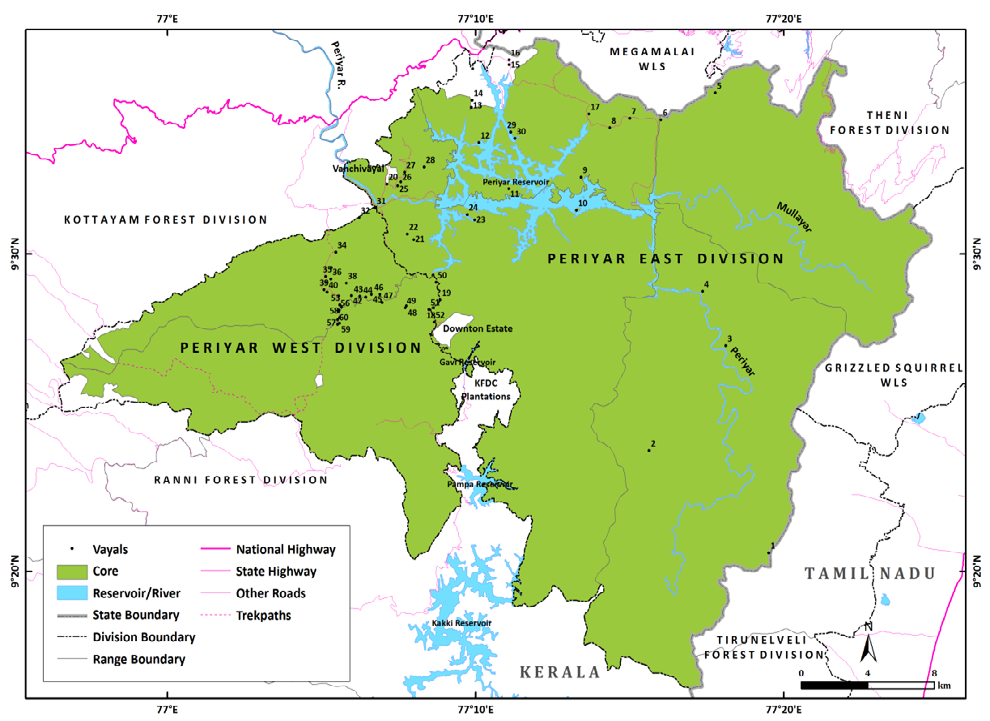
Map 1: A typical vayla habitat.
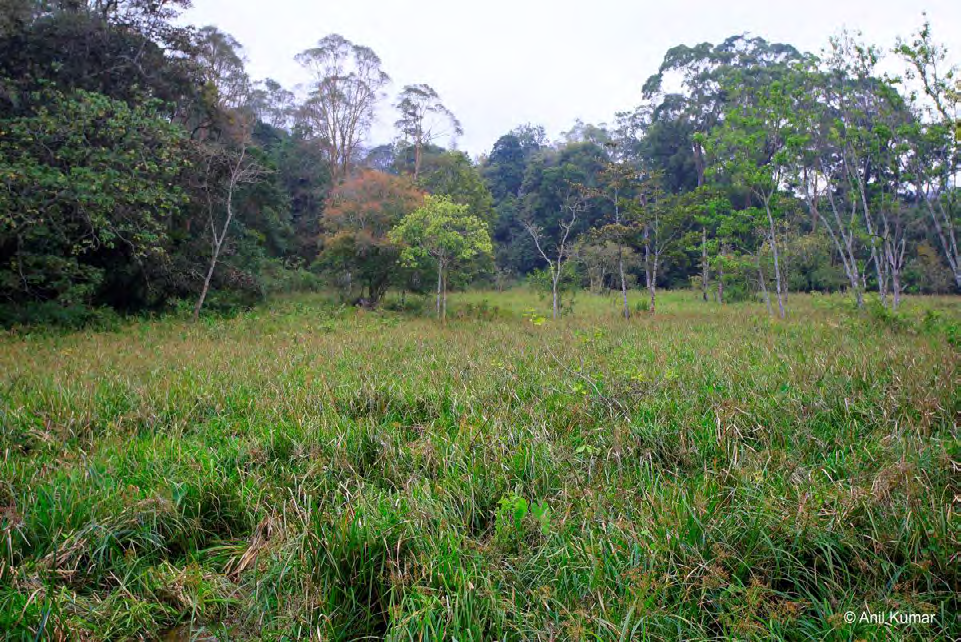
Map 2: Good Growth of grass species.
The area is less disturbed and well maintained which promote a good growth of grass species. The important grasses are Cyperus sp., Paspalum sp. and Themeda cymbaria. The good water content in the area is the major reason for the dominance and extension of Cyperus members, which in turn is the result of surrounding evergreen forest in the area. As the Cyperus members have dominated in the vayal the distribution of other herbaceous species is comparatively less in this area. However, species such as Agratum conizoides and Drymaria cordata have an average distribution. Marshy species like Hedychium coronarium and Schuminianthus virgatus are common in the fringes of the vayal. Two clumps of Bambusa arundinacea are recorded in the fringes of the vayal. Some of the trees recorded in the fringes of the vayal are Actinodaphne sp., Elaeocarpus sp. and Chionanthus mala- elengi. Weeds such as Lantana camara and Mikania cordata are present in some of the fringe areas. The presence of Mikania cordata is to be considered seriously as this climbing weed may rapidly be established if it gets rooted once at a place.
The average animal utilization of this vayal is seemed to be maximum (Table 1). The presence of luxuriant vegetation of fresh grasses and the availability of water are the main reasons for the animal abundance in this area. Gaur (Bos gaurus) is the dominant user of this vayal followed by elephant (Elephas maximus) and sambar deer (Cervus unicolor). The Cyperaceae members are the preferred food of gaur [9].
Pachakkad Vayal
The vayal, having an area of 7.9 Ha. is mainly composed of grasses and sedges along with many herbaceous species. A total of 22 species of grasses (including the members of Cyperaceae and Eriocaulaceae) has been recorded by Veeramani, et al. [7]. True grasses are mainly confined to the lakeside of the vayal. Cyperaceae members are mainly established in the upper slopes and also in the marshy areas. The weeding in the fringes of the vayal has helped in checking further extension of exotic weeds like Lantana and Eupatorium in to the vayal. Desmodium species such as D. triflorum and D. heterophyllum have uniform distribution in some of the areas of the vayal. In the fringes of the vayal Helicteres isora and Bridelia scandens have established well. Stchytarpheta indica, an under shrub has an almost uniform distribution in the area. In herbaceous species Emilia sonchifolia and Justicia procumbens have an average distribution in the vayal. In some of the plots Desmodium triflorum has occurred about 25% of the total area, while in some others D. heterophyllum has about 50% of occurrence. All other species have less than 10% of occurrence.
Zero Vyal
This vayal is situated amidst of evergreen forest with clear fringes of evergreen tree species. The vayal is spread over an area of 8 Ha.. Diversity of grass species is comparatively less in this area. Six species of grasses have been recorded in the area [7]. Cyperaceae member, Cyperus digitatus and Poaceae member, Themeda cybaria have an almost average distribution in the area. Out of the sixteen species of herbs recorded in the area, Justicia procumbens, Commelina sp. and Desmodium hetrophyllum have an average distribution. Of the two species of Hydrocotyle noted in the area, H. asiatica has distributed in a uniform manner in some areas making a carpet of greenery. Monochoria vaginalis an aquatic species is seen abundantly in some marshy areas of the vayal. One species of Impatiense is also noted in the area. In the shrubby species Hedychium coronarium has an occurrence of 60% in some of the areas of the vayal. Two species of under shrubs viz. Lantana indica and Nesaea brevipes are seen in and around the vayal. These two species have a rare distribution in Periyar Tiger Reserve. The maintenance of this vayal like all other vayals is very vital as far as the conservation of plant species is concerned. The main tree species in the fringes of the vayal are Eleocarpus sp., Glochidion sp. and Terminalia sp. Exotic weeds like Eupatorium and Lantana are dominant in some of the fringes of the vayal. So proper weeding and maintenance of the vayal is essential for the conservation of this marshy vegetation.
Kalayanapara Vayal
The largest of the vayals studied, Kalayanapara vayal is spread over an area of 18 Ha. The important species recorded from the area are Cynadon dactylon, Cyperus procerus, C. digitatus, C. rotundus, Paspalum scrobiculatum, Hedyotis herbacea, Smithia conferta, Curcuma sp., Eriocaulon sp., Isachne bourneorum and Cyanotis arachnoidea. The Zingiberaceae member, Hedychium coronarium is distributed in the more marshy areas of the vayal. Besides these, Mimosa
pudica and Tridax procumbens are also seen in the area. Cyperaceae members are very dominant in this area. The main tree species in the fringes of the vayal are Eleocarpus sp., Glochidion sp., Terminalia sp., Erythrina sp., and Lagerstroemia sp. Exotic weeds like Eupatorium and Lantana are dominant in some areas of the fringes of the vayal.
Kavalapara Vayal
This vayal is situated in the largest island of the reserve, Kavalapara. The vegetation in the entire area is composed of South Indian Sub-Tropical hill Savannah. Careya arborea, Grewia tiliifolia, Dillenia pentagyna, Bridelia airy-shawii, Phyllanthus emblica and Pterocarpus marsupium are the dominant tree species. Among the grasses two species of Themeda and Imperata are the dominant ones. The vayal is surrounded by deciduous trees and large grasses. The extent of the vayal is 6.6 Ha. The important species encountered in the vayal are Cynadon dactylon, Cyperus procerus, C. digitatus, C. rotundus, Hedyotis herbacea, Eriocaulon sp., Cyanotis archnoidea, Alysicarpus sp., Axonopus compressus, Centella asiatica, etc. Exotic weeds like Lantana sp. and Eupatorum sp. are common along the fringes of the vayal.
Animal Abundance and Species Preference
The important animals encountered in the vayals are elephant (Elephas maximus), gaur (Bos gaurus), sambar deer (Cervus unicolor), barking deer (Muntiacus muntjak), mouse deer (Moschiola indica), wild boar (Sus scrofa), porcupine (Hystrix indica) and sloth bear (Melursus ursinus). Elephant and gaur are the major user community of the vayals. Sambar deer and barking deer have also used the area. Mouse deer is reported only from Anjuruli vayal. Presence of wild boar has been recorded from all the vayals. Porcupine and sloth bear are the seasonal visitors of the vayal. Elephant mainly uses the rhizomatous portion of the grasses along with fresh leaves of grasses and sedges. Gaur mainly feed on Cyperus members. Only the upper portion of the sedges is taken by the animal. Direct sightings of elephant and gaur have been recorded from Anjuruly, Kavalapara and Zero vayals. Kavalapara hills is the ideal habitat for sloth bear. Scats of the animal have been collected from the various parts of the hill. Scats have been recorded from the vayal also. Evidences of porcupine have been noted in the fringe areas of all vayals.
In the case of animal abundance, gaur and elephant have taken the first two positions. The average density of indirect evidences of different animals in the vayals is given in the Table 1. Gaur is the most visited animal in all the studied vayals. The maximum abundance of indirect evidences (dung, hoof mark, etc.) is reported from Anjuruli vayal where the density of indirect evidence of the animal is 124 per Ha. In the case of elephants the maximum density of indirect evidences is 76 per Ha. (Zero vayal). The maximum density of indirect evidences, in the case of sambar deer is 72 per Ha., recorded from Anjuruli vayal. Wild boar also is common in all the vayals. The maximum density of indirect evidences is 73.71 per Ha. (Kavalapara vayal). The density of other animals is comparatively less in all the vayals.
| Sl. No. | Name of the vayal | Elephant | Gaur | Sambar | Barking deer | Mouse deer | Wild boar | Porcu- pine | Sloth bear |
|---|---|---|---|---|---|---|---|---|---|
| 1 | Anjuruli | 60 | 124 | 72 | 0.56 | 2.84 | 48 | 7.4 | 2.84 |
| 2 | Kavalappara | 61 | 94.85 | 56 | 1.71 | - | 73.71 | 4 | 2.85 |
| 3 | Pachakkadu | 60 | 87.2 | 34.4 | 3.2 | - | 55.2 | 6.4 | 7.2 |
| 4 | Zero | 76 | 103 | 41 | 4 | - | 50 | 8 | 4 |
| 5 | Kalyanappara | 66 | 90 | 38 | 2 | - | 44 | 7 | 4 |
Table 1: Indirect evidences of different wild animals in the maintained vayal habitats (Density of indirect evidences of animals/
In all, fifteen species have been identified as preferred food species of herbivores. They are Cynadon dactylon, Cyperus procerus, C. digitatus, C. rotundus, Mimosa pudica, Paspalum scrobiculatum, Tridax procumbens, Hedyotis herbacea, Smithia conferta, Curcuma sps., Isachne bourneorum, Eriocaulon sps., Cyanotis arachnoidea, Hedychium coronarium and Murdannia spirata. Cyperus species are the preferred food species of gaur. Grass members are taken by sambar deer and elephants. The rhizomatous portion of some grasses is the delicacy for elephant and wild boar. Out of the fifteen species identified as preferred food species, Cyperus procerus is the most used one by herbivores. In some vayals Cynadon dactylon has been extensively used by wild animals. Cyperus rotundus and C. digitatus are also well used by herbivores. Other species are comparatively less used by the herbivore (Table 2).
Cyperus procerus is the most preferred food species of herbivores (elephant and gaur). But in Zero vayal Cynadon dactylon is the most fed species by the herbivores. Cyperus
rotundus is also well consumed by them. Murdannia spirata, though consumed by animals in Anjuruli vayal is not at all consumed by them in other vayals.
| Sl. No. | Species name | Local name | Rank of utilization of plants in different vayals | ||||
|---|---|---|---|---|---|---|---|
| Anju-ruli | Kavalappara | Pachakkadu | Zero | Kalyanappara | |||
| 1 | Cynadon dactylon | Karuka | 5 | 8 | 9 | 1 | 6 |
| 2 | Cyperus procerus | Cheriya korai | 1 | 1 | 1 | 2 | 1 |
| 3 | C. digitatus | Thetty pullu | 10 | 3 | 4 | 9 | 5 |
| 4 | C. rotundus | Valiya korai | 3 | 2 | 3 | 5 | 1 |
| 5 | Mimosa pudica | Thotta vadi | 6 | 3 | 9 | 10 | 6 |
| 6 | Paspalum scrobiculatum | Methapullu | 8 | 5 | 8 | 4 | 2 |
| 7 | Tridax procumbens | Mudandai | 8 | 2 | 7 | 8 | 4 |
| 8 | Hedyotis herbacea | Padappan | 7 | 6 | 9 | 7 | 3 |
| 9 | Smithia conferta | Kottavadi | 10 | 3 | 5 | 7 | 7 |
| 10 | Curcuma sps. | Kukilai | 8 | 7 | 0 | 8 | 4 |
| 11 | Isachne bourneorum | Eli karuka | 8 | 3 | 6 | 6 | 4 |
| 12 | Eriocaulon sps. | Eluku | 4 | 4 | 8 | 3 | 4 |
| 13 | Cyanotis arachnoidea | Panchi | 9 | 5 | 4 | 6 | 4 |
| 14 | Hedychium coronarium | Puthalam | 2 | 4 | 2 | 9 | 5 |
| 15 | Murdannia spirata | ---- | 11 | 0 | 0 | 0 | 0 |
Table 2: Preferred food species of herbivores in the vayals.
Conclusion
The animal abundance is high in maintained vayals. The fresh grasses and sedges are the major attractions in these vayals for the herbivores. The animals mainly consume Cyperus members. Marshy areas are the ideal habitat for Cyperus members. Besides being good feeding ground for herbivores, marshy vayals act as water storing areas. Vayals are always wet which in turn help Amphibians in their breeding period. Vayals are also good habitat for Balsams and other fleshy stemmed herbs. Maintaining the vayals often check extension and establishment of exotic weeds, which in turn retain the original habitat preserving water and preferred food species in the forest ecosystem. Often vayals act as ecological niches being the habitat for amphibians and balsams.
References
-
The important animals encountered in the vayals are elephant (_Elephas maximus_), gaur (_Bos gaurus_), sambar deer (_Cervus unicolor_), barking deer (_Muntiacus muntjak)_, mouse deer (_Moschiola indica_), wild boar (_Sus_ _scrofa_), porcupine (_Hystrix indica_) and sloth bear (_Melursus ursinus_). Elephant and gaur are the major user community of the vayals. Sambar deer and barking deer have also used the area. Mouse deer is reported only from Anjuruli vayal. Presence of wild boar has been recorded from all the vayals. Porcupine and sloth bear are the seasonal visitors of the vayal. Elephant mainly uses the rhizomatous portion of the grasses along with fresh leaves of grasses and sedges. Gaur mainly feed on _Cyperus_ members. Only the upper portion of the sedges is taken by the animal. Direct sightings of elephant and gaur have been recorded from Anjuruly, Kavalapara and Zero vayals. Kavalapara hills is the ideal habitat for sloth bear. Scats of the animal have been collected from the various parts of the hill. Scats have been recorded from the vayal also. Evidences of porcupine have been noted in the fringe areas of all vayals. In the case of animal abundance, gaur and elephant have taken the first two positions. The average density of indirect evidences of different animals in the vayals is given in the Table 1. Gaur is the most visited animal in all the studied vayals. The maximum abundance of indirect evidences (dung, hoof mark, etc.) is reported from Anjuruli vayal where the density of indirect evidence of the animal is 124 per Ha. In the case of elephants the maximum density of indirect evidences is 76 per Ha. (Zero vayal). The maximum density of indirect evidences, in the case of sambar deer is 72 per Ha., recorded from Anjuruli vayal. Wild boar also is common in all the vayals. The maximum density of indirect evidences is 73.71 per Ha. (Kavalapara vayal). The density of other animals is comparatively less in all the vayals. [INLINE_TABLE:3:0] Table 1: Indirect evidences of different wild animals in the maintained vayal habitats (Density of indirect evidences of animals/ Ha). In all, fifteen species have been identified as preferred food species of herbivores. They are _Cynadon dactylon,_ _Cyperus procerus, C. digitatus, C. rotundus, Mimosa pudica,_ _Paspalum scrobiculatum, Tridax procumbens, Hedyotis_ _herbacea, Smithia conferta, Curcuma sps., Isachne bourneorum,_ _Eriocaulon sps., Cyanotis arachnoidea, Hedychium coronarium_ and _Murdannia spirata. Cyperus_ species are the preferred food species of gaur. Grass members are taken by sambar deer and elephants. The rhizomatous portion of some grasses is the delicacy for elephant and wild boar. Out of the fifteen species identified as preferred food species, _Cyperus procerus_ is the most used one by herbivores. In some vayals _Cynadon_ _dactylon_ has been extensively used by wild animals. _Cyperus_ _rotundus_ and _C. digitatus_ are also well used by herbivores. Other species are comparatively less used by the herbivore (Table 2). _Cyperus procerus_ is the most preferred food species of herbivores (elephant and gaur). But in Zero vayal _Cynadon_ _dactylon_ is the most fed species by the herbivores. _Cyperus_ rotundus is also well consumed by them. Murdannia spirata, though consumed by animals in Anjuruli vayal is not at all consumed by them in other vayals. [INLINE_TABLE:4:0] Table 2: Preferred food species of herbivores in the vayals.
- California Red-Legged Frog and Non-Listed Amphibians Response to Non-Native Fish Removal
- Industrial Standardization of the Bio-OS: Algorithmic Codification of Resilience Engineering Guidelines and Version V8 Architecture
- Climate Variability and the Sustainability of Snail Farming in Nigeria: Past Trends, Present Challenges and Potential Outlook
- The Evaluation of the Surveillance System of Anthrax in Gilgit-Baltistan, Pakistan, 2018
- Natural Decline to Extinction of A New Zealand Rabbit Population
- Mitochondrial Bio-Logistics: Steering Co-Enzyme Q10 and Lycopene Synergies within the Science 4.0 Bio-OS Framework