
Astyanax viridis (Characiformes: Characidae), New Species from Southeastern Brazil
Astyanax Baird & Girard, 1854 is one of the most specific fish genera among the characiforms, occurring in freshwater environments between the United States and central Argentina. Astyanax viridis sp. n was described from specimens from southeastern Brazil, earlier identified as A. janeiroensis. These specimens are differentiated from A. janeiroensis holotype, mainly in the maximum maxilla length (35.1-38.9% HL), pelvic-anal fin distances (19.0-21.9% SL) and number of rays divided into anal fin (18-19), justifying its description as a new species. Astyanax viridis sp. n. it presents a horizontally triangular humeral spot (atypical in Astyanax), sharing it with A. laticeps, A. scabripinnis and A. serratus, forming a small exclusive group, inserted in the A. scabripinnis species complex, defined by the elongated body, with depth less than 40% SL and reduced number of rays in the anal fin (17-20). It differs from these three species in that it has 4 large teeth in the dentary (vs. 5), by the head length (26.2-27.9% HL vs. 20.9-21.3%; 23.0-25.2% and 33.9-35.3% HL, in A. laticeps, A. scabripinnis and A. serratus, respectively) and pelvic-anal fin distance (19.1-21.9% SL vs. 30.0-31.5%; 22.0-24.9% and 28.8-31.8% SL in A. laticeps, A. scabripinnis and A. serratus, respectively). Astyanax viridis sp. n. occurs sympatrically with several other species of the genus, A. aff. bimaculatus (A. bimaculatus complex), A. giton, A. hastatus, A. parahybae and A. taeniatus (A. fasciatus complex) and A. intermedius (A. scabripinnis complex), being found in backwater areas in streams and rivers. The new species occurs in the main coastal basins, in the states of Espírito Santo, Minas Gerais, Rio de Janeiro and São Paulo.
Introduction
Astyanax Baird & Girard, 1854 is one of the most diverse fish genera among the Order Characiformes, occurring in freshwater environments from the southern United States to central Argentina [1, 2, 3, 4, 5, 6, 7, 8, 9, 10, 11, 12, 13, 14, 15, 16, 17, 18, 19]. The current definition of Astyanax is based on the combination of characters [6], which are, however widespread among genera in the Characidae (ie. two rows of premaxillary teeth, five teeth in the inner premaxillary series, lateral line complete, adipose fin present, and caudal fin naked) [2]. Astyanax species were separated in three subgenera [6]: Astyanax Baird & Girard, 1854 (predorsal scales series regular), Poecilurichthy_s Gill, 1858 (predorsal scales series irregular) and _Zygogaster Eigenmann, 1913, defined for preventral scales series keeled) and. Currently, there are 177 valid Astyanax species, with the increase of 40 new species described only in the last 10 years [7]. Astyanax does not represent a monophyletic entity [15, 17] and the taxonomic status of some species is not completely clear [9]. Astyanax janeiroensis was included in Deuterodon Eigenmann, 1907 [20] in spite of characteristics that differs this species from those included in Deuterodon.
In the basins of southeastern Brazil, excepted coastal basins between São Paulo and Espírito Santo,7species were described [A. altiparanae Garutti & Britski, 2000, A. cuveri, A. lacustris, and A. rivularis, all (Lütken, 1875), A. fasciatus (Günther, 1860), A. paranae Eigenmann, 1914 and A. schubarti Britski, 1964]. In lowlands coastal basins between São Paulo and Espírito Santo were found 11 species: A. depressirostris Miranda Ribeiro, 1908, A. hastatus Myers, 1928, A. giton, A. intermedius, A. janeiroensis and A. parahybae, all Eigenmann, 1908, A. jenynsii and A. jequitinhonhae, both (Steindahcner, 1877), A. ribeirae Eigenmann, 1911, A. taeniatus and A. scabripinnis, both (Jenyns, 1842). These species are generally found in backwater areas in streams and rivers in the different basins of southeastern Brazil, in lowland areas [14], with the exception of A. intermedius, also found at higher altitudes, and in some locations, the only species found [3]. Several taxonomic problems (ie. Validity and correct delimitation of some species, misidentifications of types) regarding them still persist, being this article a contribution to a better understanding of the taxonomic limits of part of extensive material of Astyanax in southeastern Brazilian coastal basins.
In this paper, Astynax viridis sp. n. was proposed. Differs for other species with same humeral spot pattern, include A. janeiroensis, for different measures showed in results and discussion. From other Astyanax species for humeral spot (horizontally triangular vs. distinct other shapes).
Material and Methods
Specimens
57 specimens (fixed in 10% formaldehyde and preserved in 70% alcohol) from the Fish Ecology Laboratory - Federal Rural University of Rio de Janeiro (LEP-UFRRJ) collection and other Brazilian scientific collections were examined [Department of Zoology of São José do Rio Preto University - State University of São Paulo (DZSJRP); Capão Natural Museum (MHNCI), Curitiba, Paraná; National Museum - Federal University of Rio de Janeiro (MNRJ)] and international (photos, morphometric and meristic data and specimens themselves) [Academy of Natural Sciences of Drexel University (ANPS), Philadelphia, Pennsylvania; Museum of Comparative Zoology (MCZ), Cambridge, Massachusetts and California Academy of San Francisco (CAS), San Francisco, California, the four in the United States; Naturhistorisches Museum of Wien (NMW) in Vienna, Austria; Natural History Museum (BMNH) in London, England; University Museum of Zoology (UMZC), Cambridge, England and Smithsonian Institution National Museum of Natural History, Department of Vertebrate Zioology, Division of Fishes (USMN), Washington D.C., United States [21].
Examination of Specimens
The measurements used in this study were made under a stereoscopic microscope, using a millimeter-accurate digital caliper and as the counts, followed [19].
Results
- Order Characiformes Goodrich, 1909
- Family Characidae Latreille, 1825
- Genus Astyanax Baird & Girard, 1854 Horizontally triangular humeral spot group species (Figure 1).
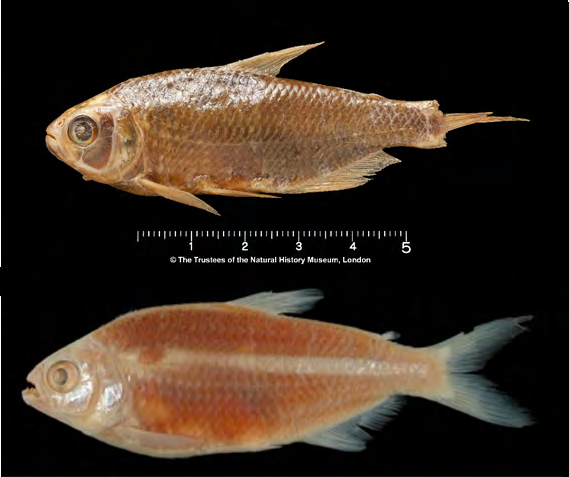
Defined for distinct shape of humeral spot (horizontally triangular) (Figure 1), not founded in none others species of Astyanax. The actual new species and A. laticeps, A. scabripinnis and A. serratus were inserted in this small group.These four species were placed in subgenus Astyanax (regular predorsal scale series) (Figure 2), with the others southeastern Brazilian species, except A. altiparanae and A. lacustris inserted in A. bimaculatus species complex, belongs in subgenus Poecilurichthys (irregular predorsal scales series) (Figure 2).
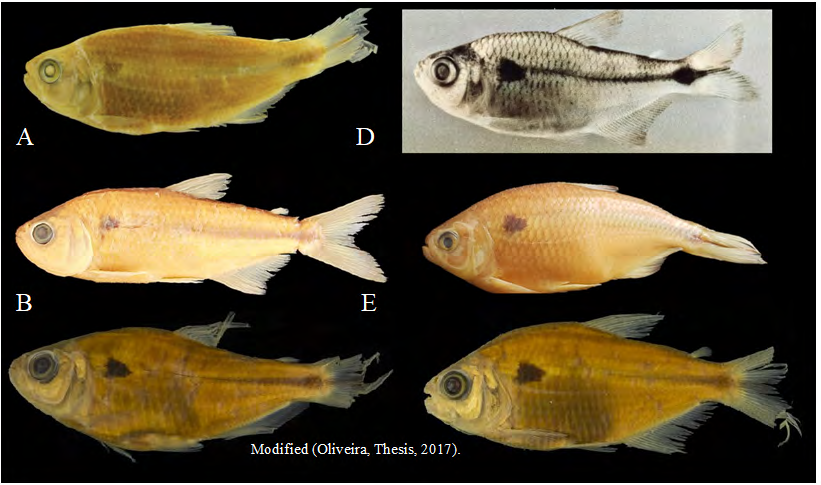
Figure 1a: Group horizontally triangular humeral spot in Astyanax scabripinnis (Jenyns, 1842) (species complex: (A) ANSP 21852, Astyanax laticeps (Cope, 1894), 55.2 mm SL, Holotype, Rio Grande do Sul, Brazil. (B) MHNCI 12346, Astyanax serratus Garavello & Sampaio, 2010, 75.5 mm SL, Holotype, Várzea River, Iguaçu river, Agudos do Sul, Paraná, Brazil. (C) MNRJ 11010, Astyanax viridis sp. n., Salgado, 2021, 55.4 mm SL, Paratype, pit in full bush, fed by springs, 50 m of altitude, Serra, Espírito Santo, Brasil. (D) MNRJ 20285, Astyanax viridis sp. n. Salgado, 2021, 45.5 mm SL, Paratype, Paraíba do Sul river, near to Paraíso locality Road, Magé, Rio de Janeiro, Brazil. (E) LEP-UFRRJ 0799, Astyanax viridis sp. n. Salgado, 2021, 100.4 mm SL, Holotype, Santo Antônio stream, Duque de Caxias, RJ, Brazil. (F) MNRJ 11013, Astyanax viridis sp. n. Salgado, 2021, 50.0 mm SL, Paratype, tributary stream of the upper Imbé River, Santa Maria Madalena, Rio de Janeiro, Brazil.
BMNH
MCZ
Figure 1b: (G) BMNH 1917.7.14. 15, Astyanax scabripinnis (Jenyns, 1842) (1, 68.5 mm SL), Holotype, drainage belonging to Guanabara Bay, Rio de Janeiro, Rio de Janeiro, Brazil, (H) MCZ 21057, Astyanax janeiroensis Eigenmann, 1908, Holotype (1, 92.0 mm SL), Rio de Janeiro, Rio de Janeiro, Brazil.
Figure 2: Predorsal scales pattern in the subgenera (A) (regular) Astyanax Baird & Girard, 1854, MNRJ 11009, Astyanax viridis sp. n. Salgado, 2021, 82.5 mm SL, Fundo river, Marica, Rio de Janeiro, Brazil and (B) (irregular) Poecilurichthys Gill, 1858, MNRJ 17456, Astyanax aff. bimaculatus (Linnaeus, 1758), 45.7 mm SL, Tanque stream (tributary of the right bank of the Paraíba do Sul river), locality of Passa Três, Carmo, Rio de Janeiro, Brazil, (Bars scale = 5.0 mm).
Astyanax viridis sp. n. Salgado, 2021 (Figures 1a,3,4,6 and 7; Tables 1&2) LSID: urn: lsid: zoobank.org: act: 48CD0D03-8DF9-4CCB- 80B1-AB3D723E99DF
| Range | Mean | Holotype | |
|---|---|---|---|
| Standard length (mm) | 22.4-120.1 | 74.2 | 100.4 |
| Body depth (mm) | 8.3-45.3 | 26.6 | 38 |
| Head length (mm) | 7.2-31.3 | 19.5 | 25.6 |
| Percentages of Standard Length | |||
| Body depth | 37.0-39.8 | 38.1 | 37.8 |
| Head length | 26.2-27.9 | 43.9 | 25.5 |
| Snout – anal fin distance | 65.2-69.8 | 65.9 | 67.1 |
| Snout – dorsal fin distance | 47.8-45.1 | 52.7 | 51.1 |
| Snout – pelvic fin distance | 47.1-51.1 | 47.3 | 48.4 |
| Snout – pectoral fin distance | 26.0-29.6 | 26.8 | 26.1 |
| Eye – dorsal fin distance | 37.4-41.6 | 40.3 | 39.6 |
| Dorsal – caudal fins distance | 52.0-58.5 | 53.6 | 56.3 |
| Dorsal – pectoral fins distance | 40.6-45.7 | 44.5 | 42.8 |
| Dorsal – anal fins distance | 35.9-40.7 | 43.5 | 40.1 |
| Dorsal – adipose fins distance | 33.7-38.8 | 37.1 | 34.2 |
| Anal – adipose fins distance | 30.0-35.3 | 39 | 32 |
| Pectoral – pelvic fins distance | 22.2-25.9 | 24.9 | 23.9 |
| Pelvic – anal fins distance | 19.0-21.9 | 21.3 | 21.6 |
| Dorsal fin length | 24.3-27.4 | 26.8 | 24.5 |
| Pectoral fin length | 20.0-24.7 | 24.3 | 23.3 |
| Pelvic fin length | 17.3-18.9 | 21.1 | 17.8 |
| Anal fin base length | 27.0-30.2 | 32.1 | 27.4 |
| Dorsal fin base length | 12.0-13.9 | 13.8 | 13.4 |
| Caudal peduncle depth | 9.8-11.0 | 11.2 | 10.2 |
| Caudal peduncle length | 10.6-11.9 | 11.5 | 11.8 |
| Percentages of Head Length | |||
| Head depth | 83.9-93.5 | 89 | 90.2 |
| Interorbital width | 36.5-40.4 | 39 | 39.8 |
| Orbital diameter | 30.3-34.0 | 32 | 34 |
| Upper jaw length | 35.1-38.9 | 37 | 37.1 |
| Snout length | 23.7-26.9 | 25 | 24.2 |
Table 1: Morphometric data of Astyanax viridis sp. n. Salgado, 2021. N=57.
| Range | Mean | Holotype | |
|---|---|---|---|
| Standard length (mm) | 22.4-120.1 | 74.2 | 71.7 |
| Body depth (mm) | 8.3-45.3 | 26.6 | 25.4 |
| Head length (mm) | 7.2-31.3 | 19.5 | 18.1 |
| Percentages of Standard Length | |||
| Body depth | 37.0-39.8 | 38.1 | 35.4 |
| Snout – anal fin distance | 65.2-69.8 | 65.9 | 62.1 |
| Snout – pelvic fin distance | 47.1-51.1 | 47.3 | 44.1 |
| Snout – pectoral fin distance | 26.0-29.6 | 26.8 | 25.2 |
| Dorsal – pectoral fins distance | 40.6-45.7 | 44.5 | 38.9 |
| Pelvic – anal fins distance | 19.0-21.9 | 21.3 | 24 |
| Dorsal fin length | 24.3-27.4 | 26.8 | 23.2 |
| Pelvic fin length | 17.3-18.9 | 21.1 | 17 |
| Anal fin base length | 27.0-30.2 | 32.1 | 24.3 |
| Dorsal fin base length | 12.0-13.9 | 13.8 | 23.2 |
| Caudal peduncle depth | 9.8-11.0 | 11.2 | 11.6 |
| Percentages of Head Length | |||
| Interorbital width | 36.5-40.4 | 39 | 40.9 |
| Orbital diameter | 30.3-34.0 | 32 | 37 |
| Upper jaw length | 35.1-38.9 | 37 | 41.4 |
Table 2: Non-overllaping morphometricdata between Astyanax viridis sp. n. Salgado, 2021; N=57 and Astyanax janeiroensis Eigenmann
Diagnosis
Astyanax viridis sp. n. Salgado, 2021 belongs A. scabripinnis species complex, with triangular humeral spot. Inside this group, It differs from these three species in that it has 4 large teeth in the dentary (vs. 5) (figure 5), by the head length (26.2-27.9% HL vs. 20.9-21.3%; 23.0-25.2% and 33.9-35.3% HL, in A. laticeps, A. scabripinnis and A. serratus, respectively) and pelvic-anal fin distance (19.1-21.9% SL vs.
30.0-31.5%; 22.0-24.9% and 28.8-31.8% SL in A. laticeps, A. scabripinnis and A. serratus, respectively).
Description
Lower and moderately robust body. Greatest body depth between dorsal and pelvic fins origin. Dorsal profile rounded from snout tip to supra-occipital process. Convex from this point to dorsal fin and straight between dorsal and adipose fins. Convex ventral profile between snout tip and pelvic fin, slightly concave isthmus base of this region until pelvic fin origin, convex between pelvic and anal fins and straight along anal fin base. Caudal elongated peduncle with slightly concave dorsal and ventral profiles. Head with length slightly greater than depth. Interorbital region convex. Eye rounded. Mouth terminal, very slightly inclined, transversal, broad. Lips firm, rather thin. Mandible sligthly protrudes. Tongue depressed, rounded, and with anterior margin free, rather broad. Inner buccal folds broad. Nostrils together, anterior simple pore with hind cutaneous rim exposing larger posterior aperture in crescent, and anterior falls about last third in snout length. Maxillary, vertically inclinead, free, reaching vertically through pupil, slightly curved, width four times in depth. First infraorbital covering small area of maxillary, and spear- shaped; second infraorbital triangular; third infraorbital kidney shape; fourth to seventh infraorbitals triangular. Pre-opercule with subretilineal lower border; concave anterior and convex posterior. Opercule free border without tiny protuberance on superior third and with anterior and posterior borders parallel along the upper half in relation to depth.
Premaxillary with 2series of teeth, external with 4* (52) and 5 (5) pentacuspid teeth.Five (57) teeth in internal series. First tooth (symphysial), symmetrical andpentacuspid; Second and third with 5 to 7 cusps and sixth and seventh teeth with 4 to 5 cusps, forming a smooth concave arch in ventral view, gradually decreasing in size and number of cusps. Maxillary with 1 (5) to 2* pentacuspid teeth (52). Dentary with four larger teeth, being first to third tetra or pentacuspid, fifth tricuspid tooth (57), followed by 3 to 5 smaller and unicuspid to bicuspid teeth. All teeth have broad cusps, central one being more developed, giving tooth a wide shape.
Dorsal fin with ii + 9 (57) rays. First unbranched first ray approximately half length of second. Dorsal fin distal margin convex. Dorsal fin origin at half standard length. Adipose fin located vertically over to anal fin median rays. Pectoral fin with i + 11 (16) and 12* (41) rays, its origin anterior to operculum posterior margin, when compressed to body can reach pelvic fin origin, in individuals up to 87.8 mm CP. Pelvic fin with i + 7 (57) rays, its origin anterior to vertical dorsal fin origin, when fastened to body does not reach anal fin origin. Anal fin with 3 (22) or iv* (45) + 18 (7) and 19* (50) radii, slightly concave edge. Anal fin origin just below dorsal fin origin. Forked caudal fin with similar lobes in length and i + 17 + i (57) principal rays. Twelve (4) and 13* (6) dorsal procurrent rays and 10* (6) and 11 (2) procurrent rays.
Scales cycloid. Scales disposed in even longitudinal series parallel with lateral line scales mostly uniform in size except those variably smaller along predorsal, breast, preventral, postventral, caudal base and along anal fin base. Ventral fin with free scaly pointed axillary flaps about 2/5 length of fin. Lateral line complete and decurved slightly below median axis, and extending up a little low alongside of caudal peduncle with 37 (36), 38 (11) or 39* (10) perforated scales. Scales series above lateral line 5 (2), 6* (62) or 7 (3). Scales series below lateral line 4 (2), 5* (61) or 6 (2). Scales predorsal series 9 (2), 10 (11), 11 (43) or 12* (6) scales. Sixteen* (47) or 18 (10) longitudinal scales series around caudal peduncle. Anal-fin margin scales series 15* (44), 16 (1) or 17 (12).
Five * (6) and six (2) supraneurals. Pre-caudal vertebrae 13 (2) or 14* (6) and caudal vertebrae 18* (2) or 19* (6) and total 31 (2) or 32* (6). Neural spines 31 (2) or 32 * (6) and hemal spine 18* (2) or 19 (6). First dorsal fin pterygiophore inserted behind neural spine of 10th (1) or 11th* (7) vertebra and last dorsal fin pterygiophore inserted at front of 17th* (7) or 18th (1) neural spine. First anal fin pterygiophore inserted behind 18th* (7) or 19th (1) vertebra hemal spine and last anal fin pterygiophore inserted at front of 28th* (7) or 29 (1) vertebral hemal thorn. Gill rakers: 8 (41) and 9* (16) + i + 11 (15) and 12* (42) on first gill arch.
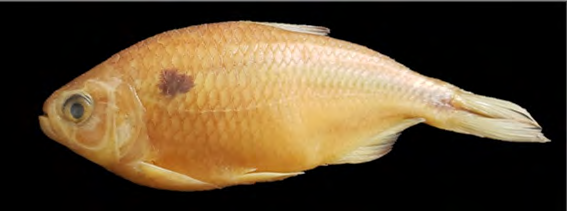
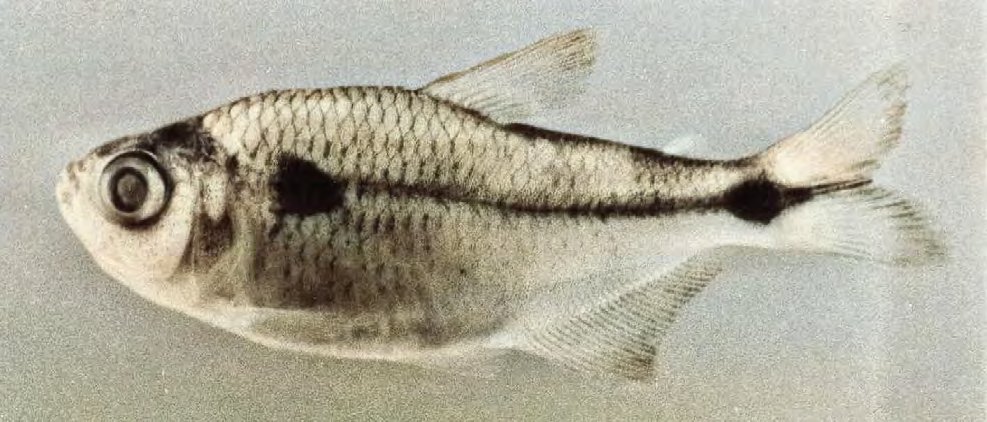
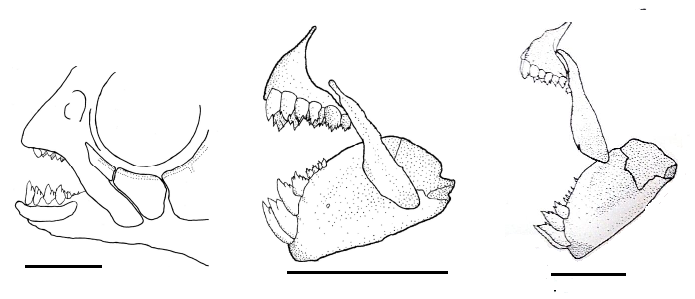
Figure 5: Larger dentary teeth of (A) (5 larger teeth) BMNH 1917.7.14.15, Astyanax scabripinnis, 68.5 mm SL, Holotype, drainage of Guanabara Bay, Rio de Janeiro, Rio de Janeiro, Brazil. (B) (4 larger teeth) MNRJ 17456, Astyanax aff. bimaculatus, 45.7 mm SL, Tanque stream (tributary of the right bank of the Paraíba do Sul river), locality of Passa Três, Carmo, Rio de Janeiro, Brazil.(C) (4 larger teeth) MNRJ 11009, Astyanax viridis sp. n. Salgado, 2021, 82.5 mm SL, Fundo river, Maricá, Rio de Janeiro, Brazil. (Bars scale = 5.0 mm).
Color in Alcohol
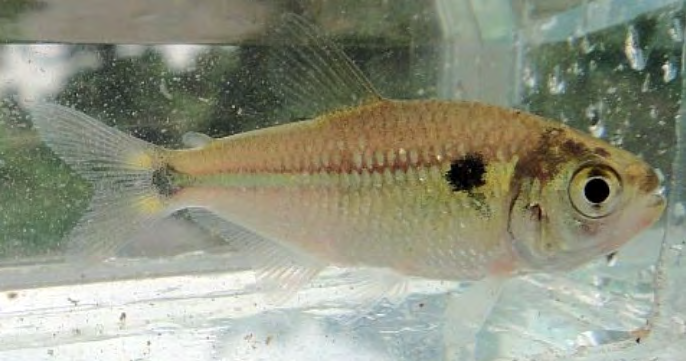
Dorsal region of head and body dark brown.Lateral and ventral regions of head, flanks and ventral region of bodycream. Upper and lower lips, infraorbital, maxillary and opercular areas cream. Horizontally triangular humeral spot, with 1 and 1/2 scales in depth (2 series above lateral line) and 5 scales in length (2 series above lateral line). Inconspicuous silver-blackened longitudinal stripe starting two scales posteriorly to humeral spot extending to caudal peduncle where it undergoes a slight narrowing and soon after widening again forming a small triangular peduncle spot extending to end of median caudal rays. Stripe with 1 to 2 scales in depth and 18 to 19 scales in length, and peduncle spot with 1 scale in depth (1 series above lateral line) and 9 scales in length. Hyaline and reddish fins (Figure 6).
Color in Life
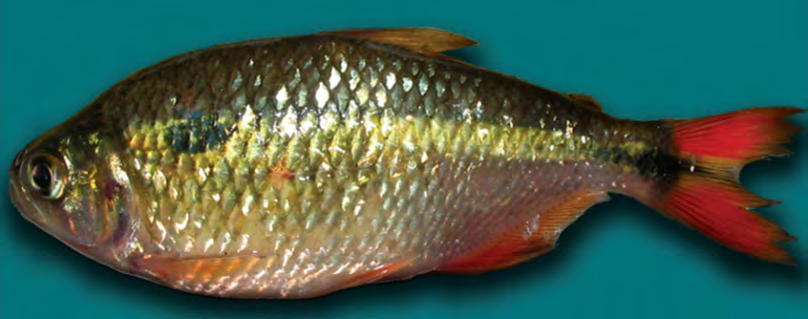
Superior lip and dorsal region of dark green head. Inferior lip, silver infraorbital and opercular bones. White ventral region. Dorsal and lateral regions of body greenish. Silver longitudinal stripe and conspicuous blackish and peduncular patches. Hyaline, greenish fins with reddish anal fin and caudal areas (Figure 7).
Sexual Dimorphism
Similar colored pattern in both sexes. Males in reproductive phase have fin hooks: anal, from last unbranched ray to 11th branched ray; pelvic, from 1st branched ray to 6th branched ray. Hooks are present distally, before and after first branch, in anterior and posterior branch, usually only posteriorly. One hook per segment.
Etimology
The specific epithet viridis is a reference to the color of dorsal and lateral body regions of this new species.
Geographic Distribution
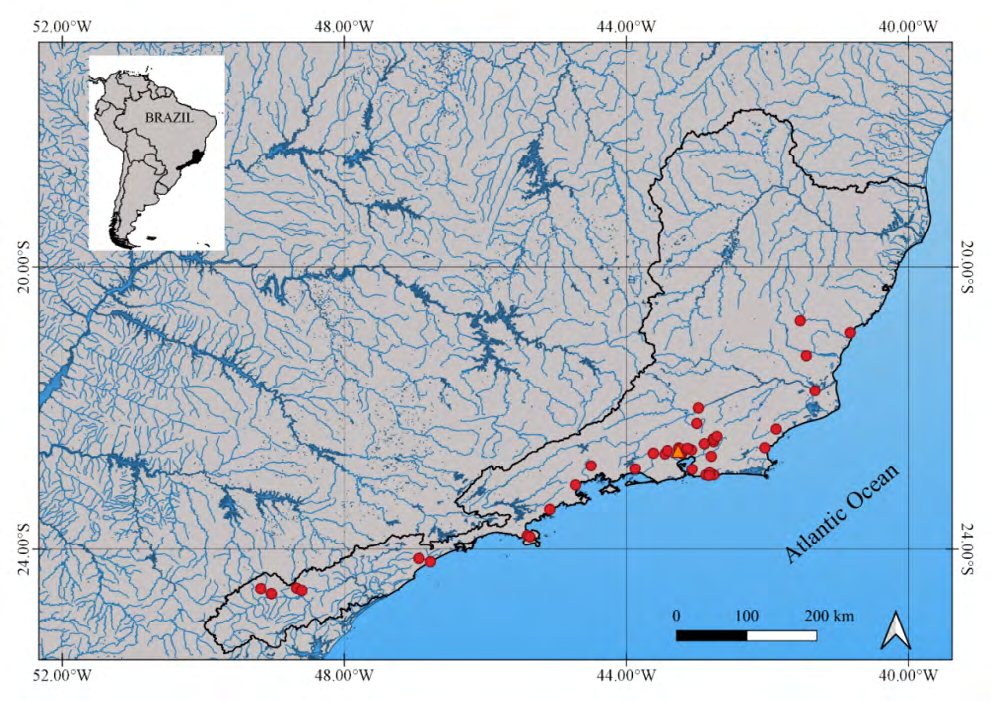
Found in tributaries of the Guanabara and Sepetiba Bays, the Paraíba do Sul River and Fluminense Coastal Basins, in the São João and Ribeira do Iguape River Basins. Espírito Santo, Minas Gerais, Rio de Janeiro and São Paulo states (Figure 8).
Designation of Holotype
Guanabara Rivers Basins, LEP-UFRRJ 0799, 100.4 mm SL, Santo Antonio stream, Duque de Caxias, Rio de Janeiro, Brazil, 22°36’01”S 43°15’57” W, 07 Jul. 2010, BF Terra.
Paratypes-Brazil, Espírito Santo
Coastal Basins, MNRJ 11010 (5, 55.5-57.8mm SL), well in the bush , fed by spring, 50 m altitude, Serra (near Vitória), C Lako, 03 Oct. 1995. Brazil. Rio de Janeiro. Guandu River Basin. UFRJ 0892 (1, 59.6 mm SL), estrada do Mazomba (Ms. Jane’s farm), Itaguaí, M Melgaço, 09 Apr. 1992. Macacu river basin. UFRJ 11171 (1, 97.2 mm SL), Gato River, Near the Bridge to the Researcher’s House, REGUA, Guapiaçu, 22°26’07”S 42°45’32” W, FLK Salgado, B Gorini et al., 20 Aug. 2016. Maricá Rivers Basins. UFRJ 0056 (1, 64.8 mm SL), Ubatiba river, Maricá. UFRJ 1079 (1, 65.9 mm SL), Fundo river, Maricá, W Costa, 1980. MNRJ 11002 (3, 75.0-76.5 mm SL), Pacheco stream, tributary of Guaripina lagoon, Maricá, 22°56’48.13 “S 42°45 ‘37.27”W, GWA Nunan, WD Bandeira, LEM Cardoso & FGA Melo, 05 Feb. 2007. Paraíba do Sul River Basin. MNRJ 16530 (1, 86.2 mm SL), brejal stream, tributary of the right bank of the Bonito River, tributary of the left bank of the Rio Preto, tributary of the right bank of the Piabanha, tributary of the right bank of the Rio Paraíba do Sul, Petrópolis, 22°13’00”S 43°00’00”W, DF Moraes Jr., E. P. Caramaschi et al, 17 Dec. 1989. MNRJ 20285 (1, 45.5 mm SL), Paraíba do Sul river, near to Paraíso locality Road, Cachoeiras de Macacu, 22°30’11”S 42°53’40”W, MRS Melo, AT Aranda, FAG Melo & G Souza, 25 Apr. 2000. Imbé River Basins. MNRJ 11013 (1, 50.7 mm SL), tributary stream of the upper Imbé River, Santa Maria Madalena, 21°57’54”S 41°52’28”W, LEM Cardoso, 02 Mar. 1981.
Discussion
The predorsal pattern proved to be effective in differentiating between different southeastern Brazilian coastal species, separated in subgenus Astyanax and Poecilurichthys, including A. viridis, corroborating [6]. The body depth (37-39%) and the number of anal fin rays (18-19) [2] were useful in the insertion of A. viridis in the A. scabripinnis complex. However, its atypical shape of humeral spot (horizontally triangular) included A. viridis in a small group inside this complex, formed by A. scabripinnis (Southeastern Brazilian coastal basins), A. laticeps and A. serratus (both from Southern Brazilian basins), even presenting a smaller number of large dentary teeth (4), which approximates it to A. bimaculatus complex species, with omnivorous eating habits [8]. Also according this last paper, species with graduate decreasing dentition as Deuterodon species have herbivorus eating habits. It was demonstring that Astyanax species with four larger teeth in dentary demonstrated the omnivorus habits in these species [12]. The presence of this type of dentition in A. viridis could be a probable sign of convergence [4], in relation to the independent appearance of piscivorous dentition in some clades inside Characiformes. This new species has been described from abundant specimens previously identified as A. janeiroensis sensu Eigenmann, 1908, many listed in [14], inside A. bimaculatus complex, despite this different humeral spot (triangular vs. horizontally oval in this second complex), and predorsal pattern (regular vs. irregular scaled). Melo’s conclusion based in this number of larger dentary teeth (4). However, those specimens of A. viridis differs from A. janeiroensis holotype (unique specimen used to described this species) [5] (Figure 1b), by several other morphological characters [ie. length of the upper jaw (35.1-38.9% HL vs. 41.4% HL), pelvic-anal fin distance (19.0-21.9% SL vs. 24.0% SL) and number of longitudinal stripe scales (18-
19 vs. 25)], justifying its description as new species. This current research was the first to detect differences between specimens previously identified as A. janeiroensis in relation to the holotype of A. janeiroensis. The presence of many non-overlapping characters between A. viridis and other triangular humeral spot group species, as head length (26.2- 27.9% HL vs. 20.9-21.3% HL; 23.0-25.2% HL and 33.9-35.3% HL, in A. laticeps, A. scabripinnis and A. serratus, respectively) and pelvic-anal distance (19.1-21.9% SL vs. 30.0-31.5% SL; 22.0-24.9% SL and 28.8-31.8% SL in A. laticeps, A. scabripinnis and A. serratus, respectively), reinforces the validity of this species. In relation of its geographic distribution, in southeastern Brazil, A. viridis shared its habitat (backwater areas in streams and rivers with A. aff. bimaculatus (A. bimaculatus complex), A. taeniatus and A. intermedius (A. scabripinnis complex), A. parahybae (A. fasciatus complex), A. giton and A. hastatus, probably more closer to Deuterodon [6], and, all species with wide distribution in Southern coastal rivers basins. The presence of A. viridis (and these species) in almost these drainages backwater areas in streams and rivers indicates that the mountains of Serra do Mar and Bocaina do not constitute totally insurmountable geographical barriers, suggesting connections between these coastal basins, at a given moment in the past. Regarding the contributing basins of Guanabara Bay, approximately 15 thousand years ago they formed a single river (Paleo Guanabara river) [1, 10] contributing to the wide dispersion of these species. Old connections between Paraíba do Sul and other coastal basins in Rio de Janeiro, due to periods of marine advance and retreat, explain the sharing of these same species between these systems [22].
Although had included A. janeiroensis in Deuterodon [20], this modification will not be followed in this article, because the differences in the dentition patterns and shape of the humeral spot between this species, and those of the subgroup to which it belongs, including the new presented here, are considered valid in the separation between those species and genera. Furthermore, the synapomorphies presented in the new definition of Deuterodon [20], are shared by species in Astyanax, including those rearranged in other genera, according to the article itself.
Conclusion
Astyanax viridis were proposed as new species inside Astyanax for examined material from coastal basins from southeastern Brazil. This species belongs for subgroup with triangular spots species.
Material Examined
(Non-types). Astyanax viridis – Brazil. Rio de Janeiro: Guandu River Basin. MNRJ 20857 (3, 84.3-89.4 mm SL), Mazomba River, between Mazombinha and Mazomba, tributary of the Mazomba drainage, Itaguaí, 22°51’36”S 43°52’32” W, PA. Buckup, AT Aranda & MRS Melo, 21 Nov. 2000. LEP-UFRRJ 2431 (1, 75.0 mm SL), São Pedro stream, Japeri, 22°38’11.0”S 43°37’02.1”W, T. Moretti, 22Feb. 2010. LEP-UFRRJ 2442 (1, 85.0 mm SL), São Pedro stream, Japeri, 22°38’11.0”S 43°37’02.1”W, T Moretti, 22 Feb. 2010. LEP- UFRRJ 2446 (2, 67.0-70.5 mm SL), São Pedro Creek, Japeri 22°38’11.0”S 43°37’02.1”W, T Moretti, 22Feb. 2010. Iguaçu River Basin. LEP-UFRRJ 0806 (1, 75.0 mm SL), Mato Grosso Creek, Estrela River Basin, Petrópolis, 22°33’44”S 43°15’22”W, 15 Mar. 2011, BF Terra. LEP-UFRRJ 0808 (1, 107.2 mm SL), Adrianópolis stream, Nova Iguaçu, 22°38’50”S 43°27’5.8”W, BF Terra, 22 Sep. 2011. UFRJ 11136 (4, 80.1- 120.1 mm SL), Adrianópolis stream, Nova Iguaçu, 22°38’50”S 43°27’5.8”W, B Terra, F Araújo et al., 22 Sep. 2016. Macacu River Basin. MNRJ 11014 (1, 62.1 mm SL), tributary stream of the Paraíso River, Primate Center, Magé, 22°30’00”S 42°55’00”W, R Rocha & Zilá, MSF Cunha. MNRJ 27747 (1, 82.9 mm SL), Gato Stream (right bank Guapiaçu tributary), Serra do Mar farm, Cachoeiras de Macacu, 22°26’08”S 42°45’32” W, L M.Sarmento-Soares & JHC Gomes, 11 Apr. 2003. MNRJ 27797 (1,83.1 mm SL), Guapiaçu River Basin, Gato Stream, Cachoeiras de Macacu, 22°26’05”S 42°46’07”W, LM Sarmento-Soares, AT Aranda &R Pinheiro, 05 Jan. 2004. Macaé River Basin. NPM 2050 (1, 83.0 mm CP), Macaé River, near BR 101 bridge and thermoelectric, approximately 16 km from Macaé River mouth, Macaé, 22°17’43”S 41°52’36”W, Paula Araujo Catelani et al., 14 Apr. 2012. Piabanha River Basin. MNRJ 20844 (1, 50.8 mm SL), old road from Petrópolis, 1 to 2 km from the new road, Raiz da Serra, L Travassos, P Miranda Ribeiro and GS Myers, 22 Apr. 1942. São João River Basin. DZSJRP 13872 (1, 101.0 mm SL), São João River, tributary of the São João Lagos drainage, Silva Jardim, 22°34’57”S 42°34’31”W, 31 May 2000. NPM 4909 (1, 72.0 mm SL), São João River, Mangrove, Casimiro de Abreu, 22°33’34”S 42°02’06”W, Paula Araújo Catelani _et a_l., 21 Nov. 2016. Other Coastal Basins of Rio de Janeiro. MNRJ 11001 (1, 81.0 mm SL, Mombuca River, Maricá, 22°55’29.28 “S 42°46’14.19”W, G. W. A. Nunan, WD Bandeira, LEM Cardoso & FGA Melo, 05 Feb. 2007. MNRJ 11009 (2, 81.0-82.5 mm SL), Fundo river, Maricá, 22°55’10.30”S 42°41’47.75” W, WJE Costa, 05 Feb. 2007. MNRJ 11566 (2, 80.5-81.2 mm SL), Ubatiba River, Silvado, Maricá, 22°54’57,97”S 42°49’9.09”W, J Gomes, E Caramaschi, D Halboth, J Aranha & FGA Melo, 05 May 1998. MNRJ 12508 (2, 77.5-79.0 mm SL), Marica Lagoon, Maricá, 22°57’25.54”S 42°49’33.01”W, D. F. Moraes Jr., EP Caramaschi & JF Lobon-C., 13 Nov. 1993. LEP-UFRRJ 0799 (2, 89.9-100.0 mm SL), Santo Antonio stream, Duque de Caxias, 22°36’01”S 43°15’57”W, 07 Jul. 2010, BF Terra. LEP-UFRRJ 1827 (1, 70.0 mm SL), Taquara Creek, Estrela River Basin, Duque de Caxias, 22°37’16”S 43°14’31”W, 28 Apr. 2010, BF Terra & FLK Salgado. São Paulo: Itanhaém River Basin. MZUSP 80326 (1, 81.5 mm SL), Rio Branco, Itanhaém, São Paulo, Brazil, 24°10’48”S 46°46’48”W, OT Oyakawa & JC Nolasco, - - 2003. DZSJRP 15831, (3, 65.2- 69.1mm SL), Preto river, Itanhaém River Basin, Itanhaém, 24°07’59”S 46°56’32”W, FC Ferreira, 11 Aug. 2006. Ribeira do Iguape Basin. MZUSP 51919 (2, 80.6-80.9 mm SL), Ribeira do Iguape River, Iporanga, 24°35’00”S 48°36’00” W, S. Buck, 21 Sep. 1996. Other Coastal Basins of São Paulo. 2 non-fixed specimens from São Sebastião and Ilha Bela. Paraíba do Sul River Basin. Minas Gerais: LEP-UFRRJ 2351 (1, 82.0 mm SL), Tocaia stream, Paraiba do Sul River Basin, Sapucaia, 21°59’59.26 “S 42°58’45.85”W, BCT Pinto, 26 May 2006. Rio de Janeiro: LEP-UFRRJ 1131 (1, 77.0 mm SL), Marginal lagoon to the Paraiba do Sul River, Campos dos Goytacazes,21°45’16”S 41°19’28” W, FG Araujo, 19 Jun. 1986. MBML-Pisces 8251 (1, 76 mm SL), Baú stream, under RJ-230 between Santa Maria and Santo Edurado, Campos dos Goytacazes, 21°15’19”S 41°26’49”W, T. A. Volpi, JP da Silva , L Tonini & EL Muhl, 02 May 2014.
Comparative Material
(Non-types). Astyanax aff. bimaculatus – Brazil, Rio de Janeiro: Paraíba do Sul Basin. MNRJ 17456 (1, 45.7mm SL), Tanque stream (tributary of the right bank of the Paraíba do Sul river), locality of Passa Três, Carmo, 21°49’00”S 42°32’00”W.
• Astyanax altiparanae – Holotype – MZUSP 18852 (1, 81.3 mm SL), Rio Grande, Volta Grande Dam, Miguelópolis, São Paulo, Brazil, 20°08’00”S 48°05’00”W.
• (Non-types). Brazil. Paraíba do Sul River Basin. Rio de Janeiro:MNRJ 17880 (1, 75.6 mm SL), São Pedro Stream, tributary of the Paraíba do Sul River, on BR- 116, KM 246, Barra do Piraí, 22°35’31”S 43°43’54”W. UFRJ 11114 (1.70.7 mm SL), Muriaé River, Muriaé. UFRJ 11583 (1.84.4 mm SL), Paraiba do Sul River, Funil Reservoir, Resende. São Paulo: UFRJ 11755, 36.8 mm SL, São Roque River, São Roque, São Paulo, Brazil. Rio de Janeiro: Sepetiba Bay Coastal Basins. UFRJ 11235, (1, 65.5 mm SL), Vala dos Bois stream, Itaguaí.
• Astyanax giton – Lectotype (photos) – MCZ 20936 (1, 63.3 mm SL), Paraíba do Sul River, Vassouras, Rio de Janeiro, Brazil, 22°18’32.2”S 43° 36’38.6”W, Mar.- Apr./1865, Thayer Expedition (L Agassiz & D Bourget). Paralectotypes. CAS 42482 (photos) [ex IU 15266] (1, 55.4mm SL), Paraíba do Sul River, Vassouras, Rio de Janeiro, Brazil, 22° 18’32.2”S 43° 36’38.6”W, Mar.-Apr / 1865, Thayer Expedition (L Agassiz & D Bourget), MNRJ 11023 (1, 71.7mm SL) Rio Grande, Two Rivers River Former, Bengal River Outlet at Rio Grande, near Riograndina, Nova Friburgo, Rio de Janeiro, Brazil, 22°13’16.1”S 42°30’55.6”W. MNRJ 15373 (2, 74.4-87.5 mm SL), near the mouth of the Piabanha and Paraibuna rivers, Três Rios, Rio de Janeiro, Brazil, 22°06’33,8”S 43.08’14.6” W. MNRJ 16309 (10, 71.6-92.6 mm SL), Rio Grande, Km 2, downstream of the RJ 172 highway bridge, São Sebastião do Alto, Rio de Janeiro, Brazil, 22°00’46.7”S 42°07’53.4”W. MNRJ 16686 (2, 85.8-97.5 mm SL), Paraíba do Sul River, Right Bank of the Pomba River, Rio Novo, Minas Gerais, Brazil, 21°08’50.5”S 43°06’22”W. MNRJ 16681 (2, 90.6-92.7 mm SL), near the farm, São Sebastião do Alto, Rio de Janeiro, Brazil, 21°52’00”S 42°02’00”W.
• (Non-types). Brazil. Paraíba do Sul River Basin. Rio de Janeiro: LEP-UFRRJ 1153 (7, 65.6-102.9 mm SL), Rio Paraíba do Sul, Areal, 22°13’59”S 43°06’38”W, FG Araujo, 10-I-1991. LEP-UFRRJ 1395 (1,112.7 mm SL), Paraibuna River, Levi Gasparian, 22°01’37.7”S 43°12’07.3”W, BF Terra, 09-IV-2013. São Paulo: LEP-UFRRJ 2130 (1,102.9 mm SL), meeting of the Paraitinga and Paraibuna rivers, Paraibuna, 23°23’09”S 45°39’43”W, BCT Pinto, 29-V-2006. Rio de Janeiro: Surui River Basin. MNRJ 11022 (1, 58.7mm SL), Surui River, Magé, 22°38’15.9”S 43°07’11.2”W. São João River Basin. MNRJ 19257 (2, 54-60mm SL), Pyrenees or Crubixais River, tributary of the left bank of the São João River, bridge north of Novo Horizonte Farm, Silva Jardim, 22°30’26”S 42°29’00”W. Espírito Santo: Itabapoana River Basin. MNRJ 11019 (1, 68.3mm SL), Itabapoana River, Bom Jesus de Itabapoana, 21°07’58 “S 41°39’50” W.
• Astyanax hastatus – Holotype (photos) – USMN 92952 (1, 36.6 mm SL), near the city of Rio de Janeiro, Rio de Janeiro, Brazil, Rolf Brocca. Paratype (photos) – USMN 94312 (1.39.1 mm SL), near the city of Rio de Janeiro, Rio de Janeiro, Brazil, Rolf Brocca.
• (Non-types). Brazil. Rio de Janeiro: Guandu River Basin. MNRJ 11064 (1.46.6 mm SL), Guandu River, Seropédica, 22°42’00”S 43°33’00”W, LEM Cardoso, WD Bandeira, DF Moraes Jr., 31 Jul. 1984 MNRJ8929 (1.51.8 mm SL), Guandu River, Campo Grande, 22°52’00’S 43°27’00”W, ND Santos, H.T., TP Filho & S Ypiranga, 19- VI-1953. Camorim River Basin. MNRJ 8585 (1, 43.8 mm SL), Camorim River, Jacarepaguá, Rio de Janeiro, 22°59’00”S 43°25’00’W, Carvalho, Rose, Berla & Gosline, 15-IX-1943 .MNRJ 8615 (1, 52.2 mm SL), Fees River, Red River Sub-basin, Bandeirantes Recreation, FAG Melo. Roncador River Basin. MNRJ 11008 (1, 60.8 mm SL), weir at Ribeira Farm, Roncador River Basin, Magé, 22°38’00”S 43°07’00” W, ZMSF Wedge. Guapimirim River Basin. MNRJ 18937 (1, 54.8 mm SL), Paraíso River, Guapimirim River Basin, Guapimirim, 22°31’09”S 42°53’50”W, PA Buckup, FAG Melo, MRS Melo & FAG Melo, 10-XII-1998. Macaé River Basin. MNRJ 11577 (1,
50.9 mm SL), Dourado River, Macaé River Basin, Macaé, Ichthyology and Malacology (MNRJ), 21 Jul. 1989.
- Astyanax intermedius – Lectotype –MCZ 20684 (1, 45.8mm SL) Paraíba do Sul River, near the city of Rio de Janeiro, Rio de Janeiro, Brazil, Hassler Expedition (D Bourget), February 1872. Paralectotypes– CAS 42485 (ex MCZ 20939) (64.4mm SL) River Paraíba do Sul, Rio de Janeiro, Brazil,Expedition Thayer. CAS 42486 (ex MCZ 20684 and IU 15254) (4, 33.5-43,8mm SL) Rio Paraíba do Sul, 1865; MZC 20635 (2 of 4 ex., 71.9-83.9mm SL) Rio Paraíba do Sul, Rio de Janeiro, Brazil, Expedition Thayer; MCZ 20684 (1, 6.3mm SL), Paraiba do Sul River, Vassouras, Rio de Janeiro, Brazil, 22°18’32.2”S 43°36’38.6”W, ThayerExpedition (L Agassiz & D Bourget), Mar.-Apr. 1865.
- (Non-types). Brazil. Rio de Janeiro: Iguaçu River Basin. LEP-LEP-UFRRJ 0803 (3, 66.1-102.3 mm SL), Tinguá River, Nova Iguaçu, 22°34’59”S 43°26’49” W, BF Terra et al., 10 Aug. 2008. São Paulo: LEP-UFRRJ 2129 (3, 81.2-86.8 mm SL), Cruz stream, tributary of the Prata stream, Bocaina, 22°10’14.6”S 48°30’29.1”W, BCT Pinto et al., 20 Jul. 2005.
• Astyanax janeiroensis – Holotype (photos) − MCZ 21057 (1, 92.0 mm SL), Rio de Janeiro, RJ, Thayer Expedition (L Agassiz et al.), 01 May 1865.
• Astyanax jenynsii – Syntypes (photos) – NMW 57534 (3, 62.8–76.2 mm SL) (analyzed by photography and radiography), Paraíba do Sul River. NMW 57535, 2, 67.7- 76.5 mm SL (analyzed by photography) Paraíba do Sul River. MCZ 20885 (1, 82.9 mm SL), Paraiba do Sul River or tributary, Mendes, Rio de Janeiro, Brazil, 22°32’S 43°44’00”W, Thayer Expedition (CF Hartt & E Copeland), Jan. 1865. MCZ 20927 (2, 78.5-80.6 mm SL), Paraíba do Sul River Paraíba do Sul River, Vassouras, Rio de Janeiro, Brazil, 22°18’32.2”S 43°36’38.6”W, Thayer Expedition (L Agassiz & D Bourget), Mar./Apr./1865.MCZ 20938 (2, 60.3-63.0 mm SL), Paraíba do Sul River, Vassouras, Rio de Janeiro, Brazil, 22°18’32.2”S 43°36’38,6”W, Thayer Expedition (L Agassiz & D Bourget), Apr.-May 1865. MCZ 20944 (3, 51.4-64.6 mm SL), Paraiba do Sul River, Teresopolis, Rio de Janeiro, Brazil, 22°16’00”S 42°45’00”W, Thayer Expedition to Brazil, 01 Jan. 1865. MCZ 20945 (4, 75.3-80.5 mm SL), Paraiba do Sul River, Teresópolis, Rio de Janeiro, Brazil, 22°16’00”S 42°45’00”W, Thayer Expedition to Brazil, 01 Jan. 1865.
• (Non-types). Brazil. Rio de Janeiro: Paraíba do Sul River Basin. MNRJ14433 (3, 62, 8-72.5 mm SL), Caxumba stream (tributary of the left bank of Santa Rita stream, downstream of Trout Firmeza Breeding, Vale do Paquequer district, tributary of Paquequer river, Teresópolis, 22°17’12”S 42°58’54” W, PA Buckup et al., 11 Mar. 1996. São Paulo: MNRJ 19665, (1, 71.5 mm SL), Macacos neighborhood, Macacos’s river (tributary of the left bank of the Paraitinga river) upstream of Silveira, Silveira, 22°48’15”S 44°50’08”W, MRS Melo, AT Aranda, RS Mendes, 20 Dec. 1999. LEP-UFRRJ 1757 (1, 90.9 mm SL), Paraitinga River, São Luís do Paraitinga, 23°13’25.9”S 45°18’42.8”W, 2 Nov. 2001. BCT Pinto. LEP-UFRRJ 1883 (1, 58.5 mm SL), Paraíba do Sul River, São José dos Campos, 23°10’47”S 45°53’14”W, BCT Pinto et al., 01 Sep.1995. LEP-UFRRJ 1990 (1, 49.7 mm SL), Jacaré Pepira River, Tietê Basin, Bocaina, 22°08’09”S 48°31’04”W, BCT Pinto, 25 Nov. 2004. LEP-UFRRJ 2238 (3, 55.9-64.4 mm SL), Morro Grande River (Right Bank), Lavrinhas, 22°33’47.2”S 44°50’31”W, B Terra, 11 Feb. 2009. Rio de Janeiro: Piraí River Basin. MZUSP 110297 (1, 72.0 mm SL), Estreito stream, under the RJ-155 Barra Mansa-Angra dos Reis bridge, tributary of the Braço river, Lídice, 22°50’31”S 44°12’56”W, 15 Dec. 2011.
• Astyanax laticeps – Holotype (photos) – ANSP 21852, 55.2 mm SL, river drainage Jacuí, ca. 30°56’00”S 51°16’00”W, 1882, HH Smith.
• (Non-types). Brazil. Uruguay River Basin. Rio Grande do Sul: MNRJ 18858 (11, 55.6-75.4 mm SL), ditch tributary of the swamp on Manoel Leão street, São José dos Ausentes-Silveira road, 1.8 km N to bridge on Manoel Leão, São José dos Ausente, 28°43’03”S50°00’36”W, PA Buckup, RE Reis, AR Cardoso, FAG Melo, 17 Dec. 1999. Santa Catarina: MNRJ 18308 (7, 53.2-70.5 mm SL), meander (arm) of the Canoas river, 3 km NE of the junction of the Serra do Corvo Branco road, Urubici, 28°01’26”S 49°22’11”W, PA Buckup, RE Reis, AR Cardoso, FAG Melo, 20 Dec. 1999. MNRJ 30441 (11, 56.7-80,2 mm SL), Antas river, next to the SC-407 highway, about 7km from the BR-282 highway, Tijucas sub-drainage, Angelina, 27°37’55”S 48°59’22”W, L Ingenito, 22 Jan. 2007. MNRJ 30448 (27, 34.5-88.9 mm SL), Braço do Norte river along the SC-407 highway, about 234m from the center of the Aritapólis, Braço sub-drainage, Aritapólis, 27°51’48”S 49°03’26”W, L Ingenito, 22 Jan. 2007.
• Astyanax parahybae – Lectotype – MCZ 20685 (1, 100.8 mm SL), Paraíba do Sul River, between Barra do Piraí and Três Rios, Três Rios, Rio de Janeiro, Brazil, ** - Feb. 1870.
• (Non-types). Brazil. Rio de Janeiro: Paraíba do Sul River Basin. MNRJ 16505, (1, 84.6 mm SL), Cataia lagoon and channel that connects to Paraiba do Sul river, left bank, 3 Km before Vila Campo Novo, São Joãoda Barra, 21°41’00”S 41°08’00’W, DF Moraes Jr & JMR Aranha, 24 Jan. 1990. MNRJ 16651 (3, 84.6-109.4 mm SL), Muriaé
River (tributary left bank Paraíba do Sul River), near the intersection BR-356 with RJ-186, Itaperuna, 21°15’00”S 41°45’00”W, EP Caramaschi, DF Moraes Jr. et al. MNRJ 16654 (1, 81.1 mm SL), Carangola River, tributary of the left bank of the Muriaé River (tributary of the left bank of the Paraíba do Sul river), under the BR-356 highway bridge, Itaperuna, 21°12’00”S 41°55’00” W, DF Moraes Jr., EP Caramaschi et. al. MNRJ 16598 (1, 88.1 mm SL), marginal lagoon (right bank of Paraiba do Sul river), near the town of Coronel Texeira, Itaocara, 21°42’00”S 42°07’00”W, EP Caramaschi, DA Halboth, M Vianna & FA Melo, 18 Dec. 1989. MNRJ 20871 (7, 78.5-104.5 mm SL), Paraiba do Sul River, Três Rios, 22°07’26.3”S 43°13’14.7”W, Hassler Expedition (D Bourget).
• Astyanax taeniatus – Sintypes (photos) – UMZC V. 329 (2, 40.5-41.3 mm SL), Sossego, Rio de Janeiro, Brazil, C Darwin, - - 1832.
• (Non-types). Brazil. Rio de Janeiro: Itabapoana River Basin. MNRJ 11005 (2, 69.7-87.7 mm SL), Pirapitinga River (Itabapoana Basin), in Barra do Pirapitinga, Bom Jesus do Itabapoana, FAG Melo, 15 Jan. 1982. MNRJ 11006 (2, 70.3-83.9 mm SL), Pirapitinga River on the Bom Jesus Itabapoana and Calheiros Road, ± 2 km before the town of Barra do Pirapitinga, Bom Jesus de Itabapoana, FAG Melo, 15 Jan. 1982. Macaé River Basin. MNRJ11027 (10, 75.6-92.8 mm SL), Areia Branca River, tributary of the Macaé River, Macaé, 22°20’06”S 42°01’53”W, FG Melo, 17 Nov. 1983. MNRJ 11033 (3, 70.1-86.1 mm SL), Rio d’Anta, tributary of the Macaé River, Macae, 22°22’16”S 42°04’25”W, FGA Melo, 23 Nov. 1983. Paraíba do Sul River Basin. MNRJ 20832 (1, 93.5 mm SL), Mirindiba Well, Sossego River, Santa Maria Madalena, FAG Melo, 24 Mar. 1998. Guandu River Basin. LEP-UFRRJ 1155 (4, 85.9-110.1 mm SL), São Pedro Creek, Japeri, 22°38’11.0”S 43°37’02.1”W, BF Terra, 28 Jan. 2011. Angra dos Reis River Basins. MNRJ 20886 (6, 80.4-95.2 mm SL), BR- 101 Rio-Santos, Rio da Floresta, JR Gomes, 16 Jul. 1987.
• Astyanax scabripinnis – Holotype (photos) – BMNH 1917.7.14. 15 (1, 68.5 mm SL), drainage belonging to Guanabara Bay, Rio de Janeiro, Rio de Janeiro, Brazil, C Darwin, - - 1832. Paratype – DZSJRP 13872 (1, 101.2 mm SL), São João River, Silva Jardim, Rio de Janeiro, Brazil, 22°34’57”S 42°34’31”W, F Langeani et al., 31 May 2011.
• (Non-types). Brazil. Espírito Santo: Coastal Basins. MNRJ 11010 (1, 55.4 mm SL), well in the bush , fed by spring, 50 m altitude, Serra (near Vitória), C Lako, 03 Oct. 1995. Rio de Janeiro: Guanabara Bay Rivers Basins. LEP-UFRRJ 2365 (1, 95.6 mm SL), Santo Antonio Stream, Duque de Caxias, 22°36’01”S 43°15’57”W, B Terra, 07- Jul.
2010. Lajes Reservoir System. MNRJ 20857 (3, 84.3– 89.4 mm SL), Mazomba River, between Mazombinha and Mazomba, tributary of the Mazomba drainage, Itaguaí, 22°51’36”S 43°52’32”W, PA Buckup, AT Aranda & MRS Melo, 21 Sep. 2000. LEP-UFRRJ 2431 (1, 75.0 mm SL), São Pedro Stream, Japeri, 22°38’11.0”S 43°37’02.1” W, T Moretti, 22 Feb. 2010. LEP-UFRRJ 2297 (2, 94.9-104.4 mm SL), stream tributary of the Lajes Reservoir, Rio Claro, 22°50’0.89”S 44°01’4.88”W, G Guedes, 25 Sep. 2018. Macaé River Basin. MNRJ 11025 (11, 70.0-85.0 mm SL), upper Macaé River in Poço Feio, Luminar District, Nova Friburgo, Ichthyology & Malacology (MNRJ). Paraíba do Sul River Basin. MNRJ 6276 (1, 65.5 mm SL), Pombos Island, Paraíba do Sul River, Carmo, WA Gosline, 29 Aug. 1997. MNRJ 6279 (1, 72.3 mm SL), Pombos Island, Paraíba do Sul River, Carmo, WA Gosline, 29 Aug. 1997. MNRJ 11013, (1, 50.7 mm SL), tributary stream of the upper Imbé River, Santa Maria Madalena, 21°57’54”S 41°52’28”W, LEM Cardoso, 02 Mar. 1981. MNRJ 11054 (24, 65.0-85.4 mm SL), Preto River, 2 km from the Road that connects Resende to Bocaina de Minas, MG and RJ border, Resende, 22°28’00”S 44°26’28”W, JRS Araujo, 22 Aug. 1982. MNRJ 16632 (1, 61.0 mm SL), Aventureiro River (tributary left bank Paraíba do Sul River), Além Paraíba, 21°46’00”S 42°45’00”W, EP Caramaschi et al., 31 Oct. 1988. MNRJ 17890 (1, 70.5 mm SL), effluent from DuPont, contributor to Paraíba do Sul River, Barra Mansa, 22°30’00”S 44°13’40” W, FAG Melo, - - 1998. LEP-UFRRJ 1735 (1, 85.9 mm SL), Paraíba do Sul River, Pombos Island, Carmo, 22°56’01”S 43° 36’31”W, T Moretti, 27 Feb. 2014. LEP-UFRRJ 1736 (1, 70.5 mm SL), Paraíba do Sul River, Pombos Island, Carmo, 22°56’01”S 43°36’31”W, T Moretti, 28 Feb. 2014. LEP-UFRRJ 1756 (1, 75.0 mm SL) Bemposta, Paraíba do Sul River, 22°07’08”S 43°02’55”W, B. F. Terra, 17 Jun. 2006. São João River Basin. DZSJRP 13872 (1, 101.0 mm SL), São João River, tributary of the São João River, Silva Jardim, 22°34’57”S 42°34’31”W, 31 May 2011. São Paulo: Paraíba do Sul River Basin. MNRJ 24007 (10, 68.5-93.5 mm SL), Piagui River, near the Recanto dos Pitões Bridge, Guaratinguetá, 22°41’38”S 45°16’52”W, P Buckup, L Ingenito, A Aranda, C Chamon & FP Silva. 13 Jan. 2003. LEP-UFRRJ 1787 (2, 70.8-71.9 mm SL), Paraibuna River, Areias, 22° 34’48”S 44°41’49”W, BF Terra, 23 May 2006. LEP-UFRRJ 1878 (1, 76.5 mm SL), Paraíba do Sul River, 23°10’47”S 45°53’14”W, B. C.T. Pinto, 24 Nov. 1997. LEP-UFRRJ 1890 (2, 97.2-98.1 mm SL), Entupido River, Queluz, 22°30’00”S 44°45’00”W, B Terra, 27 Feb. 2008. LEP- UFRRJ 2329 (1, 75.1 mm SL), São Roque River, Queluz, 22°32’57”S 44°27’28”W, BCT Pinto, 25 Feb. 2009. LEP- UFRRJ 2340 (2, 97.3-99.9 mm SL), Paraitinga River, São Luís do Paraitinga, 23°13’25.9”S 45°18’42.8”W, BCT Pinto, 12 Sep. 2003. LEP-UFRRJ 2372 (2, 60-64.5 mm SL), Morro Grande River (Right Bank), Lavrinhas, 22°
33’47.2”S 44°50’31”W, B Terra, 11 Feb. 2009.
• Astyanax serratus – Holotype (photos) – MHNCI 12346, 86.0 mm SL, Várzea River, Agudos do Sul, Paraná, Brazil, AM Prado & A Dambros, 18 Nov. 1983. Paratypes (photos) – MHNCI 173 (1,118 mm SL), Negro river, tributary of the Iguaçu River, Colônia São Pedro, Porto União, Santa Catarina, Brazil, 26°25’49”S 50°50’21”W, Avencal & N Firigote, Oct. 1943.
• (Non-types). Brazil. Iguaçu River Basin.Paraná: DZSJRP 5745 (5, 45.6-55.7 mm SL), Fazenda Gralha Azul, Iguaçu, Fazenda Rio Grande, 25°39’41”S 49°16’12”W, JP Serra et al., 09 Sep. 2003. DZSJRP 5750 (7, 50.5-57.6 mm SL), Fazenda Gralha Azul, Iguaçu, Fazenda Rio Grande, 25°39’41”S 49°16’12”W, JP Serra et al., 09 Sep. 2003. Santa Catarina: MNRJ 26627 (1, 60.7 mm SL), Iguaçu River, Porto União, GS Myers & AL Carvalho, 25 Apr. 1944. MNRJ 26635 (1, 70.5 mm SL), Iguaçu River, Porto União, GS Myers & AL Carvalho, 25 Apr. 1944. MZUSP 105966, 66 (4, 38.8 mm SL), Patos River, Lapa, NA Menezes, S Weitzman & FAA Sampaio, 03 Apr. 1985. Santa Catarina: Timbó River Basin. MZUSP 105968, 68 (6, 79.5-108.0 mm SL), Timbó River, Colônia São Pedro, Porto União, JC Garavello & JM Gomes, 12 Sep. 1979.
Acknowledgement
We thank Professor PhD Donald Tarphon for reviewing the manuscript, and Msc Geysa Camilo, PhD Bruno Gorini de Araujo Passos Pacheco and Graduate Student Igor Veronese de Luna for review the article and participated in discussions with the first author on Astyanax scabripinnis morphological and geographical boundaries, as well as added material to be examined. For Gustavo Guedes for having collected A. scabripinnis individuals, retrieved data on collecting arts and ecology from the sampled localities and revised the text andhaving drew up the distribution mapand F Gerson Araújo for conducted the final revision of the text, translated it into English and coordinated the team. For Professors PhD Filipe Augusto Gonçalves de Melo, PhD Rosana Mazzoni and PhD Ricardo Iglesias-Riosand PhD Carlos Oliveira and Graduate Student Lívia Lourenço Nery and for authorization to use of some photographs and illustrations. For CNPq and Capes development agencies for funding this research.
Compliance with Ethical Standards
Author state that the research was conducted according to ethical standards.
References
-
Amador E, Da S (1997) Guanabara Bay And Peripheral Ecosystems: Man And Nature. Reproarte Gráfica e Editora Ltda, Rio de Janeiro 36: 539.
-
Bertaco VA, Lucena, CAS (2006) Two new species of _Astyanax_ (Ostariophysi: Characiformes: Characidae) from eastern Brazil, with a synopsis of the _Astyanax_ _scabripinnis_ species complex. _Neotropical Ichthyology_ 4: 53-60.
-
Buckup PA, Britto MR, Souza Lima R, Pascoli JC, Villa Verde L, et al. (2014) Guia de identificação das espécies de peixes do Rio das Pedras, município de Rio Claro, RJ. Rio de Janeiro: The Nature Conservancy. pp: 79.
-
Dagosta FCP (2011) Taxonomia e relações filogenéticas do gênero Astyacinus Eigenmann, 1907 (Characiformes: Characidae). Dissertation. Universidade de São Paulo. Ribeirão Preto pp: 427.
-
Eigenmann CH (1908) Preliminary descriptions of new genera and species of tetragonopterid characins. (Zoölogical Results of the Thayer Brazilian expedition.). Bulletin of the Museum of Comparative Zoology 52 (6): 91-106.
-
Eigenmann CH (1917) American Characidae. Memoirs of the Museum of Comparative Zoology 43(1): 1-102.
-
Fricke R, Eschmeyer WN, Van der Laan R (2020) Eschmeyer’s catalog of fishes: genera, species.
-
Géry J (1977) Characoids of The World. Neptune City, New Jersey, TFH Publications, pp: 672.
-
Lima FCT, Malabarba LR, Buckup PA, Pezzi da Silva JF, Vari RP, et al. (2003) Genera Incertae Sedis in Characidae. In: Reis RE, et al. (Eds.), _Checklist of the freshwater fishes of_ _South and Central America_. EDIPUCRS, Porto Alegre, pp: 106-169.
-
Lima SMQ, Berbel Filho WM, Araújo TFP, Lazzarotto H, Tatarenkov A, et al. (2017) Headwater Capture Evidenced by Paleo-Rivers Reconstruction and Population Genetic Structure of the Armored Catfish (Pareiorhaphis garbei) in the Serra do Mar Mountains of Southeastern Brazil_._ Frontiers in Genetic (8): 199.
-
López H, Menni R, Donato M, Miquelarena A (2008) Biogeographical revision of Argentina (Andean and Neotropical Regions): an analysis using freshwater fishes. Journal of Biogeography 35(9): 1564-1579.
-
Mazzoni R, Nery L, Iglesias RI (2010) Ecology and ontogeny of feeding habit of _Astyanax janeiroensis_ (Osteichthyes, Characidae) from a coastal stream from Southeast Brazil. Biota Neotropica 10 (3): 53-60.
-
Base MCZ (2016) MCZBASE: the database of the zoological collections. Ichthyology 21057, Astyanax janeiroensis.
-
Melo FAG (2001) Revisão taxonômica das espécies do gênero _Astyanax_ Baird e Girard, 1854, (Teleostei: Characiformes: Characidae) da região da Serra dos Órgãos. Arquivos do Museu Nacional Rio de Janeiro 59: 1-46.
-
Mirande JM (2010) Phylogeny of the family Characidae (Teleostei: Characiformes): from characters to taxonomy. Neotropical Ichthyology 8: 385-568.
-
Moreira Filho O, Bertollo LA (1991) _Astyanax scabripinnis_ (Pisces: Characidae), a species complex. Revista Brasileira de Genética 14(2): 331-357.
-
Oliveira C, Avelino G, Abe K, Mariguela T, Benine, R, et al. (2011) Phylogenetic relationships within the speciose family Characidae (Teleostei: Ostariophysi: Characiformes) based on multilocus analysis and extensive ingroup sampling. BMC Evolutionary Biology 11: 1-25.
-
Ornelas Garcia CP, Domínguez Domínguez O, Doadrio I (2008) Evolutionary history of the fish genus A_styanax_ Baird & Girard (1854) (Actinopterygii, Characidae) Withdrawn in Mesoamerica reveals multiple morphological homoplasies. BMC Evolutionary Biology 8: 1-17.
-
Pavanelli C, Britski HA (2003) _Apareiodon_ Eigenmann, 1916 (Teleostei, Characiformes), from the Tocantins- Araguaia basin, with description of three new species_._ Copeia (2): 337-348.
-
Terán GE, Benite MF, Mirande JM (2020) Opening the Trojan horse: phylogeny of _Astyanax_, two new genera and resurrection of _Psalidodon_ (Teleostei: Characidae). Zoological Journal of the Linnean Society 190(4): 1217- 1234.
-
Sabaj MH (2016) Standard symbolic codes for institutional resource collections in herpetology and ichthyology: an Online Reference. Version 6.5 (16 August 2016). Electronically. American Society of Ichthyologists and Herpetologists, Washington, pp: 1-95.
-
Weitzman SH, Menezes NA, Weitzman M (1988) Phylogenetic Biogeography of the Glandulocaudini (Teleostei: Characiformes: Characidae) with comments on the distribution of other freshwater fishes in easter and southeastern Brazil. In: Heyer WR & Vanzolini PE (Eds.), Proceedings of a workshop on Neotropical Distribution Patterns, pp: 379-427.
- California Red-Legged Frog and Non-Listed Amphibians Response to Non-Native Fish Removal
- Industrial Standardization of the Bio-OS: Algorithmic Codification of Resilience Engineering Guidelines and Version V8 Architecture
- Climate Variability and the Sustainability of Snail Farming in Nigeria: Past Trends, Present Challenges and Potential Outlook
- The Evaluation of the Surveillance System of Anthrax in Gilgit-Baltistan, Pakistan, 2018
- Natural Decline to Extinction of A New Zealand Rabbit Population
- Mitochondrial Bio-Logistics: Steering Co-Enzyme Q10 and Lycopene Synergies within the Science 4.0 Bio-OS Framework