
Two New Species of the Genus Protolychnis Meyrick (Lepidoptera, Lecithoceridae, Torodorinae) from Tanzania
Genus Protolychnis Meyrick, 1925 of the family Lecithoceridae in Tanzania is reviewed, with descriptions of two new species of the genus (P. circuliella Park, sp. nov. and P. amaniensis Park, sp. nov.). Males of P. morogoroensis, which was described based on a single female, were found and the male genitalia are described here for the first time. Images of adults and the genitalia of the new species are provided, and also illustration of the male genitalia of P. morogoroensis is given.
Introduction
Tanzania is one of the Sub-Equatorial Afrotropic countries located in the east of the central Africa. The fauna of family Lecithoceridae in Tanzania has been very poorly explored. Among more than 200 known species of the Lecithoceridae in the Afrotropical Region, only 18 species (six species of the subfamily Lecithocerinae and 12 species of the subfamily Torodorinae) have been reported from Tanzania [1, 2, 3, 4, 5, 6, 7, 8, 9, 10, 11, 12].
The genus Protolychnis Meyrick, 1925 comprises 12 known species: nine species from Afrotropical Region, two species from Australia, and one species from China. In Tanzania, three species of Protolychnis Meyrick have been known: P. maculata, P. morogorrnsis Park & Koo, 2021 and P. tangaensis Park, 2022) [8, 9, 12]. The genus is defined by the forewing with R3 short-stalked with R4+5, CuA1 and CuA2 shortly stalked, and the hind wing with M2 coincident to M3. The male genitalia are very similar to those of the Oriental genus, Antiochtha Meyrick, 1905, but the forewing venation of Protolychnis Meyrick differs by the presence of M2 in the forewing.
In the present study, two new species of Protolychnis Meyrick, 1925 (P. circuliella Park, sp. nov. and P. amaniensis Park, sp. nov.) are described from Tanzania.
Material and Methods
The present study is based on material collected from Tanzania by Leif Arvik, Natural History Museum, University of Oslo (NHMO), Norway, in 1990 & 1991 and by D. Agassiz, UK in 2000 and 2001. For the description, the wingspan was measured from the apex of the left wing to the apex of the right wing. The types of the new species are deposited in NHMO or in the Natural History Museum, London (NHMUK), London, UK.
Taxonomic Accounts
Genus Protolychnis Meyrick, 1925 Type species: Lecithocera maculate Walsingham, 1881: 276 [12]. Type locality: S. Africa.
Protolychnis circuliella Park, sp. nov. LSID: urn: lsid: zoobank.org: act: 47C498D2-2F5F-46C9- A731-F4F1A95A1089 (Figures 1).
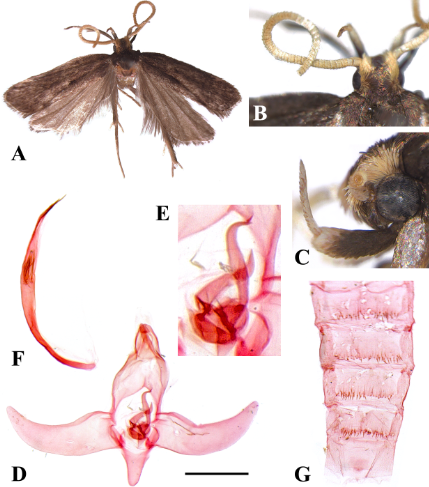
Type of specimen: Holotype: male, Tanzania, Tanga, Amani, E. Usambaras, Sigi River, 2000 m, 15 viii 2000, DJL Agassiz, gen. slide no. CIS-7569.
Diagnosis: The new species is superficially similar to P. tangaensis Park, 2022 which was described from the same locality of the latter, but it can be distinguished by the male genitalia: uncus less elongated, not exceeded the basal plate of gnathos (exceeded the basal plate of gnathos in P. tangaensis); valva less elongated, shorter; caudal processes of juxta slender, shorter, asymmetrical with different lengths; aedeagus narrowed in basal 1/3 with a bundle of cornuted medially (narrowed in basal 1/6, without cornutus in P. tangaensis). The species is also similar to P. ocullela Park & Koo, 2021 hitch was described from Kenya, but it is much smaller in size (via. wingspan 14.0 mm), forewing lacking orange-white discocellular spot, and the male genitalia are also differentiated by the larger caudal processes of the juxta.
Description: Male (Figures 1A-C). Wingspan 11.0 mm.
Head: Vertex dark brown with orange-white erect scales laterally. Antenna thick, orange white, shorter than forewing length. Labial palpus slightly upturned; 2nd segment thickened, covered with dark brown scales in basal 3/4, yellowish white beyond on outer surface; 3rd segment strongly upturned nearly same length as 2nd segment, yellowish white speckling with brown scales ventrally. Thorax: Dark brown dorsally, Forewing slightly dilated distally; ground color dark brown uniformly, with a small, wedge-shaped costal patch at 3/4 of costa; no distinct discal spots; costa slightly arched at basal 1/4, then nearly straight; apex more or less rounded; termed oblique, slightly concave; fringe concolorous with narrow yellowish-white basal line; venation with M2 present, CuA1 and CuA2 short-stalked. Hindwing broader than forewing, grey, with M2 absent. Abdomen: Spinous zones well-developed on upper surface, spines densely arranged in a row along posterior margin.
Male Genitalia (Figures 1D-F): Uncus elongate, nearly parallel sided beyond middle, with round apex. Gnathos
basal plate more or less ovate with rounded apex; median process small, slender, with sharply pointed apex. Valva with expansion basally on costa elongate; cucullus elongated, narrowed toward apex, upturned; costa concave, heavily sclerotized along margin, with sharply produced apex, ventral margin gently arched. Juxta rather small; caudal processes, slender, twisted pre-apically, symmetrical, with sharply pointed apex, extending to half of tegumen with longer; Vinculum with elongated saccal zone. Aedeagus very slender, much longer than valva+cucullus, narrowed in basal 1/3, broadened medially, then narrowed to apex, with a row of long hairs in apical 1/5; cornuti consisting of a bundle of short, broom-like setae medially. Distribution: Tanzania (Tanga).
Etymology: The species name is derived from the Latin, - circuli (= circular), referring to the circular aedeagus of the male genitalia.
• Protolychnis amaniensis Park, sp. nov. LSID: urn: lsid: zoobank.org: act: 988E3E98-4864-4190- A74C-2953A65C65EC (Figure 2).
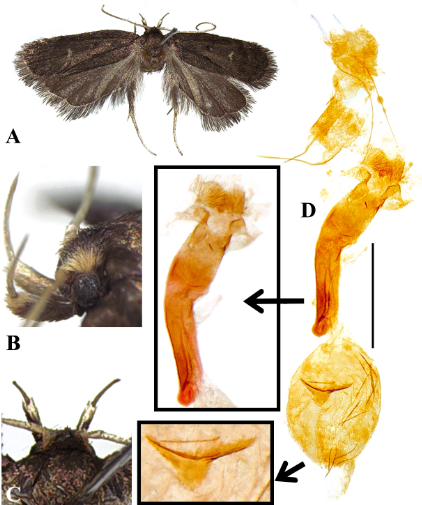
Type specimen: Holotype: female, Tanzania, Tanga, Amani (5°6’2”S 38°39’10’’E), 1500 ft, 25 iv 2001, DJL Agassiz, gen. slide no. CIS-7579.
Diagnosis: The new species is similar to P. maculata Walsingham, 1881 which was described from S. Africa and also known in Tanzania, but it can be distinguished from the latter: forewing with rounded black discal spot and small yellowish-white reniform stigma, lacking codtal patch, whereas in P. maculata, forewing with yellowish-white discal spot and larger, elliptical spot near end of cell; with small wedge-shaped orange-white costal patch beyond 3/4 of costa. The female genitalia can also be distinguished by the ostium bursae more deeply concave, as in U-shape;
conjunction between antrum and ductus bursae not well defined, connected with heavily sclerotized ductus bursae, about 2/3 the width of antrum (ductus bursae sclerotized in distal half, narrow in P. maculata). The new species can be distinguished from Protolychnis circuliella Park, sp. nov. by the larger size (via. Wingspan 11 mm of P. circuliella); the antenna not thickened as much as the latter; the forewing without wedge-shaped costal patch, with large, black discal spot and orange-white reniform stigma, apex rounded; and termen convex.
Description: Female (Figures 2A-C). Wingspan 14.0 mm. Head: frons dark brown; vertex dark brown, with orange- white erect scales laterally. Antenna with elongated scape, yellowish white all around; flagellum yellowish white throughout. Labial palpus strongly upturned; 2nd segment thickened, dark brown in basal 3/4, orange white beyond; 3rd segment slender, strongly upturned, yellowish white entirely, sharply pointed apically, longer than 2nd segment. Thorax: Tegula and thorax fuscous yellowish brown dorsally, Forewing broadened, nearly parallel-sided; ground color fuscous yellowish brown uniformly, with black discal spot at middle, small, yellowish white reniform stigma near end of cell; costa arched at basal 1/4, nearly straight medially; apex rounded; termen convex; fringe concolorous with ground color. Hindwing broader than forewing, brownish grey. Abdomen: Spinous zones well-developed on upper surface, spines densely arranged in a row along posterior margin. Female genitalia: (Figure 2D): Eighth sternite deeply emarginated medially on posterior margin. Apophyses anterior long, slightly shorter than apophyses posteriores.
Ostium bursae deeply concaved into U-shape, with well- developed latero-caudal processes. Antrum long, tube-like, heavily sclerotized, about 2/5 the length of ductus bursae, slightly narrowed distally, no clearly defined conjunction between antrum and ductus bursae; ductus bursae heavily sclerotized, tube-like, in posterior 4/5, shortly membranous and twisted between sclerotized portion of ductus bursae and corpus bursae. Corpus bursae ovate; signum crescent, wider than the half width of corpus bursae, with a semi ovate, weakly sclerotized plate anteriorly. Distribution: Tanzania (Tanga). Etymology: This species name is derived from the type locality, Amani, Tanga Distr. in Tanzania.
Protolychnis morogoroensis Park & Koo, 2021 Protolychnis morogoroensis Park & Koo, 2021: 366 [8]. TL: Tanzania, Morogoro Distr. (Figure 3).
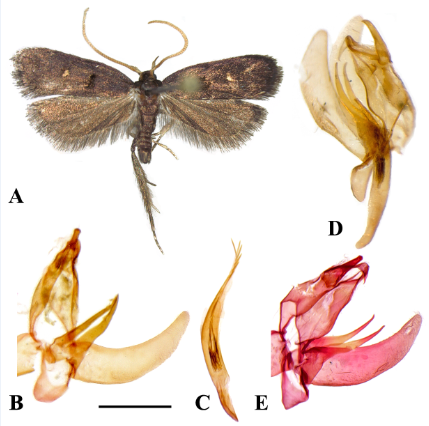
Diagnosis: Wingspan 16 mm. The male genitalia differ from those of P. petiliella Park, 2020 which was described from Uganda, by the semi-ovate saccus (narrowed in P. petiliella) and the shorter basal part of aedeagus (about half the length of aedeagus in P. petiliella. The female genitalia are also similar to those of P. petiliella but can be distinguished by the shorter antrum, membranous ductus bursae whereas in P.
petiliella it is sclerotized.
Male genitalia (Figures 3B-E): Uncus elongate, nearly parallel sided with sharply produced apex. Gnathos small, about half the length of uncus. Valva elongated, narrower toward apex; costa gently concave, with more or less rounded apex; ventral margin gently arched. Juxta with long, symmetrical processes, pointed apically, reaching to base of uncus. Saccus semi-ovate. Aedeagus slender, as long as valva; basal part about 1/3 of the total length, broadened beyond and taped toward apex, with a row of long spines in apical 1/5; apex sharply pointed; cornuti consisting of series of broom-like setae near middle.
Female genitalia: See Park & Koo (2021, Figures D-F) [9].
Material examined. 1m#, Tanzania, Morogoro Distr. & Town, Kihonda 550 m, 22 v 1992, leg. L. Aarvik, gen. slide CIS-7571; 1m#, Morogoro 1000 ft, 6 viii 2000, DJL Agassiz, gen. slide CIS-7574.; 2m#, Arumeru Usa River 1170 m, 2 & 11 ix 1991, leg. L. Aarvik, gen. slide CIS-7572; 1m#, same locality, 9 viii 1991, leg. L. Aarvik, gen. slide CIS-7577; 1m#, same locality, 11 ix 1991, leg. L. Aarvik.
Distribution: Tanzania (Morogoro).
Remarks: Protolychnis morogoroensis Park & Koo, 2021 was described based on a single female which was collected in Morogoro Distr. A male specimen from the same locality of the holotype was collected and there is no doubt that it is conspecific to P. morogoroensis. An additional specimen collected from near the type locality and three more from Arumeru Usa River were also conspecific. The male genitalia are described and illustrated.
Conflicts of Interest
The authors declare that there are no conflicts of interest.
Acknowledgements
We would like to thank Leif Aarvik, the Natural History Museum at the University of Oslo (Naturhistorisk Museum), Oslo, Norway, and D. Agassiz, UK for the loan of material collected from Tanzania. This research was supported by Basic Science Research Program through the National Research Foundation of Korea (NRF) funded by the Ministry of Education (2018R1D1A1B07042503).
References
-
Park KT, Prins WD (2019) A review of the Lecithoceridae (Lepidoptera: Gelechioidea) of southern Africa, based on type specimens deposited in the Ditsong National Museum of Natural History (TMSA), with descriptions of three new species. Zootaxa 4623(1): 61-89.
-
Park KT, Koo JM, Mey W (2019) Two new species of Homaloxestis Meyrick, 1910 (Lepidoptera: Lecithoceridae) from Uganda, with a checklist of the genus in the Afrotropical Region. Zootaxa 4658 (3): 591-
-
Park KT, Prins WD (2019) Re-examination of the type specimens of Lecithoceridae (Lepidoptera), deposited in Royal Museum for Central Africa, Belgium, with descriptions of three related species belonging to Torodora meyrick. Zootaxa 4571(4).
-
Park KT, Koo JM, Aarvik L (2019) Description of Corymbus Park, gen. n. with six new species from the Afrotropical Region (Lepidoptera: Lecithoceridae). SHILAP Revista de leipidopterologia 47(188): 657-672.
-
Park KT, Koo JM (2020) Two new species of Protolychnis Meyrick, 1925 (Lepidoptera, Lecithoceridae) from the Afrotropical Region, with a world checklist of the genus. Zootaxa 4759(2): 269-276.
-
Park KT, Prins JD, Prins WD (2021) A checklist of Lecithoceridae (Lepidoptera: Gelechioidea) of the Afrotropical Region. Journal of Asia-Pacific Biodiversity 14(3): 355-370.
-
Park KT, Cho S (2021) Four new species of Thubdora Park, 2018 and one new species of Torodora Meyrick, 1894 (Lepidoptera, Lecithoceridae, Torodorinae) from Tanzania. Zootaxa 5068(3): 399-409.
-
Park KT, Koo JM (2021) A new genus Viperinus Park with descriptions of two new species, and two new species of the genus Protolychnis Meyrick, 1925 (Lepidoptera, Gelechioidea, Lecithoceridae) in Kenya and Tanzania, with a checklist of the world species. Zootaxa 4985(3): 359-370.
-
Park KT, Koo JM (2022) Three new species of the subfamily Torodorinae (Lepidoptera, Lecithoceridae) from Tanzania. International Journal of Zoology and Animal Biology 5(5).
-
Park KT, Cho S, Koo JM (2022) The subfamily Torodorinae of the world (Lepidoptera: Lecithoceridae), Seoul, National Institute of Biological Resources pp: 584.
-
Park KT, Aarvik L, Agassiz D (2023) Lecithocera murphyi-complex in Africa, with two new species from Tanzania and Zimbabwe (Lepidoptera: Lecithoceridae). Lepidoptera Novae 16(2): 81-86.
-
Walsingham TG (1881) On the Tortricidae, Tineidae, and Pterophoridae of South Africa. Transactions of the Entomological Society of London 29(2): 219-288.
- California Red-Legged Frog and Non-Listed Amphibians Response to Non-Native Fish Removal
- Industrial Standardization of the Bio-OS: Algorithmic Codification of Resilience Engineering Guidelines and Version V8 Architecture
- Climate Variability and the Sustainability of Snail Farming in Nigeria: Past Trends, Present Challenges and Potential Outlook
- The Evaluation of the Surveillance System of Anthrax in Gilgit-Baltistan, Pakistan, 2018
- Natural Decline to Extinction of A New Zealand Rabbit Population
- Mitochondrial Bio-Logistics: Steering Co-Enzyme Q10 and Lycopene Synergies within the Science 4.0 Bio-OS Framework