
Six New Species of the Family Lecithoceridae (Lepidoptera) from Ghana
The family Lecithoceridae is still one of the poorly known groups in the Afrotropical Region. In Ghana, only eight species of the family have been known so far. In this article, six new species of Lecithoceridae are described from Ghana: four species of the subfamily Lecithocerinae: Lecithocera minutiella Park, sp. nov.; Homaloxestis dallastai Park, sp. nov.; H. nuriana Park, sp. nov., and Pectinimura bongoensis Park, sp. nov.; and two species of the subfamily Torodorinae: Thubdora laticucullusa Park, sp. nov. and T. nubidiella Park, sp. nov. In addition, T. ambliodes Park, 2018 which was described from Cameroon is reported for the first time from Ghana. Images of adults and the genitalia of all known species are provided.
Introduction
Ghana is located in western Africa, and is bordered by Rep. of Côte D’Ivoire to the West, Rep. of Togo to the East, and Burkina Faso (= Haute Volta) to North, with 23,850,000 ha of the land occupied by tropical rain forest (Figure 1). The country is one of the most poorly explored areas of the world with regards to species diversity, especially small sized insects and other micro-organisms. The taxonomic study of the lecithocerid moths in Ghana is not an exceptional case. The family Lecithoceridae (Lepidoptera: Gelechioidea) is still poorly known in the Afrotropical Region, but it is a highly diverse Microlepidoptera family with more than 1,430 described species worldwide [1]. Since a check list of the family Lecithoceridae of Afrotropical Region was published with 179 known species belonging to the family (68 species of the subfamily Lecithocerinae and 111 species of the subfamily Torodorinae) was published by Park & Cho [2] 26 new species of the family were additionally described from the Afrotropical Region: four new species of Thubdora and one new species of Torodora from Tanzania by Park, et al. [3] a new species of Spiniola Park and three new species of Torodora Meyrick from Malawi, Kenya and Uganda by Park & Cho [4] and additional three new species belonging to Protolynchus, Thubdora and Torodora from Tanzania by Park, et al. [5] five new species of Torodorinae from Bioko Island (Equatorial Guinea) by Park & Karisch [6] and nine new species of Lecithoceridae including one new species of Lecithocerinae from Côte d’Ivoire by Park, et al. [7]. The new species described in the present paper were carefully compared with the previously described species from the above mentioned adjacent territories from Ghana by the superficial and genital characters (Figure 1).
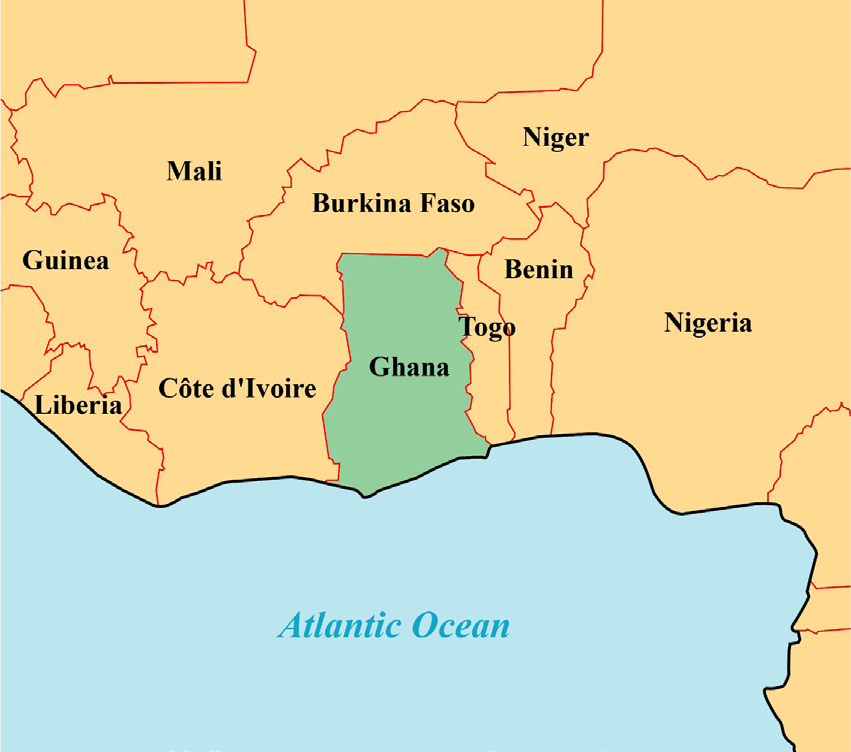
Consequently, 69 species of the subfamily Lecithocerinae and more than 130 species of the subfamily Torodorinae have been reported from the Afrotropical Region. Among these known species, only two species of the subfamily Lecithocerinae and six species of the subfamily of Torodorinae have been known in Ghana (Table 1).
| Subfamily/Genus/Species | Type localty (TL). [Depository of the holotype] |
|---|---|
| LECITHOCERINAE | |
| Homaloxestis Meyrick, 1910 | |
| dallastai Park, sp. nov. | TL: Ghana, Bia Natl. Park. [RMCA] |
| nuriana Park, sp. nov | TL: Ghana, Bia Natl. Park. [RMCA] |
| Lecithocera Herrich-Schaffer, 1853 | |
| prosoma Meyrick, 1914 | TL: Ghana, Gold Coast. [NHMUK] |
| minutiella Park, sp. nov. | TL: Ghana, Bia Natl. Park. [RMCA] |
| Paniculata Park, 2018 | |
| biaensis Park & Kim, 2021 | TL: Ghana, Bia Natl. Park. [RMCA] |
| Pectinimura Park, 2008 | |
| bongoensis Park, sp. nov | TL: Ghana, Bia Natl. Park. [RMCA] |
| TORODORINAE | |
| Dragmatucha Meyrick, 1908 | |
| ghanaensis Park, 2020 | TL: Ghana, Kakum. [NHMUK] |
| kakumensis Park, 2020 | TL: Ghana, Kakum Forest. [NHMO] |
| Ptilothyris Walsingham, 1897 | |
| enormisella Park, 2019 | TL: Ghana, Western Region. [NHMO] |
| purpurea Walsingham, 1897 | TL: Nigeria, Lagos. [NHMUK] |
| serangota Meyrick, 1932 | TL: Uganda, Kampala. [NHMUK] |
| Thubdora Park, 2018 | |
| ambliodes Park, 2018 (new record). | TL: Cameroon, Efulen. [CMNH] |
| bythota (Meyrick, 1916) (Onebalba). | TL: Ghana, Gold Coast. [NHMUK] |
| laticucullusa Park, sp. nov. | TL: Ghana, Bia Natl. Park. [RMCA] |
| nubidiella Park, sp. nov. | TL: Ghana, Bia Natl. Park. [RMCA] |
Table 1: A tentative check list of the family Lecithoceridae of Ghana.
Material and Methods
The present study is based on the material provided by the third author, Willy De Prins, Brussels, Belgium, which were collected from Ghana in 2009 and by U. Dall’Asta. The genitalia slide numbers are abbreviated as “gen. slide no.”. For descriptions, the wingspan was measured from the apex of the left wing to the apex of the right wing. The color standard for the descriptions of adults follows Kornerup, et al. [8].
Abbreviations for depositories are as follows: CMNH: Carnegie Museum of Natural History, Pittsburg, USA NHMO: The Natural History Museum, University of Oslo, Oslo, Norway NHMUK: The Natural History Museum, London, UK RMCA: Royal Museum for Central Africa, Tervuren, Belgium
Taxonomic Accounts
Subfamily Torodorinae
Genus Lecithocera Herrich-Shäffer, 1853
The genus Lecithocera is the most diverse genus in the family Lecithoceridae, with more than 300 species worldwide, but the genus is still poorly known in Africa, with less than 30 known species: seven species from South Africa [2]; 14 species from Central and East Africa (Sudan, DR Congo, Uganda, Kenya, Mozambique, and Malawi); six species from West Africa (Sierra Leone, Gambia, and Cameroon); and another two species have been known from Madagascar. However, only a single species, L. proroma Meyrick, 1914 has been reported from Ghana. On the other hand, most species of Lecithocera described by Viette from Madagascar (the types are deposited in MNHN) were transferred to Torodora or other related genera by Park, et al. [9]. The following new species is the second reported species from Ghana.
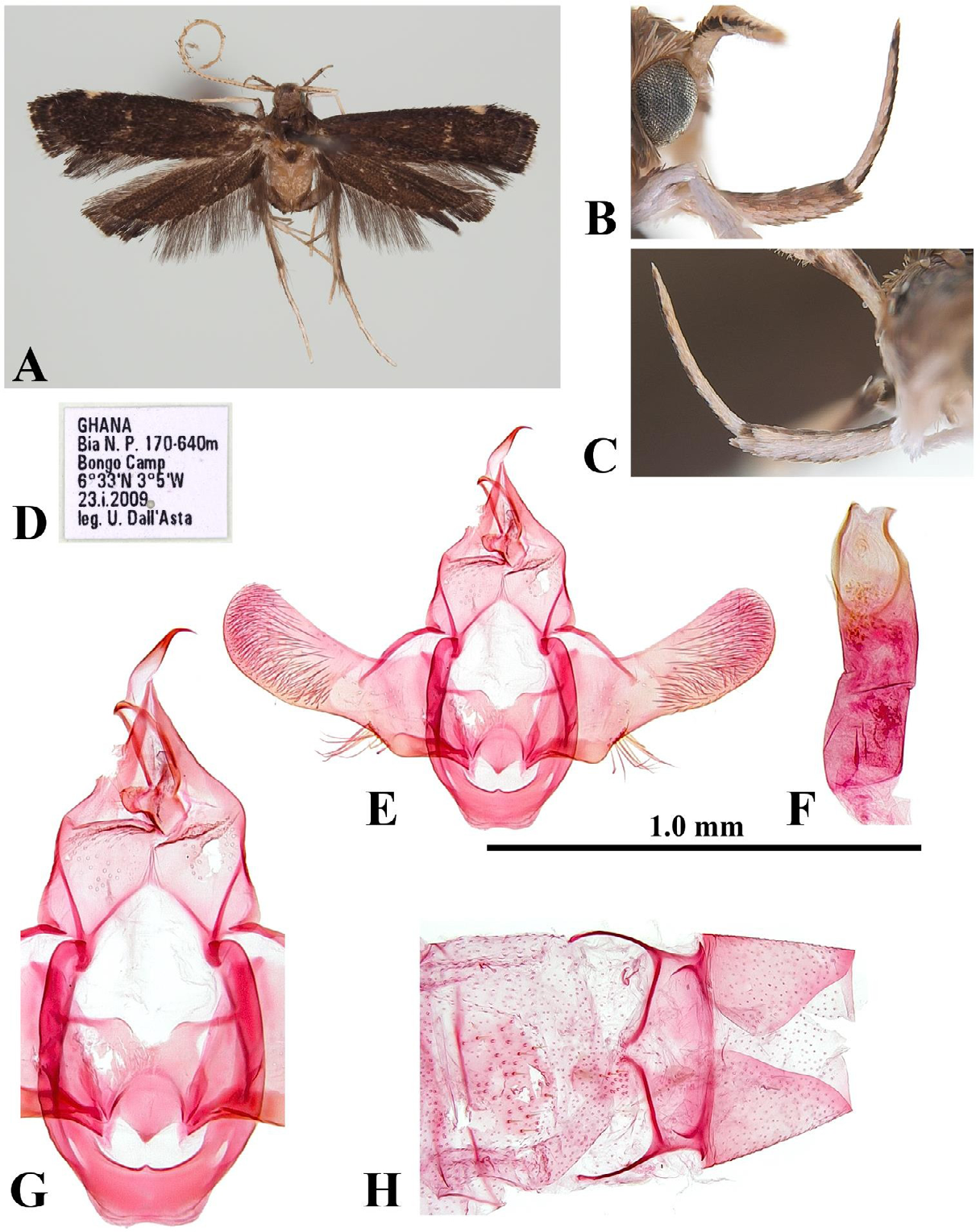
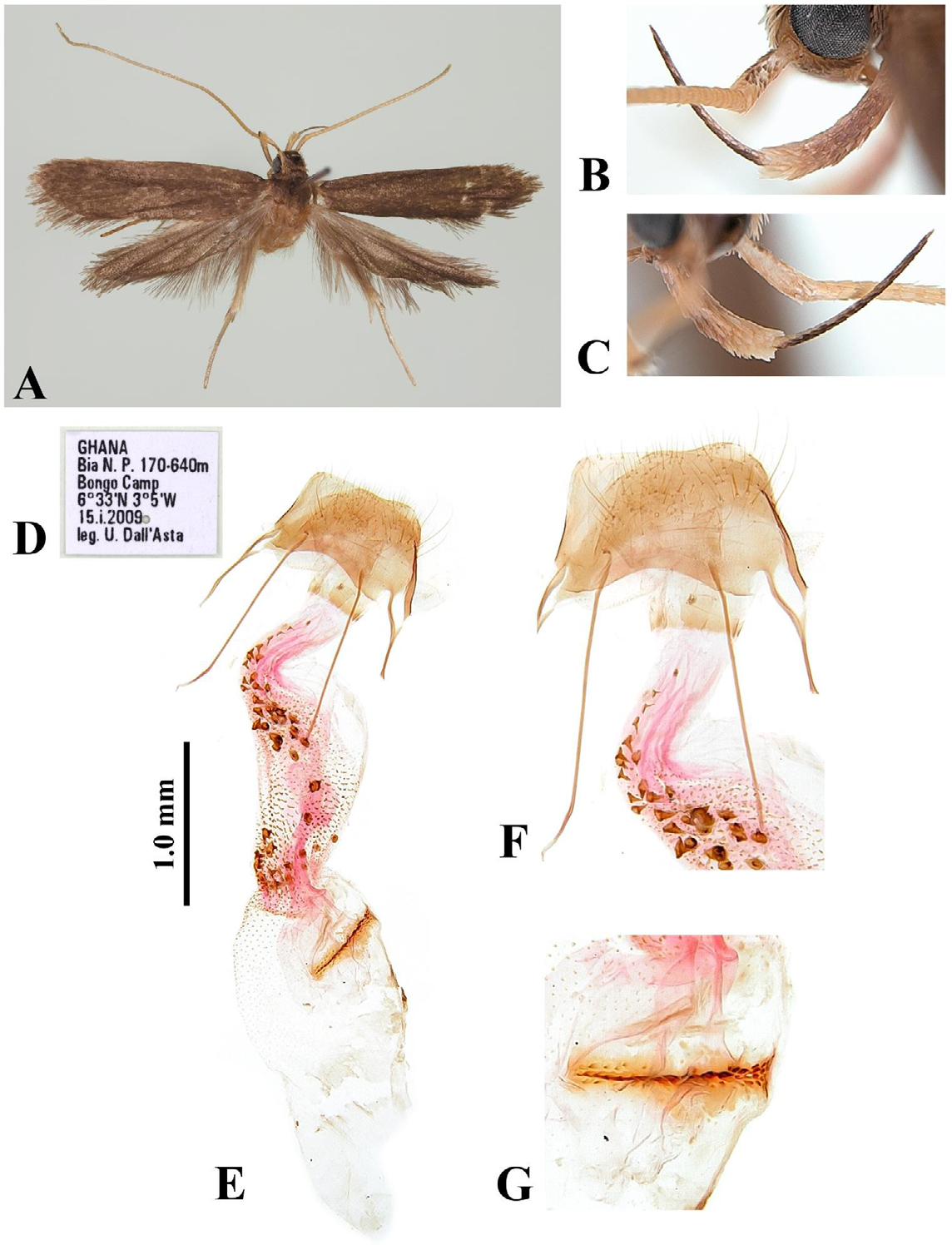
Lecithocera minutiella Park, sp. nov. LSID: urn:lsid:zoobank.org:act:F34C53AC-CC22-4B66-9756- 19AA3EB35D04 (Figure 2) Type specimen: Holotype: male, GHANA, Bia Natl. Park, 170–640 m, Bongo Camp, 6°33’N 3°5’W, 23 i 2009, leg. U. Dall’Asta, gen. slide no. CIS-s7498, in RMCA. Diagnosis: This new species is one of the smallest species of the genus, having a similar size as L. pauperella Rebel, 1917 known from Sudan, but can be distinguished by the dark- brown ground color of the forewing with a small orange- white costal patch beyond 3/4 of the costa, and in the male genital characters by the different shapes of the cucullus and the juxta; the cucullus broadened distally and the juxta not elongated. Description: Male (Figures 2A-2C). Wingspan 9.0 mm. Head:
vertex pale brownish orange, with erect brownish orange scales laterally. Antenna slightly longer than forewing; scape brownish orange dorsally and ventrally, yellowish white on anterior and posterior surface; flagellum shiny, yellowish white, dark-brown annulations dorsally in about basal 2/3. 2nd segment of labial palpus slightly thickened, mustard brown on outer surface, yellowish white on inner surface; 3rd segment slender, slightly shorter than 2nd segment, dark brown ventrally (Figures 2B,2C). Thorax: Tegula and thorax mustard brown. Forewing even mustard-brown, with small, triangular yellowish-white costal patch at 3/4 of costa; costa slightly oblique from beyond 2/3; apex somewhat rounded; termen slightly oblique; fringe dark brown; Hind tibia with long, grayish scales ventrally. Hind wing same ground color as the forewing; apex sightly produced; termen oblique; Abdomen: pregenital segment of abdomen modified as in Figure 2H. Male genitalia (Figures 2E-2G): Basal lobes of uncus with ovate lateral arms, concave into V-shape. Mesial process of gnathos narrower toward apex; dorsal margin convex at basal 1/3, strongly bent pre-apically. Costal bar connecting tegumen and valva narrowly banded, nearly not angled medially. Tegumen broad with inverted V-shaped anterior margin. Valva broad basally; cucullus broad, slightly narrowed basally, costa nearly straight and rounded on outer margin; apex rounded; sacculus broadly developed, with median expansion in basal 1/4, bearing long setae beyond middle, terminated before lower corner of cucullus. Vinculum broad, with rounded apices; saccal zone truncated on anterior margin. Juxta with bird head-shaped latero-caudal processes; caudal margin deeply concave into U-shape; anterior margin triangularly produced. Aedeagus stout, as broad as cucullus; ventral margin deeply concave in distal 1/3 with sclerotized margin; cornutus absent. Female unknown. Distribution: Ghana. Etymology: The species name is derived from Latin, minutus (= small), referring to the small size.
Genus Homaloxestis Meyrick, 1910
The genus Homaloxestis Meyrick [9] is an Oriental genus, comprising more than 50 described species worldwide. In Africa, five species of the genus have been known, excluding three previously described species of the genus from Africa [2]: Homaloxestis lophophora Janse, 1954 (Cameroon, DR Congo, Gabon, Kenya, South Africa, Tanzania, and Uganda); H. subpallida Meyrick, 1931 and H. rawlinsi Park, 2018 from Cameroon; and H. arcuatus Park & Mey, 2019 and H. lactizonalis Park & Mey, 2019 from Uganda. However, no species has been reported from Ghana. The following new species is the first known species from Ghana.
Homaloxestis dallastai Park, sp. nov. LSID: urn:lsid:zoobank.org:act:896BEC2E-13AC-475D- 8978-A7B8A6EB2C85 (Figure 3) Type specimen: Holotype: male, GHANA, Bia Natl. Park, 170–640 m, Bongo Camp, 6°33’N 3°5’W, 16 i 2009, leg. U. Dall’Asta, gen. slide no. CIS-7323, in RMCA. Diagnosis: The male genitalia are more or less similar to those of H. hades Gozmány, 1978 known from Asia minor and Turkey, but can be distinguished from the latter by its smaller size (18–20 mm in H. hades) and the forewing with orange- gray ground color (dark brown in H. hades), and in the male genitalia, the bowl-shaped juxta with heavily sclerotized latero-caudal processes arched inwardly. Description: Male (Figures 3A-3C). Wingspan 12.0 mm. Head: vertex creamy white, mixed with brownish scales, with pale orange-gray scale-tufts posteriorly. Antenna about 1.2 times longer than forewing; scape grayish orange dorsally, more brownish on ventral surface; flagellum shiny, yellowish white, without annulations, orange gray in apical 1/10. 2nd segment of labial palpus thickened, brownish orange on outer surface; yellowish white on inner surface; 3rd segment slender, longer than 2nd segment, with brownish scales ventrally (Figures 3B-3C). Thorax: Tegula and thorax brownish orange. Forewing with orange-gray ground color; costa oblique from beyond 2/3; apex produced, somewhat acute; termen very oblique; fringes concolorous; M2 present; R3, and R4 stalked from beyond 2/3; R5 to termen; M2, M3 and CuA1 free basally; CuA2 free from CuA1. Hind tibia with long, yellowish-white scales. Hind wing pale grayish; apex sharply produced; termen oblique; venation with well-developed M2. Abdomen: a pair of long hair-pencils well developed, as long as segment VIII (Figure 3H).
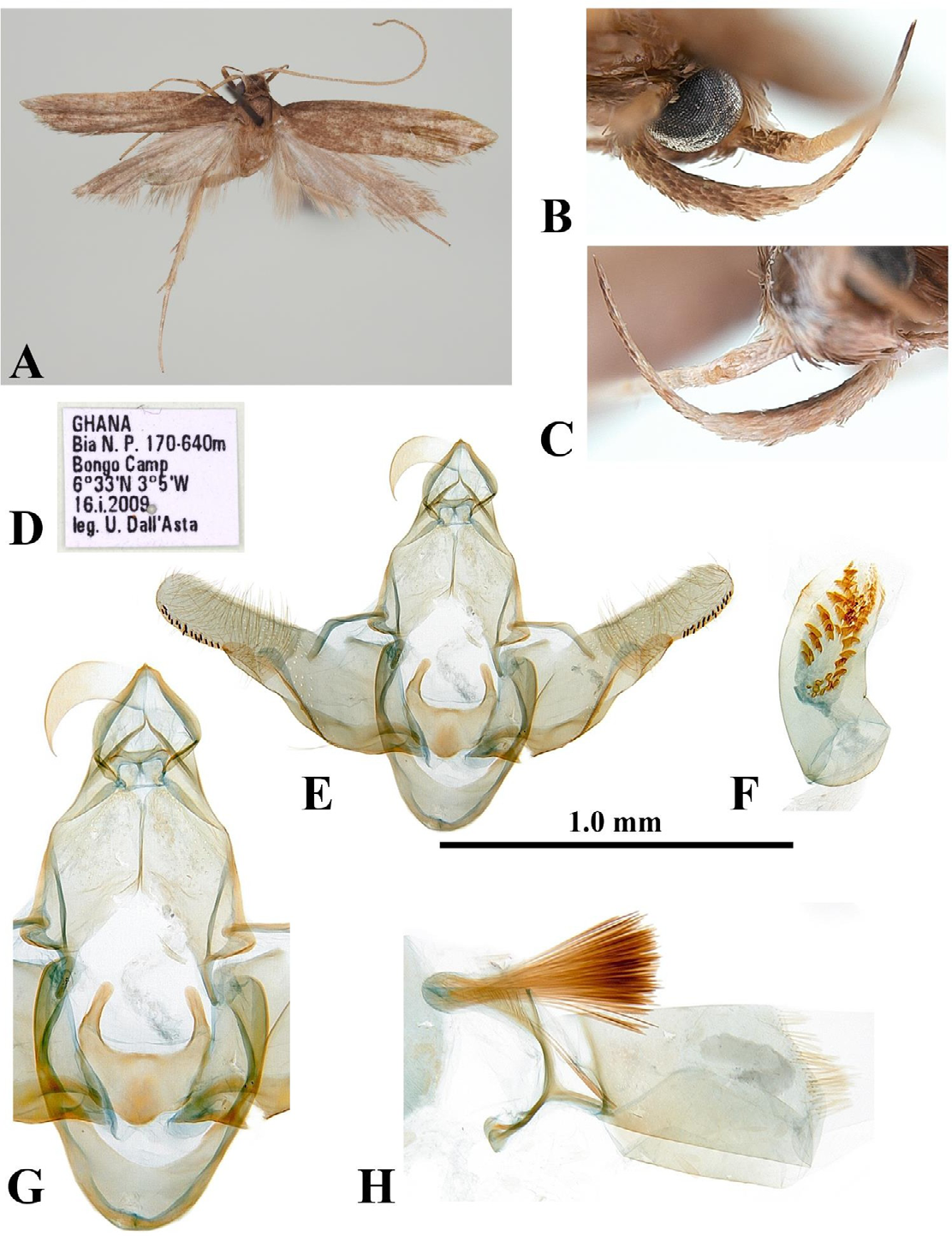
Male genitalia (Figures 3E-3G): Basal lobes of uncus relatively small. Gnathos strongly arched on along dorsal margin. Costal bar band-like, angled medially. Valva broad basally; cucullus elongated, nearly parallel sided, with nearly straight costal margin, with numerous short, conical spines along ventral margin and rounded apex; sacculus broadly developed, reaching to lower corner of cucullus, followed by semi-ovate protrusion at lower corner of cucullus; apex round. Juxta bowl-shaped, with a heavily scerotized, digitated latero- caudal processes, slightly curved inwardly; caudal margin slightly convex at middle; anterior margin roundly produced. Aedeagus stout, broader basally (apical part broken), with arched dorsal margin; cornuti consisting of two rows with numerous strong conical spines, longer than 2/3 the length of aedeagus. Female unknown. Distribution: Ghana. Etymology: The specific epithet honors Dr. U. Dall’Asta who collected the type specimen.
Homaloxestis nuriana Park, sp. nov. LSID: urn: lsid:zoobank.org:act:83E974E0-BACE-4388- BB24-0E549747BE67 (Figures 4 & 5) Type specimen: Holotype: male, GHANA, Bia Natl. Park, 170–640 m, Bongo Camp, 6°33’N 3°5’W, 18 i 2009, leg. U. Dall’Asta, gen. slide no. CIS-7509, in RMCA. Paratypes: 1m#, 1f#, same locality and collector, 15 i 2009, gen. slide no. CIS- 7324 (m#), CIS-7511(f#), in RMCA. Diagnosis: This species is one of the smallest species of the genus and is similar to T. pumilis Park, 2004, but it can be distinguished by the male genitalia as follows: uncus smaller, costal margin of cucullus gently arched (strongly protruded basally in H. pumilis), ventral margin nearly straight, and ventral process stronger, not sharply pointed (the margin convex medially and the ventral process shorter and sharply pointed in H. pumilis). Description: Adults of both sexes (Figures 4A-4C & 5A-5C). Wingspan 10.5–11.5 mm. Head: vertex brownish orange dorsally, with orange-white, erect scales laterally. Antenna
longer than forewing, about 1.2 times; scape grayish brown dorsally and ventrally, yellowish white anterior and posterior surface; flagellum yellowish white, without annulations. 2nd segment of labial palpus thickened, brownish orange on outer surface, yellowish white on inner surface; 3rd segment slender, as long as 2nd segment, slightly arched (Figures 4B,4C & 5B,5C). Thorax: Tegula and thorax brownish orange. Hind tibia with long, yellowish-white rough scales dorsally, grayish scales ventrally. Forewing ground color brownish orange evenly; costa nearly straight, yellowish orange along costal margin; apex slightly produced; termen very oblique; fringes concolorous; M2 present; R4 and R5 short stalked; R5 to termen; CuA2 arising from near corner of cell. Hind wing pale grayish white; apex sharply produced; termen oblique; venation with well-developed M2. Abdomen: abdominal segment VIII of male illustrated in Figure 4J. Male genitalia (Figures 4E-4I): Basal lobes of uncus slightly concave on caudal margin. Basal plate of gnathos elongated. Costal bar banded, angled medially. Cucullus with gently arched costal margin; ventral margin nearly straight with numerous spines along margin, with strong, heavily sclerotized process at lower corner, slightly upturned apically, not sharply pointed; basal part of valva divided with cucullus by a narrow, slightly curved line. Sacculus broadly developed, weakly sclerotized, not reached to median process. Juxta relatively small, with latero-caudal process. Vinculum broad in saccal zone. Saccus produced anteriorly. Aedeagus stout, bent in basal 1/3; cornuti consisting of two rows of numerous conical spines which different sized. Female genitalia (Figures 5E-5G): Apophyses anteriores about half the length of apophyses posteriors. Abdominal sternite VIII slightly concave medially. Antrum short, broadened, with sclerotized band along anterior margin. Ductus bursae narrowed in distal 1/4, broadened in anterior 3/4, with numerous conical spines; ductus seminalis arising from distal part of the broadened bursae. Corpus bursae large, ovate; signum linear plate with denticles in right half, about half width of corpus bursae, positioned in distal 1/3. Distribution: Ghana. Etymology: The specific name is derived from a Korean term, nuri, meaning “the world” in English.
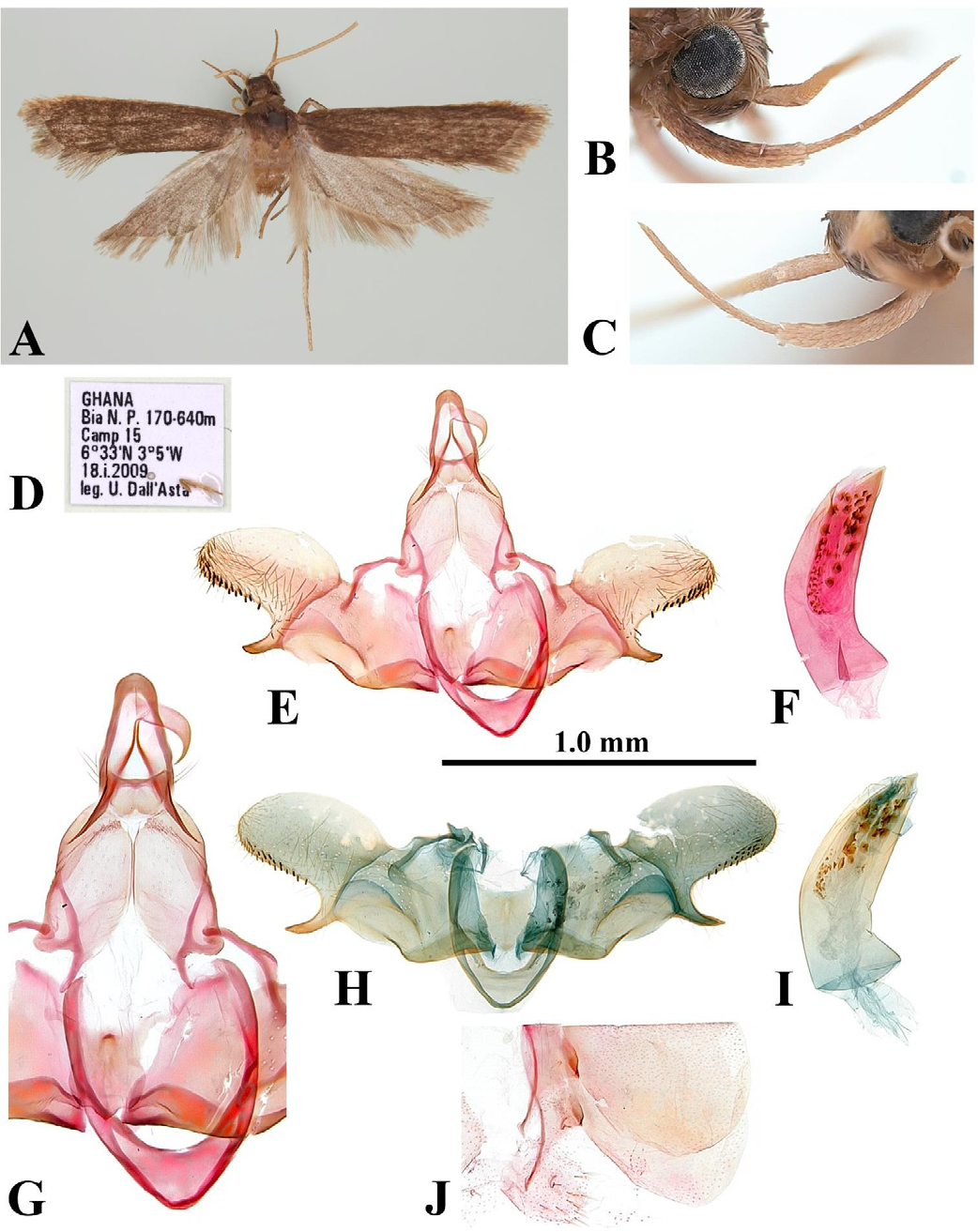
Figure 4: Homaloxestis nuriana Park, sp. nov.: A, adult, male, holotype; B, outer surface of labial palpus; C, inner surface of labial palpus; D, label; E, male genitalia of holotype, slide no. CIS-7509; F, ditto, aedeagus; G, close-up central part of genitalia; H, male genitalia of paratype, slide no. CIS-7324; I, ditto, aedeagus; J, abdominal segments VII–VIII, holotype. Scale bar: 1.0 mm.
Genus Pectinimura Park, 2008
The genus Pectinimura Park, 2008 is related to Lecithocera Herrich-Schäffer, 1853 belonging to the subfamily Lecithocerinae. The genus is characterized by the male genitalia with a comb-like plate on the valva. The distributional range of the genus is concentrated mostly in the Oriental and Oceanian regions, comprising 13 known species from both regions, but recently a new species was described from Côte-d’Ivoire, Africa by Park, et al. [7]. The following new species is the second known species of the genus from the Afrotropical Region.
Pectinimura bongoensis Park, sp. nov. LSID: urn:lsid:zoobank.org:act:03DE0523-DFA2-4813- BC91-28BB3B3EAB16 (Figure 6) Type specimen: Holotype: male, GHANA, Bia Natl. Park, 170–640 m, Bongo Camp, 6°33’N 3°5’W, 22 i 2009, leg. U. Dall’Asta, gen. slide no. CIS-7507, in RMCA. Diagnosis: This new species can be easily distinguished from Pectinimura paraliberalis Park & Karisch which was described from Côte d’Ivoire, by the antenna without clavate segments in the basal part of the flagellum, the second segment of labial palpus lacking rough scale-tufts ventrally, and in the male genitalia by the extremely broadened distal part of the cucullus. Description: Male (Figures 6A-6C). Wingspan 11.0 mm. Head: vertex grayish orange dorsally, with orange-white, erect scales laterally. Antenna (broken in apical part); scape elongated, much broadened in distal half; flagellum yellowish white, with weak annulations. 2nd segment of labial palpus thickened, slightly dilated distally with more rough scales apically, brownish orange on outer surface; 3rd segment more or less thickened basally, as long as 2nd segment, brownish orange on outer surface (Figures 6B, 6C). Thorax: Tegula and thorax grayish orange. Hind tibia without rough scales dorsally. Forewing ground color pale grayish orange evenly, without any markings; costa nearly straight; apex obtuse; termen oblique, with some black scales along margin in basal half; fringes concolorous. Hind wing ground color as same as that of forewing; apex produced; termen oblique; venation with well-developed M2. Abdomen: abdominal segment VII with long hair-pencils; sternite VIII illustrated in Figure 6H.
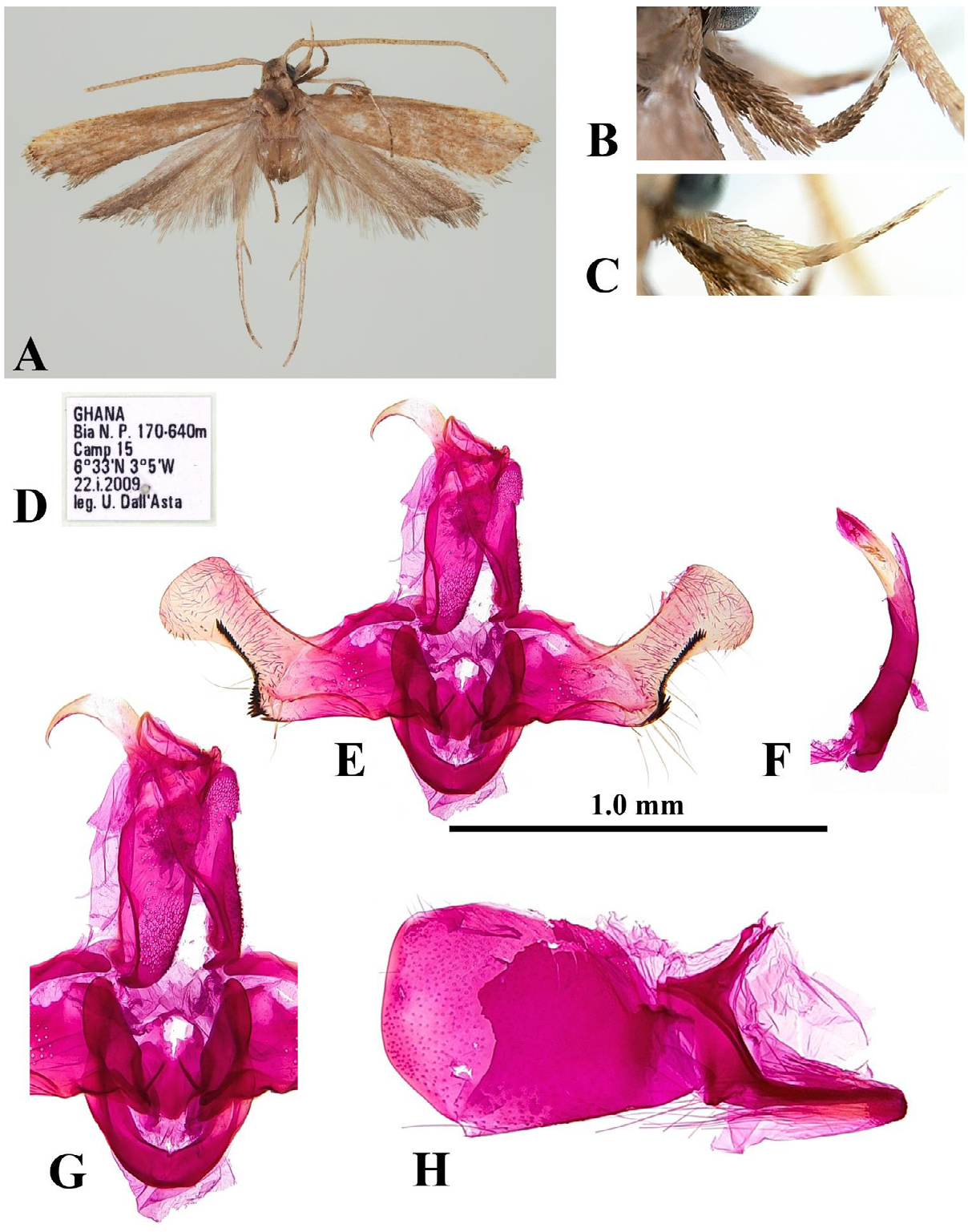
Male genitalia (Figures 5E-5G): Basal plate of uncus weakly developed. Median process of gnathos gently arched downwardly. Costal bar broad slightly angled beyond middle. Tegumen emarginated into inverted V-shape anteriorly. Cucullus broadened distally with round outer margin; costal margin slightly concave; ventral margin roundly concave with rounded protrusion at base; pectinate plate with short combs, arising from base of basal protrusion to about basal 2/3 centrally; sacculus extended to median protrusion. Vinculum connected broad, large elliptical plate distally. Juxta small, with ovate latero-caudal lobes. Aedeagus very slender, slightly arched, broad basally, sharply pointed apically; dorsal margin sharply produced. Female unknown. Distribution: Ghana.
Etymology: The specific name is derived from the type locality. Remarks: Recently a new species, Pectinimura paraliberalis Park & Karisch, 2022, was described from Côte d’Ivoire [7] for the first time from Africa.
Subfamily Torodorinae
Genus Thubdora Park, 2018 Since the genus Thubdora Park, an Afro-tropical genus, which was described based on T. acutalis Park, 2018 from Congo Rep., 44 species have been listed as Afrotropical species, including 39 newly described species by Park and his co-authors after 2028. The genus is characterized by the forewing venation with M3, CuA1, and CuA2 on a common stalk. Only a single species, Thubdora bythota (Meyrick, 1916) has been known in Ghana [1]. The following three new species are reported for the first time.
Thubdora laticucullusa Park, sp. nov. LSID: urn:lsid:zoobank.org:act:68BA36EF-9141-4540- AEBB-7A26D4FC35F8 (Figure 7) Type Specimen: Holotype: male, GHANA, Bia Natl. Park, 170–640 m, Bongo Camp, 6°33’N 3°5’W, 23 i 2009, leg. U. Dall’Asta, gen. slide no. CIS-7322, in RMCA. Diagnosis: This species can be distinguished from its congeners by the male genitalia with the cucullus broadly expanded in distal half and rounded apically. The male genitalia are more or less similar to those of T. biocoica Park & Karisch, 2021, which was described from the Island of Bioko, Equatorial Guinea, but can be distinguished by the uncus broadened triangularly, cucullus narrowed in basal half and broadened distally, juxta with ovate median plate, and aedeagus without spine apically, whereas in T. biocoica the uncus is bifurcated apically, the cucullus is nearly parallel-sided, the median process of the juxta is long and very sharply pointed apically. Description: Male (Figures 7A-7C). Wingspan 11.5 mm. Head: grayish brown dorsally with yellowish-white erect scales laterally. Antenna as long as forewing; scape elongated, yellowish white all around; flagellum shiny, yellowish white, without annulations, orange gray in apical 1/4. 2nd segment of labial palpus thickened, yellowish white on both surfaces; 3rd segment slender, as long as 2nd segment, with deep grayish brown scales ventrally (Figures 7B,7C). Thorax: Tegula and thorax brownish orange; metathorax with more rough scales. Forewing ground color mustard brown, scattered with dark brown scales evenly; costa arched in basal 1/4, with small yellowish white costal patch at 3/4, strongly oblique beyond; apex obtuse; termen oblique; fringes concolorous; M2 present; M3, CuA1, and CuA2 on a common stalk. Hind tibia with long, yellowish-white scales. Hind wing grayish brown; apex sharply produced; termen oblique, concaved medially; venation with M3 and CuA1 stalked for basal 1/3. Abdomen: spinose zones well-developed on tergites, with a pair of long hair-pencils, about 1.5 times the length of segment VIII; tergite VIII with a heavily sclerotized, more or less V-shaped plate (Figure 7H).
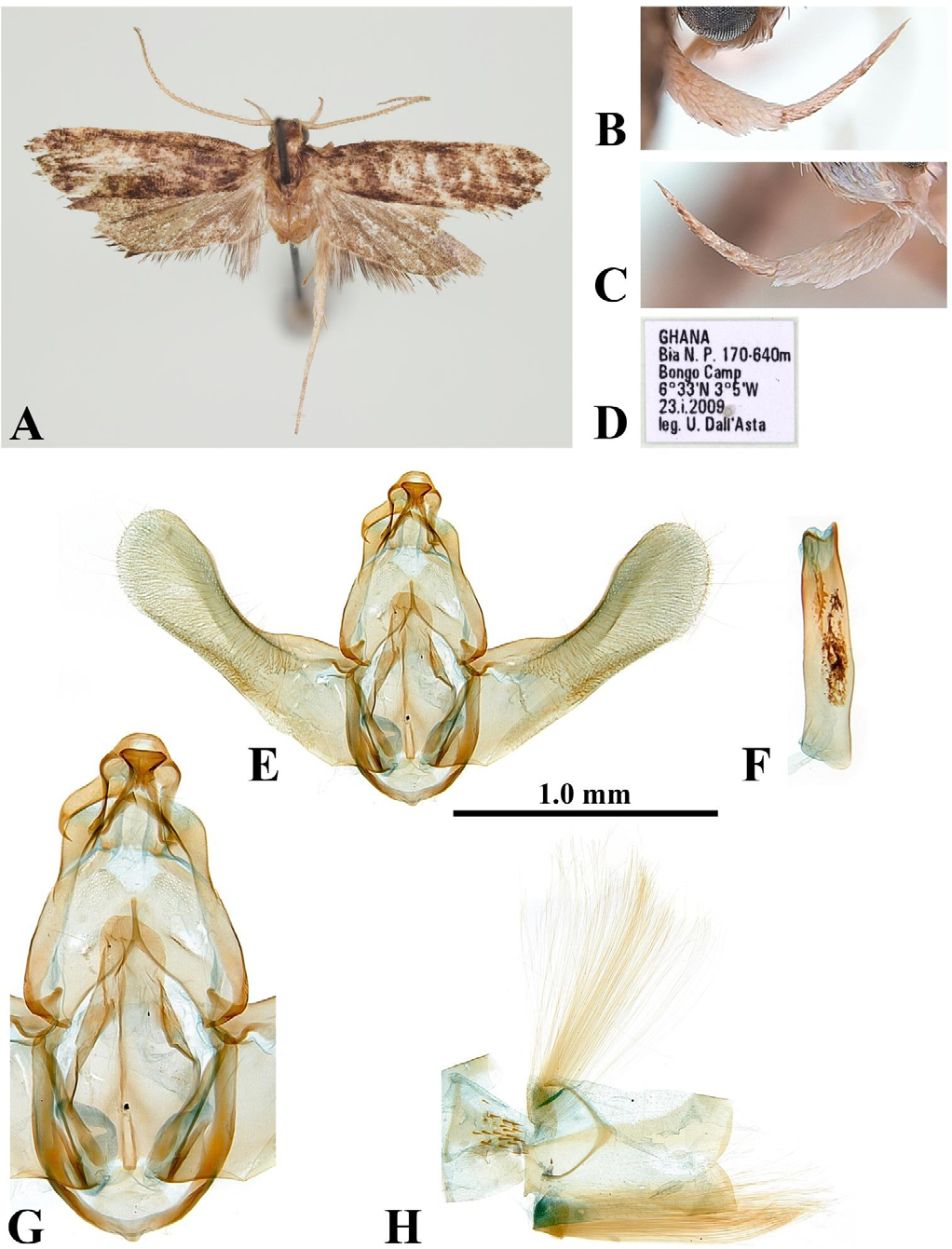
Male genitalia (Figures 7E-7G): Uncus triangular in distal 1/4; caudal margin nearly straight. Basal plate of gnathos hat-shaped, apical part as wide as uncus. Tegumen broad, with sclerotized lateral margins. Valva with short basal part, about 2/3 the length of cucullus; costa arched basally; cucullus long, more or less spatulate, broadened in distal half. With rounded apical margin. Vinculum narrow, banded; saccal zone not developed. Juxta extremely large, long with ovate median plate, extended to middle of tegumen, with central linear ridge arising from about basal 1/3 to caudal margin. Aedeagus stout, nearly straight, about 2/3 the length of valva, dorsal margin slightly produced apically, concave on apical margin; cornuti consisting of a crescent plate, about 1/4 the length of aedeagus, with 5–6 conical spines, beyond half; numerous minute spines irregularly clustering from basal 1/4 to 3/4. Female unknown. Distribution: Ghana. Etymology: Named from the Latin, lati (= broad), referring to the broad cucullus in the male genitalia.
Thubdora nubidiella Park, sp. nov. LSID: urn:lsid:zoobank.org:act:36E73776-FE3E-42D5- 9A45-A1804529DD47 (Figure 8) Type specimen: Holotype: female, GHANA, Bia Natl. Park, 170–640 m, Camp 15, 6°33’N 3°5’W, 21 i 2009, leg. U. Dall’Asta, gen. slide no. CIS-7304, in RMCA. Diagnosis: This new species is similar to T. angustiala Park & Karisch, 2021, which was described from the island of Bioko, Equatorial Guinea, in the forewing pattern with small, triangular yellowish-white costal patch, but it can be distinguished by the female genitalia: ostium bursae more deeply concaved; antrum shortened with strongly convex on anterior margin; ductus bursae in distal half narrower than that of anterior half; signum with narrower plates (Figures 8E-8G), whereas in T. angustiala, the ostium bursae broader, gently concave; the antrum with gently arched anterior margin; the ductus bursae in distal half much broader than that of anterior half; and the signum with hood-shaped plates. It is also somewhat similar to T. cuneiformis Park & Karisch, 2022 which was described from Côte d’Ivoire, but the female genitalia can be easily distinguished by the nearly parallel sided ductus bursae of T. cuneiformis. Description: Female (Figures 8A-8C). Wingspan 14.0 mm. Head: dark brown dorsally, with yellowish-white erect scales laterally. Antenna as long as forewing; scape elongated, yellowish white on anterior and posterior surface, dark brown dorsally; flagellum yellowish white, densely covered with dark brown scales dorsally. 2nd segment of labial palpus thickened, brownish on outer surface, yellowish white on inner surface; 3rd segment slender, as long as 2nd segment, with dark-brown scales ventrally. Thorax: Tegula and thorax dark brown. Forewing ground color dark brown; costa with small yellowish white costal patch beyond 3/4, then slightly oblique; apex obtuse; termen oblique, sinuate; fringes concolorous; R3 stalked with R4+5 for basal 1/3; M3, CuA1, and CuA2 on a common stalk. Hind tibia with brownish scales dorsally; shiny, yellowish white ventrally. Hind wing grayish brown; apex slightly produced; termen oblique; venation with M3 and CuA1 stalked for basal 1/3. Abdomen: spinose zones broadly occupied medially on tergites (Figure 8H).
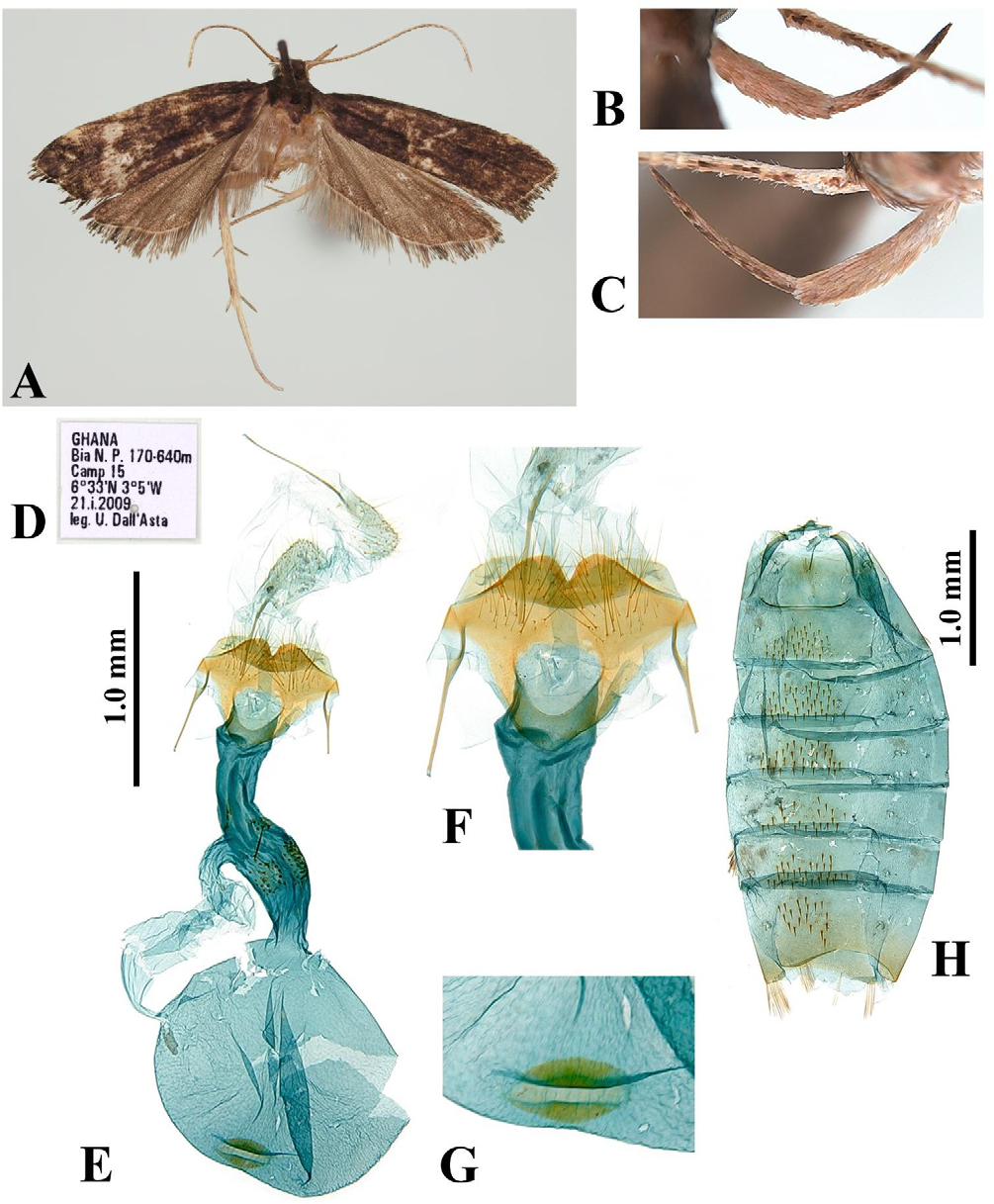
Female genitalia (Figures 8E-8G): Abdominal sternite VIII deeply emarginated into V-shape at middle. Ostium bursae deeply concave. Antrum shortened, weakly sclerotized, length about 1/4 of the width, with sharply pointed latero- caudal processes; anterior margin produced medially. Ductus bursae broad, more broadened in anterior half, with numerous minute conical spines, narrowed toward corpus bursae; ductus seminalis arising from near middle. Corpus bursae ovate; signum with lip-like plates anteriorly and posteriorly, divided by a broad transverse groove centrally, positioned anteriorly. Male unknown. Distribution: Ghana.
Etymology: This species name is derived from a Korean term, nubida, meaning “wondering” in English.
Thubdora ambliodes Park, 2018
Material Examined: 1f#, GHANA, Bia Natl. Park, 170–640 m, Camp 15, 6°33’N 3°5’W, 20 i 2009, leg. U. Dall’Asta, gen. slide no. CIS-7497, in RMCA (Figure 9) Diagnosis: Wingspan 14.0 mm. This species was described based on both sexes from Cameroon, and the female genitalia of the specimen collected from Ghana are well matched to this species, but the size is larger (11.0 mm of the holotype) than the type specimens of this species. It is considered that the larger size is its sexual variance and hence, we identify it as T. ambliodes.
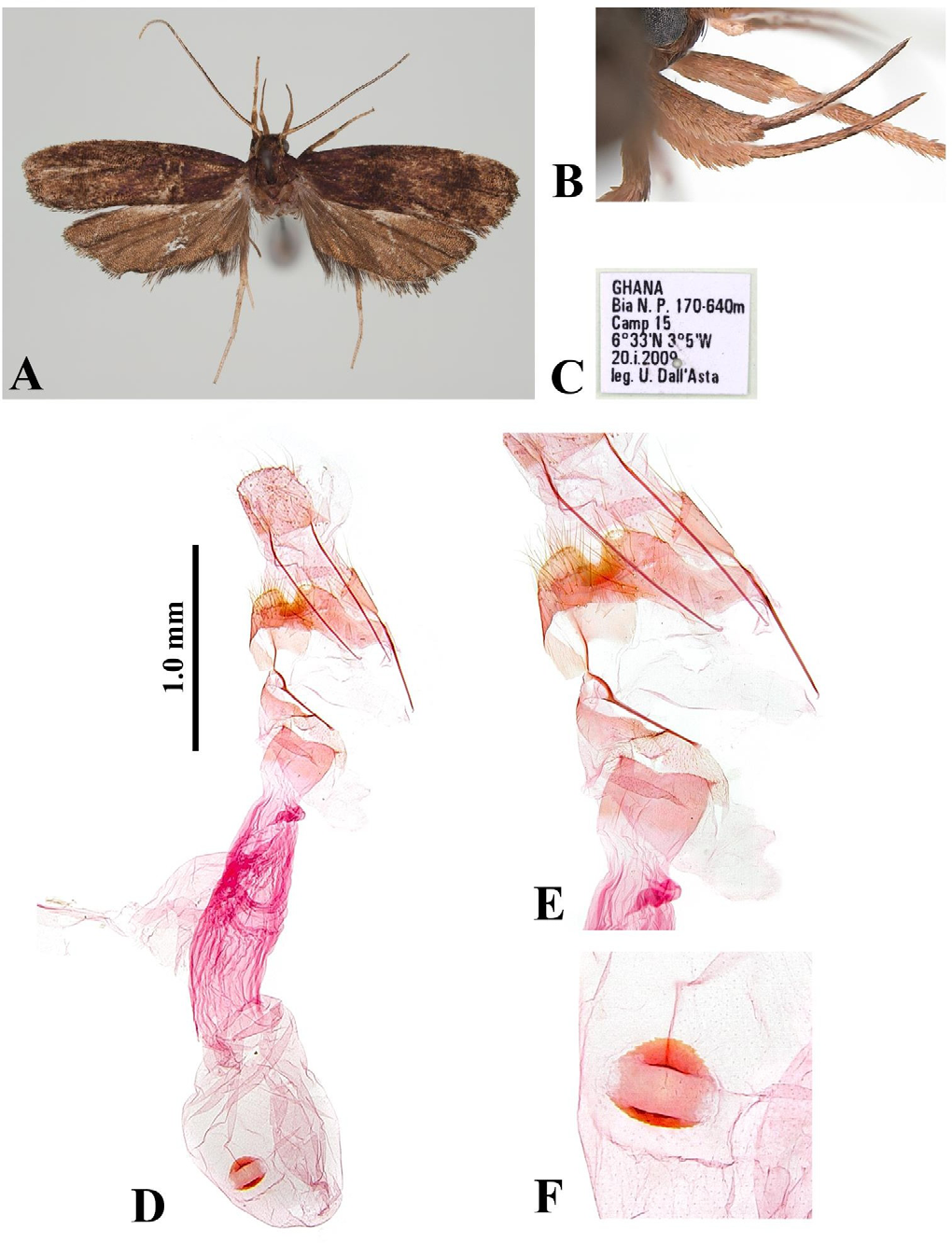
Female genitalia (Figures 9D-9F): See Park (Figure 2) [10]; Park, et al. (Figure 3E) [11]; Park, et al. [1]. Distribution: Cameroon, Uganda, Ghana (new record).
Acknowledgements
We are indebted to Mr. U. Dall’Asta who collected material from Ghana in 2009. We also would like to thank Stefan Kerkhof (Royal Belgian Institute of Natural Sciences) for intermediating in the loan of the specimens studied in this paper. This research was supported by Basic Science Research Program through the National Research Foundation of Korea (NRF) funded by the Ministry of Education (2018R1D1A1B07042503).
References
-
Park KT, Cho SW, Koo JM (2022) The subfamily Torodorinae of the world (Lepidoptera: Lecithoceridae). National Institute of Biological Resources, Incheon, Korea, pp: 1-584.
-
Park KT, De Prins J, De Prins W (2019) A checklist of Lecithoceridae (Lepidoptera: Gelechioidea) of the Afrotropical Region. Journal of Asia-Pacific Entomology 14(3): 355-370.
-
Park KT, Cho SW (2021) Four new species of Thubdora Park, 2018 and one new species of Torodora Meyrick, 1894 (Lepidoptera, Lecithoceridae, Torodorinae) from Tanzania. Zootaxa 5068(3): 399-409.
-
Park KT, Koo JM (2022a) Description of Spiniola hanaro Park, gen. and sp. nov., and three new species of Torodora Meyrick, 1894 (Lepidoptera, Lecithoceridae, Torodorinae) from the Afrotropical Region. Zootaxa 5092 (5): 576-586.
-
Park KT, Koo JM (2022b) Three new species of the subfamily Torodorinae (Lepidoptera, Lecithoceridae) from Tanzania. International Journal of Zoology and Animal Biology 5(5): 1-9.
-
Park KT, Yu TW, Karisch T (2021) The family Lecithoceridae (Lepidoptera, Gelechioidea) from Bioko Island (Equatorial Guinea), with descriptions of five new species. Zootaxa 4995(3): 581-593.
-
Park KT, Yu TW, Karisch T (2022) The family Lecithoceridae (Lepidoptera, Gelechioidea) from Ivory Coast (Republic of Côte d’Ivoire), with descriptions of nine new species. Zootaxa 5162 (4): 357-377.
-
Kornerup A, Wanscher JH (1978) Methuen Handbook of Color. In: 3rd (Edn.), Eyre Methuen, London, UK, pp: 1-252.
-
Park KT, Koo JM, Minet J (2020) Review of the Malagasy lecithocerid species described by Pierre Viette and deposited in MNHN (Paris), with new generic combinations and descriptions of a new subfamily and genus of Momphidae (Lepidoptera: Gelechioidea). Zootaxa 4845(2): 151-190.
-
Park KT (2018) A new genus Thubdora Park, sp. nov. and seven new species of the subfamily Torodorinae (Lepidoptera, Lecithoceridae) from Cameroon. J Asia- Pacific Entomol 21: 1085-1093.
-
Park KT, Mey W, Koo JM, De Prins J, Akite P, et al. (2020) Fourteen new species of the genus Thubdora Park, 2018 (Lepidoptera: Gelechioidea: Lecithoceridae) from Uganda, and three new combinations in Ptilothyris Walsingham, 1897 from DR Congo. Zootaxa 4759(4): 451-487.
-
Park KT, De Prins W (2019) Re-examination of the type specimens of Lecithoceridae (Lepidoptera, Gelechioidea) deposited in Royal Museum for Central Africa, Belgium, with descriptions of ten new species from DR Congo belonging to Torodora Meyrick and Thubdora Park. Zootaxa 4571: 451-476.
-
Park KT, Aarvik L (2021) Two new species of the genus Thubdora Park and a new species of Ptilothyris Walsingham (Lepidoptera, Gelechioidea, Lecithoceridae) from Uganda. Zootaxa 4926: 590-596.
-
Park KT, Cho SW (2021) Four new species of Thubdora Park, 2018 and one new species of Torodora Meyrick, 1894 ((Lepidoptera, Lecithoceridae, Torodorinae) from Tanzania. Zootaxa 5068(3): 399-409.
- California Red-Legged Frog and Non-Listed Amphibians Response to Non-Native Fish Removal
- Industrial Standardization of the Bio-OS: Algorithmic Codification of Resilience Engineering Guidelines and Version V8 Architecture
- Climate Variability and the Sustainability of Snail Farming in Nigeria: Past Trends, Present Challenges and Potential Outlook
- The Evaluation of the Surveillance System of Anthrax in Gilgit-Baltistan, Pakistan, 2018
- Natural Decline to Extinction of A New Zealand Rabbit Population
- Mitochondrial Bio-Logistics: Steering Co-Enzyme Q10 and Lycopene Synergies within the Science 4.0 Bio-OS Framework