
Three New Species of the Subfamily Torodorinae (Lepidoptera, Lecithoceridae) From Tanzania
Three new species of the genera Protolychnis Meyrick, 1925, Torodora Meyrick, 1894, and Thubdora Park, 2018 (Protolychnis tangaensis Park, sp. nov., Torodora nixcrinis Park, sp. nov., and Thubdora muhezaica Park, sp. nov.) are described respectively from Tanzania. Images for adults and the genitalia of all species are provided and a list of the known Tanzanian species of the family Lecithoceridae is given.
Introduction
The family Lecithoceridae (Lepidoptera: Gelechioidea) is still poorly known in the Afrotropical Region, but it is a highly diverse Microlepidoptera family with more than 1,430 described species worldwide [1]. In the Afrotropical and Madagascar regions, less than 200 species belonging to 26 genera of the family are known [2, 3]. Of them, only 14 species have been known in Tanzania [5, 6, 7, 8, 9, 10, 11, 12]. This number may be far from the reflecting the actual species richness, because the available data for this area were based on very limited sampling and material. The first species of Lecithoceridae from Tanzania was Protolychnis maculata Walsingham, et al. [4] reported by Walsingham, et al. [5], and Frisilia triturata Meyrick, 1914 was the second species reported from Tanzania, based on a single male from Morogoro District by Park, et al. [6]. Recently two species of Corymbus Park, one species of Protolychnis Meyrick, four species of Thubdora Park, and one species of Torodora Meyrick were described by Park with his colleagues [7, 11, 12] (Table 1).
- Lecithocerinae no. of species
- Torodorinae no. of species
- Corymbus Park
- 3
- Protolychnis Meyrick
- 3
- Frisilia Walker
- 1
- Ptilothyris Walsingham
- 1
- Homaloxestis Meyrick
- 1
- Thubdora Park
- 4
- Torodora Meyrick
- 1
- Total
- 14
Table 1: The number of the known species of Lecithoceridae in Tanzania.
The genus Protolychnis Meyrick E [13] is one of the small genera of the subfamily Torodorinae, comprising 11 known species worldwide. Of them, eight species are known in Afrotropical Region and two species are known from Australia [1]. In Tanzania, two species, P. maculata and P. morogorensis, have been known. The genus is characterized by the antenna which is shorter than the forewing and by a round stigma on discal cell of forewing which is usually whitish surrounded by black scales.
The genus Torodora Meyrick E [14] is the most diverse genus in the subfamily Torodorinae, comprising more than 210 described species [1], which are mostly distributed in the Oriental Region. In the Afrotropical Region, 25 species have been known, and only a single species, T. melanonota, has been known in Tanzania [12]. The genus is generally defined by the wing venation with Forewing with R3, R4, and R5 usually on a common stalk, CuA1 and CuA2 stalked; and M2 present in both wings.
The genus Thubdora Park KT [15] is known to be endemic to Afrotropical Region, comprising 39 known species [1, 2], and the largest genus of the subfamily in the Afrotropical Region. In Tanzania, four species which were recently described by Park KT, et al. [12] have been known so far. The genus is characterized by the forewing with R1 abruptly bent outward at base and M3, CuA1 and CuA2 on a common stalk; the hind wing with M2 absent; and the abdomen with long hair pencils usually between the segment VII and VIII.
Material and Methods
The present study is based on the material provided by L. Aarvik, the Natural History Museum, University of Oslo (NHMO), Oslo, Norway, and D.J.L. Agassiz, London, UK. Preparation methods of genitalia and wing venation follow Park KT, et al. [10]. The genitalia slide numbers are abbreviated as “gen. slide no.”. For descriptions, the wingspan was measured from the apex of the left wing to the apex of the right wing. The color standard for the descriptions of adults follows Kornerup A, et al. [16].
Taxonomic Accounts
Genus Protolychnis Meyrick, 1925 Protolychnis tangaensis Park, sp. nov.
LSID: urn:lsid:zoobank.org:act:CDB93B47-08E3-4B61- A096-61CDE1A2A66C (Figures 1 & 2)
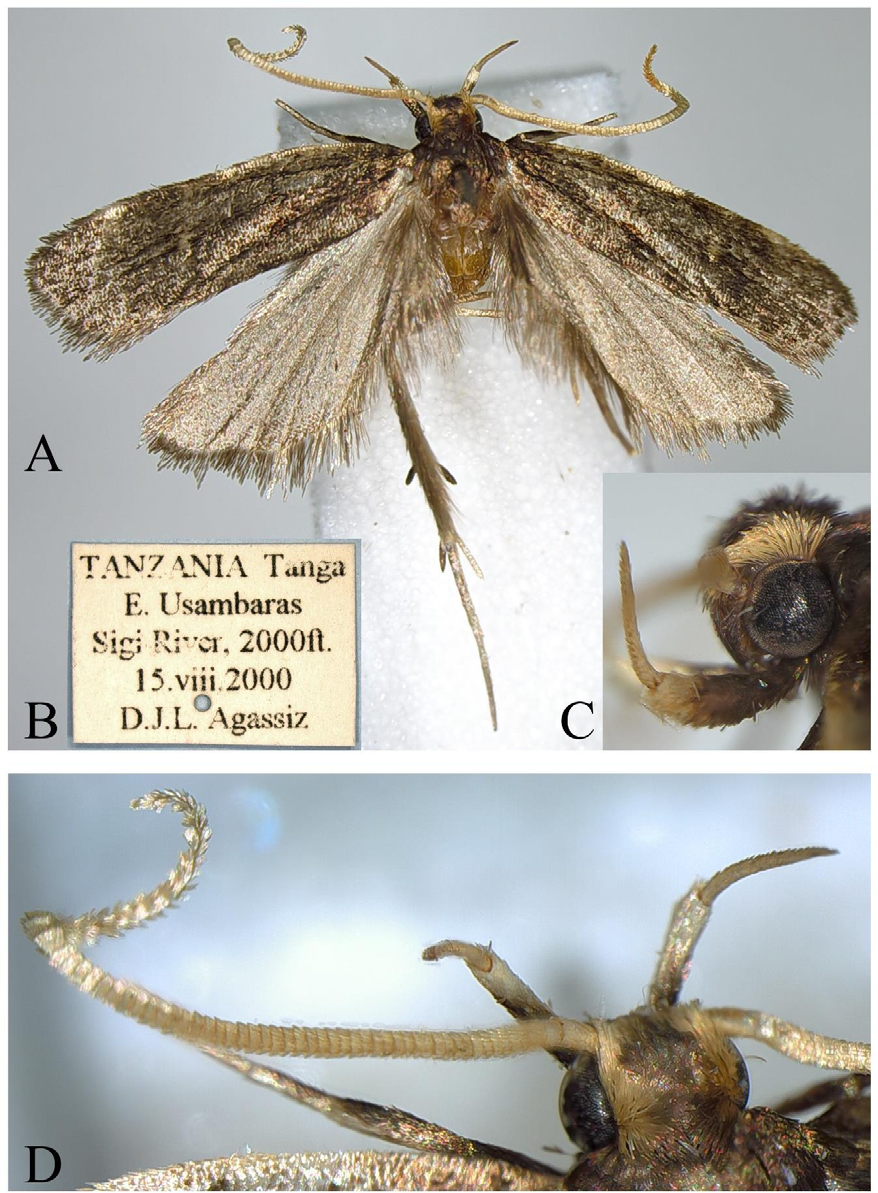
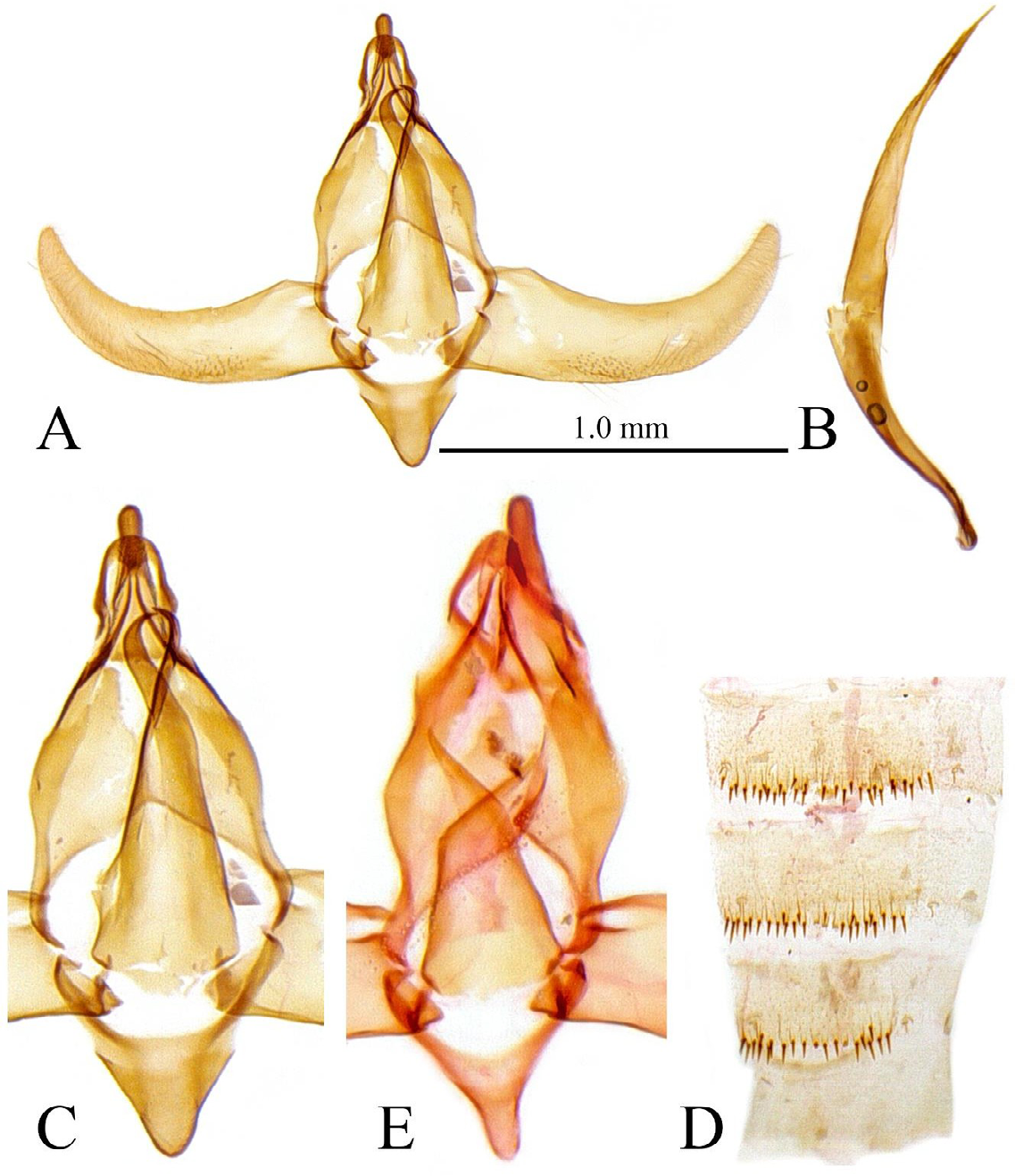
Type Specimen: Holotype: Male, Tanzania, Tanga, E. Usambaras, Sigi River, 2,000 ft, 15 viii 2000, leg. D.J.L. Agassiz, gen. slide no. CIS-7503.
Diagnosis: This new species is similar to P. oculiella Park & Koo, 2021, which was described from Kenya, in the superficial and genital characters, but it is much smaller (wingspan 14.0 mm in P. oculiella) and the male genitalia differ from those of the latter by the uncus with parallel sided in distal half (gradually narrowed toward apex in P. oculiella); the caudal processes of juxta narrowly elongated, longer, hook-shaped apically, much exceeding the caudal margin of the tegumen; and the saccus much broader than that of P. oculiella (Figure 2E).
Description: Male (Figures 1A,C&D). Wingspan 11.0 mm. Head: Vertex with dark-brown appressed scales, with orange erect scales laterally. Antenna (Figure 1D) thick, broken distal part; scape elongated, dilated distally; dark brown dorsally, pale orange ventro-laterally. 2nd segment of labial palpus (Figure 1C), thickened, dark brown in basal 2/3 and orange white beyond; 3rd segment more or less stout, strongly upturned, as long as 2nd segment, orange white. Thorax: Thorax and tegula purplish dark brown. Forewing slightly broadened distally; ground color dark brown, densely speckled with fuscous scales; discal stigma very small, poorly presented; costa slightly arched in basal 1/3, then nearly straight; apex rounded; termen slightly convex medially; fringe concolorous with ground color; venation with M2 present, CuA1 and CuA2 short-stalked, Hind wing broader than forewing, brownish gray; apex rounded; fringe concolorous with ground color; venation with M2 absent. Abdomen: Dark brown, spinous zones on dorsal surface forming a band along posterior margin of each segment (Figure 2D).
Male genitalia (Figures 2A-2C): Uncus elongated, slender, nearly parallel sided in distal half; apex rounded. Gnathos rather weakly developed, with sharply pointed apex. Valva elongated, broadest at about basal 1/7; costa slightly expanded near base, then gently concave; ventral margin expanded in basal 1/3, gently arched medially; cucullus gradually narrowed toward apex, strongly upturned distally; apex rounded. Juxta broad basally, with rounded anterior margin; caudal processes nearly symmetrical, hook-shaped apically, much exceeding distal margin of tegumen, Saccus broad. Aedeagus slender, arched, longer than valva, narrowed in basal 1/3; cornuti absent.
Distribution: Tanzania. Etymology: The species name is derived from the type locality, Tanga.
Genus Torodora Meyrick, 1894 Torodora nixcrinis Park, sp. nov.
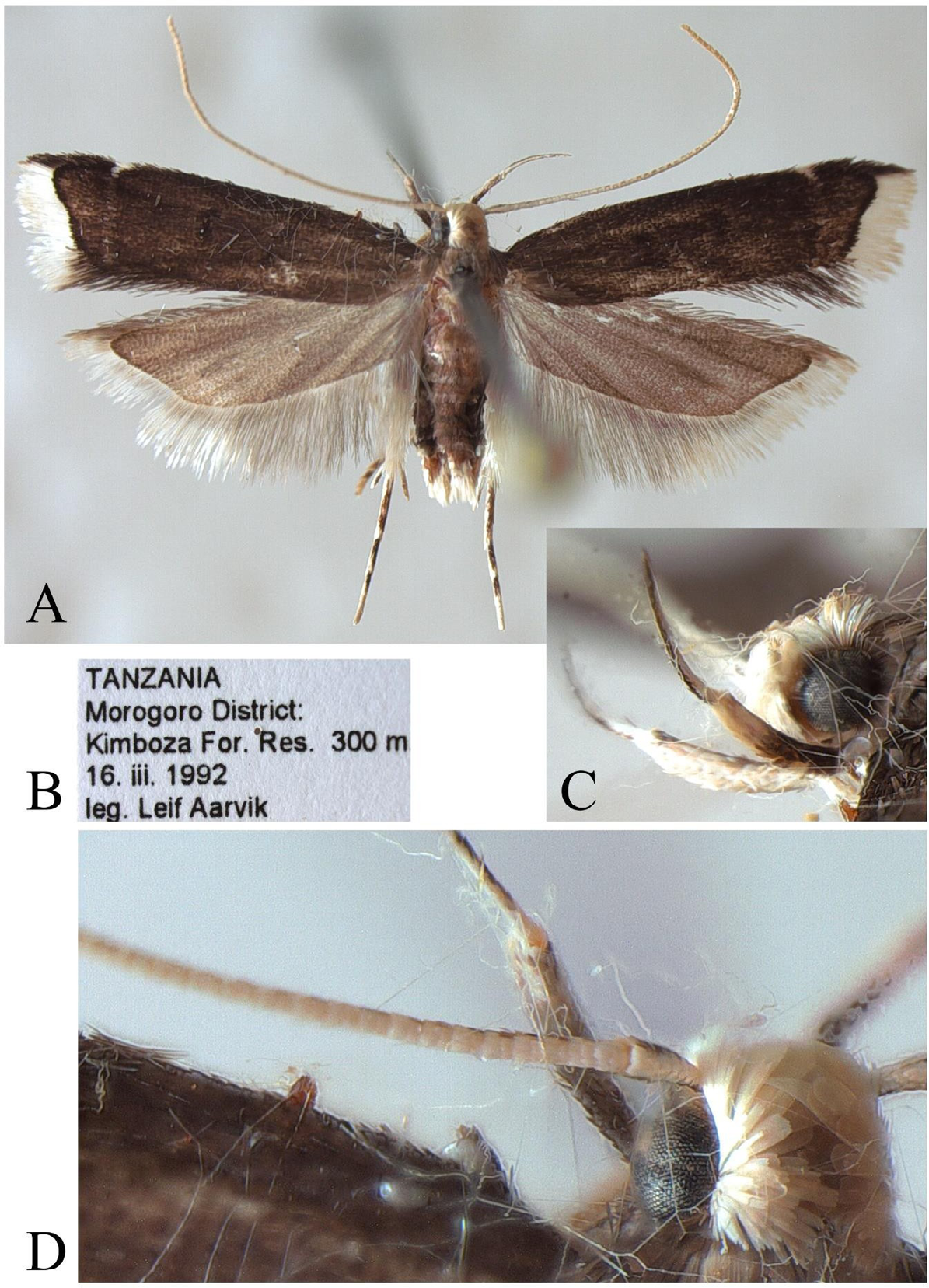
LSID: urn:lsid:zoobank.org:act: BEED88BD-E1F6-4666- A420-290753E9FF8C (Figures 3 & 4) Type specimen: Holotype: Female, Tanzania, Morogoro Distr., Kimboza For. Res. 300 m, 16 iii 1992, leg. L. Aarvik, gen. slide no. CIS-7504.
Diagnosis: The new species can be superficially distinguished from all known Afrotropical species of the genus Torodora Meyrick by the smaller size (the smallest species among all known species); the forewing with creamy-white fringes along termen; the hind wing with M3 and CuA1 long-stalked for basal 3/4; and the hind tibia with creamy-white rough scale in distal half (Figure 4A).
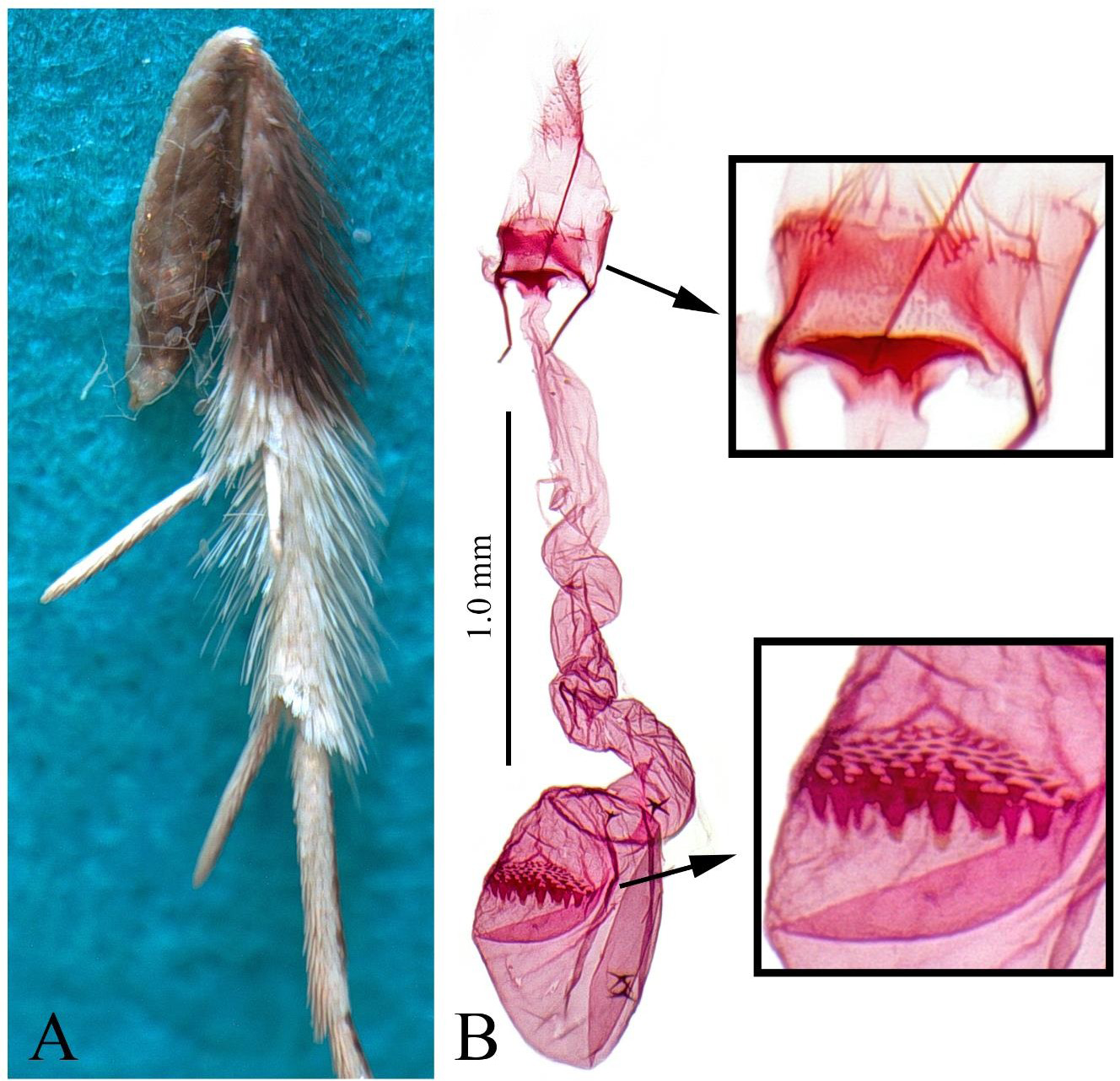
Description: Female (Figure 3A, C & D). Wingspan 10.0 mm. Head: Vertex covered with light- yellow scales; lateral side with pale-yellow erect scales. Antenna with scape elongated, orange white on anterior and posterior surface, dark brown on dorsal and ventral surface; flagellum orange white, with sparsely dark-brown scales dorsally. 2nd segment of labial palpus (Figure 3C) thickened, slightly arched, dark brown in basal half and orange white beyond on outer surface, evenly orange white on inner surface; 3rd segment slightly upturned, as long as 2nd segment, orange white laterally, dark brown on dorsal and ventral surface, with sharply pointed apex. Thorax: Thorax and tegula dark brown. Hind tibia (Figure 4A) brownish in basal half and with creamy- white rough scale in distal half. Forewing slightly broadened distally; costa slightly arched around basal 1/4; ground color dark brown uniformly, with a small, wedge-shape yellowish- white costal patch beyond 3/4 of costa, connecting to linear white subterminal line; apex more or less rounded; termen concave at middle; fringe creamy white uniformly from apex to tornus. Hind wing broader than forewing, brownish orange; venation with M2 present; M3 and CuA1 stalked for basal 3/4.
Female genitalia (Figure 4B). Apophyses anteriores about half the length of apophyses posteriores. Abdominal sternite VIII emarginated at middle, with strong setae in lateral plates. Lammella antevaginalis well-developed, broadened like spread-wings of butterfly, about twice of the width of antrum, with sharply pointed proximal end laterally. Antrum weakly sclerotized, bowl-shaped. Ductus bursae about three times the length of corpus bursae, narrowed in posterior 1/7; ductus seminalis very narrow, arising from beyond middle. Corpus bursae ovate, about 1/3 the length of ductus bursae; signum plate large, wide, with numerous strong spines on lower surface, about 3/5 the width of corpus bursae.
Distribution: Tanzania. Etymology: The species name is derived from the Latin, nix (= snow) and crinis (= hair), referring to the white fringe on the forewing.
Genus Thubdora Park, 2018 Thubdora muhezaica Park, sp. nov.
LSID: urn:lsid:zoobank.org:act: DBE77204-50C2-44B0-
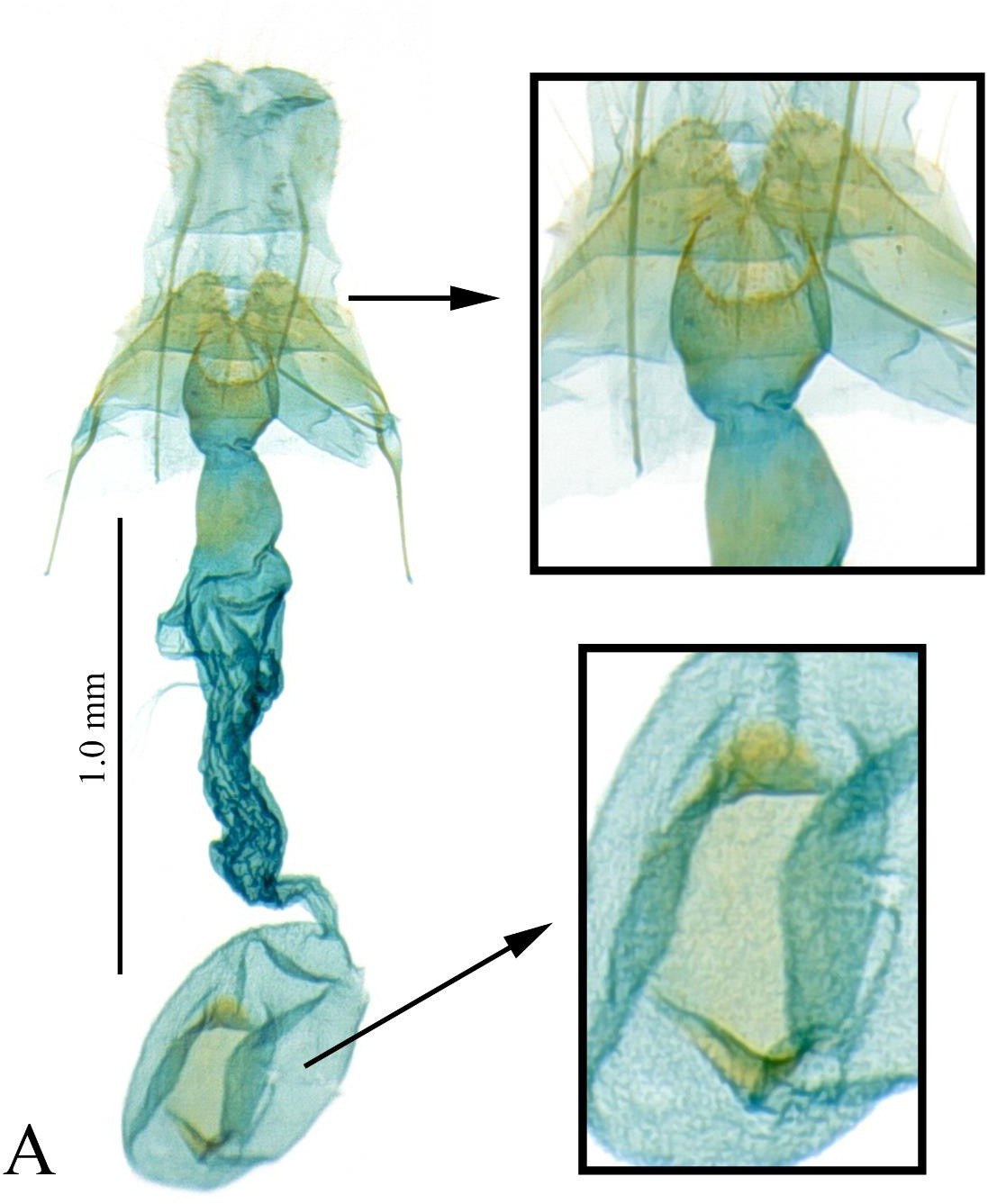
88FD-8372044F750D (Figures 5&6)
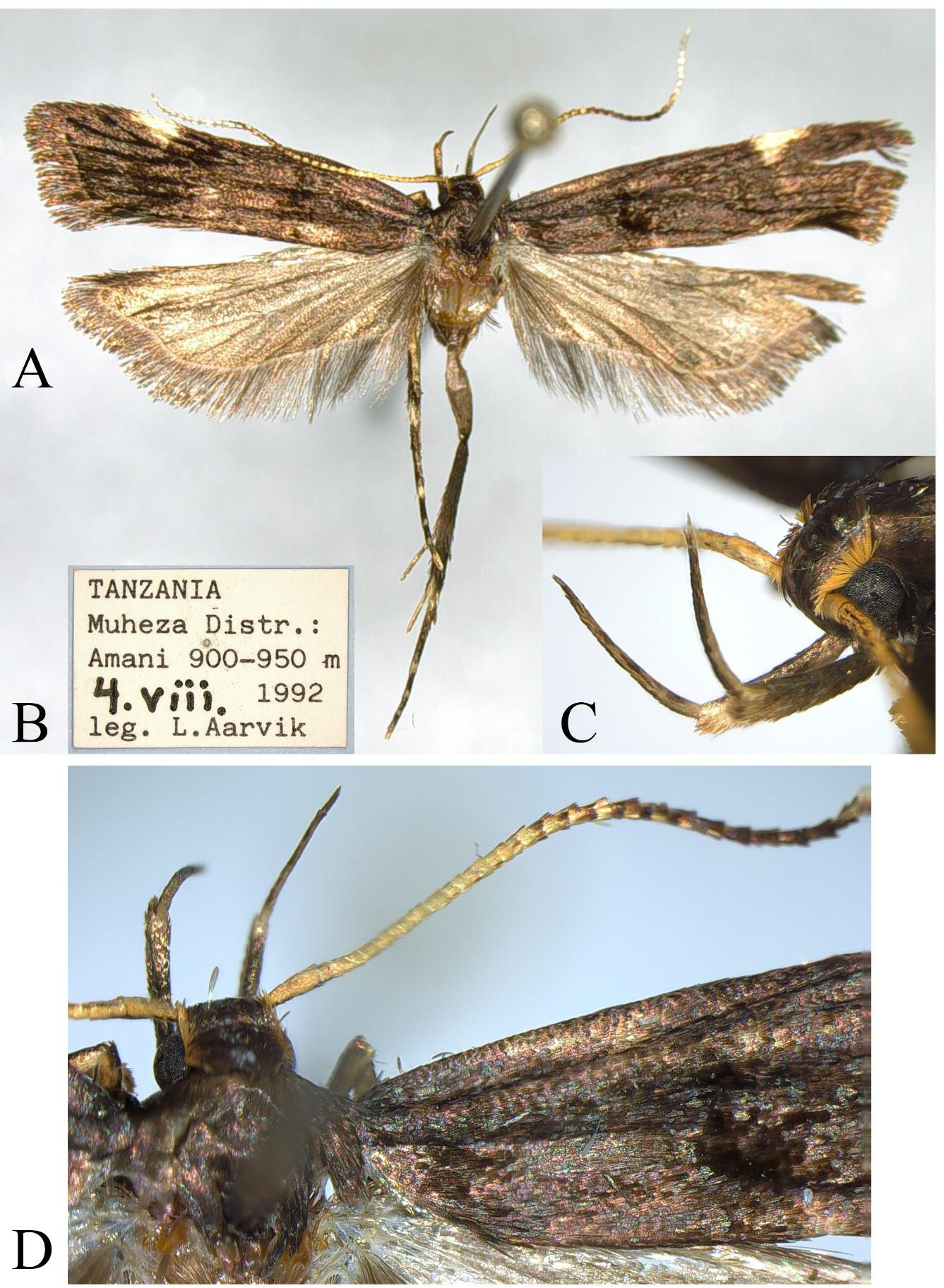
Type specimen: Holotype: female, Tanzania, Muheza Distr., Amani 900–950 m, 4 viii 1992, leg. L. Aarvik, gen. slide no. CIS-7286. Paratype: 1 female, same data as the holotype.
Diagnosis: The new species can also be distinguished from all known Afrotropical species of Thubdora Park by the narrowly elongated forewing with a large, yellowish- white triangular costal patch. It is more or less similar to Th. neobarbata Park & De Prins, 2019 by having a large, yellowish-white costal patch, but the forewing of the latter is not so elongated. The female genitalia are similar to those of Th. afropyralidis Park, 2020 which was described from Uganda, but it can be distinguished by following characters: the caudal margin of the antrum is not deeply emarginated; the ductus bursae is broadened and wrinkled (narrowed and not wrinkled in Th. afropyralidis); and the signum is much longer, about 2/3 the length of corpus bursae (about 1/4 in Th. afropyralidis).
Description: Female (Figures 5A, C, D). Wingspan 16.0 mm. Head: Vertex fuscous dark brown, with pale-yellow erect scales laterally. Antenna shorter than forewing; scape elongated, slightly dilated distally, orange white on dorsal surface mixed with grayish scales, dark brown on anterior and posterior surface; flagellum pale yellow dorsally in basal 1/3, serrated with dark- brown annulations in about median half, creamy white in distal 1/4. Labial palpi (Figure 5C) with 2nd segment thickened, dark brown on outer surface, whitish apically; 3rd segment strongly upturned, as long as 2nd segment, orange white laterally, dark brown ventrally, with sharply pointed apex. Thorax: Forewing narrowly elongated; ground color dark purplish brown, with irregular subbasal blackish fascia and broad, dark-fuscous antemedian fascia below discal cell, irregularly dark fuscous beyond 3/5 of the forewing; costa nearly straight before costal patch; apex obtuse; termen slightly sinuate; slightly concave medially; fringe concolorous with ground color, with narrow whitish basal line; venation with R3 and R4 stalked for basal half; R5 absent; M1 close to R3+4 at base; M2 nearly parallel to M1; M3, CuA1 and CuA2 on a common stalk; CuA1 and CuA2 stalked for basal 1/4. Hind wing broader than forewing, grayish white; apex obtuse; termen concave medially; fringe concolorous with ground color; venation with M2 absent; M3 and CuA1 stalked; CuA2 arising from near lower corner of discal cell.
Female genitalia (Figure 6A), Apophyses anteriores about half the length of apophyses posteriores. Abdominal sternite VIII deeply emarginated at middle, with strong setae laterally. Antrum bowl-shaped, sclerotized, concave on caudal margin with sharply pointed latero-caudal processes, narrowed in conjunction with ductus bursae. Ductus bursae heavily sclerotized, broadened in posterior 1/5, heavily wrinkled beyond, narrowed in anterior 1/5; ductus seminalis very narrow, arising from beyond half. Corpus bursae ovate, about half the length of ductus bursae; signum a filling- carrier shaped, large, about 2/3 the length of corpus bursae, produced to hood-shaped, weakly sclerotized expansions anteriorly and posteriorly.
Distribution: Tanzania. Etymology: The species name is derived from the type locality, Muheza.
Discussion
It is generally not recommendable to describe a new species, based on only the female. The two new species belong to Torodora and Thubdora in this paper were described based on female respectively, However, they can be distinguished from any known species of the genera in the superficial characters and there will be no chance to overlap: Torodora nixcrinis Park, sp. nov. can be distinguished by the smaller size (it is the smallest species of all known species) and the forewing with creamy-white fringes along termen; and Thubdora muhezaica Park, sp. nov. by the extremely elongated forewing with a large, yellowish-white distinctive costal patch.
List of species of Lecithoceridae known in Tanzania Subfamily Lecithocerinae Corymbus hirtitibia Park & Aarvik, 2019. TL: Morogoro Distr., Tanzania. C. malmoius Park & Aarvik, 2019. TL: Arumeru Distr., Tanzania. C. nigrizosterus Park & Aarvik, 2019. TL: Muheza Distr., Tanzania. Frisilia triturata Meyrick, 1914. TL: Mulanje, Nyassaland, Malawi. Homaloxestis lophophora Janse, 1954. TL: Pretoria, Rep. South Africa.
Subfamily Torodorinae Protolychnis maculata (Walsingham, 1881). TL: Spring Vale, Rep. South Africa. P. morogorensis Park & Koo, 2021. TL: Morogoro Distr., Tanzania. P. petiliella Park, 2020. TL: Mpigi, Uganda. P. tangaensis Park, sp. nov. TL: Tanga, Tanzania (Present article). Ptilothyris crossoceros Meyrick, 1934. TL: Tanganyika, Tanzania. Thubdora forficatalis Park & Cho, 2021. TL: Kigoma Distr., Tanzania. Th. mufindiensis Park & Cho, 2021. TL: Mufindi Distr., Tanzania. Th. muhezaica Park, sp. nov. TL: Muheza Distr., Tanzania (Present article). Th. ochrospilosa Park & Cho, 2021. TL: Morogoro Distr., Tanzania. Th. tanzaniana Park & Cho, 2021. TL: Kilombero Distr., Tanzania. Torodora melanonota Park & Cho, 2021. TL: Kilombero Distr., Tanzania. T. nixcrinis Park, sp. nov. TL: Morogro Distr., Tanzania (Present article).
Conflicts of Interest
The authors declare that there are no conflicts of interest.
Acknowledgements
We are indebted to Leif Aarvik, the Natural History Museum at the University of Oslo (Naturhistorisk Museum), Oslo, Norway, and to D.J.L. Agassiz, London, UK, for the loan of material collected from Tanzania. This research was supported by Basic Science Research Program through the National Research Foundation of Korea (NRF) funded by the Ministry of Education (2018R1D1A1B07042503).
References
-
Park KT, Cho SW, Koo JM (2022) The subfamily Torodorinae of the world (Lepidoptera: Lecithoceridae). National Institute of Biological Resources, Incheon, Korea, pp: 1-584.
-
Park KT, De Prins J, De Prins W (2021) A checklist of Lecithoceridae (Lepidoptera: Gelechioidea) of the Afrotropical Region. J Asia-Pac Biodivers 14(3): 355-370.
-
Park KT, Koo JM (2022) Description of Spiniola hanaro Park, gen. and sp. nov., and three new species of Torodora Meyrick, 1894 (Lepidoptera, Lecithoceridae, Torodorinae) from the Afrotropical Region. Zootaxa 5092(5): 576-586.
-
Walsingham TG (1881) On the Tortricidœ, Tineidœ, and Pterophoridœ of South Africa. Trans Ent Soc Lond 29(2): 219-288.
-
Walsingham TG (1891) African Micro-Lepidoptera. Trans. Ent Soc Lond 39(1): 63-132.
-
Park KT, Agassiz DJL, Kim SR (2019) New records for the genus Frisilia Walker (Lepidoptera, Lecithoceridae) in the Afrotropical region. J Asia-Pac Biodivers 12: 438- 443.
-
Park KT, Koo JM, Aarvik L (2019) Description of Corymbus Park, gen. n. with six new species from the Afrotropical Region (Lepidoptera: Lecithoceridae). SHILAP Revta Lepid 47(188): 657-672.
-
Park KT, De Prins W (2019) A review of the Lecithoceridae (Lepidoptera: Gelechioidea) of southern Africa, based on type specimens deposited in the Ditsong National Museum of Natural History (TMSA), with descriptions of three new species. Zootaxa 4623(1): 61-89.
-
Park KT, Koo JM, Mey W (2019) Two new species of Homaloxestis Meyrick, 1910 (Lepidoptera: Lecithoceridae) from Uganda, with a checklist of the genus in the Afrotropical Region. Zootaxa 4658(3): 591- 598.
-
Park KT, Koo JM (2020) Two new species of Protolychnis Meyrick, 1925 (Lepidoptera, Lecithoceridae) from the Afrotropical Region, with a world check-list of the genus. Zootaxa 4759(2): 269-276.
-
Park KT, Koo JM (2021) A new genus Viperinus Park with descriptions of two new species, and two new species of the genus Protolychnis Meyrick, 1925 (Lepidoptera, Gelechioidea, Lecithoceridae) in Kenya and Tanzania, with a checklist of the world species. Zootaxa 4985(3): 359-370.
-
Park KT, Cho SW (2021) Four new species of Thubdora Park, 2018 and one new species of Torodora Meyrick, 1894 (Lepidoptera, Lecithoceridae, Torodorinae) from Tanzania. Zootaxa 5068(3): 399-409.
-
Meyrick E (1925) Lepidoptera Heterocera Fam. Gelechiadae. In: Wytsman P, Et al. (Eds.), Gen Ins., 184: 1-290.
-
Meyrick E (1894) On a collection of Lepidoptera from Upper Burma. Trans. Ent Soc Lond 42(1): 1-29.
-
Park KT (2018) A new genus Thubdora Park, gen. nov. and seven new species of the subfamily Torodorinae (Lepidoptera, Lecithoceridae) from Cameroon and Rep. of Congo, Africa J Asia-Pac Entomol 21: 1085-1093.
-
Kornerup A, Wanscher JH (1978) Methuen Handbook of Color. In: 3rd (Edn.), Eyre Methuen, London, UK, pp: 1-252.
- California Red-Legged Frog and Non-Listed Amphibians Response to Non-Native Fish Removal
- Industrial Standardization of the Bio-OS: Algorithmic Codification of Resilience Engineering Guidelines and Version V8 Architecture
- Climate Variability and the Sustainability of Snail Farming in Nigeria: Past Trends, Present Challenges and Potential Outlook
- The Evaluation of the Surveillance System of Anthrax in Gilgit-Baltistan, Pakistan, 2018
- Natural Decline to Extinction of A New Zealand Rabbit Population
- Mitochondrial Bio-Logistics: Steering Co-Enzyme Q10 and Lycopene Synergies within the Science 4.0 Bio-OS Framework