
Evaluation of Importance of Teksar Mountain of Armenia for Bird and Butterfly Protection
The Teksar Mountain requires evaluation as a potential Important Bird and Biodiversity Area (IBA) and as a Prime Butterfly Area (PBA), especially because the networks of those areas in Armenia are underdeveloped. There are 131 species of birds recorded in the area, among which 101 are breeding and 30 occur during migration or found in breeding season having this site as part of their foraging range. The site fits several criteria of IBA: A1, B1a, B1b, as well as the criteria of PBA: it hosts a number of globally threatened and nationally threatened species, as well as the regional endemics. The site faces a number of threats, related to poaching, overgrazing, uncontrolled mowing, arsons, small Hydro Power Plants, and potentially – metal mining. The existing Yeghegis State Sanctuary covers only 17% of the valuable ecosystems and doesn’t function properly. It is proposed to evaluate the area as an Emerald Site, with further development of the site’s management plan. Such a management plan should consider extraction of the area from the public hunting, sustainable grazing and mowing schemes, improvement of the local communities’ livelihood through development of wildlife tourism, and an extensive training and educational program.
Introduction
Armenia as part of the Caucasus ecoregion is included in the list of global biodiversity hotspots [1], having over 17,700 species of animals, including 495 endemic species and over 3,800 species of vascular plants, including 142 endemic species [2]. Only 13% of the country is covered by the network of National Protected Areas [2], and 17% – by the network of Important Bird and Biodiversity Areas – IBAs [3, 4].
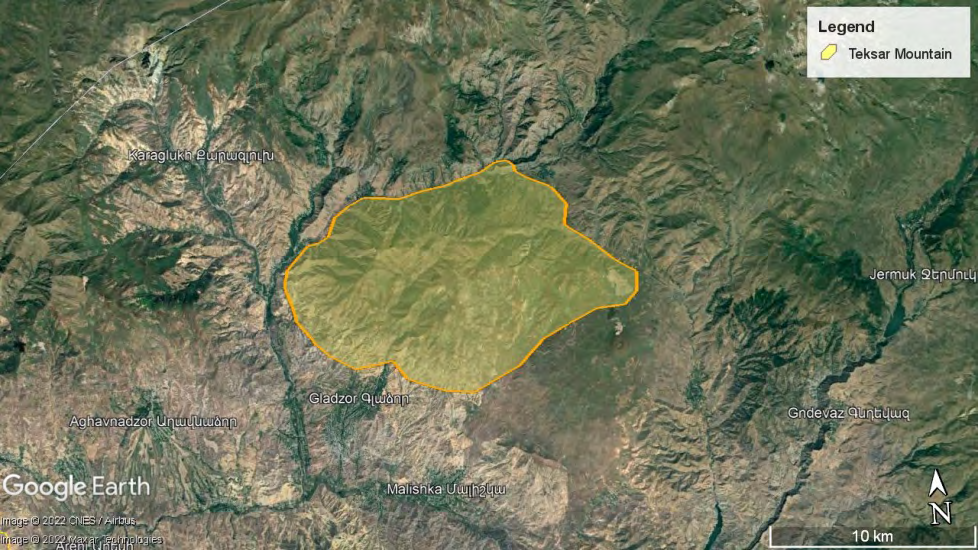
Currently for the country, there are 18 IBAs recognized [5], and 12 Prime Butterfly Areas (PBAs) evaluated [6]. The recent revision of IBAs shows a necessity of increasing their number in the country [4]. At the same time, the preliminary screening of the country’s butterfly fauna, demonstrated potential for at least 20 other PBAs to be evaluated [7]. One of such areas, is the Teksar Mountain, which is located in the Vayots Dzor province and is bordered by the rivers Arpa from the south and Yeghegis from the north and north-east. The mountain ridge is situated mainly within the elevation range from about 1,700 m to 2,750 m above sea level and is presented by a variety of habitats: tragacanth mountain steppe, alpine meadows and carpets, oak woodland, and juniper woodland. A preliminary screening of the area shows presence of several threatened and endemic species of birds and butterflies, which are inhabiting the range, and thus, it is necessary to evaluate the area versus criteria of IBAs and PBAs. Such evaluation is especially important, as can provide the necessary information for the further assessments of the conservation importance of the area at the national level, or internationally, e.g., as Emerald Site protected under Bern Convention [8].
Therefore, the main purpose of the current article is to evaluate the Teksar Mountain as Important Bird and Biodiversity Area and as a Prime Butterfly Area.
Materials and Methods
According to general requirements for recognition of the IBAs, those should fit one or several criteria listed below [9].
- Places of international significance for the conservation of birds and other biodiversity
- Recognized world-wide as practical tools for conservation
- Distinct areas amenable to practical conservation action
- Identified using robust, standardized criteria
- Sites that together form part of a wider integrated approach to the conservation and sustainable use of the natural environment The identification of Prime Butterfly Areas is based on methodology developed for Europe [10], and local adaptations of that under some local conditions, such as in Turkey [11], Bulgaria [12], and other countries. Therefore, the methodology assigns to designate the Prime Butterfly Area as such, if two of the following have been represented:
- Species included in Red Data book of European butterflies [13].
- Species included in Appendix II of the Bern Convention (on the conservation of European wildlife and natural habitats)
- and/or species include in the EU Habitats and Species Directive, as well as species of national concern listed in Red Book of Animals of the Republic of Armenia.
Therefore, the data needed for assessment of the area include data on bird fauna, data on butterfly fauna, data on existing and potential threats to the birds, butterflies and their habitats, spatial data on land use, spatial data on areas of national or international conservation concern.
Bird Data Collection
For the current assessment of Teksar Mountain we used the data, which was collected in the period of 2003-2022 in frames of the National Bird Monitoring Scheme, developed by BirdLinks Armenia NGO. It includes (1) unstandardized observations (so called opportunistic data) and (2) standardized counts (data, collected according to standard methodology).
Unstandardized observations (opportunistic data) are usually provided by birdwatchers and contain minimum data requirements: precise identification of species, observation date, geographic coordinates, name of nearest locality (human settlement, mountain, historical site, etc.), breeding code, name of observer and his contacts. It is desirable to mention whether all observations have been recorded or the list represents only a selection of species. Every comment is useful (time, observation duration, number of people in the group, etc.). Since it’s not always possible to record precise geographical coordinates on the spot, information may be provided according to the 10x10 km square code.
Standardized counts (counts conducted within a certain time), are led both by specialists and birdwatchers, having proper skills [14]. Counts are implemented during a fixed period of 1 or 2 hours, when an observer passes the route in slow motion. It is desirable to make such counts at the time of the day, when birds are most active (as a rule, early in the morning). The best season for bird count is the period between 10th of May and 10th of June, nevertheless, data, collected in March-April and July-August are used as well (for some species, e.g., Bearded Vulture or Eagle Owl, the best period of count of breeding pairs is January-February). With this method, there are more requirements to data: precise identification of species, number of observed or acoustically recorded individuals, observation date, geographical location: 10x10 km square code, coordinates of a beginning of the route, start and end times of the count, name of nearest locality (human settlement, mountain, historical site, etc.), breeding code, name and contacts of observer/s. Collected data are entered into standardized protocols and when the field work is over are inputted into the Database of National Bird Monitoring owned by BirdLinks Armenia NGO.
Both types of data have been collected using the volunteer force – over 300 persons provided the data about this specific area.
Butterfly Data Collection
For the current assessment of Teksar Mountain we used the data, which was collected in the period of 2003-2022 in frames of the National Butterfly Monitoring Scheme, developed by BirdLinks Armenia NGO. Similar to the bird data, it includes (1) unstandardized observations and (2) standardized counts.
Unstandardized observations (opportunistic data) are usually provided by wildlife lovers and contain minimum data requirements: precise identification of species, observation date, geographic coordinates, name of nearest locality (human settlement, mountain, historical site, etc.), name of observer and his contacts. It is desirable to mention whether all observations have been recorded or the list represents only a selection of species. Since it’s not always possible to record precise geographical coordinates on the spot, information may be provided according to the 10x10 km square code.
Standardized counts (counts conducted within a certain time), are led both by specialists and wildlife lovers, having proper skills. The Standardized Transect Counts are better known as Pollard Walks [15]. Routes of transects were laid out to sample representative habitat and ran for 100 m parallel to the slopes. The width of routes was 5 meters. The walks have been implemented during 11:00-13:00 in sunny weather, with the wind speed less than 3 by Boffort Scale. Collected data are entered into standardized protocols and when the field work is over are inputted into the Database of National Butterfly Monitoring Scheme, owned by BirdLinks Armenia NGO [16, 17, 18, 19, 20].
Both types of data have been collected using the volunteer force – over 20 persons in total.
Geographical Data Collection
This includes the boundaries of the candidate Emerald Sites, Key Biodiversity Areas (hereinafter KBAs), and Specially Protected Natural Areas (hereinafter SPNAs).
The spatial data on KBAs was provided by WWF Armenia, the data on candidate Emerald Sites, SPNAs, and Public Hunting Lands was provided by the Ministry of Environment of RA.
Threat Data Collection
For collection of the data on existing and possible threats we have checked the land ownership, types and scale of various human activities, and conducted interviews of some target groups.
The data on land ownership was collected through the National Cadaster and Department of Protected Areas of the Ministry of Environment.
The data on human activities was collected through the National Statistical Agency and by visiting the sites.
The data on direct threats was collected through the semi-structured interviews of the local farmers and hunters. Additional information on the direct threats was accumulated in this period through social media, specifically the Armenian Ornithological Society (formerly Birding Association of Armenia) group.
Data Processing
The first part of the data processing includes preparation of the area’s account, listing the general description of the site, description of characteristics of avifauna and butterfly fauna and the priority species of global and national concern, features of land use and current threats, as well as existing and necessary conservation measures.
The second part of the processing includes evaluation of the features of the area versus criteria of the area as IBA and as PBA, and analysis of the area’s overlap with the public hunting lands, with the areas on national and global conservation concern, namely: SPNAs, candidate Emerald Sites, and by KBAs. This part of processing was implemented using ArcGIS 10.0 (Environmental Systems Research Institute, Inc.).
Results and Discussion
General Description
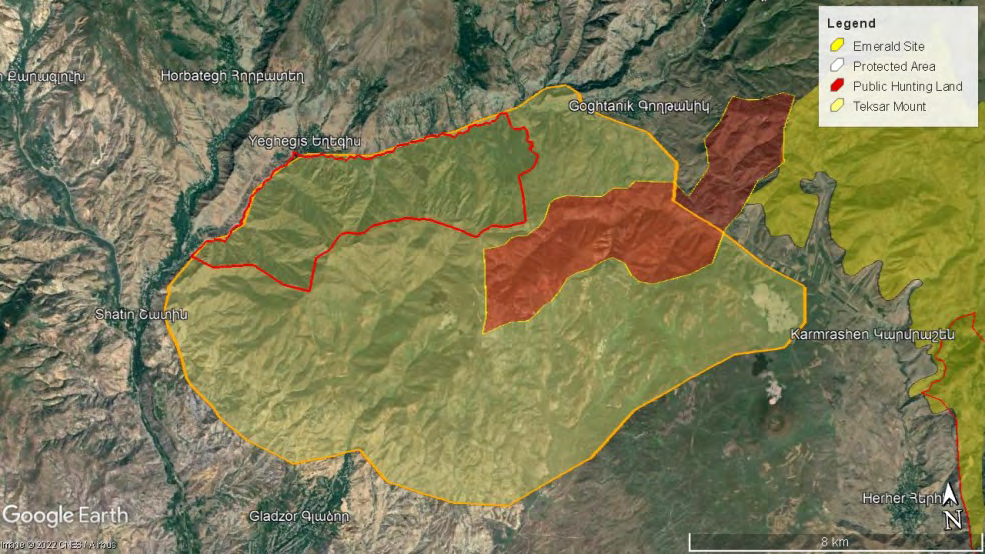
The site is represented by a rather separated mountain which branches off from the Vardenis Mountain Ridge and has an elevation range from 1,700 m to 2,750 m above sea level (Figures 1 & 2) and makes about 12,196 ha. About 83% area of site belongs to the community and about 17% of it is allocated to Yeghegis State Sanctuary. At the same time, 11% of the area is allocated as a public hunting land (Table 1). The southern slopes of the mountain is covered by calcareous grasslands, which at the lower part are represented by semi-desert like formations and shrublands, while with the increase of elevation, those formations are being replaced with the tragacanth mountain steppes. With further increase of elevation, the landscape changes towards grassy mountain steppe, then to meadows, and then to sub-alpine carpets. The northern slope of the ridge has much more rigorous terrain, rich with rocks, cliffs, and screes, and being cut by several deep canyons. The lower part of the northern slope is covered by the scarce juniper woodlands, while the numerous gorges are hosting remains of deciduous woodlands formed by oak, hornbeam, wild plum, hawthorn, and other trees. At the bottom of the northern slope, there is a Yeghegis river, surrounded by riparian woodlands and shrublands.
| Name of Site | Area (ha) | Hunting Lands | Protected Areas | Candidate Emerald Sites | KBAs | Working lands | |||||
|---|---|---|---|---|---|---|---|---|---|---|---|
| ha | % | ha | % | ha | % | ha | % | ha | % | ||
| Teksar Mountain | 12,196 | 1,291 | 11% | 2,080 | 17% | 0 | 0% | 11,232 | 92% | 10,116 | 83% |
Table 1: Allocation of the land at the Teksar Mountain area.
Bird Fauna
There are 131 species of birds recorded in the area (Table 2), among which 101 are breeding and 30 occur during migration or found in breeding season having this site as part of their foraging range. Among the mentioned species, the area is important for breeding populations of high mountain species, such as Caspian Snowcock Tetraogallus caspius (B1b), Alpine Accentor Prunella collaris (B1b), Crimson- winged Finch Rhodopechys sanguineus (B1b), Wallcreeper Tichodroma muraria (B1b) and White-winged Snowfinch Montifringilla nivalis (B1b). Soaring migrants, like storks, cranes, and raptors, sometimes make congregations in the lower edge of the area, however, the site doesn’t or just occasionally might reach the threshold of criteria B3c. The site represents an important breeding and foraging range for such raptors, as Egyptian Vulture (A1), Bearded Vulture (B1a), Short-toed Snake Eagle (B1b), Levant Sparrowhawk (B1b), Golden Eagle (B1b), and Eagle Owl (B1b).
| Latin names | English names | Breeding status |
|---|---|---|
| PHASIANIDAE | ||
| Tetraogallus caspius | Caspian Snowcock | Breeding |
| Alectoris chukar | Chukar | Breeding |
| Perdix perdix | Grey Partridge | Breeding |
| Coturnix coturnix | Common Quail | Breeding |
| CICONIIDAE | ||
| Ciconia nigra | Black Stork | Non-breeding |
| ACCIPITRIDAE | ||
| Pernis apivorus | European Honey-buzzard | Non-breeding |
| Milvus migrans | Black Kite | Non-breeding |
| Gypaetus barbatus | Lammergeyer | Breeding |
| Neophron percnopterus | Egyptian Vulture | Breeding |
| Gyps fulvus | Eurasian Griffon Vulture | Breeding |
| Aegypius monachus | Eurasian Black Vulture | Breeding |
| Circaetus gallicus | Short-toed Snake-eagle | Breeding |
| Circus cyaneus | Northern Harrier | Non-breeding |
| Circus pygargus | Montagu’s Harrier | Non-breeding |
| Accipiter gentilis | Northern Goshawk | Breeding |
| Accipiter nisus | Eurasian Sparrowhawk | Breeding |
| Accipiter brevipes | Levant Sparrowhawk | Non-breeding |
| Buteo buteo | Common Buzzard | Breeding |
| Buteo rufinus | Long-legged Buzzard | Breeding |
| Aquila pomarina | Lesser Spotted Eagle | Breeding |
| Aquila nipalensis | Steppe Eagle | Non-breeding |
| Aquila chrysaetos | Golden Eagle | Breeding |
| Hieraaetus pennatus | Booted Eagle | Breeding |
| FALCONIDAE | ||
| Falco naumanni | Lesser Kestrel | Non-breeding |
| Falco tinnunculus | Common Kestrel | Breeding |
| Falco subbuteo | Eurasian Hobby | Breeding |
| Falco cherrug | Saker Falcon | Non-breeding |
| Falco peregrinus | Peregrine Falcon | Breeding |
| RALLIDAE | ||
| Crex crex | Corn Crake | Breeding |
| GRUIDAE | ||
| Anthropoides virgo | Demoiselle Crane | Non-breeding |
| CHARADRIIDAE | ||
| Vanellus vanellus | Northern Lapwing | Non-breeding |
| SCOLOPACIDAE | ||
| Gallinago media | Greater Snipe | Non-breeding |
| Actitis hypoleucos | Common Sandpiper | Breeding |
| COLUMBIDAE | ||
| Columba livia | Rock Dove | Breeding |
| Columba palumbus | Common Wood-pigeon | Breeding |
| CUCULIDAE | CUCULIDAE | |
| Cuculus canorus | Common Cuckoo | Breeding |
| STRIGIDAE | ||
| Otus scops | Common Scops-owl | Breeding |
| Bubo bubo | Eurasian Eagle-owl | Breeding |
| Athene noctua | Little Owl | Breeding |
| CAPRIMULGIDAE | ||
| Caprimulgus europaeus | Eurasian Nightjar | Breeding |
| APODIDAE | ||
| Apus melba | Alpine Swift | Breeding |
| Apus apus | Common Swift | Breeding |
| ALCEDINIDAE | ||
| Alcedo atthis | Common Kingfisher | Breeding |
| MEROPIDAE | ||
| Merops apiaster | European Bee-eater | Breeding |
| CORACIIDAE | ||
| Coracias garrulus | European Roller | Breeding |
| UPUPIDAE | ||
| Upupa epops | Eurasian Hoopoe | Breeding |
| PICIDAE | ||
| Picus viridis | Eurasian Green Woodpecker | Non-breeding |
| Dendrocopos syriacus | Syrian Woodpecker | Breeding |
| ALAUDIDAE | ||
| Melanocorypha bimaculata | Bimaculated Lark | Breeding |
| Calandrella brachydactyla | Greater Short-toed Lark | Breeding |
| Galerida cristata | Crested Lark | Breeding |
| Lullula arborea | Wood Lark | Breeding |
| Alauda arvensis | Eurasian Skylark | Breeding |
| Eremophila alpestris | Horned Lark | Breeding |
| HIRUNDINIDAE | ||
| Ptyonoprogne rupestris | Eurasian Crag Martin | Breeding |
| Hirundo rustica | Barn Swallow | Breeding |
| Delichon urbica | Northern House-martin | Breeding |
| MOTACILLIDAE | ||
| Anthus campestris | Tawny Pipit | Breeding |
| Anthus trivialis | Tree Pipit | Breeding |
| Anthus spinoletta | Water Pipit | Breeding |
| Motacilla cinerea | Grey Wagtail | Breeding |
| Motacilla alba | White Wagtail | Breeding |
| CINCLIDAE | ||
| Cinclus cinclus | White-throated Dipper | Breeding |
| TROGLODYTIDAE | ||
| Troglodytes troglodytes | Winter Wren | Non-breeding |
| PRUNELLIDAE | ||
| Prunella modularis | Dunnock | Non-breeding |
| Prunella ocularis | Radde’s Accentor | Breeding |
| Prunella collaris | Alpine Accentor | Breeding |
| MUSCICAPIDAE | ||
| Erithacus rubecula | European Robin | Non-breeding |
| Luscinia megarhynchos | Common Nightingale | Breeding |
| Luscinia svecica | Bluethroat | Breeding |
| Irania gutturalis | White-throated Robin | Breeding |
| Phoenicurus ochruros | Black Redstart | Breeding |
| Phoenicurus phoenicurus | Common Redstart | Non-breeding |
| Saxicola rubetra | Whinchat | Breeding |
| Saxicola maurus | Siberian Stonechat | Breeding |
| Oenanthe oenanthe | Northern Wheatear | Breeding |
| Oenanthe hispanica | Black-eared Wheatear | Breeding |
| Monticola saxatilis | Rufous-tailed Rock-thrush | Breeding |
| Monticola solitarius | Blue Rock-thrush | Breeding |
| Muscicapa striata | Spotted Flycatcher | Non-breeding |
| Ficedula parva | Red-breasted Flycatcher | Non-breeding |
| Ficedula semitorquata | Semi-collared Flycatcher | Non-breeding |
| TURDIDAE | ||
| Turdus torquatus | Ring Ouzel | Breeding |
| Turdus merula | Eurasian Blackbird | Breeding |
| Turdus viscivorus | Mistle Thrush | Breeding |
| Turdus pilaris | Fieldfare | Non-breeding |
| SYLVIIDAE | ||
| Cettia cetti | Cetti’s Warbler | Breeding |
| Acrocephalus palustris | Marsh Warbler | Breeding |
| Iduna pallida | Olivaceous Warbler | Breeding |
| Hippolais languida | Upcher’s Warbler | Breeding |
| Sylvia nisoria | Barred Warbler | Breeding |
| Sylvia curruca | Lesser Whitethroat | Breeding |
| Sylvia communis | Greater Whitethroat | Breeding |
| Phylloscopus trochilus | Willow Warbler | Non-breeding |
| Phylloscopus collybita | Eurasian Chiffchaff | Non-breeding |
| Phylloscopus sindianus | Mountain Chiffchaff | Non-breeding |
| AEGITHALIDAE | ||
| Aegithalos caudatus | Long-tailed Tit | Breeding |
| PARIDAE | ||
| Parus caeruleus | Blue Tit | Non-breeding |
| Parus major | Great Tit | Breeding |
| SITTIDAE | ||
| Sitta neumayer | Western Rock-nuthatch | Breeding |
| TICHODROMADIDAE | ||
| Tichodroma muraria | Wallcreeper | Breeding |
| REMIZIDAE | ||
| Remiz pendulinus | Eurasian Penduline-tit | Breeding |
| ORIOLIDAE | ||
| Oriolus oriolus | Eurasian Golden-oriole | Breeding |
| LANIIDAE | ||
| Lanius collurio | Red-backed Shrike | Breeding |
| Lanius minor | Lesser Grey Shrike | Breeding |
| CORVIDAE | ||
| Garrulus glandarius | Eurasian Jay | Breeding |
| Pica pica | Black-billed Magpie | Breeding |
| Pyrrhocorax graculus | Yellow-billed Chough | Non-breeding |
| Pyrrhocorax pyrrhocorax | Red-billed Chough | Breeding |
| Corvus corone | Carrion Crow | Breeding |
| Corvus corax | Common Raven | Breeding |
| STURNIDAE | ||
| Sturnus roseus | Rose-coloured Starling | Breeding |
| PASSERIDAE | ||
| Passer domesticus | House Sparrow | Breeding |
| Passer montanus | Eurasian Tree Sparrow | Breeding |
| Petronia petronia | Rock Sparrow | Breeding |
| Montifringilla nivalis | White-winged Snowfinch | Breeding |
| FRINGILLIDAE | ||
| Fringilla coelebs | Chaffinch | Non-breeding |
| Fringilla montifringilla | Brambling | Non-breeding |
| Serinus pusillus | Red-fronted Serin | Breeding |
| Carduelis chloris | European Greenfinch | Breeding |
| Carduelis carduelis | European Goldfinch | Breeding |
| Carduelis spinus | Eurasian Siskin | Non-breeding |
| Carduelis cannabina | Eurasian Linnet | Breeding |
| Carduelis flavirostris | Twite | Breeding |
| Rhodopechys sanguinea | Crimson-winged Finch | Breeding |
| Carpodacus erythrinus | Common Rosefinch | Breeding |
| EMBERIZIDAE | ||
| Emberiza citrinella | Yellowhammer | Non-breeding |
| Emberiza cia | Rock Bunting | Breeding |
| Emberiza hortulana | Ortolan Bunting | Breeding |
| Emberiza melanocephala | Black-headed Bunting | Breeding |
| Miliaria calandra | Corn Bunting | Breeding |
Table 2: Bird species, which inhabit Teksar Mountain.
Butterfly Fauna
There are 153 species of butterflies recorded in the area (Table 3). Among the mentioned species, the area is important for such globally threatened species as Parnassius apollo, Maculinea arion, and Maculinea rebeli, and nationally threatened ones, such as Papilio alexanor, Colias aurorina, Brenthis ino, Tomares romanovi, Polyommatus huberti, P. erewanensis, P. surakovi, P. ninae. Also, the area is critically important for the regional endemics, such as Satyrus effendi and Callophris danchenkoi.
| Latin names | Status in Red Book of Armenia | Regional endemic | |
|---|---|---|---|
| Hesperiidae | |||
| 1 | Erynnis tages | NE | |
| 2 | Erynnis marloyi | NE | |
| 3 | Carcharodus alceae | NE | |
| 4 | Carcharodus lavatherae | NE | |
| 5 | Carcharodus orientalis | NE | X |
| 6 | Muschampia tessellum | NE | |
| 7 | Spialia phlomidis | NE | X |
| 8 | Spialia orbifer | NE | |
| 9 | Pyrgus melotis | NE | |
| 10 | Pyrgus sidae | NE | |
| 11 | Pyrgus cinarae | NE | |
| 12 | Pyrgus serratulae | NE | |
| 13 | Pyrgus armoricanus | NE | |
| 14 | Pyrgus alveus | NE | |
| 15 | Thymelicus lineola | NE | |
| 16 | Thymelicus sylvestris | NE | |
| 17 | Ochlodes sylvanus | NE | |
| 18 | Hesperia comma | NE | |
| Papilionidae | |||
| 19 | Parnassius mnemosyne | VU | |
| 20 | Parnassius apollo | VU | |
| 21 | Iphiclides podalirius | NE | |
| 22 | Papilio machaon | NE | |
| 23 | Papilio alexanor | VU | |
| Pieridae | |||
| 24 | Leptidea sinapis | NE | |
| 25 | Leptidea duponcheli | NE | |
| 26 | Anthocharis cardamines | NE | |
| 27 | Anthocharis gruneri | NE | X |
| 28 | Anthocharis damone | NE | X |
| 29 | Euchloe ausonia | NE | |
| 30 | Zegris eupheme | NE | |
| 31 | Aporia crataegi | NE | |
| 32 | Pontia daplidice | NE | |
| 33 | Pontia chloridice | NE | X |
| 34 | Pieris bryoniae | NE | |
| 35 | Pieris pseudorapae | NE | |
| 36 | Pieris ergane | NE | |
| 37 | Pieris krueperi | NE | X |
| 38 | Pieris rapae | NE | |
| 39 | Pieris brassicae | NE | |
| 40 | Colias sareptensis | NE | |
| 41 | Colias thisoa | NE | X |
| 42 | Colias aurorina | VU | X |
| 43 | Colias crocea | NE | |
| 44 | Gonepteryx rhamni | NE | |
| 45 | Gonepteryx farinosa | NE | |
| Lycaenidae | |||
| 46 | Armenia ledereri | NE | X |
| 47 | Armenia hyrcanica | NE | X |
| 48 | Nordmannia spini | NE | |
| 49 | Nordmannia abdominalis | NE | X |
| 50 | Callophrys chalybeitincta | NE | |
| 51 | Callophrys paulae | NE | X |
| 52 | Callophrys danchenkoi | NE | X |
| 53 | Tomares romanovi | VU | X |
| 54 | Tomares callimachus | NE | |
| 55 | Lycaena phlaeas | NE | |
| 56 | Lycaena virgaurea | NE | |
| 57 | Lycaena tityrus | NE | |
| 58 | Lycaena candens | NE | |
| 59 | Lycaena alciphron | NE | |
| 60 | Lycaena kurdistanica | NE | X |
| 61 | Lycaena thetis | NE | |
| 62 | Cupido minima | NE | |
| 63 | Cupido osiris | NE | |
| 64 | Celastrina argiolus | NE | |
| 65 | Pseudophilotes vicrama | NE | |
| 66 | Glaucopsyche alexis | NE | |
| 67 | Maculinea rebeli | VU | |
| 68 | Maculinea arion | VU | |
| 69 | Plebeius argus | NE | |
| 70 | Plebeius (idas) idas | NE | |
| 71 | Plebejides zephyrinus | NE | |
| 72 | Eumedonia eumedon | NE | |
| 73 | Aricia agestis | NE | |
| 74 | Ultraaricia crassipuncta | NE | X |
| 75 | Cyaniris bellis | NE | |
| 76 | Plebejidea loewii | NE | |
| 77 | Kretania eurypilus | NE | |
| 78 | Neolysandra coelestina | NE | X |
| 79 | Agriades pyrenaicus | NE | |
| 80 | Lysandra bellargus | NE | |
| 81 | Lysandra corydonius | NE | |
| 82 | Meleageria daphnis | NE | |
| 83 | Polyommatus (icarus) icarus | NE | |
| 84 | Polyommatus amandus | NE | |
| 85 | Polyommatus dorylas | NE | |
| 86 | Polyommatus thersites | NE | |
| 87 | Polyommatus (Agrodiaetus) ripartii | NE | |
| 88 | Polyommatus (Agrodiaetus) demavendi | NE | X |
| 89 | Polyommatus (Agrodiaetus) eriwanensis | EN | X |
| 90 | Polyommatus (Agrodiaetus) damon | NE | |
| 91 | Polyommatus (Agrodiaetus) cyaneus | NE | X |
| 92 | Polyommatus (Agrodiaetus) firdussii | NE | X |
| 93 | Polyommatus (Agrodiaetus) vanensis | NE | X |
| 94 | Polyommatus (Agrodiaetus) surakovi | EN | X |
| 95 | Polyommatus (Agrodiaetus) huberti | EN | X |
| 96 | Polyommatus (Agrodiaetus) ninae | VU | X |
| 97 | Polyommatus (Agrodiaetus) altivagans | NE | X |
| 98 | Polyommatus (Agrodiaetus) iphigenia | EN | |
| Nymphalidae | |||
| 99 | Libythea celtis | NE | |
| 100 | Esperarge climene | NE | |
| 101 | Lasiommata megera | NE | |
| 102 | Lasiommata maera | NE | |
| 103 | Melanargia galathea | NE | |
| 104 | Melanargia russiae | NE | |
| 105 | Melanargia larissa | NE | |
| 106 | Coenonympha pamphilus | NE | |
| 107 | Coenonympha lyllus | NE | X |
| 108 | Coenonympha leander | NE | |
| 109 | Erebia aethiops | VU | |
| 110 | Erebia graucasica | NE | X |
| 111 | Erebia medusa | NE | |
| 112 | Proterebia afra | NE | |
| 113 | Hyponephele lycaon | NE | |
| 114 | Hyponephele lupina | NE | |
| 115 | Maniola jurtina | NE | |
| 116 | Hipparchia pellucida | NE | |
| 117 | Hipparchia syriaca | NE | X |
| 118 | Hipparchia fatua | NE | X |
| 119 | Hipparchia parisatis | NE | X |
| 120 | Brintesia circe | NE | |
| 121 | Arethusana arethusa | NE | |
| 122 | Satyrus amasinus | NE | X |
| 123 | Satyrus effendi | NE | X |
| 124 | Pseudochazara pelopea | NE | X |
| 125 | Pseudochazara schahrudensis | NE | X |
| 126 | Pseudochazara thelephassa | NE | |
| 127 | Chazara briseis | NE | |
| 128 | Chazara persephone | NE | |
| 129 | Chazara bischoffi | NE | X |
| 130 | Thaleropis ionia | NE | X |
| 131 | Limenitis reducta | NE | |
| 132 | Neptis rivularis | NE | |
| 133 | Vanessa atalanta | NE | |
| 134 | Vanessa cardui | NE | |
| 135 | Inachis io | NE | |
| 136 | Polygonia c-album | NE | |
| 137 | Polygonia egea | NE | |
| 138 | Nymphalis xanthomelas | NE | |
| 139 | Aglais urticae | NE | |
| 140 | Argynnis pandora | NE | |
| 141 | Argynnis aglaja | NE | |
| 142 | Argynnis adippe | NE | |
| 143 | Argynnis niobe | NE | |
| 144 | Issoria lathonia | NE | |
| 145 | Brenthis hecate | NE | |
| 146 | Brenthis ino | VU | |
| 147 | Boloria caucasica | NE | X |
| 148 | Euphydryas aurinia | NE | |
| 149 | Melitaea didyma | NE | |
| 150 | Melitaea persea | NE | X |
| 151 | Melitaea cinxia | NE | |
| 152 | Melitaea arduinna | NE | |
| 153 | Melitaea phoebe | NE |
Table 3: Butterfly species, which inhabit Teksar Mountain.
Threats
Significant portion of the area is used as a pastureland for nomadic grazing by surrounding communities. Smaller portion is allocated for haymaking, which faces obstacles of the difficult terrain. Also, the part of the area is included in the public hunting lands (Figure 2), with the lack of control over the hunting, which is increasing the risk of poaching in the area. Such poaching was reported, both: on game birds out of official hunting season and on raptors taken as trophy. At the lower elevation, the area’s natural grasslands suffer from the intensive pasture use that causes overgrazing with all the consequences: from a change of plant community to the soil erosion, which is particularly dangerous at this steep area. Another threat comes from human induced fires: the local people often burn Astracantha spp. and Onobrychis cornuta bushes, either for quick fire for cooking or just for fun. Such a habit can provoke large-scale fires in the area. The next threat comes from the small Hydro Power Plants, which have significantly fragmented the river Yeghegis, and enormously decreased the volume of the water in the river. Such practice affects humidity of the value and makes the ecosystems even more vulnerable to the climatic changes. Eventually, the area was a subject of investigations for the potential mining of color metals. Such project, if accepted, can damage entire habitats and ecosystems, resulting in extermination of the whole populations of the plant and animal species.
Existing and Proposed Conservation Measures
The area is recognized as KBA and is partly included into the Yeghegis State Sanctuary, which however doesn’t have neither administration nor a management plan.
The area can be assessed as the Important Bird Area according to the criteria A1, B1a, B1b. Also, the area can be assessed as Prime Butterfly Area, as it hosts a number of globally threatened and nationally threatened species, as well as the regional endemics. In frames of the international programs, it is important to conduct a full assessment of the area as an Emerald Site. Then, the integrated management plan for the area could be developed, which should take into account the priorities of Yeghegis State Sanctuary from one side and the interests of local communities from another. Specifically, such plan should consider the careful impact assessment of all the new infrastructure and especially mining projects, as well as should set up strict protection of the nesting sites of sensitive bird species and the host areas of the patchy distributed butterfly species. Also, the plan should consider sustainable grazing schemes. At the same time, the plan can consider development of wildlife tourism in the area (birdwatching, butterfly-watching, mammal watching, flower-watching etc.), which can create a new value for the wildlife. Such development should be aligned with the education program aimed at local people.
Most of the area is located at the community lands. The rest of the area is used for horticulture and livestock husbandry. Intensive grazing, uncontrolled mowing, and non- coordinated habitat transformation under orchards – are the major threats here. Also, some poaching was reported, both: on game birds out of official hunting season and on raptors taken as trophy.
Acknowledgements
The authors are grateful to BirdLife International for providing the spatial data on IBAs, WWF Armenia for providing spatial data on KBAs, Ministry of Environment of RA for providing data on SPNAs, Emerald Network, and Public Hunting Lands, and National Statistical Agency for data on human activities. During 2015–2017 the surveys in Armenia were supported by the European Bird Census Council through a grant from the MAVA Foundation for the European Breeding Bird Atlas (EBBA2). The authors are especially grateful to all the volunteers who contributed in the data collection. The Deutsche Gesellschaft für Internationale Zusammenarbeit (GIZ) GmbH supported Environmental Programme and Innovation Challenge competition “GreenOvation contributed to the data analysis. The analysis of the influence of public hunting lands was supported by the Eurasia Partnership Foundation, Embassy of Sweden in Yerevan and SIDA through the Civil Society Support for Ensuring Impact on Reforms project.
References
-
CEPF (2004) Caucasus Ecosystem Profile. Technical Report. Critical Ecosystem Partnership Fund.
-
CBD Armenia (2014) Fifth National Report of the Republic of Armenia to the Convention on Biological Diversity. Ministry of Nature Protection of the Republic of Armenia. pp: 1-107.
-
Heath MF, Evans MI, Hoccom DG, Payne AJ, Peet NB (2000) Important Bird Areas in Europe: priority sites for conservation, Volume 1 Northern Europe, Volume 2 Southern Europe. Cambridge, UK: BirdLife International.
-
Aghababyan K, Khanamirian G, Khachatryan A, Grigoryan V, Tamazyan T, et al. (2022) Revision of Important Bird and Biodiversity Areas of Armenia. International Journal of Zoology and Animal Biolog 5(1): 1-27.
-
BirdLife International (2017) The IUCN Red List of Threatened Species 2017.
-
Khanamirian G, Aghababyan K (2019) Further development of Prime Butterfly Area network in Armenia. Aksu-Zhabagly Nature Reserve Proceedings 12: 69-80.
-
Butterfly Conservation Armenia (2022) Prime Butterfly Areas.
-
Fayvush G, Arakelyan M, Aghababyan K, Aleksanyan A, Aslanyan A, et al. (2016) The Emerald Network in the Republic of Armenia. Ministry of Nature protection of RA, Van Aryan pp: 114.
-
BirdLife International (2020) Guidelines for the application of the IBA criteria.
-
Van Swaay CAM, Warren MS (2006) Prime Butterfly Areas of Europe: An Initial Selection of Priority Sites for Conservation. Journal of Insect Conservation 10(1): 5-11.
-
Zeydanli US, Turak AS, Balkız O, Ozut D, Erturk A, et al. (2012) Identification of Prime Butterfly Areas in Turkey using systematic conservation planning: Challenges and opportunities. Biological Conservation 150(1): 86-93.
-
Abadjiev S (2003) Prime Butterfly Areas in Europe: Priority sites for conservation. pp: 1-6.
-
Van Swaay CAM, Warren MS (1999) Red Data book of European butterflies (Rhopalocera). Nature and Environment, No. 99, Council of Europe Publishing, Strasbourg. pp: 264.
-
Voříšek P, Klvaňová A, Wotton S, Gregory RD (2008) A best practice guide for wild bird monitoring schemes. First edition. RSPB/CSO.
-
Pollard E, Yates TJ (1993) Monitoring Butterflies for Ecology and Conservation. Chapman & Hall, London, UK.
-
Aghababyan K (2019) Important Bird and Biodiversity Areas of Armenia. Technical Report. Ministry of Environment of the Republic of Armenia. Yerevan pp: 52.
-
BirdLife International (2022) Country profile: Armenia.
-
Javakhishvili Z, Aghababyan K, Sultanov E, Tohidifare M, Mnatsekanovf R, Isfendiyaroğlu S (2020) Status of Birds in the Caucasus. In: Zazanashvili N, Garforth M, Bitsadze M, et al. (Eds.), Ecoregional Conservation Plan for the Caucasus, 2020 Edition. Supplementary Report. WWF, KfW, Tbilisi, Georgia, pp: 72-82.
-
Parliament of RA (2010) Amendments to the Law on Fauna. ЗР-6-Н. Parliament of the Republic of Armenia.
-
Parliament of RA (1991) Law on Special Protected Natural Areas. С-0450-1-ЗР-5. Parliament of the Republic of Armenia.
- California Red-Legged Frog and Non-Listed Amphibians Response to Non-Native Fish Removal
- Industrial Standardization of the Bio-OS: Algorithmic Codification of Resilience Engineering Guidelines and Version V8 Architecture
- Climate Variability and the Sustainability of Snail Farming in Nigeria: Past Trends, Present Challenges and Potential Outlook
- The Evaluation of the Surveillance System of Anthrax in Gilgit-Baltistan, Pakistan, 2018
- Natural Decline to Extinction of A New Zealand Rabbit Population
- Mitochondrial Bio-Logistics: Steering Co-Enzyme Q10 and Lycopene Synergies within the Science 4.0 Bio-OS Framework