
Cataglyphis convexus sp.n., A New Ant Species (Hymenoptera: Formicidae) in Tunisia
A new Tunisian ant species, Cataglyphis convexus sp.n., is described based on the morphological traits of its workers. The species is endemic to Tunisia. The taxonomic position of C. convexus is not clear; it shares features of the altisquamis-, emmaeand bicolor-groups, but differs from all species of these genera by the presence of a V-shaped cavity at the level of the apical margin of the petiole.
Introduction
Cataglyphis is one of the keystone ant genera in arid zones of the Old World [1, 2]. Currently, it includes 93 valid species and 18 valid. It is distributed mainly in Palaearctic, while several species dwell in deserts and semi-deserts of Afrotropical and Oriental Regions (India and Pakistan) [1, 3, 4]. Agosti defined this genus as one of the most typical insects of North Africa which so far has colonized the area with 36 species and 13 subspecies. Representatives of this genus are mainly large ants (up to 13 mm long), and all of this North African species are found from the seashore to 2800 m at the Hoggar in Algeria [5]. Null in the forest or dense matorrals, these ants nest in open places (large clearings, mountain pastures, steppes) [5]. They appear to be anthropogenic and their expansion has been favored by human activities [5]. Their role in the desert ecosystem is important as they have been reported pollinating flowering plants [6] and contributing to the dispersal of seeds [7, 8].
Starting with Santschi [9], the North African thermophilic desert-dwelling ants of the genus Cataglyphis have been the subject of intensive research in taxonomy, biogeography, ecology, neuroethology, physiology and biochemistry [10, 11, 12]. Various species within the genus Cataglyphis have drawn the attention of researchers as a result of their diverse and original reproductive strategies and their extraordinary adaptations to hot environments, including landmark navigation and foraging activity regulation [13, 14, 15, 16, 17, 18, 19, 20].
Since 1990, this genus was separated into several ‘species- group’ and ‘species-complex’. Based on the study of Wehner [12], four species groups (bombycinus group, altisquamis group, bicolor group and albicans group), including in total nine species of Cataglyphis, occur in Tunisia.
Material and Methods
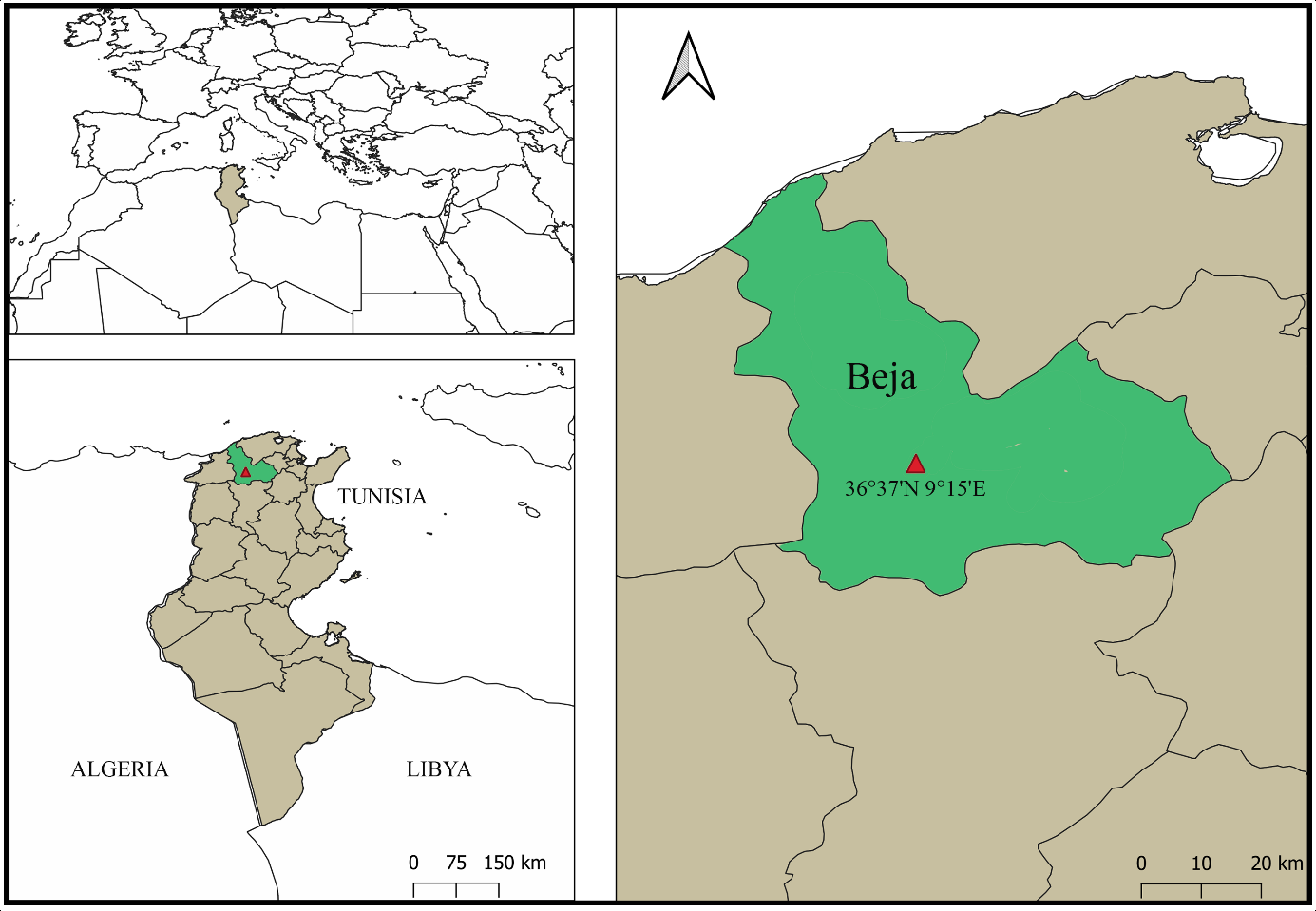
Material was collected from arid area upstream of the Sidi Salem dam in northern Tunisia-; governorate of Beja (36°37’21.5”N 9°15’39.7”E) (Figure 1) during two field trips in spring 2016. The area is part of the upper semiarid bioclimatic stage, marked by a hot summer and a mild winter.
The average annual rainfall varies between 400 and 450 mm with an irregular seasonal distribution. The region is characterized by a cold winter with an average temperature of 10.3°C, and a hot summer with an average temperature of 30°C and up to 47°C in July and August.
Specimen images were taken using a Canon camera EOS 6D attached to a canon macro lens MP-E 65mm f/2,8. with a size scale then edited using Adobe Photoshop CS6 2012.
Measurements and Indices
All measurements are in millimeters and follow standard measurements of Agosti [21].
Measurements
Alitrunk length (AL): The diagonal length of the alitrunk in profile from the point at which the pronotum meets the cervical shield to the posterior base of the metapleuron.
Metanotum height (MH): The maximum distance from the line spanned between the anteriormost and posteriormost part of the alitrunk and the lowest part of the metanotum, measured at a right angle to this line.
Propodeum height (PH): The maximum distance from the line spanned between the anteriormost and posteriormost part of the alitrunk and the most raised part of the propodeum, measured at a right angle to this line.
Eye length (EL): The maximum diameter of the eye. Head length (HL): The length of the head proper, excluding the mandibles, measured from the mid-point of the anterior clypeal margin to the mid-point of the occipital margin, in full-face view. Head width (HW): The maximum width of the head in full- face view, measured below the eyes. Scape length (SL): The maximum straight line length of the antennal scape excluding the basal constriction or neck to the condylar bulb. F1: Length of first funicular segment. F2: Length of second funicular segment.
Indices
Cephalic index (CI): HW × 100/HL. Eye index (El): EL × 100/HW. Funicular index (FI): F1 × 100/F2. Maxillary palp index (MPI): Length of fourth maxillary palp segment × 100/Length of fifth. Propodeum index (PI): PH × 100/MH.
Scape index (SI): SL x 100/HW.
Type Depositorie
The holotype is deposited in the entomological collection of the Biology Department, Faculty of Science Tunis El Manar.
A Paratype from the material studied in this paper will be deposited in the Natural History Museum, London, United Kingdom (NHM ex. BNHM) 2 workers (NHMUK 013806166; NHMUK 013806167); and another Paratype in the Muséum national d’Histoire naturelle, Paris, France (MNHN) 2 workers (MNHN-EY-EY XXXX; MNHN-EY-EY XXXX).
Results and Discussion
Taxonomy Family FORMICIDAE Latreille, 1809 Subfamily FORMICINAE Latreille, 1809 Genus Cataglyphis Foerster 1850 Cataglyphis convexus sp.n.,
Etymology
The word “convexus” is derived from the Latin word “convexus”, to emphasize the presence of a convexity at the apical end of the petiolar node.
Diagnosis
For the description of this new species of Cataglyphis we used the caste of workers, while the queens and males are still unknown (Figures 1-4). It’s a bicoloured species with reddish head, alitrunk, petiolar node and black gaster. Workers are of variable size; their body length can reach 12 mm (Figures 2A & 2B). Their head has almost parallel sides (below the eyes) and gradually convex occipital margin (Figure 2C). The occipital corners are not marked. Their head length is longer than its width (CI 71–93) (Table 1). The anterior clypeal margin presents a convex form, without median notch. A light setae covers the clypeus; slightly longer than the length of clypeus and joined in near its posterior margin. The eyes are relatively small; 0.78 mm is their maximum diameter. The posterior ocelli; located at the level of the posterior margin of eyes; are relatively big, forming equilateral triangle.
The antennae are fragmented into 12 segments. Scapes are long; when laid back from their insertions, they surpass posterior margin of head by less than ⅓ of its length. The first funicular segment is 1.66 time longer than second.
| Measurements | Cataglyphis convexus (n=31) | ||||
|---|---|---|---|---|---|
| holotype | min | max | mean | ± SD | |
| AL | 3,590 | 1,880 | 4,460 | 3,281 | 0,720 |
| MH | 0,50 | 0,280 | 0,680 | 0,450 | 0,091 |
| PH | 0,730 | 0,360 | 0,930 | 0,649 | 0,149 |
| PI | 1,46,000 | 1,20,588 | 1,92,105 | 1,43,816 | 16,353 |
| HL | 2,150 | 1,170 | 2,860 | 1,993 | 0,472 |
| HW | 1,790 | 0,880 | 2,480 | 1,708 | 0,432 |
| CI | 83,255 | 71,910 | 95,348 | 85,456 | 6,604 |
| EL | 0,540 | 0,290 | 0,780 | 0,523 | 0,122 |
| EI | 30,167 | 26,130 | 34,259 | 30,917 | 2,017 |
| SL | 2,440 | 1,100 | 3,230 | 2,214 | 0,575 |
| SI | 1,36,312 | 1,08,108 | 1,51,000 | 1,29,821 | 9,434 |
| F1 | 0,550 | 0,270 | 0,790 | 0,529 | 0,142 |
| F2 | 0,310 | 0,150 | 0,490 | 0,325 | 0,102 |
| FI | 1,77,419 | 1,04,878 | 2,00,000 | 1,66,266 | 19,549 |
| P3 | 0,470 | 0,240 | 0,690 | 0,490 | 0,111 |
| P4 | 0,330 | 0,160 | 0,460 | 0,317 | 0,070 |
| P5 | 0,200 | 0,100 | 0,290 | 0,209 | 0,047 |
| P6 | 0,160 | 0,080 | 0,230 | 0,162 | 0,036 |
| MPI | 1,65,000 | 1,40,740 | 1,75,000 | 1,51,950 | 7,657 |
Table 1: Measurements (in mm) of _Cataglyphis convexus_ sp. nov.
The first, second and sixth segments of maxillary palpes are the shortest with the same length almost; fifth segment 1.3 times longer than sixth ones while the fourth is 2 times longer and the third is 3 times longer than the sixth. The third segment is never flattened, with abundant erect hairs on inner margin. The length of the longest hairs- that cover maxillary palpes is equal or only a little longer than the maximum diameter of the 4th segment. The two apical segments are covered with abundant shorter hairs. The robust mandibles contain six teeth: a long apical one, a slightly smaller periapical tooth, three small post-basal teeth and another smaller basal one.
The petiole in profile squamiform is reminiscent of the petiolar form of the species group altisquamis with an originality never encountered in the genus Cataglyphis: the presence of a V-shaped cavity at the level of apical margin of the petiole whose depth does not exceed 20% the petiolar height (Figure 2D). This character persists in all specimens studied. The alitrunk is long and thick. The pronotum is elevated and followed by a mesonotum a little higher than the pronotal level. The propodeal dorsum is in profile distinctly low and little arched, nearly at same level as petiolar node.
The surface of the whole body has a dense micro- reticulation; appears dull although not strongly matt; which is more specific to the surface of the head giving a honeycomb effect. The body has sparse whitish short hairs. The Occiput has 1 or 2 quite long standing sallow hairs, frons haven’t, clypeus have 1 or 2 similar hairs. The gaster and petiolar node are covered by a very sparse and short decumbent silver pilosity. Each gastric segment has a low density of long sallow hairs which are more abundant in the lower side. The coxae are upholstered with a dense silver pubescence with 3 to 4 long dark hairs in the lower side. The tibiae and femur are lined with dark short setae. The antennae are upholstered with fine, short whitish depressed pubescence, without semi-erect hairs.
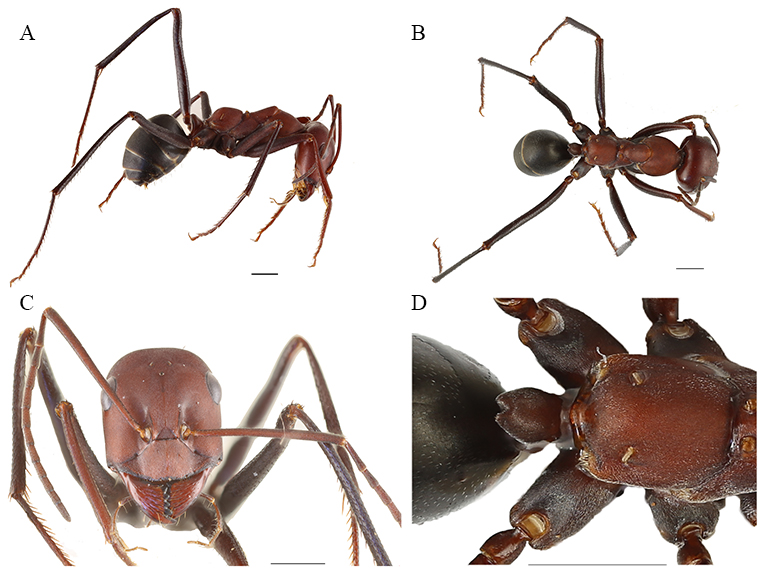
Figures 2: Holotype worker: A – body in lateral view; B – body in dorsal view; C – head in full-face view D – petiolar node in dorsal view. Scale bar 1 mm.
Habitat
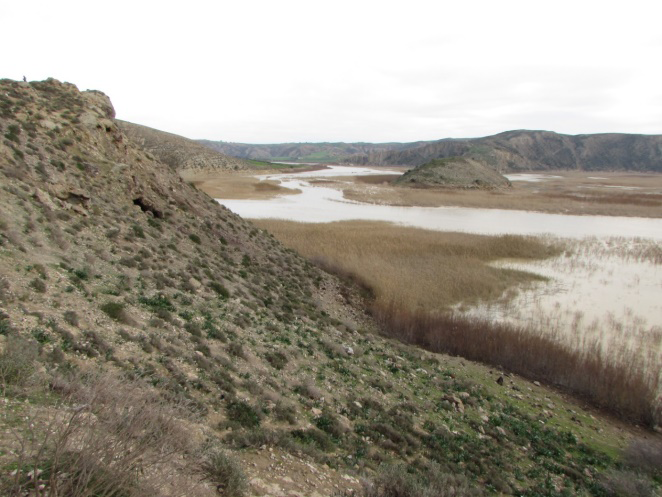
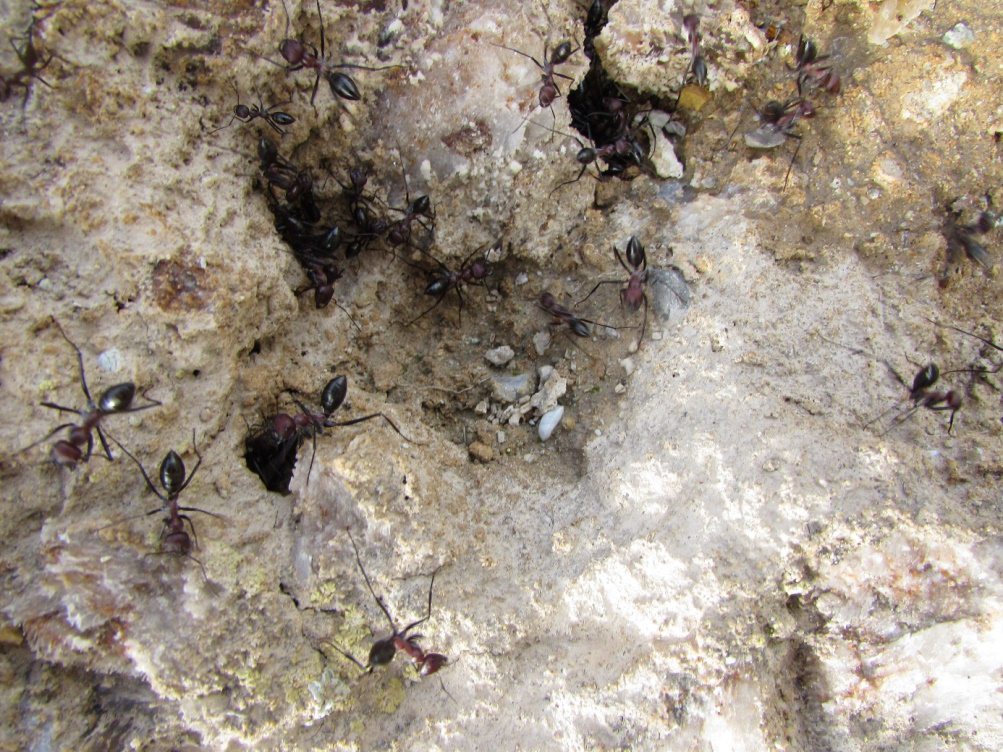
According to our observations, C. convexus has a preference for rocky areas (Figure 3). It has been found that the presence of this species is limited in space with a very high density. During the sampling the workers are going to move overwhelmingly, some workers are carried by others between their mandibles (Figure 4: video: https://www. youtube.com/watch?v=yK72AVJ6P7w).
Comparative Diagnosis
C. convexus shares several features of the altisquamis-, emmae- and bicolor species-groups of Cataglyphis. This species presents a squamiform petiole with a general appearance cuneiform. Its mandibule contains six or seven teeth by splitting off of the median and the premedian teeth into two denticles. The third maxillary palp is the longest segment never lattened and with erect hairs shorter than 1.5 maximum diameter of the segment. Its Gaster has a widely set pubescence. The head of C. convexus is reticulate and sometimes with a honeycombed appearance. The alitrunk length exceeds 4.2 mm. According to Agosti [21], all these last characteristics confirm that these ants belong to the group altisquamis.
On the other hand, caste worker of C. convexus has a high funicular index (FI) that may exceed 1990; distinct allometric growth with very dimorphic workers (these last are characteristics for the emmae-group species).
In general, workers of the species of all two groups above mentioned are unicolorous while ours is bicoloured; with reddish head, alitrunk and petiolar node and black gaster; reminiscent of bicolor species-groups. Moreover, members of this species have a high gaster in locomotion, propodeum arched with an index (PI) less than 200, cephalic index (CI) less than 97; which matches even more the members of the bicolor group.
The appropriate taxonomic position of this species can be definitively resolved when males are found. Despite this slight taxonomic blur, C. convexus clearly differs from one of the species mentioned above by the presence of a V-shaped cavity at the level of apical margin of the petiole.
Acknowledgment
We especially thank the members of Exploralis-Tunisia association for their help and support in the field during the Med-EX project.
References
-
Radchenko A, Paknia O (2010) Two new species of the genus _Cataglyphis_ Foerster, 1850 (Hymenoptera: Formicidae) from Iran. Annales Zoologici (Warsaw) 60 : 69-76.
-
Collingwood CA, Agosti D, Sharaf MR, Van Harten A (2011) Order Hymenoptera, family Formicidae. Arthropod Fauna of the UAE 4: 405-474.
-
Brown WL (2000) Diversity of ants. In: Agosti D, Majer J, et al. (Eds.), Ants: standard methods for measuring and monitoring biodiversity. Smithsonian Institution Press, Washington DC, USA pp: 280.
-
Sharaf MR, Collingwood CA, Aldawood SA (2015) Notes on the ant genus _Cataglyphis_ Foerster, 1850 (Hymenoptera, Formicidae) in the Arabian Peninsula with description of a new species and a key to species of the _C. pallida_-group. ZooKeys 545: 101-117.
-
Cagniant H (2009) Le genre _Cataglyphis_ Foerster, 1850 au Maroc (Hyménoptères Formicidae). Orsis 24: 41-71.
-
Herrera CM, Herrera J, Espadaler X (1984) Nectar thievery by ants from southern Spanish insect-pollinated flowers. Insectes Sociaux 31: 142-154.
-
Hulme PE (1997) Post-dispersal seed predation and the establishment of vertebrate dispersed plants in Mediterranean scrublands. Oecologia 111: 91-98.
-
Boulay R, Carro F, Soriguer RC, Cerdá X (2007) Synchrony between fruit maturation and effective dispersers’ foraging activity increases seed protection against seed predators. Proceedings of the Royal Society of London 274(1625): 2515-2522.
-
Santschi F (1929) Étude sur les _Cataglyphis_. Revue Suisse de Zoologie 36: 25-70.
-
Wehner R (1983) Taxonomie, Funktionsmorphologie und Zoogeographie der saharischen Wüstenameise Cataglyphis fortis (Forel 1902) stat. nov. (Insecta: Hymenoptera: Formicidae). Senckenbergiana Biologica 64: 89-132.
-
Wehner R (1986) Visuelle Orientierung bei Wüstenameisen: Art- und kastenspezifische Mechanismen. Jahrbuch. Akademie der Wissenschaften und der Literatur. Mainz pp: 107-112.
-
Wehner R, Wehner S, Agosti D (1994) Patterns of biogeographic distribution within the bicolor species group of the North African desert ant, _Cataglyphis_ Foerster 1850 (Insecta: Hymenoptera: Formicidae). Senckenbergiana Biologica 74: 163-191.
-
Pearcy M, Aron S, Doums C, Keller L (2004) Conditional use of sex and parthenogenesis for worker and queen production in ants. Science 306(5702): 1780-1783.
-
Leniaud L, Darras H, Boulay R, Aron S (2012) Social hybridogenesis in the clonal ant _Cataglyphis hispanica_. Current Biology 22(13): 1188-1193.
-
Wehner R, Boyer M, Loertscher F, Sommer S, Menzi U (2006) Desert ant navigation: one-way routes rather than maps. Current Biology 16: 75-79.
-
Collett M, Collet TS (2009) Local and global navigatio- nal coordinate systems in desert ants. The Journal of Ex- perimental Biology 212(7): 901-905.
-
Wehner R (2009) The architecture of the desert ant’s navigatio-nal toolkit (Hymenoptera: Formicidae). Myrmecological News 12: 85-96.
-
Lenoir A, Aron S, Cerdá X, Hefetz A (2009) _Cataglyphis_ desert ants: a good model for evolutionary biology in Darwin’s anniversary year – A review. Israel Journal of Entomology 39: 1-32.
-
Amor F, Ortega P, Cerdá X, Boulay R (2011) Solar elevation triggers foraging activity in a thermophilic ant. Ethology 117: 1031-1039.
-
Mangan M, Webb B (2012) Spontaneous formation of multiple routes in individual desert ants (_Cataglyphis_ _velox_). Behavioral Ecology 23(5): 944-954.
-
Agosti D (1990) Review and reclassification of _Cataglyphis_ (Hymenoptera, Formicidae). Journal of Natural History 24: 1457-1505.
- California Red-Legged Frog and Non-Listed Amphibians Response to Non-Native Fish Removal
- Industrial Standardization of the Bio-OS: Algorithmic Codification of Resilience Engineering Guidelines and Version V8 Architecture
- Climate Variability and the Sustainability of Snail Farming in Nigeria: Past Trends, Present Challenges and Potential Outlook
- The Evaluation of the Surveillance System of Anthrax in Gilgit-Baltistan, Pakistan, 2018
- Natural Decline to Extinction of A New Zealand Rabbit Population
- Mitochondrial Bio-Logistics: Steering Co-Enzyme Q10 and Lycopene Synergies within the Science 4.0 Bio-OS Framework