
Neural Stem Cells: How Far Can we Give Justice For Brain Diseases Therapeutics?
Neural stem cells are potential undifferentiated cells which are involved in regeneration of neurons and glial cells after transplantation in the treatment of brain diseases. If so how far we have reached the impact on various differentiated types of neural stem cells work especially to the world of medical neuroscience related to the fundamental concepts to Medical applications for brain diseases treatment. The mesenchymal stem cells are also have the capacity to regenerate the neural stem cells and involved in the treatment of neurodegenerative diseases such as Parkinson’s and Alzheimer’s diseases. Neural stem cells with neurotransmitters and enzymes are also involved towards the design of therapeutics for the brain diseases treatment. If so how do these stem cells behaves and solve the issues towards the different brain diseases treatment such as neurodegenerative diseases, Brain tumors, etc. can be briefly addressed to overcome the problems for better therapeutics.
Neural Stem Cell Types Differentiation, Tran’s Differentiation and Function
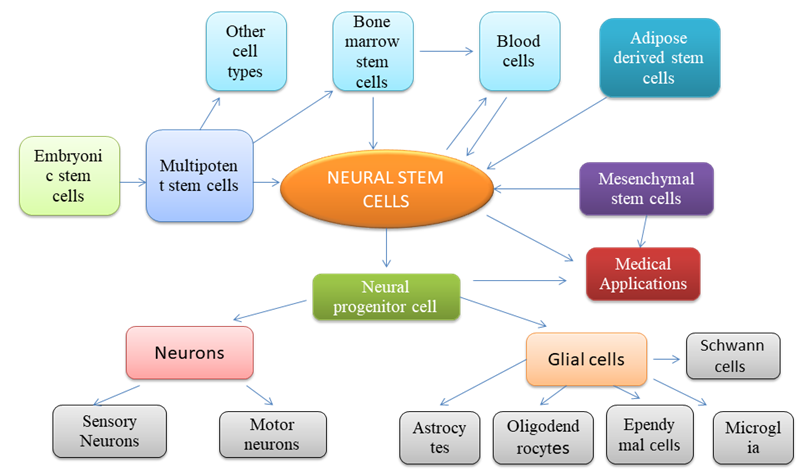
Neural stem cells (NSCs) were discovered in the year of 1960 [1] and continuously been studied for Basic research and medical applications with mainly for transplantation. Neural stem cells are somatic cells differentiated to neural progenitor cells and further it give rise to neurons and glial cell types such as astrocytes, oligodendrocytes, ependymal cells, microglia and Schwann cells. Whereas neurons can differentiated into sensory and motor neurons according to their function. Mesenchymal stem cells can give rise to NSC and widely use in the treatment of Brain diseases (Parkinson’s disease) and Adipose derived stem cells were also utilized in the treatment of neurological diseases such as nerve injury and neurodegenerative disorders [2, 3]. The commonly used the neurosphere culture system to identify NSC [4, 5]. Neural stem cells invivo and invitro studies been done with phenotypic markers are used to identify NS cells including nestin (an intermediate filament), Sox2, Notch, and CD133. NSCs are widely used in the treatment of various brain diseases such as Alzheimer’s disease, brain tumor, Parkinson’s disease etc.
Mesenchymal Stem Cells (MSC) Relation to Neural Stem Cells (NSC)
NSCs can be generated from human BM-derived mesenchymal stem cells (MSCs). When cultured in NSC culture environment, 8% of MSCs were able to generate neurospheres. These MSC-derived neurospheres expressed characteristic NSC antigens, such as nestin and musashi-1, and were capable of self-renewal and multilineage differentiation into neurons, astrocytes, and oligodendrocytes. But when MSC-derived NSCs were switched back to MSC culture conditions, a small fraction 4 to 5% of NSCs adhered to the culture flasks, cells grown, and displayed the morphology of MSCs [6].
Neural Stem Cells Role in Medicine for the Treatment of Neurological Diseases
Neural stem cells (NSCs) transplantation is the potential therapeutics that has the capacity to differentiate into neurons, astrocytes, and oligodendrocytes, which can produce a large amount of brain tissue and can self-renew, and a population of cells sufficient to provide a large number of brain tissue cells especially in neurodegenerative diseases. The NSC migrate from the aggregation site to the site of the diseases, reducing damage to the blood brain barrier repairing learning and memory abilities that depend on the hippocampus and secreting neurotrophic factors [7]. NSC grafts are potential and innovative strategy for the treatment of many Brain diseases such as AD, provides a more permanent remedy than present drug treatments [8]. Bio molecules and NSC involved in brain diseases treatment. Undifferentiated human neural stem cells (hNSCs) transplanted into severely Parkinsonian 1-methyl-4-phenyl- 1,2,3,6-tetrahydropyridine (MPTP)-treated primates could survive, migrate, and induce behavioral recovery of Parkinsonian symptoms, which were directly related to reduced dopamine levels in the nigrostriatal system [9]. The translational studies reported about the CE/CPT-11 prevent disseminated neuroblastoma where administration of NSC expressing rCE resulted in a significant increase in animal survival, and this occurred in a drug dose-dependent fashion [10]. Then what are the challenges in front of us? Do we need to work deep into the mechanism of stem cell activation and the role of biomolecules towards the better diagnosis and therapeutics?
References
-
Takagi Y (2016) History of Neural Stem Cell Research and Its Clinical Application. Neurol Med Chir (Tokyo) 56(3): 110-124.
-
Krabbe C, Zimmer J, Meyer M (2005) Neural transdifferentiation of mesenchymal stem cells-a critical review. APMIS 113(11-12): 831-844.
-
Luo L, Hu DH, James Q, Yin, Xu RX (2018) Molecular Mechanisms of Transdifferentiation of Adipose- Derived Stem Cells into Neural Cells: Current Status and Perspectives.
-
Tropepe V, Hitoshi S, Sirard C, Mak TW, Rossant J, et al. (2001) Direct neural fate specification from embryonic stem cells: a primitive mammalian neural stem cell stage acquired through a default mechanism. Neuron 30(1): 65-78.
-
Conti L, Pollard SM, Gorba T, Reitano E, Toselli M, et al. (2005) Niche-Independent Symmetrical Self-Renewal of a Mammalian Tissue Stem Cell. PLoS Biol 3(9): e283.
-
Lijuan Fu, Lunjian Zhu, Yu Huang, Tsung D Lee, Forman SJ, et al. (2008) Derivation of Neural Stem Cells from Mesenchymal Stem Cells: Evidence for a Bipotential Stem Cell Population. Stem Cells Dev 17(6): 1109-1121.
-
Chen W (2021) Neural Stem Cells Therapy to Treat Neurodegenerative Diseases. E3S Web of Conferences 271: 6.
-
Hassan AUl, Hassan G, Rasool Z (2009) Role of Stem Cells in Treatment of Neurological Disorder. India International Journal of Health Sciences (Qassim) 3(2): 227-233.
-
Paul RS (2007) Neural stem cells for Parkinson’s disease: To protect and repair. Proc Natl Acad Sci USA 104(29): 11869-11870.
-
Aboody KS, Bush RA, Garcia E, Metz MZ, Najbauer J, et al, (2006). Development of a tumor-selective approach to treat metastatic cancer. PLoS One 1(1): e23.
- Assessing the Accuracy of Refractive Prediction of Different IOL Formulas in Medium Long Eyes
- The Effect of Imatinib on the Fetus Growth and Development of a Pregnant Woman Involved with CML, a Case Report and a Literature Review
- Acquired Neutropenia and Fever, its Treatment and Complications in an Infant, A Case Report
- Coccidioidomycosis with Laryngeal Nodule and Cavitary Lung Disease: A Case Report
- Hodgkin Lymphoma in a Girl with Common Variable Immune Deficiency: A Case Report and Review of Literature
- Public Administration and the Management of Beliefs in Risks and Dangers in the COVID-19 Era