
Management of Northern Hill Myna Gracula Religiosa Intermedia in Cage for Talking
Before the wildlife act in Bangladesh, the first line hobby of bird keeping was Hill Myna. That time most luxurious people reared it for their man-like nice talking. Its price was huge. Hill Myna is our native bird. So, now for strong wildlife act pet of the Hill Myna is not accepted. Recently, many birds collected from Dhaka Kataban and released them in Lawachara National Park, Sylhet, Bangladesh. Now in Bangladesh this Hill Myna is replaced by exotic parrots, parakeets, cockatoos, macaws, and lovebirds etc.
Introduction
As Passeriformes birds are very talkative so Hill Myna is a nice talking bird. The common name of myna is starling and the word mynah is derived from Hindi ‘maina’ means madana which is ‘joyful/delightful’. In Sanskrit meaning, this is ‘Messenger of God’. Its vocal cord is fine in structure so it can produce lots of different sound in nature or in captivity. Indian Hill Myna is the number one talking birds of Bangladesh. Once upon a time it was very common cage bird in most houses but now due to wildlife act it has been reduced. This bird is our local hill birds available in Sylhet and Chittagong Hill Tracts. It is reared in small cages and mainly one. Rearers say that if they pet one the talking ability is made excellent. Due to small cages it not moves freely and for one sex it passes lonely life and this creates breeding barrier after releasing in jungle. This is the first stage of cruelty to this bird. Most of the cage birds of the local species finally die. Mismanagement and unhygienic environment are the main cause for this death. Moreover, people are not conscious for its disease. On the rump of Myna, wound is very common. In this case, in jungle, it takes some fruits which are helpful to cure such kind of problem.
Rearers suggest that poprika with rice is the solution for this case. But it is true that maximum Myna dies in cage for this treatment. That is why the Hill Myna is decreasing day by day. Bangladesh Wildlife Society collects that Myna from various shops in Bangladesh then releases in the forest occasionally. Tribal people in jungle and illegal poachers are related to catch or hunt this nice talking bird. In some cases, we can make a large-sized aviary and by breeding, we can release chicks in nature. This bird is popular talkative bird in western countries. All sub species are more or less same devoid the structure of nape-wattle. In zoo or for road-side commuters this bird hears lots of sentences and repeat as same. After releasing this bird in jungle such type of talking ability is lost automatically for their gregarious natural life. Its voice is loud and is different types of whistle is very common. Myna is very fond of bathe and it has daily two times bathe record. It is very clean, hardy, high tempered and perching bird. Its audio-visual perception is very strong and repeats the same word within the short time. Morning and dawn are their main talking time. It lives in tropical, moist-deciduous, and semi-evergreen forest. These birds are almost arboreal and hardly ever to the ground. Ceylon Hill Myna is also a popular cage bird [1].
During resting it is constantly call and answer one another in low conversational croaks. Its voices are– whistle, wails, screech, and gurgle. Till now this bird showed 3-13 repertoire call- types. This Myna was practiced to utter total 9 voices- major, hallo, tomar num ki, bhat dao, sattar bhai, najma ara koi, o priya o priya tumi kothai, amar nam moina, romeo etc and after hear sudden new sentences it could reply most of the time (Figure 1). The common voice of pet Myna in Bangladesh is moina kotha kao [4]. Due to talking ability this bird now in threatened species in some areas [5]. Hill Myna farming is more profitable at present [6]. Northern sub species (intermedia) are usually taken from the nest before fledging and then hand-reared, whereas the southern birds sub species (indica) mostly trapped as adults, which rarely tame [7]. There were at least 50-60 endangered hill mynas were captured from Dhaka Kataban and released them its forest [8]. Breeding of Myna is not too difficult [9]. In ancient Greece there a lot of people who reared Hill Myna for nice talking [10]. Illegal trade of Hill Myna is a regular practice in most roadside markets.
Materials and Methods
Observed Hill Myna was in intermedia sub species and its age was seven years. A pair was collected from Chittagong Hill Tracts and one died by pneumonia. The measurement of the cage was about 24 x 18 x 21 inch. In captivity, Myna is used to regular bathe. Supplied foods were rice, poprika, bread, liver and gizzard of chicken with rice, all fruits especially ripe papaw and orange etc. Very bad food for myna is chocolate, cherry, apple pips, avocado, and peaches. The rearing cage needs to maintain 40-watt bulb and 12 inches away from the cage and the ideal room temperature should 960 Fahrenheit [2]. The outdoor aviary for mynas should maintain 4 x 5 x 3 metre cube. The southern sub species is the biggest and more aggressive [3].
Results and Discussion
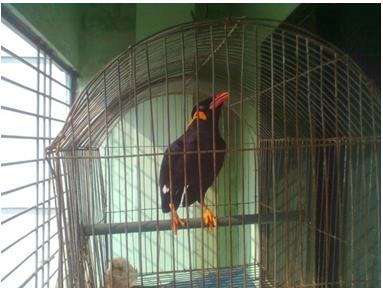
now in danger [16]. Both sub species (Gracula religiosa intermedia and Gracula religiosa religiosa) were bred successfully for three generations at the Zoological Research Station, Ramkhamhaeng University, Bangkok, Thailand [17, 18]. In India, the pet record of this Myna is 2000 years [3].
References
-
Ali S, Ripley SD (1986) Handbook of the birds of India and Pakistan together with those of Bangladesh, Nepal, Sikkim, Bhutan and Sri Lanka. The Quarterly Review of Biology 52(1): 103.
-
Gardner C (2012) Hand-raising and rehabilitation of mynas. Rehabber’s Den pp:1-30.
-
Dearborn DC, Wiley RH (1993) Prior residence has a gradual influence on dominance in captive White- throated sparrows. Anim Behav 46(1): 39-46.
-
Khan MAR 2008 Bangladesher Pakhi (in Bangla). Bangla Academy, Dhaka, Bangladesh.
-
Bertram B (1969) Avicultural Magazine 75: 253-255
-
Bertram B (1967) Journal of Bombay Natural History Society 64: 369.
-
Ali S, Ripley SD (1986) Handbook of the birds of India and Pakistan together with those of Bangladesh, Nepal, Sikkim, Bhutan and Sri Lanka. The Quarterly Review of Biology 52(1): 103.
-
Staff correspondent (2010) Kataban illegal wildlife trade busted. The Daily Star.
-
Alderton D (2005) The ultimate encyclopedia of caged and aviary birds. Anness Publishing Ltd, London.
-
Rahman, ANMA (2004) Posha pakhi pakhi posha (in Bangla). Nandini Printing and Publications, Dhaka, Bangladesh.
-
Ahmed A (1997) Live bird trade in Northern India. WWF/TRAFFIC India, New Delhi, pp: 104.
-
Ahmed A, Islam MZ, Rahmani AR (2004) Important bird areas in India: Priority sites for conservation. Indian Bird Conservation Network: Bombay Natural History Society and Bird Life International pp: 66-70.
-
Menon V (1993) Hill myna trade. Newsletter for Birdwatchers. 33(4): 68-69.
-
Ahmed A (2002) Live bird trade in India. Unpublished report. TRAFFIC India/WWFIndia. New Delhi, pp: 113.
-
Ali S (1963) On the alleged inferiority of the Southern Grackle [Gracula religiosa indica (Cuvier)] as a talking bird. Journal of the Bombay Natural History Society Mumbai 60: 455-456.
-
Siawomartono D (1996) Pers corres.
-
Archawaranon M (2002) Causes of morphological variation in the Hill Mynah population in Thailand. J Biol Sci 2: 662-665.
-
Archawaranon M (2005) Captive Hill Mynah Gracula religiosa breeding success: potential for bird conservation in Thailand?. Bird Conserv Int 25: 327- 335.
- In Situ Evaluation of the Anthelmintic Effect of the Aqueous Extract of Syzygium aromaticum (L) Merr and Perry on Bovine Strongyles
- Successful in Vitro Embryo Production with Oocytes Aspirated from Live White-Tailed Deer (Odocoileus Virginianus Texanus) Donors under Captivity in Northeast Mexico
- Bangladeshi Finches with their Evolutionary Thoughts (Aves: Passeriformes)
- Note on the Survival Status of Przewalski’s Horse, Equus ferus przewalskii (Perissodactyla: Equidae)
- In-Situ and Ex-Situ Protection of White-Breasted Waterhen (Amaurornis Phoenicurus) (Pennant, 1769) (Aves: Rallidae)
- Meat Examination in the Laboratory, the Acceptability and the Human Health