
A Note on Status and Breeding Biology of Birds-of-Paradise (Aves: Paradisaeidae)
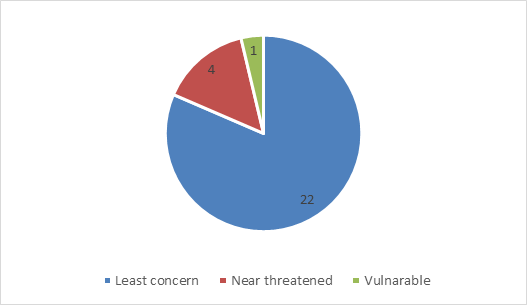
Based on the extraordinary plumage colours and courtship display, the birds-of-paradise are most significant bird in the world. To know its breeding biology fully, these birds can be study bird to everybody. After reviewing many write-ups, it was possible to mention its status and remarkable breeding biology. Noted, 27 species of these birds were in the order Passeriformes and family Paradisaeidae. Most of the birds were showed polygamous, and only two were (crinkle-collared manucode, Manucodia chalybatus, halmahera paradise-crow/Silky-crow, Lycocorax pyrrhopterus) monogamous. Observation suggested 15 genera of this bird group. Based on the information, 22 species were found least concerned (81.48%), near threatened 4 (14.81%), and vulnerable 1 (3.70%). Habitat loss, limited range, and for bright plumage of male birds, some species are showing their risky life in nature.
Introduction
Status of Birds-of-Paradise
The birds in the family Paradisaeidae are foraged throughout the islands of New Guinea and its surroundings, including the Aru Islands, Misool and Salawati Islands, and Yapen Island. In addition, there are two species native in Moluccas islands and four species whose range includes (partially or entirely) north-eastern Australia [1]. In fact, birds-of-paradise are residents of humid and tropical rainforest. BirdLife International enlisted 41 species of these birds with their threat of extinction [2].
Breeding Biology
Birds of paradise have become an important focus for testing current theories regarding sexual selection [3]. There are four theories for the breeding of this bird―dominant male, metabolic cost, intrasexual competition, cryptic colouration [4]. Some males may take up to seven years to obtain full adult plumage [5]. Colorfully plumed males gather in groups to perform in courtship display [6], and females are attracted to these communal display arenas [7]. In the case of king bird-of-paradise (the smallest bird-of-paradise) (Cicinnurus regius) (Plate 1), the average distance between neighbouring males is 70m [1]. In some habitats, leks may be so dispersed, so females have difficulty locating them [8, 9, 10]. Most of the individuals in a lek never receive a mating opportunity; lek polygamous continues to flourish among various species of birds and insects [11]. It has two breeding behavior-lek and court. At least eight species of birds-of-paradise exhibit lek mating systems [12]. In the Paradisaeidae family, the largest bird-of-paradise is mentioned as greater bird-of-paradise (Plate 2). These birds are difficult to maintain and breed in captivity. In aviary it needs―many perches at all heights, large numbers of live plants, water sprinklers, feeding station, shade-cloth on the roof, pop-hole and sliding hatch door, hatches or tunnel systems, climate control (up to 50° Celsius), and concrete floor [1]. The bright and conspicuous plumage may increase its vulnerability to predation [13] (Tables 1 & 2, Figure 1).
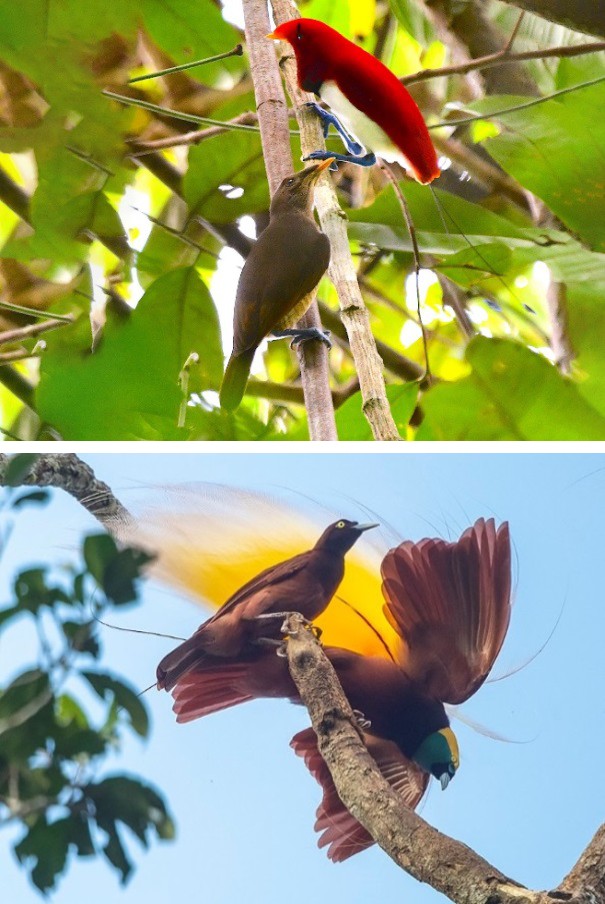
Plate 1: King bird of paradise.
Plate 2: Greater bird of paradise.
| Names | Breeding status | Global status |
|---|---|---|
| Greater lophorina, Lophorina superba(Pennant 1781) | Polygamous | LC |
| Red bird-of-paradise, Paradisaea rubra, Daudin 1800 | Polygamous | NT |
| Greater bird-of-paradise, P. apoda, Linnaeus 1758 | Polygamous | LC |
| Raggiana bird-of-paradise, P. raggiana, PL Sclater 1873 | Polygamous | LC |
| Lesser bird-of-paradise, P. minor, Shaw 1809 | Polygamous | LC |
| Wilson's bird-of-paradise, Diphyllodes respublica(Bonaparte 1850) | Polygamous | NT |
| Magnificent bird-of-paradise, D. magnificus(Pennant 1781) | Polygamous | LC |
| King bird-of-paradise, Cicinnurus regius(Linnaeus 1758) | Polygamous | LC |
| Blue bird-of-paradise, Paradisornis rudolphi,Finsch & Meyer AB 1886 | Polygamous | NT |
| Twelve-wired bird-of-paradise, Seleucidis melanoleucos(Daudin 1800) | Polygamous | LC |
| Black sicklebill, Epimachus fastosus(Hermann 1783) | Polygamous | LC |
| Brown sicklebill, E. meyeri,Finsch & Meyer 1886 | Polygamous | LC |
| Western parotia/Arfak parotia, Parotia sefilata(Pennant 1781) | Polygamous | LC |
| Eastern or Lawes's parotia, P. fawesii, EP Ramsay 1885 | Polygamous | LC |
| Victoria's riflebird, Ptiloris victoriae,Gould 1850 | Polygamous | VU |
| Growling riflebird/Eastern riflebird, P. intercedens, Sharpe 1882 | Polygamous | LC |
| Magnificent riflebird, P. magnificus(Vieillot 1819) | Polygamous | LC |
| Paradise riflebird, P. paradiseus, Swainson 1825 | Polygamous | LC |
| Long-tailed paradigalla, Paradigalla carunculata, Lesson 1835 | Polygamous | NT |
| Short-tailed paradigalla, P. brevicauda,Rothschi & Hartert 1911 | Polygamous | LC |
| Ribbon-tailed astrapia/Shaw Mayer's astrapia, Astrapia mayeri, Stonor 1939 | Polygamous | LC |
| Arfak astrapia, A. nigra(Gmelin JF 1788) | Polygamous | LC |
| Standardwing bird-of-paradise/Wallace's standardwing, Semioptera wallacii, GR Gray 1859 | Polygamous | LC |
| Crinkle-collared manucode, Manucodia chalybatus(Pennant 1781) | Monogamous | LC |
| Halmahera paradise-crow/Silky-crow, Lycocorax pyrrhopterus(Bonaparte 1850) | Monogamous | LC |
| Black-billed sicklebill/Buff-tailed sicklebill, Drepanornis albertisi(Sclater PL 1873) | Polygamous | LC |
| Pale-billed sicklebill, D. bruijnii, Oustalet 1879 | Polygamous | LC |
Table 1: Breeding status of some birds-of-paradise of the world.
Source: Wikipedia (2023); LC=least concern; NT=near threatened; VU=vulnerable. Table 1: Breeding status of some birds-of-paradise of the world.
| Causes of present status | |
|---|---|
| Red bird-of-paradise, Paradisaea rubra | Habitat loss; degradation |
| Wilson’s bird-of-paradise, Diphyllodes respublica | Habitat loss; limited range; exploitation |
| Blue bird-of-paradise, Paradisornis rudolphi | Habitat loss; hunt of adult males for their plumage |
| Long-tailed paradigalla, Paradigalla carunculata | Limited range |
| Victoria’s riflebird, Ptiloris victoriae | Climate change |
Table 2: Causes of threatening remarks of birds-of-paradise.
Conclusion
Due to natural polygamous breeding, these birds get preference to survive in nature, but it is difficult to reproduce them in captivity. Adequate breeding facilities in zoos could enhance their production. Climate change, habitat loss, and bright plumage of male birds are their threats for declining.
References
-
Switzer R (2008) Management and breeding of birds of paradise (family Paradisaeidae) at the Al Wabra Wildlife Preservation. Aviary Congress Singapore pp: 1-11.
-
(2008) BirdLife International.
-
Beehler BM, Foster MS (1987) Hotshots, hotspots, and female preference in the organization of lek mating systems. American Naturalist 131(2): 203-219.
-
Laska MS, Hutchins M, Sheppard C, Worth W, Hundgen K, et al. (1992) Reproduction by captive unplumed male lesser bird of paradise Paradisaea minor: evidence for an alternative mating strategy. Emu 92: 108-111.
-
Cooper WT, Forshaw JM (1977) The Birds of Paradise and Bowerbirds. Collins, Sydney.
-
Gilliard ET (1969) Birds of Paradise and Bowerbirds 1st (Edn.), Natural History Press, Garden City, New York.
-
Emlen ST, Oring LW (1977) Ecology, sexual selection, and the evolution of mating systems. Science 197(4300): 215-223.
-
Healy CJ (1978) Effects of human activity on Paradisaea minor in the Jimi Valley, New Guinea. Emu 78(3): 149- 155.
-
Oring LW (1982) Avian mating systems. In: Farner, et al. (Eds.), Academic Press, New York, pp: 1-92.
-
Beehler BM (1988) Lek behavior of the Raggiana Bird of Paradise. National Geographic Research 4: 343-358.
-
Sherman PW (1999) Bird of a feather flock together. Nature 401: 119-120.
-
Beehler BM, Pruett JSG (1983) Display dispersion and diet of birds of paradise: a comparison of nine species. Behavioral Ecology and Sociobiology 13(3): 229-238.
-
Zahavi A (1975) Mate selection-a selection for a handicap. Journal of Theoretical Biology 53(1): 205-214.
- In Situ Evaluation of the Anthelmintic Effect of the Aqueous Extract of Syzygium aromaticum (L) Merr and Perry on Bovine Strongyles
- Successful in Vitro Embryo Production with Oocytes Aspirated from Live White-Tailed Deer (Odocoileus Virginianus Texanus) Donors under Captivity in Northeast Mexico
- Bangladeshi Finches with their Evolutionary Thoughts (Aves: Passeriformes)
- Note on the Survival Status of Przewalski’s Horse, Equus ferus przewalskii (Perissodactyla: Equidae)
- In-Situ and Ex-Situ Protection of White-Breasted Waterhen (Amaurornis Phoenicurus) (Pennant, 1769) (Aves: Rallidae)
- Meat Examination in the Laboratory, the Acceptability and the Human Health