
A Mixed Studies on Bird Strikes with Special Emphasis on their Management
This article has an impact to minimize the bird strikes in Bangladesh or airports of other countries. A great source of online supplements helped to complete this write-up. Many birds strike in various times in home and abroad focused a clear idea on this topic. Results showed that many airports located near sea or small forests, so wildlife are common there. In Europe and USA, most strikes found for the activities of lapwings, gulls, and starlings. In Bangladesh, kites were the most hazardous birds at the airports. Six species of crows observed in the airports with their lowest hazards (5%), highest was happened by six species of gulls (33%) (Figure 1, Table 1). It is impossible to ignore wildlife from the airports. In this regard, concerning authorities should come forward through providing enough funds in order to enrich this wildlife control sector. Till now, only proper inspection before landing and takeoff of aircraft could resolve this unwanted bird strikes at the airports.
Introduction
Birds are a serious hazard to aviation as a whole. Bird collision with aircraft known as bird strike (Plate 1, Plate 2). Although most bird strikes do not result crash, they do involve expensive structural and mechanical damage to aircraft. Faster speed birds have less time to react to approaching aircraft. The force generated by bird impact is tremendous for fast-moving aircraft. The newer turbine engines with light weight and high-speed mechanical parts are vulnerable to bird strike damage. The USDA-APHIS-ADC program provides technical assistance to alleviate bird hazards to civilian and military airbases. Migratory birds protected by Migratory Bird Treaty Act of 1918, non-migratory birds by state laws, and Endangered Species by Act of 1973. Many airports situated along migratory routes used by birds. Starlings, pigeons, house- sparrows, and swallows often roost or nest in large numbers in airport buildings or nearby trees. Near cities of airports may experience thousands of starlings at early morning and late afternoon (Figure 1, Table 1) [1].
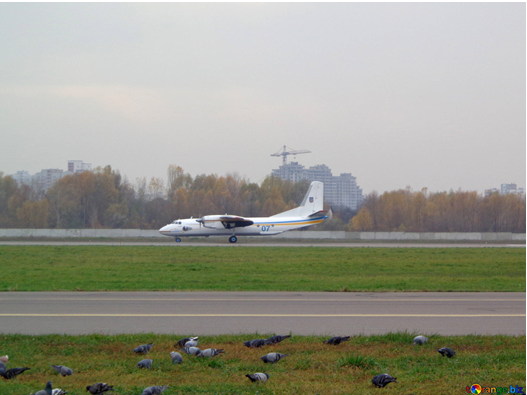
Plate 1: Pigeons on runway.
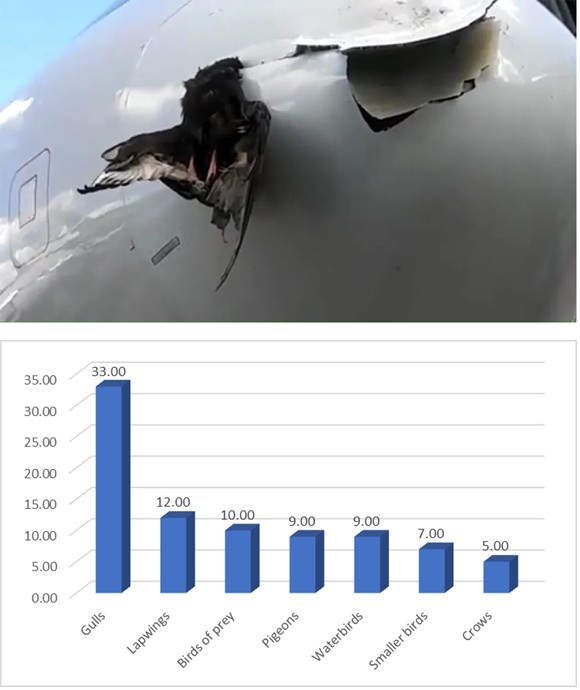
Plate 2: A severe bird strikes.
| Species characteristics | Illustrative species | |
|---|---|---|
| Level 1 | Very large | Geese, cranes, cormorants |
| Level 2 | Very large or large | Vultures, mallards, great black-backed gulls |
| Level 3 | Large or medium | Red-tailed hawks, American crows |
| Level 4 | Medium or small | European starlings |
| Level 5 | Small or very small | Eastern meadow larks, swallows |
| Level 6 | Very small | Warblers, vireos, sparrows |
Table 1: Bird hazard ranking system.
Birds are attracted to airports for vast area as a safe place for resting, gathering, and hiding them from predators [2]. The probability of a bird strike is the highest where aircraft fly low and use the same space in the air and on the ground as birds do [3, 4, 5]. An increasing frequency of the use of faster and more silent two-engine aircraft reduce the noise of flights over urban areas. Unfortunately, such machines are more exposed to bird strikes than older models [6]. Modern aircraft with turbofan engines are fast and relatively silent.
Birds perceive too late the threat of an approaching aircraft do not keep a sufficient long distance of escape the danger [6, 7, 8]. Destruction of one engine can have more distress consequences for an aircraft with two-engine than for a three- or four-engine aircraft [5]. About 51% of the collisions were noted between July and October [9]. The majority of bird strikes (about 60-70%) take place during the day in the morning and early evening [6, 5].
Bird strikes at night are rare because of night aircrafts are few, and birds which fly at night are rare. In Polland, all bird species occurring at airports protected by laws. Threatened animals, on the way to extinction, and migratory species are under a special legal protection by the European Union. At international airports with a high intensity of flight operations, it can be troublesome to manage everything [5]. In the United States and Israel, raptors are also a hazardous group of birds [10, 11]. Military exercises involve flying at high speed and low altitudes and are exposed more risk [12]. This study determines what species of birds are involved, what attracts them at airports, their abundance, and peak use of hazardous zones. The objective of this study is to highlight more appropriate method for managing wildlife as well as birds at airports.
Bird Strikes in Europe and USA
In Europe and North America, from 75-95% of bird collisions with civil aircraft occurred at the airport or close to it [6, 7]. As American studies show, 93% of the collisions occur during takeoff and in the landing [9]. In USA, as many as 32% collisions with waterbirds destroy aircraft, and 20% disturb the flight [5]. About 40% of bird strikes happens on the runway and 92% at a height of 0-900 m. In co-operation with biologists, an array of methods for bird control on the airport was developed [5, 7, 13, 14, 15].
Bird Strike Reports in Bangladesh
A Singapore-bound Biman Bangladesh Airlines (Boing 737) landed urgently after striking by birds. This aircraft carried 156 passengers and 07 crews, and the pilot made landing safely. A flight of Biman Bangladesh Airlines for Saudi Arabia with 375 passengers faced a bird strike. In December 2022, a Dreamliner Aircraft of Biman damaged when a bird hit the engine of the plane during landing at the Dhaka Airport. A bird entered the landing gear of the Biman’s Thailand-bound flight during takeoff. Another (Boeing 737) aircraft of Fly Dubai also faced a similar incident. The bird strike damaged the aircraft’s engine and landing gear. In Bangladeshi airports, since crows are abundant but for their intelligence, they do not make a problem at all. In raptorial group, only periah kite (Milvus migrans govinda) sometimes stay on the runway.
Flight Height and Bird Strikes
Near the ground of any airports, bird strike is common incident. 90% bird strikes occur at or below 3000 feet AGL. Ducks and geese observed frequently up to 7000 feet AGL, and pilots cautioned to minimize and route flying at lower during migration. Denver International Airport of USA is central flyway for migration birds has the most reports of wildlife strike over 9000 through the end of 2022. When an aircraft fly at 35000 feet, it burns less fuel and can fly faster, as the air is less dense. Rocket-powered aircraft can fly 100000 feet to gather data, but they specially designed for it. There are no specific regulations governing civil aircraft operations beyond the altitude of 60000 feet. Helicopter flies at 25000 feet. Oxygen decreases above 10000 feet of the sky. The remarkable loss of life directly linked to a bird strike was on October 4, 1960, when a flying from Boston Eastern Airlines (Flight 375) flew through a flock of common starlings during takeoff. Guam in Micronesia is the first and Dominican Republic (European-African), Punta Cana International Airport is an ideal second bird free destination. Engineers of the National Aviation Facilities Experimental Center has been conducting research with the biologists of the Bureau of Sport Fisheries and Wildlife, U. S. Department of Interior on bird habitats migration and methods of minimizing bird hazards to aircraft or near airports. Most strikes occur during landing and takeoff at altitudes of 2500 feet or less and have involved over 25 species of birds. Gulls and starlings are the most numerous and hazardous causes of strike incidents. Federal Aviation Agency studied of 149 bird strike, 24% incidents on takeoff, 10% on approach, 1% on pavement, 37% at 800 feet altitudes or less, 28% at 800 feet to 2500 feet.
Bird Species at Airports
Water Birds
In European and North American airports, gulls (Larus sp.) cause most hazards. In Europe, there are mainly herring gulls (Larus argentatus), great black-backed gulls (L. marinus), lesser black-backed gull (L. fuscus), common gulls (L. canus), and black-headed gulls (L. ridibundus). American famous pilot Calbraith Rodgers the first who hit by a gull, and he failed to control and felt to the sea and was drowned [16]. Sixty-two passengers on the board crushed near Boston because of the collision with starlings [3]. Gulls cause the remarkable number of collisions with aircraft (25-40) [5, 6, 15]. Immature gulls are most dangerous as being inexperienced than adults [7, 8]. In Europe, lapwings (Vanellus vanellus), in addition gulls belong to the most harassing birds. In Britain, lapwings account for 11-12% of the collisions with aircraft [15]. In waterbirds group, swans (Cygnus sp.), geese (Anser sp., Branta sp.), ducks, herons (grey heron, Ardea cinerea), and cormorants (Phalacrocorax carbo) like to visit fire control basins, wet areas, and even puddles after heavy rains. Waterbirds are responsible for only 6-12% of bird strikes (heron alone for less than 1%), collisions with them belong to the most dangerous because of their heavy body weight and occurrence in flocks [6, 15].
Raptorial Birds
Due to habit of soaring and circling at high in the warm air, birds of prey are dangerous to aircraft. Kestrels (Falco tinnunculus) hunt every day for rodents near a runway. A single American kestrel caused significant damage to a Boing 737 at Louisville Airport in a category C incident [17]. Buzzards (Buteo buteo) can hunt for rodents, lizards and insects all the day long. Some species of hawk always fly close and at higher altitudes of 1000 to 1500 feet, and enhance a risk to aircraft on approach and departure. Eagles (Aquilla sp.) arrive to hunt for hares and rabbits and white- tailed eagles (Haliaeetus albicilla) in search of carrion. Birds of prey accounted for 8-12% of bird strikes [5, 6, 15]. For the white-tailed eagle the protection measure resulted in the recovery of their populations several ten years ago at the verge of extinction [18, 19]. Raptors are highly dependent on voles for food at Toronto International Airport [12, 20].
Pigeons
Wood pigeons (Columba palumbus) and feral pigeons (Columba livia domestica) are social birds live on grain, seed, and fruits. They can wander in flocks near buildings of the airport terminals and in the airside zone. Pigeons accounted for 3-15% of bird strikes [5, 6, 15].
Small Birds
Small gregarious birds such as starlings and swallows are hazardous to the aircrafts [6, 7]. Birds fly at 10-100 m, rarely 200 m above ground level. The body of starlings is very dense are called ‘feathered bullet’. Smaller birds moving around or migrating in large flocks are starlings (Sturnus vulgaris), swallows (Hirundo rustica), house martins (Delichon urbica) are responsible for 3-10% of bird strikes [5, 15]. Also, swifts (Apus apus) can cause trouble at the airport. These birds arrive to hunt for insects over the grass in warm air.
Corvid Birds
Corvid birds such as jackdaws (Corvus monedula), rooks (C. frugilegus), hooded crows (C. corone), ravens (C. corax), and magpies (Pica pica) frequently occur at the airports. Corvids are intelligent bird and learn quickly. They cause collisions to aircraft on rare occasions (up to 5%) [15].
Migratory Birds
During migration, they fly up to 500-1500 m high, occasionally up to 6000-8000 m high [6].
Overall Management at the Airports
Sewerage and buildings within the airports: The water bodies near or within the airport should cover by mats and nets. Open pipes of the drainage system could establish into covered. Unused buildings of the airport, where pigeons and starlings make their nests, should remove. Level building ledges and window-sills are replaced by tilted at 45°, so birds cannot stay on them. Hanger doorways are equipped with nets preventing nesting and roosting of starlings and pigeons [6]. Alternative habitat of birds, can be shifted from the airport area in the opposite direction. Zoning system prevents the build-up of hazardous wildlife populations near airports [21, 22, 23].
Design of Aircraft
Aircraft design (engines, windshield, leading edges) may contribute to reduce a damage of a bird strike event [24].
Plant Management
The best time of grass mows at night so that exposed insects and rodent could not attract corvid birds, starlings, gulls, and storks. Earthworms are controlled by spraying grass trips 30-40 m wide-boarding on the runways [5, 14, 25]. Cereal crops and sunflower plantations should not locate less than 1 km from the active runways and fruit orchards, berry- bearing plants, and animal farms not less than 2-3 km [6].
Proper Inspection
The patrol should check the area along runways 15 minutes before an aircraft lands or takeoff. Departures can be stopped for half an hour to one hour at sunrise and sunset when large flocks of starlings more between wetland and foraging grounds. This method is appropriate in small regional airports with a low intensity of flights. At night, active runways should patrol by concern workers. In addition, patrols provide an excellent opportunity for gathering information on behaviour of birds, routes of their passage, and places of concentration [6].
Shooting
The large-scale programme of shooting the laughing gull (Larus atricilla) systematically conducted for many years at the J. F. Kennedy Airport in New York reduced the number of collisions (97%) with these birds. It may be necessary to use live ammunition to kill an occasional bird. Remember that a permission is required to take protected species. Shooting is not practical or desirable as a method for reducing large number of birds [1].
Lighting and Radar
Blue light may be more effective than other colours for its higher sensitivity on the bird’s visual senses. Laser has been good results with a portable helium-neon laser in France [26, 27]. However, test results also showed that the required laser intensity would harm to animals and man [24]. A standard way of preventing collisions is switching on landing lights when flying at a low height [5]. It would be good to strengthen their work with a bird detection radar system enabling the observation of bird actively near runways and approaches to the airport [28, 29]. Radar is not significant to scare birds [24, 26].
Acoustics
Generally, ultra-sound has appeared unsuccessful in chasing away birds [11, 24, 30]. The hearing range of birds is assumed to be narrower than the human range (proven for pigeons, sparrows, and starlings), so sounds inaudible to humans are inaudible to birds. Moreover, ultra-sound requires much power and quickly loses strength with distance. Loud noise does not bother birds [24]. Experience with a result of audio repellents varies between countries [27].
Chemical Treatment
Rodents and invertebrates should control using zoocides (rodenticides, insecticides, molluscocides. Rodenticides used once a year before the onset of reproduction of the animals in early spring [5, 14, 25]. A number of chemical repellents currently used in the United States and Australia [27]. There is an example of successful application of sleeping drug in a gull colony in New Zealand, after which many birds were captured [26].
Falconry and other Trained Animals
This method provides trained hawks, goshawks, and other birds of prey or trained dogs ((border collies). Its effectiveness is due to the fact that birds threatened by predators [2]. Falconry is renowned in Scotland, Canada, and Spain with good results [24, 31]. In the United States, for controlling herring gulls, introduced foxes and raccoons themselves may pose a strike risk to aircraft [26].
Other methods
Eye spots on aircraft (engine spinner) are studies with various outcomes [30] to a 20% reduction of bird strike [27].
Stuffed or plastic owls are advertised for use in buildings but are generally considered unsuccessful [30]. With destroying the eggs and nests of birds, they do not attempt to re-nest [31].
Conclusion
For transporting long distances, journey by air is mandatory from one place to another. As the present demand and for increasing population, airports will establish more, so wildlife attacks and bird strikes could increase. For the general purpose, an airport needs huge facilities like water basins, buildings, restaurants, etc. A keen observation by the Airport Wildlife Biologist with their team before takeoff and landing aircrafts is mandatory to manage that wildlife, as well as birds on runway or adjacent areas. A report by ASA Enterprise Bangladesh said that the technology assumes a significant part in bird control in airport. The system utilizes radar systems, acoustic gadgets, robots and deflect birds from entering the airport region. The bird control system of Bangladesh faces lack of fund for research, infrastructure, and qualified staff. Also, the system’s prosperity vigorously depends on the participation of airport specialists, airlines, and travelers.
References
-
Godin AJ (1994) Birds at Airports. The Handbook: Prevention and Control of Wildlife Damage 56.
-
Matyjasiak P (2008). Methods of bird control at airports. In: Theoretical and Applied Aspects of Modern Ecology. Journal Uchmanski 1st (Edn.), Cardinal Stefan Wyszynski University Press, Warsaw, 171-203.
-
Pearson EW (1967) Birds and aircrafts. Proceedings of the Third Vertebrate Pest Conference, USA.
-
Sodhi NS (2002) Competition in the air: birds versus aircraft. The Auk 119(3): 587-595.
-
Cleary EC, Dolbeer RA (2005) Wildlife Hazard Management at Airports, A Manual for Airport operations (2nd Edn.), U. S. Department of Transportation, Federal Aviation Administration, Office of Airport Safety and Standards, Washington, DC, USA pp: 1-363.
-
MacKinnon B, Sowden R, Russell K, Dudley S (2004) Sharing the Skies: An Aviation Industry Guide to the Management of Wildlife Hazards 2nd (Edn.), Transport Canada, Aerodrome Safety Branch, Publication TP 13549E, Ottawa, Ontario, Canada pp: 1-366.
-
Burger J (1983) a. Bird control at airports. Environmental Conservation 10(2): 115-124.
-
Burger J (1983) b. Jet aircraft noise and bird strikes: why more birds are being hit. Environmental Pollution Series A, Ecological and Biological 30(2): 143-152.
-
Cleary EC, Dolbeer RA, Wright SE (2006) Wildlife strikes to civil aircraft in the United States 1990-2005. U.S. Department of Transportation, Federal Aviation Administration, Serial Report 12, Washington, DC, USA pp: 1-77.
-
National Wildlife Rescue Centre (1999) FAA wildlife strikes to civil aircraft in the United States. Department of Agriculture, NWRC Ohio Field Station.
-
Van Vliet NP, Van Gend (1997) Bezoek 30 April 1997 and Yossi Leshem (Universiteit van Tel Aviven the Society for the Protection of Nature, Israel). Memo Werkbezoek Siemens/Boskalis b.v.
-
Desoky AEASS (2014) A review of bird control methods at airports. Global Journal of Science Frontier Research: E 14(2): 41-50.
-
Mudd L (1988) Airport wildlife hazard management. Advisory Circular 150/5200-XX.
-
Transport Canada (2002) Wildlife control procedures manual (3rd Edn.). Transport Canada, Aerodrome Safety Branch, Publication TP 11500E, Ottawa, Ontario.
-
Civil Aviation Authority (2002). Civil Aviation Publication 680. Wildlife Control on Aerodromes 2nd (Edn.), Civil Aviation Authority, London, United Kingdom.
-
Thorpe J (2003) Fatalities and destroyed civil aircraft due to bird strikes, 1912-2002.
-
Sowden R, Kelly T, Dudley S (2007) Airport bird hazard risk assessment process. 2007 Bird Strike Committee USA/Canada, 9th Annual Meeting, Kingston, Ontario pp: 1-26.
-
Tomialojc L (1990) Birds of Poland. Distribution and numbers, PWN, Warsaw.
-
Tomialojc L, Stawarczyk T (2003) Avifauna of Polland. Iris nos, and trends. Vol. I and II, PTPP, Pro Natura, Wroclaw.
-
Baker JA, Brooks RJ (1981) Raptor and vole populations at an airport. Journal of Wildlife Management 45(2): 390-396.
-
Project Mainport en Millieu (1993) Airports, environment and ecology. Part of the Integrated Environmental Impact Report on Schiphol and the surrounding area.
-
MacKinnon B (1997) Beyond airport boundaries. Airport Wildlife Management Bulletin #20, Transport Canada.
-
Curtis T (1999) Key issues in bird and wildlife hazard reduction efforts. Risk Assessment. Bird Strike Conference, USA.
-
Blokpoel H (1976) Bird hazards to aircraft. Problems and Prevention of bird/aircraft collisions. Clarke, Irwin & Co. Ltd./Canadian Wildlife Service/Publishing Centre, Supply and Services Canada, pp: 1-12.
-
Harris RE, Davis RA (1998) Evaluation of the efficacy of products and techniques for airport bird control. Transport Canada, Aerodrome Safety Branch, Ontario, Canada, pp: 1-93.
-
Kuyk F (1981) Literature research into the distribution and group behavior of gulls in Neduland. Working group to prevent collisions between birds and civil aircraft.
-
Stenman O (1990) Some measures used in different countries for reduction of bird strike risk around airports. Aerodrome working group, fourth edition “Green Booklet”.
-
Walls R (2005) Monitoring avian movement using bird detection radar; impacts of nocturnal movement on flight safety at a military aerodrome. Proceedings of the 27th International Bird Strike Committee Meeting, IBSC27/WP VIII-4, Athens, pp: 1-8.
-
Kelly TA, Merritt R, Andrews GW (2007) An advanced aviation radar display for automated bird strike risk determination for airports and airfields. Bird Strike USA- Canada, pp: 1-8.
-
Godsey OL (1997) Bird aircraft strike hazard (BASH) management techniques. Department of the US Airforce.
-
Dolbeer RA (1998) Evaluation of shooting and falconry to reduce bird strikes at John F. Kennedy International Airport. Proceedings International Bird Strike Conference 24, pp: 145-158.
- In Situ Evaluation of the Anthelmintic Effect of the Aqueous Extract of Syzygium aromaticum (L) Merr and Perry on Bovine Strongyles
- Successful in Vitro Embryo Production with Oocytes Aspirated from Live White-Tailed Deer (Odocoileus Virginianus Texanus) Donors under Captivity in Northeast Mexico
- Bangladeshi Finches with their Evolutionary Thoughts (Aves: Passeriformes)
- Note on the Survival Status of Przewalski’s Horse, Equus ferus przewalskii (Perissodactyla: Equidae)
- In-Situ and Ex-Situ Protection of White-Breasted Waterhen (Amaurornis Phoenicurus) (Pennant, 1769) (Aves: Rallidae)
- Meat Examination in the Laboratory, the Acceptability and the Human Health