
Bangladeshi Finches with their Evolutionary Thoughts (Aves: Passeriformes)
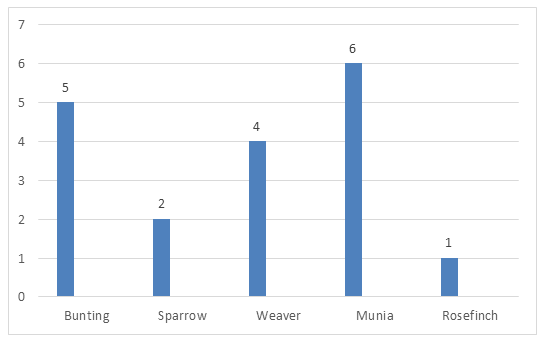
Finches are the group of evolutionary birds with numerous individuals in the world. Keen observation on their overall behaviour, dry- and wet-preserved museum specimens as well as very sharp online images helped to focus their evolutionary divergence especially on beak sizes and beak types. Out of 18 finches of Bangladesh, the members in the family Estrildidae (munias) showed the highest 6 (33.33%) then Emberizidae 5 (27.78%). All finches were sexually dimorphic except scalybreasted munia (Lonchura punctulata). Since, beaks of finches are conical (seed eating type) but due to different types of seeds in different places, their beaks are slightly modified. Beaks of weaver birds are also conical but for nesting ability their larger beaks help more to do this act. Except weaver bird (like mangrove finch of Galapagos Islands), other types of beaks in this group were somewhat (sharp-beaked, medium) Darwin’s ground finches. All finches exhibited least concern (LC) only yellow-breasted bunting was vulnerable (VU) perspective Bangladesh.
Abbreviations
LC: Least Concern; CR: Critical Endangered.
Natural History of Finches
Finches are the largest group of small song birds in the world. British and European finches include the bullfinch, chaffinch, greenfinch, goldfinch, sparrow, brambling, crossbill, linnet, and many others. All finches of Bangladesh are found easily with remarkable number. Left over feed is occasionally their secondary source of feed. In addition, many insects and ripe fruits are found adequate in the country. Due to frequent urbanization many wild birds are found like tame, so it is possible to know their natural history. Siddiqui KU, et al. [1] mentioned the subspecies of the finches of Bangladesh. Darwin’s finches are famous as an example of adaptive radiation. Population sizes and number of species are limited in Galapagos Islands and allows easy observation with different habitats. Ground finches and tree finches are two bigger ecological groups in these lands [2]. Short eared owls, Galapagos hawks, lava herons, and cats are the predator of Darwin’s finches, and egg-eating predators are mainly larger birds and snakes as well [2].
Finches of Bangladesh
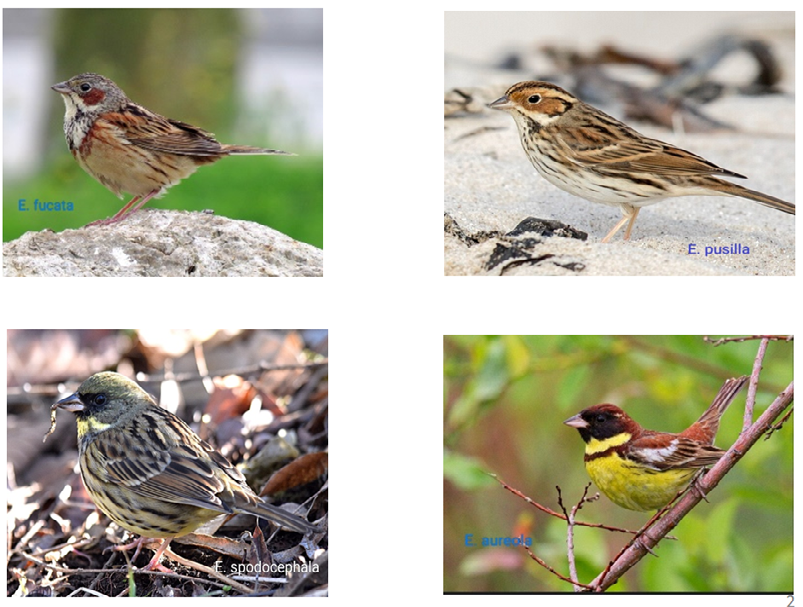
Bunting: These birds are colourful like other finches in the world. It has conical beak that allows taking seeds as their feed, and is similar to sharp-beaked Darwin’s finches of Galapagos Islands. In Bangladesh, there are five bunting species, and global and Bangladesh status are critical endangered (CR) and vulnerable (VU). Based on the plumage colour of the subspecies of Emberiza fucata (head gray, upper parts chestnut) and E. f. kuatunensis (darker and more rufous above with narrower breast bands) possible to isolate from each other. All buntings are more of less rare and winter migrant in Bangladesh (Figure 1).
Baya Weaver
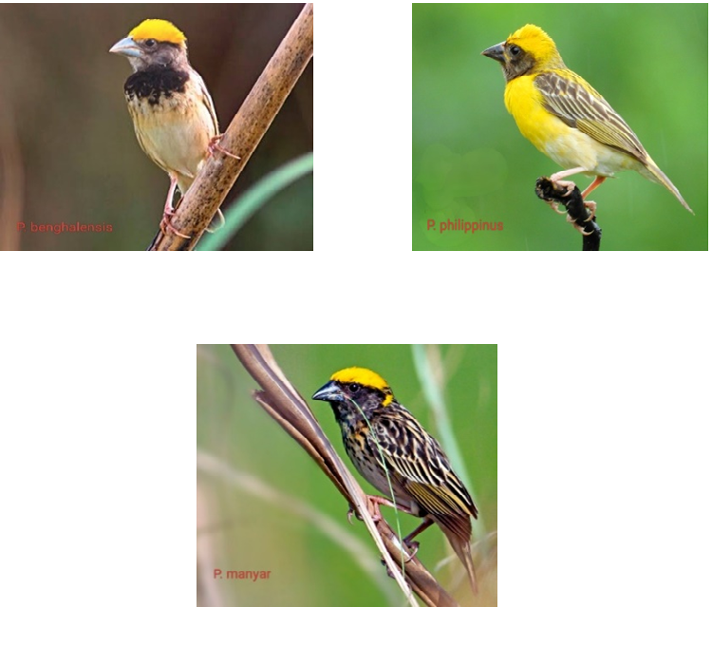
These weavers are known weaver finch due to its finch- like beaks, and it well-known for its pendulous type of nest. Genetic factors are precursor to make this nesting ability. In breeding season, males are focused themselves with brilliant plumages to the females for mating. These are least concern (LC) bird. Beak size and length is comparatively big in these birds than other finch species of Bangladesh. Two subspecies of streaked weaver bird, Ploceus manyar flaviceps (paler, less rufous above) and P. m. peguensis (darker, more rufous above) differs by their plumages. Baya weaver birds (Ploceus philippinus) are very common breeding birds in Bangladesh [3] (Figure 2).
Munia
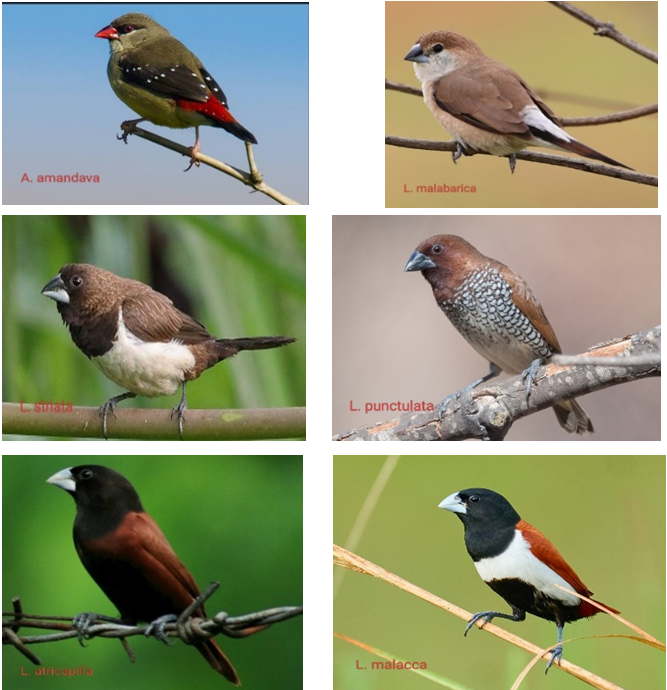
Munias are common passerine birds in Bangladesh. Some wild finches (Lonchura Malacca, L. malabarica, L. punctulata) are kept in Bangladesh as recognized cage birds [4]. In an aviary, it is possible to breed them successfully. In our local markets or in pet shops, sometimes, animal traders sell these wild birds illegally. Its conical beaks are responsible to take seeds from the ground. This bird is least concern bird (LC) in both global and Bangladesh affairs. These Bangladeshi munias can be compared with the Darwin’s finches which are sharp-beaked ground finches and medium ground finches (Figure 3).
Sparrow
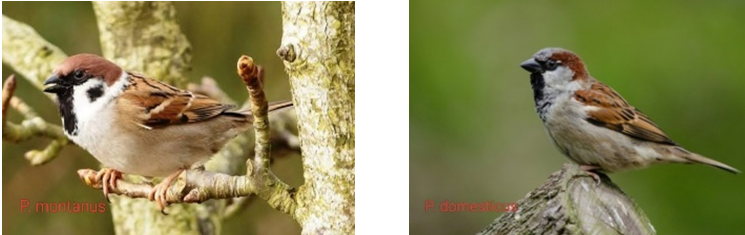
Sparrows as well as house sparrows are very common throughout Bangladesh. Human dwelling and electric poles are their dominant and successful breeding place. Its conical beak helps to take seeds but due to live near human habitat, it takes rice and other kitchen materials too. In addition, these sparrows are helpful to control pests of crop-fields. Tree sparrows are not common like house sparrow. This is slightly smaller than house sparrow and a shy bird (Figure 4).
Rose Finch
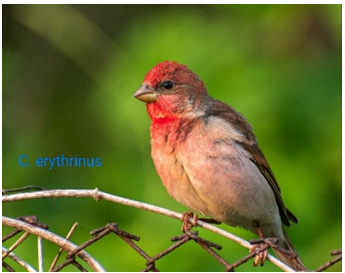
This is another group of finches. In world, it has many species but in Bangladesh, only one species is observed. Bright red plumages are their main identity. Conical beak allows taking seeds. Sharp-beaked ground finch of the Galapagos Islands is similar to this rose finch of Bangladesh (Figure 5).
Studies on Habitats and Beaks of Finches
It is easy to understand the relation between the beak size or beak types with the feeding habit of finches. Some different species were more or less the same with these beaks, habitats, and feed habits. Through the study in the evolutionary changes on the beak of Bangladeshi finches then the comparison with the Darwin’s finches, it could be known the origin of these finches. There are large variations in beak sizes between the same species on different islands of Darwin’s finches [5, 6]. Long and potential beaks are the best for probing during catching feed. Beak size and shape are highly heritable between Darwin’s finches [2]. Types of feed and habitat influence to change their beak size that allows speciation finally (Table 1, Figure 6).
| Abundance and Habit | Beak size (mm) | Similarity with Darwin's finches | |
|---|---|---|---|
| Emberizidae: Yellow-breasted bunting, Emberiza aureola, Pallas 1773 | Rare; winter migrant | 13-14 | Sharp-beaked ground finch |
| Chestnut-eared bunting, E. f. fucata, Pallas 1776 | Rare; winter migrant | 15-16 | - |
| Chestnut-eared bunting, E. f. kuatunensis, La Touche 1925 | Rare; winter migrant | 15-16 | - |
| Little bunting, E. pusilla, Pallas 1776 | Rare; winter migrant | 13-Oct | - |
| Black-faced bunting, E. spodocephala, Pallas 1776 | Uncommon; winter migrant | 14-15 | - |
| Passeridae: House sparrow, Passer domesticus indicus, Jardine & Selby 1835 | Very common; resident | 13-15 | Sharp-beaked ground finch |
| Eurasian tree sparrow, P. montanus malaccensis, Dubois 1885 | Uncommon; resident | 13-Dec | Sharp-beaked ground finch |
| Ploceidae: Black-breasted weaver, Ploceus benghalensis (L. 1758) | Uncommon; resident | 16 | - |
| Streaked weaver, P. manyar flaviceps, Lesson 1831 | Uncommon; resident | 18 | - |
| Streaked weaver, P. m. peguensis, Baker 1925 | Uncommon; resident | 18 | - |
| Baya weaver, P. philippinus burmanicus, Ticehurst 1932 | Common; resident | 17-20 | Mangrove finch |
| Estrildidae: Red avadavat, Amandava a. amandava (L. 1758) | Uncommon; resident | 11-Sep | Sharp-beaked ground finch |
| White-throated munia/Common silverbill, Lonchura malabarica (L. 1758) | Common; resident | 11-Oct | Medium ground finch |
| Tricolored munia, L. malacca (L. 1766) | Common; resident | 13-14 | - |
| Chestnut munia, L. atricapilla (Vieillot 1807) | Uncommon; resident | 13-14 | Medium ground finch |
| Scaly-breasted munia, L. punctulata (L. 1758) | Common; resident | 13-Dec | Medium ground finch |
| White-rumped munia, L. striata (L. 1766) | Common; resident | 14-Dec | Medium ground finch |
| Fringillidae: Common rosefinch, Carpodacus erythrinus roseatus (Blyth 1842) | Rare; winter migrant | 13-15 | Sharp-beaked ground finch |
Table 1: Evolutionary comparison of the finch species of Bangladesh. Source: [7,8]
Force of Hybridization and Speciation
Genetic drift acts in harsh environmental conditions. Competition between species was indeed the most important factor to the differences on beak size of finches. Fitness of hybrids, sexual imprinting, hybridization, and mate choice is the ingredients for speciation in birds [2].
Conservation of Finches
Passeriformes is an order with significant number of individuals. In fact, these are song bird and have very colourful plumages at all. The behaviour of these finches can be noteworthy at the time of breeding season. Finches could be an excellent type bird especially on their evolutionary trends. This avian group has great diversity on the basis of their beak sizes and beak types. To overcome many limitations on the evolution and speciation, finch could be a model group of bird.
Conclusions
As finches are evolutionary birds, so this is urgent to take necessary studies on its ecosystem diversity. These birds have numerous subspecies in the world as well as Bangladesh.
Remarkable changes on their plumage colours, beak sizes, feed habit, and habitat could ensure different species later on. Birds in the family Passeridae, Estrildidae, Emberizidae, Ploceidae, and Fringillidae are considered finches. Skin taxidermy, dry- and wet-preserved museum specimens of colleges, universities, and national museum could play a significant role to study such evolutionary changes of finches. Due to different environmental and genetic factors, such changes act as a raw material for speciation.
References
-
Siddiqui KU, Islam MA, Kabir SMH, Ahmad ATA, Rahman AKA, et al. (2008) Encyclopedia of Flora and Fauna of Bangladesh. Asiatic Society of Bangladesh 26: 662.
-
Hau M, Wikelski M (2001) Darwin’s finches. Nature Publishing Group.
-
Kabir MA (2018) Nesting of baya weaver Ploceus philippinus in Mohammadpur village under Rajshahi division of Bangladesh. IJSSET 5(7): 21-25.
-
Kabir MA (2014) Available exotic cage birds in Bangladesh. Global journal of multidisciplinary and applied sciences 2(1): 1-4.
-
Lack D (1947) Darwin’s Finches. Cambridge University Press, London.
-
Boag PT, Grant PR (1984) the classical case of character release: Darwin’s finches (Geospiza) on Isla Daphne Major, Galapagos. Biological Journal of the Linnean Society 22(3): 243-287.
-
Ali S, Ripley SD (2001) Handbook of the Birds of India and Pakistan. Oxford University Press 10: 250.
-
IUCN Bangladesh (2015) Red List of Bangladesh: Birds. Bangladesh Country Office 3: 676.
- In Situ Evaluation of the Anthelmintic Effect of the Aqueous Extract of Syzygium aromaticum (L) Merr and Perry on Bovine Strongyles
- Successful in Vitro Embryo Production with Oocytes Aspirated from Live White-Tailed Deer (Odocoileus Virginianus Texanus) Donors under Captivity in Northeast Mexico
- Note on the Survival Status of Przewalski’s Horse, Equus ferus przewalskii (Perissodactyla: Equidae)
- In-Situ and Ex-Situ Protection of White-Breasted Waterhen (Amaurornis Phoenicurus) (Pennant, 1769) (Aves: Rallidae)
- Meat Examination in the Laboratory, the Acceptability and the Human Health
- Mutations in the GDF8 Gene in Double-Muscled Cattle: Mechanisms of Action and Relevance for Livestock Production