
In-Situ and Ex-Situ Protection of White-Breasted Waterhen (Amaurornis Phoenicurus) (Pennant, 1769) (Aves: Rallidae)
As a common and resident bird of Bangladesh, White-breasted waterhen (Amaurornis phoenicurus) is one of them. This bird is found around human habitat. Bushy pond is their remarkable place for breeding. Careful observation for years, it was possible to find out their complete breeding biology.
Introduction
The white-breasted waterhen (Amaurornis phoenicurus) is a common and resident wetland bird of Bangladesh. This is a bird of the Asian continent and exhibits breeding all the year round but chiefly from June to October. Based on the taxonomy, this bird is considered in the order Gruiformes and family Rallidae. This is shy bird and sometimes seen to cross the road. Like the death of other animals on road at the time of crossing the road in Bangladesh, this bird can be affected [1]. The objective of this write-up is to focus its breeding biology for protection.
Classification
• Phylum: Chordata
• Subphylum: Vertebrata
• Class: Aves
• Order: Gruiformes
• Family: Rallidae
• Genus: Amaurornis
News
• Species: phoenicurus
• Binomial name: Amaurornis phoenicurus (Pennant, 1769)
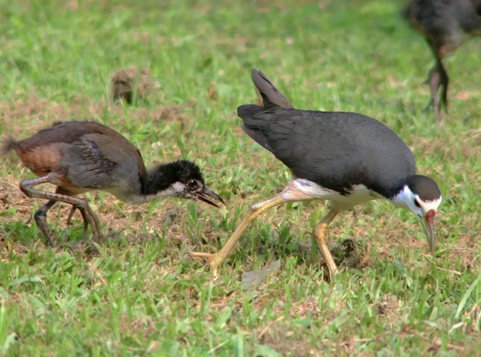
Identified Habitat for this Significant Bird
In Bangladesh, all habitats are responsible for their overall foraging but the cantonment area [2] and Saidpur Upazila of Bangladesh [3] were the target place for this scientific report. From 2020 to 2023, after careful observation through years, available information was the ingredient for this significant issue.
Characteristics and Breeding Biology
This bird is widely dispersed in the rainy season. Its stumpy tail is constantly jerked up, and swims buoyantly like a moorhen. It could produce grunt, chuckle, croak, hoot, and rasping types of sound. White-breasted waterhen avoided any conflicts with other wetland birds by hiding themselves in the same feeding and breeding grounds [4]. Prolong and loud call indicates their probable breeding [5]. Vigorous calling in the morning leads to their pair formation [6]. The maximum breeding activities were found in April (9.41%) and the lowest in July (1.72%) [7]. Ali and Ripley mentioned that the breeding season coincide with the south- western monsoon in June- July to October. These findings are differed in Bangladesh because monsoon started earlier here. It makes twig nest 2-3 metres from the ground. Eggs are 6-7 with pinkish white and some shade of reddish brown. Incubation period takes place from 19 to 21 days, and in 25 days their chicks are independent from their parents [8]. Newly hatched black plumed chicks are extraordinary active.
Conclusions
Due to different breeding seasons in different localities or this bird could get an advantage to protect naturally (in- situ) with the human concerns (ex-situ). Humans, monitor lizards, and crows, etc. are the major threats for the falling chicks from the nest of this waterhen [9]. In addition, treepies, domestic cats, and mongooses are also eating their eggs and chicks [8]. Specifically, hunting by making traps [10] and habitat loss were the most concern of this bird.
References
-
Kabir MA (2018) Fate of animals on road. JDVAR 7(4): 167-169.
-
Kabir A, Hawkeswood TJ, Makhan D (2020) the vertebrate fauna of the teachers’ quarters-2 of Saidpur Cantonment Public School and College, Nilphamari, Bangladesh. Calodema 730: 1-6.
-
Kabir A (2023) A checklist of the avian species of Saidpur Upazila of Bangladesh. University of Sindh Journal of Animal Sciences 7(2): 59-69.
-
Akhtar S, Kabir MM, Begum S, Hasan MK (2013) Activity pattern of white-breasted waterhen (Amaurornis phoenicurus) at Jahangirnagar University Campus, Savar, Dhaka, Bangladesh. Bangladesh Journal of Zoology 41(2): 189-198.
-
Feijen C, Feijen HR (2008) a revision of the breeding birds of Bhutan. Forktail 24: 1-24.
-
Gopakumar PS, Kaimal PP (2007) Loss of wetland breeding habitats and population declining of white-breasted water hen, Amaurornis phoenicurus (Pennant)―a case study. World Lake Conference 529: 536.
-
Ali S, Ripley SD (2001) Handbook of the Birds of India and Pakistan. Oxford University Press 2: 347.
-
Mitra A (2021) White-breasted waterhen. Science Reporter, pp: 34-35.
-
Haque EU (2022) the recipe for looking at and appreciating a waterhen! The Business Standard.
-
Kabir MA (2019) Birds were hunted through making trap in the past in Bangladesh. EC Veterinary Science 4(8): 681-683.
- In Situ Evaluation of the Anthelmintic Effect of the Aqueous Extract of Syzygium aromaticum (L) Merr and Perry on Bovine Strongyles
- Successful in Vitro Embryo Production with Oocytes Aspirated from Live White-Tailed Deer (Odocoileus Virginianus Texanus) Donors under Captivity in Northeast Mexico
- Bangladeshi Finches with their Evolutionary Thoughts (Aves: Passeriformes)
- Note on the Survival Status of Przewalski’s Horse, Equus ferus przewalskii (Perissodactyla: Equidae)
- Meat Examination in the Laboratory, the Acceptability and the Human Health
- Mutations in the GDF8 Gene in Double-Muscled Cattle: Mechanisms of Action and Relevance for Livestock Production