
Recessive Trait of Feather Patterns and Feather Colours of Some Fancy Pigeons in Bangladesh
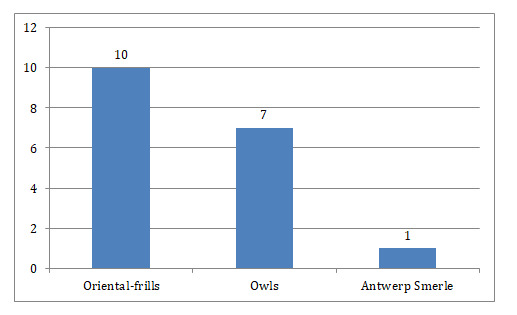
Since Oriental-frills are an ancient group of pigeon so this is devoted to forecast the patterns of their feather which were created by human through selective breeding? Out of 18 Breast-frilled Pigeons of Bangladesh, 10 were Oriental-frills/Turkishfrills (4 Satinettes and 6 Blondinettes) (22.22+33.33=55.55%), Owls 7(38.89%), and Antwerp Smerle 1(5.56%). In Orientalfrills (so-called in Bangladesh this is ‘Jharna Sartin’) which is actually Brownette is widely common. In Owl Pigeon family Chinese/Whiskered and Polish Owl Pigeon are available. Crosses between Oriental-frills and Owls create lots of mixed-breed which looks excellent. Syrian Turbiteen is basically an Owl (Barbarisi Owl) and was few. Antwerp Smerle is rare in Bangladesh.
Introduction
In Breast-frilled Pigeons, Satinette and Blondinette are two major groups in fancy pigeon. Satinette was originated from Oriental Owl Pigeon, Turbit, and some semi-wild pigeons of Asia. Sulphurette and Brunette are the sub-variety of Oriental-frills. Bluette and Silverette are charming birds in other Satinettes. In Blondinette their head, neck, breast, and flight are solid in colour whereas in Satinette these portions are white as well. Primaries and secondaries are coloured in Blondinette and in Satinette 10 primaries are white and 10 coloured. Turbit is another breed in Oriental-frills which are not in beautiful lacing or markings and they are not grouse- legged. Turbiteen variety is very fascinating and hardiest member in Oriental-frills [1]. In Netherlands, Owl Pigeon is called ‘Farmers’ Owl’ because they kept it in the farm. Study suggested that Shield-marked Owl is German/Old Dutch Owl is an ancient breed [2]. The ‘Classic Oriental Frill’ is an exhibition breed of pigeon and its beak is moderately long. It is known upon the sultans’ request a special breed of pigeon was bred in old Ottoman city in Western Turkey and sultan developed this unique breed. It was first exhibited in National Columbarian Society in 1879 in America. Oriental- frill is still a good flyer pigeon in the world. African Owls were imported from Tunis in 1857. H. P. Caridia a Greek merchant who arrived in the country with several pairs of Blue-laced Satinettes and Brunettes. For over twenty years, Mr. Caridia was the recognized authority on Oriental-frill, and he finally completed his research on fancy pigeons in 1884. Fulton’s Book of Pigeons when came out, revealed that Satinettes (Blue-laced) were the oldest penciled variety of Asia Minor back to 1750. The Oriental-frills as Satinettes were regarded as of the highest type of excellent breeding bird (History of Satinette Pigeon). The objective of this study is to observe the recessive trait of the head-breast feather arrangements of the Oriental-frills and Owl group.
Materials and Methods
Oriental-Frills
On the basis of this study, Oriental or Turkish-frills were Satinettes and Blondinettes. In Satinettes group- Brownette, Bluette, Silverette, Black and Dun) and Blondinettes- sulphur, silver, brown, red, yellow, black, and dun-laced were found. In Satinettes its beak is slightly long and looked like tumbler pigeon. Its wing and tail was coloured. In Blondinette it was self-coloured and slightly larger than the Satinette. Its body colour was soft and very nice in appearance.
Owl Pigeons
This group was focused by Chinese, Polish, Arabian, German, African, Italian, and Turbiteen. Chinese variety was very common in Bangladesh, but at the present context, Polish Owl is demandable than others. Upper beak is curve in case of Owl Pigeon. Basically the Syrian Turbiteen is a Barbarisi Owl Pigeon. It’s both sides of cheeks are come about black spots.
Antwerp Smerle
Very rare and this is actually flying bird. Its beak is very short but broad in its base. So, do not create any malfunctioning for the young after hatching (Plate 18).
Breeding Performance
The breeding status of Oriental-frill pigeons is moderately good. Due to their very short beak they cannot feed their chicks well. Foster pigeons are necessary for caring their young.
Birds Shop
Pet shop of Dhaka, Dinajpur, Saidpur, Bogura, Rajshahi, and Kushtia were subjected to this paper. About Antwerp Smerle the breeder of Dhaka, Bangladesh was devoted to deliver his experiences on this pigeon.
Results
In Bangladesh the Breast-frilled Pigeons were found in three groups- Oriental-frills, Owls, and Antwerp Smerle. Within these pigeons their plumage patterns and colours are recessive and dilute. Oriental-frills were come about brown, blue, silver, black and dun, sulphur, red, yellow; Owl group- Chinese, Polish, Arabian, German, African, Italian, Turbiteen; and only one rare variety Antwerp Smerle (Table 1 & Figure 1).
| Origin | Family | Group | Salient characteristics | |
|---|---|---|---|---|
| Brownette | Satinette | Tumbler type, Moderate beak | ||
| Bluette | Satinette | Tumbler type, Moderate beak | ||
| Silverette | Turkey | Oriental- frill | Blondinette | Self-coloured and slight larger version of Satinette |
| Black and Dun | Turkey | Oriental- frill | Blondinette | Self-coloured and slight larger version of Satinette |
| Brown-laced | Turkey | Oriental- frill | Blondinette | Self-coloured and slight larger version of Satinette |
| Silver-laced | Turkey | Oriental- frill | Blondinette | Self-coloured and slight larger version of Satinette |
| Sulphur-laced | Turkey | Oriental- frill | Blondinette | Self-coloured and slight larger version of Satinette |
| Red-laced | Turkey | Oriental- frill | Blondinette | Self-coloured and slight larger version of Satinette |
| Yellow-laced | Turkey | Oriental- frill | Blondinette | Self-coloured and slight larger version of Satinette |
| Black and Dun-laced | Turkey | Oriental- frill | Blondinette | Self-coloured and slight larger version of Satinette |
| Chinese/Whiskered | China | Owl | Owl | Upper beak is large and curved |
| Dutch/German/Shield | German | Owl | Owl | Upper beak is large and curved |
| Polish | Poland | Owl | Owl | Upper beak is large and curved |
| Arabian | Arab | Owl | Owl | Upper beak is large and curved |
| Italian | Italy | Owl | Owl | Upper beak is large and curved |
| African | Africa | Owl | Owl | Upper beak is large and curved |
| Barbarisi (Syrian Turbiteen) | Syria | Owl | Owl | Upper beak is large and curved |
| Antwerp Smerle | Belgium | Homing | Sporting | Full curve of the head |
Table 1: Breast-frilled Pigeons of Bangladesh.
Discussion
The beak of Turbit Pigeon is looked Partridge type and till 1860, there were no record for the improvement of Owl tribe in England. Mr. Jayne said that African Owl was used of the combination of the Short-faced tumblers, but this record has lost. Short-faced Antwerp is descended from the Owl. Blue and Satinette is formed Bluette and then gradually Blondinette, Sulphurette and others are come [3]. Turbits are the purest races of pigeons and its breeding is normal. This is not derived from Wild Rock Pigeon and both Owls and Turbits have flying powers [4]. Oriental-frills are composed of Satinette, Blondinette, Bluette, Silverette, Vizor, Turbiteen, Oriental Turbit, and Domino [5]. A study in Bangladesh suggests that out of 14 pigeons the grading system of Satinette was 87 out of 100 and considered A+. Leg, feather, tail, head, beak, eye, neck, cere, and wattle were found excellent in Satinette pigeon [6]. Orientals have never attained popularity as Fantail Pigeon [7]. Owl Pigeons are consisted of three groups- Japanese, Syrian, and Spanish [8]. The Turbit has a conical beak with a line of reversed feathers down the breast and it has a habit of expanding slightly of upper part of oesophagus [9, 10]. Oesophagus of the dead birds was seen to larger than other breeds and so distinctly separated from the crop [10]. For the production of Owl Pigeon it needs tumbler pigeon as a foster parent [11]. Crest of reversed feathers on their head coding ephrin receptor B2 (EphB2) gene and this gene is spreading through hybridization, repeated selection on mutation that was already present in Wild Rock Pigeon [12]. For achieving better breeding performance plain headed male and crested female with dark-coloured is the best. All members in Oriental- frills are more active for squab producing at all. Its mortality rate is very low and now the breed ‘domino’ is extinct [1].
Conclusions
Pigeon breeders and importers are trying to organize an association to invent new breeds in modern lab in Bangladesh. If government takes initiatives on this, it will be easy for them. If we could produce new varieties, currency will save because we import various expensive breeds from abroad. Oriental-frills, Owls, and Antwerp Smerle are the candidates of Breast-frilled Pigeons and all have very short beak. Tumbler pigeons are good fostering bird in this case. Except its beak the gesture, posture, and physique all characteristics are very similar with the tumbler pigeons. This is an excellent pigeon in a loft but we should take emphasis on their breeding for plumage colours and their patterns.
References
-
Machin F (1920) The Oriental Frill Pigeon with Notes on Breeding, Management, Exhibiting, Feeding.
-
Bresler H (1997) The Old German Owl. A New old breed.
-
Lyell JC (1981) Fancy Pigeons. L. Upcott Gill, London, pp: 431.
-
Tegetmeier WB (1868) Pigeons: Structure, Varieties, Habits, and Management. George Routledge and Sons, New York, pp: 190.
-
Hazard FA (1922) Profitable Pigeon Breeding. American Pigeon Journal Company, pp: 236.
-
Kabir MA (2014) Grading system of ten common fancy pigeons of Bangladesh. Integrated J British 1(1): 19-26.
-
Levi WM (1941) The Pigeon. Levi Publishing Co., Inc., Sumter, SC. pp: 640.
-
Rahman MA (1999) Kobutar Jagat (in Bangla). Tatini Bhaban, Noyarhat, Savar, Dhaka, pp: 83.
-
Darwin CR (1859) On the Origin of Species by Means of Natural Selection. John Murray, London, pp: 477.
-
Darwin CR (1868) The Variation of Animals and Plants under Domestication, John Murray, London 1st and 2nd (Vol.), pp: 411-486.
-
McNeillie A (1993) Pigeons of the World. A Magna Illustrated Guide, Leicester, pp: 160.
-
Shapiro MD, Domyan ET (2013) Domestic pigeons. Current Biology 23(8): 302-303.
- In Situ Evaluation of the Anthelmintic Effect of the Aqueous Extract of Syzygium aromaticum (L) Merr and Perry on Bovine Strongyles
- Successful in Vitro Embryo Production with Oocytes Aspirated from Live White-Tailed Deer (Odocoileus Virginianus Texanus) Donors under Captivity in Northeast Mexico
- Bangladeshi Finches with their Evolutionary Thoughts (Aves: Passeriformes)
- Note on the Survival Status of Przewalski’s Horse, Equus ferus przewalskii (Perissodactyla: Equidae)
- In-Situ and Ex-Situ Protection of White-Breasted Waterhen (Amaurornis Phoenicurus) (Pennant, 1769) (Aves: Rallidae)
- Meat Examination in the Laboratory, the Acceptability and the Human Health