
Cassava Ecosystem Left Toxic Produce Processing for Building Chain Break Powerful Products for Combating Bio-Pandemics
Worldwide intensive endeavors exist in actions to derive benefits of ecosystem services viz food, fiber, shelter and betterment of environment. International Livestock Research Institute Kenya presented an ecosystem scenario with emphasis of zoonotic diseases transmission chain breaks in attempt to combat COVID 19. Objective of this study was to develop processing and products so that chains of spreads of such diseases and bio-pandemic be halted. In this study cassava based ecosystem was taken up to utilize toxic produce gets useful in combating environmental disasters. The epidemics of Covid 19 and Locust which became huge global problem will get halted by such chain breaks, which bring global relief from bio based calamities. Thus, Cassava based ecosystem is highly useful in building prosperity and environmental improvement.
Introduction
Space (having dimension of L3) and existing entities (alive or dead) form ecology at any point of time when its Situation is reviewed. Ecologists argue of occurrence of idealistic ecological balance, which is difficult to get established under normal situation of multiple disturbances when time is taken in to consideration the ecology becomes dynamic and it becomes ecosystem. The ecosystem enforces production and consumption which involves occurrence of some wastes. These wastes undergo decomposition, which can be aerobic or anaerobic and produce detritus food chains and toxic gases, for which detritus food chain consumer’s emerged and occupy the ecosystems. The detritus consumers may be inform of fungus, algae, small plants, bacteria, flies and mosquitoes, crickets, cockroaches, crabs, scorpions, muse, cats bats, snakes and animals which become hosts for many viruses that cause spread of diseases and epidemics. International Live Stock Research Institute (ILRI), Kenya has patternised such ecosystem depicted in Figure 1 [1].
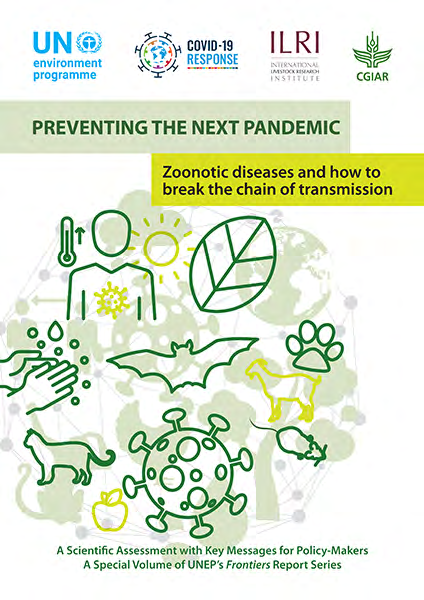
The United Nations, CGIAR and ILRI launched open challenge to develop chain break powerful products preventing any next bio pandemic. It was reported that many proposals had been submitted.
The cassava is cultivated to fulfill partial subsistence, as single row cutting planted at 60 cm or more and inter row spaces converted in form of furrows. The crop is largely rainfed. The ridges are sown cowpea the most popular pulse crop to produce pulses. The plant nutrition and plant protection measures remain equally weak, thereby revealing low attention on creating condition for good growth. In view poor situation of production it became necessary to develop production system productive and sustainable. Lal [2] and Lal and Follet [3] presented utility of forest in carbon sequestration. In this respect cassava is scientifically better than agricultural crops, which keeps annual growth for period of six months. This implies that cassava should be grown for food crop which will produce indirect effect on carbon sequestration. But, as such there appears no concentrated research on innovative production system for cassava. Yadav and Yadav [4] demonstrated innovative ecological Yadav and Chaudhary [5] and land and water combined innovative method of production system of cassava and equipped it with bio based eco zero weeding making production system sustainable and toil free [6, 7, 8, 9, 10], for wide spread adoption in world agriculture. On the other hand, soil scientists get worried about bad impact of cassava based toxicity from the effluents of cassava based industries. In this situation it will be imperative to develop innovative system for production of cassava and its non-food usable product processed for developing products for controlling detritus food chain and destroying detritus food chain consumers which create environmental nuisances.
Cassava, like other foods, also has ant nutritional and toxic factors. Those of particular concern are the crayogenic glucosides of cassava (linamarin and lotaustralin). On hydrolysis, cassava food releases hydrocyanic acid (HCN). The presence of cyanide in cassava is of concern for human and for animal consumption [11, 12, 13]. The concentration of these ant nutritional and unsafe glycosides varies considerably between varieties and also with climatic and cultural conditions. Selection of cassava species to be grown, therefore, is quite important. Once harvested, bitter cassava must be descaled and prepared properly prior to human or animal consumption, while sweet cassava can be used after simply boiling.
Books authored by Ardagh [14] and Parkinson and Rustam ji [15] inspired the authors for seeking innovative developments for searching opportunity in situation of difficulties of bad nonusable produce of cassava for this study. Therefore, objective set for the study was to develop chain breaks so that no next pandemic of type of COVID 19 reoccur. Likewise, frequently occurring attacks of locust(a bio mishap ful disaster) get easily combated.
Materials and Methods
Plant features and useful versus toxic produces
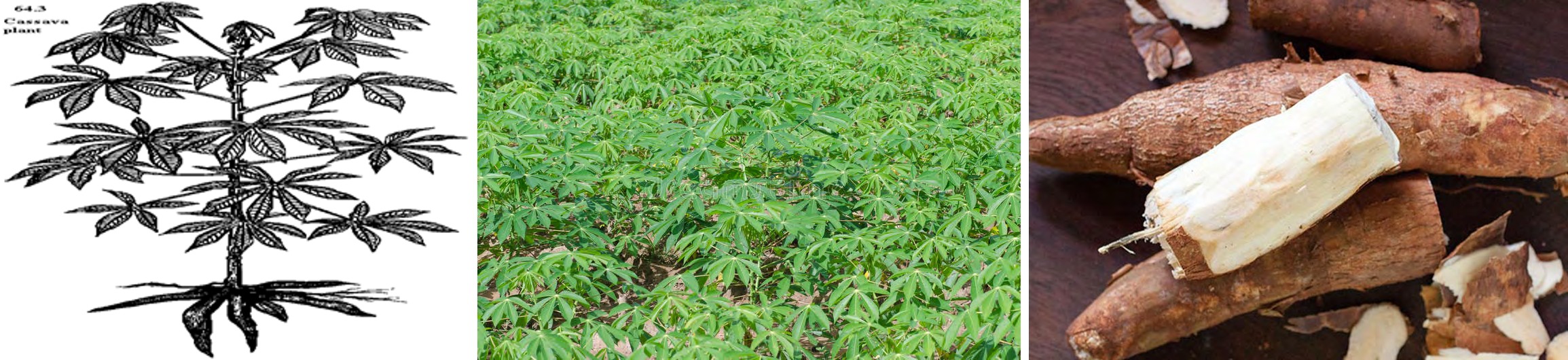
The Cassava is stem cutting planting propagated tuber crop growing 1.0 to 2.5 m tall and having bunch of leaves at top end. Tuber containing carbohydrate spread below ground (Figure 1). Above the ground surface plants having star type spreading leaves it forms moderate height vegetation and grow in terrestrial ecosystem (Figure 1).

This silver featured commodity did not spread in many part of the world. The commercial values of cassava are high and so for a countrywide for example in Nigeria the costs of cassava varies 12-20 fold, being low in South (where it grows well) and high in North East and North West of the country (Where it is not cultivated).
Global Production of Cassava
Maximum production of cassava comes from Nigeria in Africa, followed by that from Thighland in South East Asia, in Democratic Republic of Congo, Brazil and Indonesia (Table 2). It is coming to realization that production listed vide countries constitute about 55 percent of production and remaining 45 percent must be getting produced as minor cultivation hectare. Thus, it is becoming clear that in spite of low nutrient content it is not getting popularity in the World for its extensive cultivation. This aspect will become prominent justification for the present study.
Sweet cassava is eaten after boiling, as well as gari (a boiled thickened pasty food) prepared form its flour. It is evident from the table only few countries are cultivating cassava, which is only about 50% of reported worldwide production. It is also getting evident that some countries must be undertaking production of cassava, as it is in Kerala. In India, Indian Council of Agricultural Research, Ministry of Agriculture and Farmers Welfare, has a Central Tuber Crop Research Institute at Sreekaryam P.O., Tiruvantpuram, Kerala having only one Regional Research Centre at Dumdama, P. O. Bhibaneswar. Thus, there is no much emphasis on research and development of Casaava. The global production and shares of productions revealed in Table 1 establish that Cassava had not due research attention and extension boost for enhancing productivity to fulfill huge demand in the Worlds. This implicates that many innovative researches needed on this useful crop.
| S.No | Country | Region of the World | Production, million tonnes | % Contribution total | Potential uses |
|---|---|---|---|---|---|
| 1 | Nigeria | Africa-Western and Southern, Tropical region | 59.5 | 21.4 | In all countries of world, with different industrial applications. Japan imports dried leaf of alfalfa and cassava, animal feeds, industrial products such as dextrose, food additive, adhesive, textiles and furniture paints etc. |
| 2 | Thai land | South East Asia Tropical region | 31.7 | 11.4 | |
| 3 | Democratic Republic of Congo | Africa-Western and Southern, Tropical region | 30.0 | 10.79 | |
| 4 | Brazil | South America-tropical region | 17.0 | 6.11 | |
| 5 | Indonesia | South East Asia Tropical Region | 16.1 | 5.79 | |
| World | Tropics | 278 | 55.49/100 |
Table 1: Cassava global production in 2018 FAO Statistics of the UNITED NATIONS through Cassava Wikipedia
Non-conventional Uses of Cassava Produce
Textile industry: In the textile industry, starches occupy an important place in such operations as warp sizing, cloth finishing and printing. Warp sizing is the application of a protective coating to prevent the single yarns from disintegrating during weaving. The size consists of an adhesive and a lubricant and is generally removed after weaving. Cloth finishing alters the “feel” of the fabric by making it firmer, stiffer and heavier. Cassava starch is also used for cloth printing or producing certain designs in various colors on the smooth surface of a finished fabric. While cassava accounted for about 20 percent of all starch for these purposes in 1937, it has been largely replaced by other starches after the Second World War.
An exception is the manufacture of felt, where cassava continues to be used exclusively in the finishing process.
Wood furniture: Before the Second World War the manufacture of plywood and veneer relied mainly on cassava as a glue. The basic material in this case is gelatinized at room temperature with about double the amount of a solution of sodium hydroxide. After prolonged kneading of the very stiff paste in order to give it the required stringy consistency, the glue is applied to the wood with rollers. As the presence of a certain amount of the pulp is useful, medium- to low- quality flours are acceptable or even preferable, although the presence of sand is objectionable.
Particle board from cassava stalks: As cassava cultivation increases, more stalks will become available for disposal. The Tropical Products Institute, London, has been working on the utilization of the cassava plant. Particle boards could be made from cassava stalks by cutting them into small sections and mixing them with certain resins. The strength of the board can be varied by altering the resin content or the density.
Fermented products • Cassava Alcohol Cassava is one of the richest fermentable substances for the production of alcohol. The fresh roots contain about 30 percent starch and 5 percent sugars, and the dried roots contain about 80 percent fermentable substances which are equivalent to rice as a source of alcohol.
Ethyl alcohol is produced from many carbohydrate materials. In Malaysia and some other countries, many factories are equipped to use cassava roots, starch or molasses (by-product of the sugar industry), the type of product depending on the costs of the raw materials. When cassava is used, the roots are washed, crushed into a thin pulp and then screened. Saccharification is carried out by adding sulfuric acid to the pulp in pressure cookers until total sugars reach 15-17 percent of the contents. The pH value is adjusted by using sodium carbonate, and then yeast fermentation is allowed for three to four days at a suitable temperature for the production of alcohol, carbon dioxide and small amounts of other substances from sugar. Alcohol is then separated by heat distillation. The yield of conversion is about 70-110 liters of absolute alcohol per ton of cassava roots depending on the variety and method of manufacture. The crude alcohol of cassava is described as average in quality. It has a disagreeable odor, but can be improved if the first and last fractions in the distillation process are discarded. It is usually utilized for industrial purposes, as in cosmetics, solvents and pharmaceutical products. If the production is required for human consumption, special care should be taken in handling the roots to rid them of hydrocyanic acid.
• Dried yeast Most of the production of yeast is based on such low- cost raw materials as waste liquids, wood hydrolyztes and molasses. Starch-rich plant materials from wastes or surplus production are also utilized as substrata for yeast production. Cassava starch and cassava roots are being used in Malaysia and some other countries for the production of yeasts for animal feed’ the human diet and for bakery yeast. The starch is hydrolyzed into simple sugars (predominantly glucose) by means of mineral acid or by enzymes. Certain yeasts are then propagated which assimilate the simple sugars and produce microbial cellular substances. The dry, inactive yeast contains about 7 percent moisture and the raw protein content can vary between 40 and 50 percent depending on the raw material.
The yield of yeast production also depends on the raw material. In some applications of cassava starch conversion into substances obtained from yeasts, a 38-42 percent yield of yeast product containing 50 percent raw protein has been obtained.
Poor /limiting quality contents of cassava, making best use of it: The researches that have been done on the effect of cassava effluent have shown that there are always some changes in the soil properties when cassava effluents are discharged on it. Reports have also shown that the cassava effluent contains harmful cyanides, copper, mercury and nickel, which have the capacity to affect native micro-biota [12]. Cyanide released from the cassava effluents are highly lethal, it is fairly mobile in the soil and destroy microbes [13]. Selection of cassava species to be grown, therefore, is quite important. Once harvested, bitter cassava must be treated and prepared properly prior to human or animal consumption, while sweet cassava can be used after simply boiling.
The most prominent problem of locust invasion becoming a global problem( Figure 2)p, chemical pesticide spray will be highly expensive and creating problem of environment pollution. Bio pesticide preparable with cassava toxic produces will be readily available, affordable and environmentally eco-friendly. Development of processing and product s will enhance utility and economic value of cassava cultivation.

Synthesis of Potential Products
The fore going descriptions indicated that cassava is usable for food, composite food, bakery, confectionery, making dextrose (DE), alcohol, yeast extraction, animal feed for fattening of pigs, poultry, dairy animals, sheep and goats by adding dried chips of roots and stems in silage by mixing 10- 30%. The bad quality of cyanides and high content of heavy metals in tuber skins can be equally prepared as bio- pesticide for control of epidemics of locust invasion. The bio product prepared and brought to suitable concentration, the bio-pesticide can be easily aerially sprayed by application of new technology of drone. Thus, new innovative product and innovative application of high tech drone will bring fast eradication of epidemic of locust, which originate from African and Gulf countries. This will be a simple eco- friendly fast solution of environmental problem. As already established dried leaf of alfalfa and Cassava dried chips can be exported for income generation from many other countries in Latin America in addition to Japan.
Ecology and Ecosystem
The cassava is plant material which had adopted ecology of tropical belt spreading from South America Viz Brazil, in Africa Nigeria and DR of Congo, in South East Asia Thailand and Indonesia. The production of cassava nearly to same extent is not in country records. The cassava becomes a constituent in building the space ie environment to become prospecting ecology. In lieu of this, the cassava has potential for getting used and transformed in to produce, which will become useable for combating such bad developments in the environment. This aspect will be taken up in result part of study. At the moment it is focused that cultivation of cassava can be promoted in all such ecological zones and many non food products developed. There have been innovative developments on Nitrogen cycle management, which foster cultivation of cassava for multiple uses.
Potential Analysis
Benefits from the production system and innovative products from different angles will be presented in result part of the study. For locust the practiced method is I s beating cannester and dish to frighten the locust.
Results
Multiple Nonfood Uses of Enhanced Production of Cassava
Huge production of cassava enabled by efficient and effective cultivation method [4]. Innovative application of cassava flour use enabled tremendous scope of utilizing products of cassava (Table2). There are total VII aspects created in Table 2 and of these earlier known aspects were in five areas and new two areas are added in this research. Coming to total composite flour this is applicable in making bread with coarse grain, industrial preservative for confectionery and preserving canned foods, production of caramels and glucose industries. In the area of fermentation which produces alcohol and production of tastes have been used. Its use is made in furniture industries and textiles. Its use in paper industry is made to add strength, quality whiteness and strength. The printing papers is rated by GSM (gram per sq m). This implies that finely grinded solution of Cassava starch is usable to add weight and strength, thus it makes value addition for enhancing printing quality and color printing. Cassava starch is also usable for furniture industries. In these sectors some innovative developments are indicated. In addition there are two innovative areas with several items of broader usable products are mooted to further extend application of cassava starch.
The cassava plant materials are exported to Japan with dried alfalfa and in the Latin American countries. So far the uses of cassava tubers had been largely for subsistence, but research and development brought out here will bring economic return that will enable betterment of economic status of producers of cassava. This study has brought out several uses of broad spectrum that will enhance use efficiency of resources of N fertilizers such as urea, Fixation of N and pelletting of innovative products for combating desertification. Thus, this study enhances ways of producing huge quantity of cassava tubers, plant material and plentiful multiple uses. This study creates new way of prospecting the World, creating industries of varying products and resources conservation. Overall picture of existing and future uses revealed that there are 65 % existing and 50% advancements of total 20 products of cassava, thereby implying that some existing products also have got improved.
| S. No. | Domain of use | Known | Innovative | Addition basis | Prospects | |
|---|---|---|---|---|---|---|
| I Food and Nutrition | ||||||
| 1 | Composite flour | * | + | Gluten free flour | Better quality | |
| 2 | Bakery | * | + | Eggless cake | Better quality | |
| 3 | Confectionary | * | Preservative | Better quality | ||
| 4 | Canned fruits, jams and preservatives | * | Low cost preservative | Better quality | ||
| 5 | The production of commercial caramel | * | + | Providing safe color | Better quality | |
| 6 | The glucose industries | ** | Glucose | Coarse grain biscuits | ||
| 7 | Do | Dextrine | Toffie | |||
| 8 | Non cristalizing sugar | + | Spiced Jaggary | Value addition | ||
| II Fermented products | ||||||
| 9 | Cassva alcohol | * | + | Sanitizers | ||
| 10 | Yeast production | * | Single cell protein | For animal and organic manure | ||
| III Cassava in animal feed | ||||||
| 11 | Animal feed as supplement to silage | ** | Fattening of animals | Earn Foreign exchange | ||
| IV Textile industry | ||||||
| 12 | New fortification of earlieruse | * | Add Bio- P | Value addition | ||
| V Furniture industry | ||||||
| 13 | Particle board | * | + | Value addition | ||
| 14 | Glue and filling | * | ||||
| 15 | Bright paint with caramel | * | Add Bio P | Value addition | ||
| VI New innovative products | ||||||
| 16 | Pellet ting of organic manure | - | ++ | Productive agriculture | ||
| 17 | Pelletting of innovated measures for applications in combating desertification | - | ++ | Combating desertification | ||
| 18 | Innovative method of Nitrogen fixation | - | ++ | |||
| 19 | Enhancing efficiency of urea | - | ++ | |||
| VII Poor limiting quality contents of cassava | ||||||
| 20 | Many innovative products from Peels of cassava tubers with added toxic metals | - | ++++ | +++ | Next table | |
| 13 | 13(65%) | 10(50%)++ |
Table 2: Summary of uses of cassava and possible innovative enhancement of value addition The major group items VI and VII list b
*Existing products and ++ new devised products Table 2: Summary of uses of cassava and possible innovative enhancement of value addition The major group items VI and VII list bright ideas become as open challenge for finding feasible solution based on use of products from cassava tuber or plant. It is expected that such inspiration will lead to development of innovative measure, which will further enhance economic value of cassava.
Utility of Cassava for Chain Break and Overcoming Future Epidemics
This research attempted to extend utility of cassava products in preparation of products which will go long way in breaking invisible chain of pandemics. Among many that with bad quality of cassava peels for making insecticides and pesticides is low costing and simple. Aerial spray of pesticides with use of drone will quickly overcome wide spread problem of locust (Figure 2).
| S. No | Contributing factors | Likely epidemic | Remedial product | R and D | Remark |
|---|---|---|---|---|---|
| 1 | Corona Virus | Covid 19 | Braking chain of spread | Needed | Awareness is the basic for protection |
| 2 | Tics | Tics virus | Insecticides | Spray | Usable product |
| 3 | Rats | Bubonic plague | pesticides | Poison bating | Safe disposal |
| 4 | Hand wash | Sanitization | Alcohol based sanitizers | Liquid sanitizers | Regular use |
| 5 | Vaccine | Bio-products for vaccine | Vision | Needed | Wait for new development |
| 6 | Bio-pesticide | Bio pesticides | Development of famine | Already developed | Widespread protection of environment |
| 7 | Immunity booster products | Spices and boosters | Booster commodities | Creating awareness | Build immunity to escape infecting attack |
| 8 | Eco for O 2 | Supplementing oxygen in environment | Healthy breathing | Making people know of it | Aware people of photosynthesis process |
| 9 | N fixation for plant productivity | Element for boosting plant productivity | Food commodity | Bring in agric practice | Rich harvest for food and nutrition |
Table 3: Innovative products and process that will get boosted by the cassava and associated products
Preventing the Next Pandemic - Zoonotic Diseases and how to Break the Chain of Transmission
Thousands of papers and guidelines have already been published about COVID-19. Most of these consider the important questions of how to respond to the ongoing public health crisis, or how to mitigate the impacts of the pandemic. This report takes a step back and considers the root causes of the emergence and spread of the novel corona virus and other ‘zoonoses’—diseases that are transmitted between animals and humans. The report also offers a set of practical recommendations that can help policymakers prevent and respond to future disease outbreaks.
UNEP Executive Director General Andersen and ILRI Director General Jimmy Smith launched the report at a press briefing in New York City on 6 July
2020. Watch session here.
The diseases chain break and control measures will go long way in fulfilling objective of U.N mission on control of epidemics.
| S. No | Contributing factors | Possible epidemic | Remedial product | R and D | Remark |
|---|---|---|---|---|---|
| 1 | Corona Virus | Covid 19 | Braking chain of spread | Needed | Awareness is the basic for protection |
| 2 | Virus from pets such as dogs and cats | Tics virus | Insecticides | Spray | Usable product |
| 3 | Flukes from sheep and goats | Alcohol based sanitizers | Liquid sanitizers | Regular use | |
| 4 | Virus from Rats | Bubonic plague | pesticides | Poison bating | Safe disposal |
| 5 | Vaccine | Bio-products for vaccine | Vision | Needed | Wait for new development |
| 6 | Bio-pesticides | Bio pesticides | Development of famine | Already developed | Widespread protection of environment |
| 7 | Immunity boosting products | Spices and boosters | Booster commodities | Creating awareness | Build immunity to escape infecting attack |
| 8 | O for Eco 2 | Supplementing oxygen in environment | Healthy breathing | Making people know of it | Aware people of photosynthesis process |
| 9 | Biopesticides | Locust | Aerial spray | Complted | Bio pesticide spray |
| 10 | N fixation for plant productivity | Element for boosting plant productivity | Food commodity | Bring in agric practice | Rich harvest for food and nutrition |
Table 4: Innovative products and process that will get boosted by use of Cassava and associated products
Refer Figure 1. Table 4: Innovative products and process that will get boosted by use of Cassava and associated products
Geographical Indication Registry (GIr)
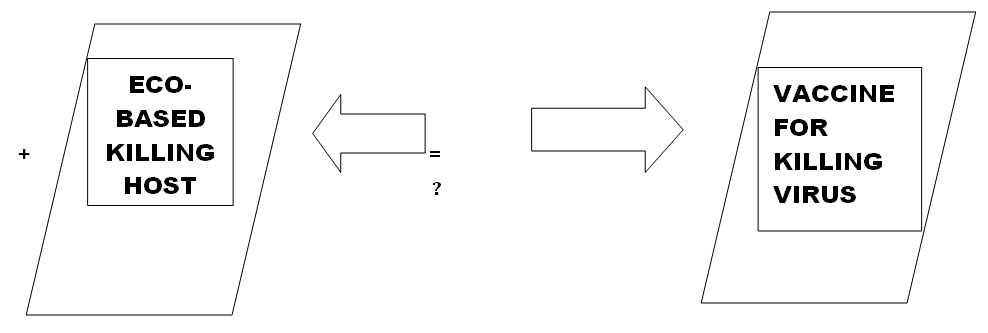
The study sets a quantum cassava production system developed on high scientific strength and its cultivation on global scale with one possible effective measure. Lot of variations in soil, climate, socio-culture and environment interaction will produce commodity with large variability in quality and many other characteristics. With these products industrial processing will further enhance attractive features of the cassava based products and commodities. The large variation will provide opportunity of rating the product on various considerations. This identification is known as geographical indication and process forms registry of it. The established GIr will enable consumers find good quality products and producer appropriate price of it. This will attract international business and market that will accomplish the contemporary economic growth. Thus, future and sustainability of silver product cassava will be progressing continuously. Therefore, all aspects, production and processing should be in irrotaional dynamics [16]. Ecosystem Chain Brake Versus Vaccine Development -Comparison between Approaches based on Ecosystem and Medical for Vaccine Development After spread COVID 19 In December, 2019 onward all countries have put their thrust on development of vaccines for killing virus of COVID-19 in human bodies. The Aurvedic Doctors always provoke for building immunity for enabling people escape attack of the virus. In contrast the present crisp details emphasize to kill the various foodcahin consumers which thrive in ecosystems as host and release virus in environment or on products specially fruits they consume or infect. This writeup introduced cassava and production of toxic contents fortified its content suitably refined and reformed as spray, bates and paste to kill the hosts in the ecosystem such as rats, bats, cockroaches, tics and any detritus food chain thriving consumers. The environment gets free of environmental nuisances such as mosquitoes, flies as well as any foul odors. This ecological control will become new mission for eradicating such virus sources. The problem will get eradicated from root cause. This issue is fully elaborated through Figure 4. The ecosystem is supported by peoples’ action whereas the vaccine by wealthy countries. After development of any successful vaccine, there will be huge rush to acquire such vaccine. This write up support the ecosystem approach in broader aspect whereas vaccine be made available for sever most cases. Therefore, it is recommended that equal emphasis on fortification of eco based combating of pandemic diseases should also be taken up. Cassava will play good role in this domain and keep economies of countries uplifted (Figure 4).
Discussion
The present study took dormant status of Cassava production, consumption as means of low income group subsistence and processing. The study brought the existing scenario to a quantum (fix mode) scenario of production and processing and created to be commodity of huge prospects. Various aspects dealt in this endeavor and results so produced are further ratified to polish for building skepticism free so that it is widely adopted for bringing global prosperity.
Present Scenario of Tuber Cassava
Table 2 presented that total production is 278 million tonne and out of this only about 55% are accounted for the countries in Africa, South America, South East Asia; Thailand and Indonesia. These countries are so apart that there can be no spread of cassava due to impact of neighborhood impact. Further, about 45% of total production comes from un named locations. In general cassava is considered as low subsistence providing commodity for low income group of gentry. There had been some industrial uses from European countries. But on the whole it depicted situation of dormancy on Cassava production, processing and industrial applications.
Quantum Technology of Processing
Like the quantum production systems the processing of cassava products are brought to me highly innovative. This earlier and new processing technology will produce commodity of high economic values. There are many aspects to be developed by using basic materials from cassava and take the commodity to become highly resource producing. The product tuber cassava in appearance of precious silver would appear as economic commodities. This will reduce pressure on other commodity of direct use in human consumption and as price rise check in the market.
Innovative Technology beyond Existing Ones
In Table 6 major area VI and VII are totally new vision that will produce prospecting advancement of use of Cassava. These innovations cast rays and inspire world scientific community put their attention and come out some with any brilliant way of accomplishing envisaged goal. Thus, this study presented ground for inspiration for future developments. With these it is expected that open declaration of challenge will prove highly effective in finding simple and feasible solution. This was a situation when a renowned American Scientist Wubble [17] declared that laughing gas (GHG-N2O) was not a simple matter. He declared a challenge of developing a simple effective and feasible solution. This open challenge led to development of control measure of Nitrous Oxide (N2O) in research (Yadav 2017), which was declared Winner of World Academic Championship in Chemical Research in 2017.
Suitability of Cassava in Breaking Chains of Pandemic Diseases
CGIAR-ILRI have focused need of breaking chain of spread of Zoonotic Disease, which large emerge from variety of living creatures viz mouse bats, Cats, pigs cow etc in Figure 4. This study derived various aspects in Table7 and process as well product from the cassava which will become readily accessible resource to produce items of interest. Among them some products viz ant nutritional containing part of tuber cassava peels, which contain heavy metals harmful cyanides, copper, mercury and nickel which have the capacity to affect native micro-biota [12]. Cyanide released from the cassava effluents are highly lethal, it is fairly mobile in the soil and destroy microbes [13]. The cassva byproducts will be suitable proceessed with fortification of desired strength for using any epidemic that might spread. The products need to be kept ready in stock so that it is quickly applied to break chain and eradicate source of problem. This study support that as there are several avenues of fattening of live stocks, inclusion of cassava cultivation, production and processing should be regular wing of ILRI so as to foster product and process research be in continuous activity. It is accepted fact there occurs a decades lag in research and its application. Cassava is commodity of direct concern of ILRI, and fulfill needs.
Prospecting Contemporary Economic Growth
The product, diversity and product processing will create economic commodity of international interest. Huge production and long list of diversified products will make products for international markets, which is main impact indicator of contemporary economic growth. The products will be useable for fattening of animal consumption, high tech processed glucose and dextrose (Table 6) and Table 7. This plentiful commodity will emerge from natural product cassava. The wide spread availability of cassava will enable enhancing individual incomes, which warranted in Ginni Coefficient an index for evaluation of income distribution.
Conclusion
The study devised innovative industrial products and many new ones of wide application areas. The industrially processed goods will produce economic growth and employment. It provides commodity for producing product usable in breaking bio chains of spreads of bio pandemic such as COVID-19 and other diseases viz wild spread of locust. The toxic and heavy metal content of cassava tubers are brought to produce processed products for controlling locust epidemics and its application by using innovative technology of drone and alike other diseases. This cassava is poised to be global economic commodity for industrial and environment protective measures.
Acknowledgements
For all these developments senior author expressed his gratitude for the world renowned Ahmadu Bello University. Authors duly acknowledged all sources of information from reference used in support of statements made in the manuscript.
Declaration of no conflict of interest
It was declared by the authors that there exists no any conflict of interest of authorship. This study did not avail any funding from any Government institution or nongovernmental organizations.
References
-
ILRI (2020) Press release for search of an ecosystem that can be effective in providing products for producing material for combating pandemic Covid 19.
-
Lal R (2002) The potential of soils in the Tropics to sequestration. Forest Ecology Management pp: 22242- 22258
-
Lal R, Follet RF (2009) Soil carbon sequestration and the greenhouse effect SSSA special Publication St, 2nd (Edn.), pp: 452.
-
Yadav RC, Yadav J (2020) Fixed mode technology support for eco boosted cultivation of Cassava for multiple benefits. African j of Agri Research Accepted for publication.
-
Yadav RC, Chaudhary MP (2014) Racy nature agriculture: A Sun technology towards quantum mechanics in agriculture. World J of Agr Research Sci EP UK 2(5): 223- 227.
-
Yadav RC (2014) Innovative application of scientific facts for arresting GHG-N2O and improvising lucrative ventures with enhanced land, water and nutrient use efficiency. Journal of Energy and Environment 128: 486- 520.
-
Yadav RC (2018b) Eco-zero weeding: a wow incredible innovation for altering things around us and India inaction. World J Agri Research 6(3): 94-104.
-
Yadav RC (2018c) Nano bio technology for enhancing agri productivityto elimiminate global hunger. Bio- Core: International J. Bio Technology in medicine and Engineering 3(4).
-
Yadav RC (2018d) Nature based production technology for wheat. Submitted ICAR News Letter. Directorate of publications of agriculture, KAB I, Pusa campus, New Delhi.
-
Yadav RC (2019) Eco-zero weeding: A usable science for harnessing multiple benefits. Research and Review Ecology and Environmental Sciences 7(2): 16-22.
-
Jastrzębska E, Kucharski J (2007) Dehydrogenases, urease and phosphatases activities of soil contaminated with fungicides. Plant Soil Environment 53(2): 51-57.
-
Aiyegoro OA, Akinpelu DA, Igbinosa EO, Ogunmwonyi HI (2007) Effect of cassava effluent on the microbial population dynamic and physicochemical characteristic on soil community_._ Science Focus (12): 98-101.
-
Akani NP, Nmelo SA, Ihemanadu IN (2006) Effects of Cassava Mill Effluents on the Microbial Population and Physico chemical Properties of Loamy Soil in Nigeria. 10th Annual Conference of Nigerian Society for Microbiology, Nasarawa State University, Keffi.
-
Ardagh P (2000) Wow- Discoveries that changed the world. Mac Millan Children’ Book, pp: 17.
-
Parkinson CN, Rustom Ji MK (1993) _Realities in_ _management._ India Book House Pvt Ltd, pp: 80-103.
-
Ramamrutham S (2008) Hydraulics, Fluid Mechanics, and Hydraulic Machines. 8th (Edn.), Dhanpat Rai Publishing Co., New Delhi, pp: 252.
-
Wuebbles DJ (2009) Nitrous oxide: no laughing matter. Science 326(5949): 56-57.
- Lessons to Learn: Trees are More than the Lungs of the World
- Community Forestry Enterprises as a Model for Sustainable Forest Development: The Case Of The "Baja Tarahumara" in Chihuahua, Mexico
- Ecological and Socio-Economic Impacts of Chromolaena odorata and Mesosphaerum suaveolens, Two Invasive Alien Species in Central and Southern Benin, West Africa
- Epigenetic Sustainability: Modeling the Human Factor as a Natural Resource through Science 4.0 and the NR3C1 Biological Pilot
- Growth-at-Risk: A Framework for Assessing Economic Vulnerability
- The Rural Territory as a Socioecological System for the Management of Public Policy for Sustainable Rural Development