
Water Security and Sustainability in India
Water is valuable for life, livelihood, economy and ecosystem services, but distributed unevenly. Water scarcity in general and water quality in the particular region, are posing risks to sustainability and quality of life. Indian economy and agricultural practices depend on its rivers, as per an estimate about 80 percent of fresh surface water and 60 percent of ground water have been used by the agricultural sector, but rivers and other water bodies are facing problems of contamination due to domestic waste, sewage, agriculture effluents of chemical fertilizers and discharge of industrial effluents. Domestic waste is drained out as waste and ends up flowing into various water bodies which leads to pollution of water sources. The careful utilizing of river water is the biggest challenge. Losses are also due to traditional way of irrigation which increases the problem of water scarcity. For sustainability of livelihood and maintaining quality of life, it is essential to have sufficient water availability even in the phase of climate change. The national drinking water programme and accelerated urban water supply programme aim to provide universal and equitable access to safe and affordable drinking water for all by 2030. It is time to value every drop of water and rejuvenate our traditional water bodies, clean rivers, recharge ground water, collect rain water and successful implementation of technology for achieving water resource management.
Introduction
Water is a prime resource for the sustenance of life. With every passing day its sustainability is questionable and has become a concern for academicians and policy makers. Interestingly, Earth, being a blue planet, covered around 70 percent of the total area. Out of the total, only around 1 percent Shiklomanov’s [1] freshwater- suitable for human consumption is available to fulfil agricultural, industrial and domestic demands of 7.7 billion people [2]. Moreover, the sectoral and regional distribution of freshwater is highly variable in terms of time and space. The largest consumer of water is agriculture Falkenmark [3] which constitutes 70 percent of the total demand whereas the remaining 30 percent is used by industries, domestic and other sectors.
The World freshwater availability has been declining from 33,300 cubic metres in 1850 Swain [4] to 13,360 cubic metres in 1962 and 8500 cubic meters in 1993 to 5926 cubic metres in 2014. The threshold for water availability is 1700 cubic metres [5]. According to Falkenmark Index, an area having the availability of water below the threshold limit (1700 cubic metres) considered as water stress region and vice-versa. The regional distribution shows that most countries in the North Africa suffer from severe water scarcity, also countries such as Mexico, Pakistan, South Africa, and large parts of China and India [6]. Further, water scarcity is not only concerned about the declining per capita supply of water but also extends to the problems related to inadequate access, low income and poor quality.
It has been estimated that around 1800 million population will be living in countries with absolute water scarcity (<500 cubic metres per capita per year) and around 75 percent people will be under stress condition (500 to 1000 cubic metres per capita per year) by 2025 [6]. The aim of the paper is to highlight the relationship between water scarcity and sustainability.
Conceptual Framework
Conceptually, scarcity is complex as it is a multidimensional phenomenon. Water scarcity has temporal and cyclic dimension, distributional and relative dimension and anthropogenic dimension [7]. It is essential to understand scarcity relatively as well as dynamically. The former focuses on the demand and supply gap and the latter highlights the increasing demand with decreasing quality and quantity of water [6]. There are three main dimensions of water scarcity which is in terms of:
- Availability
- Accessibility
- Inadequate infrastructure
Water is a renewable but finite resource. Water scarcity is not only about the declining per capita supply of water but encompasses the issues like low income, inadequate access and poor quality. Moreover, the issues related to water are not limited to the natural causes but also include factors related to anthropogenic which has been highlighted by Sullivan while calculating Water Poverty Index [8]. The country like India which has diverse physiography and immense regional inequalities in terms of economic development still assess water situation in terms of primitive parameters such as per capita availability, accessibility and quality. The UNICEF in the report highlighted that India needs to develop new and composite indices which captures the disparities in water access and usage [9].
Emerging Challenges through Review of Literatures
A legion of literature has been available in the form of research journals, working papers, reports by various governmental, non-governmental organisations (NGOs) especially UN on water scarcity. But very few papers highlight the linkage between water scarcity and sustainability.
Lall [10] studied the status of water in the 21st century, defined the elements of global crisis and provided the potential solutions. Wutich and Brewis [11] discussed the difference between food and water insecurity and highlighted the role of structural factors in creating community level vulnerabilities. Falkenmark [3] argued growing water scarcity in agriculture which is considered as a future challenge to global water security. The paper examines that water scarcity originating from both climatic phenomena and water partitioning disturbances on different measures: crop field, country level and the global circulation system. McCaffrey [12] discussed water scarcity and security issues with reference to climate change in the Middle East.
Winpenny [13] highlighted the degrees of scarcity – absolute, life-threatening, seasonal, temporal, cyclical etc. On the other hand, Mehta [14] proposed various dimension of water scarcity viz. temporal and cyclic, distributional and relative anthropogenic.
The 1997 UN study introduced the idea of technical water stress based on the percentage of total water withdrawal in relation to available resources. The level of stress had been categorised on the basis of development of water resources. Ohlsson and Turton [15] postulated first order scarcity and second order scarcity ranging from water shortage to adaptive capacity meaning ability of a society to combat the shortage. Swain [4] discussed that if a country's per capita fresh water availability per year goes less than 500 cubic metres, the country will face absolute water scarcity. This clearly envisages that different scholars have different yardstick to assess water scarcity. It has been found that there has been a dearth of literature available on the theme under study viz. water scarcity and sustainability. The major contribution was given by Bachhuber [16]. He explored the developmental challenges and complexities faced by Indians in order to have safe and sustainable water access.
Water Resources Scenario in India: Availability and Uses
India, the land of natural and cultural diversity, shares 2.4 percent of the total geographical area of the world, 18 percent of the population and merely 4 percent of fresh water resources. Primarily rivers are the direct source of water but precipitation is the main source of fresh water in India. Annually, an estimated amount of 4000 billion cubic metres (bcm) of water receives through precipitation in India. A substantial amount of loss is through the process of evaporation, transpiration and also percolates into the ground in the form of ground water. The distribution of freshwater is highly uneven spatially and temporally. Out of the total precipitation received, approximately 80 percent of rainfall is received only in the four months, from June to September, from the South-West monsoon. The total utilizable water resources are estimated to be 1123 bcm out of which surface water resources are about 690 bcm and ground water are 433 bcm. The net annual ground water availability is 398 bcm.
India has 14 major, 55 minor and 700 small rivers which have been regarded as the key support of its economy, potable water, electricity generation and livelihoods. About 80 percent of fresh surface water and 60 percent of ground water have been used by the agricultural sector. More than 8 percent of fresh water and 10 percent of the ground water are used by the industrial sectors. The water demand of both the sectors will go high in the coming future. The third major demand for water after agriculture and industrial is for domestic purposes in civic and agrarian India which has shown a sharp increase but the supply has not grown at the same rate (Table 1).
Water scarcity has emerged as India’s greatest challenge due to current agricultural practices, population growth, industrialization, energy and inter-state dispute in sharing. In order to support India’s economy and livelihood, 140 major lakes in India are facing problems of contamination due to domestic waste, sewage, agriculture, run-off, discharge of industrial effluents, and urbanization.
Wastage of water is also an important aspect with respect to availability of water in India. According to the Central Water Commission, the amount of rainfall is sufficient for fulfilling the growing needs of water but India only collects 8 percent of its rainfall annually. The main reasons are poor rainwater harvesting methods and lack of awareness among common people.
Another global issue is climate change that affects the recent water situation. Due to climate change rainfall has been decreased in the monsoon season. In 2018, the North- East monsoon decreased by 44 percent and the South-West monsoon was deficient by 10 percent resulting in decreased water level in reservoirs across the country which led to an extreme shortage of water in many big cities of India. During the first half of the year 2019, a major reservoir in the country recorded a 32 percent drop in its water capacity resulting in disaster such as Chennai water crisis. Several large cities of India such as Delhi, Mumbai have experienced water shortages in recent years among them Chennai being the most prominent in 2019. India is facing a serious water problem due to uneven distribution, pollution and improper utilization of surface and ground water resources, which resulted in water crisis in India. This will also increase in future especially in the industrial sector and domestic sector, which requires more water than today, about 80 percent and 44 percent respectively by 2025 (Table 1). For development, energy sector will require adequate amount of water in the future. As the trend shows, it is expected to become ‘water stressed’ by 2025 and ‘water-scarce ‘by 2050 (Table 2).
| 2010 | 2025 | 2050 | |
|---|---|---|---|
| Irrigation | 557 | 611 | 807 |
| Domestic | 43 | 62 | 111 |
| Industrial | 37 | 67 | 81 |
| Environment | 5 | 10 | 20 |
| Others | 68 | 93 | 161 |
| Total | 710 | 843 | 1180 |
Table 1: Demand of water for various Uses (Projected) Figures in BCM. Source: National Commission on Integrated Water Resources D
Per capita water availability
The requirement for water resources is increasing with rapidly growing population, economic development and increasing standard of living. The standard benchmark of per capita water which has been suggested by the Ministry of Housing and Urban Affairs should be 135 liters per capita per day (lpcd) for urban water supply and a minimum of 55 lpcd has been fixed for rural area under Jal Jiwan Mission. Currently, per capita availability is 1486 cubic meters per year in India.
| Population (million) | Per Capita Water Availability (Meter Cubic/year) | |
|---|---|---|
| 1951 | 361 | 5177 |
| 1955 | 395 | 4732 |
| 1991 | 846 | 2209 |
| 2001 | 1027 | 1820 |
| 2025 | 1334 | 1341 |
| 2050 | 1640 | 1140 |
Table 2: Per capita water availability in India Source: Government of India, Ministry of Water Resources, 2009.
In fact, 820 million living in 12 river basins have per capita water availability around 1000 cubic metres lower than the threshold for water security. The per capita availability of water has been declining due to increasing population from 361 million to 1027 million during 1951-2001, from 5177 cubic metres (cu.m) per year in 1951 to 1820 cu.m per year in 2001 and assumed it will further decline to 1341 cu.m in 2025, will make India a water stress nation by 2030 (per capita water availability 1367 cu.m per year). It is evident that there will be 50 percent gap in demand and supply.
About 82 percent of rural households in India do not have individual piped water supply and 163 million live without access to clean water close to their homes. By 2030 India’s water demand will exceed the supply by 2 times indicating severe water scarcity in the country. Annual per capita water availability expected to reduce to 1140 cubic metres by 2050, close to the official water scarcity threshold of 1000 cubic metres per year.
Drinking Water Crises
As per the estimation 75.78 million of a large number of people are found without having access to drinking water even after considerable progress. According to WHO, there is an estimation that 97 million population in India lack access to safe water resulting in increasing communicable diseases. The World Bank estimated that 21 percent of communicable diseases in India are related to unsafe water. Around 1000 villages of 8 districts of Gujarat are suffering from acute drinking water crises. On the other hand, Shimla, a capital city of Himachal Pradesh, is facing a problem of contaminated drinking water resulted in jaundice outbreak. Moreover, some cities are relying on water tankers to meet the increasing demand for water such as Pune city in Maharashtra.
Ground Water
The total utilizable ground water resource is 433 billion cubic metres, out of which 90 percent of rural and more than 50 percent of urban water supply is fulfilled. The problem is not restricted to the availability of ground water but also with the quality of ground water. There is a problem of unchecked withdrawal of ground water for agricultural practices which requires a sustainable solution in securing ground water resources for its multipurpose uses.
According to Central Ground Water Commission due to excess and continued exploitation, the ground water has been decreased by 61 percent from 2007 to 2017. As per the NITI Aayog report [17], “the worst water crisis”, 21 Indian cities will run out of ground water by 2020 including the capital New Delhi. Ground water meets more than half of the country’s water supply and nearly 89 percent of the ground water extracted in India is used for irrigation. The traditional techniques of irrigation are also to be blamed for water crises, resulting in major water loss and evaporation during the irrigation process.
River Water Pollution
The rivers are suffering from bad quality of water which is a matter of great concern, especially in India. It is linked with decreasing availability of fresh water and increasing water pollutants that rivers carry. There are total 31 states and UTs having rivers and streams which are unable to fulfil water quality criteria.
Under the action for restoration of river water quality, Central Pollution Control Board (CPCB) has categorized ‘Polluted River Stretches’(PRSs), it is defined as continuous polluted location on the basis of Biological Oxygen Demand (BOD) ranging from BOD level more than 30 mg/l in priority class 1 to BOD level 3-6 mg/l for priority class 5. According to CPCB, for consideration of healthy river, the BOD level should be less than 3 mg/l. There were only 37 PRSs in 1992. The number of PRSs has been increasing from 317 on 293 rivers in 2015 to 351 on 323 rivers in 2017. But, not even single PRSs could be restored to acceptable water quality, even after 25 years [18].
The maximum number of polluted river stretches is 53 in Maharashtra, followed by Assam (44), Madhya Pradesh (22), Kerala (21), Gujarat (20), Odisha (19), West Bengal (17), Karnataka (17) and Uttar Pradesh (12), are top 10 polluted states on the basis PRSs of river quality. The polluted river stretches of priority class 1 and 2 are located in 20 states and UTs. Whereas priority class 3, 4 and 5 are found in 28 states and UTs.
Many Indian cities do not have sufficient arrangements for sewage collection, transportation, treatment and disposal. They have failed to increase the capacity of sewage treatment in comparison to the increasing level of urbanization and population growth in cities. The capacity of infrastructure development has always been less than waste water generation. Initially, the River Action Plan has not improved the water quality of aquatic resources [19].
‘Namami Gange’ under the river action plan is a holistic approach to control water pollution to restore the water quality. According to CPCB, out of the total 816, only 14 Sewage Treatment Plants (STPs) are performing satisfactorily, in all respect, in 2016. Mostly Sulabh Sochalayas, community toilets, farm house, across India are not connected to the sewerage network. Therefore, septic tanks, is thrown in nearby drain across the country with high contains of phosphorous, nitrogen pathogens, biochemical oxygen demand (BOD), chemical oxygen demand (COD) and suspended matter [20, 21].
Presently, there are 1469 (STPs) having the capacity of 31841 million liters per day (mld) of India, in which 1093 STPs are operational, 102 STPs are non-operational, 274 STPs are under construction, and 162 STPs are proposed for construction. Total amount of sewage generation from urban centres is 72368 mld and total treatment is 26869 Mld only about 63 percent of sewage.
Loss of fresh water from rivers is very high mainly during summer by evapotranspiration process through diversion for irrigation in canal system, and through manmade reservoirs to hydroelectric power projects. Out of the total, 70 percent of water is wasted, in which 95 percent of farmers using flooding methods of irrigation [22].
The use of phosphate-based soaps and detergent is causing a nuisance in water bodies i.e., rivers, lake and wetlands. As per CPCB, 30 percent of industries are not complying with the effluents norms. The policy to clean river has so far been STP oriented, but one of the major issues is the fact that rivers have no fresh water or ecological flow for dilution of water pollution.
A total of 151 lakes/wetlands have been identified as polluted by the CPCB across the country. So far 63 lakes and 42 wetlands (Ramsar site) have been supported by the Government under the National Lake Conservation Programme and National Wetland Conservation Programme (2016) which have been merged and are now known as the National Plan for Conservation of Aquatic Ecosystem (NPCA) [23].
Water Security and Sustainability
Water scarcity affects every sphere of life from ecology to economy and health to human right. Basic needs for sustainability like health, sanitation, food security and protection of ecosystems and biodiversity etc. are very much linked with water security (Figure 1). India is facing such challenges and its implications are visible every aspects of life.
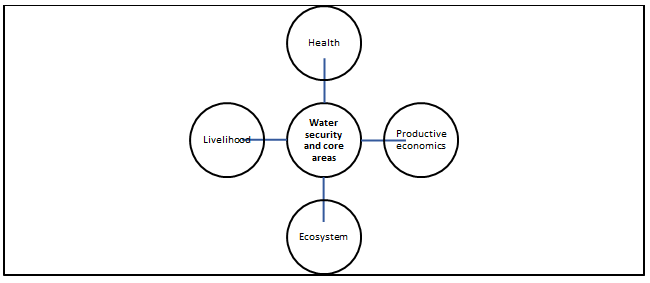
Health
In June 2019, 65 percent of all reservoirs in India reported below normal water level and 12 percent were completely dried. Limited accessibility of water is a threat to people’s health. Insufficient water has the capacity to deteriorate the health of the entire city in times of water crisis. In the city of Latur, 90 percent depleted water resource causing many health issues. In 2016, health problems skyrocketed in Latur; with multiple people showing symptoms of fever, infection, dehydration, vomiting and kidney ailments. Moreover, meeting health crisis, hospitals are unable to conduct safe treatment due to the increased threat of post-operative infection and complications resulting from lack of clean drinking water [24].
Livelihood
One-third districts of India are becoming the victim of severe drought, affecting around 330 million people belonging to 256 districts in 10 states in India. Thousands of farmers have killed themselves due to acute drought and debt in Karnataka since January 2015. Later in the Marathwada region in Maharashtra is the worst affected by severe drought conditions. Bundelkhand districts across Madhya Pradesh and Uttar Pradesh with consequent drought in raw resulting 50 percent of its water resources dried up. Four major reservoirs in Hyderabad city have dried up.
Ecosystem
In 2016, the city of Mettur and Kolathur experienced acute water shortage caused by drought which caused water bodies in the nearby forest to dry out. Eventually, local wild animal like elephants, tigers and spotted dears started to sneak into the city in search of water. Some of these animals pose threat to the citizens as they can attack people. Some animals like spotted dears get physically attacked or injured and died in accident. In the Madurai district the acute water shortage caused gauze to die by felling into well as they looked for water.
Productive Economics
In 2016, the city of Latur witnessed mass unemployment where about half of its workforce was threatened to be unemployed as the agricultural industries struggled. Much land economy and farming regions nearly collapsed as citizens were left with no choice but to use the polluted water. This reduced job opportunities in rural areas which pushed citizens to move to the cities in search of jobs. Such trend only adds pressure to the already strained infrastructure as the demand for water in larger cities continues.
Integrated Programmes and Policies: Development and Implications
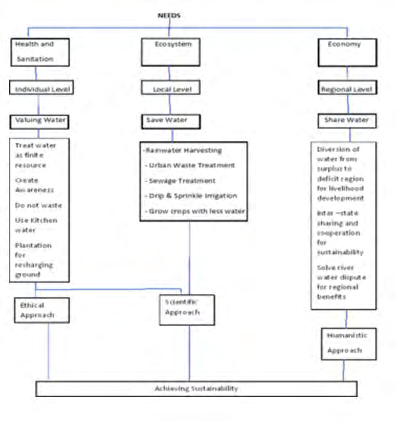
The main objective of the water management programme includes restoration of the ecological balance at the watershed level by utilising, conserving and developing degraded natural resources (Figure 2). In order to make India, a water secure nation, the following programmes have been initiated:
- The national project for Repair, Renovation and Restoration (RRR) of water bodies, 2005
- Integrated watershed management programme (IWMP), 2008
- Atal Mission for Rejuvenation and Urban Transformation (AMRUT), 2015 Under the water supply component of the mission, projects related to rain water harvesting, rejuvenation of water bodies specifically for drinking water supply, recharging of ground water etc., can be taken up by the states/UTs to enhance water supply in the mission cities.
Rain water harvesting is the name given to the innovative way of collecting rain water in order to recharge the underground water. A lot of houses have built their own rain water harvesting in order to be self-sufficient. Scheme of Common Effluent Treatment Plant (CETP) being operated by the central government through Ministry of Environment, Forest & Climate Change (MoEF & CC) on the cost sharing basis to provide the treatment of effluent being generated by cluster of Small Scale Industries/ Small and Medium Enterprise (SSI/SME). The sustainable development goals (SDGs) addresses water security with aims to ensure water and sanitation for all. Recently, Swachh Bharat Abhiyan (SBA) 2014 aims to ensure access to sanitation facility and safe and adequate water supply to every person by 2019.
There is a good example available such as use of treated sewage by thermal power plants as raw water for industrial purpose (Pragati Power Plant based on natural gas in Delhi) and in turn power plant supplies electricity free of cost to concerned STP in barter. Currently almost 351000 hectares of land is under drip irrigation compared to just 40 hectares in 1960. India is already looking into installing a desalination plant near the coastal region to fulfil the water needs of city such as Chennai.
Jal Shakti Mission established in June 2019, combines the Ministry of Water Resources, River Development and Ganga Rejuvenation, Ministry of Drinking water and Sanitation. Jal Shakti Mission is ‘pipped water supply for all rural household by 2024’ to every rural household at the service level of 55 litters per capita per day. This Ministry is responsible for managing all the financial and technical resource, policy support and the pollution regulation deployment regarding the water resource throughout the country. This mission focuses on integrated demand side management of water at the local level, including the creation of local infrastructure for source sustainability like rainwater harvesting, groundwater recharge and management of household wastewater for reuse in agriculture [25].
The Indian Government has declared that the new ministry could increase the whole country’s water use efficiency by 20 percent in addition to enhancing the capacity of its water reserves and protecting the current overexploited ones.
Conclusion
Water security is one of the core issues of human wellbeing and quality of life. Water is needed for varieties of uses and maintaining a healthy environment. The requirement of water is increasing with an increase in population, urbanisation and standard of living. Other aspects like poverty, economy and climate change also determine the demand for water. Good governance is a key to solve the problem of all water-related issues, and integrated approach will serve as a foundation for water security and sustainability.
References
-
Shiklomanov’s I (1993) World fresh water resources. In: Peter H Gleick (Ed.), Water in Crisis: A Guide to the World’s Fresh Water Resources (Oxford University Press, New York).
-
UN, UNDP, UNEP, FAO, UNESCO, WMO, W. Bank, WHO, UNIDO & SEI (1997) Comprehensive Assessment of the Freshwater Resources of the World. World Meteorological Organization, pp: 33.
-
Falkenmark M (2002) Growing water scarcity in agriculture: future challenge to global water security. Philosophical Transactions: Mathematical, Physical and Engineering Sciences 371(2002): 1-14.
-
Swain A (1998) A New Challenge: Water Scarcity In The Arab World. Arab Studies Quarterly 20(1): 1-11.
-
Falkenmark M (1989) The Massive Water Scarcity Now Threatening Africa - Why Isn’t it being Addressed? Ambio 18(2): 112-118.
-
United Nations (2006) Coping with water Scarcity: A strategic issue and priority for system-wide action, UN- Water Thematic Issue.
-
Mehta L (2001) The Manufacture of Popular Perceptions of Scarcity: Dams and Water-Related Narratives in Gujrat, India. World Development 29(12): 2025-2041.
-
Sullivan C (2002) Calculating a Water Poverty Index. World Development 30(7): 1195-1210.
-
UNICEF, FAO, SaciWATERs (2013) Water in India: Situation and Prospects.
-
Lall U, Heikkila T, Brown C, Siegfried T (2008) Water In The 21st Century: Defining The Elements of Global Crises and Potential Solutions. Journal of International Affairs 61(2): 1-17.
-
Wutich A, Brewis A (2014) Food, Water, and Scarcity. Current Anthropology 55(4): 444-468.
-
McCaffrey SC (2014) Water Scarcity and Security Issues in the Middle East. Proceedings Annual Meeting 108: 297-300.
-
Winpenny JT (1994) Managing Water as an Economic Resource, Routledge, London, UK.
-
Mehta L (2003) Contexts and Constructions of Water Scarcity. Economic and Political Weekly 38(48): 5066- 5072.
-
Ohlsson L, Turton AR (1999) The Turning of Screw: Social Resource Scarcity as a Bottleneck in Adaptation to Water Scarcity. Working Paper, London: School of Oriental African Studies, University of London.
-
Bachhuber D (2009) India, Water and Sustainable Development: Consilience, Columbia University 2: 1-22.
-
NITI Aayog (2018) Composite Water Management Index: A Tool for Water Management, National Institute of Transforming India.
-
Central Pollution Control Board (2018) River Stretches for Restoration of Water Quality, Ministry of Environment, Forest & Climate Change Government of India, Delhi, India.
-
Central Pollution Control Board (2021) National Inventory of Sewage Treatment Plants, Ministry of Environment, Forest & Climate Change Government of India, Delhi, India.
-
Central Water Commission (2015) Water and Related Statistics, Water Resources Information Directorate, Water Planning & Project Wing, New Delhi, India
-
Central Water Commission (2019) Reassessment of Water Availability Using Space Inputs, Basin Planning and management organization, New Delhi, India
-
Jindal RN (2018) Water Pollution in India: Issues and Option, Pragun Publication, Delhi, India.
-
Kaur J (2016) Water poverty index an interstate analysis of India, Department of Economics, Jamia Milia Islamia University, Ph.D. Thesis Unpublished.
-
Schewe J (2014) Multimodel assessment of water scarcity under climate change. Proceedings National Academy Sciences United States America 111(9): 3245- 3250.
-
United Nations, Department of Economic and Social Affairs, Population Division (2019). World Population Prospects 2019: Highlights. ST/ESA/SER.A/423.
- Lessons to Learn: Trees are More than the Lungs of the World
- Community Forestry Enterprises as a Model for Sustainable Forest Development: The Case Of The "Baja Tarahumara" in Chihuahua, Mexico
- Ecological and Socio-Economic Impacts of Chromolaena odorata and Mesosphaerum suaveolens, Two Invasive Alien Species in Central and Southern Benin, West Africa
- Epigenetic Sustainability: Modeling the Human Factor as a Natural Resource through Science 4.0 and the NR3C1 Biological Pilot
- Growth-at-Risk: A Framework for Assessing Economic Vulnerability
- The Rural Territory as a Socioecological System for the Management of Public Policy for Sustainable Rural Development