
Farmers Participation toward Forest Production and Protection in Dawuro Zone, Essera District, Ethiopia
Natural resource degradation has become a serious environmental problem in Ethiopia. Deforestation, which is occurring at an alarming rate, is one of such problems. Forest cover has been declining at an alarming rate indifferent areas of Dawuro zone, Essera district. This is because of expansion of agricultural land, cutting of trees for fuel, construction, charcoal making and pit-sawing, which are the manifestations of population pressure as well as failure in property rights institutions. The study was carried out in SNNPR in Dawuro zone in general Essera district in particular. The study was focused on the assessment of farmers’ participation towards forest production and protection in Essera district of Dawuro zone. In the study both primary and secondary data were used. Primary data was obtained from the respondents through semi- structured questionnaires and, interview schedule Sample size was obtained from this district by purposively selecting two kebele from twenty nine kebeles. The respondents were selected randomly and sample size obtained was 60. Collected data was analyzed using the statistical package for the social sciences (SPSS) and appropriate statistical procedures for description (frequencies, percent, means and standard deviation) were used. An attempt has been made to assess farmers’ participation on forest production and protection in the study area. From the respondents almost all are males and all are married finally the collected data was analyzed by descriptive statistics such as percentages, frequencies and tabulation techniques. About 83.3% of the respondents participate on forest production and protection. The study also tried to show currently deforestation rate of forest was very high due to agricultural land expansion, for different constructions, fuel wood, urbanization, rural job opportunity for youths and climate change due to deforestation. Factors affecting farmers participation on forest production and protection were land size, age sex, family size, ethnicity, religion, education, marital status were the major ones. The study recommends that sustainable development and rural livelihood of rural household cannot be guaranteed through agricultural crops production alone. There is thus a need to restructure and strength the extension division service need to be established and integrated with the existing agricultural extension programs.
Introduction
Background
In Ethiopia, natural resource degradation has become a serious environmental problem. Deforestation, which is occurring at an alarming rate, is one of such problems. In a year, 150,000 to 200,000 ha of forests, i.e. about 6% of the remaining forest of the country are cleared. Currently only 2.4% of the total land of the country is under forest cover though it was estimated to have been about 34% in the past. The fast growing population with increasing demand for farmland and wood for construction and fuel, political unrest, forest fire, insecure land tenure system, inappropriate conservation approaches and lack of awareness are the most commonly mentioned factors for deforestation in the country.
Deforestation has many repercussions that include soil, water and biodiversity degradation. Recognizing the potential impacts of resource degradation, some measures have been taken towards resource conservation in the country. These include establishment of protected areas like parks, game reserves and sanctuaries and mobilization of people to construct physical soil conservation structures for reforestation through food-for-work programs. Nonetheless, the measures taken could not guarantee long lasting protection and preservation of the country’s resources [1]. At the present, only patches of forests remain in the country, mainly in the western and southwestern parts. One such forest is found in Dawuro area.
The forest in Essera district is presently managed by participatory forest management (PFM) mainly. Forest cover has been declining at an alarming rate in Essera area. This is because of expansion of agricultural land, cutting of trees for fuel, construction, charcoal making, in name of job opportunity for rural youths government let youths to plant coffee in forest and pit-sawing, which are the manifestations of population pressure as well as failure in property rights institutions. Land once covered by natural forest is now converted into agricultural land and settlement. The existing relationships between the Organizations and the local people are thus not favorable for a sustainable management of the forests. So as far as concerned with farmers’ participation the care is not given at all because for the sake of farm land as well as for different purposes people cut forests without replacing.
Statement of the problem
The forest cover of Ethiopia is reduced increasingly as a result of excessive deforestation and the consequent degradation of land resources due to accelerated soil erosion [2, 3]. FAO 1998 attributes the problem of land degradation in Ethiopia to the high rates of removal of natural vegetation improper land use practices and habitat factors. In the year 2001 for instance 85 % the total energy requirement were met from biomass sources like fuel wood, chanced crop residue and dung [4].
To this end result of scientific study and experience of elderly natives made decades of motives discrimination of Ethiopian forest resource crystal clear. Forest history of recent past reveals the conversion of substantial amounts of forested lands in to agricultural use. In conversion of repeatedly reported high rate (160000 to 200000) of annual deforestation in the past (Bishaw 2001). FAO [5] gives only 40000 ha for the period for 1990 to 2000. Deplorably enough, Ethiopia was restoring only 5% (200ha) of the annual deforestation through plantation by the year 2000 [6]. The failure to understand farmers’ choice criteria led the success of development project aimed at growing food security and rehabilitating the living environment. Deterioration of food availability coupled with rapid rising human population will continue treating the well-being of the rural community unless corrective measures are identified and implemented with no further delay. This study aims at identifying means by which famers’ participation in their own needs and aspiration could be addressed in community forest production and protection.
Objectives
General Objective
The general objective of the study is to assess farmers’ participation towards production and protection of forest practice in Essera district.
Specific Objectives
- To assess deforestation status in the study area.
- To analyze level of farmers participation in production and protection of forest.
- To identify factor that affecting farmers’ participation.
Research Questions
- What is the status of deforestation in Essera district?
- What is the level of farmers’ participation in the forest production and protection in the study area?
- What are the possible factors affecting farmer participation in forest production and protection?
Significance of the study
The study would contribute towards creating awareness among governmental organization and nongovernmental organizations in planning and implementation programs to increase farmers’ participation in forest production and protection. The results of study will also be useful in formulating policies to improve farmers’ participation in forest production and protection. The finding of the study would be at great contribution towards breaching the existing information gap regarding the farmers’ participation in forest production and protection and was an indispensable information source for interested. In addition to this the finding of this research was reference for future to those researchers who are interested on such type of research area.
Scope of Study
This research study area was focused entirely in Essera district, which is one of the district found in Dawuro zone of SNNPR. The study dealt with the assessing of the farmers participation towards production and protection of the forests in this district. The research was conducted in the two kebeles found in this district as a sample. In this study the kebeles which had an access of farmers’ participation as well as farming activities were selected after arriving that district.
Limitation of the Study
- As researcher, during conducting my research from the start of proposal up to the research result presentation, I suffered the following problems or difficulties (challenges).
- Unwillingness of the respondents to give a response or accurate information.
- The selection of an appropriate or suitable area to collect real data was one obstacle.
- Shortage of time due to summer season as a result of excess rain fall hampered.
- Budget or an expenses shortage was challenge my way to successfully collect the data. Getting the accurate data was also one of the difficult challenges during data collection due to respondents’ carelessness.
Literature Review
Theoretical Context
Definition of forest
A forest is an area of land with many trees. Many animals need forests to live and survive. Forests are very important and grow all over the world. They are an ecosystem which includes many plants and animals. Temperature and rainfall are the two of the most important things for forests. Forests can exist from the equator to near the Polar Regions, but the character of the forest differs greatly. In cold climates conifers dominate, but in temperate and tropical climates forests are mainly of flowering plants. Rainfall is also a major factor. No forests exist in deserts, just a few trees in places where their roots can get at some underground water. The three major forest biomes are coniferous forests, deciduous forests, and tropical rain forests.
Coniferous forests
Evergreen coniferous forests stretch across Canada, Alaska, Northern Asia, and Northern Europe. They are composed of conifers which produce seeds in cones.
The weather during the winter is cold, but the snow melts completely in the spring, turning some parts of the forest into swamps. There are only eight types of trees in the coniferous forests, including balsams, firs, and black spruce. There are not many different types of trees in coniferous forests because of the cold weather, and the poor soil. Fallen branches, needles, and dead animals do not decay as fast as in warmer regions. This is why the soil in coniferous forests is not very fertile. Also, only those trees that have adapted to cold weather and poor soil have been able to survive. These trees have flexible branches that support heavy snowfalls. Less water evaporates from their leaves because of the shape of their needles [7].
Natural Resource Management Approaches
Concern about changes in the environment was started over two millennia ago, when Plato wrote about hills of Attica in Greece that had lost forest cover. However, the idea of conservation was crystallized very recently (Talbot, 1984), and initially natural resource conservation had taken the modernization approach [8, 9]. This approach emanates from modernization framework, which “is firmly rooted in, and driven by, the enlightenment tradition of positivist science.” Modernization assumes technologies are universal and “implies that what has gone before is not as good as what we have now.” This framework has been influencing not only the approach to natural resource management but also the thinking, practices and policies of development among others [8]. In the modernization approach to resource conservation scientists and planners identify problems such as severe degradation and search for rational solutions or technologies, which are tested under controlled environment to be taken up by farmers. Peasants are expected to change their previous practices which, most of the time, involve altering their livelihood to comply with new technologies. The basic assumption behind the modernization approach is that farmers are the cause of natural resource degradation such as deforestation, soil degradation and overgrazing. Thus, it recommends the exclusion of people from forests to protect trees and wild life and the adoption of externally developed water and soil conservation technologies [8]. Being influenced by modernization or traditional conservation approach, conservation polices of governments in Africa have been focused on biological value of forests and ignored the people who depend on such resources (Feyera, undated). Local communities do not participate in planning for the management of resources. Under extreme scenarios, local communities were relocated to other places that broke down their tradition, culture and moral systems, and livelihoods. Community faced with resource scarcity to sustain themselves and their livestock, and not infrequently protested conversion of resources to protected area [1].
The Responsibilities of the States on Forest Protection
In the modernization approach, responsibilities of forest conservation have been vested in the state and its agencies. But it has never managed forestland at its stake effectively simply because it lacks the resources [10]. On the other hand, it has destroyed the local management system of forests and thereby disturbed local peoples livelihood and expedited the rate at which this resource is converted to open access property. Moreover, states have, in many cases, granted logging concessions to exploitative companies or privatized forestlands completely. The privatized forestlands have been subsequently converted into farms like ranching of cattle, which is of low productivity while the displaced people face severe impacts on their livelihoods [10]. Likewise in Ethiopia, the state owns most large forestlands mainly by expanding to the so-called forests not owned by anyone there have been frequent encroachments and illegal utilization of these forests as the state was ineffective in controlling. Even three major waves of clearance of forests and woodlands owned by the state occurred in the country in the mid- 1960s, late 1970s and early 1990s [11, 1]. In addition, in the country, community forestry was promoted by Imperial and Derg governments with the intention to conserve natural resources and provide forest products to local communities. However, community forestry failed as “many peasants were not convinced of” its benefits among many other factors [1].
The Role of Participation on Forest Conservation
Most of the conservation efforts in modernization framework have not brought lasting effects though they have conveyed considerable success in the short run [8, 9]. Under most circumstances, they aggravated resource degradation. The approach succeeds only with coercion and when external pressures were removed the local people reject the measures in place [8]. As a response to this failure, alterative approach to resource management has been developed starting from the mid-1980s and mid-1990s [10]. Postmodernism rejects the claim that resource management technologies have universal application. In this approach, the central issue is that people know best for themselves. So one has to listen to and actively seek after their voices, which are “authentic and legitimate”, and brings sustainable resource management [8]. This new approach incorporates and glorifies the term participation [10]. Participation comprises the strategy to involve the beneficiaries in natural resource management. But there exists no consensus on the definition of participation and participatory approaches. Some view participation as a means to an end while others perceive it as an end in itself [8]. Also some pay only lip-service to participation for reasons of its political usefulness [12]. Thus, the ways participation is interpreted and used by different entities are many. These One has to be cautious in using and interpreting participation and reference must be made to the type of participation because most of the participation typologies like manipulation, passive and consultation threaten the goals of projects rather than promoting. Such participation involves no more than telling what is going to happen or requiring responses to some questions where the locals respond, and contribution of resources like labor in return for food or cash to put to practice what has been already decided by outsiders. In genuine participation, on the other hand, local people actively involved in decision- making, implementation of activities affecting their lives and sharing the benefits thereof [8]. This approach is believed to bring many benefits that include enhancement of efficiency, transparency and accountability, empowerment of the poor and disadvantaged, mitigation of natural resource degradation, livelihood improvement, sense of belongingness and capacity to learn and act [8, 13].
In a real participatory (joint or collaborative or co- management) natural resource management “two or more social actors negotiate, define and guarantee amongst themselves a fair sharing of the management functions, entitlements and responsibilities for a given set of natural resources”. Its end goals are sustainable use and conservation of the resource and equitable sharing of benefits and responsibilities related to it [14].
Empirical Review
History of forest production and protection practice Forestry practice has come off as during the past 15 years. During this period activities and in forestry practices evaluation and training interest in forestry practice, evaluation and training increased tremendously (P.K Romn Chandrain) tracing the history of forestry practice. King 1987 states that in Europe until the middle ages it was the general custom to clear _full degrade forest burn the slash cultivate the food crops for sowing agricultural crops. King added also that thin farming system is no longer popular in Europe but was widely practiced in Finland up to the end of the last century when one come to our country Ethiopian case this bad custom is still paratactic. Even though some important activities are started on forestry practice but yet to do more because the wellbeing of the country is dependent on directly or in directly on forestry practice. We can think of in the last many centuries the country was covered by dense forest. Many evidences indicate that at that time the country was for living.
Eucalyptus as a forest
In 1990 an estimated of 10 million hectare or approximately one quarter of topical were planted were equal puts more than half of their plantation located in tropical Asia and Oceania mainly in India (4.8 million)FAO year, this varieties is also familiar in our country . It covers large amount of the land when we compare with other types of forest trees eucalyptus provide woody materials with wide range of use such as sow timber, ply wood paper and poles and medicinal products. Eucalyptus species characterized by fast growth and can be cross breed for more rapid growth, good farm or favorable wood properties.
But there are opposition to eucalyptus puts dive to failure to appreciate that high demand for soil moisture makes then unsustainable for other forestry practice in dry areas. It produces poisoned substance, which attach other tree plants under it. Some farmers said that root of eucalyptus is very long and can absorb its surrounding water service. Due to this high absorption power, other tree plans and crop varieties become sustainable for drought. Even though this fact is known but most farmers were grow in their land.
Impacts of Forest Plantation on National Forest Program
Forest plantations are expected to play important role in national; forestry program in the future. Many development countries provided up dated information on for present and future plantation programs in FAO in 1996. Most of the countries with large plantation estates indicated that they intended to double their plantation areas between 1995 and 2010.
According to FAO [15] the expansion of forest plantation practice in all developing regions is expected to accompany by quality active changes in the programs including:
- Increasing in sensitivity on the part of planners to the need for consultation and involvement of all concerned parties in planning plantation programs.
- More integration of trees in to agricultural system to supply domestic needs and were the price is attractive, industrial round wood and
- Enhanced development of true breeding programs some using advanced techniques The participation of farmers in forestry practice is all important roles in development.
The Role of Farmers Participation in Forest Production
The participation of farmers in forest protection is an important role in development. Their participation includes site selection, nursery preparation, sowing activity, watering, weeding, transplanting and for looking of the forest for ever.
This activities are undeniable role in the forest sustenance of the forest by the supporting of some forest specialist. It is inevitable the farmers indigenous knowledge and experience on their areas results in sustained and guaranteed way of on environment. Their participation of clear –cut (filing of all trees over a considerable area at time again a successful result. Their participation in forestry practice with a harmony of specialists will give prodigies of results.
In 1996, with in its forestry for community development program the FAO forestry department published a forestry paper entitled tree growing by rural people. It presented various pets of the state of knowledge about free growing managers. However also some of the most interesting future opportunities for community forestry practice lie in improving a management of existing trees rather than in creating new resources practices of farmers. Forestry provides an excellent opportunity to promote participatory approach to development and calls for a large number of widely dispersed nurseries in rural area to make seedlings easily accessible forestry we really said that any forestry activities in the community in order to increase benefits my value.
Impacts of Forestry on Farmers Living Standards
The importance of forests and the goods and services from the forests to the rural people in developing countries is mainly three fold. As FAO [15] forest trees provides fuels and others goods essential to meeting basic needs of the rural household environmental stability necessary for continued food production forest and forest products generate income and employment in the rural community are as follows:
- Fuel
- Building materials
- Food
- Fodder
- Raw materials grazing saleable products Wood is the dominant domestic fuel for rural people in developing countries and for many of the urban poor as well as in many parts of the developing countries. Wood is also the principal structural material for constructing shelter and housing.
Causes of Deforestation Direct Causes
People have been deforesting the Earth for thousands of years, primarily to clear land for crops or livestock. Although tropical forests are largely confined to developing countries, they aren’t just meeting local or national needs; economic globalization means that the needs and wants of the global population are bearing down on them as well. Direct causes of deforestation are agricultural expansion, wood extraction (e.g., logging or wood harvest for domestic fuel or charcoal), and infrastructure expansion such as road building and urbanization. Rarely is there a single direct cause for deforestation. Most often, multiple processes work simultaneously or sequentially to cause deforestation.
The single biggest direct cause of tropical deforestation is conversion to cropland and pasture, mostly for subsistence, which is growing crops or raising livestock to meet daily needs. The conversion to agricultural land usually results from multiple direct factors. For example, countries build roads into remote areas to improve overland transportation of goods. The road development itself causes a limited amount of deforestation. But roads also provide entry to previously inaccessible and often unclaimed land. Logging, both legal and illegal, often follows road expansion (and in some cases is the reason for the road expansion). When loggers have harvested an area’s valuable timber, they move on. The roads and the logged areas become a magnet for settler’s farmers and ranchers who slash and burn the remaining forest for cropland or cattle pasture, completing the deforestation chain that began with road building. In other cases, forests that have been degraded by logging become fire-prone and are eventually deforested by repeated accidental fires from adjacent farms or pastures.
There are now perhaps 200 million people living in the tropical forest areas and plasticizing slash and bush farming (shifting cultivation). On perhaps 300 million hectare of forest land in order to provide their daily food [15] in parts of south and south east Asia, this form of land use occupies some 30% of the officially designated forest area traditional system of shifting agriculture, which employed a lengthy fallow period under forest area to restore fertility of the soil, which were capable of supporting agricultural crops only a limited number of years have largely broken down. Growing population pressure and migration in to the forest area by land less people from elsewhere have forced a progressive shortening of the fallow period to the point where it suffice neither to restore soil fertility nor to recreate a usable forest crop. The FAO forestry paper of FAO [15] referred to it has been estimated tool to the existing area of the forest in developing countries being reduced annually by 5-10million hectare in Latin America, 2 million hectare in Africa 4 million in Asia. To the extent that this process release to food production land which come sustain the growth of crops. This is logically and to be planned for. But over large areas. The pressure of growing population force land less farmers on to soil erosion, silting, flooding and drought are well known.
Forest Management
Forests are one of the most important common resources. Forest management consists of group deliberate activities for conservation and possible enhancement of useful forest resource and the controlled utilization of these resources EFAP [3] such as
- Controlled utilization of forest resources
- Protection and maintenance of forest trees stands and
- Purpose full propagation of valuable tree species The Role of Extension in Forest Resources There is growing recognition of the need to give proper attention to the remaining rural population who are predominantly peasant farmers and to use appropriate skill in agriculture forestry and related activities to improve their general well fare of and the gravity of their lives. Too often in the past a narrow view has been taken of this process. Extension has been regarded as a means of passing down in to former techniques which it was believed would be beneficial to them without taking in to account sufficiently the particular social or environmental condition of the areas. In particular too often the indigenous skill, social structure and detailed social knowledge of the people have been ignored in trying to transfer new skills or techniques to them. Fortunately extension is now being regarded as a much wider task of integrating indigenous and new skill or techniques derived from study or research in to an overall farm work of discussion and cooperation between the people and the extension organization [8].
Methodology
Area Description
Types and Source of Data
To conduct this study both primary and secondary data were used. The data were obtained from primary and secondary sources. Primary data was obtained from sample by asking farmers different questions. The secondary data were also obtained from published material found in the kebeles administration office and Essera district agricultural development and Forest office were selected by simple random sampling method.
Methods of Data Collection
The data was collected by visiting the household and conducting face-to–face interview on famers’ participation in forest production and protection practice. In order to produce required information, the data collection instruments were prepared prior to the field work. The semi-structured questionnaires was prepared and pretested for those people who can read and write interview schedule was prepared to obtain sufficient information from those famers who cannot read and write by changing the questionnaires in to the language in which farmers can understand.
Sampling Techniques and Sample Size
A multistage sampling technique were used for the study; where in the first step; Dawuro zone and then Essera district was selected purposively, to assess the participation of farmers towards forest production and protection in the study area.
Then at the last step, a total of two Kebeles namely: Zadi Shamayti and Arusi Balakebeles were selected by using simple random sampling among the total Kebeles. Then Slovin’s sampling formula with 90 percent confidence level used to determine sample respondents. Slovin’s Formula: $$ n = \frac {W}{I + W (6) _ {2}} $$ Where: n = sample size N = total number of household from two kebeles’ E = margin of error 10% for social science Form Zadi shamayti kebele 1124 residents and from Arusi Bale kebele 1283 residents. Then the total residents of the two kebeles were 2407. From this to determine sample size = 2407/1+2407(E2) =96. But the sample obtained from this formula was more than 96, due to time and budget shortage and for the quality data; I reduced the sample size into 60. Proportional sample size based on household is essential to determine the number of respondent from two kebeles’.
Method of Data Analysis
The data that was collected in the aforementioned methods and procedures were analyzed in the systematic manner and answered the research questions in this study report made the finding and data more clear for simple understanding percentages, frequencies and tabulation techniques were used to analyze the respondents’ responses by using statistical package for social science (SPSS) software version 20.
Hypothesis
Dependent variable
The dependent variable in this study is participants and non-participants.
Independent variable
The main factors that determine farmers’ participation were hypothesized to be consisting of the following factors:
Education level: Education level has a great impact on the participation. Despite some improvements by recent years, the education level of developing countries like Ethiopia is more or less categorized under low level. Due to this the labors that are learned are more likely to be employed. Whereas, most of the labor that does not learned or illiterates are more likely to be non-participants Age: Age has also impact on the probability of being participant. If a person is at very lower age, he may not have a chance to be participants. But, the more the individual is aged, the higher the probability of being participants.
Sex: As recent studies shows that, males have higher probability of being participant than females. Most of the time, females are not participants rather they depend on the house work. This problem is highly visible in developing countries like Ethiopia. But, there is some improvement from time to time.
Marital status: The marital status of each individual household has an impact on participation. Mostly, single or unmarried individuals are without job. But when individuals get married, they get employment opportunities at home or small shops around their village.
| Proposed impact on participation | |
|---|---|
| Education level | + |
| Age | + |
| Sex | + |
| Marital status | + |
| Family size | - |
| Religion | - |
| Ethnicity | - |
Table 1: Hypothetical impact of variables.
Results and Discussion
Demographic and Socio-Economic Characteristics of Respondent Farmers
The demographic and socio-comic characteristics of the respondents’ farmers in the study area are sex, age, marital status, family size, education level, and religion.
| Variables | Participants | Non-participants | ||
|---|---|---|---|---|
| Frequency | Percent | Frequency | Percent | |
| Sex structure of HH | ||||
| Male | 50 | 100 | 10 | 100 |
| Female | ||||
| Religion of HH | ||||
| Protestant | 33 | 66 | 9 | 90 |
| Orthodox | 17 | 34 | 1 | 10 |
| Education of HH | ||||
| Illiterate | 16 | 32 | 7 | 70 |
| Can read and write | 34 | 68 | 3 | 30 |
| Age of HH | ||||
| 30-40 | 1 | 2 | ||
| 40-50 | 22 | 44 | 1 | 10 |
| 50-60 | 19 | 38 | 9 | 90 |
| Above 60 | 8 | 16 |
Table 2: Demographic and Socio-Economic Characteristics of Respondent Farmers.
Source own survey (2017) Table 2: Demographic and Socio-Economic Characteristics of Respondent Farmers.
There are 29 kebeles in Essera district. The research data were collected from two kebeble, namely Zadishamayti and ArusiBala from twenty nine kebeles of Essera district. The sample size obtained these two kebeles were 60 by simple random sampling technique. From zadi shamayti kebele 28 respondents and 32 from Arusi balakebele. From the table above respondents who were volunteers to give the required information almost all are males from the two kebeles. This is because of preference of real information as well as women were not given the ownership right. Community believes that work of women is only house wife they cannot contribute and participate in development activities.
Marital status of the respondents
The marital status of the respondents is that almost all respondents who were interviewed married. Among the respondent I didn’t come up with unmarried widowed or divorced unfortunately. A man who has lost his wife by death can marry extra wife and a woman who has lost her husband can marry to anyone else. But such type of married practice is not allowed in religion followers.
Religion of the Respondents
As far as concerned with the religion people in the woreda different have religion and beliefs. From the interviewed respondents 71.7 percents are the followers of the protestant religion and the rest 28.3percents are the followers of the orthodox religions respectively Education levels of respondents
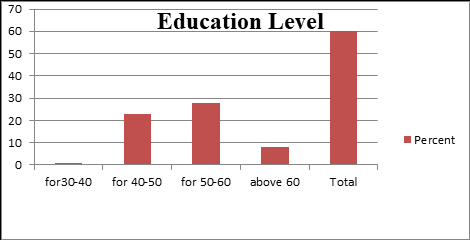
Source own survey (2017) Figure 2: Education level of respondents.
Education levels of the respondents about 38.3 percents are those who cannot read and write and sign their signature by their finger and the rest 61.7 percents literate who have learned from the grade four and above However majority of respondents can read and write. They could not know the exact date of birth.
Age of respondents
Source from survey data 2017 The age of the respondents was 30 up to 60 and above, but the age of the respondents more their ages since they tell the assumption or estimate about their age. Dominated were
40 up 60 and above as can see on the bar graph. From those respondents majority of their age accounts 40-50 and 50-60 are 38.3%and 46.7% from the 60 respondents’ respectively. This is because those people under the age below 30 do not have awareness on the benefit of forest production and protection, so age significantly affects participation on forest production and protection.
| Frequency | Percent | |
|---|---|---|
| for house construction | 18 | 30.0 |
| for road construction | 1 | 1.7 |
| for agricultural expansion | 41 | 68.3 |
| Total | 60 | 100.0 |
Table 3: Age of respondents.
In the study area deforestation was very high; the reasons are some natural, others mainly due to human actions owing to inappropriate land-use systems. According to the respondents about 68.3% reason for deforestation was expansion of agricultural areas, for house construction 30%, road construction and urbanization1.7% in this study it was identified as forest is being delivered for many peoples whose hand was taken for infrastructure in urban or center of district. For instance, as on spot observation and respondents result indicated area called “GUITY” was totally covered by jangled forest before 7 or 8 years now it completely bare due to compensation given for people come from Bale town as their land plundered for infrastructure. In addition to these increasing demands for forest products and lack of information and understanding on the importance of forests to the livelihoods of the local people were the main reasons. Due to deforestation there are different climatic change in the study area environment become barren, loss of wild animals, loss of some medicinal trees loss of biodiversity and etc. Deforestation of forests in the study area was very high. People cut forest trees consciously or unconsciously. This due to lack of awareness about the importance of production and the protection of the forests, they cut forests whether communal or the individual for the different purposes, such as for expansion of agricultural land, house construction, urbanization, road construction etc. majority of the respondents believe that expansion of agricultural land is better than forests. However they get some befits from the forests the benefits which obtained from the agricultural production is more than that of the forests. Types of trees dominantly found study area are eucalyptus, acacia etc. but among those trees found in these area eucalyptuses has an economic importance.
Management and utilization of natural resources in a sustainable way has become a frightening challenge in this zone in general and in study area in particular. Like many other forest areas of the country, the Essera catchment area has been experiencing recurrent outbreak of fire and illegal cutting that have huge consequences on the forest resources of the area. The negative consequences of forest fire are immense and they involve loss of species diversity, irregularity of rainfall, and reduction of water for drinking and irrigation; as well as extinction of some wildlife species According to the respondents there is climate change observed in the study area.
According to the respondents they obtain different benefits from the forest trees. Forest trees serve to them different purposes such as for house construction, source of income, sources of fuel wood sources of free and cold air sources of rain fall.
Land use pattern has changed frequently in the area. For instance, the respondents confirmed that they have observed major changes in land use at least once in their life time. The principal reason for these changes was associated with the increasing value of cash crops over cereals partly in response to population pressure and shortage of farmland at household level. Farm size in the study areas ranged of the respondents. Consequently, large family size households do not usually produce enough to cover their annual food requirements unless they rely on alternative income sources such as forests.
Consequences of Deforestation on the Environment
| Frequency | Percent | |
|---|---|---|
| environment become barren | 40 | 66.66 |
| loss of non-timber forest products | 5 | 8.33 |
| loss of wild animals | 7 | 11.7 |
| loss of some medicinal trees | 1 | 1.7 |
| loss of biodiversity | 7 | 11.7 |
| Total | 60 | 100 |
Table 4: Consequences of deforestation on the environment.
Currently deforestation of forest is high. People cut forest trees for different purposes. Such as for agricultural expansion urbanization ,for construction of houses for selling of forest trees to get some income for fuel wood, due to these and others reasons the rate of deforestation is high. These all factors lead to the environmental effects such as erratic rain fall, increase of temperature due to climatic change environment becoming barren land degradation which results in soil erosion. The majority of the communities is well aware of the ongoing changes on the forest resources and the economic and environmental consequences of deforestation, and therefore is prepared and willing to participate in forest management activities provided that the right policy environment for such participation is created. The research revealed that the area formerly covered by the forest is shrinking every year though the exact rate of conversion of forestland into cropland needs to be substantiated by successive studies.
Participation of Farmers on Forest Production and Protection
| Frequency | Percent | |
|---|---|---|
| Yes | 50 | 83.3 |
| No | 10 | 16.7 |
| Total | 60 | 100 |
Table 5: Participation of farmers on forest production.
Farmers’ have been participating on forest production and protection for a long period of time. But their participation is not high enough when they compare their past participation with that of the current. According to data obtained from the respondents about 83.3 % of the respondents have been participating towards forest production and protection. And they were asked where they plant tree and said that on their own farm land and on communal land. The researcher observed the management of seedlings planted and compared which one had better management. Consequently, it is impossible to compare, i.e trees planted on communal almost all dried and on farm land is too nice. As respondents said, on communal land they simply come and plant as government mobilize and no body look after or care for it. Most of them have participating above twenty years. About 16.7% of the respondents do not participate on forest production and protection. This is because as interviewed respondent reason which hinder them is shortage farmland.
Land Size Owned by the Respondent
| Forest land of respondents | Frequency | Percent |
|---|---|---|
| 0 | 11 | 18.3 |
| 0.25 | 36 | 60.0 |
| 0.5 | 12 | 20.0 |
| 1 | 12 | 20.0 |
| 1.5 | 1 | 1.7 |
| 2 | 25.0 | 1.7 |
| 2.5 and above | 60 | 100.0 |
| Total | 60 | 100.0 |
Table 8: Land size owned by the respondent.
Source own survey (2017) Table 6: Land size owned by the respondent.
Majority of the respondents have the cultivated land less than two hectares. This is because they have many children per house hold as a result of population density. People in the study area practiced polygamy married and they have more than one wife. They also have children above five and those children need future their own farm land. They also have grazing land not more than zero point five. They also have livestock few in number. Majority of respondents’ do not have fallow land. The need for extra farmland for expansion of agriculture they do not leave the land fallow. Respondents in the study area have different concerns. Some of the respondents about 36.7% have 0.5 hectares of land. About 16.7 % have no forest land and few in number have above 0.5 hectare of land. According to the results obtained from the respondents the total land of each respondent was less than three hectares of land. The ratio to population per land of hectare is not proportional. Due to high birth rate, low death rate lack of family planning [16].
Level of participation of the respondents
| Variables | Frequency | Percent (%) |
|---|---|---|
| High | 9 | 15.0 |
| Medium | 23 | 38.3 |
| Low | 28 | 46.7 |
| Total | 60 | 100.0 |
Table 6: Level of participation of the respondents.
Source own survey (2017) Table 7: Level of participation of the respondents.
The level of participation of each respondent was based on the position their current status, forest land they do have, participation on protection of the forest. It was labeled just like low medium and high. Those respondents who have high participation are 15%, those have medium participation are 38.3% and those who were have low participation were 46.7%. However not high enough it is some farmers have a forest land less than 0.5 hectare of land.
| Forest land of respondents | Frequency | Percent |
|---|---|---|
| 0 | 11 | 18.3 |
| for less than one hectare | 36 | 60.0 |
| for one hectare | 12 | 20.0 |
| for above one hectare | 1 | 1.7 |
| Total | 60 | 100.0 |
Among the respondents about 80 % of the respondents have forest land about 0.5 ha and less. A few of the rest do not have an opportunity to have a forest land. Forest lands owned by the respondent vary with size of land area. Among
the respondents about 61.7% of them have a forest land less than one hectare. A few in percentages have forest land about one and above one hectare. Some of them get nursery from their own effort, about 90% of the respondent preparer nursery and nursery bed by their own. The rest get by buying from the market. About 80% of the local people in the study area plant trees around their homesteads. Few people (20 %) do not plant trees due to shortage of land or complete landlessness. The most commonly planted tree species is Eucalyptus for construction and fuel wood purposes.
The responsible body in production and protection in forests are community in general farmers in particular. The role of community is that active participation in decision making area discus together on environmental problems. Governments has given awareness about the importance if forests on the environment Extension agents in this woreda
Factors affecting farmers’ participation
give many services such as to take agricultural inputs on time, using intercropping methods grow forest trees to protect climatic change since trees are source of rainfall. There are some institutions which are governmental and nongovernmental which supports the production and protection of forest in this area. They give to the community mostly advice Members of the community are convinced of the need for conserving and managing the forest because they appreciate the value of the forest not only as a source of fuel wood and construction material but also as source of water for drinking and downstream irrigation. The communities have also perceived forests as means of stabilizing climatic conditions and a means of off/on-farm employment and income generation my finding, so lined with Bekele [16].
| Frequency | Percent | |
|---|---|---|
| for sex | 21 | 35.0 |
| for age | 8 | 13.3 |
| for education | 17 | 28.3 |
| for land size | 6 | 10.0 |
| for marital status | 8 | 13.3 |
| Total | 60 | 100.0 |
Table 9: Factors affecting farmer’s participation.
Source own survey (2017) Table 9: Factors affecting farmer’s participation.
Among the factors affecting farmers’ participation sex is first and mostly affecting. According to the data collected from the respondents about 21(35%) said that sex affects farmers’ participation on forest prod.
Land Scarcity
According to respondents in study area the land size and their family size are not proportional. As discussed above the total land size mean of 3.10ha of land. Most of farmers have a few farm lands. As a result they interfere to the forest to sustain their life on agriculture. Access ownership and the size of land are one of the important determinant factors in participating in forest production and protection in the study area small land size ownership may affect farmers’ participation and adoption of new species of forests [17].
Population Pressure
Even though now there are some good activities concerning population policy in the past many years, population increases without any control. As discussed above, according to the respondents children per house hold is high. About 48(80%) of the respondents have children number above five. Because community believes that child bearing is the gift of God and living child do not miss food to eat. Due to this increment the woreda’s forests were created and changed in to the farm lands.
Financial Limitation
The farmers of the study area are more or less poor; their living is based on subsistence farming. They have less income generating resources. The base sources of income of the society chat/khat. People get the income from chat by selling the products of it. However majority of the respondents do not have enough farm land and cannot get enough income from it. Due to these economic problems farmers always depend on forest and forest products for their livelihood. They cultivate forest rather than planting and forest looking of these resources. Due to limited financial potential the farmers of the study area do not adopt improved forest species. According to the respondents response do have awareness about the benefits production and protection. About 76.7 % among the respondent said that production of forests has negative influence on agricultural expansion it result in shortage of farm land.
Descriptive analysis for categorical/discrete variable
| Variables | Participants | Non-participants | X2 | ||
|---|---|---|---|---|---|
| Frequency | Percent | Frequency | Percent | ||
| Education | 3.267*** | ||||
| Illiterate | 16 | 32 | 7 | 70 | |
| Can read and write | 34 | 68 | 3 | 30 | |
| Age | 43.9** | ||||
| 30-40 | 1 | 2 | |||
| 40-50 | 22 | 44 | 1 | 10 | |
| 50-60 | 19 | 38 | 9 | 90 | |
| Above 60 | 8 | 16 | |||
| Family size | 1.706*** | ||||
| Less than 55 | 4 | 8 | |||
| Above 5 | 7 | 14 | 1 | 10 | |
| 39 | 78 | 9 | 90 |
Table 10: Descriptive analysis for categorical/discrete variable.
Source own survey (2017) Table 10: Descriptive analysis for categorical/discrete variable.
Chi-square test showed significant relationship among different factors. According to the result obtained ethnicity, family size, age, education affect significantly but sex and Descriptive analysis for continuous variables marital status are not significant. However both sex and marital status were considered as important factors in society.
| Land type | Participants | Non participants | t value |
|---|---|---|---|
| Mean | Mean | ||
| Cultivated land of respondent | 1.93 | 1.55 | 0.914 ** |
| Grazing land of the respondent | 0.465 | 0.5 | 0.911 |
| Fallow land of the respondent | 0.27 | 0.35 | 0.216 |
| Forest land of the respondent | 0.55 | 0.05 | 6.081 *** |
| Total land size of the respondent | 3.23 | 2.45 | 0.675 |
Table 11: Descriptive analysis for continuous variables.
Source own survey (2014) Table 11: Descriptive analysis for continuous variables.
Independent sample t-test was run to test the difference between the land size of respondents of participants and non-participants. Cultivated land and forest land significantly affect.
Summery, Conclusions and Recommendations
Conclusions
The existing condition of forest and natural resources within the Essera catchment is so much precarious. The rate of deforestation was very high due to lack of responsibility and ownership mechanisms put in place. Deforestation was the result of many causes; some natural, others mainly due to human actions owing to inappropriate land-use systems and incentives, expansion of agricultural areas, increasing demand for forest products and lack of information and understanding on the importance of forests to the livelihoods of the local people According to the respondents indication illegal cutting is one of the top most causes of deforestation followed by expansion of agricultural land. They believe that the forest area is shrinking from what used to be before as far as their memory extends back. The major leading roles of illegal cutting and logging of trees are reported to come from outside the forest areas: lumber hunters.
Majority of the respondents have the cultivated land less than two hectare. This is because they have many children per house hold as a result of population density. People in the study area practiced polygamy married and they have more than one wife. They also have children above five and those children need future their own farm land. They also have grazing land not more than zero point five. They also have livestock few in number. Majority of respondents’ do not have fallow land. The need for extra farmland for expansion of agriculture they do not leave the land fallow. Respondents in the study area have different concerns.
According to the data obtained from the respondents very few of them have the total livestock number greater than fifty. To have more than these they should have to practice pastoral way of life but did not’ due to shortage of enough land, farmers not interested to rare many livestock.
Recommendations
- Formation of forestry is crucial for sustenance of farm land productivity and meeting the increasing demand for tree production. This hold a great promise particularly the high land where land scarcity and soil erosion problems are acute relation of responsive and enabling farm forestry policy and marketing infrastructure could pave a way for exploitation of potential.
- Sustainable development and rural livelihood of rural household cannot be guaranteed through agricultural crops production alone. There is thus a need to restructure and strength the extension division service need to be established and integrated with the existing agricultural extension programs.
- Consideration of women towards agricultural extension activities in general forest production in particularly was low around the study area, so it is better if are awareness creation agents cooperative with agricultural extension agents, to make community participants.
- Farmers should practice agroforestry in their farm to balance climatic change instead of deforestation.
- Responsible body such as extension agents, DA”s government body as well as NGO”s and other concerned bodies cooperative with community should play role to avert alarming rate of deforestation.
References
-
Dessalegn R (2001) Environmental Change and State Policy in Ethiopia: Lessons from Past Experience. FSS Monograph Series 2. FSS, Addis Ababa.
-
SFCDD (1990) Study on Forest Bare: Identification Conservation and Rational Use in Ethiopia.
-
EFAP (1994) Ethiopian Forest Action Program, table 2gdp (in million birr).
-
Teketay (2001) Deforestation wood famine and environmental degradation in highland ecosystem of Ethiopia; urgent need for action.
-
FAO (2003) Reports Every Two Years On The States Of Forests, Recent Major Policies And Institutional Developments And Key Issue Concerning The Forest Sector.
-
FAO (2001) States of World’s Forests.
-
Blue P, Mc Graw H (2010) The Definition and Types of Forests.
-
Pretty JN, Shah P (1997) Making Soil and Water Conservation Sustainable: From Coercion and Control to Partnerships and Participation. Land Degradation & Development 8(1): 39-58.
-
Talbot L (1984) The World Conservation Strategy. In: Thibodeau F, Field H (Eds.), Sustaining Tomorrow: A Strategy for World Conservation and Development. London: University of New England.
-
Carney D, Farrington J (1999) Natural Resource Management and Institutional Change: ODI Development Policy Studies. Rout ledge, Taylor and Francis Group, London.
-
Pankhurst A (2001) Conservation and Participation in Community Forests. In: InfoRM Ethiopia: Institutions for Natural Resource Management, Thematic Briefing, No. 9 Forum of Social Studies and the University of Sussex.
-
Brohman J (1996) Popular Development: Rethinking the Theory and Practice of Development. Black Well Publishers, Oxford.
-
Borri-Feyerabend G (2000) Co-Management of Natural Resources: Organizing, Negotiating and Learning by Doing. IUCN, Yaoundê, Cameroon.
-
FAO (1987) Trees to Meet Contingences Saving and Security for the Rural poor….Forestry Paper 42, FAO Rome.
-
Bekel T, Kassa K, Mengistu T, Debele M, Melka Y (2013) Working with communities to address deforestation in the Wondo Genet Catchment Area, Ethiopia: Lessons learnt from a participatory action research.
-
Bishaw (2001) Degradation and land degradation in the Ethiopian highlands: stratage for physical.
-
Von braitenbach (1963)
- Lessons to Learn: Trees are More than the Lungs of the World
- Community Forestry Enterprises as a Model for Sustainable Forest Development: The Case Of The "Baja Tarahumara" in Chihuahua, Mexico
- Ecological and Socio-Economic Impacts of Chromolaena odorata and Mesosphaerum suaveolens, Two Invasive Alien Species in Central and Southern Benin, West Africa
- Epigenetic Sustainability: Modeling the Human Factor as a Natural Resource through Science 4.0 and the NR3C1 Biological Pilot
- Growth-at-Risk: A Framework for Assessing Economic Vulnerability
- The Rural Territory as a Socioecological System for the Management of Public Policy for Sustainable Rural Development